
The Wien Filter
A beam of charged particles enters a device travelling from left to right. The particles have different speeds, but at the other end there is a narrow opening.
A beam of charged particles enters a device travelling from left to right. The particles have different speeds, but at the other end there is a narrow opening. Some particles hit the sides, while others travel straight through.
Predict which particles make it: the fastest, the heaviest, or those travelling at one particular speed?
The answer is the third option. A device called a Wien filter uses crossed electric and magnetic fields to select charged particles travelling at a particular speed. It does this without needing to measure the speed of each particle individually.
This is extension material, not a required Year 12 HSC assessment topic. It builds on the magnetic force experienced by moving charges in the Year 12 Physics 2025 syllabus, Electromagnetism, and takes that familiar idea one step further.
01Two forces competing for control
Start with the magnetic force you already know.
When a charged particle moves through a magnetic field, it experiences a force perpendicular to both its velocity and the magnetic field. Its magnitude is
\[ F_B=|q|vB\sin\theta \]
where:
- \(F_B\) is the magnetic force in newtons (N).
- \(q\) is the particle’s charge in coulombs (C).
- \(v\) is its speed in metres per second (m/s).
- \(B\) is the magnetic field strength in teslas (T).
- \(\theta\) is the angle between the particle’s velocity and the magnetic field.
For the arrangement we will use, the particle travels perpendicular to the magnetic field, so \(\theta=90^\circ\). Since \(\sin90^\circ=1\), the equation simplifies to
\[ F_B=|q|vB \]
Remember that magnetic force alone changes the direction of a moving particle, not its speed. The force is always perpendicular to its instantaneous velocity.
Now introduce a second force: the electric force.
A charged particle in an electric field experiences a force with magnitude
\[ F_E=|q|E \]
where \(F_E\) is the electric force and \(E\) is the electric field strength, measured in newtons per coulomb (N/C), or equivalently volts per metre (V/m).
Here is the important difference:
- The electric force depends on the particle’s charge and the electric field strength.
- The magnetic force depends on the particle’s charge, the magnetic field strength, and its speed.
The electric force does not depend on speed. The magnetic force does.
Arrange the forces in opposite directions
Imagine a positive particle travelling horizontally to the right.
Arrange the fields so that:
- The electric field points upwards.
- The magnetic field points out of the page, towards you.
Using the right-hand rule, the magnetic force on the positive particle points downwards. The electric force points upwards.
The two forces therefore oppose each other.
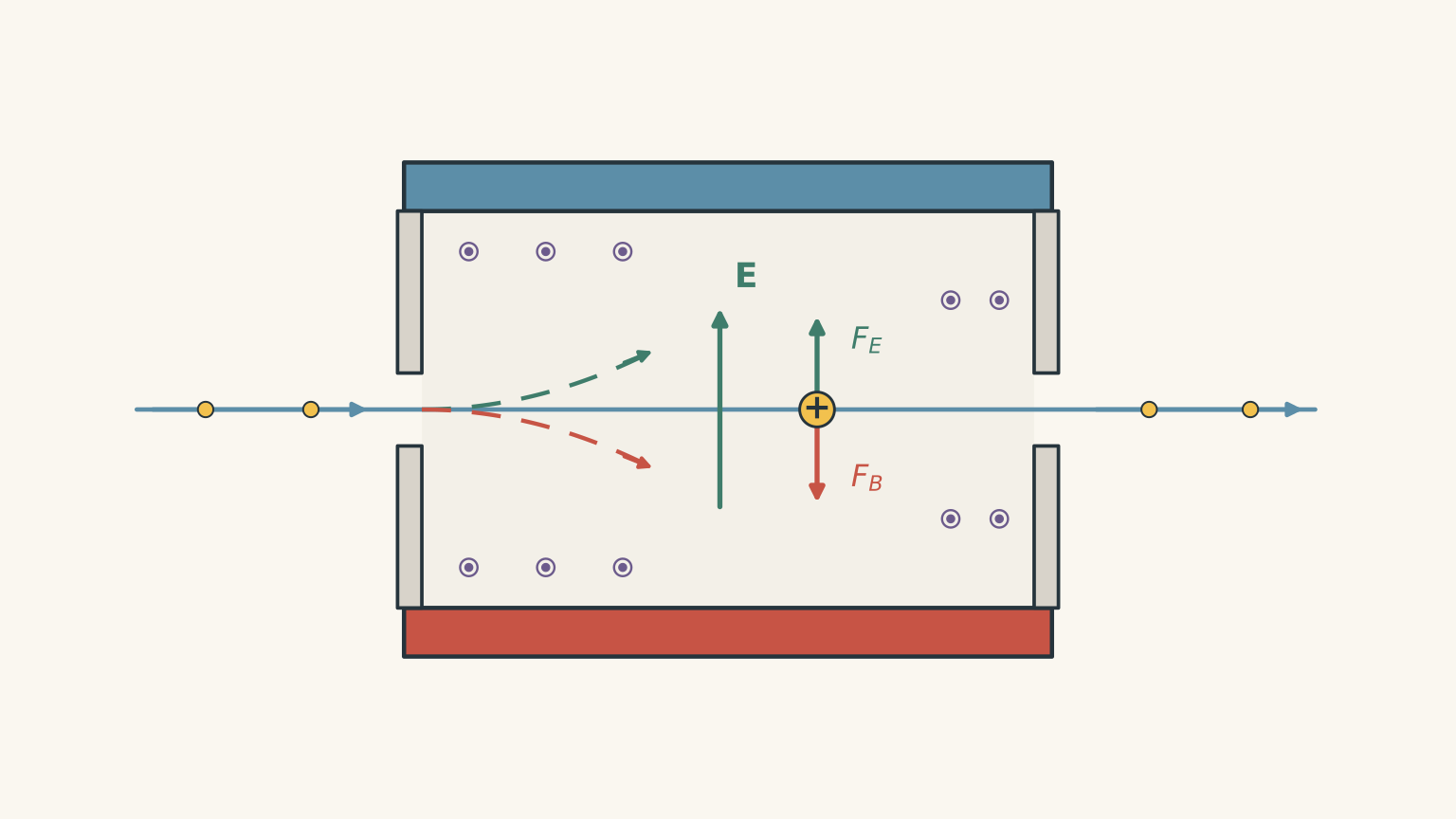
Due to technical limitations, this figure may display incorrectly or contain inaccuracies. Please check key details against your course materials.
Now make a prediction.
What happens if the particle moves more slowly? What if it moves faster?
For a slower particle, the magnetic force is weaker because \(F_B\) is proportional to \(v\). The electric force stays the same. The electric force therefore dominates, and the positive particle initially accelerates upwards.
For a faster particle, the magnetic force becomes stronger. It eventually exceeds the electric force, so the particle initially accelerates downwards.
There must be one particular speed at which the forces balance exactly.
That is the central idea behind a Wien filter.
02Finding the selected speed
Consider a particle travelling at the speed where the two opposing forces have equal magnitudes.
The condition for balance is
\[ F_E=F_B \]
Substitute the expressions for each force:
\[ |q|E=|q|vB \]
For a charged particle, \(q\ne0\), so we can cancel the charge magnitude:
\[ E=vB \]
Rearranging gives
\[ \boxed{v_s=\frac{E}{B}} \]
Here, \(v_s\) is the selected speed: the speed at which a particle experiences zero net electromagnetic force in the transverse direction.
Notice something interesting.
The selected speed does not depend on the particle’s mass or charge magnitude.
An electron and a much heavier positive ion can both travel straight through the same ideal Wien filter, provided they have the same speed and travel in the same direction.
The selected speed depends only on the strengths of the electric and magnetic fields.
Understanding the equation physically
Suppose we increase the electric field while keeping the magnetic field constant.
The electric force becomes stronger. A faster particle is now needed to produce an equally strong magnetic force.
Therefore, the selected speed increases.
What if we increase the magnetic field instead?
The magnetic force becomes stronger at every given speed. A slower particle is now needed to balance the electric force.
Therefore, the selected speed decreases.
The relationship is summarised below.
| Change | Effect on selected speed |
|---|---|
| Increase \(E\), keep \(B\) constant | Increases |
| Decrease \(E\), keep \(B\) constant | Decreases |
| Increase \(B\), keep \(E\) constant | Decreases |
| Decrease \(B\), keep \(E\) constant | Increases |
| Multiply both fields by the same factor | Unchanged |
The units also make sense.
\[ v_s=\frac{E}{B} \]
Using \(E\) in N/C and \(B\) in teslas gives
\[ \frac{\mathrm{N/C}}{\mathrm{T}} =\mathrm{m/s} \]
So the equation produces a speed, as required.
The force-balance derivation is also presented in the University of Rhode Island’s physics lecture notes on velocity selectors.
03How the Wien filter selects particles
Knowing the selected speed is only part of the story. We also need to understand how the device actually rejects particles travelling at other speeds.
A typical arrangement uses two aligned openings:
- An entrance aperture allows a narrow, approximately parallel beam of charged particles to enter.
- An exit aperture allows particles travelling along the required path to leave.
The electric and magnetic fields occupy the region between these openings.
A particle travelling at \(v_s\) experiences equal and opposite forces. Its net force is zero, so it continues along a straight path and reaches the exit aperture.
A particle travelling too slowly experiences a stronger electric force than magnetic force. It initially deflects upwards in our chosen arrangement.
A particle travelling too quickly experiences a stronger magnetic force. It initially deflects downwards.
Both particles are likely to miss the exit aperture.
The device therefore acts as a filter: it transmits particles within a narrow range of speeds and rejects particles outside that range.
An important limitation of the model
The equation \(v_s=E/B\) describes the ideal selection condition. A real Wien filter is not a perfect mathematical arrangement.
Several factors affect its performance:
- The electric and magnetic fields may not be perfectly uniform.
- The fields can change near the entrance and exit of the device.
- The apertures have finite widths, so particles travelling at speeds close to \(v_s\) may also pass through.
- Particles may enter at slightly different angles rather than travelling in exactly parallel directions.
There is another subtlety worth understanding.
When a particle starts to deflect, its velocity changes direction. The magnetic force changes direction with it. Therefore, we cannot assume that a particle outside the selected speed experiences a constant sideways force throughout the entire device.
The simple force comparison predicts its initial tendency to deflect. Its complete trajectory depends on the fields and the geometry of the filter.
These practical effects are important in specialist instrument design. For example, W. H. J. Andersen’s research on Wien filters examines field inhomogeneity and trajectory aberrations in real devices (1967 research paper).
What does the filter actually depend on?
There are three useful distinctions.
1. Charge sign
Changing a particle from positive to negative reverses both electric and magnetic force directions.
The forces still oppose each other, so the selected speed remains \(E/B\).
2. Particle mass
Mass does not appear in the force-balance equation. A heavier particle can pass through at exactly the same selected speed as a lighter particle.
However, mass can affect how strongly an off-speed particle deviates over the finite length of a real filter.
3. Neutral particles
A neutral particle has \(q=0\). It experiences neither electric nor magnetic force.
If it is already travelling along the central path, it can pass straight through regardless of its speed.
This means a Wien filter is not a universal speed detector. It selects the speed of charged particles under the appropriate beam conditions.
04Worked examples
Worked example: calculate the selected speed
A Wien filter contains perpendicular electric and magnetic fields with strengths of \(3.6\times10^4\ \mathrm{N/C}\) and \(0.12\ \mathrm{T}\), respectively.
A collimated beam of positive ions enters perpendicular to the magnetic field. Calculate the speed of the ions that pass through undeflected.
Step 1
The electric and magnetic forces must have equal magnitudes and opposite directions.
\[ F_E=F_B \]
Step 2
\[ v_s=\frac{E}{B} \]
Step 3
\[ \begin{aligned} v_s&=\frac{3.6\times10^4}{0.12}\\ &=3.0\times10^5\ \mathrm{m/s} \end{aligned} \]
Answer: The selected speed is
\[ \boxed{v_s=3.0\times10^5\ \mathrm{m/s}} \]
Any positively charged ion travelling at this speed in the specified direction experiences zero net force and continues straight through the ideal filter.
Notice that we did not need to know the mass or charge of the ions.
Worked example: determine the net force on an incorrectly selected particle
A positive ion with charge \(+3.2\times10^{-19}\ \mathrm{C}\) enters a Wien filter.
The electric field points upwards and has a strength of \(1.8\times10^4\ \mathrm{N/C}\). The magnetic field points out of the page and has a strength of \(0.030\ \mathrm{T}\).
The ion travels horizontally to the right at \(4.0\times10^5\ \mathrm{m/s}\).
Calculate:
(a) The selected speed of the filter.
(b) The magnitude and direction of the ion’s initial net electromagnetic force.
Step 1
Use
\[ v_s=\frac{E}{B} \]
Substituting:
\[ \begin{aligned} v_s&=\frac{1.8\times10^4}{0.030}\\ &=6.0\times10^5\ \mathrm{m/s} \end{aligned} \]
The ion is travelling at only \(4.0\times10^5\ \mathrm{m/s}\), so it is slower than the selected speed.
The electric force should therefore dominate.
Step 2
\[ F_E=|q|E \]
\[ \begin{aligned} F_E&=(3.2\times10^{-19})(1.8\times10^4)\\ &=5.76\times10^{-15}\ \mathrm{N} \end{aligned} \]
The electric force acts upwards.
Step 3
Since the particle travels perpendicular to the magnetic field,
\[ F_B=|q|vB \]
\[ \begin{aligned} F_B&=(3.2\times10^{-19})\\ &\quad\times(4.0\times10^5)(0.030)\\ &=3.84\times10^{-15}\ \mathrm{N} \end{aligned} \]
The magnetic force acts downwards.
Step 4
The two forces act in opposite directions, so subtract their magnitudes.
\[ \begin{aligned} F_{\mathrm{net}}&=F_E-F_B\\ &=5.76\times10^{-15}\\ &\quad-3.84\times10^{-15}\\ &=1.92\times10^{-15}\ \mathrm{N} \end{aligned} \]
Answer:
\[ \boxed{F_{\mathrm{net}}=1.92\times10^{-15}\ \mathrm{N}} \]
The initial net force is upwards.
This confirms our prediction: the particle is travelling too slowly for its magnetic force to balance the electric force.
05From velocity selection to mass analysis
A Wien filter can also be useful as part of a larger scientific instrument.
Consider what happens when a selected beam enters a second magnetic field, separate from the one inside the Wien filter.
The particles now experience magnetic forces that bend their paths into circular arcs.
This connects directly to the magnetic circular motion you study in physics.
For a particle travelling perpendicular to a uniform magnetic field, the magnetic force provides the centripetal force:
\[ F_B=F_C \]
Therefore,
\[ |q|vB_a=\frac{mv^2}{r} \]
Rearranging gives
\[ \boxed{r=\frac{mv}{|q|B_a}} \]
where:
- \(r\) is the radius of the circular path in metres.
- \(m\) is the particle’s mass in kilograms.
- \(v\) is its speed in metres per second.
- \(q\) is its charge in coulombs.
- \(B_a\) is the magnetic field strength in the separate analyser, measured in teslas.
This equation assumes non-relativistic motion and a velocity perpendicular to the analyser’s magnetic field.
Notice the difference between the two devices.
The Wien filter selects particles based on speed. The magnetic analyser bends particles according to their mass-to-charge ratio.
If two particles have the same speed and charge magnitude but different masses, they both pass through the ideal Wien filter. However, they follow different circular paths in the analyser.
The heavier particle has the larger radius.
This principle connects to mass spectrometry and charged-particle analysis. The IUPAC Gold Book definition of a Wien filter describes its role in mass spectrometry and also identifies its use as a charged-particle energy analyser or monochromator.
06Questions and solutions
Question 1
A Wien filter has an electric field strength of \(5.0\times10^3\ \mathrm{N/C}\) and a magnetic field strength of \(0.025\ \mathrm{T}\).
A beam of charged particles enters perpendicular to both fields, with all particles travelling in the same direction.
Calculate the speed of particles that pass through undeflected.
Solution 1
The selected speed is \(2.0\times10^5\ \mathrm{m/s}\).
For a particle to pass through undeflected, the electric and magnetic forces must balance:
\[ F_E=F_B \]
Using the Wien filter equation,
\[ v_s=\frac{E}{B} \]
Substitute:
\[ \begin{aligned} v_s&=\frac{5.0\times10^3}{0.025}\\ &=2.0\times10^5\ \mathrm{m/s} \end{aligned} \]
The filter therefore selects particles travelling at \(2.0\times10^5\ \mathrm{m/s}\).
The mass and charge magnitude of the particles do not affect this ideal selected speed.
Question 2
A positive ion with charge \(+1.6\times10^{-19}\ \mathrm{C}\) enters a Wien filter travelling horizontally to the right.
The electric field points upwards and has a strength of \(1.6\times10^4\ \mathrm{N/C}\). The magnetic field points out of the page and has a strength of \(0.040\ \mathrm{T}\).
Two ions enter with different speeds:
- Ion A: \(3.0\times10^5\ \mathrm{m/s}\)
- Ion B: \(5.0\times10^5\ \mathrm{m/s}\)
Calculate:
(a) The selected speed.
(b) The initial net electromagnetic force on each ion, including its direction.
(c) Explain why the two ions initially experience net forces of equal magnitude but opposite directions.
Solution 2
The selected speed is \(4.0\times10^5\ \mathrm{m/s}\). Ion A initially experiences an upwards force of \(6.4\times10^{-16}\ \mathrm{N}\), while ion B experiences a downwards force of the same magnitude.
Step 1: Calculate the selected speed.
\[ \begin{aligned} v_s&=\frac{E}{B}\\ &=\frac{1.6\times10^4}{0.040}\\ &=4.0\times10^5\ \mathrm{m/s} \end{aligned} \]
Ion A is slower than the selected speed, while ion B is faster.
Step 2: Calculate the electric force.
Both ions have the same charge and experience the same electric field.
\[ \begin{aligned} F_E&=|q|E\\ &=(1.6\times10^{-19})(1.6\times10^4)\\ &=2.56\times10^{-15}\ \mathrm{N} \end{aligned} \]
The electric force acts upwards.
Step 3: Calculate the magnetic force on ion A.
\[ \begin{aligned} F_{B,A}&=|q|v_AB\\ &=(1.6\times10^{-19})\\ &\quad\times(3.0\times10^5)(0.040)\\ &=1.92\times10^{-15}\ \mathrm{N} \end{aligned} \]
The magnetic force acts downwards.
Therefore,
\[ \begin{aligned} F_{\mathrm{net},A} &=2.56\times10^{-15}\\ &\quad-1.92\times10^{-15}\\ &=6.4\times10^{-16}\ \mathrm{N} \end{aligned} \]
Ion A experiences an initial net force upwards.
Step 4: Calculate the magnetic force on ion B.
\[ \begin{aligned} F_{B,B}&=|q|v_BB\\ &=(1.6\times10^{-19})\\ &\quad\times(5.0\times10^5)(0.040)\\ &=3.2\times10^{-15}\ \mathrm{N} \end{aligned} \]
The magnetic force is now greater than the electric force.
\[ \begin{aligned} F_{\mathrm{net},B} &=3.2\times10^{-15}\\ &\quad-2.56\times10^{-15}\\ &=6.4\times10^{-16}\ \mathrm{N} \end{aligned} \]
Ion B experiences an initial net force downwards.
Step 5: Explain the equal magnitudes.
The two speeds are equally spaced around the selected speed:
\[ 4.0\times10^5-3.0\times10^5 = 5.0\times10^5-4.0\times10^5 \]
Since magnetic force is directly proportional to speed, the magnetic force on ion A is below the balancing value by the same amount that the magnetic force on ion B exceeds it.
The resulting force imbalances therefore have equal magnitudes and opposite directions.
Question 3
A Wien filter has an electric field strength of \(2.4\times10^4\ \mathrm{N/C}\) and a magnetic field strength of \(0.060\ \mathrm{T}\).
The filter is followed by a separate magnetic analyser with a field strength of \(0.50\ \mathrm{T}\). The analyser’s magnetic field is perpendicular to the incoming particle velocities.
A beam contains two types of singly charged positive ions:
- Ion A has a mass of \(3.2\times10^{-26}\ \mathrm{kg}\).
- Ion B has a mass of \(6.4\times10^{-26}\ \mathrm{kg}\).
Both ions have a charge of \(+1.60\times10^{-19}\ \mathrm{C}\), and both initially travel at the selected speed.
Assume uniform fields and non-relativistic particle speeds.
(a) Calculate the selected speed of the Wien filter.
(b) Calculate the radius of each ion’s circular path in the magnetic analyser.
(c) Explain why both ions pass through the Wien filter despite having different masses.
Solution 3
Both ions pass through the Wien filter. Their selected speed is \(4.0\times10^5\ \mathrm{m/s}\), and their analyser radii are \(0.16\ \mathrm{m}\) for ion A and \(0.32\ \mathrm{m}\) for ion B.
Step 1: Calculate the selected speed.
\[ \begin{aligned} v_s&=\frac{E}{B_s}\\ &=\frac{2.4\times10^4}{0.060}\\ &=4.0\times10^5\ \mathrm{m/s} \end{aligned} \]
Both ions enter the filter at this speed, so their electric and magnetic forces balance.
Step 2: Identify the equation for the analyser.
The magnetic force provides the centripetal force:
\[ |q|vB_a=\frac{mv^2}{r} \]
Rearrange:
\[ r=\frac{mv}{|q|B_a} \]
Step 3: Calculate the radius for ion A.
\[ \begin{aligned} r_A&=\frac{(3.2\times10^{-26})(4.0\times10^5)} {(1.60\times10^{-19})(0.50)}\\ &=\frac{1.28\times10^{-20}}{8.0\times10^{-20}}\\ &=0.16\ \mathrm{m} \end{aligned} \]
Step 4: Calculate the radius for ion B.
\[ \begin{aligned} r_B&=\frac{(6.4\times10^{-26})(4.0\times10^5)} {(1.60\times10^{-19})(0.50)}\\ &=\frac{2.56\times10^{-20}}{8.0\times10^{-20}}\\ &=0.32\ \mathrm{m} \end{aligned} \]
Step 5: Explain why the ions behave differently in the two devices.
The Wien filter balances two electromagnetic forces. Its selected-speed equation contains no mass term, so both ions pass through at the same speed.
The magnetic analyser works differently. Its magnetic force provides the centripetal force required for circular motion. A larger mass requires a larger radius when speed, charge magnitude, and magnetic field strength remain constant.
Ion B has twice the mass of ion A, so it follows a circular path with twice the radius.
This demonstrates an important distinction: selecting speed does not mean selecting mass.
Question 4
A Wien filter is adjusted to have an electric field strength of \(2.0\times10^4\ \mathrm{N/C}\) and a magnetic field strength of \(0.050\ \mathrm{T}\).
A beam contains three types of particles travelling in the same direction:
- Positively charged ions.
- Electrons.
- Neutral atoms.
A student makes the following claims:
- Only positive ions can pass through undeflected because electrons experience forces in the opposite directions.
- Heavier ions require a different selected speed.
- Neutral atoms will be deflected because they do not satisfy the selected-speed equation.
- Doubling the magnitude of a particle’s charge doubles its selected speed.
Evaluate each claim using the physics of the Wien filter. Assume the particles are initially aligned with the central path and ignore collisions and other forces.
Solution 4
All positively and negatively charged particles travelling at the selected speed can pass through undeflected, regardless of their mass. Neutral particles can also pass straight through, but they are not speed-selected by the fields.
Step 1: Calculate the selected speed.
\[ \begin{aligned} v_s&=\frac{E}{B}\\ &=\frac{2.0\times10^4}{0.050}\\ &=4.0\times10^5\ \mathrm{m/s} \end{aligned} \]
Step 2: Evaluate claim 1.
The claim is incorrect.
For a positive ion, the electric and magnetic forces act in opposite directions.
For an electron, both forces reverse direction because its charge is negative.
However, the forces still oppose each other. Their magnitudes are equal at exactly the same speed:
\[ |q|E=|q|vB \]
Therefore, electrons and positive ions can both pass through at \(4.0\times10^5\ \mathrm{m/s}\).
Step 3: Evaluate claim 2.
The claim is also incorrect.
Mass does not appear in the force-balance equation. A heavier ion and a lighter ion travelling at the selected speed experience balanced forces.
The ideal selected speed is independent of mass.
Step 4: Evaluate claim 3.
The claim is incorrect.
A neutral particle has no electric charge, so
\[ F_E=0 \]
It also experiences no magnetic force:
\[ F_B=0 \]
Consequently, it travels straight through the device if it is already aligned with the central path.
It may pass through at any speed. The Wien filter cannot distinguish neutral particles by speed.
Step 5: Evaluate claim 4.
The claim is incorrect.
Doubling the charge magnitude doubles both the electric and magnetic forces:
\[ F_E=|q|E \]
\[ F_B=|q|vB \]
Both forces increase by the same factor, so the balancing condition remains unchanged.
The selected speed is still
\[ v_s=\frac{E}{B} \]
There is one additional detail: a larger charge magnitude can cause a stronger deviation for an off-speed particle of the same mass. This can affect how effectively a real, finite filter rejects particles outside its selected speed range.
Question 5
A Wien filter has an electric field pointing upwards with strength \(2.0\times10^4\ \mathrm{N/C}\). Its magnetic field points out of the page with strength \(0.050\ \mathrm{T}\).
Two positive particles, each carrying a charge of \(+1.60\times10^{-19}\ \mathrm{C}\), enter the field region.
Unlike the usual arrangement, the particles are not travelling entirely perpendicular to the magnetic field.
Define three perpendicular directions:
- The \(x\)-direction is horizontally to the right.
- The \(y\)-direction is vertically upwards.
- The \(z\)-direction is out of the page, parallel to the magnetic field.
Both particles have zero velocity component in the \(y\)-direction.
Their velocity components are:
| Particle | \(v_x\) | \(v_z\) |
|---|---|---|
| A | \(4.0\times10^5\ \mathrm{m/s}\) | \(3.0\times10^5\ \mathrm{m/s}\) |
| B | \(3.0\times10^5\ \mathrm{m/s}\) | \(4.0\times10^5\ \mathrm{m/s}\) |
Both particles therefore have the same total speed.
Assume the entrance and exit apertures are sufficiently long in the \(z\)-direction that movement parallel to the magnetic field does not cause either particle to clip the apparatus.
(a) Calculate the total speed of each particle.
(b) Determine which particle experiences zero net electromagnetic force.
(c) Calculate the initial net electromagnetic force on the other particle, including its direction.
(d) Explain why this result reveals a limitation in the statement that a Wien filter selects particles with speed \(E/B\).
Solution 5
Particle A experiences zero net electromagnetic force and travels straight through the ideal field region. Particle B experiences an initial upwards force of \(8.0\times10^{-16}\ \mathrm{N}\).
The important result is that the filter balances the velocity component perpendicular to the magnetic field, not necessarily the particle’s total speed.
Step 1: Calculate the total speed of each particle.
Since the velocity components are perpendicular, use Pythagoras’ theorem:
\[ v=\sqrt{v_x^2+v_z^2} \]
For particle A:
\[ \begin{aligned} v_A&=\sqrt{(4.0\times10^5)^2+(3.0\times10^5)^2}\\ &=\sqrt{25\times10^{10}}\\ &=5.0\times10^5\ \mathrm{m/s} \end{aligned} \]
For particle B:
\[ \begin{aligned} v_B&=\sqrt{(3.0\times10^5)^2+(4.0\times10^5)^2}\\ &=\sqrt{25\times10^{10}}\\ &=5.0\times10^5\ \mathrm{m/s} \end{aligned} \]
Both particles have the same total speed.
Step 2: Identify which velocity component produces the magnetic force.
The magnetic field points in the positive \(z\)-direction.
Particle velocity parallel to the magnetic field produces no magnetic force. Therefore, the \(v_z\) component contributes nothing to the magnetic force.
Only the \(v_x\) component contributes to the vertical magnetic force in this arrangement.
The electric force, however, acts vertically regardless of the particle’s velocity components.
The balancing condition is therefore
\[ |q|E=|q|v_xB \]
Rearranging:
\[ v_x=\frac{E}{B} \]
The required horizontal velocity component is
\[ \begin{aligned} v_x&=\frac{2.0\times10^4}{0.050}\\ &=4.0\times10^5\ \mathrm{m/s} \end{aligned} \]
Step 3: Evaluate particle A.
Particle A has
\[ v_x=4.0\times10^5\ \mathrm{m/s} \]
This matches the required horizontal velocity component.
Calculate its electric force:
\[ \begin{aligned} F_E&=|q|E\\ &=(1.60\times10^{-19})(2.0\times10^4)\\ &=3.2\times10^{-15}\ \mathrm{N} \end{aligned} \]
Its magnetic force is
\[ \begin{aligned} F_B&=|q|v_xB\\ &=(1.60\times10^{-19})\\ &\quad\times(4.0\times10^5)(0.050)\\ &=3.2\times10^{-15}\ \mathrm{N} \end{aligned} \]
The electric force acts upwards, and the magnetic force acts downwards.
Their magnitudes are equal, so the net electromagnetic force is zero.
Particle A therefore travels straight through the filter, even though its total speed is \(5.0\times10^5\ \mathrm{m/s}\), not \(4.0\times10^5\ \mathrm{m/s}\).
Step 4: Evaluate particle B.
Particle B has
\[ v_x=3.0\times10^5\ \mathrm{m/s} \]
Its electric force is still
\[ F_E=3.2\times10^{-15}\ \mathrm{N} \]
However, its magnetic force is
\[ \begin{aligned} F_B&=|q|v_xB\\ &=(1.60\times10^{-19})\\ &\quad\times(3.0\times10^5)(0.050)\\ &=2.4\times10^{-15}\ \mathrm{N} \end{aligned} \]
The electric force is larger.
Therefore,
\[ \begin{aligned} F_{\mathrm{net}}&=F_E-F_B\\ &=3.2\times10^{-15}-2.4\times10^{-15}\\ &=8.0\times10^{-16}\ \mathrm{N} \end{aligned} \]
The initial net force is upwards.
Particle B is therefore deflected away from the central path.
Step 5: Explain the limitation.
The tempting conclusion is that particles with the same total speed should behave identically.
But the magnetic force depends on the component of velocity perpendicular to the magnetic field:
\[ F_B=|q|vB\sin\theta \]
It does not depend on the component parallel to the field.
In the usual Wien filter arrangement, particles are collimated so that their velocity is entirely perpendicular to the magnetic field. Under this assumption, the total speed equals the relevant perpendicular velocity component, and the familiar equation
\[ v_s=\frac{E}{B} \]
is valid as a total-speed selection rule.
When particles have additional velocity components parallel to the magnetic field, that assumption no longer holds.
This is why a Wien filter is more precisely understood as selecting a particular velocity vector. The familiar speed-selection equation is a special case that works when the incoming beam has the required direction.
07Where to go next
The Wien filter combines two ideas from electromagnetism: electric forces on charges and magnetic forces on moving charges.
Its key result is simple:
\[ \boxed{v_s=\frac{E}{B}} \]
But its usefulness becomes much clearer when you combine it with magnetic circular motion.
The Wien filter first produces a beam with a narrow range of speeds. A subsequent magnetic analyser can then bend the particles according to their mass-to-charge ratios.
That is the next relationship worth mastering:
\[ r=\frac{mv}{|q|B} \]
Keep the two jobs separate. The Wien filter selects velocity; the magnetic analyser uses curvature to distinguish particles.