
Stimulated Emission: How Atoms Amplify Light in Lasers
Explore how stimulated emission differs from absorption and spontaneous emission. Learn how population inversion allows atoms to amplify light and how this process makes laser operation possible.
Shine a beam of light through a material and, under the right conditions, the beam can emerge with more photons than it contained when it entered. Where did the extra photons come from?
The material has stored energy in atoms whose electrons occupy excited energy states. An incoming photon can trigger one of these atoms to drop to a lower energy state, releasing another photon. Crucially, the new photon joins the incoming light in exactly the same optical mode, reinforcing the original beam.
This process is called stimulated emission, and it is the physical mechanism behind laser amplification.
Stimulated emission is extension material beyond the required Year 12 Physics syllabus. It is not an HSC assessment requirement. The Year 12 Nature of light focus area in the 2025 NSW Physics 11-12 syllabus provides the foundation for this article, but the year level is a prerequisite entry point, not a requirement to study stimulated emission for assessment. The new syllabus is scheduled for implementation in Year 12 from Term 4 2027, with its first HSC examination in 2028.
01Start with the photon
You already know that light can behave as a wave. Its wave properties explain phenomena such as interference, diffraction, and polarisation.
The particle model adds another important idea: light transfers energy in discrete packets called photons.
A photon has an energy determined by its frequency:
\[ E_\gamma=hf \]
where:
- \(E_\gamma\) is the energy of one photon, measured in joules (J).
- \(h\) is Planck’s constant, \(6.626\times10^{-34}\text{ J s}\).
- \(f\) is the photon’s frequency, measured in hertz (Hz).
Since \(f=c/\lambda\), we can also write:
\[ E_\gamma=\frac{hc}{\lambda} \]
Here, \(c\) is the speed of light in a vacuum, approximately \(3.00\times10^8\text{ m s}^{-1}\), and \(\lambda\) is wavelength in metres.
The important distinction is that frequency determines the energy of an individual photon. Increasing the intensity of a beam at a fixed frequency increases the number of photons passing through a given area each second, not the energy of each photon.
This is the same photon-energy relationship you encounter when studying the photoelectric effect. See The Photoelectric Quantum Yield: How Photons Produce Electrons for another application of this model.
Why atomic energy levels matter
An electron in an atom cannot occupy just any energy. It occupies particular allowed energy states.
Suppose an atom has two relevant energy levels:
- \(E_1\): the lower-energy state.
- \(E_2\): the higher-energy state.
The energy difference is:
\[ \Delta E=E_2-E_1 \]
For a photon to interact resonantly with this transition, its energy must match the energy difference:
\[ \boxed{hf=\Delta E} \]
This means the transition has a characteristic frequency:
\[ f=\frac{\Delta E}{h} \]
An atom can absorb a photon to move from \(E_1\) to \(E_2\). It can also release a photon when moving from \(E_2\) to \(E_1\).
The interesting part is that there are two different ways this downward transition can happen.
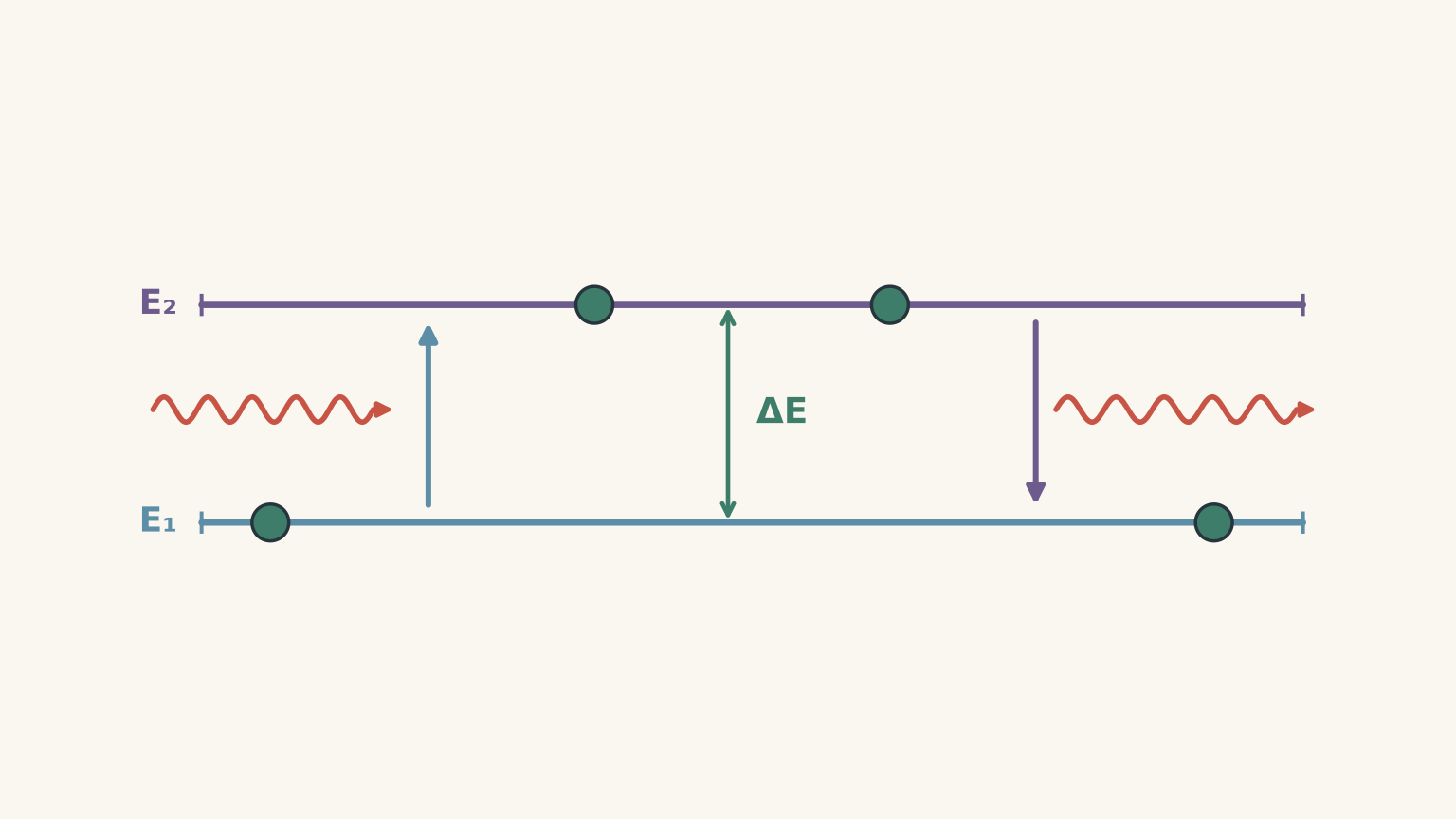
Due to technical limitations, this figure may display incorrectly or contain inaccuracies. Please check key details against your course materials.
02Three ways an atom interacts with light
Imagine a photon with exactly the right energy arriving at an atom.
Before predicting what happens, consider the atom’s starting state.
If the electron is already in the lower state, the atom can absorb the photon. But what if the electron is already excited?
The answer is that the atom can release energy instead. Whether that happens spontaneously or because of the incoming radiation gives us two distinct emission processes.
1. Absorption
Absorption occurs when an atom in its lower energy state takes in a photon.
The photon transfers its energy to the atom, exciting the electron from \(E_1\) to \(E_2\).
\[ E_1+hf\longrightarrow E_2 \]
The energy of the incoming photon must match the energy gap:
\[ hf=E_2-E_1 \]
The photon is removed from the incoming radiation field.
2. Spontaneous emission
Now suppose the electron is already in the excited state \(E_2\).
Even without an incoming photon, the atom can spontaneously transition to the lower state \(E_1\), releasing a photon.
\[ E_2\longrightarrow E_1+hf \]
The emitted photon has energy:
\[ hf=E_2-E_1 \]
The crucial feature is that the transition does not require an external photon to trigger it.
The exact time at which an individual atom spontaneously emits is unpredictable. The emission also has no fixed phase relationship with an incoming light beam.
Its direction and polarisation depend on the particular atomic transition, but spontaneous emission generally distributes radiation across many available optical modes rather than reinforcing one selected beam.
This is why light from an ordinary lamp is generally incoherent: emissions from different atoms are not synchronised into one common phase relationship.
3. Stimulated emission
Here is the more interesting process.
An atom is already in its excited state \(E_2\). A photon with the correct frequency interacts with it.
Instead of being absorbed, the incoming radiation can stimulate the atom to transition down to \(E_1\).
The atom releases its energy difference as an additional photon.
\[ E_2+hf\longrightarrow E_1+2hf \]
The expression shows that the radiation field gains one photon of energy \(hf\).
But there is an important detail.
The emitted photon joins the same optical mode as the stimulating radiation. It has the same:
- Frequency.
- Direction of propagation.
- Polarisation.
- Phase relationship with the stimulating electromagnetic field.
The incoming mode therefore contains one additional photon after the interaction.
This matching is what makes stimulated emission so useful.
Think about pushing someone on a swing. A push delivered at the right point in the swing’s motion adds energy in step with the existing movement. A badly timed push does not reinforce the motion in the same way.
Stimulated emission has a related idea: the emitted radiation reinforces the existing electromagnetic field rather than adding an unrelated oscillation.
The analogy is about timing and phase only. An atomic transition is a quantum process, not a mechanical swing.
Does the original photon survive?
Yes, in the sense that the photon number in the incoming optical mode increases by one.
However, there is a subtle quantum detail: photons are indistinguishable. We cannot physically label one photon as the original and another as its copy.
It is more accurate to say that stimulated emission increases the occupation of the existing light mode by one photon.
The result is amplification of the incoming radiation.
03Comparing the three processes
The differences are worth learning precisely because absorption and stimulated emission can look deceptively similar.
| Feature | Absorption | Spontaneous emission | Stimulated emission |
|---|---|---|---|
| Initial atomic state | Lower | Upper | Upper |
| External photon required? | Yes | No | Yes |
| Electron transition | Upwards | Downwards | Downwards |
| Photon number in the interacting mode | Decreases by one | No fixed change to an existing beam | Increases by one |
| Phase relationship with incoming beam | Not applicable | Not phase-locked | Coherent with the stimulating field |
| Main effect | Excitation | Independent emission | Amplification |
The most important distinction is between the two emission processes.
Both release the same energy difference between atomic states. Both produce photons of the corresponding transition frequency.
However, only stimulated emission directly reinforces the optical mode that caused the transition.
04What determines whether light is amplified?
So far, we have considered one atom.
A laser or optical amplifier contains an enormous number of atoms or other active particles. Some can absorb photons, while others can undergo stimulated emission.
The overall effect depends on how many particles occupy each energy state.
Population inversion
Let:
- \(N_1\) be the number of atoms in the lower energy state.
- \(N_2\) be the number of atoms in the upper energy state.
For the simplified model, assume both energy levels have equal degeneracy, meaning they have the same number of available quantum states.
Under this assumption, absorption and stimulated emission have equal transition coefficients for the same radiation field.
The rates of the two stimulated processes are proportional to:
\[ R_{\text{abs}}=B\rho(\nu)N_1 \]
\[ R_{\text{stim}}=B\rho(\nu)N_2 \]
Here:
- \(R_{\text{abs}}\) is the total absorption rate.
- \(R_{\text{stim}}\) is the total stimulated-emission rate.
- \(B\) is the shared Einstein coefficient for the simplified transition.
- \(\rho(\nu)\) is the spectral energy density of the radiation field at frequency \(\nu\).
- \(N_1\) and \(N_2\) are the respective atomic populations.
The net effect of the stimulated processes is proportional to:
\[ R_{\text{stim}}-R_{\text{abs}} =B\rho(\nu)(N_2-N_1) \]
This equation gives us a useful decision rule.
Case 1: More atoms in the lower state
\[ N_1>N_2 \]
Absorption occurs more frequently than stimulated emission.
The beam loses photons overall.
Case 2: Equal populations
\[ N_1=N_2 \]
Absorption and stimulated emission balance each other.
There is no net stimulated amplification or absorption in this simplified model.
Case 3: More atoms in the upper state
\[ N_2>N_1 \]
Stimulated emission exceeds absorption.
The beam gains photons overall.
This condition is called population inversion.
It is essential for ordinary laser amplification.
Why a brighter beam is not necessarily amplified
Here is a tempting prediction: if we increase the intensity of the incoming beam, surely stimulated emission will eventually dominate.
Not necessarily.
Increasing the intensity increases the radiation energy density \(\rho(\nu)\). This makes both absorption and stimulated emission more likely.
It does not automatically favour stimulated emission over absorption.
If there are many more atoms in the lower state, absorption can still dominate, even under intense illumination.
The population distribution is what determines the sign of the net stimulated gain.
What about spontaneous emission?
We have deliberately left spontaneous emission out of the net-gain equation above.
That does not mean it stops happening.
For an individual atom, the spontaneous-emission rate is independent of the external radiation intensity. It can therefore continue even when no stimulating beam is present.
A more complete description uses the Einstein coefficients:
\[ W_{\text{down}}=A_{21}+B_{21}\rho(\nu) \]
where:
- \(W_{\text{down}}\) is the total downward transition rate per excited atom.
- \(A_{21}\) is the spontaneous-emission coefficient, measured in \(\text{s}^{-1}\).
- \(B_{21}\rho(\nu)\) is the stimulated-emission rate per atom, also measured in \(\text{s}^{-1}\).
Absorption has its own rate:
\[ W_{\text{up}}=B_{12}\rho(\nu) \]
The \(B\) coefficients describe transitions caused by the radiation field, while \(A_{21}\) describes spontaneous emission.
For the equal-degeneracy model used here, \(B_{12}=B_{21}\).
These are known as Einstein’s A and B coefficients. Einstein introduced this description in his 1917 work on the quantum theory of radiation.
You can explore how the same radiation processes connect to thermal equilibrium in The Planck Radiation Law: Understanding Black-Body Spectra.
05How stimulated emission produces laser light
A laser uses stimulated emission to amplify light inside a material called the gain medium.
But there is a problem.
If a material is initially in thermal equilibrium, most atoms occupy lower energy states. Absorption therefore tends to dominate.
A laser needs a way to create and maintain population inversion.
This is achieved by supplying energy to the gain medium, a process called pumping.
A simplified laser system contains three important components:
- Gain medium: Contains atoms or particles capable of stimulated emission.
- Energy source: Pumps energy into the medium to establish population inversion.
- Optical cavity: Uses mirrors to reflect light repeatedly through the gain medium.
One mirror is partially transmitting, allowing some amplified light to escape as the laser output.
The process works as follows:
- Pumping transfers energy into the active material.
- Atoms accumulate in an excited state suitable for the laser transition.
- A spontaneously emitted photon can enter an appropriate cavity mode and provide an initial seed.
- This photon stimulates other excited atoms to emit into the same mode.
- The additional photons reinforce the radiation already travelling through the cavity.
- Repeated passes amplify the light, provided the gain exceeds the losses.
The cavity also helps select the allowed optical modes, producing a narrow range of frequencies and a highly coherent output.
This explains why a laser is different from an ordinary light source. It is not simply producing lots of photons. It is amplifying radiation through coordinated emission into selected optical modes.
Why ordinary two-level pumping is not enough
There is one limitation in our original model.
Suppose you try to make a laser using only two energy levels. You shine resonant light at the transition, hoping to push lots of atoms into the upper state.
The same radiation that excites atoms upwards can also stimulate excited atoms to transition downwards.
For equal degeneracies, these processes have equal coefficients.
If we include spontaneous emission, the population of the upper state changes according to:
\[ \frac{dN_2}{dt} = B\rho(\nu)N_1 - B\rho(\nu)N_2 - A_{21}N_2 \]
At equilibrium, the upper-state population cannot exceed half the total population in this simple pumping model.
Increasing the pump intensity drives the populations towards equality, but does not produce a steady population inversion.
Real laser systems therefore commonly use three- or four-level schemes.
In these systems, pumping takes atoms to a higher energy state. They then rapidly relax into a longer-lived excited state called a metastable state.
Atoms can accumulate in this metastable state, creating the population inversion needed for stimulated emission.
The two-level model is still extremely useful. It isolates the three fundamental radiation processes without requiring us to understand every detail of a real laser.
06Worked example: Finding the frequency of stimulated emission
An atom has two relevant energy levels separated by \(3.31\times10^{-19}\text{ J}\).
A photon stimulates the atom to transition from the upper level to the lower level.
Calculate:
- The frequency of the emitted photon.
- Its wavelength.
- The change in photon number in the stimulating optical mode.
Step 1
The atom releases the energy difference between its two states.
Energy conservation requires:
\[ hf=\Delta E \]
Step 2
Rearrange the equation:
\[ f=\frac{\Delta E}{h} \]
Substitute:
\[ f=\frac{3.31\times10^{-19}} {6.626\times10^{-34}} \]
\[ f=4.995\times10^{14}\text{ Hz} \]
Therefore:
\[ \boxed{f\approx5.00\times10^{14}\text{ Hz}} \]
Step 3
Using \(c=f\lambda\):
\[ \lambda=\frac{c}{f} \]
\[ \lambda= \frac{3.00\times10^8} {4.995\times10^{14}} \]
\[ \boxed{\lambda\approx6.01\times10^{-7}\text{ m}} \]
Or approximately:
\[ \boxed{\lambda=601\text{ nm}} \]
This is in the visible orange-red region of the spectrum.
Step 4
One stimulated-emission event increases the number of photons in the interacting optical mode by one.
The original mode therefore contains one additional photon, with the same frequency and wavelength.
The atom supplies the energy for this additional photon by transitioning to its lower energy state.
07Worked example: Comparing spontaneous and stimulated emission rates
An excited atom has a spontaneous-emission rate of \(2.0\text{ s}^{-1}\).
It is then exposed to a resonant radiation field that produces a stimulated-emission rate of \(6.0\text{ s}^{-1}\).
Assume both rates remain constant.
Calculate:
- The total downward transition rate.
- The probability that the atom has emitted a photon within \(0.10\text{ s}\).
- The fraction of downward transitions caused by stimulated emission.
Step 1
Spontaneous and stimulated emission are independent ways for the atom to transition downwards.
Therefore:
\[ W_{\text{down}}=A_{21}+B_{21}\rho \]
Substitute:
\[ W_{\text{down}}=2.0+6.0 \]
\[ \boxed{W_{\text{down}}=8.0\text{ s}^{-1}} \]
Step 2
For a constant transition rate, the probability that the atom remains in its excited state after time \(t\) is:
\[ P_{\text{remain}}=e^{-W_{\text{down}}t} \]
Therefore, the probability of at least one downward transition is:
\[ P_{\text{emission}}=1-e^{-W_{\text{down}}t} \]
Substitute:
\[ P_{\text{emission}} =1-e^{-(8.0)(0.10)} \]
\[ =1-e^{-0.80} \]
\[ \boxed{P_{\text{emission}}\approx0.551} \]
There is approximately a 55.1% probability of emission within \(0.10\text{ s}\).
Step 3
The stimulated rate is \(6.0\text{ s}^{-1}\), out of a total downward rate of \(8.0\text{ s}^{-1}\).
\[ \text{Fraction stimulated} = \frac{6.0}{8.0} \]
\[ \boxed{75\%} \]
Three-quarters of the downward transitions are expected to be stimulated under these conditions.
Notice that spontaneous emission has not disappeared. It still contributes to the total transition rate, even in the presence of a strong resonant beam.
08Questions and solutions
Question 1
An atom has two relevant energy levels separated by \(4.0\times10^{-19}\text{ J}\).
A photon with the matching energy interacts with the atom.
(a) Calculate the resonant photon frequency.
(b) Calculate its wavelength.
(c) Explain what happens if the atom begins in the lower energy state.
(d) Explain what can happen if the atom begins in the upper energy state. Distinguish between spontaneous and stimulated emission.
Solution 1
The resonant frequency is approximately \(6.04\times10^{14}\text{ Hz}\), and the corresponding wavelength is approximately \(497\text{ nm}\).
(a) Use the photon energy equation:
\[ E_\gamma=hf \]
Rearrange:
\[ f=\frac{E_\gamma}{h} \]
Substitute:
\[ f= \frac{4.0\times10^{-19}} {6.626\times10^{-34}} \]
\[ \boxed{f=6.04\times10^{14}\text{ Hz}} \]
(b) Use:
\[ \lambda=\frac{c}{f} \]
Substitute:
\[ \lambda= \frac{3.00\times10^8} {6.04\times10^{14}} \]
\[ \boxed{\lambda=4.97\times10^{-7}\text{ m}} \]
This is approximately \(497\text{ nm}\).
(c) If the atom begins in the lower energy state, it can absorb the photon.
The electron moves to the upper energy state, and the photon is removed from the incoming radiation mode.
(d) If the atom begins in the upper energy state, two types of emission are possible.
- Spontaneous emission occurs without requiring an incoming photon. The atom independently transitions down and releases a photon.
- Stimulated emission occurs when the resonant incoming radiation triggers the downward transition. The radiation field gains an additional photon in the same optical mode.
The key difference is that spontaneous emission does not require an external stimulating field, whereas stimulated emission does.
Question 2
An excited atom is exposed to a resonant beam of radiation.
Its spontaneous-emission rate is \(1.0\text{ s}^{-1}\), while its stimulated-emission rate is \(3.0\text{ s}^{-1}\).
Assume both rates remain constant over a time interval of \(0.50\text{ s}\).
(a) Calculate the total downward transition rate.
(b) Calculate the probability that the atom remains excited after \(0.50\text{ s}\).
(c) Calculate the probability that the atom has transitioned to the lower state within this interval.
(d) What percentage of its downward transitions are expected to be stimulated?
(e) Can the same atom immediately produce another stimulated photon after its first downward transition? Explain.
Solution 2
The total downward transition rate is \(4.0\text{ s}^{-1}\). There is approximately a 13.5% probability that the atom remains excited after \(0.50\text{ s}\), and a 86.5% probability that it has transitioned down.
(a) Add the spontaneous and stimulated rates:
\[ W_{\text{down}}=A_{21}+B_{21}\rho \]
\[ =1.0+3.0 \]
\[ \boxed{W_{\text{down}}=4.0\text{ s}^{-1}} \]
(b) The probability of remaining excited is:
\[ P_{\text{remain}}=e^{-Wt} \]
Substitute:
\[ P_{\text{remain}}=e^{-(4.0)(0.50)} \]
\[ =e^{-2} \]
\[ \boxed{P_{\text{remain}}=0.135} \]
Therefore, there is approximately a 13.5% probability that the atom remains excited.
(c) The probability of transitioning down is the complement:
\[ P_{\text{down}}=1-P_{\text{remain}} \]
\[ =1-0.135 \]
\[ \boxed{P_{\text{down}}=0.865} \]
This is approximately 86.5%.
(d) The fraction of downward transitions that are stimulated is:
\[ \frac{W_{\text{stim}}}{W_{\text{down}}} = \frac{3.0}{4.0} \]
\[ \boxed{75\%} \]
The remaining 25% are spontaneous transitions.
(e) No. Once the atom undergoes the downward transition, it occupies the lower energy state.
It cannot undergo another stimulated downward transition until it has first been re-excited.
This is an important limitation when thinking about laser amplification. The amplification process involves many excited atoms, not one atom repeatedly releasing photons without gaining energy again.
Question 3
An idealised gain medium contains 300 identical atoms.
There are:
- 180 atoms in the upper energy state.
- 120 atoms in the lower energy state.
Assume both states have equal degeneracy.
A resonant beam containing 40 photons passes through the medium.
During the short interaction, each atom has a 5% probability of undergoing its relevant radiation-induced transition:
- An upper-state atom may undergo stimulated emission.
- A lower-state atom may absorb a photon.
Ignore spontaneous emission, multiple transitions, and population changes during this pass.
(a) Calculate the expected number of stimulated-emission events.
(b) Calculate the expected number of absorption events.
(c) Determine the expected number of photons in the beam after passing through the medium.
(d) Suppose 20 additional spontaneous-emission events occur outside the forward beam mode. Should these be added to the forward beam’s photon count? Explain.
Solution 3
The beam gains an expected three photons, leaving approximately 43 photons in its original optical mode.
(a) Each upper-state atom has a 5% probability of stimulated emission.
Therefore:
\[ N_{\text{stim}}=180(0.05) \]
\[ \boxed{N_{\text{stim}}=9} \]
Nine stimulated-emission events are expected.
(b) Each lower-state atom has a 5% probability of absorption.
\[ N_{\text{abs}}=120(0.05) \]
\[ \boxed{N_{\text{abs}}=6} \]
Six absorption events are expected.
(c) Each stimulated-emission event adds one photon to the beam mode, while each absorption event removes one.
Therefore:
\[ \Delta N_\gamma=N_{\text{stim}}-N_{\text{abs}} \]
\[ =9-6 \]
\[ \Delta N_\gamma=+3 \]
The initial beam contains 40 photons, so:
\[ N_{\text{final}}=40+3 \]
\[ \boxed{N_{\text{final}}=43\text{ photons}} \]
The medium produces net amplification because more atoms undergo stimulated emission than absorption.
Notice that the individual events are probabilistic. The calculated values represent expected event counts under the assumptions in the question.
(d) No. The 20 spontaneous emissions should not automatically be added to the forward beam’s photon count.
The question specifies that these photons are emitted outside the forward optical mode.
Spontaneous photons can travel in different directions and occupy different optical modes. They are not automatically coherent additions to the original beam.
If a spontaneous photon enters the selected beam mode, it can contribute to that mode, but that is not the situation described here.
Question 4
An engineer proposes constructing a laser using a material with only two relevant energy levels.
The engineer pumps the material using light at the same resonant frequency as the intended laser transition.
Assume:
- The two levels have equal degeneracy.
- The material is described by the simple Einstein rate model.
- Spontaneous emission occurs from the upper level.
- No other energy levels or population-transfer mechanisms are available.
The engineer argues that sufficiently intense pumping will eventually produce a population inversion. They also suggest that adding perfect mirrors will guarantee amplification.
Explain why both claims are incorrect.
Solution 4
The engineer cannot produce a steady population inversion by pumping this simple two-level system through the same resonant transition. Perfect mirrors cannot overcome the resulting lack of net gain.
The reason is that the pump radiation drives both absorption and stimulated emission.
For equal degeneracies, the two stimulated processes have equal coefficients.
The rate equation for the upper-state population is:
\[ \frac{dN_2}{dt} = B\rho(\nu)N_1 - B\rho(\nu)N_2 - A_{21}N_2 \]
The three terms represent:
- Absorption, which increases \(N_2\).
- Stimulated emission, which decreases \(N_2\).
- Spontaneous emission, which also decreases \(N_2\).
Let the total number of atoms be \(N\), so:
\[ N=N_1+N_2 \]
At steady state:
\[ \frac{dN_2}{dt}=0 \]
Therefore:
\[ B\rho(\nu)(N-N_2) - B\rho(\nu)N_2 - A_{21}N_2=0 \]
Rearranging:
\[ B\rho(\nu)N = [2B\rho(\nu)+A_{21}]N_2 \]
Hence:
\[ \boxed{ \frac{N_2}{N} = \frac{B\rho(\nu)} {2B\rho(\nu)+A_{21}} } \]
Because \(A_{21}\) is positive, this fraction is always less than one-half.
Even if spontaneous emission were neglected, the upper-state population could approach, but not exceed, half the total population under this pumping model.
Increasing the pump intensity makes both absorption and stimulated emission more frequent. It does not change the fundamental balance between them.
The mirrors do not solve the problem either. They increase the number of times radiation passes through the medium, but they cannot turn a medium with net absorption into one with net gain.
What would work instead?
A three- or four-level laser system introduces additional energy states.
Pumping can excite atoms into a higher state, followed by rapid relaxation into a metastable upper laser state. This allows atoms to accumulate in the upper state without the pumping process directly driving the reverse transition of the laser itself.
One important qualification: a two-level system can amplify light if an inversion is established by some other preparation mechanism. The limitation here is specifically that ordinary resonant pumping of the same two-level transition cannot establish a steady inversion.
Question 5
A laser material uses three energy levels:
\[ E_0=0\text{ eV} \]
\[ E_1=2.0\text{ eV} \]
\[ E_2=3.2\text{ eV} \]
Four atoms are initially in the lowest state \(E_0\).
A pump source supplies four photons, each with an energy of \(3.2\text{ eV}\). Each atom absorbs one pump photon and moves to \(E_2\).
The atoms then rapidly relax from \(E_2\) to \(E_1\) without emitting photons. Instead, the energy difference is transferred to the surrounding material.
At this point:
- Four atoms occupy \(E_1\).
- All four atoms have previously absorbed one pump photon.
- The energy transferred to the surroundings during relaxation has not been recovered.
A seed beam now enters the material. It contains five photons, each with an energy of \(2.0\text{ eV}\), all occupying the same optical mode.
Assume that each of the four excited atoms undergoes exactly one stimulated-emission event. Ignore absorption, spontaneous emission, and optical losses.
(a) Calculate the final number of photons in the seed beam’s optical mode.
(b) Calculate the initial and final total energy of the seed beam.
(c) Calculate the total energy supplied by the pump source.
(d) Calculate the energy transferred to the surroundings during the non-radiative relaxation.
(e) A student argues that the four additional photons must each have an energy of \(3.2\text{ eV}\), because that was the energy supplied by the pump source. Explain precisely why this reasoning is incorrect.
(f) Once all four atoms have undergone stimulated emission, can the remaining seed photons continue producing additional stimulated-emission events from these same four atoms? Explain.
Solution 5
The final seed beam contains nine photons, each with an energy of \(2.0\text{ eV}\). The apparent difference between the pump energy and the emitted photon energy is accounted for by the energy transferred to the surroundings during non-radiative relaxation.
This problem involves three separate energy transfers. Treating them as one transition is the mistake that leads to the incorrect prediction.
(a) Each stimulated-emission event adds one photon to the existing optical mode.
There are four excited atoms, and each undergoes one stimulated-emission event.
Therefore:
\[ N_{\text{final}}=N_{\text{initial}}+4 \]
\[ =5+4 \]
\[ \boxed{N_{\text{final}}=9\text{ photons}} \]
The original optical mode gains four photons.
Importantly, the photons are indistinguishable. We are counting the final photon occupation, not identifying individual original and emitted photons.
(b) Initially, the seed beam contains five photons of \(2.0\text{ eV}\) each.
\[ E_{\text{initial}}=5(2.0) \]
\[ \boxed{E_{\text{initial}}=10.0\text{ eV}} \]
After stimulated emission, the beam contains nine photons of the same energy.
\[ E_{\text{final}}=9(2.0) \]
\[ \boxed{E_{\text{final}}=18.0\text{ eV}} \]
The increase in the seed beam’s energy is:
\[ \Delta E_{\text{beam}}=18.0-10.0 \]
\[ \boxed{\Delta E_{\text{beam}}=8.0\text{ eV}} \]
This additional energy comes from the four atoms transitioning from \(E_1\) to \(E_0\).
Each atom releases \(2.0\text{ eV}\).
(c) Each pump photon supplies \(3.2\text{ eV}\).
There are four pump photons:
\[ E_{\text{pump}}=4(3.2) \]
\[ \boxed{E_{\text{pump}}=12.8\text{ eV}} \]
This is the total energy initially supplied to the four atoms.
(d) During relaxation from \(E_2\) to \(E_1\), each atom loses:
\[ \Delta E_{\text{relax}}=3.2-2.0 \]
\[ =1.2\text{ eV} \]
This energy is transferred to the surroundings.
For four atoms:
\[ E_{\text{surroundings}}=4(1.2) \]
\[ \boxed{E_{\text{surroundings}}=4.8\text{ eV}} \]
The atoms retain \(2.0\text{ eV}\) each after relaxation, giving a total of \(8.0\text{ eV}\) stored in the upper laser states.
That is precisely the energy released into the seed beam through stimulated emission.
(e) The student’s prediction is incorrect because the pump transition and the laser transition are different transitions.
The pump photons excite atoms from \(E_0\) to \(E_2\), requiring \(3.2\text{ eV}\).
However, the atoms then relax to \(E_1\), transferring \(1.2\text{ eV}\) per atom to the surroundings.
The stimulated-emission transition occurs between \(E_1\) and \(E_0\).
Its energy difference is only:
\[ E_1-E_0=2.0\text{ eV} \]
Therefore, the additional photons must have an energy of \(2.0\text{ eV}\).
They also occupy the same optical mode as the incoming seed photons.
The pump photons are not the photons that stimulate the final transition. They were absorbed earlier in a separate process.
(f) No. Once all four atoms have transitioned from \(E_1\) to \(E_0\), there are no remaining excited atoms in the upper laser state.
The seed photons cannot stimulate these atoms to emit again because they are already in the lower state.
The material must be pumped again to restore its population inversion.
Finally, check the overall energy conservation.
The initial energy supplied by the pump and seed beam is:
\[ E_{\text{total, initial}}=12.8+10.0 \]
\[ =22.8\text{ eV} \]
The final energy is distributed between the seed beam and the surroundings:
\[ E_{\text{total, final}}=18.0+4.8 \]
\[ =22.8\text{ eV} \]
Therefore:
\[ \boxed{E_{\text{initial}}=E_{\text{final}}} \]
No energy has been created. The laser has transferred stored energy from the pumped atoms into the seed beam through stimulated emission.
This is the central idea behind laser amplification.
09Further reading
The following resources provide the scientific foundations for this extension.
- NESA: Physics 11-12 Syllabus (2025) – the structure and implementation of the NSW Physics course.
- MIT OpenCourseWare: Electromagnetics and Applications, Chapter 12 – absorption, spontaneous emission, stimulated emission, Einstein coefficients, and laser amplification.
- TU Delft: Interactive Optics – Lasers – population inversion, optical cavities, and laser coherence.
- Physics Today: Rereading Einstein on Radiation – an explanation of Einstein’s 1917 theory of radiation and the introduction of spontaneous and stimulated emission.
10What comes next?
Stimulated emission explains how a photon can trigger the release of another photon into the same optical mode. Population inversion explains when this process can produce net amplification.
The next useful step is understanding three- and four-level laser systems: how pumping creates a metastable population, why some energy transitions are more useful than others, and how optical cavity losses determine whether a laser can sustain its output.