
Biodegradable Polymer Chemistry
A PLA coffee cup can remain recognisable in a cool backyard compost heap for months, yet break down much faster in a managed industrial composting facility. The polymer hasn't changed.
A PLA coffee cup can remain recognisable in a cool backyard compost heap for months, yet break down much faster in a managed industrial composting facility. The polymer hasn’t changed. So why does one environment seem to destroy it while another barely affects it?
The answer lies in two things working together: the bonds holding the polymer chains together and the conditions surrounding those chains. A polymer may contain bonds that are susceptible to water or enzymes, but that doesn’t mean those bonds will be broken quickly in every environment.
This article is an extension beyond the required Year 12 HSC Chemistry syllabus. The 2025 NSW Chemistry 11-12 syllabus is scheduled for implementation from 2028, and this topic is not a required assessment component. Year 12 organic chemistry and structure analysis provide the starting knowledge, rather than an assessment requirement for biodegradable polymers. See the NESA syllabus implementation information.
01From simple organic molecules to polymer chains
In Year 12 Chemistry, you develop the ability to work backwards from experimental evidence to a molecular structure.
For example, mass spectrometry separates ions according to their mass-to-charge ratio, written as \(m/z\). A molecular-ion peak, when present, can provide information about molecular mass, while fragment peaks help identify smaller structural units.
You use this information to make decisions about the bonds and functional groups present in a molecule.
Biodegradable polymer chemistry takes that reasoning one step further. Instead of examining a single small molecule, we examine a very large molecule made from repeating sections.
A polymer is a substance consisting of many repeating molecular units joined together by covalent bonds. The smaller molecules used to form polymers are called monomers, while the repeating sections within the finished polymer are called repeat units.
Think of a polymer as a very long chain. The atoms within each link matter, but so do the bonds connecting one link to the next.
Two polymers can contain similar elements and still behave very differently because their backbones contain different bonds.
This is the starting point for understanding biodegradability.
01Why some polymer bonds are easier to break
Consider two common plastics: polyethylene (PE) and polylactic acid (PLA).
Both are polymers. Both contain carbon and hydrogen, and both can be manufactured into everyday packaging.
However, their repeating structures are quite different.
Polyethylene: a carbon-carbon backbone
Polyethylene is an addition polymer formed from ethene molecules.
Its repeating unit is:
\[ \left[-\mathrm{CH_2-CH_2-}\right]_N \]
Here, \(N\) represents the number of repeating units in the polymer chain.
Notice that the backbone consists entirely of carbon-carbon single bonds.
These bonds are relatively resistant to ordinary chemical attack by water. There is no ester functional group for water to hydrolyse.
This doesn’t mean polyethylene can never degrade. Ultraviolet radiation and oxygen can cause chemical changes, including oxidation and chain fragmentation. However, breaking the material into smaller pieces does not automatically mean microorganisms can consume those pieces.
Polylactic acid: an ester-containing backbone
Polylactic acid, commonly abbreviated to PLA, has a different structure.
It is a polyester made from lactic acid-derived units. Its repeating structure can be represented as:
\[ \left[-\mathrm{O-CH(CH_3)-C(=O)-}\right]_N \]
The important feature is the ester linkage:
\[ \mathrm{-C(=O)-O-} \]
An ester contains a carbonyl group, \( \mathrm{C=O} \), connected to an oxygen atom that is bonded to another carbon-containing group.
This linkage is susceptible to hydrolysis.
Hydrolysis is a chemical reaction in which water breaks a chemical bond. For an ester, the simplified overall reaction is:
\[ \mathrm{R-C(=O)-O-R'+H_2O} \]
\[ \mathrm{\longrightarrow R-C(=O)-OH+HO-R'} \]
Here, \(R\) and \(R'\) represent the remaining molecular sections attached to the ester group.
When this reaction occurs within a polymer backbone, the original chain is split into shorter chains.
Each cleavage produces a carboxylic acid end and a hydroxyl end.
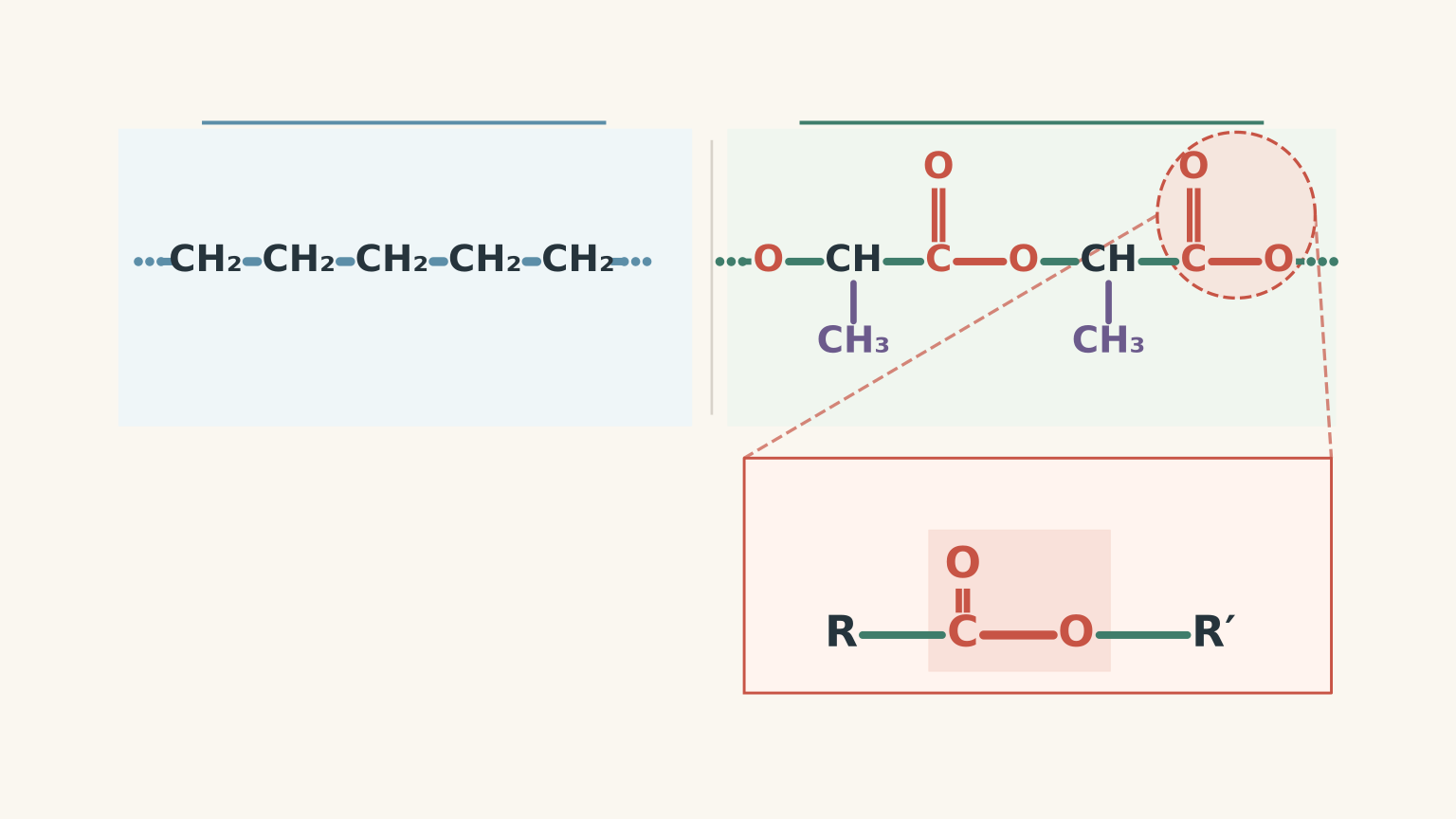
Due to technical limitations, this figure may display incorrectly or contain inaccuracies. Please check key details against your course materials.
The difference is important:
- Polyethylene does not contain hydrolysable ester linkages in its backbone.
- PLA contains ester linkages that can be broken through hydrolysis.
- The resulting smaller PLA molecules can become accessible to microorganisms.
An ester linkage doesn’t guarantee rapid degradation, though. Water must reach the bond, the reaction must occur, and the resulting products must be able to leave the polymer and enter the biological environment.
This is why structure is only half the explanation.
For a closer look at the alternative polymer structure, see Addition polymers explained: PE, PVC, PS and PTFE for HSC Chemistry.
02How biodegradable polymers actually break down
Let’s follow a PLA chain through its degradation.
There are two important processes involved:
- Chemical breakdown of the polymer chains.
- Biological consumption of the smaller products.
These processes are related, but they are not identical.
Stage 1: Water reaches the polymer
Water from the surrounding environment enters the polymer material.
The amount of water that can enter depends on the polymer’s structure, physical arrangement, temperature, and surrounding conditions.
Once water reaches accessible ester linkages, hydrolysis can occur.
Importantly, this initial reaction does not necessarily require microorganisms. It can happen through ordinary chemical reactions involving water.
This is called abiotic degradation, meaning degradation caused by non-living processes.
Stage 2: The polymer chains are shortened
As ester linkages are broken, the long PLA chains become shorter.
The polymer’s average molecular mass decreases.
Eventually, sufficiently small fragments can become soluble in the surrounding water.
For PLA, complete hydrolysis produces lactic acid molecules:
\[ \ce{C3H4O2 + H2O -> C3H6O3} \]
This equation represents the simplified conversion of one PLA repeat-unit equivalent into one lactic acid molecule.
Notice that water becomes part of the products. Hydrolysis is not simply the disappearance of material.
Stage 3: Microorganisms consume the products
Bacteria and fungi can metabolise suitable smaller molecules produced during polymer breakdown.
For PLA, microorganisms can use lactic acid and other smaller degradation products as carbon sources.
The carbon is incorporated into microbial biomass or converted into simpler substances through metabolic reactions.
Under aerobic conditions, where oxygen is available, the overall process can produce:
- Carbon dioxide, \(\ce{CO2}\)
- Water, \(\ce{H2O}\)
- New microbial biomass
Under anaerobic conditions, where oxygen is absent, microbial degradation can instead produce products including methane, \(\ce{CH4}\), and carbon dioxide.
The important point is that microorganisms must actually process the polymer-derived material.
A plastic object becoming brittle or breaking into tiny fragments is not sufficient evidence of complete biodegradation.
Degradation versus biodegradation
These terms are often used interchangeably in advertising, but they describe different things.
| Term | What it actually means |
|---|---|
| Degradation | Chemical or physical changes that damage or break down a material |
| Fragmentation | Breaking a material into smaller physical pieces |
| Biodegradation | Microorganisms convert organic material into simpler products and biomass |
| Mineralisation | Conversion of organic carbon into inorganic products such as carbon dioxide or methane |
Mineralisation is particularly useful when evaluating biodegradable plastics because it provides evidence that polymer-derived carbon has been converted into simpler inorganic substances.
The OECD report on biodegradable plastics provides further discussion of these distinctions.
A plastic that has fragmented into thousands of tiny particles may still contain almost all its original polymer carbon. It has physically broken apart, but that does not establish that microorganisms have metabolised it.
03Why environmental conditions matter
Suppose two identical PLA containers are placed in different environments.
One is buried in cool, relatively dry garden soil. The other is placed in a warm, moist industrial composting facility with an active microbial community.
Would you expect them to break down at the same rate?
No. Even though the polymer structure is identical, the conditions controlling hydrolysis and microbial activity are very different.
Several factors determine how quickly biodegradable polymers break down.
Temperature
Temperature affects both chemical reaction rates and microbial activity.
For PLA, higher temperatures generally accelerate hydrolysis over a suitable temperature range. They also increase the activity of many microorganisms and their enzymes, provided the temperature remains suitable for those organisms.
Industrial composting environments use controlled conditions that can be much warmer than ordinary outdoor environments.
For example, many controlled PLA composting studies investigate degradation around \(58^\circ\mathrm{C}\).
At ordinary environmental temperatures, PLA can degrade much more slowly.
However, higher temperature does not always mean faster biodegradation. Excessive temperatures can reduce microbial activity or deactivate enzymes.
The effect depends on the particular polymer and microorganisms involved.
Moisture
Water is a reactant in hydrolysis.
If a PLA object is kept in a very dry environment, there is less water available to reach and react with its ester linkages.
This can substantially slow chemical chain breakdown.
Moisture also affects microbial activity. Microorganisms generally require suitable water availability to grow, move nutrients, and carry out metabolic processes.
A moist environment therefore supports both the chemical and biological stages of degradation.
pH
The acidity or alkalinity of the environment can influence ester hydrolysis.
Both acidic and alkaline conditions can catalyse ester hydrolysis through different reaction pathways.
However, there is an important complication.
An environment with an extreme pH may accelerate certain chemical reactions while reducing the activity or survival of microorganisms.
Therefore, the conditions that maximise chemical hydrolysis do not necessarily maximise overall biodegradation.
Oxygen availability
Oxygen affects the products formed during microbial metabolism.
In an aerobic environment, microorganisms can convert polymer-derived carbon into carbon dioxide and water, while also producing biomass.
In anaerobic environments, different metabolic pathways operate, and methane may be produced.
This means that oxygen availability affects the pathway and products of biodegradation, rather than determining whether all biodegradation is possible.
Microorganisms and enzymes
Not every microorganism can break down every polymer.
Microorganisms produce enzymes that catalyse particular chemical reactions. Some enzymes can recognise and hydrolyse ester linkages in suitable polymers.
For example, PHA-depolymerase enzymes can break down polyhydroxyalkanoates, another family of biodegradable polyesters.
The presence of a suitable microorganism, the activity of its enzymes, and access to the polymer surface all influence the rate of breakdown.
This is one reason why the same polymer can behave differently in two soils or two bodies of water.
Crystallinity and molecular arrangement
So far, we’ve treated a polymer chain as though it sits in a simple, open arrangement.
Real polymers are more complicated.
Some sections of a polymer can pack closely together in an ordered arrangement. These regions are called crystalline regions.
Other sections have a more disordered arrangement. These are called amorphous regions.
Water and enzymes generally have easier access to the less tightly packed amorphous regions.
Crystalline regions restrict molecular movement and often limit water penetration, making their bonds less accessible to hydrolysis.
This creates an important distinction between two samples made from the same polymer.
A sample with a greater proportion of accessible amorphous material may undergo faster hydrolysis than a more crystalline sample.
Research on PLA has demonstrated that crystallinity influences hydrolytic degradation, partly through its effect on water diffusion. See the 2021 study published in ACS Applied Polymer Materials.
Other factors, including polymer thickness, molecular mass, and the arrangement of the chains, also affect the result.
Two ways polymer materials can erode
There is another useful distinction when studying degradation.
Depending on how quickly water enters the material compared with how quickly bonds break, two broad degradation patterns can occur.
Bulk erosion occurs when water penetrates the interior faster than the polymer chains are hydrolysed.
Chain cleavage can then occur throughout the material, including inside its centre.
The polymer’s average molecular mass may fall substantially before much material is lost from the outside.
Surface erosion occurs when degradation is concentrated near the outer surface because the reaction is faster than the penetration of water or degrading agents into the interior.
The object gradually shrinks from its outside surface.
These are useful models, not universal descriptions of every biodegradable polymer.
PLA commonly undergoes significant bulk hydrolysis under suitable moist conditions, while enzymatic degradation of PHA often involves surface erosion.
The dominant mechanism depends on the material, its dimensions, and the surrounding conditions.
04Biobased, biodegradable, and compostable are not the same
These three terms are often grouped together on packaging, but they describe different properties.
| Term | Meaning | What it does not guarantee |
|---|---|---|
| Biobased | Made partly or entirely from biological resources | That the material will biodegrade |
| Biodegradable | Capable of being broken down by microorganisms under suitable conditions | That it will break down quickly in every environment |
| Compostable | Designed to biodegrade under specified composting conditions and meet additional requirements for the resulting compost | That it is suitable for every composting system |
Consider polyethylene made from sugarcane.
The sugarcane can be processed to produce ethanol, which can then be converted into ethene.
That ethene can undergo addition polymerisation to produce polyethylene.
The resulting polymer has the same repeating structure as polyethylene produced from petroleum:
\[ \left[-\mathrm{CH_2-CH_2-}\right]_N \]
Its biological origin has changed, but its chemical backbone has not.
It therefore does not become readily biodegradable simply because its carbon originally came from a plant.
The US Environmental Protection Agency discusses this distinction in its guide to plastic recycling and composting.
Industrial composting versus home composting
PLA provides a useful example of why the word compostable needs context.
Some PLA products are designed and certified for industrial composting.
These facilities can provide controlled temperature, moisture, oxygen, and microbial conditions that support the degradation process.
A backyard compost heap may not reach the same temperatures or maintain the same conditions.
Consequently, a PLA product designed for industrial composting may break down very slowly in a home composting environment.
It may also persist in marine environments, where temperature, microbial activity, and other conditions differ substantially from those in industrial composting.
In Australia, two relevant standards are:
- AS 4736, which addresses plastics suitable for commercial composting and other microbial treatment.
- AS 5810, which addresses plastics suitable for home composting.
The distinction matters when interpreting a product’s environmental claims. A product certified for one system should not automatically be assumed suitable for another.
Another biodegradable polymer: PHA
Polyhydroxyalkanoates, abbreviated to PHA, are a family of polyesters produced naturally by certain microorganisms.
Microorganisms can accumulate these polymers inside their cells as a way of storing carbon and energy.
Like PLA, PHAs contain ester linkages that can undergo hydrolysis.
However, PHA degradation is strongly influenced by enzymes called PHA depolymerases.
These enzymes can be released by microorganisms and act on the exposed polymer surface, breaking the chains into smaller products that can subsequently be consumed.
Unlike PLA, which often relies heavily on an initial hydrolysis stage under industrial composting conditions, PHA materials can undergo enzymatic degradation in a broader range of natural environments.
This does not mean every PHA will degrade rapidly in every environment.
The particular PHA structure, its crystallinity, the surrounding microbial community, and environmental conditions all influence the outcome.
A useful further reading is the 2025 review, Biodegradability of polyhydroxyalkanoate (PHA) biopolyesters in nature.
06Worked examples
The chemistry becomes much clearer when we follow the atoms through the degradation process.
Worked example: Calculating the products of PLA hydrolysis
A sample contains 5.00 g of PLA. Estimate the mass of lactic acid produced if the polymer undergoes complete hydrolysis.
Assume:
- The PLA repeat unit has the formula \(\mathrm{C_3H_4O_2}\).
- Each repeat-unit equivalent produces one lactic acid molecule.
- The polymer has a sufficiently large number of repeat units that end-group corrections can be ignored.
Step 1
For one repeat-unit equivalent:
\[ \ce{C3H4O2 + H2O -> C3H6O3} \]
The mole ratio between PLA repeat units and lactic acid is 1:1.
Step 2
Using \(C=12.01\), \(H=1.008\), and \(O=16.00\):
\[ \begin{aligned} M(\mathrm{C_3H_4O_2}) &=3(12.01)+4(1.008)\\ &\quad+2(16.00)\\ &=72.06\ \mathrm{g\,mol^{-1}} \end{aligned} \]
Step 3
Using \(n=m/M\), where \(n\) is amount in moles, \(m\) is mass, and \(M\) is molar mass:
\[ \begin{aligned} n_{\text{repeat}} &=\frac{5.00}{72.06}\\ &=0.0694\ \mathrm{mol} \end{aligned} \]
Step 4
The ratio is 1:1, so:
\[ n_{\text{lactic acid}}=0.0694\ \mathrm{mol} \]
Step 5
The molar mass of lactic acid, \(\mathrm{C_3H_6O_3}\), is:
\[ M=3(12.01)+6(1.008)+3(16.00) \]
\[ M=90.08\ \mathrm{g\,mol^{-1}} \]
Therefore:
\[ \begin{aligned} m&=nM\\ &=0.0694\times90.08\\ &=6.25\ \mathrm{g} \end{aligned} \]
Final answer: 6.25 g of lactic acid is produced.
Notice that the product has a greater mass than the original PLA sample.
This is because water is incorporated into the products during hydrolysis. The polymer hasn’t simply disappeared; its chemical structure has changed.
Worked example: Calculating theoretical carbon dioxide production
A 5.00 g PLA sample undergoes complete aerobic mineralisation.
During testing, 5.50 g of carbon dioxide originating from the polymer is measured.
Calculate the percentage of the theoretical maximum carbon dioxide production that has occurred.
Step 1
Using the PLA repeat-unit formula:
\[ \ce{C3H4O2 + 3O2 -> 3CO2 + 2H2O} \]
One mole of PLA repeat units produces three moles of carbon dioxide.
Step 2
\[ \begin{aligned} n_{\text{PLA}} &=\frac{5.00}{72.06}\\ &=0.0694\ \mathrm{mol} \end{aligned} \]
Step 3
Using the mole ratio of 1:3:
\[ \begin{aligned} n_{\ce{CO2}} &=3(0.0694)\\ &=0.208\ \mathrm{mol} \end{aligned} \]
Step 4
The molar mass of carbon dioxide is \(44.01\ \mathrm{g\,mol^{-1}}\).
\[ \begin{aligned} m_{\ce{CO2}} &=nM\\ &=0.208\times44.01\\ &=9.16\ \mathrm{g} \end{aligned} \]
Step 5
\[ \begin{aligned} \%&=\frac{\text{actual CO}_2} {\text{theoretical CO}_2}\times100\\ &=\frac{5.50}{9.16}\times100\\ &=60.0\% \end{aligned} \]
Final answer: 60.0% of the theoretical maximum carbon dioxide production has occurred.
This provides evidence of substantial mineralisation of the polymer’s carbon.
However, it does not necessarily mean that exactly 60.0% of the original polymer has biodegraded. Some polymer-derived carbon may have entered microbial biomass or remained in dissolved degradation products rather than becoming carbon dioxide.
This distinction becomes important when interpreting experimental data.
07Questions and solutions
Question 1
A PLA sample has a mass of 3.60 g. Assume its repeat-unit formula is \(\mathrm{C_3H_4O_2}\).
Calculate:
(a) The amount, in moles, of PLA repeat units present.
(b) The mass of water required for complete hydrolysis.
(c) The mass of lactic acid produced.
Assume a sufficiently large degree of polymerisation that end-group corrections can be ignored.
Solution 1
The sample contains 0.0500 mol of PLA repeat units, requiring approximately 0.901 g of water and producing 4.50 g of lactic acid.
(a) Amount of PLA repeat units
First, calculate the molar mass:
\[ M(\mathrm{C_3H_4O_2})=72.06\ \mathrm{g\,mol^{-1}} \]
Then:
\[ \begin{aligned} n&=\frac{m}{M}\\ &=\frac{3.60}{72.06}\\ &=0.0500\ \mathrm{mol} \end{aligned} \]
(b) Mass of water required
The hydrolysis equation gives a 1:1 mole ratio between PLA repeat units and water.
Therefore:
\[ n_{\ce{H2O}}=0.0500\ \mathrm{mol} \]
Using the molar mass of water, \(18.02\ \mathrm{g\,mol^{-1}}\):
\[ \begin{aligned} m&=nM\\ &=0.0500\times18.02\\ &=0.901\ \mathrm{g} \end{aligned} \]
(c) Mass of lactic acid produced
The mole ratio between PLA repeat units and lactic acid is also 1:1.
\[ n_{\text{lactic acid}}=0.0500\ \mathrm{mol} \]
Using \(M(\mathrm{C_3H_6O_3})=90.08\ \mathrm{g\,mol^{-1}}\):
\[ \begin{aligned} m&=nM\\ &=0.0500\times90.08\\ &=4.50\ \mathrm{g} \end{aligned} \]
The mass balance is consistent:
\[ 3.60+0.901\approx4.50\ \mathrm{g} \]
The additional mass comes from the water incorporated during hydrolysis.
Question 2
Two plastic containers have identical dimensions and are placed in the same warm, moist, aerobic industrial composting environment.
- Container A is made from PLA.
- Container B is made from polyethylene manufactured using sugarcane-derived ethene.
A manufacturer claims that Container B should biodegrade readily because its carbon originally came from a renewable biological resource.
Evaluate this claim. Explain which polymer is more likely to undergo hydrolytic chain breakdown and why the biological origin of the raw material is not sufficient evidence of biodegradability.
Solution 2
Container A, made from PLA, is more likely to undergo hydrolytic chain breakdown. The sugarcane origin of Container B does not make its polyethylene backbone biodegradable.
The critical difference is the chemical structure of the two polymers.
PLA contains ester linkages:
\[ \mathrm{-C(=O)-O-} \]
These bonds can be broken through hydrolysis when water reaches the linkage and suitable conditions support the reaction.
Breaking these bonds shortens the polymer chains and produces smaller molecules that may subsequently be consumed by microorganisms.
Container B has a polyethylene backbone:
\[ \left[-\mathrm{CH_2-CH_2-}\right]_N \]
Its carbon atoms are connected by carbon-carbon single bonds.
There are no ester linkages available for ordinary ester hydrolysis.
The fact that its ethene originated from sugarcane rather than petroleum does not change its final repeating structure.
This is the manufacturer’s central misconception: the origin of the carbon atoms does not determine whether the finished polymer is biodegradable.
Polyethylene can undergo oxidative degradation under certain environmental conditions, but fragmentation through oxidation is not equivalent to microbial mineralisation.
Container A is therefore more chemically susceptible to the degradation processes expected in the specified composting environment. However, its actual biodegradation rate still depends on temperature, moisture, crystallinity, microbial activity, and the particular product formulation.
Question 3
Two samples made from the same PLA grade are placed in identical warm, moist, aerobic composting conditions.
Both samples initially have the same mass and average molecular mass.
Sample A is a thin film, while Sample B is a thick block.
After 30 days, the following results are recorded:
| Measurement | Sample A | Sample B |
|---|---|---|
| Initial mass | 10.0 g | 10.0 g |
| Mass remaining | 70% | 96% |
| Average molecular mass of recovered polymer, relative to initial value | 85% | 40% |
A student concludes that Sample B must have undergone more biodegradation because its average molecular mass decreased by a greater percentage.
Evaluate this conclusion. Explain what the results actually establish and identify an additional measurement required to compare the extent of biodegradation.
Solution 3
The student’s conclusion is not justified. Sample B shows greater chain scission in the recovered polymer, while Sample A shows greater mass loss, but neither result establishes which sample has undergone more biodegradation.
The two measurements describe different aspects of degradation.
First, consider the mass remaining.
Sample A has lost 30% of its original mass, while Sample B has lost only 4%.
This suggests that more material has left the recovered Sample A.
However, that material could have become soluble oligomers, dissolved molecules, or detached fragments. Mass loss alone does not establish that microorganisms have consumed it.
Now consider the average molecular mass.
Sample B’s recovered polymer has an average molecular mass equal to only 40% of its initial value.
This indicates substantial chain scission within the material that remains.
A possible explanation is bulk hydrolysis. Water enters the interior of the thick sample and breaks ester linkages throughout its structure, shortening chains without immediately removing much material from the block.
Sample A behaves differently because its thin geometry provides a greater surface-area-to-volume ratio and a shorter distance for degradation products to escape.
Smaller fragments and soluble oligomers can leave the material more readily. The remaining solid may therefore contain a greater proportion of the longer or less accessible polymer chains.
This creates an important measurement problem.
The average molecular mass of the recovered polymer describes only what remains. It does not describe all the polymer chains that have already left the sample.
To compare biodegradation properly, we need to measure polymer-derived carbon converted into biological products.
Under aerobic conditions, measuring carbon dioxide evolution provides useful evidence of mineralisation. The measurement should account for carbon dioxide produced naturally by the compost itself.
Therefore, the data establish different patterns of physical and chemical degradation, but they do not establish which sample has undergone more complete biodegradation.
Question 4
A 10.0 g PLA sample is placed in an aerobic composting environment.
After a specified period, the experiment measures 13.7 g of carbon dioxide originating from the PLA. The measurement has been corrected for background carbon dioxide produced by the compost.
Using the repeat-unit formula \(\mathrm{C_3H_4O_2}\), calculate:
(a) The theoretical maximum mass of carbon dioxide that could be produced through complete aerobic oxidation of the PLA.
(b) The percentage of theoretical carbon dioxide production achieved.
(c) Explain why this percentage should not automatically be interpreted as the exact percentage of polymer that has biodegraded.
Solution 4
The theoretical maximum carbon dioxide production is 18.3 g, and the experiment achieves 74.8% of this value. This is a measure of carbon mineralisation, not necessarily the exact total percentage of polymer biodegraded.
(a) Theoretical carbon dioxide production
Begin with the balanced equation:
\[ \ce{C3H4O2 + 3O2 -> 3CO2 + 2H2O} \]
One mole of PLA repeat units produces three moles of carbon dioxide.
The molar mass of the repeat unit is:
\[ M(\mathrm{C_3H_4O_2})=72.06\ \mathrm{g\,mol^{-1}} \]
Calculate the amount of PLA:
\[ \begin{aligned} n_{\text{PLA}} &=\frac{10.0}{72.06}\\ &=0.1388\ \mathrm{mol} \end{aligned} \]
Apply the mole ratio:
\[ \begin{aligned} n_{\ce{CO2}} &=3(0.1388)\\ &=0.4164\ \mathrm{mol} \end{aligned} \]
Calculate the theoretical carbon dioxide mass:
\[ \begin{aligned} m_{\ce{CO2}} &=0.4164\times44.01\\ &=18.3\ \mathrm{g} \end{aligned} \]
(b) Percentage of theoretical production
\[ \begin{aligned} \% &=\frac{13.7}{18.3}\times100\\ &=74.8\% \end{aligned} \]
(c) Interpretation
The result indicates that approximately 74.8% of the theoretical carbon dioxide production has occurred.
This provides strong evidence that a substantial proportion of the polymer’s carbon has been mineralised.
However, microorganisms do not necessarily convert every carbon atom they consume directly into carbon dioxide.
Some carbon is incorporated into new microbial cells, while some may remain in soluble intermediate compounds.
Therefore, the carbon dioxide measurement does not account for every possible destination of the original polymer carbon.
The correct conclusion is that 74.8% of the theoretical carbon dioxide production has been achieved, not that exactly 74.8% of the original polymer mass has biodegraded.
Question 5
A research team investigates whether hydrolysis alone is sufficient evidence of PLA biodegradation.
They prepare two identical PLA specimens, each with an initial mass of 5.00 g and the same polymer structure.
Both specimens are maintained at \(58^\circ\mathrm{C}\) under moist conditions for 30 days.
The specimens are placed in different environments:
Specimen S: Sterile water
- The environment contains no microorganisms.
- The average molecular mass of the recovered polymer decreases by 80%.
- The recovered polymer retains 98% of its initial mass.
- No additional carbon dioxide attributable to the PLA is detected.
Specimen C: Active industrial compost
- The environment contains an active microbial community and oxygen.
- The average molecular mass of the recovered polymer decreases by only 20%.
- Carbon dioxide attributable to the PLA reaches 65% of the theoretical maximum.
A researcher argues that Specimen S has undergone more biodegradation because its average molecular mass has decreased much more substantially.
Another researcher argues that Specimen C has undergone more biodegradation because it produces substantially more carbon dioxide.
Evaluate both arguments.
In your response:
(a) Identify which specimen has undergone greater biodegradation.
(b) Explain why the molecular-mass measurements appear to contradict the carbon dioxide measurements.
(c) Explain what the 65% carbon dioxide result establishes and what it does not establish.
Solution 5
Specimen C has undergone greater biodegradation. Specimen S has experienced substantial chemical chain breakdown, but the absence of microorganisms and measurable polymer-derived carbon dioxide means there is no evidence of significant biological mineralisation.
This question tests an important distinction: chemical degradation and biodegradation are related, but they are not interchangeable.
(a) Which specimen has undergone greater biodegradation?
Specimen C provides the stronger evidence of biodegradation.
It contains an active microbial community, and a substantial amount of polymer-derived carbon has been measured as carbon dioxide.
Specimen S contains no microorganisms.
Its decrease in average molecular mass therefore results from abiotic hydrolysis rather than microbial metabolism.
The ester linkages in PLA can react with water even in the absence of living organisms.
As a result, the polymer chains can become much shorter without the polymer carbon being biologically consumed.
Specimen S has undergone chemical degradation, but that alone does not establish biodegradation.
(b) Why do the molecular-mass measurements appear contradictory?
At first, Specimen S appears to have undergone more extensive degradation because its recovered polymer has lost 80% of its initial average molecular mass.
Specimen C has experienced only a 20% decrease.
However, these measurements describe only the polymer that remains in each specimen.
In Specimen S, hydrolysis has shortened the polymer chains, but almost all the original material remains in the vessel.
The smaller molecular fragments have not been substantially mineralised.
In Specimen C, microorganisms can consume suitable small molecules released by hydrolysis.
Some of these products leave the recovered polymer and are converted into carbon dioxide and microbial biomass.
This creates a selection effect.
The polymer remaining in Specimen C may be enriched in less accessible chains or more resistant crystalline regions. The chains that were most readily broken down and consumed are no longer represented in the recovered polymer sample.
Consequently, the average molecular mass of the remaining polymer can decrease by a smaller percentage even when substantially more biological conversion has occurred.
The tempting mistake is to assume that the molecular mass of the recovered material represents the entire history of the original polymer.
It doesn’t.
(c) What does the 65% carbon dioxide result establish?
The result establishes that carbon dioxide corresponding to 65% of the theoretical maximum has been produced from the original PLA carbon.
This is strong evidence of substantial mineralisation.
However, it does not establish that exactly 65% of the original polymer mass has biodegraded.
Some polymer-derived carbon may have entered microbial biomass rather than being released as carbon dioxide.
Other carbon may remain in soluble intermediate compounds or undegraded polymer.
The experiment therefore provides two different types of evidence:
- Molecular-mass measurements show changes in the structure of the recovered polymer.
- Carbon dioxide measurements provide evidence that polymer-derived carbon has been mineralised.
Together, these measurements give a much more complete understanding of biodegradation than either measurement could provide alone.
The second researcher has the stronger argument, because the biological conversion of polymer-derived carbon is the defining feature that distinguishes biodegradation from hydrolysis alone.
08Where this leads next
Biodegradable polymer chemistry is ultimately a problem of connecting molecular structure with experimental evidence.
The presence of ester linkages helps predict whether hydrolysis is possible. Polymer crystallinity and physical arrangement help predict whether water and enzymes can reach those linkages. Environmental conditions then influence how quickly chemical and biological breakdown can proceed.
But a predicted degradation pathway is not the same as an experimentally demonstrated outcome.
To investigate a real biodegradable polymer, chemists need several complementary techniques:
- Mass spectrometry can help identify smaller molecular products and investigate changes in molecular composition.
- Infrared spectroscopy can provide evidence of functional groups, including changes associated with ester hydrolysis.
- Molecular-mass analysis can reveal changes in the size distribution of polymer chains.
- Respirometry can measure carbon dioxide production during aerobic biodegradation.
The key decision is to match the measurement to the question being asked.
If you want to know whether polymer chains have been broken, investigate their molecular structure and molecular mass.
If you want to know whether microorganisms have actually consumed the polymer-derived material, investigate its biological conversion and mineralisation.
That distinction is what turns a claim that a plastic is biodegradable into a scientifically testable conclusion.