
Delayed Neutrons: Their Role in Nuclear Reactor Control
Discover how delayed neutrons are produced by radioactive decay, why a small fraction has such a large effect on reactor controllability, and how delayed supercriticality differs from prompt criticality. Includes worked examples and challenging HSC extension questions.
A fission reactor can produce millions of neutrons, yet its power output does not have to change uncontrollably every time a neutron causes another fission. The surprising reason is that not all neutrons arrive at the same time. Most are released almost instantly, but a small fraction emerge seconds later from the radioactive decay of fission products.
These late arrivals are called delayed neutrons. They make an enormous difference to how a nuclear reactor can be controlled, despite accounting for less than 1% of the neutrons produced in many common reactor fuels.
This article goes beyond the required HSC Physics syllabus. It uses the Year 12 focus area Matter, energy and the cosmos as its starting point, then develops the additional physics of delayed neutrons. The NSW Physics 11-12 Syllabus (2025) is scheduled for implementation from 2027, with the first HSC examination under the new syllabus in 2028. Delayed-neutron kinetics is an extension topic, not an assessment requirement.
01First, how does a fission reactor work?
Before delayed neutrons make sense, we need a picture of the process they affect.
Consider a uranium-235 nucleus absorbing a neutron. The resulting nucleus becomes unstable and splits into two smaller nuclei, releasing energy and several more neutrons.
This process is called nuclear fission.
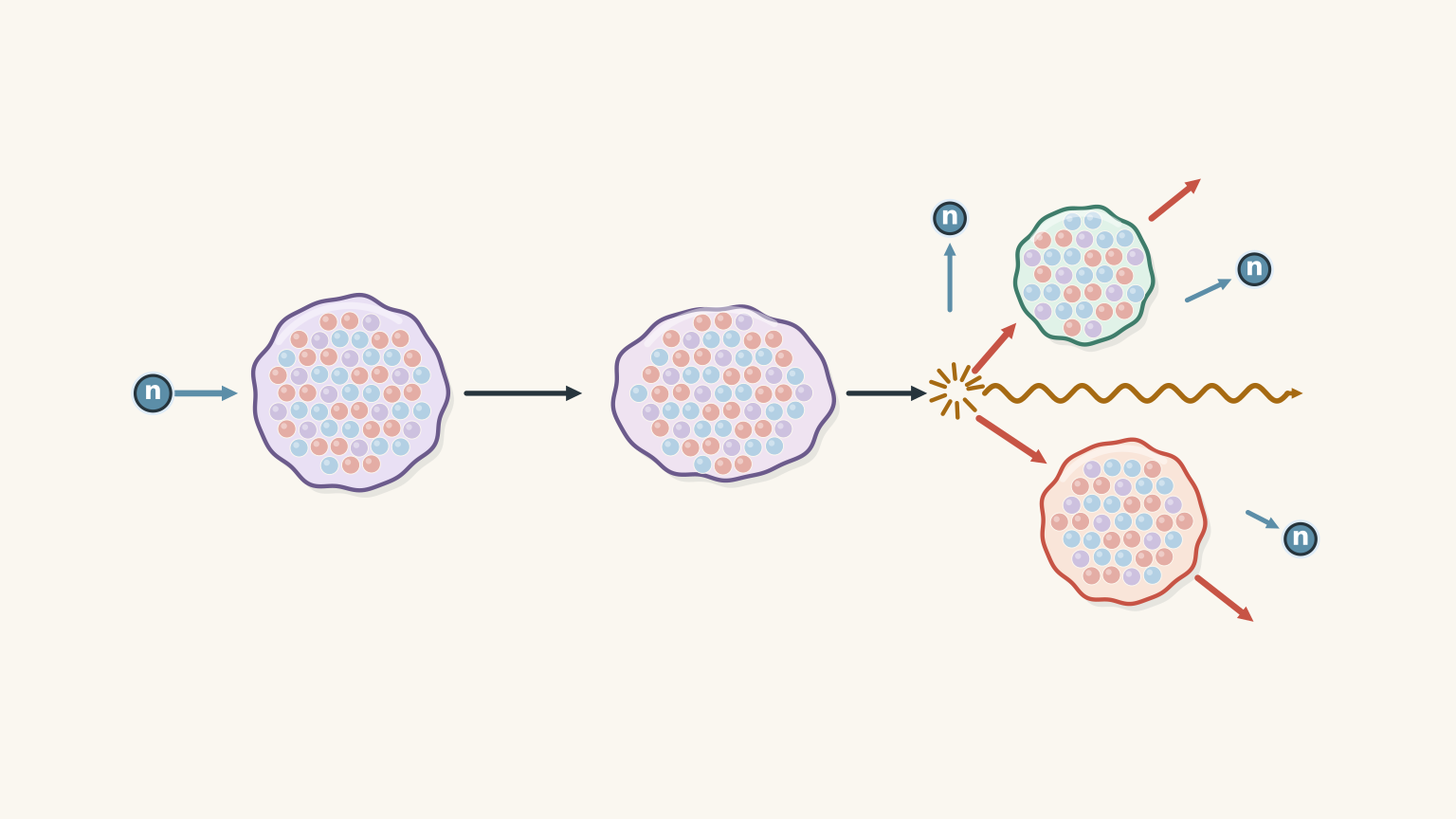
Due to technical limitations, this figure may display incorrectly or contain inaccuracies. Please check key details against your course materials.
The released neutrons can cause further fission events. Each new fission can release more neutrons, creating a chain reaction.
But there is an important distinction between a chain reaction that dies away, one that grows, and one that sustains itself.
Imagine the average number of neutrons from one generation that successfully cause fission in the next generation:
- If fewer than one neutron causes another fission, the chain reaction decreases.
- If exactly one neutron causes another fission on average, the chain reaction is self-sustaining.
- If more than one neutron causes another fission on average, the chain reaction grows.
The average is important. Individual fission events are random, so the number of neutrons released in any one event is not guaranteed to be the same.
A reactor is designed to maintain a controlled, self-sustaining chain reaction. Its components help manage neutron behaviour and remove the heat produced by fission.
The four important reactor components
| Component | Main function | Why it matters |
|---|---|---|
| Fuel | Contains fissile nuclei, such as uranium-235, that can undergo fission. | Supplies the nuclei needed to sustain the chain reaction. |
| Moderator | Slows down fast neutrons through collisions. | In a thermal reactor, slower neutrons are more likely to cause further fission in the fuel. |
| Control rods | Absorb neutrons. | Help regulate the neutron population and the chain reaction. |
| Coolant | Carries thermal energy away from the reactor core. | Prevents excessive heat accumulation and transfers energy for useful applications. |
The moderator and coolant can be the same substance. In many water-cooled reactors, water performs both roles, although the two functions are physically different.
The moderator changes neutron energy. It does this mainly through collisions, transferring some of a neutron’s kinetic energy to surrounding nuclei.
The coolant transports thermal energy. It carries energy away from the fuel and other hot components.
Control rods perform a different job. Materials such as boron or cadmium absorb neutrons, reducing the number available to cause further fission.
These components affect whether a chain reaction can be sustained, but they do not explain the full story of reactor controllability.
For that, we need to look at when neutrons are actually released.
02Prompt neutrons: the immediate generation
When a uranium-235 nucleus undergoes fission, most of its released neutrons appear essentially immediately.
These are called prompt neutrons.
The word prompt is not just a casual description. The neutrons are released on a timescale of approximately \(10^{-13}\) seconds after the fission event.
To picture this, imagine a chain reaction in which every new generation of neutrons is produced almost instantly after the previous generation.
If each generation produces slightly more neutrons capable of causing fission, the population can grow extremely quickly.
This creates a problem.
A reactor needs to respond to changes in its neutron population. If the entire chain reaction depended on prompt neutrons alone, changes could occur on timescales far too short for ordinary reactor control systems to manage.
You might predict that the solution is simply to absorb enough neutrons using control rods.
That is part of the answer, but it misses a much more interesting feature of nuclear fission: some neutrons are not released during the original fission event at all.
They arrive later.
03Where delayed neutrons actually come from
The delayed neutron is not a prompt neutron that has taken a long time to travel through the reactor.
It is a newly emitted neutron produced by a radioactive decay that happens after the original fission.
Here is the sequence.
Step 1: Fission produces unstable fragments.
When a heavy nucleus splits, it usually produces two smaller nuclei called fission fragments. Many of these fragments contain too many neutrons to be stable.
Step 2: A fission fragment undergoes beta-minus decay.
In beta-minus decay, a neutron inside the fragment changes into a proton. An electron and an electron antineutrino are also emitted.
The atomic number increases by one, but the mass number stays the same.
Step 3: The daughter nucleus releases a neutron.
Sometimes the daughter nucleus is left with enough excitation energy to eject a neutron. This neutron is the delayed neutron.
The original unstable fragment is called a delayed neutron precursor.
A real example: bromine-87
One example of a delayed neutron precursor is bromine-87.
A neutron-emitting decay pathway can be represented as:
\[ {}^{87}_{35}\mathrm{Br} \rightarrow {}^{87}_{36}\mathrm{Kr}^{*} +e^-+\bar{\nu}_e \]
The excited krypton-87 nucleus can then emit a neutron:
\[ {}^{87}_{36}\mathrm{Kr}^{*} \rightarrow {}^{86}_{36}\mathrm{Kr}+n \]
The asterisk indicates that the krypton nucleus is in an excited energy state.
Notice what happens to the mass number. It remains 87 during beta-minus decay, then decreases to 86 when the neutron is emitted.
Bromine-87 has a half-life of approximately 55.9 seconds. This means that its population decreases through radioactive decay over a timescale much longer than the prompt fission event.
Importantly, not every precursor has the same half-life, and not every beta decay necessarily produces a neutron. Only the appropriate neutron-emitting decay branches contribute to delayed neutron production.
Why do some neutrons take longer than others?
A reactor produces many different fission fragments. Each precursor has its own probability of decaying per unit time.
This means delayed neutrons are not all released after one fixed delay.
Some appear relatively quickly. Others emerge much later.
For a single radioactive precursor group, the number remaining after time \(t\) is described by:
\[ N(t)=N_0\left(\frac{1}{2}\right)^{t/t_{1/2}} \]
where:
- \(N(t)\) is the number of undecayed precursor nuclei after time \(t\),
- \(N_0\) is the initial number of precursor nuclei,
- \(t\) is the elapsed time, and
- \(t_{1/2}\) is the half-life.
For example, suppose a precursor group starts with 800 nuclei and has a half-life of 10 seconds.
After 10 seconds, 400 remain. After another 10 seconds, 200 remain. After 30 seconds, 100 remain.
The important point is that precursor nuclei act as a temporary reservoir of future neutrons.
A fission event can therefore influence the neutron population several seconds after it occurred.
In reactor physics, the many different precursor isotopes are commonly represented by six groups with different average decay properties. This makes the mathematical model manageable without pretending that all delayed neutrons have the same delay time.
04The delayed neutron fraction
We can now put a number on how many neutrons are delayed.
The delayed neutron fraction, represented by the Greek letter \(\beta\), is the fraction of all neutrons produced by fission that are delayed neutrons.
It is defined as:
\[ \beta=\frac{N_d}{N_{\mathrm{total}}} \]
where:
- \(\beta\) is the delayed neutron fraction,
- \(N_d\) is the number of delayed neutrons, and
- \(N_{\mathrm{total}}\) is the total number of prompt and delayed neutrons.
For thermal-neutron-induced fission, approximate values are:
| Fissile nucleus | Delayed neutron fraction | Percentage |
|---|---|---|
| Uranium-235 | 0.0065 | 0.65% |
| Plutonium-239 | 0.0022 | 0.22% |
These are representative nuclear data values, not universal constants for every reactor. The fraction depends on the fissile isotope and the energy of the neutron causing fission. A real reactor’s fuel composition also changes over time.
Notice that uranium-235 produces a larger delayed neutron fraction than plutonium-239.
This difference will become important when we discuss prompt criticality.
Worked example: calculating the delayed neutron population
A simplified fission process produces 80,000 neutrons. The delayed neutron fraction is 0.0065.
Calculate the number of delayed neutrons and prompt neutrons.
Step 1
The delayed neutron fraction is:
\[ \beta=0.0065 \]
Step 2
Rearrange the fraction equation:
\[ N_d=\beta N_{\mathrm{total}} \]
Substitute:
\[ N_d=0.0065\times80\,000 \]
\[ \boxed{N_d=520} \]
Step 3
Every neutron must belong to either the prompt or delayed population.
\[ N_p=N_{\mathrm{total}}-N_d \]
\[ N_p=80\,000-520 \]
\[ \boxed{N_p=79\,480} \]
So, 79,480 neutrons are prompt and 520 are delayed.
The delayed fraction is small, but that does not mean its effect on reactor behaviour is small. We need to consider the time between neutron generations.
05Why delayed neutrons make a reactor controllable
Imagine two reactors with identical fuel and neutron populations.
In the first reactor, every neutron is prompt. In the second, a small fraction of the neutrons is delayed.
Which reactor gives its control systems more time to respond when the chain reaction starts growing?
The second reactor.
The reason is the difference in neutron generation time.
Neutron generation time is the average time between the birth of a neutron and the birth of the neutrons it produces in the next generation.
For prompt neutrons, this interval is extremely short. It includes the time spent slowing down, being absorbed in a fission-producing interaction, and producing the next generation.
For delayed neutrons, the interval includes the waiting time for the precursor to undergo radioactive decay.
Typical illustrative values used in introductory reactor theory are:
| Quantity | Approximate time |
|---|---|
| Prompt neutron generation time | \(5\times10^{-5}\) s |
| Delayed neutron generation time | 12.5 s |
The delayed generation time is enormously longer.
This means even a tiny delayed neutron fraction can significantly increase the average time between neutron generations.
Worked example: finding the average neutron generation time
Consider a simplified reactor model with:
- Prompt neutron generation time \(T_p=5.0\times10^{-5}\) s.
- Delayed neutron generation time \(T_d=12.5\) s.
- Delayed neutron fraction \(\beta=0.0065\).
Calculate the average neutron generation time.
Step 1
A fraction \(1-\beta\) of neutrons are prompt, while a fraction \(\beta\) are delayed.
We calculate the average by weighting each generation time according to its fraction:
\[ T_{\mathrm{avg}}=(1-\beta)T_p+\beta T_d \]
Here, \(T_{\mathrm{avg}}\) is the simplified average generation time.
Step 2
\[ \begin{aligned} T_{\mathrm{avg}} &=(1-0.0065)(5.0\times10^{-5})\\ &\quad +(0.0065)(12.5) \end{aligned} \]
\[ T_{\mathrm{avg}}=4.9675\times10^{-5}+0.08125 \]
\[ \boxed{T_{\mathrm{avg}}\approx0.0813\text{ s}} \]
Step 3
If every neutron were prompt, the average generation time would be approximately:
\[ T_{\mathrm{prompt}}=0.00005\text{ s} \]
The delayed-neutron model gives:
\[ \frac{0.0813}{0.00005}\approx1626 \]
The average generation time is approximately 1,600 times longer.
That is a remarkable result. Only 0.65% of the neutrons are delayed, yet they have a major influence on the timescale of the chain reaction.
A limitation of this calculation: This is a simplified weighted-average model. Real reactors contain several precursor groups with different decay constants, and reactor kinetics must track their populations separately. The calculated average is useful for understanding the physical effect, but it is not a complete prediction of reactor power over time.
06Critical, supercritical, and prompt critical
To understand the actual limit of delayed neutron control, we need one more idea: the neutron multiplication factor.
The effective neutron multiplication factor, \(k_{\mathrm{eff}}\), describes the ratio of the neutron population in one generation to the population in the previous generation, accounting for the reactor’s neutron losses.
Its three basic conditions are:
| Condition | Meaning |
|---|---|
| \(k_{\mathrm{eff}}<1\) | Subcritical: the chain reaction decreases. |
| \(k_{\mathrm{eff}}=1\) | Critical: the chain reaction is self-sustaining. |
| \(k_{\mathrm{eff}}>1\) | Supercritical: the neutron population grows. |
Critical does not mean that a reactor is necessarily operating at high power. It means that the neutron population is self-sustaining on average.
A reactor can also be supercritical while still relying on delayed neutrons to sustain its growth.
This brings us to an important distinction.
Delayed critical versus prompt critical
A reactor is described as delayed supercritical when its total neutron population is growing, but prompt neutrons alone would not sustain that growth.
It is prompt critical when prompt neutrons alone are sufficient to sustain a growing chain reaction.
To express this distinction, we introduce reactivity, \(\rho\):
\[ \rho=\frac{k_{\mathrm{eff}}-1}{k_{\mathrm{eff}}} \]
Reactivity measures how far the reactor is from criticality.
For the simplified model, prompt criticality occurs when:
\[ \boxed{\rho\geq\beta_{\mathrm{eff}}} \]
Here, \(\beta_{\mathrm{eff}}\) is the effective delayed neutron fraction.
Why introduce another version of the delayed neutron fraction?
The ordinary \(\beta\) counts delayed neutrons as a fraction of all neutrons produced. However, not all neutrons have exactly the same likelihood of contributing to the next generation. Their energy and position in the core affect their importance.
The effective fraction, \(\beta_{\mathrm{eff}}\), accounts for this difference.
For an introductory calculation, we can sometimes approximate \(\beta_{\mathrm{eff}}\) using a representative delayed neutron fraction. A real reactor requires a core-specific value.
The distinction between delayed and prompt criticality is essential:
- Below prompt criticality, delayed neutrons are needed to sustain the growing chain reaction.
- At or above prompt criticality, prompt neutrons alone can sustain it.
Prompt criticality is associated with much faster changes in neutron population because the chain reaction no longer needs to wait for precursor decay to sustain itself.
This does not mean that every supercritical reactor is prompt critical. Nor does the word critical mean that a nuclear explosion is occurring. These terms describe neutron multiplication and reactor kinetics.
The delayed neutron fraction therefore establishes an important boundary between two very different types of reactor response.
07How the reactor components work together
Delayed neutrons explain why reactor control is possible on a more manageable timescale. However, they are only one part of the system.
The four reactor components each affect a different part of the physics.
| Component | Connection to reactor controllability |
|---|---|
| Fuel | Determines which fissile nuclei undergo fission and influences the delayed neutron fraction. |
| Moderator | Changes neutron energies and therefore the likelihood of further fission. |
| Control rods | Absorb neutrons, influencing the effective multiplication factor and reactivity. |
| Coolant | Removes thermal energy. Changes in coolant temperature or density can also influence reactivity, depending on the reactor design. |
There are a few important interactions here.
Fuel composition matters. Different fissile isotopes have different delayed neutron fractions. As the composition of nuclear fuel changes during its use, the effective delayed neutron fraction can also change.
The moderator affects the neutron population. In a thermal reactor, slowing neutrons increases the likelihood of further fission in suitable fuel nuclei. However, a moderator does not create delayed neutrons. Their origin is radioactive decay.
Control rods influence neutron multiplication. Their neutron-absorbing materials reduce the number of neutrons available to cause further fission. The delayed neutron population influences the timescale over which changes in multiplication affect the reactor.
The coolant manages thermal energy. It is not a substitute for neutron control. However, changes in coolant temperature and density can affect neutron moderation and absorption, producing feedback effects on reactivity.
One important qualification: not every reactor uses a moderator. Fast reactors, for example, are designed to operate using fast neutrons. Similarly, the coolant and moderator are not necessarily the same material.
The model we’ve used is therefore a simplified description of a common thermal, water-cooled reactor, rather than a description of every reactor design.
Why delayed neutrons do not guarantee safety
It would be tempting to conclude that delayed neutrons automatically make a reactor safe.
That is too strong.
They provide a longer timescale for changes in neutron population, which makes controlled reactor operation possible. But reactor safety also depends on neutron-absorbing systems, reliable instrumentation, heat removal, engineered shutdown systems, and multiple protective barriers.
Delayed neutrons do not prevent a reactor from becoming prompt critical. They do not prevent overheating, and they do not replace the systems designed to manage abnormal conditions.
Their contribution is specific: they change the kinetics of the chain reaction.
08Common misconceptions
| Misconception | What actually happens |
|---|---|
| Delayed neutrons are prompt neutrons travelling slowly. | They are newly emitted neutrons produced following radioactive decay of precursor nuclei. |
| Less than 1% means they have a negligible effect. | Their much longer generation times make their influence on reactor kinetics substantial. |
| Every neutron generation takes the same amount of time. | Prompt and delayed neutrons have very different generation times, and delayed precursors belong to different decay groups. |
| A supercritical reactor must be prompt critical. | A reactor can be supercritical while still relying on delayed neutrons. |
| The moderator and coolant do the same job. | The moderator changes neutron energy; the coolant transports thermal energy. A material can perform both functions, but the functions are different. |
| Delayed neutrons alone make a reactor safe. | They improve controllability but do not replace engineered safety systems. |
The distinction between supercritical and prompt critical is particularly important. It is possible for a reactor’s total neutron population to grow while its prompt neutron population, considered separately, would decrease.
That is the central reason delayed neutrons matter.
09Questions and solutions
Question 1
Explain how a delayed neutron is produced following nuclear fission. Your answer should identify the role of the fission fragment, beta-minus decay, and the excited daughter nucleus.
Solution 1
A delayed neutron is produced when an unstable fission fragment undergoes beta-minus decay, leaving an excited daughter nucleus that subsequently emits a neutron.
The sequence is:
- Nuclear fission produces neutron-rich, unstable fragments.
- One of these fragments undergoes beta-minus decay. A neutron changes into a proton, emitting an electron and an electron antineutrino.
- The daughter nucleus may be left in an excited energy state.
- If its excitation energy is sufficient, the daughter nucleus emits a neutron.
The original fission fragment is called the delayed neutron precursor.
The important distinction is that the neutron is produced during the later radioactive decay, rather than during the original fission event. It is not a prompt neutron that has simply travelled slowly.
Question 2
An idealised reactor model contains two groups of delayed neutron precursors.
| Property | Group A | Group B |
|---|---|---|
| Initial precursor population | 800 | 400 |
| Half-life | 10 s | 40 s |
Assume every precursor decay in these groups produces exactly one delayed neutron.
At \(t=40\) s:
(a) Calculate the number of undecayed precursors remaining in each group.
(b) Calculate the instantaneous delayed neutron emission rate from each group.
(c) Explain why the two groups can have the same emission rate despite having different precursor populations.
Use the radioactive decay constant:
\[ \lambda=\frac{\ln 2}{t_{1/2}} \]
and the decay rate:
\[ R=\lambda N \]
where \(\lambda\) is the decay constant, \(t_{1/2}\) is the half-life, \(N\) is the remaining precursor population, and \(R\) is the number of decays per second.
Solution 2
Both groups emit approximately 3.47 delayed neutrons per second at \(t=40\) s, despite having different numbers of remaining precursors.
The key is that the instantaneous decay rate depends on both the number of precursors and their decay constant.
(a) Remaining precursor populations
For Group A, 40 seconds represents four half-lives.
\[ N_A=800\left(\frac12\right)^{40/10} \]
\[ N_A=\frac{800}{16} \]
\[ \boxed{N_A=50} \]
For Group B, 40 seconds represents one half-life.
\[ N_B=400\left(\frac12\right)^{40/40} \]
\[ \boxed{N_B=200} \]
Group B has four times as many remaining precursors.
(b) Instantaneous emission rates
For Group A:
\[ \lambda_A=\frac{0.693}{10} =0.0693\text{ s}^{-1} \]
Therefore:
\[ R_A=0.0693\times50 \]
\[ \boxed{R_A=3.47\text{ s}^{-1}} \]
For Group B:
\[ \lambda_B=\frac{0.693}{40} =0.0173\text{ s}^{-1} \]
Therefore:
\[ R_B=0.0173\times200 \]
\[ \boxed{R_B=3.47\text{ s}^{-1}} \]
(c) Explanation
Group A has fewer remaining precursors, but each precursor has a higher probability of decaying per second.
Group B has more remaining precursors, but each decays more slowly.
These effects balance exactly at the specified time.
The important lesson is that the number of precursors remaining does not, by itself, determine the number of delayed neutrons being released per second.
Question 3
A simplified thermal reactor model has an effective neutron multiplication factor of:
\[ k_{\mathrm{eff}}=1.004 \]
Assume its effective delayed neutron fraction is:
\[ \beta_{\mathrm{eff}}=0.0065 \]
(a) Calculate the reactor reactivity.
(b) Determine whether the reactor is subcritical, critical, or supercritical.
(c) Determine whether it is prompt critical or delayed supercritical.
(d) Suppose the reactor had the same multiplication factor but an effective delayed neutron fraction of 0.0022. Would its prompt-critical classification change? Explain.
Solution 3
The first reactor is delayed supercritical, while the second reactor is prompt critical. Although their multiplication factors are identical, their delayed neutron fractions are different.
(a) Calculate reactivity
Use:
\[ \rho=\frac{k_{\mathrm{eff}}-1}{k_{\mathrm{eff}}} \]
Substitute:
\[ \rho=\frac{1.004-1}{1.004} \]
\[ \rho=\frac{0.004}{1.004} \]
\[ \boxed{\rho=0.00398} \]
(b) Determine the criticality condition
Since:
\[ k_{\mathrm{eff}}=1.004>1 \]
the reactor is supercritical.
Its total neutron population grows on average.
(c) Determine whether it is prompt critical
Compare the reactivity with the effective delayed neutron fraction:
\[ \rho=0.00398 \]
\[ \beta_{\mathrm{eff}}=0.0065 \]
Since:
\[ \rho<\beta_{\mathrm{eff}} \]
the reactor is delayed supercritical.
Prompt neutrons alone are insufficient to sustain the growing chain reaction. Delayed neutrons are still required.
(d) Consider the alternative fuel composition
Now suppose:
\[ \beta_{\mathrm{eff}}=0.0022 \]
The reactivity remains:
\[ \rho=0.00398 \]
This time:
\[ \rho>\beta_{\mathrm{eff}} \]
The reactor is prompt critical.
The classification has changed even though \(k_{\mathrm{eff}}\) has not.
This demonstrates why the multiplication factor alone cannot describe the timescale of reactor behaviour. The proportion of delayed neutrons also matters.
Question 4
A reactor initially operates with a self-sustaining chain reaction. Following a change in its overall neutron balance, its effective multiplication factor becomes:
\[ k_{\mathrm{eff}}=0.97 \]
A neutron detector continues registering neutrons above background levels for several tens of seconds.
Assume there is no external neutron source and that precursor nuclei produced before the change continue to undergo radioactive decay.
Explain:
(a) Why neutrons can still be detected after the reactor becomes subcritical.
(b) Why this observation does not demonstrate that the reactor still has a self-sustaining chain reaction.
(c) How the delayed neutron population is expected to change over time.
Solution 4
The detector continues recording neutrons because previously formed delayed neutron precursors are still decaying. Their neutron emissions can continue after the reactor has become subcritical.
(a) Why are neutrons still detected?
Before the change, fission events produced both prompt neutrons and delayed neutron precursors.
When the reactor becomes subcritical, the existing precursors do not instantly disappear.
They continue undergoing beta-minus decay, and some of these decays produce delayed neutrons.
These neutrons can also cause further fission events, producing additional prompt neutrons.
Therefore, neutron production can continue even after the reactor’s multiplication factor falls below one.
(b) Why does this not mean the reactor is critical?
The multiplication factor describes the average neutron multiplication between generations.
Here:
\[ k_{\mathrm{eff}}=0.97<1 \]
Each generation produces fewer neutrons than the previous generation on average.
The delayed neutron emissions act as an additional source of neutrons, but they do not change the fact that the chain reaction is subcritical.
A neutron population can therefore remain measurable without being self-sustaining.
(c) What happens over time?
The precursor population gradually decreases through radioactive decay.
As fewer precursors remain, the delayed neutron source weakens. The resulting neutron population also decreases, although the exact time dependence depends on the different precursor groups and their decay rates.
This is why a subcritical reactor can have a neutron-count tail rather than an instantaneous disappearance of all neutron activity.
The crucial distinction is between continued neutron production and a self-sustaining chain reaction. They are not the same thing.
Question 5
Two idealised thermal reactor cores have the same effective neutron multiplication factor:
\[ k_{\mathrm{eff}}=1.004 \]
However, their fuel compositions and previous operating histories differ.
| Property | Core A | Core B |
|---|---|---|
| Dominant fissile isotope | Uranium-235 | Plutonium-239 |
| Effective delayed neutron fraction | 0.0065 | 0.0022 |
| Initial neutron population | Same | Same |
| Prompt neutron generation time | Same | Same |
| Existing precursor inventory | Substantial | Negligible |
Core A has a substantial precursor inventory because it previously sustained fission for a long period. Core B has negligible precursor inventory because it has remained subcritical for many precursor half-lives.
Both cores now have the stated multiplication factor. Assume there are no thermal feedback effects during the comparison.
A student makes the following claim:
Core B must have a greater total neutron population than Core A at every instant after the change because Core B is prompt critical, whereas Core A is only delayed supercritical.
Evaluate this claim.
Your response must:
(a) Calculate the reactivity of both cores.
(b) Determine the criticality classification of each core.
(c) Explain whether prompt-critical classification is sufficient to predict which core will have the greater total neutron population throughout the subsequent transient.
Solution 5
The student’s claim is incorrect. Core B is prompt critical, but this does not guarantee that its total neutron population will exceed Core A’s at every instant.
The subtlety is that prompt-critical classification describes the multiplication of prompt neutrons. It does not account, by itself, for the existing population of delayed neutron precursors.
(a) Calculate reactivity
Both cores have the same multiplication factor, so:
\[ \rho=\frac{1.004-1}{1.004} \]
\[ \boxed{\rho=0.00398} \]
Their reactivities are identical.
(b) Classify the two cores
For Core A:
\[ \rho=0.00398 \]
\[ \beta_{\mathrm{eff}}=0.0065 \]
Therefore:
\[ 0.00398<0.0065 \]
Core A is delayed supercritical.
For Core B:
\[ \rho=0.00398 \]
\[ \beta_{\mathrm{eff}}=0.0022 \]
Therefore:
\[ 0.00398>0.0022 \]
Core B is prompt critical.
The difference becomes clearer if we consider the simplified prompt-only multiplication factor:
\[ k_p=(1-\beta_{\mathrm{eff}})k_{\mathrm{eff}} \]
Here, \(k_p\) represents the multiplication factor associated with prompt neutrons alone.
For Core A:
\[ k_{p,A}=(1-0.0065)(1.004) \]
\[ \boxed{k_{p,A}=0.99747} \]
This is below one. Prompt neutrons alone cannot sustain the chain reaction.
For Core B:
\[ k_{p,B}=(1-0.0022)(1.004) \]
\[ \boxed{k_{p,B}=1.00179} \]
This is above one. Prompt neutrons alone can sustain a growing chain reaction.
So far, the student’s reasoning appears convincing.
But there is another variable.
(c) Account for the existing precursor populations
Core A has a substantial population of delayed neutron precursors.
These precursors were created by previous fission events. Their radioactive decay continues to supply delayed neutrons, even though the reactor’s present conditions have changed.
Core B has very few existing precursors. Its prompt neutrons can sustain growth without relying on delayed neutron production, but it initially has a much smaller delayed neutron source.
This means the two cores have different sources of neutron production:
- Core A has prompt neutron production that is insufficient to sustain growth independently, but it also has a substantial existing reservoir of delayed neutron precursors.
- Core B has prompt neutron production that can sustain growth independently, but its existing delayed neutron source is negligible.
The prompt-critical classification does not tell us the complete neutron population at every moment.
To predict the actual detector counts, we would need the precise precursor populations, their individual decay constants, and their contributions to neutron production over time.
Core A could therefore have a greater total neutron count for part of the transient, despite being only delayed supercritical. Core B’s prompt neutron population, meanwhile, can grow without waiting for additional precursor decays.
The two populations must be analysed using the full time-dependent reactor kinetics model before their relative behaviour can be established.
The deeper lesson: A reactor’s current neutron multiplication factor does not contain all the information needed to predict its immediate response. Its history matters because radioactive precursors store information about previous fission events.
This is why reactor physics needs to track both the neutron population and the precursor population.
10Where to go next: point reactor kinetics
The next concept is point reactor kinetics.
Instead of representing all delayed neutrons with one average generation time, this model tracks the neutron population and the different groups of delayed neutron precursors separately.
It considers two interacting quantities:
- The neutron population, which changes through neutron production and loss.
- The precursor populations, which build up during fission and decrease through radioactive decay.
A more complete model also considers spatial differences across the reactor core and feedback from changes in fuel and coolant temperatures.
This is the natural next step because delayed neutrons have shown us something important: predicting how many neutrons a reactor produces is not enough. We also need to understand when those neutrons appear.
11Further reading
The following authoritative resources support the nuclear physics and reactor kinetics discussed in this article.
NSW Education Standards Authority – Physics 11-12 Syllabus (2025)
Official syllabus information, including implementation dates and course structure.
U.S. Department of Energy – Nuclear Physics and Reactor Theory, Volume 1
Covers prompt and delayed neutrons, precursor groups, neutron generation times, and the role of delayed neutrons in reactor control.
International Atomic Energy Agency – Nuclear Physics and Reactor Theory
Provides further detail on beta-delayed neutron emission, effective delayed neutron fractions, and prompt criticality.
Argonne National Laboratory – Delayed-Neutron Precursors
A more advanced treatment of precursor populations and their mathematical representation in reactor kinetics.
U.S. Nuclear Regulatory Commission – Nuclear Reactors and Energy Generation
An accessible explanation of reactor fuel, control rods, moderators, coolants, and the nuclear fission chain reaction.