
How to Catch Careless Mistakes in HSC Maths Exams
Learn a practical checking routine to catch copying errors, negative sign mistakes, forgotten domain restrictions, and incorrect calculator entries. Includes worked examples and practice questions with detailed solutions.
Expand \(-3(2x-5)\). Is the answer \(-6x-15\) or \(-6x+15\)?
It’s \(-6x+15\), because a negative multiplied by a negative gives a positive.
If you choose the first answer, every calculation that follows could be perfectly executed and still produce the wrong result. That’s the frustrating thing about careless mistakes in HSC Maths: a small error early in a solution can undo several minutes of correct working.
The answer isn’t to check every line repeatedly or tell yourself to concentrate harder. It’s to build a short checking routine around the four places where these mistakes commonly occur:
- Copying information incorrectly.
- Losing or changing negative signs.
- Forgetting domain restrictions.
- Entering expressions incorrectly into your calculator.
Each has a different cause, so each needs a different check.
01The four-check routine
Think of checking as part of solving a question, not something you do only when you’ve finished.
| Stage of your working | What to check |
|---|---|
| Before solving | Have you copied every number, sign, bracket, and condition correctly? |
| During algebra | Have negative signs and brackets been handled correctly? |
| When finding solutions | Are your answers allowed by the original domain and interval? |
| When using your calculator | Does the calculator input match the mathematical expression? |
There is an important difference between this routine and a general error log.
An error log records mistakes you’ve already made. It helps you identify recurring weaknesses over time.
This checking routine is designed to catch mistakes while you’re solving a question, before they become part of your final answer.
You can use both, but they do different jobs.
01Check what you’ve copied
A surprisingly common mistake is changing the question without realising it.
This happens particularly when substituting negative numbers, copying fractions, or transferring an equation from one line to the next.
Consider the function
\[ f(x)=x^2-3x+4 \]
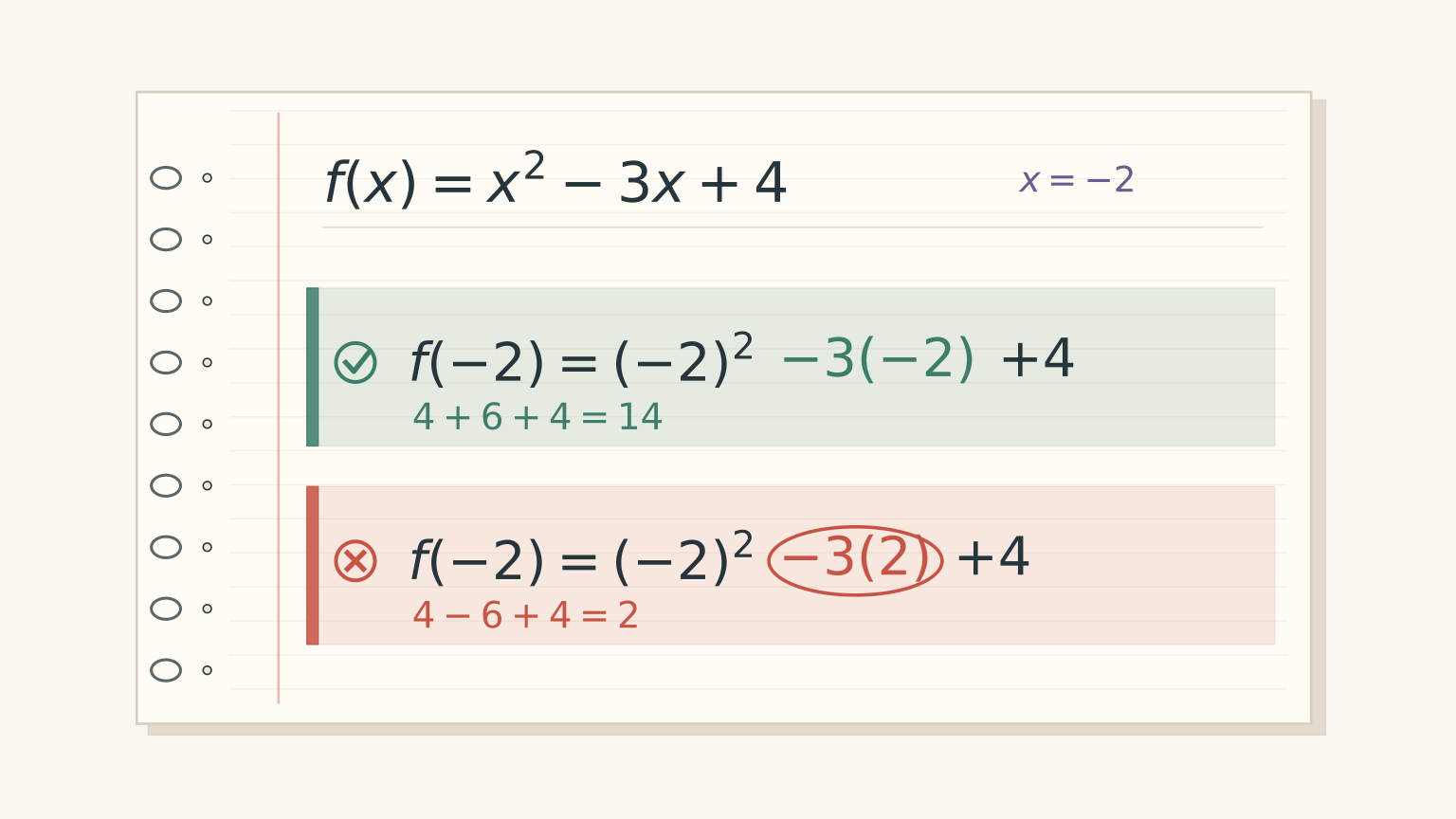
Suppose you’re asked to calculate \(f(-2)\).
The correct substitution is
\[ f(-2)=(-2)^2-3(-2)+4 \]
Notice that the negative input must replace every occurrence of \(x\).
A student might accidentally write
\[ f(-2)=(-2)^2-3(2)+4 \]
The negative sign has disappeared from the second term.
The resulting calculation is
\[ 4-6+4=2 \]
The correct calculation is
\[ 4+6+4=14 \]
The algebra wasn’t particularly difficult. The mistake happened before the calculation even began.
Due to technical limitations, this figure may display incorrectly or contain inaccuracies. Please check key details against your course materials.
The copying check
Before simplifying a substituted expression, check these five things:
- Negative signs: Have you preserved every negative sign?
- Brackets: Have you copied the entire expression inside each bracket?
- Powers: Is the exponent attached to the correct term?
- Fractions: Have you copied the complete numerator and denominator?
- Conditions: Have you preserved any stated interval, inequality, or restriction?
A particularly useful habit is to keep negative numbers inside brackets until you’ve finished substituting.
For example, if \(x=-3\), write \((-3)^2\), not \(-3^2\). These expressions have different meanings:
\[ (-3)^2=9 \]
\[ -3^2=-9 \]
The brackets make it clear that the negative number is being squared.
A practical rule: Never rely on remembering what the question said. Look back at the original expression when copying something important.
02Check every negative sign
Negative signs are especially dangerous when expanding brackets and rearranging equations.
The main problem is that a negative sign can affect an entire expression, rather than just the first term you see.
For example,
\[ -(a-b)=-a+b \]
The negative sign changes both terms inside the bracket.
Similarly,
\[ a-(b-c)=a-b+c \]
The second negative becomes positive because two negative signs are being multiplied.
Worked example: Expanding brackets without losing a sign
Solve the equation
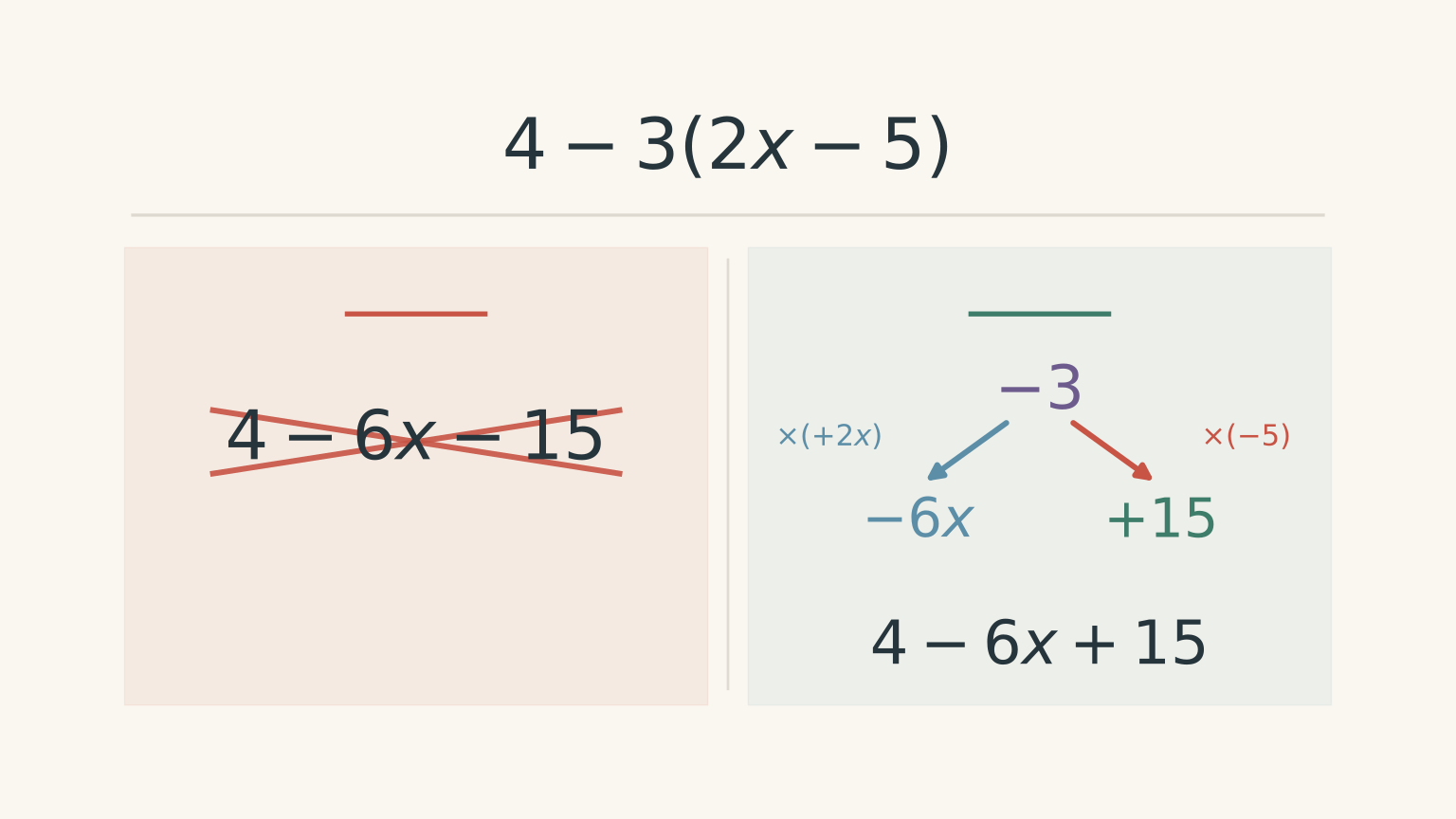
\[ 4-3(2x-5)=2x+7 \]
A student writes:
\[ 4-6x-15=2x+7 \]
They then obtain
\[ -8x=18 \]
\[ x=-\frac94 \]
Find the correct solution and identify the mistake.
Step 1
The outside multiplier is \(-3\).
Multiplying each term gives
\[ -3(2x-5)=-6x+15 \]
The constant term is positive because
\[ (-3)(-5)=+15 \]
Step 2
\[ 4-6x+15=2x+7 \]
Collect the constant terms:
\[ 19-6x=2x+7 \]
Step 3
\[ 19-7=2x+6x \]
\[ 12=8x \]
Therefore,
\[ \boxed{x=\frac32} \]
Step 4
For \(x=\frac32\), the left-hand side is
\[ 4-3(3-5) \]
\[ =4-3(-2) \]
\[ =10 \]
The right-hand side is
\[ 2\left(\frac32\right)+7=10 \]
Both sides agree, so the solution is correct.
Due to technical limitations, this figure may display incorrectly or contain inaccuracies. Please check key details against your course materials.
A quick way to catch sign errors
You can sometimes check an expansion without solving the entire equation.
Take the original left-hand side:
\[ 4-3(2x-5) \]
Now substitute \(x=0\):
\[ 4-3(-5)=19 \]
The expanded expression should produce the same result:
\[ 4-6(0)+15=19 \]
But the student’s incorrect expression gives
\[ 4-6(0)-15=-11 \]
The two expressions disagree immediately.
This is called a substitution check. It doesn’t prove that two expressions are identical, but it can quickly expose an incorrect expansion.
Make sign checking a habit
Whenever you encounter any of these operations, slow down slightly:
- Expanding a negative bracket.
- Subtracting an expression containing multiple terms.
- Rearranging an equation.
- Multiplying or dividing an inequality by a negative number.
- Differentiating or integrating expressions with negative coefficients.
For inequalities, remember that multiplying or dividing both sides by a negative number reverses the inequality sign.
For example,
\[ -2x>6 \]
Dividing by \(-2\) gives
\[ x<-3 \]
not \(x>-3\).
The aim isn’t to calculate slowly. It’s to recognise the steps where a small sign error is most likely.
03Check domain restrictions before accepting an answer
This is one of the most important checks in HSC Mathematics Advanced.
A student can perform every algebraic step correctly, solve an equation, and still accept an invalid answer.
Why?
Because some algebraic operations change the set of possible solutions.
Before solving, you need to know which values are allowed in the original expression.
This set of allowed inputs is called the domain.
Three common restrictions are worth remembering:
| Expression | Restriction |
|---|---|
| \(\frac{1}{f(x)}\) | \(f(x)\ne 0\) |
| \(\sqrt{f(x)}\) | \(f(x)\geq 0\) |
| \(\ln(f(x))\) | \(f(x)>0\) |
These restrictions are not optional. They are part of the original question.
Why algebra can introduce invalid solutions
Consider what happens when you square both sides of an equation.
If
\[ a=b \]
then
\[ a^2=b^2 \]
must also be true.
However, the reverse is not always true.
For example,
\[ 3^2=(-3)^2 \]
Both sides are equal, but \(3\ne -3\).
Squaring can therefore introduce solutions that weren’t valid in the original equation.
The same issue appears when cancelling factors, dividing by expressions, and combining logarithms without checking their domains.
Worked example: Finding an extraneous solution
Solve
\[ \sqrt{2x+3}=x-1 \]
Step 1
The square root requires
\[ 2x+3\geq 0 \]
Therefore,
\[ x\geq-\frac32 \]
There is another important condition.
The left-hand side is a square root, so it cannot be negative. Therefore, the right-hand side must also be non-negative:
\[ x-1\geq0 \]
Hence,
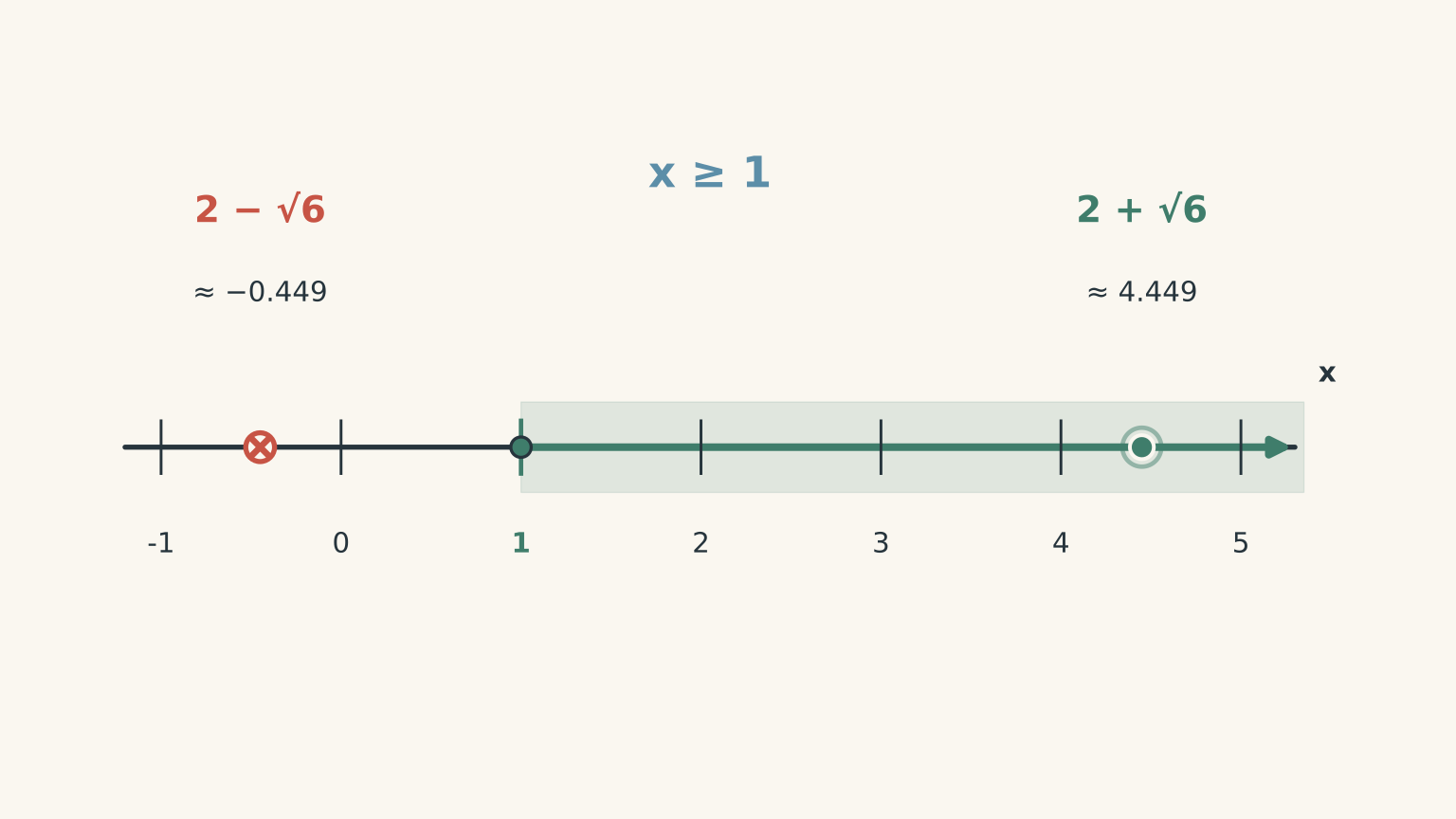
\[ \boxed{x\geq1} \]
This is the restriction we must preserve.
Step 2
\[ 2x+3=(x-1)^2 \]
Expand:
\[ 2x+3=x^2-2x+1 \]
Rearrange:
\[ x^2-4x-2=0 \]
Step 3
Using the quadratic formula,
\[ x=\frac{4\pm\sqrt{16+8}}{2} \]
\[ x=\frac{4\pm\sqrt{24}}{2} \]
Therefore,
\[ x=2\pm\sqrt6 \]
At this point, you have two candidates.
Step 4
We established that \(x\geq1\).
The first solution is
\[ x=2-\sqrt6\approx-0.449 \]
This is not allowed.
The second solution is
\[ x=2+\sqrt6\approx4.449 \]
This satisfies the restriction.
Step 5
For \(x=2+\sqrt6\), the right-hand side becomes
\[ x-1=1+\sqrt6 \]
The left-hand side becomes
\[ \sqrt{7+2\sqrt6} \]
Since
\[ (1+\sqrt6)^2=7+2\sqrt6 \]
and \(1+\sqrt6\) is positive, the two sides are equal.
Therefore, the final answer is
\[ \boxed{x=2+\sqrt6} \]
The tempting mistake here is to accept both quadratic roots because both solve the equation obtained after squaring.
But the squared equation is not equivalent to the original equation in both directions. It can contain extra solutions.
The original equation is always the final test.
Due to technical limitations, this figure may display incorrectly or contain inaccuracies. Please check key details against your course materials.
Four restrictions to remember
Before manipulating an expression, ask:
- Fractions: Could a denominator equal zero?
- Square roots: Is the expression inside the root non-negative?
- Logarithms: Is the argument strictly positive?
- Specified intervals: Does the question restrict the possible values of \(x\), such as \(0\leq x\leq2\pi\)?
Also be careful when dividing by an expression involving \(x\).
If you divide by \(x-2\), for example, you must consider the possibility that \(x=2\). If that value could solve the original equation, check it separately before dividing.
When cancelling a factor from a fraction, retain any values excluded by the original denominator.
The checking rule: Write your restrictions before solving, then test every candidate against the original equation and its original conditions.
04Check your calculator entry, not just your calculator answer
Your calculator can perform calculations extremely accurately and still give you the wrong answer.
It doesn’t know what you intended to type. It only evaluates the expression you entered.
The most common problems involve:
- Missing brackets.
- Incorrect fraction entry.
- Negative signs entered incorrectly.
- Powers attached to the wrong terms.
- Incorrect degree or radian mode.
- Using a previous stored answer accidentally.
Worked example: Entering the quadratic formula correctly
Solve
\[ 3x^2-2x-1=0 \]
using the quadratic formula.
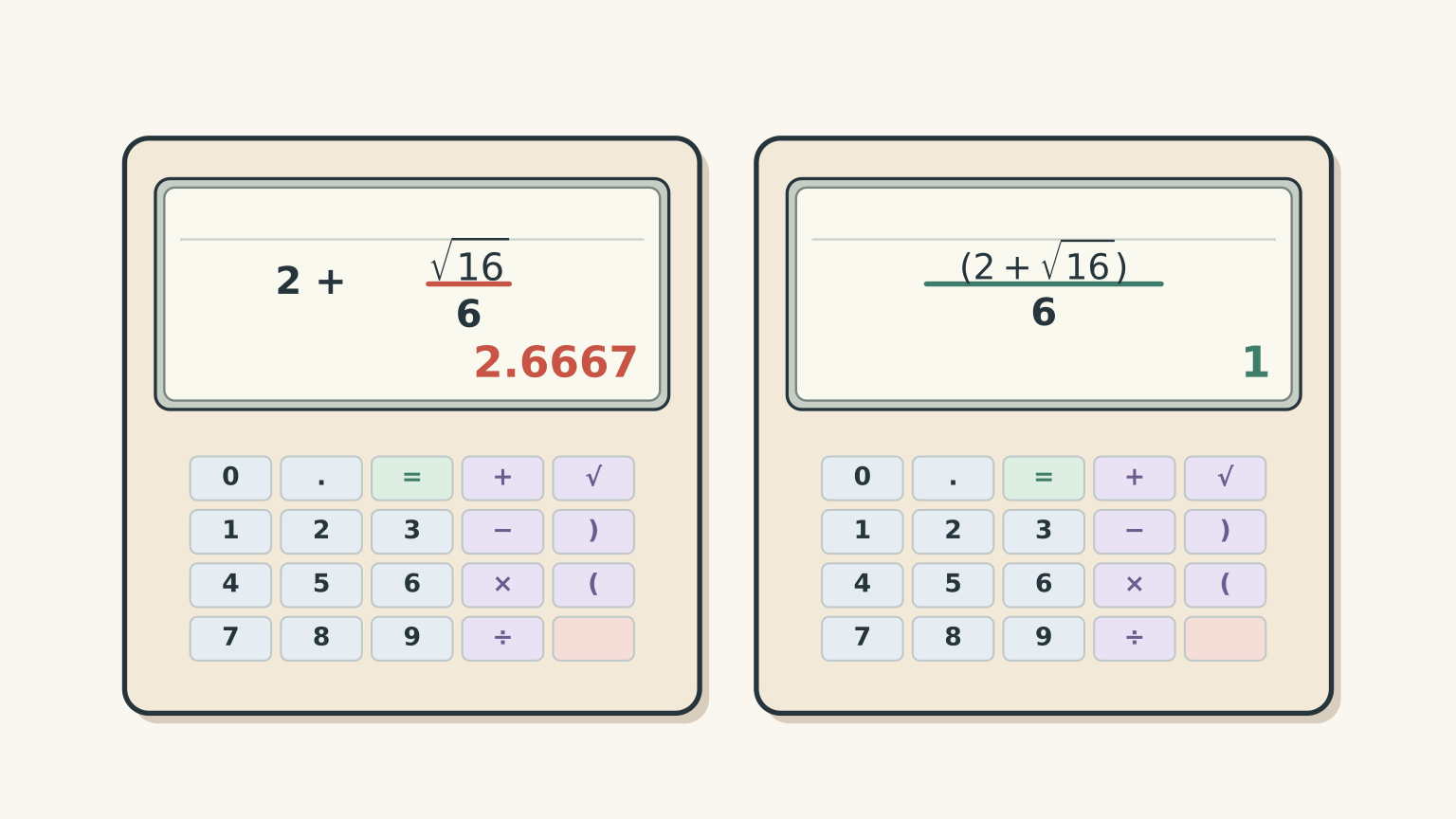
A student identifies the coefficients correctly but enters the positive solution as:
2 + sqrt(16) / 6
Their calculator displays approximately \(2.6667\).
What went wrong?
Step 1
Comparing with
\[ ax^2+bx+c=0 \]
gives
\[ a=3,\qquad b=-2,\qquad c=-1 \]
Step 2
\[ x=\frac{-b\pm\sqrt{b^2-4ac}}{2a} \]
Substituting:
\[ x=\frac{2\pm\sqrt{4-4(3)(-1)}}{6} \]
Therefore,
\[ x=\frac{2\pm\sqrt{16}}{6} \]
Step 3
For the positive solution, the correct calculator entry is:
(2 + sqrt(16)) / 6
The brackets around the numerator are essential.
Without them, the calculator interprets the original entry as
\[ 2+\frac{\sqrt{16}}{6} \]
rather than
\[ \frac{2+\sqrt{16}}{6} \]
These are different calculations.
Step 4
\[ x=\frac{2+4}{6}=1 \]
and
\[ x=\frac{2-4}{6}=-\frac13 \]
Therefore,
\[ \boxed{x=1\quad\text{or}\quad x=-\frac13} \]
Step 5
The original equation can be factorised:
\[ 3x^2-2x-1=(3x+1)(x-1) \]
Setting each factor equal to zero gives
\[ x=-\frac13,\qquad x=1 \]
Both methods agree.
Due to technical limitations, this figure may display incorrectly or contain inaccuracies. Please check key details against your course materials.
The calculator-entry checklist
Before pressing equals, check the following.
1. Brackets
If your written expression contains a fraction, enter the entire numerator and denominator with brackets.
For example,
\[ \frac{a+b}{c-d} \]
should be entered as
(a+b)/(c-d)
not as an unbracketed sequence of operations.
2. Negative numbers
If your calculator distinguishes between a negative-number key and a subtraction key, use the correct one.
For example, entering \((-3)^2\) requires the negative number to be grouped before squaring.
3. Powers
Check exactly which term is being squared or raised to a power.
For example,
\[ (-2x)^2=4x^2 \]
but
\[ -2x^2 \]
is a different expression.
4. Degree and radian mode
This is especially important in trigonometry.
If the question uses degrees, your calculator should be in degree mode. If it uses radians, use radian mode.
For example,
\[ \sin(30^\circ)=0.5 \]
Entering \(30\) while the calculator is in radian mode gives a completely different result.
5. Stored answers
Be careful when using the previous-answer function. Make sure the stored value is the one you actually intend to use.
6. The displayed expression
If your calculator displays the complete expression, read it before evaluating.
Compare it with the expression in your written working. Don’t just check the final decimal.
A calculator is a tool for evaluating mathematics, not a replacement for checking the mathematics itself.
05A checking routine you can use in every exam
You don’t have unlimited time in an HSC examination, so checking needs to be efficient.
You shouldn’t spend two minutes redoing an entire question when a ten-second check would catch the problem.
Use this routine at the relevant stages of your working.
Before you start
- Read the question carefully.
- Copy the equation or function accurately.
- Circle negative inputs and coefficients.
- Underline any domain restrictions or specified intervals.
While solving
- Expand negative brackets one term at a time.
- Check signs when moving terms across an equation.
- Preserve restrictions when cancelling or dividing.
- Check that each algebraic transformation is valid.
When using your calculator
- Group numerators and denominators with brackets.
- Check negative signs and powers.
- Confirm degree or radian mode.
- Read the displayed expression before evaluating.
Before moving on
- Substitute your answer into the original equation.
- Check that it satisfies the original domain.
- Check that it falls within the specified interval.
- Make sure you’ve answered exactly what the question asks.
Not every question requires every check. A straightforward differentiation question might not involve domain restrictions, while a logarithmic equation certainly does.
The goal is to apply the relevant check at the point where an error could enter.
07Questions and solutions
Try these three questions without looking at the solutions first. Each contains a deliberately flawed piece of working. Your job is to identify the error, explain why it matters, and produce the correct answer.
Question 1
A function is defined by
\[ h(t)=\frac{t^2+3t}{t-2} \]
A student is asked to calculate \(h(-1)\) and writes
\[ h(-1)=\frac{(-1)^2+3(1)}{-1-2} \]
They obtain
\[ h(-1)=-\frac43 \]
Identify the first mistake and calculate the correct value.
Solution 1
The correct answer is
\[ \boxed{h(-1)=\frac23} \]
The student has lost the negative sign when substituting \(t=-1\) into the middle term.
Step 1: Substitute \(t=-1\) into every occurrence of \(t\).
The correct expression is
\[ h(-1)=\frac{(-1)^2+3(-1)}{-1-2} \]
Step 2: Simplify the numerator and denominator.
\[ =\frac{1-3}{-3} \]
\[ =\frac{-2}{-3} \]
Therefore,
\[ \boxed{h(-1)=\frac23} \]
The important lesson is that the substitution must be consistent throughout the entire expression. Changing the sign in even one term changes the result.
Question 2
Solve the equation
\[ \ln(x-1)+\ln(x+2)=\ln8 \]
A student uses the logarithm addition rule and obtains
\[ x=\frac{-1\pm\sqrt{41}}{2} \]
They accept both solutions.
Explain why one solution must be rejected and determine the valid answer.
Solution 2
Only one solution is valid:
\[ \boxed{x=\frac{-1+\sqrt{41}}{2}} \]
The student has solved the resulting quadratic correctly but forgotten the domain restrictions of the original logarithms.
Step 1: Establish the domain.
For the first logarithm,
\[ x-1>0 \]
Therefore,
\[ x>1 \]
For the second logarithm,
\[ x+2>0 \]
Therefore,
\[ x>-2 \]
Both conditions must be satisfied simultaneously.
Combining them gives
\[ \boxed{x>1} \]
Step 2: Apply the logarithm addition rule.
\[ \ln[(x-1)(x+2)]=\ln8 \]
Since the logarithms are equal, their arguments must be equal:
\[ (x-1)(x+2)=8 \]
Expand:
\[ x^2+x-2=8 \]
Rearrange:
\[ x^2+x-10=0 \]
Step 3: Solve using the quadratic formula.
\[ x=\frac{-1\pm\sqrt{1+40}}{2} \]
Therefore,
\[ x=\frac{-1\pm\sqrt{41}}{2} \]
Step 4: Apply the original domain restriction.
The two approximate values are
\[ x\approx2.702 \]
and
\[ x\approx-3.702 \]
The second value does not satisfy \(x>1\).
Therefore, it cannot be substituted into the original logarithmic equation.
The only valid solution is
\[ \boxed{x=\frac{-1+\sqrt{41}}{2}} \]
This is a good example of why solving an equation and finding a valid solution are not always the same thing.
Question 3
Solve
\[ 2\sin x=1 \]
for
\[ 0^\circ\leq x\leq360^\circ \]
A student uses the inverse sine function on their calculator while it is in radian mode.
They obtain
\[ x=0.5236 \]
and write this as their only solution.
Identify both problems with this answer and find all valid solutions.
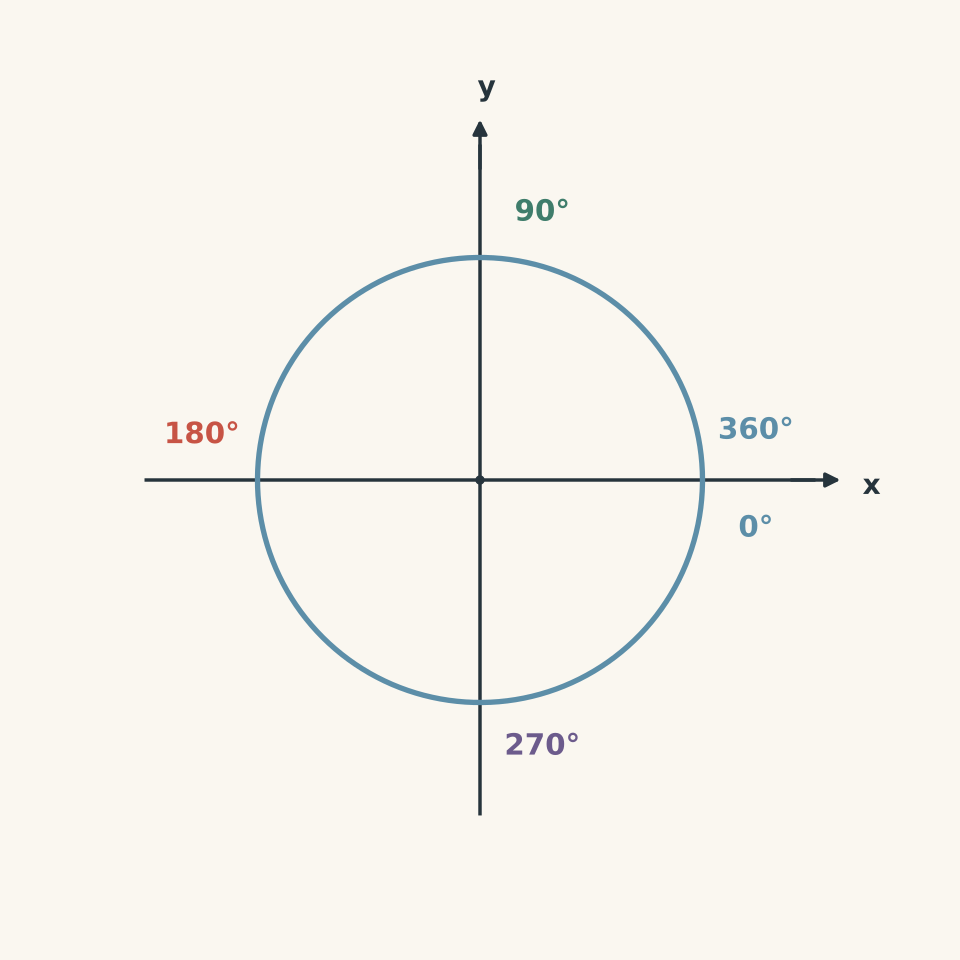
Due to technical limitations, this figure may display incorrectly or contain inaccuracies. Please check key details against your course materials.
Solution 3
The correct solutions are
\[ \boxed{x=30^\circ,\quad x=150^\circ} \]
The student has made two mistakes:
- They have not converted their calculator result from radians to degrees.
- They have only found the principal inverse sine value, rather than all solutions within the specified interval.
Step 1: Rearrange the equation.
\[ 2\sin x=1 \]
Therefore,
\[ \sin x=\frac12 \]
Step 2: Find the principal angle.
The inverse sine of \(\frac12\) is
\[ \sin^{-1}\left(\frac12\right)=0.5236 \]
in radian mode.
Converting to degrees gives
\[ 0.5236\times\frac{180^\circ}{\pi} \approx30^\circ \]
So the first solution is
\[ x=30^\circ \]
Step 3: Find the remaining solutions.
Sine is positive in the first and second quadrants.
The second solution is therefore
\[ x=180^\circ-30^\circ \]
\[ x=150^\circ \]
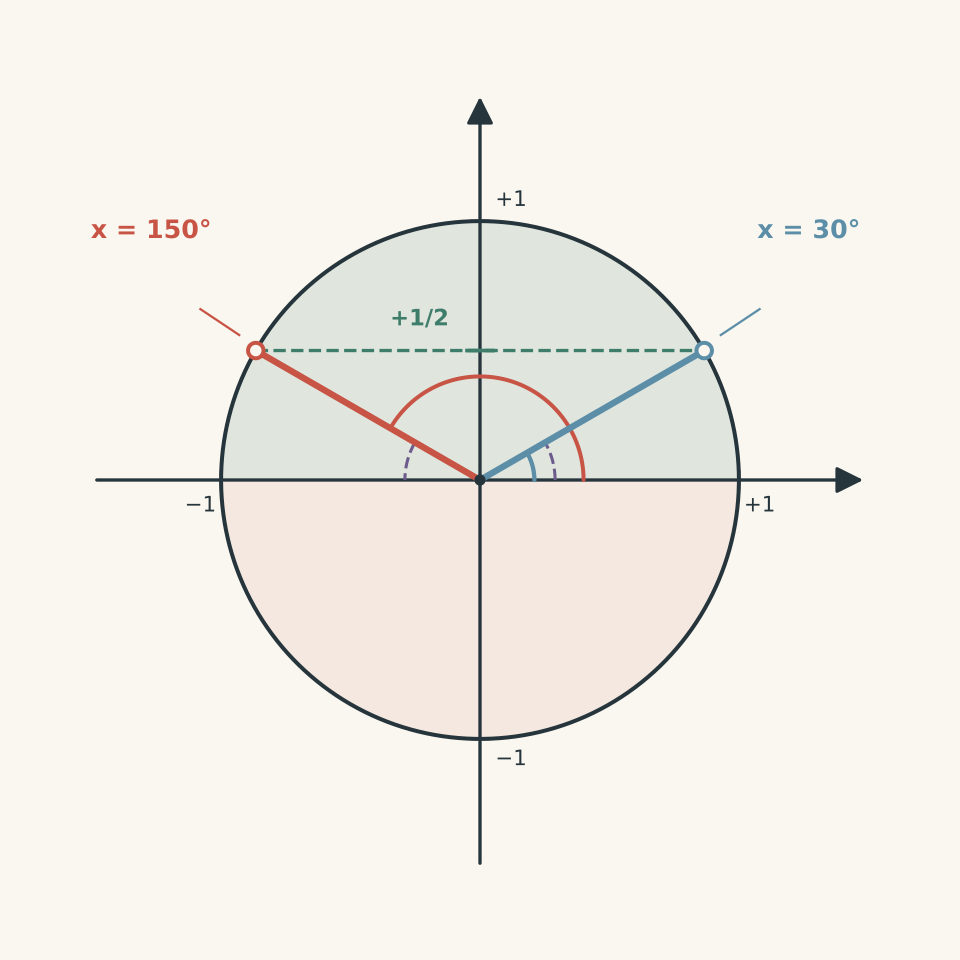
Due to technical limitations, this figure may display incorrectly or contain inaccuracies. Please check key details against your course materials.
Step 4: Check the specified interval.
Both solutions satisfy
\[ 0^\circ\leq x\leq360^\circ \]
There are no other solutions in this interval.
Therefore,
\[ \boxed{x=30^\circ,\quad x=150^\circ} \]
The important distinction is that the inverse sine button gives a principal angle. It does not automatically list every solution of a trigonometric equation over a specified interval.
Always check the calculator’s angle mode and the interval in the question.
08One final habit that makes checking more effective
When you finish a practice paper or assessment, don’t just write down that you made a careless mistake.
Identify the exact point where the error entered.
Was it:
- A negative sign that disappeared during substitution?
- A bracket that was expanded incorrectly?
- A restriction that wasn’t written down?
- A missing bracket in your calculator input?
Record repeated patterns in your error log, then use the relevant check deliberately in your next set of questions.
Over time, you’ll become quicker at recognising which lines need extra attention.
Once these four checks become part of your normal working, the next skill to develop is checking whether your mathematical steps are logically reversible. That means knowing not just whether an answer works, but whether your method has preserved every possible solution along the way.
That distinction becomes particularly important in more demanding HSC questions involving logarithms, equations, functions, and calculus.
Syllabus note (15 November 2026): NESA lists the 2017 Mathematics Advanced Stage 6 syllabus as having its final HSC examination in 2026. The 2024 Mathematics Advanced 11-12 syllabus is being implemented from 2026, with its first HSC examination in 2027. The checking strategies in this guide apply across both cohorts. For course-specific content, follow the syllabus relevant to your year group. See NESA’s senior syllabus list and the 2024 Mathematics Advanced syllabus overview.