
How to Organise HSC Chemistry Notes by Reactions, Evidence and Calculations
Learn how to organise HSC Chemistry notes into connected reaction, evidence, and calculation records. Includes a worked miniature note set, practical examples, and a revision system to help you retrieve information and apply it to exam questions.
You can have 40 pages of HSC Chemistry notes and still struggle with a question that asks you to explain an observation, identify the reaction responsible, and calculate an unknown concentration. The problem isn’t necessarily that you’ve forgotten the content. It might be that your notes have separated three things that belong together.
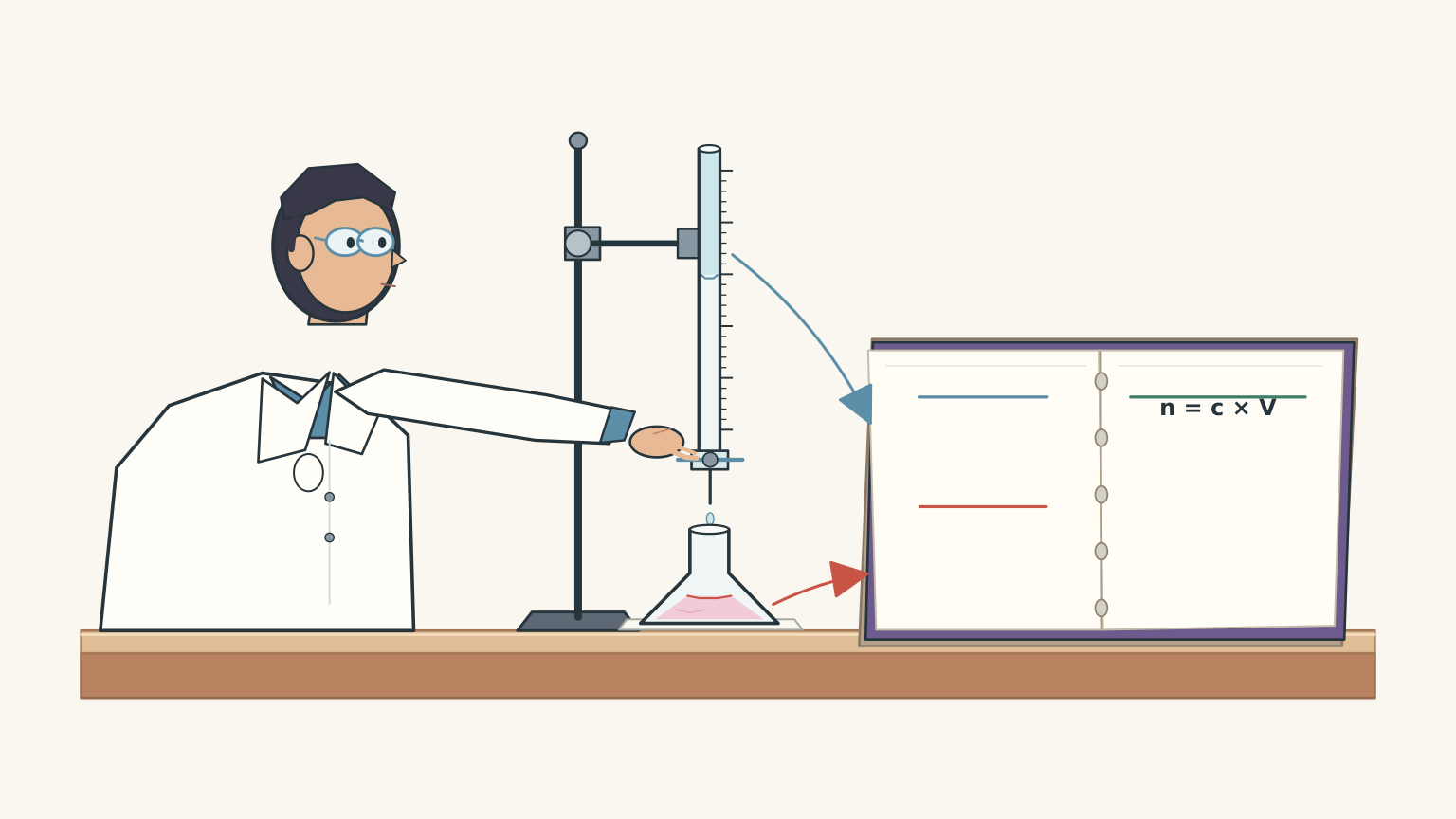
A useful Chemistry note system connects reactions, evidence, and calculations. Instead of keeping equations in one section, experimental observations in another, and mathematical methods somewhere else, organise them so you can move between all three when answering a question.
The aim is simple: when you encounter an unfamiliar question, you should know what information to retrieve, which chemical principles apply, and how to turn the evidence into a justified answer.
Due to technical limitations, this figure may display incorrectly or contain inaccuracies. Please check key details against your course materials.
01The three-part system for HSC Chemistry notes
Think about what an HSC Chemistry question might ask you to do.
- Identify the products of a reaction and explain why they form.
- Describe experimental observations and explain what they indicate.
- Calculate an unknown quantity using experimental measurements.
- Evaluate whether experimental evidence supports a chemical conclusion.
These questions require different kinds of knowledge, but they often involve the same chemical system.
For example, an acid-base titration involves a chemical reaction, an observable indicator colour change, and a calculation using concentration and volume.
If you study these separately, you have to reconstruct their connections during an exam. If you organise them together, those connections are already familiar.
Use three linked types of notes:
| Note type | What it answers | What to include |
|---|---|---|
| Reaction notes | What chemical change occurs? | Balanced equations, conditions, reactants, products, and stoichiometric ratios |
| Evidence notes | What tells us the reaction occurred? | Observations, experimental methods, data, inferences, and limitations |
| Calculation notes | How do we quantify the change? | Relevant equations, units, worked examples, and assumptions |
The reaction record acts as the hub, with evidence and calculations connected to it. However, the same evidence method or calculation technique can support several different reactions.
Due to technical limitations, this figure may display incorrectly or contain inaccuracies. Please check key details against your course materials.
1. Reaction notes: understand what changes
Start with the chemical reaction itself.
For each important reaction, record:
- The balanced chemical equation, including state symbols.
- The reactants and products.
- The reaction conditions, including temperature, catalysts, or other relevant requirements.
- The reaction type.
- Any important net ionic equation.
- The mole ratios between reacting species.
- A common misconception or mistake associated with the reaction.
Don’t just copy an equation and move on.
You should be able to explain what the equation represents. For example, a balanced equation tells you the relative numbers of particles involved in the reaction. Its coefficients also provide the mole ratios needed for quantitative calculations.
Consider the neutralisation reaction between hydrochloric acid and sodium hydroxide:
\[ \ce{HCl(aq) + NaOH(aq) -> NaCl(aq) + H2O(l)} \]
The equation tells us that one mole of hydrochloric acid reacts with one mole of sodium hydroxide.
The net ionic equation is:
\[ \ce{H+(aq) + OH-(aq) -> H2O(l)} \]
This shows the actual chemical change involving the hydrogen and hydroxide ions. The sodium and chloride ions remain in solution as spectator ions.
Your reaction notes should capture both the overall reaction and the underlying chemical change where relevant.
2. Evidence notes: distinguish observations from explanations
This is where many students lose useful information.
Writing that a reaction produces a precipitate is not the same as explaining how you know a particular substance has formed.
Separate three things:
- Observation: What did you actually see or measure?
- Inference: What does that observation suggest?
- Limitation: What can the observation not establish on its own?
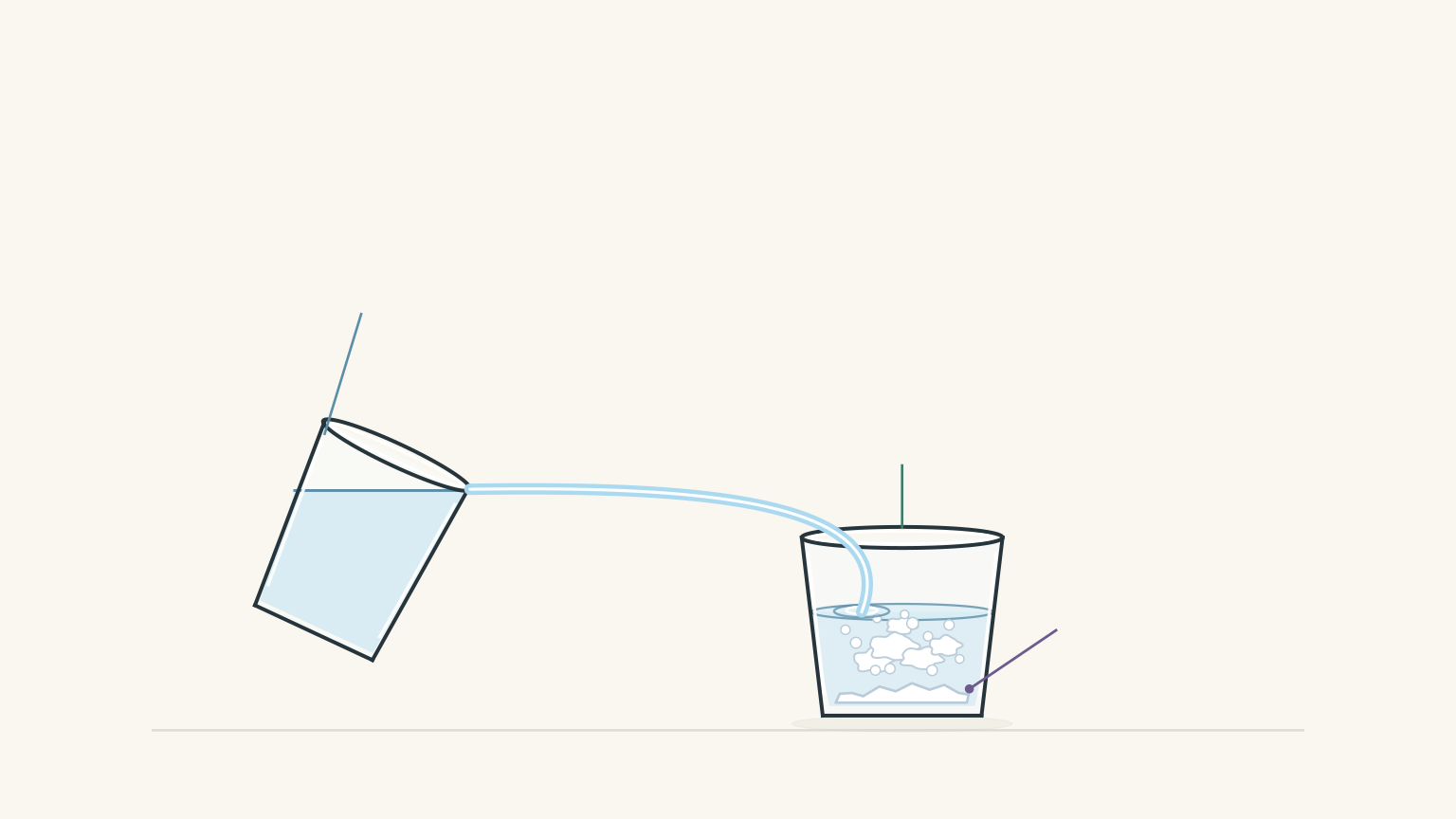
For example, mixing aqueous silver nitrate and sodium chloride produces a white solid.
Due to technical limitations, this figure may display incorrectly or contain inaccuracies. Please check key details against your course materials.
A useful evidence record would look like this:
| Category | Note |
|---|---|
| Observation | A white precipitate forms when the solutions are mixed. |
| Chemical explanation | Insoluble silver chloride forms. |
| Relevant equation | \(\ce{Ag+(aq) + Cl-(aq) -> AgCl(s)}\) |
| Inference | The observation is consistent with the formation of silver chloride. |
| Limitation | A white precipitate alone does not uniquely identify the ions present. |
Notice the difference between the first and fourth rows.
The observation is what you can directly report. The inference is the chemical explanation you draw from it.
This distinction becomes particularly important in questions involving experimental reliability, validity, and the strength of evidence.
A strong evidence record should also include the experimental method. Record relevant details such as:
- The equipment used.
- The quantities and concentrations of solutions.
- The temperature and other controlled conditions.
- How measurements were taken.
- Any potential sources of uncertainty or error.
Don’t write vague observations such as “the solution changed”. Record the actual change, including colour, temperature, gas formation, or precipitate formation where relevant.
3. Calculation notes: organise methods around the information given
Calculation notes should help you recognise which mathematical relationship applies to a question.
A page containing ten formulas isn’t particularly useful if you don’t know when to use them.
For each calculation method, record:
- The type of question it answers.
- The information usually provided.
- The relevant equation.
- The units required.
- A complete worked example.
- A common mistake.
- A quick check for whether your answer is reasonable.
For example, if a question gives concentration and volume and asks for the amount of substance, you should recognise the relationship:
\[ n=cV \]
where:
- \(n\) is the amount of substance, measured in moles (mol).
- \(c\) is concentration, measured in mol L\(^{-1}\).
- \(V\) is solution volume, measured in litres (L).
A common mistake is substituting a volume in millilitres without converting it to litres.
Your calculation notes should make that requirement obvious.
02A worked miniature note set: acid-base titration
Let’s put the three types of notes together.
Suppose you are investigating the concentration of an unknown hydrochloric acid solution using a standard sodium hydroxide solution.
The experimental arrangement is as follows:
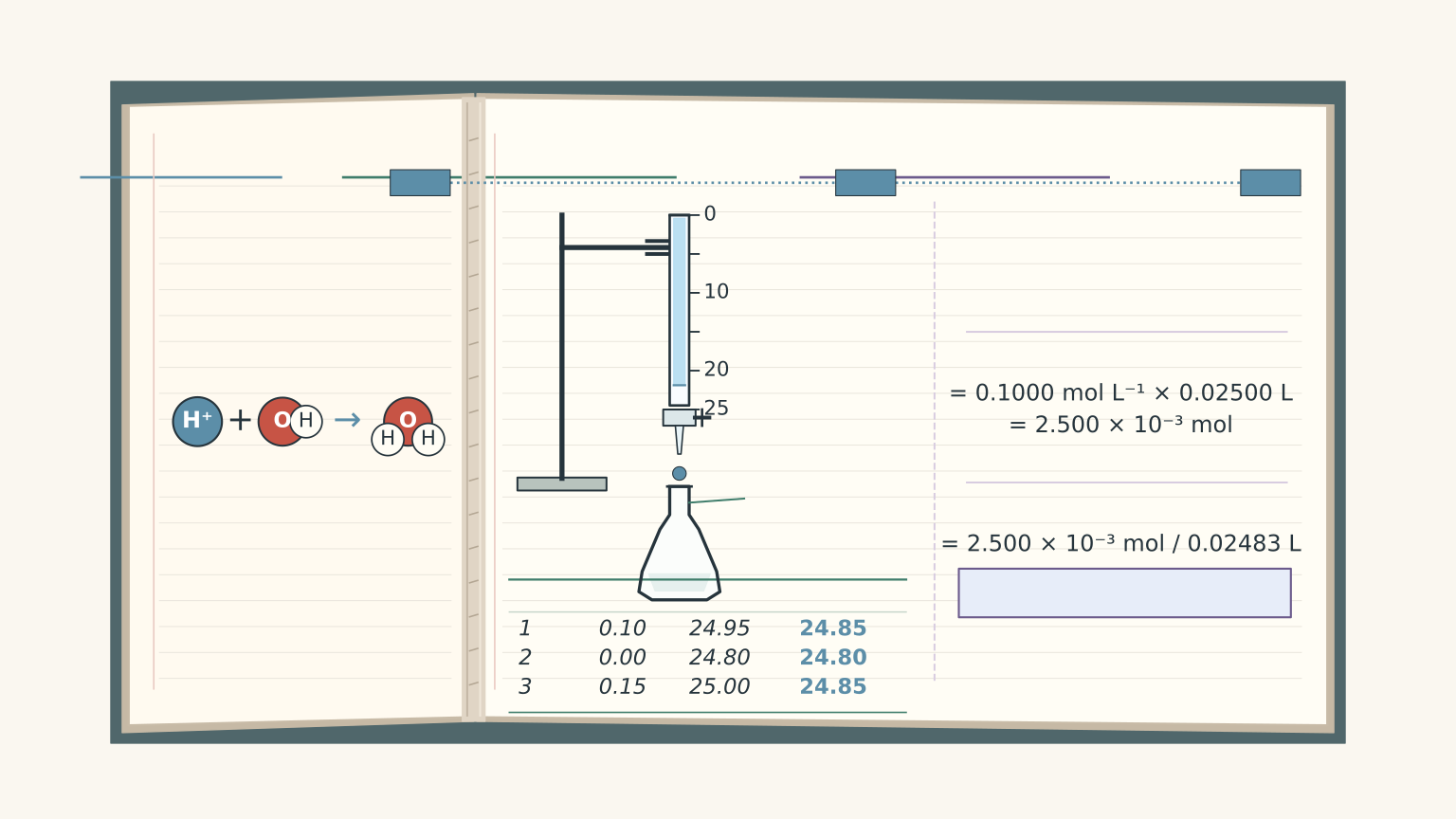
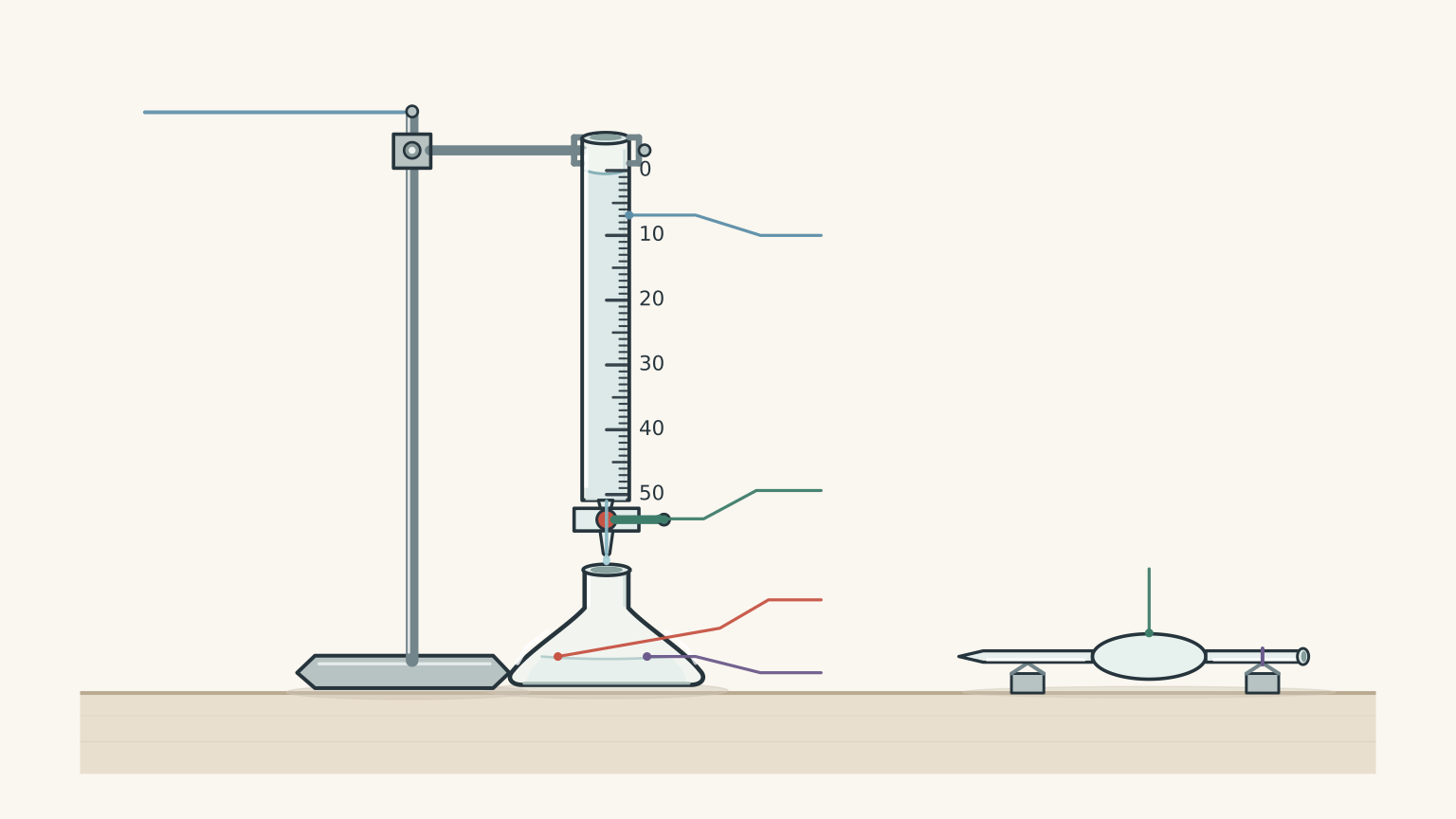
- A 25.00 mL sample of hydrochloric acid is measured into a conical flask using a pipette.
- Phenolphthalein indicator is added to the flask.
- A burette contains sodium hydroxide solution with a known concentration of 0.1000 mol L\(^{-1}\).
- The average titre is 24.60 mL.
The endpoint is identified by the first faint pink colour that persists for approximately 30 seconds.
Due to technical limitations, this figure may display incorrectly or contain inaccuracies. Please check key details against your course materials.
Reaction record R-01: Neutralisation
Reaction:
\[ \ce{HCl(aq) + NaOH(aq) -> NaCl(aq) + H2O(l)} \]
Reaction type: Acid-base neutralisation.
Net ionic equation:
\[ \ce{H+(aq) + OH-(aq) -> H2O(l)} \]
Important relationship:
\[ n(\ce{HCl}):n(\ce{NaOH})=1:1 \]
Conditions: Aqueous solutions reacting at approximately constant laboratory temperature.
Important exam connection: The balanced equation provides the mole ratio required to determine the unknown acid concentration.
Evidence record E-01: Titration endpoint
Observation: The indicator changes from colourless to faint pink, with the colour persisting for approximately 30 seconds.
Method: Sodium hydroxide is gradually added from a burette to a measured hydrochloric acid sample.
Evidence: The indicator colour change provides an observable signal that the titration endpoint has been reached.
Interpretation: The endpoint is used to estimate the equivalence point, where the acid and base have reacted in their stoichiometric proportions.
Limitation: The endpoint is an experimental indicator signal, not a direct measurement of the exact mole quantities. A suitable indicator is selected so its colour-change range lies within the steep pH change around the equivalence point.
Data: Mean titre = 24.60 mL.
This is much more useful than simply writing “phenolphthalein turns pink”.
Calculation record C-01: Finding an unknown concentration
Question type: Determine the concentration of an acid using titration data.
Relevant relationships:
\[ n=cV \]
\[ c=\frac{n}{V} \]
Method:
- Write the balanced chemical equation.
- Calculate the moles of the known solution.
- Use the mole ratio to calculate the moles of the unknown substance.
- Calculate the unknown concentration.
- Check units and significant figures.
Now let’s complete the calculation.
Worked example 1: Calculate the hydrochloric acid concentration
A 25.00 mL sample of hydrochloric acid is titrated with 0.1000 mol L\(^{-1}\) sodium hydroxide. The average titre is 24.60 mL. Calculate the concentration of the hydrochloric acid.
Step 1
\[ \ce{HCl + NaOH -> NaCl + H2O} \]
The mole ratio between hydrochloric acid and sodium hydroxide is 1:1.
Step 2
\[ V=24.60\text{ mL}=0.02460\text{ L} \]
Step 3
Using \(n=cV\):
\[ \begin{aligned} n(\ce{NaOH})&=0.1000\times0.02460\\ &=0.002460\text{ mol} \end{aligned} \]
Step 4
The reaction has a 1:1 mole ratio, so:
\[ n(\ce{HCl})=0.002460\text{ mol} \]
Step 5
The original acid volume was 25.00 mL, or 0.02500 L.
\[ \begin{aligned} c&=\frac{n}{V}\\ &=\frac{0.002460}{0.02500}\\ &=0.09840\text{ mol L}^{-1} \end{aligned} \]
Final answer:
\[ \boxed{c(\ce{HCl})=0.09840\text{ mol L}^{-1}} \]
The unknown hydrochloric acid concentration is 0.09840 mol L\(^{-1}\).
Notice how the calculation depended on the reaction notes. Without the balanced equation, you wouldn’t know whether to use a 1:1 mole ratio or a different relationship.
The evidence notes explain how the experimental endpoint was identified, while the calculation notes explain how the measured titre produces a numerical concentration.
That’s the connection you want your notes to preserve.
03Make the system work for different types of reactions
The titration example is useful, but the same structure applies to precipitation, redox, equilibrium, and other chemical systems.
The key is to keep the three records connected without forcing every reaction into an identical calculation method.
Worked example 2: Determine the limiting reactant and precipitate mass
Consider a mixture containing:
- 25.0 mL of 0.100 mol L\(^{-1}\) silver nitrate.
- 30.0 mL of 0.0800 mol L\(^{-1}\) sodium chloride.
The solutions are mixed, and a white precipitate forms.
Calculate the limiting reactant and the theoretical mass of silver chloride produced. Assume the reaction proceeds to completion.
Step 1
\[ \ce{AgNO3(aq) + NaCl(aq) -> AgCl(s) + NaNO3(aq)} \]
The mole ratio between silver nitrate and sodium chloride is 1:1.
Step 2
For silver nitrate:
\[ \begin{aligned} n(\ce{AgNO3})&=cV\\ &=0.100\times0.0250\\ &=0.00250\text{ mol} \end{aligned} \]
For sodium chloride:
\[ \begin{aligned} n(\ce{NaCl})&=cV\\ &=0.0800\times0.0300\\ &=0.00240\text{ mol} \end{aligned} \]
Step 3
The reaction requires equal numbers of moles of silver nitrate and sodium chloride.
However, only 0.00240 mol of sodium chloride is available, compared with 0.00250 mol of silver nitrate.
Therefore, sodium chloride is the limiting reactant.
Step 4
The balanced equation gives a 1:1 mole ratio between sodium chloride and silver chloride.
Therefore:
\[ n(\ce{AgCl})=0.00240\text{ mol} \]
Step 5
The molar mass of silver chloride is 143.32 g mol\(^{-1}\).
Using \(m=nM\), where \(m\) is mass and \(M\) is molar mass:
\[ \begin{aligned} m(\ce{AgCl})&=0.00240\times143.32\\ &=0.343968\text{ g}\\ &=0.344\text{ g} \end{aligned} \]
Final answer:
\[ \boxed{m(\ce{AgCl})=0.344\text{ g}} \]
Sodium chloride is the limiting reactant, and the theoretical yield of silver chloride is 0.344 g.
The important point is that the white precipitate is experimental evidence of an insoluble product, while the mass calculation depends on the balanced equation and the limiting reactant.
These are different pieces of information, but they belong to the same reaction record.
Your notes could now contain:
| Record | Information |
|---|---|
| R-02: Reaction | Silver nitrate reacts with sodium chloride to form silver chloride and sodium nitrate. |
| E-02: Evidence | A white precipitate forms. |
| C-02: Calculation | Sodium chloride is limiting; theoretical AgCl mass is 0.344 g. |
This is how you make notes that can be retrieved from several different question angles.
04How to organise your actual notebook or digital notes
You don’t need an elaborate filing system. A paper notebook, a set of digital documents, or a simple folder structure can all work.
What matters is that you can find the relevant information quickly.
A practical structure is:
| Section | Purpose |
|---|---|
| 00 – Syllabus index | Map each topic to your course content. |
| 01 – Reaction index | Store balanced equations, conditions, and reaction types. |
| 02 – Evidence index | Store observations, practical methods, and interpretations. |
| 03 – Calculation index | Store mathematical methods and worked examples. |
| 04 – Mistake log | Record errors from practice questions and how to correct them. |
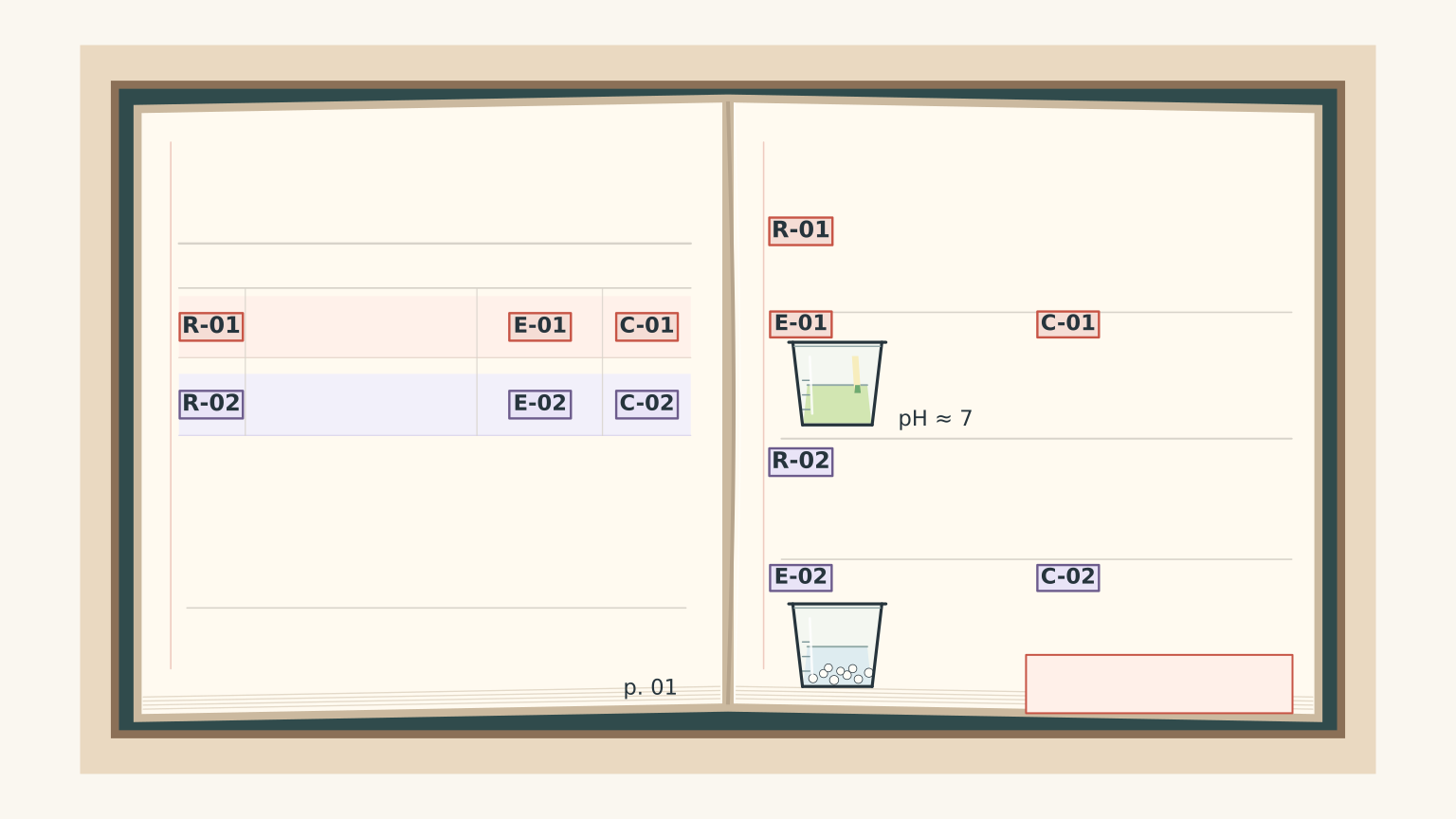
Give each reaction a reference code.
For example:
- R-01: Acid-base neutralisation.
- R-02: Precipitation reactions.
- R-03: Relevant redox reaction.
- R-04: Relevant equilibrium reaction.
Then connect the corresponding evidence and calculation records.
A single reaction might have several evidence records or calculation methods. That’s fine. You don’t need to force everything onto one page.
The purpose of the reference codes is to make those connections easy to follow.
Due to technical limitations, this figure may display incorrectly or contain inaccuracies. Please check key details against your course materials.
Keep organic chemistry pathways in their own reference
Organic chemistry has a different organisational challenge.
One organic compound can undergo several reactions, producing different products depending on the reagents and conditions.
Trying to reproduce every pathway in a general reaction-and-evidence notebook creates unnecessary duplication.
Keep the detailed organic reaction pathways, reagents, conditions, and product relationships in your existing organic-reaction reference.
Instead, add a short reaction index entry that links to the relevant organic chemistry reference. This keeps the overall note system connected without making you maintain two copies of the same information.
Keep detailed calculation explanations where they already belong
You also don’t need to rewrite every calculation resource into this system.
Your calculation index should tell you when a method applies and where to find a complete explanation.
For example:
- For equilibrium calculations and predicting reaction direction, use Keq Calculations and Reaction Direction | HSC Chemistry.
- For concentration changes when diluting a solution, use Solution dilution calculations for HSC Chemistry.
- For energy calculations involving combustion, use Heat of Combustion: Calculations for HSC Chemistry.
Your own notes should capture the decision-making process: what information identifies the method, which equation applies, and what mistakes you need to avoid.
This article is about organising those connections, rather than repeating entire calculation lessons.
05How to revise using your new notes
Having organised notes is only half the job. You need to practise retrieving information without looking at the page.
Try this process after completing a topic.
1. Start with the reaction.
Cover your notes and write the balanced equation from memory.
Check the state symbols, coefficients, and reaction conditions.
2. Retrieve the evidence.
Ask yourself what you would expect to observe if the reaction occurred.
Be specific. Would you see a precipitate, a colour change, gas formation, or a temperature change?
Then explain what the observation actually establishes.
3. Retrieve the calculation method.
Choose a calculation associated with the reaction.
Write the relevant formula, identify the supplied quantities, and decide which values need to be converted before substituting.
4. Connect the three.
Attempt a question that combines a chemical explanation with experimental evidence or a numerical calculation.
This is important because HSC questions don’t always tell you which section of your notes to use.
5. Update your mistake log.
When you make an error, don’t simply copy the correct answer.
Record:
- What you originally thought.
- Why that approach was incorrect.
- Which chemical principle or mathematical relationship applies.
- Which reaction, evidence, or calculation record needs updating.
For example:
| Mistake | Correction |
|---|---|
| Used mL directly in \(n=cV\). | Convert volume into litres first. |
| Assumed a colour change proves a specific ion is present. | Distinguish the observation from the chemical inference. |
| Ignored the coefficients in a balanced equation. | Use the mole ratio before calculating the unknown amount. |
| Treated the experimental endpoint as an exact equivalence point. | Explain the endpoint as an experimental approximation. |
A useful test is whether you can answer a question using your notes without having to reread an entire chapter.
If you can’t find the relevant information quickly, improve the index or add a cross-reference.
06Check your understanding
Use these questions to test whether you can apply the organisation system, rather than simply describe it.
Question 1
A student’s notes contain the following information:
- \(\ce{HCl + NaOH -> NaCl + H2O}\)
- Phenolphthalein changes from colourless to pale pink.
- The average sodium hydroxide titre is 24.60 mL.
- \(n=cV\).
How should the student organise this information, and which pieces should be connected?
Solution 1
The student should organise the information into three linked records: reaction, evidence, and calculation.
The balanced equation belongs in the reaction record because it describes the chemical change and provides the mole ratio.
The phenolphthalein colour change belongs in the evidence record because it is an observable indicator of the titration endpoint.
The average titre and \(n=cV\) belong in the calculation record because they are used to determine the amount of sodium hydroxide that reacted.
The records should be cross-referenced because the calculation depends on the reaction’s mole ratio, while the experimental endpoint explains how the titre was obtained.
Keeping the information in separate but connected records makes it easier to retrieve each part when a question combines them.
Question 2
A student writes the following statement in their evidence notes:
“The pale-pink colour proves that exactly 0.002460 mol of hydrochloric acid was present in the conical flask.”
Is this scientifically justified? Rewrite the statement to distinguish the observation from the calculation.
Assume the sodium hydroxide concentration is 0.1000 mol L\(^{-1}\), the mean titre is 24.60 mL, and the reaction has a 1:1 mole ratio.
Solution 2
No. The colour change identifies the experimental endpoint, but it does not directly measure the number of moles of hydrochloric acid.
The correct reasoning uses the measured titre and known sodium hydroxide concentration.
First, calculate the moles of sodium hydroxide:
\[ \begin{aligned} n&=cV\\ &=0.1000\times0.02460\\ &=0.002460\text{ mol} \end{aligned} \]
The balanced equation gives a 1:1 mole ratio, so:
\[ n(\ce{HCl})=0.002460\text{ mol} \]
A better evidence record would say:
- Observation: Phenolphthalein changes from colourless to pale pink, indicating the titration endpoint.
- Inference: The endpoint approximates the equivalence point for the acid-base reaction.
- Calculation: The measured titre and known titrant concentration give 0.002460 mol of sodium hydroxide, corresponding to 0.002460 mol of hydrochloric acid through the 1:1 mole ratio.
The distinction matters because experimental observations and calculated quantities are not interchangeable.
Question 3
A student repeats the silver nitrate and sodium chloride precipitation experiment.
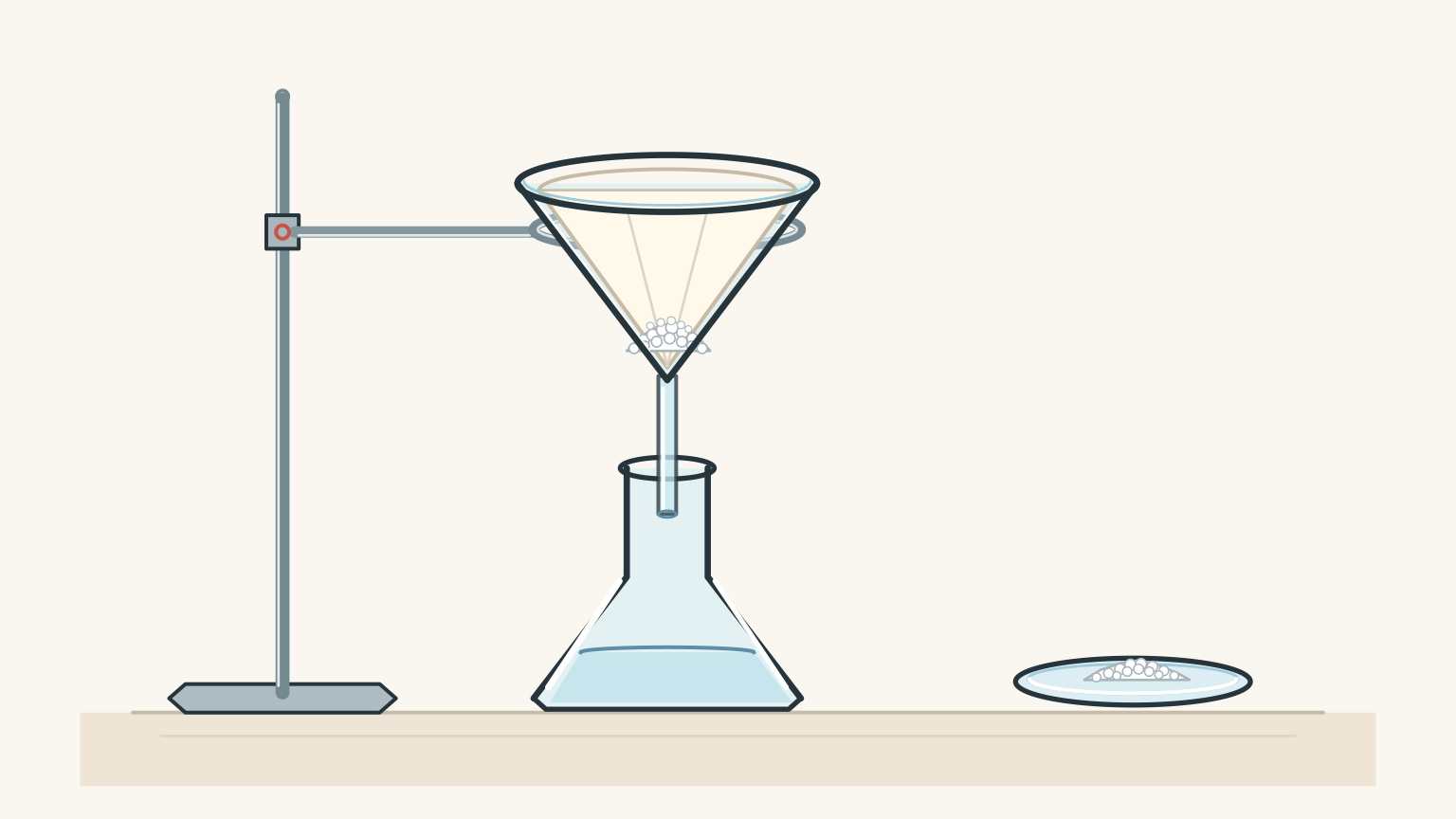
The theoretical mass of silver chloride is 0.344 g, but the actual mass of the dried precipitate collected is 0.301 g.
The student writes:
“The reaction did not work properly because the mass was lower than expected.”
Calculate the percentage yield and explain why the student’s conclusion is too strong. How should the result be organised in the three-part note system?
Due to technical limitations, this figure may display incorrectly or contain inaccuracies. Please check key details against your course materials.
Solution 3
The percentage yield is approximately 87.5%, but the lower experimental mass does not establish that the chemical reaction failed.
Percentage yield compares the actual amount of product collected with the theoretical amount predicted by the limiting reactant.
\[ \text{Percentage yield} = \frac{\text{Actual yield}}{\text{Theoretical yield}} \times100 \]
Substituting the values:
\[ \begin{aligned} \text{Percentage yield} &=\frac{0.301}{0.344}\times100\\ &=87.5\% \end{aligned} \]
The experiment therefore produced an isolated silver chloride mass equivalent to 87.5% of the theoretical yield.
However, several factors could explain the difference.
- Some precipitate may have remained in the original reaction vessel.
- Some solid may have passed through or been lost during filtration.
- Some precipitate may have been lost during transfer or washing.
- The reaction may not have proceeded completely.
The measured mass alone cannot identify which explanation is responsible.
The notes should separate the information:
| Record | What to include |
|---|---|
| Reaction | Balanced precipitation equation and limiting reactant. |
| Evidence | White precipitate formation, filtration observations, and mass of dried solid collected. |
| Calculation | Theoretical yield of 0.344 g and percentage yield of 87.5%. |
This is a useful example of why experimental evidence needs careful interpretation. A difference between theoretical and actual yield tells you something about the overall process, but it does not automatically identify the source of the difference.
07The next step: connect evidence to chemical reasoning
Good HSC Chemistry notes should do more than remind you what happened in a reaction.
They should help you explain why it happened, identify what experimental evidence supports your explanation, and calculate quantities using the correct chemical relationships.
The three-part system gives you a consistent way to organise that information:
- Reactions explain the chemical change.
- Evidence connects the chemical model to observations and measurements.
- Calculations turn experimental information into quantitative results.
As you progress, add more detail to your evidence records about uncertainty, reliability, and validity. In your calculation records, become increasingly precise about assumptions, significant figures, and the conditions under which each equation applies.
These skills become particularly important when studying equilibrium, where you need to connect reaction equations, experimental observations, and quantitative predictions rather than treating them as separate topics.
If you want feedback on how clearly you’re connecting these ideas in exam responses, tutorgum offers online HSC Chemistry tutoring focused on developing chemical understanding and applying it to questions.