
How to Use the HSC Chemistry Data Sheet in Calculation Questions
Learn how to navigate the HSC Chemistry formulae sheet, data tables, and Periodic Table to find the correct constants and reference values. Includes worked examples showing how to choose appropriate values, manage units, and avoid common calculation mistakes.
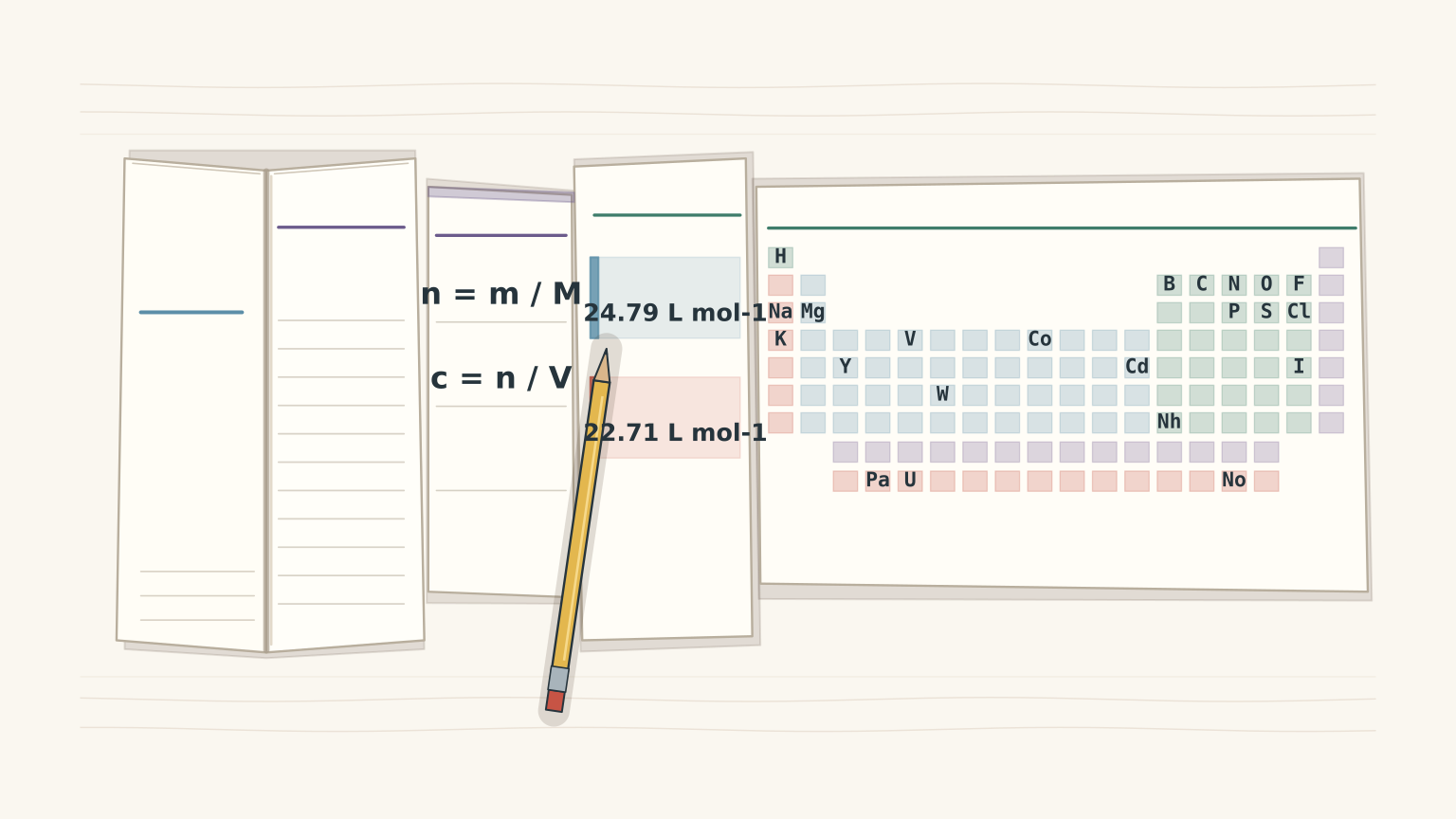
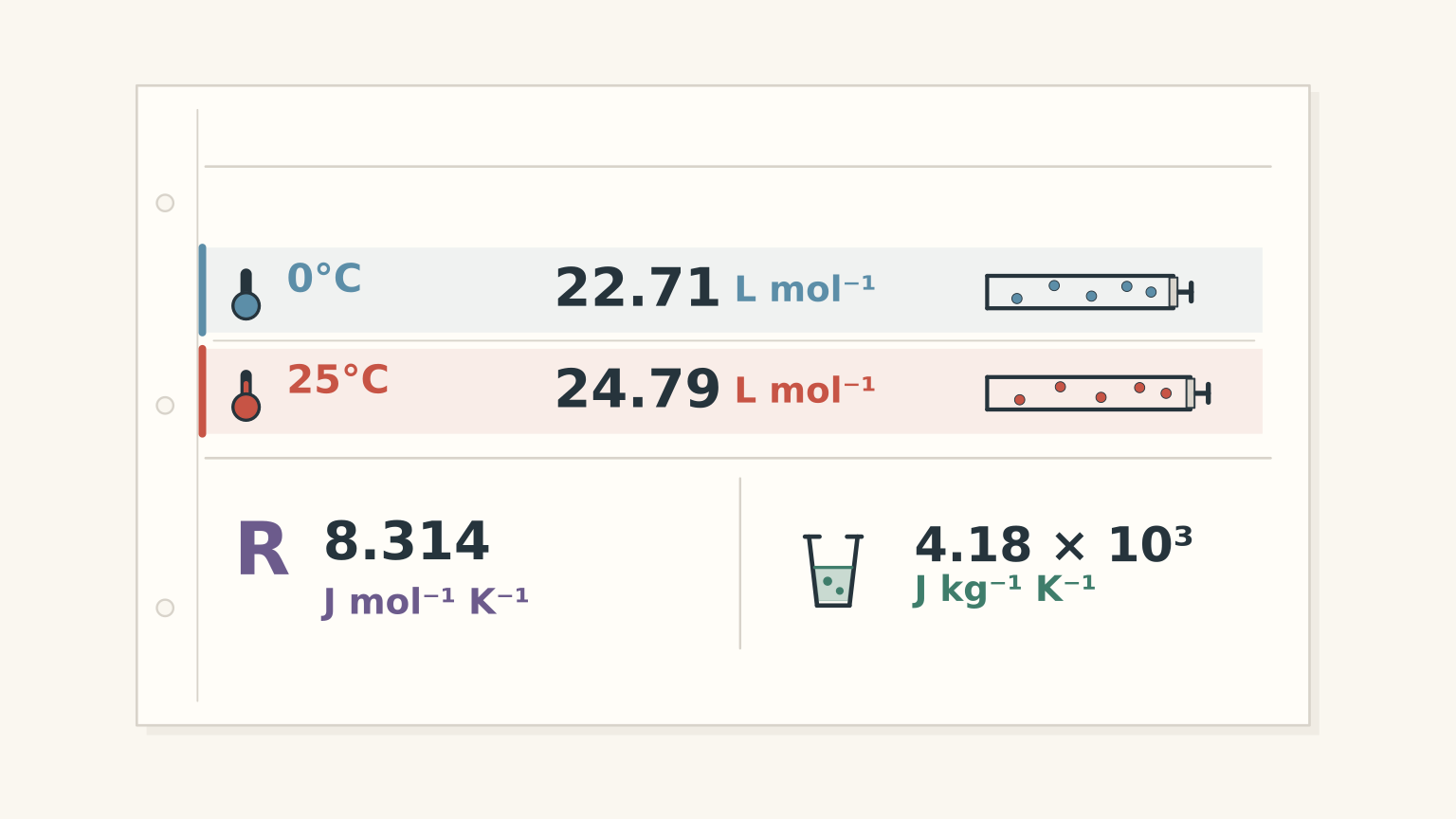
At 100 kPa and 25°C, one mole of an ideal gas occupies 24.79 L. At 100 kPa and 0°C, it occupies 22.71 L.
A student sees a gas calculation and immediately reaches for 22.71 L because they’ve memorised it. The calculation is already heading in the wrong direction.
Which value should they use? The answer is 24.79 L, because the temperature and pressure in the question match those conditions.
This is the skill behind using the HSC Chemistry data sheet well. You need to know where information is located, but more importantly, you need to recognise which value actually applies to the problem in front of you.
Due to technical limitations, this figure may display incorrectly or contain inaccuracies. Please check key details against your course materials.
01First, make sure you have the correct data sheet
Before learning how to navigate the reference material, check that you’re using the correct version.
As at November 2026, the relevant course for students preparing for the 2027 and 2028 HSC Chemistry examinations is the Chemistry Stage 6 Syllabus (2017).
NESA has released a replacement Chemistry 11-12 Syllabus (2025), but its implementation begins with Year 11 students in 2028. Its first HSC examination will be in 2029.
This means you shouldn’t accidentally use reference material from a different course or an overseas chemistry qualification.
The latest completed examination paper available at the time of writing is the 2026 HSC Chemistry examination paper. Its final pages contain the formulae sheet, data sheet and Periodic Table.
You can also access the reference material through the official NESA Chemistry Stage 6 (2017) syllabus page.
02What’s actually on the HSC Chemistry data sheet?
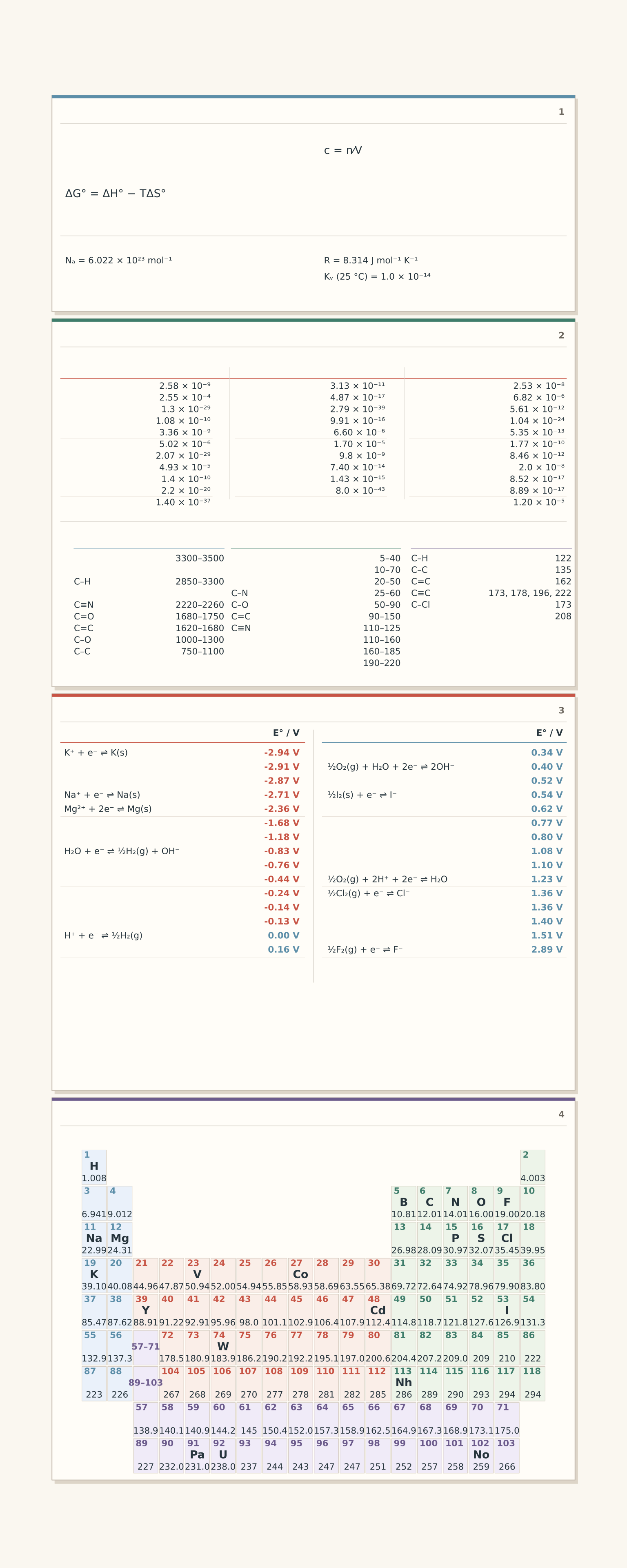
Students often refer to the entire collection of reference material as the data sheet. Strictly speaking, there are three components:
- The formulae sheet.
- The data sheet.
- The Periodic Table.
Each has a different job.
Due to technical limitations, this figure may display incorrectly or contain inaccuracies. Please check key details against your course materials.
1. The formulae sheet
This is where you find the mathematical relationships and physical constants needed for calculations.
The main equations are:
| Equation | What it calculates |
|---|---|
| \(n=\dfrac{m}{MM}\) | Amount of substance |
| \(c=\dfrac{n}{V}\) | Concentration |
| \(PV=nRT\) | Ideal gas behaviour |
| \(q=mc\Delta T\) | Thermal energy transferred |
| \(\Delta G^\circ=\Delta H^\circ-T\Delta S^\circ\) | Standard Gibbs free energy change |
| \(\mathrm{pH}=-\log_{10}[\mathrm{H}^+]\) | pH |
| \(\mathrm{p}K_a=-\log_{10}K_a\) | Acid dissociation |
| \(A=\varepsilon lc=\log_{10}\left(\dfrac{I_0}{I}\right)\) | Absorbance |
A quick reminder of the symbols:
- \(n\) = amount of substance, in mol
- \(m\) = mass, usually in g or kg depending on the equation
- \(MM\) = molar mass, in g mol\(^{-1}\)
- \(c\) = concentration in \(c=n/V\), usually in mol L\(^{-1}\)
- \(V\) = volume
- \(P\) = pressure
- \(R\) = ideal gas constant
- \(T\) = absolute temperature, in K
- \(q\) = heat transferred, in J
- \(c\) in \(q=mc\Delta T\) = specific heat capacity
- \(\Delta T\) = temperature change, in K or °C
- \(\Delta G^\circ\), \(\Delta H^\circ\) and \(\Delta S^\circ\) = standard Gibbs free energy, enthalpy and entropy changes
- \(A\) = absorbance
- \(\varepsilon\) = molar absorptivity
- \(l\) = path length of light through the sample
- \(I_0\) and \(I\) = incident and transmitted light intensities
Notice that the same symbol can mean different things in different equations. In particular, \(c\) can represent concentration or specific heat capacity. Always read the equation in context.
2. Important constants supplied on the formulae sheet
You don’t need to memorise every constant if it is supplied in the examination. You do need to recognise what each one describes.
| Constant | Supplied value | When you use it |
|---|---|---|
| Avogadro constant, \(N_A\) | \(6.022\times10^{23}\ \mathrm{mol}^{-1}\) | Converting between moles and particles |
| Molar gas volume at 0°C and 100 kPa | 22.71 L mol\(^{-1}\) | Ideal gas calculations under these conditions |
| Molar gas volume at 25°C and 100 kPa | 24.79 L mol\(^{-1}\) | Ideal gas calculations under these conditions |
| Gas constant, \(R\) | \(8.314\ \mathrm{J\,mol^{-1}\,K^{-1}}\) | Ideal gas equation |
| Ionisation constant of water, \(K_w\) | \(1.0\times10^{-14}\) at 25°C | Acid and base calculations |
| Specific heat capacity of water | \(4.18\times10^3\ \mathrm{J\,kg^{-1}\,K^{-1}}\) | Calorimetry calculations |
There are two particularly important details here.
First, the molar gas volumes are only supplied for the stated temperatures and pressure. You cannot automatically use 24.79 L mol\(^{-1}\) for a gas at 110 kPa and 40°C.
Second, the specific heat capacity of water is given in joules per kilogram per kelvin. If a question gives you mass in grams, convert it to kilograms before substituting.
Due to technical limitations, this figure may display incorrectly or contain inaccuracies. Please check key details against your course materials.
3. The data sheet
The data sheet contains reference values that help you interpret chemical behaviour and solve particular calculation problems.
Its main sections include:
| Reference section | Information supplied | Typical application |
|---|---|---|
| Solubility constants | \(K_{sp}\) values | Precipitation and solubility calculations |
| Infrared absorption data | Bond absorption ranges in cm\(^{-1}\) | Identifying functional groups |
| Carbon-13 NMR data | Chemical shifts in ppm | Identifying carbon environments |
| UV absorption data | Approximate absorption wavelengths in nm | Identifying chromophores |
| Standard potentials | Reduction potentials in V | Redox and electrochemical calculations |
The important thing is to match the table to the chemical process in the question.
For example, if a question asks you to calculate the solubility of silver chloride, you need its \(K_{sp}\) value. Looking up a standard potential or an infrared absorption range won’t help.
4. The Periodic Table
The Periodic Table supplies relative atomic masses, which you use to calculate molar masses.
For example, the molar mass of carbon dioxide is:
\[ MM(\ce{CO2})=12.01+2(16.00) \]
\[ =44.01\ \mathrm{g\,mol^{-1}} \]
You can then use this value in:
\[ n=\frac{m}{MM} \]
If the question supplies the molar mass directly, use the supplied value rather than introducing unnecessary rounding differences.
03A reliable method for choosing the right value
When you encounter a calculation question, don’t immediately start searching through the reference sheet.
Work through these steps.
Step 1: Identify what the question wants.
Are you calculating an amount of substance, concentration, heat transfer, gas volume, solubility or cell potential?
The unknown tells you what relationship or reference value you need.
Step 2: Identify the relevant equation.
For example:
- Heat transferred: \(q=mc\Delta T\)
- Amount of gas: \(PV=nRT\)
- Concentration: \(c=n/V\)
- pH: \(\mathrm{pH}=-\log_{10}[\mathrm{H}^+]\)
Step 3: Find the corresponding reference value.
Check the constants or the relevant data table.
Step 4: Check the conditions.
This is where many otherwise sensible calculations go wrong.
Look for:
- Temperature
- Pressure
- Chemical formula
- Ionic charge
- Concentration
- Units
A value can be correct in isolation but inappropriate for the conditions in the question.
Step 5: Check whether the question supplies its own data.
If the question provides a specific value for the substance or experimental conditions, use that value where appropriate.
Don’t replace a supplied experimental value with something you remember from another example.
Step 6: Substitute, calculate and check your answer.
Show the equation, substitution, units and final result. Check that the answer makes physical or chemical sense.
Let’s apply this method.
04Worked example: Calculating heat transferred to water
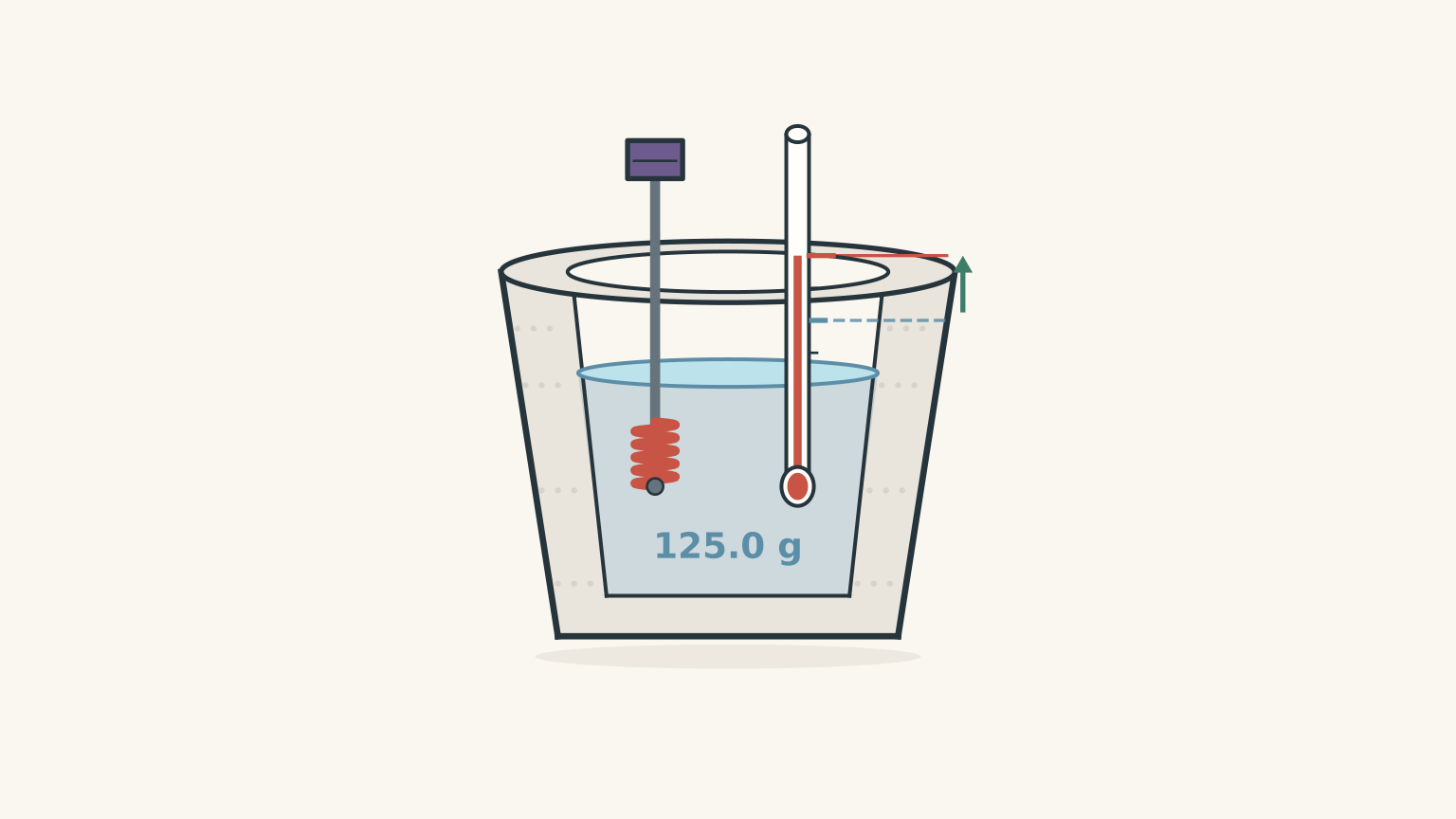
A student heats 125.0 g of water from 19.0°C to 27.0°C. Assuming all the heat transferred by the heater is absorbed by the water, calculate the heat gained by the water.
Step 1
The question asks for heat transferred, \(q\).
The formulae sheet gives:
\[ q=mc\Delta T \]
Step 2
The substance being heated is water.
The formulae sheet supplies its specific heat capacity:
\[ c=4.18\times10^3\ \mathrm{J\,kg^{-1}\,K^{-1}} \]
This is the value we need.
Step 3
The equation requires mass in kg when using the supplied specific heat capacity.
\[ m=\frac{125.0}{1000} \]
\[ m=0.1250\ \mathrm{kg} \]
Step 4
\[ \Delta T=T_f-T_i \]
\[ \Delta T=27.0-19.0=8.0\ \mathrm{K} \]
A temperature difference of 8.0°C is numerically equal to a difference of 8.0 K.
Step 5
\[ q=mc\Delta T \]
\[ q=0.1250\times4.18\times10^3\times8.0 \]
\[ q=4180\ \mathrm{J} \]
Therefore:
\[ \boxed{q=4.2\ \mathrm{kJ}} \]
The water absorbs 4.2 kJ of thermal energy.
If the question instead asked for the heat released by the reaction supplying this energy, the reaction’s heat change would be negative, assuming no heat loss.
The important lesson: We didn’t need to memorise the specific heat capacity of water. We needed to recognise which substance was being heated, locate the correct constant, and use consistent units.
Due to technical limitations, this figure may display incorrectly or contain inaccuracies. Please check key details against your course materials.
05Worked example: Choosing between the molar gas volume and ideal gas equation
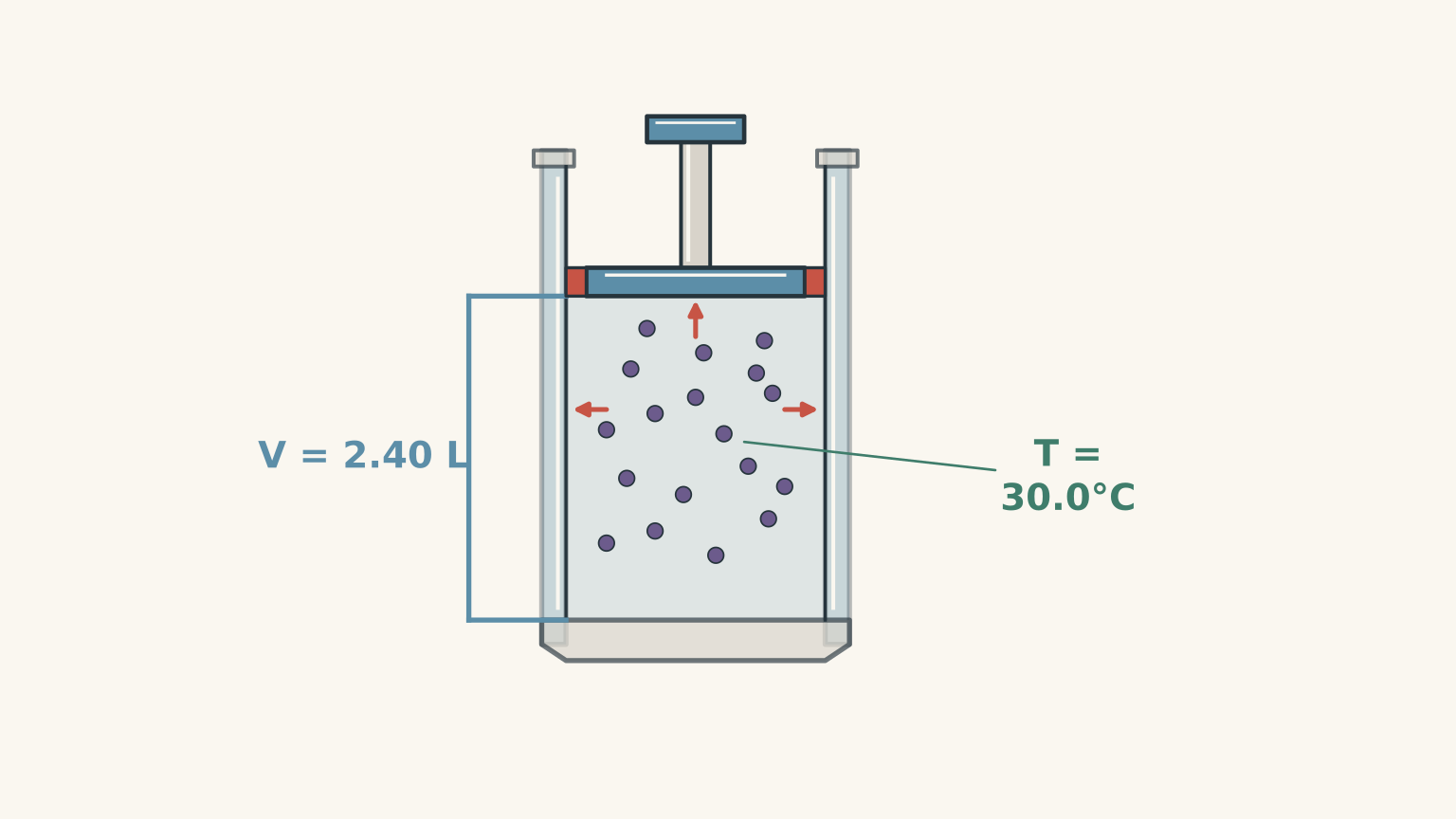
A sealed container holds an ideal gas at 110 kPa and 30.0°C. Its volume is 2.40 L.
Calculate the amount of gas in the container.
Step 1
We need the amount of gas, \(n\), measured in mol.
The formulae sheet provides:
\[ PV=nRT \]
Step 2
The sheet provides two molar gas volumes:
- 22.71 L mol\(^{-1}\) at 0°C and 100 kPa
- 24.79 L mol\(^{-1}\) at 25°C and 100 kPa
Our gas is at 30.0°C and 110 kPa.
Neither set of conditions matches.
We should therefore use the ideal gas equation rather than either supplied molar volume.
Step 3
The ideal gas equation requires absolute temperature.
\[ T=30.0+273.15 \]
\[ T=303.15\ \mathrm{K} \]
Step 4
We can use pressure in kPa and volume in L because \(1\ \mathrm{kPa\,L}=1\ \mathrm{J}\).
The numerical value of the gas constant therefore remains 8.314.
\[ n=\frac{PV}{RT} \]
\[ n=\frac{110\times2.40} {8.314\times303.15} \]
\[ n=\frac{264}{2520.8} \]
\[ n=0.1047\ \mathrm{mol} \]
Therefore:
\[ \boxed{n=0.105\ \mathrm{mol}} \]
The container holds 0.105 mol of gas.
The important lesson: Having a molar gas volume printed on the sheet doesn’t mean you should always use it. Check the temperature and pressure first. If they don’t match, use \(PV=nRT\).
Due to technical limitations, this figure may display incorrectly or contain inaccuracies. Please check key details against your course materials.
06How to navigate the more specialised data tables
The formulae sheet is relatively straightforward. The data tables require a little more chemical judgement.
Here are three sections worth understanding before your examination.
Solubility constants: finding the correct \(K_{sp}\)
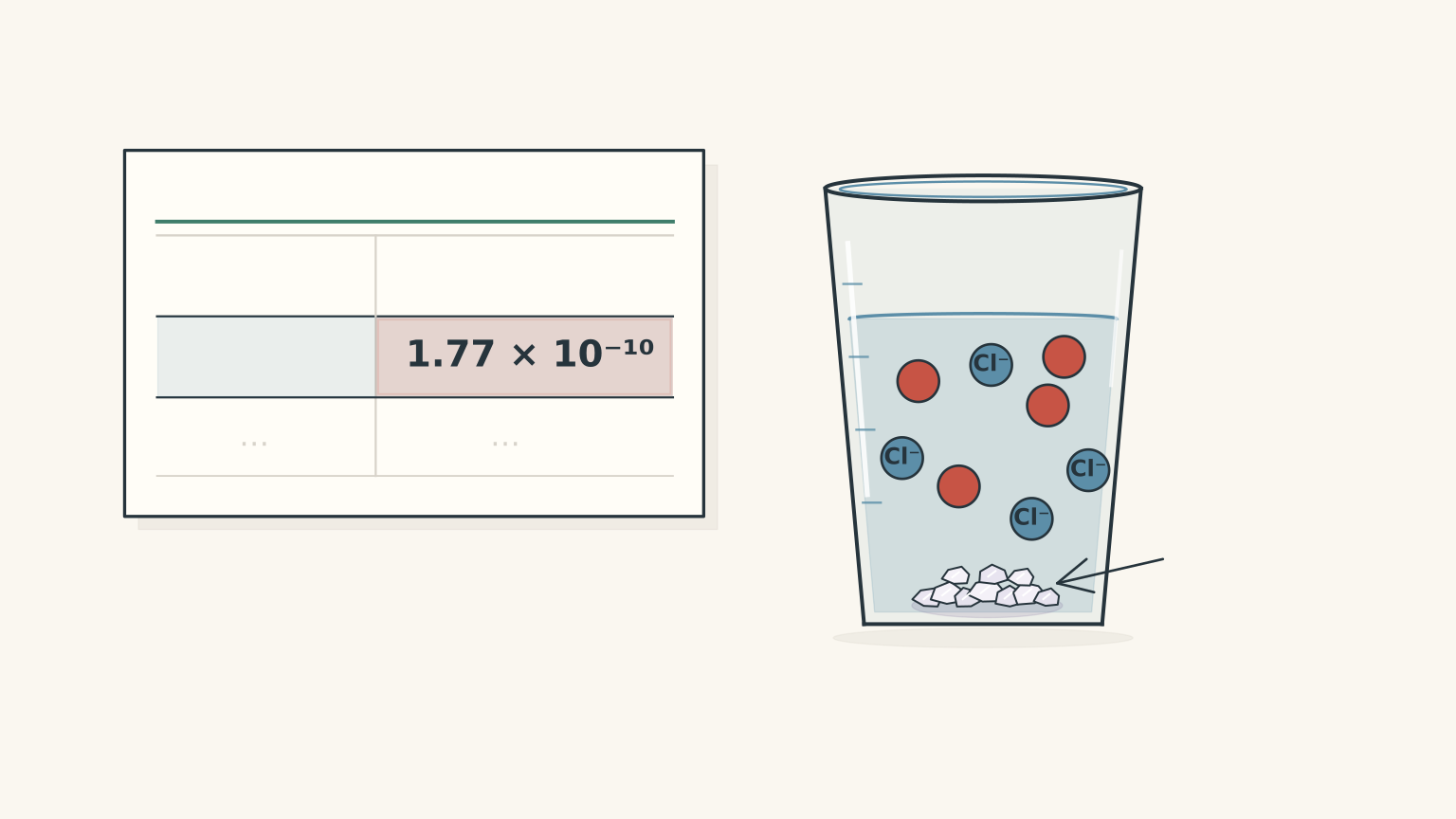
The solubility table lists equilibrium constants for particular ionic compounds at 25°C.
For example, the sheet gives:
\[ K_{sp}(\ce{AgCl})=1.77\times10^{-10} \]
This value belongs specifically to silver chloride.
When a question asks you to calculate a solubility product or use a supplied \(K_{sp}\), follow this process:
- Identify the exact ionic compound.
- Find its corresponding \(K_{sp}\) value.
- Write the balanced dissolution equation.
- Construct the equilibrium expression using the coefficients in that equation.
- Include any ions already present in the solution.
For silver chloride:
\[ \ce{AgCl(s) <=> Ag+(aq) + Cl-(aq)} \]
The corresponding equilibrium expression is:
\[ K_{sp}=[\mathrm{Ag}^{+}][\mathrm{Cl}^{-}] \]
Notice that both concentrations have a power of one because the dissolution equation produces one silver ion and one chloride ion.
For a compound with a different formula, the expression changes.
Due to technical limitations, this figure may display incorrectly or contain inaccuracies. Please check key details against your course materials.
One important warning: \(K_{sp}\) is not the same thing as molar solubility.
You cannot simply read the \(K_{sp}\) value and call it the solubility. You must use the dissolution equation to construct the correct expression.
Also, the supplied solubility constants are specified at 25°C. Don’t automatically apply them at another temperature.
Standard potentials: check the direction of the reaction
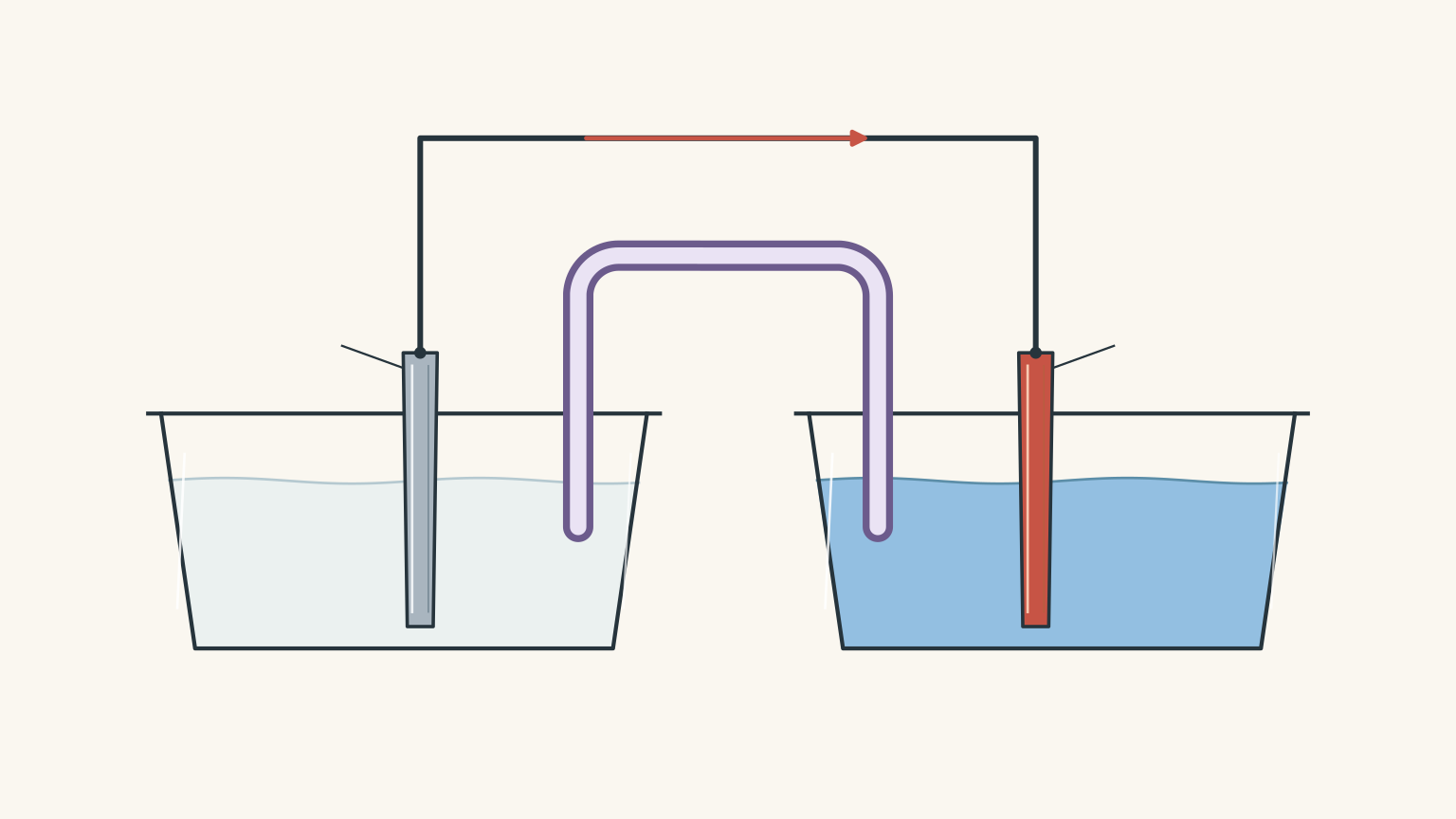
The standard potentials table is useful for questions involving redox reactions and electrochemical cells.
The most important detail is that the half-equations in the table are written as reductions.
For example:
\[ \ce{Cu^2+(aq) + 2e- <=> Cu(s)} \]
has a standard reduction potential of:
\[ E^\circ=+0.34\ \mathrm{V} \]
Suppose a question requires copper metal to be oxidised instead.
You must reverse the half-equation:
\[ \ce{Cu(s) -> Cu^2+(aq) + 2e-} \]
The corresponding oxidation potential is now:
\[ E^\circ=-0.34\ \mathrm{V} \]
When calculating the standard cell potential, you can use:
\[ E^\circ_{\mathrm{cell}} = E^\circ_{\mathrm{red,cathode}} - E^\circ_{\mathrm{red,anode}} \]
The cathode is where reduction occurs. The anode is where oxidation occurs.
Two common mistakes are worth avoiding:
- Forgetting to reverse the sign when reversing a half-equation.
- Multiplying an electrode potential by the coefficient used to balance electrons.
Electrode potentials are not multiplied when balancing the overall reaction.
Due to technical limitations, this figure may display incorrectly or contain inaccuracies. Please check key details against your course materials.
Spectroscopy: match the type of data to the technique
The spectroscopy tables are mainly used to interpret experimental results and identify chemical structures.
You should know what each column represents.
| Technique | What to look for | Units |
|---|---|---|
| Infrared (IR) | Characteristic bond absorption ranges | cm\(^{-1}\) |
| Carbon-13 NMR | Chemical environment of carbon atoms | ppm |
| UV absorption | Absorption wavelength of a chromophore | nm |
For example, if an IR spectrum contains a strong absorption in the carbonyl region, you can compare its wavenumber with the C=O absorption range on the data sheet.
The table gives a range, not necessarily one exact number. Real absorption positions can vary with the molecular environment.
The UV absorption section also states that its values are approximate and not a definitive list.
One more detail: don’t assume every proton NMR reference value is printed on the data sheet. A question may provide its own proton NMR chemical-shift table as part of the stimulus material. Always inspect the question itself before deciding that information is missing.
07Common mistakes when using the data sheet
These are the errors to watch for when practising calculation questions.
| Mistake | Why it causes problems | What to do instead |
|---|---|---|
| Using the wrong molar gas volume | The temperature or pressure doesn’t match | Check both conditions before choosing |
| Leaving mass in grams for \(q=mc\Delta T\) | The supplied specific heat capacity uses kg | Convert mass into kg |
| Using Celsius in \(PV=nRT\) | The equation requires absolute temperature | Convert to kelvin |
| Choosing the wrong \(K_{sp}\) | Different compounds have different equilibrium constants | Match the exact chemical formula |
| Ignoring the temperature attached to \(K_{sp}\) | Equilibrium constants can change with temperature | Check the stated temperature |
| Reversing a redox half-equation without changing its sign | The electrode potential is no longer correct | Reverse the sign when reversing the reaction |
| Multiplying standard potentials by coefficients | Electrode potentials are not scaled when balancing equations | Balance electrons separately |
| Ignoring values supplied in the question | The calculation may use specific experimental data | Prioritise relevant question data |
A particularly useful habit is to write the units beside every value before substituting it into an equation.
For example:
\[ c=4.18\times10^3\ \mathrm{J\,kg^{-1}\,K^{-1}} \]
Seeing those units immediately reminds you that your mass must be in kilograms and your temperature change must be expressed in kelvin or an equivalent Celsius difference.
08Questions and solutions
Try these questions without looking at the solutions first. The aim is to practise choosing the correct reference information, not simply recognising a formula.
Question 1
An ideal gas sample contains 0.0800 mol of gas at 100 kPa and 25°C.
Calculate its volume using the appropriate value from the HSC Chemistry reference sheet.
Solution 1
The volume is 1.98 L.
The pressure and temperature match the conditions supplied for the 25°C molar gas volume.
From the formulae sheet:
\[ V_m=24.79\ \mathrm{L\,mol^{-1}} \]
Use:
\[ V=nV_m \]
Substituting:
\[ V=0.0800\times24.79 \]
\[ V=1.9832\ \mathrm{L} \]
Therefore:
\[ \boxed{V=1.98\ \mathrm{L}} \]
The tempting mistake is to use 22.71 L mol\(^{-1}\), which is the value for 0°C and 100 kPa. The temperature in this question is 25°C, so 24.79 L mol\(^{-1}\) is the correct choice.
Question 2
At 25°C, solid lead(II) bromide, \(\ce{PbBr2}\), is added to a solution containing 0.200 mol L\(^{-1}\) sodium bromide.
The HSC Chemistry data sheet gives:
\[ K_{sp}(\ce{PbBr2})=6.60\times10^{-6} \]
Calculate the molar solubility of lead(II) bromide in this solution.
Assume the volume change on dissolving the solid is negligible.
Solution 2
The molar solubility is approximately:
\[ \boxed{1.65\times10^{-4}\ \mathrm{mol\,L^{-1}}} \]
The first step is finding the correct \(K_{sp}\) value. The table lists lead(II) bromide at \(6.60\times10^{-6}\), at 25°C.
Now write the dissolution equation:
\[ \ce{PbBr2(s) <=> Pb^2+(aq) + 2Br-(aq)} \]
Let the molar solubility be \(s\).
The equilibrium concentrations are:
\[ [\mathrm{Pb}^{2+}]=s \]
\[ [\mathrm{Br}^{-}]=0.200+2s \]
The bromide concentration includes the bromide ions already present from sodium bromide.
The solubility product expression is:
\[ K_{sp}=[\mathrm{Pb}^{2+}][\mathrm{Br}^{-}]^2 \]
Substitute:
\[ 6.60\times10^{-6} =s(0.200+2s)^2 \]
Since the initial bromide concentration is much larger than the additional bromide produced by dissolution, we can approximate:
\[ 0.200+2s\approx0.200 \]
Therefore:
\[ 6.60\times10^{-6}=s(0.200)^2 \]
Rearranging:
\[ s=\frac{6.60\times10^{-6}}{0.0400} \]
\[ s=1.65\times10^{-4}\ \mathrm{mol\,L^{-1}} \]
The approximation is justified because \(2s=3.30\times10^{-4}\), which is very small compared with 0.200 mol L\(^{-1}\).
The important trap is forgetting the original bromide ions in the solution. Using only the bromide produced by the dissolving solid would give the wrong equilibrium expression.
Question 3
A galvanic cell operates under standard conditions using the following overall reaction:
\[ \ce{2Fe^3+(aq) + 2I-(aq) -> 2Fe^2+(aq) + I2(s)} \]
The data sheet provides these standard reduction potentials:
| Half-equation | \(E^\circ\) |
|---|---|
| \(\ce{Fe^3+ + e- <=> Fe^2+}\) | +0.77 V |
| \(\ce{\frac{1}{2}I2 + e- <=> I-}\) | +0.54 V |
Calculate the standard cell potential and explain which species is oxidised.
Solution 3
The standard cell potential is +0.23 V, and iodide ions are oxidised to iodine.
Both values in the table are reduction potentials.
From the overall reaction, iron(III) ions gain electrons:
\[ \ce{Fe^3+ + e- -> Fe^2+} \]
This is reduction, so the iron half-cell is the cathode.
Iodide ions lose electrons:
\[ \ce{2I- -> I2 + 2e-} \]
This is oxidation, so the iodine half-cell is the anode.
Use the standard cell potential relationship:
\[ E^\circ_{\mathrm{cell}} = E^\circ_{\mathrm{cathode}} - E^\circ_{\mathrm{anode}} \]
Substitute the reduction potentials from the table:
\[ E^\circ_{\mathrm{cell}} =0.77-0.54 \]
\[ \boxed{E^\circ_{\mathrm{cell}}=+0.23\ \mathrm{V}} \]
The positive cell potential indicates that the reaction is spontaneous under standard conditions.
The tempting mistake is to reverse the iodine half-equation but forget that its potential must also change sign. The subtraction method already accounts for that reversal.
You should also avoid multiplying the iron potential by two simply because two iron ions are involved. Balancing electrons changes the coefficients in the reaction, not the electrode potentials.
09What to practise next
Using the data sheet is only the first part of a successful calculation.
You still need to recognise the chemical process, select the correct equation, and understand how the quantities in that equation relate to one another.
For example:
- After finding the correct concentration relationship, practise applying it to solution dilution calculations for HSC Chemistry.
- After using the specific heat capacity of water, practise applying calorimetry to Heat of Combustion: Calculations for HSC Chemistry.
A good final check before submitting any calculation is simple: can you explain why you chose that particular value, rather than just point to where you found it?
If you can justify the value, its units, and the conditions under which it applies, you’re using the HSC Chemistry data sheet properly.
Official NESA references (checked November 2026)