
How Long Should an HSC Tutoring Session Be?
Compare HSC lesson structures and see how tutorgum's two-hour weekly online classes combine quizzes, explanations, practice and questions.
A useful HSC tutoring lesson gives students time to understand an idea, apply it, ask questions and act on feedback. Duration matters alongside how actively that time is used.
Session lengths vary with the format and goal. A short individual appointment may address one narrow question; a longer structured class can combine a quiz, several teaching-and-practice cycles and time for questions. tutorgum’s weekly online classes run for two hours.
The important question isn’t simply how long the tutor is teaching. It’s how much useful learning can happen within that time.
01How long should an HSC tutoring session be?
The right duration depends on what the student needs to accomplish.
| Session format | A useful teaching goal |
|---|---|
| Short individual appointment | Clarify a defined question or correction. |
| 60-90 minute session | Work through a focused concept and related practice. |
| Two-hour structured class | Combine a quiz, concept explanations, active problem-solving and questions across several teaching cycles. |
These are examples of how time can be organised, not an evidence-based ranking of session lengths. Match the structure and opportunities for participation to the student’s course and goals.

Due to technical limitations, this figure may display incorrectly or contain inaccuracies. Please check key details against your course materials.
Why 60-75 minutes is a useful starting point
A productive tutoring session needs to accomplish several different jobs:
- Identify what the student understands and where they’re getting stuck.
- Explain the relevant concept or correct a misconception.
- Give the student an opportunity to apply the explanation.
- Identify errors and provide specific feedback.
- Check whether the student can now solve a similar problem independently.
Each stage takes time.
If a session is too short, the tutor might identify a misconception and explain the correction without leaving enough time for the student to practise it.
If a session is too long, the quality of concentration and problem-solving may decline, particularly after a full school day.
A 60-75-minute session generally provides enough room for a complete learning cycle without making every lesson unnecessarily long.
02What should happen during a tutoring session?
Session length matters, but structure matters just as much.
Consider a 60-minute session. It shouldn’t consist of 60 minutes of explanations followed by a quick question at the end. The student needs to do some of the intellectual work themselves.
A useful structure looks like this:
| Stage | Time | What happens |
|---|---|---|
| Diagnosis | 8 minutes | The student attempts a short question to reveal gaps in understanding |
| Instruction | 15 minutes | The tutor explains the concept and demonstrates a worked example |
| Guided practice | 22 minutes | The student solves similar questions with progressively less assistance |
| Feedback | 10 minutes | The tutor identifies mistakes, explains corrections, and checks the student’s reasoning |
| Independent check | 5 minutes | The student attempts a fresh question without assistance |
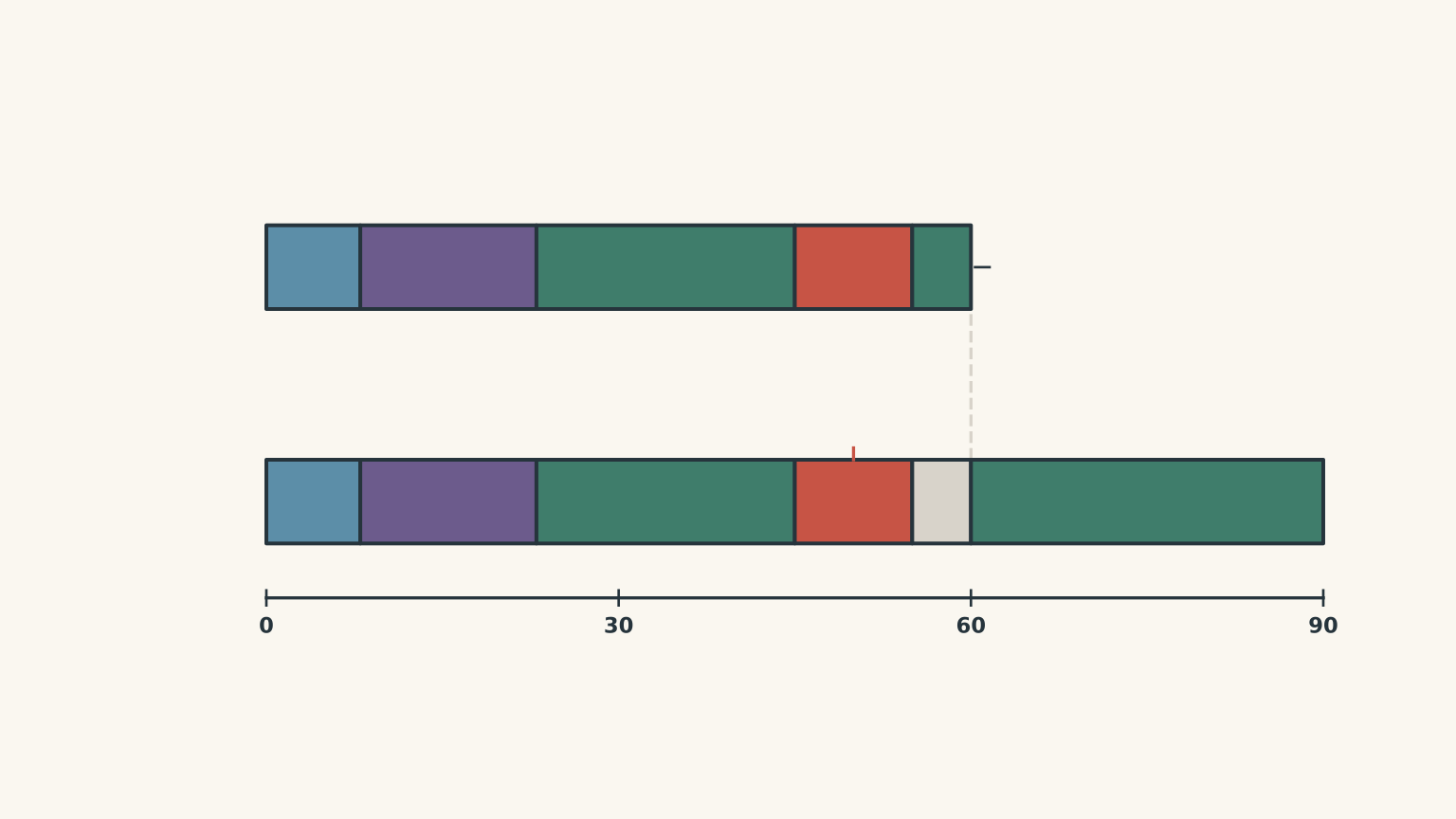
Due to technical limitations, this figure may display incorrectly or contain inaccuracies. Please check key details against your course materials.
Notice that the tutor isn’t responsible for doing all the work.
The explanation is important, but the student needs to make decisions, attempt questions, and explain their reasoning. Otherwise, they might recognise a solution when somebody else presents it without being able to reproduce the method independently.
1. Diagnosis: Find the actual problem
The first few minutes should establish what the student knows already.
For example, a student might say they’re struggling with a Physics question involving conservation of momentum.
There are several possible problems:
- They don’t understand what momentum represents.
- They don’t recognise which objects form the system.
- They don’t know when momentum is conserved.
- They understand the principle but make algebraic mistakes.
These problems need different explanations.
A good tutor asks the student to attempt a question before immediately presenting the solution. This reveals whether the difficulty is conceptual, mathematical, or related to applying knowledge in an unfamiliar situation.
2. Instruction: Explain one important idea properly
Once the problem is identified, the tutor can explain the relevant concept.
The aim isn’t to cover as much content as possible. It’s to help the student understand the particular idea that is preventing them from progressing.
A useful explanation includes:
- The underlying concept or principle.
- Why a particular method works.
- A worked example showing the reasoning.
- Common mistakes and how to recognise them.
For instance, in Chemistry, a student might know the formula for calculating concentration but struggle to understand how concentration changes when a solution is diluted.
Simply memorising the equation won’t necessarily resolve the problem. The student needs to understand what happens to the amount of solute and the total volume.
3. Guided practice: Let the student do the thinking
This is where a tutoring session becomes genuinely useful.
After seeing a worked example, the student should attempt a similar question.
Initially, the tutor might provide prompts. As the student becomes more confident, those prompts should disappear.
For example, in Mathematics Extension 1 or 2, a tutor might demonstrate how to approach an unfamiliar problem. The student then attempts another question where the relevant technique isn’t immediately obvious.
The important step is making the student choose the method themselves.
Watching someone solve a difficult problem and solving it independently are two different skills.
4. Feedback: Correct the reasoning, not just the answer
Suppose a student reaches the wrong answer in a Physics calculation.
Simply showing them the correct answer doesn’t address why their method failed.
The tutor should identify the first important mistake, explain its consequences, and ask the student to correct the relevant step.
This is particularly important in Mathematics Extension 1 and 2, where an incorrect choice of technique can affect an entire solution.
In Chemistry, the error might involve an incorrect mole ratio. In Physics, it might involve choosing an inappropriate system or applying a conservation principle under conditions where it doesn’t hold.
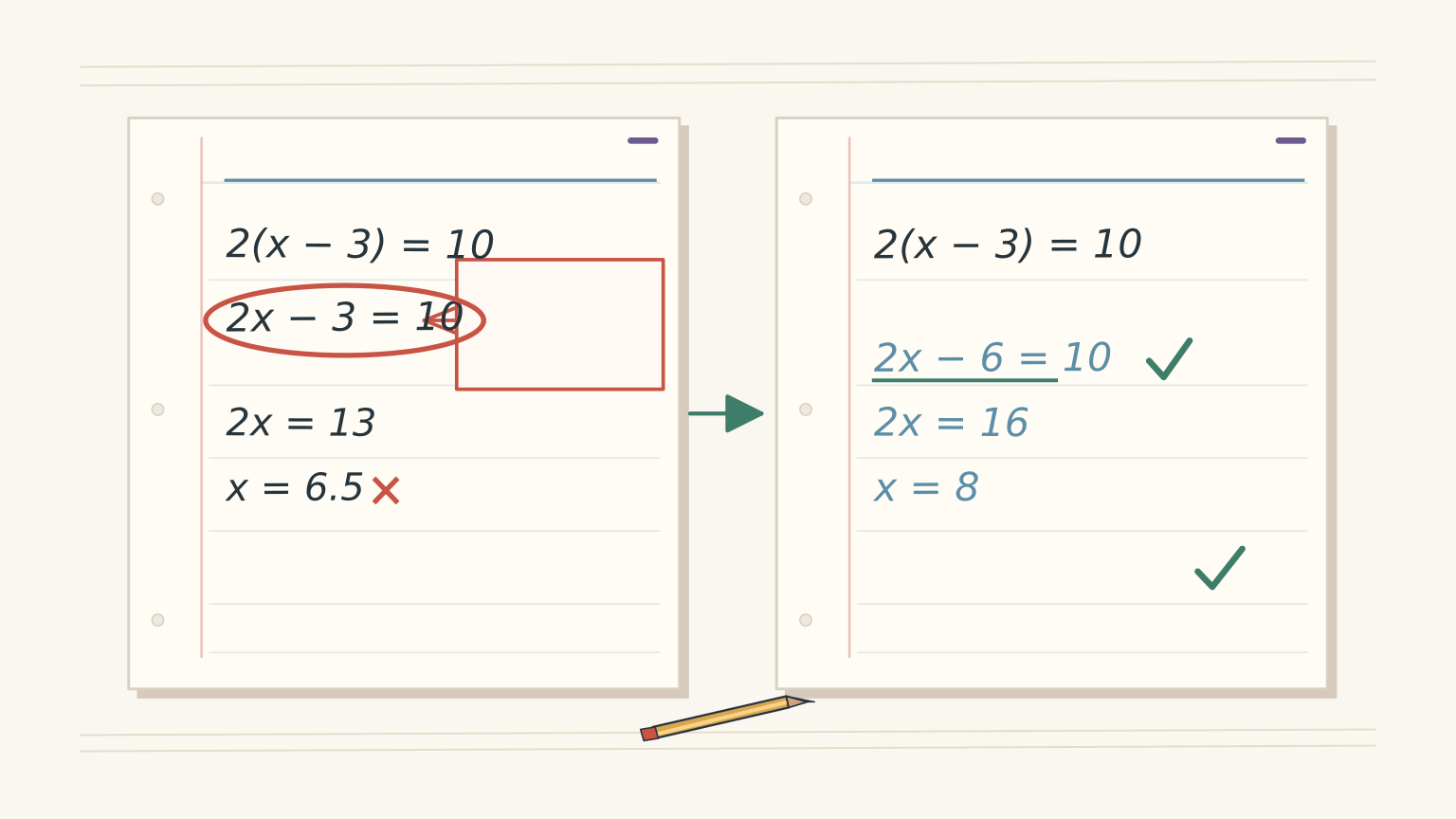
Due to technical limitations, this figure may display incorrectly or contain inaccuracies. Please check key details against your course materials.
A session should ideally finish with the student attempting another question or explaining the corrected reasoning without relying on the tutor.
03Does the subject change the ideal session length?
Yes, although the basic structure remains the same.
Physics, Chemistry, and Mathematics Extension 1 and 2 require different types of thinking. Some tasks can be addressed relatively quickly, while others need time for students to connect several ideas.
| Subject | What takes time during a session? | Useful session structure |
|---|---|---|
| Physics | Understanding physical situations, selecting relevant principles, setting up equations, and interpreting results | Concept explanation followed by diagram-based and numerical practice |
| Chemistry | Connecting chemical equations, particle-level explanations, and calculations | Concept clarification followed by worked calculations and unfamiliar applications |
| Maths Extension 1 | Recognising techniques, understanding mathematical relationships, and applying methods to unfamiliar questions | Demonstration followed by increasingly independent problem-solving |
| Maths Extension 2 | Developing rigorous reasoning, selecting appropriate methods, and solving challenging multi-step problems | Extended problem-solving with time for feedback and a second attempt |
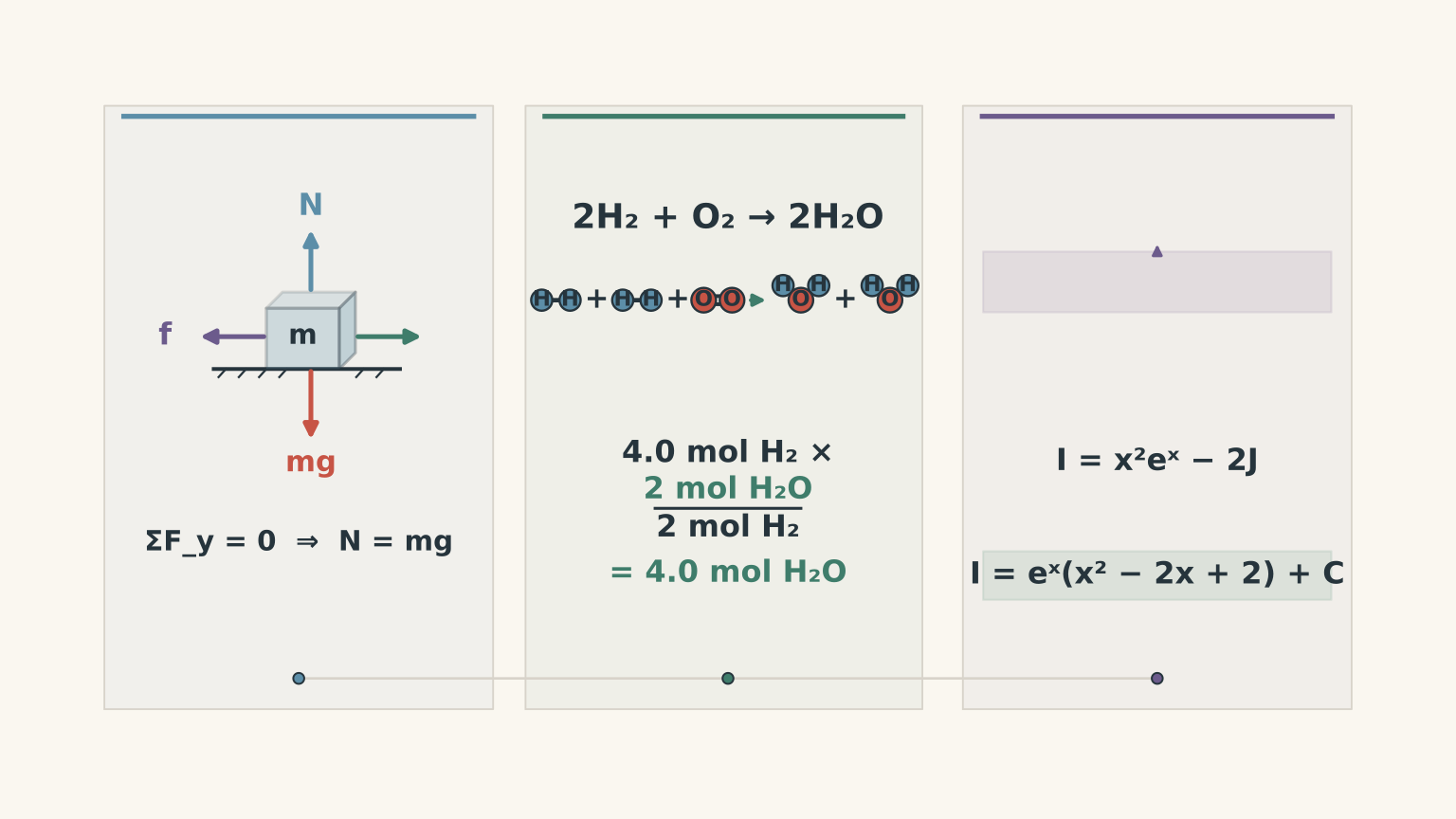
Due to technical limitations, this figure may display incorrectly or contain inaccuracies. Please check key details against your course materials.
For example, a student who understands the basic equations in Physics might only need a short session to correct a particular application error.
However, a student who struggles to connect several concepts in an unfamiliar Mathematics Extension 2 problem may need a longer session to understand the approach, attempt the solution, and work through feedback.
The subject alone doesn’t determine the duration. The complexity of the learning task does.
04Two examples: Choosing the right session length
Example 1: A targeted Chemistry problem
Imagine a Year 12 Chemistry student who understands how to calculate the number of moles from a given mass but repeatedly makes mistakes when using the coefficients in a balanced chemical equation.
This is a relatively specific problem.
The student doesn’t necessarily need a 90-minute session covering an entire stoichiometry topic. They need to understand how the balanced equation establishes the mole ratio between reactants and products.
A 55-minute session could be structured as follows:
| Time | Activity |
|---|---|
| 0-5 minutes | Attempt a short stoichiometry question to identify the error |
| 5-17 minutes | Explain how coefficients establish mole ratios |
| 17-37 minutes | Work through one guided and one independent calculation |
| 37-49 minutes | Review mistakes and correct the student’s reasoning |
| 49-55 minutes | Attempt a fresh question independently |
This session is long enough to identify the misconception, explain the relevant Chemistry, and check that the student can apply the method.
Extending the session would only be useful if another learning need emerged.
Example 2: An unfamiliar Mathematics Extension problem
Now consider a student studying Mathematics Extension 1 or 2.
They can perform familiar calculations but struggle when an exam question requires them to recognise which mathematical technique to use.
This is a different problem.
The student needs to develop their ability to interpret the question, identify relevant mathematical relationships, select an approach, and justify their working.
An 80-minute session provides more room for this process.
A possible structure is:
| Time | Activity |
|---|---|
| 0-8 minutes | Attempt an unfamiliar question and identify the point of difficulty |
| 8-23 minutes | Explain the mathematical structure and demonstrate an appropriate approach |
| 23-48 minutes | Solve a related problem with progressively fewer prompts |
| 48-53 minutes | Take a short reset |
| 53-70 minutes | Attempt a more challenging variation independently |
| 70-80 minutes | Review the reasoning, correct mistakes, and identify the next practice task |
The additional time isn’t being used to make the tutor’s explanation longer.
It’s being used to give the student another opportunity to solve a problem without assistance.
That’s the important difference.
05When should a tutoring session be shorter or longer?
There are several signs that can help you decide.
Consider a shorter session when:
- The student has one clearly identified misconception.
- They only need to revise a particular technique.
- They understand the topic but need help correcting a recurring mistake.
- Their concentration is declining and they are no longer attempting questions carefully.
- The learning objective can be achieved without introducing additional content.
Consider a longer session when:
- The student needs to connect several related concepts.
- A new concept requires substantial explanation and practice.
- They need to work through a difficult multi-step problem.
- They need detailed feedback on an extended written response.
- There is enough additional work to justify another round of independent practice.
There is one important qualification: a longer session should include changes in activity.
For a 90-minute session, a short break or reset can help maintain concentration. The second half should involve meaningful student work rather than simply extending the explanation.
If the student is mentally exhausted, adding another 30 minutes may not be particularly useful.
06How do online tutoring sessions fit into this?
Online tutoring follows the same learning principles as face-to-face tutoring.
The important thing is making sure the student actively participates rather than becoming a passive viewer of someone else’s working.
For online Physics, Chemistry, and Mathematics tutoring, useful activities include:
- Writing out a solution while explaining each step.
- Sharing working so the tutor can identify where an error occurs.
- Attempting questions before seeing the complete solution.
- Explaining why a particular equation or mathematical technique is appropriate.
- Reattempting a similar question after receiving feedback.
For small-group online tutoring, this structure is particularly important. Each student needs opportunities to demonstrate their own understanding, rather than simply following the answers produced by somebody else.
If you’re preparing for a small-group online session, it’s worth having a recent question attempt and a specific area of difficulty ready beforehand.
See tutorgum’s guide to How to Prepare for a Small-Group Online HSC Tutoring Session for practical preparation advice.
It’s also important that the questions used during tutoring match the student’s current NESA course and syllabus cohort. An older HSC question isn’t automatically appropriate for every student studying the subject today.
07A quick decision guide
If you’re deciding how long a tutoring session should be, start with the learning objective.
One specific problem to fix?
Choose approximately 45-60 minutes. Allow enough time to identify the mistake, explain the correction, and practise it independently.
A new concept to understand and apply?
Choose approximately 60-75 minutes. The student needs time for explanation, guided practice, and an independent attempt.
Several connected concepts or a challenging exam-style problem?
Consider 75-90 minutes. Include a short reset and allow enough time for independent problem-solving and feedback.
Not sure what the student struggles with?
Start with a diagnostic task. It’s better to identify the actual problem before deciding that more tutoring time is needed.
Before committing to a particular session length, check that the lesson has room for all four essential activities:
- [ ] The tutor can identify the student’s current understanding.
- [ ] The student receives a clear explanation of the difficult concept.
- [ ] The student has time to attempt questions independently.
- [ ] The tutor can provide feedback and check whether the student has improved their approach.
If one of these activities is consistently missing, changing the session structure may be more useful than simply making the session longer.
08Questions and solutions
Question 1
A Year 12 Physics student understands the relevant physical principles but repeatedly makes mistakes when rearranging equations. They need help identifying the algebraic error, correcting it, and applying the correct method to another question.
Would a 60-minute tutoring session be sufficient, or would 90 minutes be more appropriate?
Solution 1
A 60-minute session should be sufficient, provided the problem is limited to the identified algebraic difficulty.
The tutor can begin by asking the student to solve a representative question independently. This establishes whether the difficulty is actually algebraic rather than a misunderstanding of the Physics.
The tutor can then demonstrate the correct rearrangement, explain the mathematical steps, and ask the student to complete a similar calculation.
The remaining time can be used to identify mistakes and check the student’s ability to apply the method independently.
A 90-minute session might be appropriate if the diagnostic reveals additional conceptual problems. However, extending the session without identifying another learning objective would add time without necessarily improving the quality of the lesson.
Question 2
A student has 90 minutes available for an online Mathematics Extension 2 tutoring session. They want to cover three unrelated topics.
The proposed lesson involves the tutor explaining each topic, followed by one difficult practice question at the end.
Is this a good use of the 90 minutes?
Solution 2
No. The proposed structure is likely to be less effective than focusing on one or two connected learning objectives.
The problem isn’t the 90-minute duration. It’s how the time is being allocated.
Explaining three unrelated topics creates several separate demands on the student’s understanding. The student might follow each explanation without developing the ability to solve questions independently.
There is also very little time for feedback if the only practice question comes at the end.
A better approach would be to identify the most important learning gap, explain the relevant mathematical ideas, and allow the student to attempt several progressively challenging questions.
If there is enough time, a second related concept can be introduced and connected to the first.
The tutor should then check whether the student can apply the methods to an unfamiliar question without assistance.
The goal is not to cover the greatest number of topics. It’s to develop the student’s ability to solve problems independently.
09Explore the next step
Choose a lesson structure that gives time for explanation, active problem-solving and questions. tutorgum’s two-hour weekly online classes combine a short quiz with repeated concept-and-practice cycles, providing a regular structure for HSC learning.
tutorgum offers live online small-group teaching for Year 11 and 12 Physics, Chemistry and Maths, with opportunities for questions and feedback on student responses. View the current classes, pricing and timetable and enquire about a first lesson. The published first-lesson arrangement charges the lesson normally if you continue; it is free if you decide not to continue.