
Can You Use Dot Points in HSC Physics and Chemistry Answers?
Yes, you can use dot points in HSC Physics and Chemistry answers. Learn when dot points work, when paragraphs are more effective, and how to structure explain and evaluate responses that meet the marking criteria.
You have just written a three-mark Physics explanation. You know the science, but you have written your answer as three dot points rather than a paragraph. Have you lost marks?
No. You can use dot points in NSW HSC Physics and Chemistry answers, including questions that ask you to explain or evaluate something.
There is no blanket NESA requirement that these responses must be written in paragraphs. What matters is whether your answer satisfies the marking criteria and communicates the scientific reasoning the question requires.
However, there is an important distinction between writing your answer in dot points and simply listing everything you remember about a topic. The first can be an excellent exam technique. The second can leave important marks behind.
Let’s look at when each format works, and how to make your dot points count.

Due to technical limitations, this figure may display incorrectly or contain inaccuracies. Please check key details against your course materials.
01What does NESA actually assess?
The most useful starting point is understanding what markers are looking for.
NESA’s HSC exam marking process explains that marking guidelines describe the characteristics of responses in each mark range. Markers use these guidelines to assess students’ answers.
The focus is on the quality and relevance of your response, not whether you have arranged your sentences into paragraphs.
NESA’s Glossary of Key Words also explains what common question verbs require.
Two are particularly important here.
| Question verb | What your answer needs to demonstrate |
|---|---|
| Explain | Cause and effect, relationships, and why or how something happens. |
| Evaluate | A judgement based on relevant criteria, evidence, and reasoning. |
| Describe | Relevant characteristics and features. |
| Compare | How two or more things are similar or different. |
| Justify | Evidence and reasoning supporting a conclusion. |
Notice something?
Neither explain nor evaluate specifies that you must write a paragraph. They specify the thinking your answer must demonstrate.
NESA also cautions against interpreting question verbs too rigidly. The actual question and its subject-specific requirements matter.
This is consistent with NESA’s 2025 HSC marking feedback:
- Physics feedback emphasises logical sequencing, appropriate scientific terminology, and clear cause-and-effect relationships.
- Chemistry feedback emphasises logical, succinct responses, accurate terminology, and clear links between scientific concepts.
You can read the feedback in the official 2025 Physics HSC exam pack and 2025 Chemistry HSC exam pack.
These are the qualities you should aim for, regardless of your chosen format.
02When should you use dot points instead of paragraphs?
A useful rule is to choose the format that makes your reasoning easiest to follow.
| Type of question | Recommended approach |
|---|---|
| Identify or list | Short dot points are usually ideal. |
| Describe or outline | Dot points or concise paragraphs. |
| Explain | Connected dot points or a paragraph showing cause and effect. |
| Compare | Paired dot points or a structured paragraph. |
| Evaluate or assess | Dot points can organise your evidence, but include a clear overall judgement. |
| Justify | Either format, provided your reasoning supports your conclusion. |
There is no need to force every answer into a paragraph.
Equally, there is no advantage in using dot points if they make your reasoning harder to understand.
The important difference: explaining versus listing
Consider this question:
Explain why increasing the speed of an object moving in a circle increases its centripetal force, assuming its mass and orbital radius remain constant.
A weak dot-point answer might look like this:
- Speed increases.
- Centripetal force increases.
- \(F_c = \frac{mv^2}{r}\).
The information is relevant, but the answer hasn’t properly explained the relationship.
It hasn’t made clear that speed is squared in the equation, or why that matters.
A stronger dot-point answer would be:
- Centripetal acceleration is given by \(a_c = \frac{v^2}{r}\), meaning it is proportional to the square of the object’s speed.
- According to Newton’s second law, the net centripetal force is \(F_c = ma_c = \frac{mv^2}{r}\).
- Therefore, with mass and radius constant, increasing speed increases the required centripetal force because the force is proportional to \(v^2\).
This is a perfectly sensible way to structure an explanation.
Each point develops the previous one. The scientific relationship is clear, and the final point directly answers the question.
You could write exactly the same reasoning as a paragraph:
“Since centripetal acceleration is proportional to the square of velocity, increasing the object’s speed increases its acceleration. According to Newton’s second law, the net centripetal force is equal to mass multiplied by acceleration. Therefore, with mass and radius constant, increasing speed increases the required centripetal force.”
Both formats communicate the same physics.
The difference is presentation, not scientific quality.
For more practice with this particular concept, see Centripetal Acceleration: Why It Points Inward in HSC Physics.
03Worked example: Using dot points in a Physics explain question
Consider a slightly more demanding version of the previous question.
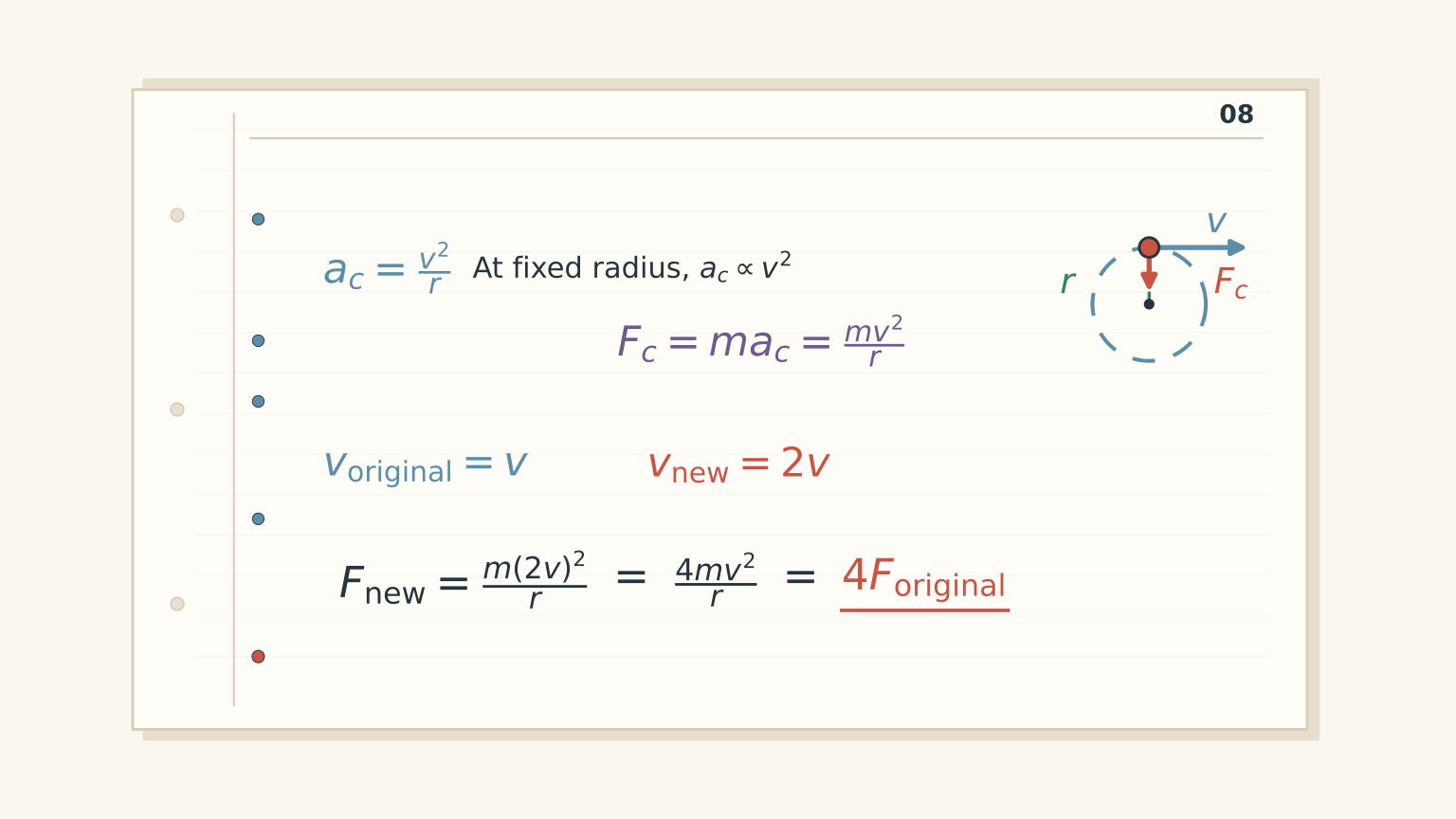
Question: An object moves in a horizontal circle. Its speed is doubled while its mass and orbital radius remain unchanged. Explain why the required centripetal force increases by a factor of four.
A strong answer can be written entirely in dot points.
Step 1Identify the relevant relationship.
Centripetal acceleration is:
\[ a_c = \frac{v^2}{r} \]
Because velocity is squared, centripetal acceleration is proportional to the square of speed when radius is constant.
Step 2Connect acceleration to force.
Newton’s second law gives:
\[ F_c = ma_c = \frac{mv^2}{r} \]
With mass and radius unchanged, centripetal force is also proportional to the square of speed.
Step 3Explain the change.
If the original speed is \(v\), the new speed is \(2v\).
\[ \begin{aligned} F_{\text{new}} &= \frac{m(2v)^2}{r}\\ &= \frac{4mv^2}{r}\\ &= 4F_{\text{original}} \end{aligned} \]
Therefore, doubling the speed quadruples the required centripetal force.
Notice that the answer has a logical sequence:
- State the relevant relationship.
- Connect it to the governing law.
- Apply the change in conditions.
- State the resulting effect.
You can use these four steps in a paragraph or as separate dot points.
The important thing is that the reasoning is complete.
Due to technical limitations, this figure may display incorrectly or contain inaccuracies. Please check key details against your course materials.
04What about evaluate questions in Chemistry?
This is where students sometimes get caught out.
An explain question generally requires you to establish a relationship or mechanism. An evaluate question requires something extra: a judgement.
According to NESA’s glossary, to evaluate means to make a judgement based on criteria.
In Chemistry, that often means considering the benefits and limitations of a process, interpreting experimental evidence, or deciding how effective a particular change is.
You can absolutely use dot points. However, simply listing advantages and disadvantages is not necessarily an evaluation.
You need to connect the evidence to your judgement.
Worked example: A Chemistry evaluation
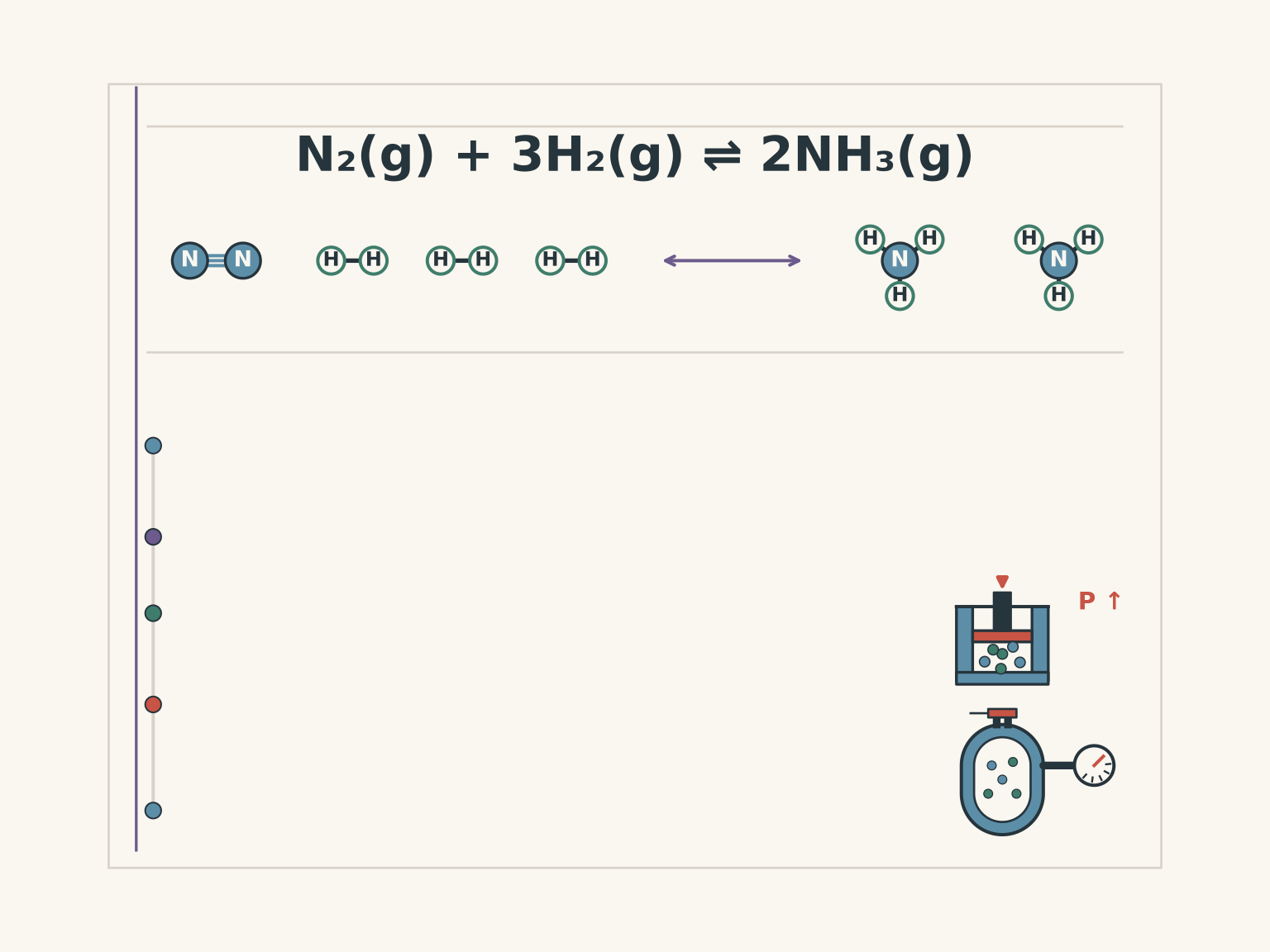
Question: Evaluate whether increasing pressure is an effective way to increase the equilibrium yield of ammonia in the Haber process.
Assume temperature is held constant.
The equilibrium reaction is:
\[ \ce{N2(g) + 3H2(g) <=> 2NH3(g)} \]
A well-structured dot-point response could be:
- Increasing pressure favours the side of the equilibrium with fewer moles of gas, according to Le Chatelier’s principle.
- The forward reaction involves four moles of gaseous reactants producing two moles of gaseous products. Therefore, increasing pressure shifts the equilibrium towards ammonia formation.
- This increases the equilibrium yield of ammonia, making higher pressure beneficial when maximising product yield is the main criterion.
- However, operating at higher pressures requires stronger equipment and increases engineering, safety, and operating demands.
- Therefore, increasing pressure is effective for improving equilibrium yield, but the operating pressure must balance the improvement in yield against the practical costs and risks.
This answer does more than identify what happens to the equilibrium.
It explains why the equilibrium shifts, identifies the benefit, considers a limitation, and reaches a supported judgement.
That’s what makes it an evaluation.
A paragraph could communicate exactly the same reasoning. The choice is yours.
Due to technical limitations, this figure may display incorrectly or contain inaccuracies. Please check key details against your course materials.
Why a list of advantages and disadvantages isn’t enough
Compare the previous answer with this one:
- Higher pressure increases ammonia yield.
- Higher pressure is expensive.
- Higher pressure requires stronger equipment.
These points are relevant, but the response has not fully evaluated the process.
There is no explanation of why the equilibrium shifts towards ammonia. There is also no clear judgement about whether the improvement in yield justifies the additional costs.
The student has supplied information but hasn’t used it to answer the question.
A useful way to approach an evaluation is:
- State the relevant scientific principle.
- Explain what it predicts in the given situation.
- Identify the benefit or positive outcome.
- Consider relevant limitations or competing factors.
- Make an overall judgement.
You don’t need five separate dot points. You need the reasoning represented by those steps.
05Common mistakes when using dot points
There are a few habits worth avoiding in both subjects.
1. Writing one dot point per mark
A four-mark question does not automatically require four dot points.
Mark allocations indicate the expected scope of the response, but they do not establish a universal one-point-per-mark system.
One well-developed point might demonstrate several connected ideas. Four repetitive points might demonstrate very little.
Use the actual marking criteria to judge how much detail is needed.
2. Using incomplete phrases for an explanation
For example:
- Increased temperature.
- More successful collisions.
- Increased reaction rate.
These phrases identify relevant concepts, but they don’t clearly explain their relationship.
A stronger response would be:
- Increasing temperature increases the average kinetic energy of reacting particles.
- A greater proportion of particles therefore have energy equal to or greater than the activation energy.
- Consequently, a greater proportion of collisions are successful per unit time, increasing the reaction rate.
The second version makes the causal relationship explicit.
3. Forgetting the final judgement in an evaluation
If a question asks you to evaluate whether a particular method is effective, don’t finish after listing its advantages and disadvantages.
State your conclusion.
For example:
“Overall, the method improves the accuracy of the measurement, but its additional time and equipment requirements make it less suitable for large-scale testing.”
Your judgement should follow from the evidence you’ve discussed.
4. Including irrelevant information
Dot points can make it tempting to include every fact you remember.
Don’t.
If the question asks you to explain energy losses in a transformer, a lengthy description of how transformers were invented isn’t going to help.
NESA specifically advises students to answer the question being asked rather than relying on memorised responses.
Every point should contribute to answering the question.
06A quick checklist for your next HSC exam
Before moving on from an explain or evaluate question, check the following.
- [ ] Have I answered the actual question?
- [ ] Have I identified the relevant scientific principle, law, or theory?
- [ ] Have I explained the relationship between the relevant variables or concepts?
- [ ] Have I used appropriate Physics or Chemistry terminology?
- [ ] Have I included relevant equations, data, or experimental evidence?
- [ ] If I used dot points, do they connect logically?
- [ ] If the question asks me to evaluate, have I made a clear judgement?
- [ ] Have I followed the instructions and written in the correct answer space?
If you can tick these boxes, your choice of dot points or paragraphs is unlikely to be the issue.
07Does the syllabus change affect this advice?
One important NSW-specific detail: Physics and Chemistry are moving to their new 2025 syllabuses at different times.
As at 15 November 2026:
| Course | New Year 11 syllabus begins | First HSC examination under new syllabus |
|---|---|---|
| Physics | Term 1, 2027 | 2028 |
| Chemistry | Term 1, 2028 | 2029 |
This means a student starting Year 11 in 2027 will study the new Physics syllabus but the existing Chemistry syllabus.
The written-answer advice in this resource applies to both courses. However, always check the syllabus and assessment requirements that apply to your own cohort.
You can check the official NESA Physics syllabus information and NESA Chemistry syllabus information for the implementation dates.
08Questions and solutions
Question 1
A student answers the following Physics question using three dot points:
Explain why doubling the speed of an object moving in a circle quadruples its centripetal force, assuming mass and radius remain constant.
Their answer is:
- Speed doubles.
- Centripetal force increases.
- \(F_c = \frac{mv^2}{r}\).
Is this a sufficiently developed explanation? What should they change?
Solution 1
No. The answer identifies relevant information but doesn’t explicitly explain the relationship between speed and centripetal force.
A stronger response would be:
- Centripetal force is given by \(F_c = \frac{mv^2}{r}\), so it is proportional to the square of speed when mass and radius are constant.
- Doubling the speed multiplies the squared velocity term by four.
- Therefore, the required centripetal force increases by a factor of four.
The improvement isn’t the number of dot points. It’s the explicit reasoning connecting the equation to the conclusion.
Question 2
A student is asked to explain why a catalyst does not change the equilibrium yield of a reversible chemical reaction.
They write:
- A catalyst lowers the activation energy.
- The forward and reverse reactions become faster.
- Equilibrium is reached sooner.
Is this a complete answer?
Solution 2
Not quite. The student has identified what a catalyst does, but hasn’t explained why the equilibrium yield remains unchanged.
A stronger answer would be:
- A catalyst provides an alternative reaction pathway with a lower activation energy.
- This increases the rates of both the forward and reverse reactions.
- Because both reaction rates increase, neither direction is preferentially favoured by the catalyst.
- Therefore, the equilibrium position and equilibrium yield remain unchanged, although equilibrium is reached sooner.
The missing idea was the connection between the two reaction rates and the equilibrium position.
This is exactly the sort of reasoning that makes a dot-point explanation effective.
The takeaway is straightforward: use dot points when they make your scientific reasoning clearer, and use paragraphs when they help you develop a connected argument.
Neither format is automatically better.
The next skill is learning to turn syllabus knowledge into a clear, relevant response under exam conditions. A useful starting point is How to Turn an HSC Syllabus Dot Point Into a Self-Test Question.
And when a Physics question involves forces, directions, or physical arrangements, remember that a correctly annotated diagram can support your written explanation too. See How to Use Diagrams in HSC Physics Written Answers.