
Projectile Launch Angle: Height, Flight Time and Range
Learn how projectile launch angle changes maximum height, flight time, and horizontal range in HSC Physics. Includes worked examples and challenging practice problems.
Two projectiles leave the ground at exactly the same speed. One is launched at \(30^\circ\), and the other at \(60^\circ\). Which one lands farther away?
The \(60^\circ\) launch stays in the air longer and rises much higher, so it is tempting to pick that one. But under the usual ideal projectile assumptions, they land at exactly the same horizontal distance.
That result is the key to understanding launch angle. Increasing the angle gives the projectile more upward velocity, but less sideways velocity. Height and flight time keep increasing as the launch gets steeper. Range does not.
01Start by splitting the launch velocity
Suppose a projectile leaves with speed \(u\) at an angle \(\theta\) above the horizontal.
Its initial velocity can be split into two perpendicular components:
\[
u_x=u\cos\theta
\]
\[
u_y=u\sin\theta
\]
where:
- \(u_x\) is the initial horizontal velocity in \(\mathrm{m\,s^{-1}}\),
- \(u_y\) is the initial vertical velocity in \(\mathrm{m\,s^{-1}}\),
- \(u\) is the launch speed in \(\mathrm{m\,s^{-1}}\), and
- \(\theta\) is the launch angle above the horizontal.
If you need a refresher on why sine and cosine appear here, see Projectile Initial Velocity Components for HSC Physics.
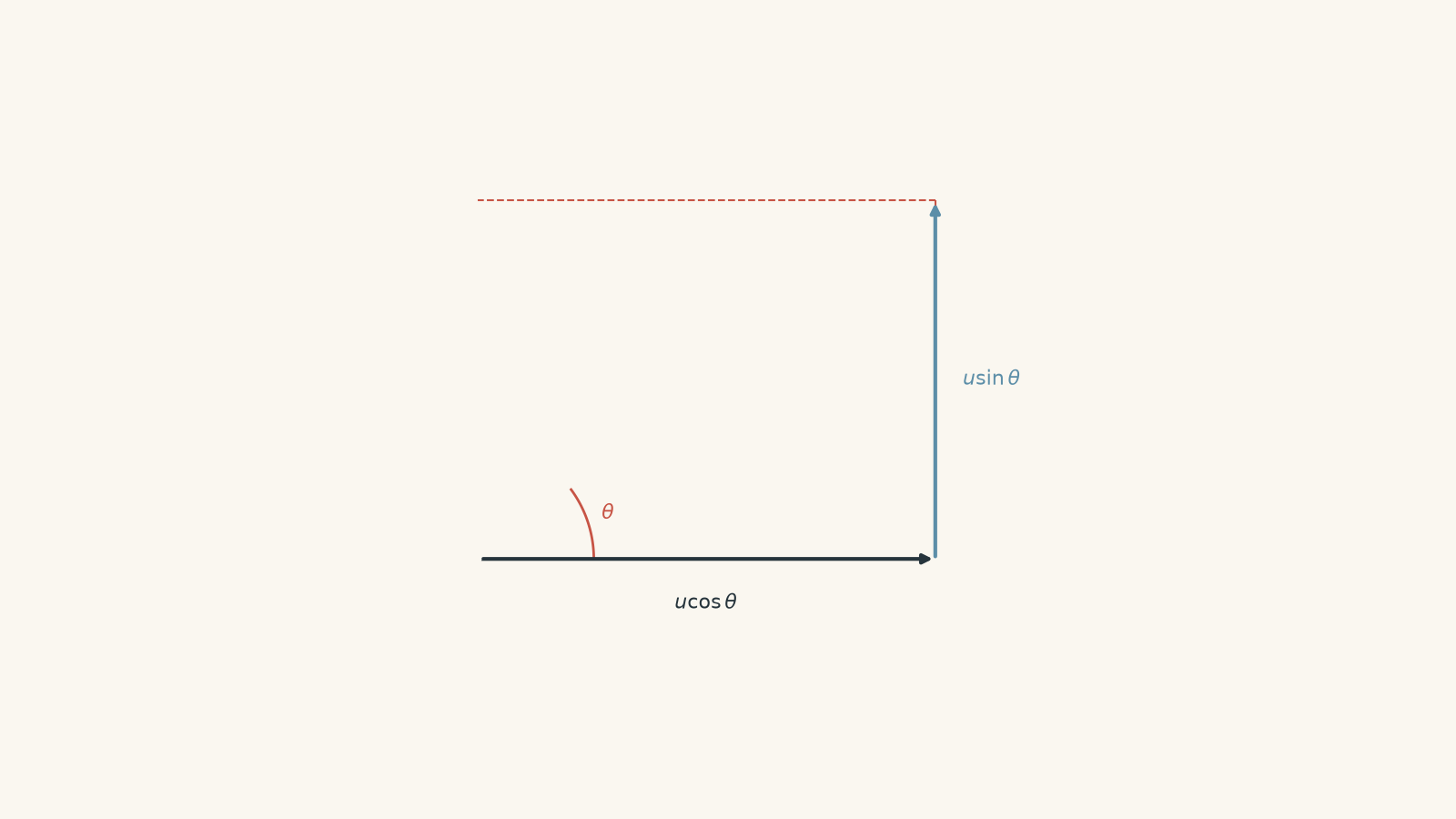
A useful first picture is to think of the launch speed as a fixed velocity budget. Tilt the velocity vector upwards and more of that budget goes into the vertical component, while less goes into the horizontal component.
The analogy is not exact. The components are not quantities that get used up or exchanged during flight. Once the projectile is airborne, gravity continuously changes the vertical velocity, while the horizontal velocity remains constant in the ideal model.
That distinction explains almost everything launch angle does.
02What happens when the angle increases?
Keep the launch speed \(u\) fixed.
As \(\theta\) increases from \(0^\circ\) towards \(90^\circ\):
- \(\cos\theta\) decreases, so \(u_x\) decreases,
- \(\sin\theta\) increases, so \(u_y\) increases,
- the projectile rises higher,
- it stays in the air longer, but
- it does not necessarily travel farther horizontally.
For now, assume:
- air resistance is negligible,
- gravitational acceleration is constant,
- the projectile lands at the same vertical level from which it was launched, and
- \(g=9.8\ \mathrm{m\,s^{-2}}\).
These assumptions matter. In particular, the familiar \(45^\circ\) maximum-range result depends on the launch point and landing point being at the same height. You can review the model in Projectile Motion Assumptions in HSC Physics Explained.
03Launch angle and maximum height
Imagine two balls launched at the same speed. One leaves at \(20^\circ\), and the other at \(70^\circ\).
Which reaches the greater height?
The \(70^\circ\) projectile does, because maximum height depends on the vertical component \(u_y\), not directly on the total launch speed.
At maximum height, the vertical velocity has fallen to zero. Using
\[
v_y^2=u_y^2+2a_y\Delta y
\]
with \(v_y=0\), \(a_y=-g\), and \(\Delta y=H\),
\[
0=u_y^2-2gH
\]
so
\[
H=\frac{u_y^2}{2g}.
\]
Since \(u_y=u\sin\theta\),
\[
H=\frac{u^2\sin^2\theta}{2g}.
\]
Here \(H\) is the maximum height above the launch point, measured in metres.
For a fixed launch speed,
\[
H\propto\sin^2\theta.
\]
So increasing the launch angle increases the maximum height all the way up to \(90^\circ\).
A vertical launch has the greatest possible height because all of the initial velocity is vertical.
04Launch angle and flight time
Now consider time in the air.
For a projectile that lands back at its launch height, the upward and downward parts of the vertical motion are symmetric.
The time to reach maximum height comes from
\[
v_y=u_y-gt.
\]
At the top, \(v_y=0\), so
\[
t_{\text{up}}=\frac{u_y}{g}.
\]
The total flight time \(T\) is twice this:
\[
T=\frac{2u_y}{g}.
\]
Substituting \(u_y=u\sin\theta\),
\[
T=\frac{2u\sin\theta}{g}.
\]
So, for a fixed launch speed,
\[
T\propto\sin\theta.
\]
A steeper launch stays airborne longer.
This sometimes gets confused with range. More time in the air sounds as though it must mean more horizontal distance. But the steeper projectile also has a smaller horizontal velocity. Range depends on both effects at once.
05Launch angle and horizontal range
Horizontal acceleration is zero in the ideal projectile model, so
\[
R=u_xT,
\]
where \(R\) is the horizontal range in metres.
Using
\[
u_x=u\cos\theta
\]
and
\[
T=\frac{2u\sin\theta}{g},
\]
we get
\[
R=(u\cos\theta)\left(\frac{2u\sin\theta}{g}\right).
\]
Therefore,
\[
R=\frac{2u^2\sin\theta\cos\theta}{g}.
\]
Using the identity
\[
2\sin\theta\cos\theta=\sin2\theta,
\]
the range equation becomes
\[
R=\frac{u^2\sin2\theta}{g}.
\]
This equation contains the important surprise.
Range depends on \(\sin2\theta\), not simply on \(\sin\theta\) or \(\cos\theta\).
06Why \(45^\circ\) gives maximum range
For fixed \(u\) and \(g\), the only part of
\[
R=\frac{u^2\sin2\theta}{g}
\]
that can change is \(\sin2\theta\).
The largest possible value of sine is \(1\). Therefore maximum range occurs when
\[
\sin2\theta=1.
\]
That means
\[
2\theta=90^\circ
\]
and therefore
\[
\theta=45^\circ.
\]
So an ideal projectile launched and landing at the same height has maximum range at \(45^\circ\).
Notice what this does not mean. It does not mean \(45^\circ\) is the best launch angle in every projectile problem. If the landing point is above or below the launch point, if air resistance matters, or if an obstacle constrains the path, the answer can change.
07Complementary angles have the same range
Return to the original \(30^\circ\) and \(60^\circ\) puzzle.
For \(30^\circ\),
\[
\sin(2\theta)=\sin60^\circ.
\]
For \(60^\circ\),
\[
\sin(2\theta)=\sin120^\circ.
\]
But
\[
\sin60^\circ=\sin120^\circ.
\]
Therefore the ranges are equal.
More generally, two launch angles that add to \(90^\circ\) give the same range when the launch speed and landing height are the same.
Examples include:
- \(20^\circ\) and \(70^\circ\),
- \(35^\circ\) and \(55^\circ\),
- \(40^\circ\) and \(50^\circ\).
These are called complementary angles.
They have equal range, but they do not have equal trajectories.
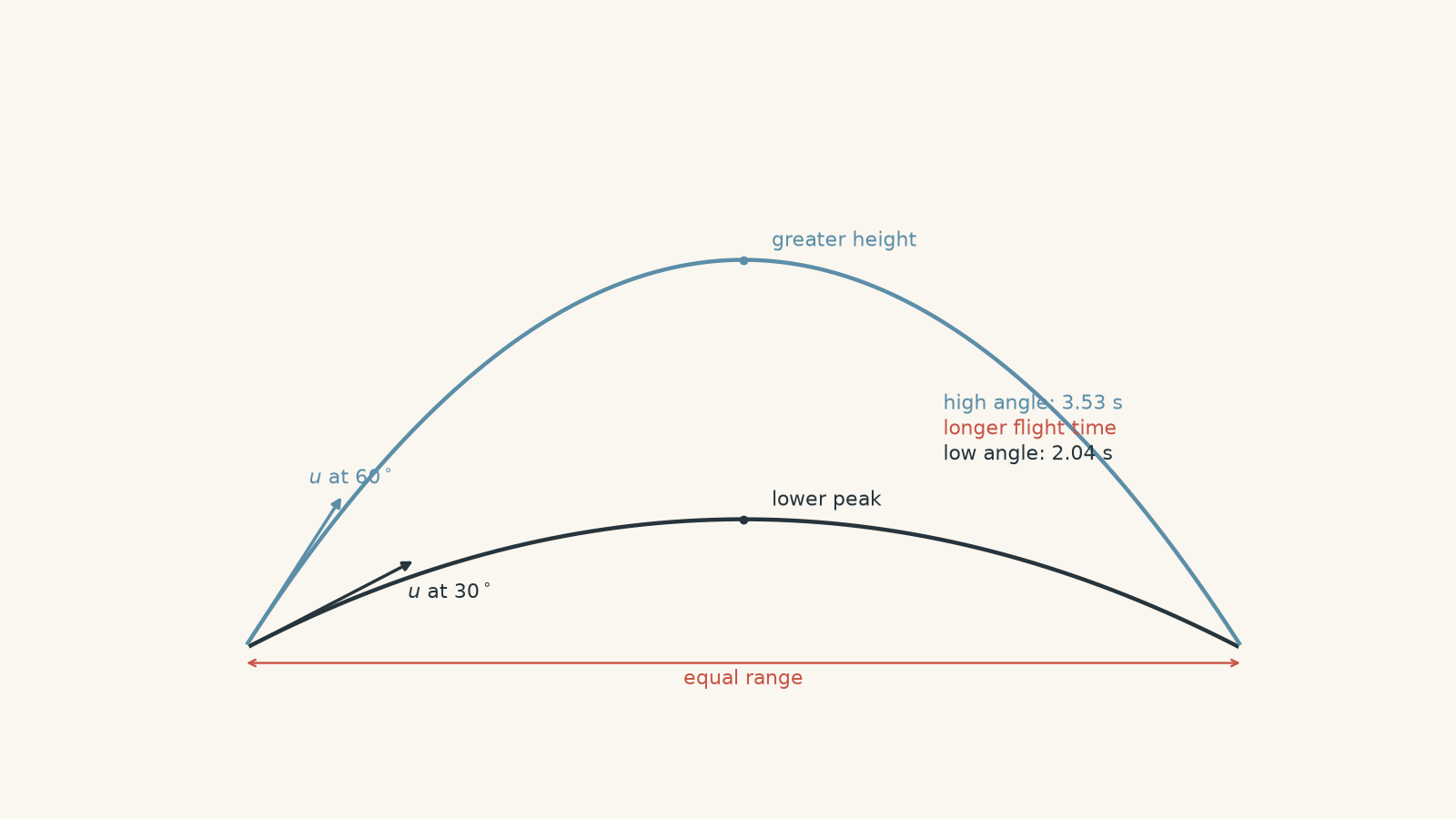
The low-angle projectile has a larger horizontal component, so it covers ground quickly.
The high-angle projectile has a larger vertical component, so it spends much longer in the air.
Those two effects happen to balance perfectly when the angles are complementary.
08Comparing height, time, and range directly
For a fixed launch speed and equal launch and landing heights:
| Quantity | Equation | Effect of increasing angle from \(0^\circ\) to \(90^\circ\) |
|---|---|---|
| Horizontal component | \(u_x=u\cos\theta\) | Decreases |
| Vertical component | \(u_y=u\sin\theta\) | Increases |
| Maximum height | \(H=\frac{u^2\sin^2\theta}{2g}\) | Increases |
| Flight time | \(T=\frac{2u\sin\theta}{g}\) | Increases |
| Range | \(R=\frac{u^2\sin2\theta}{g}\) | Increases to \(45^\circ\), then decreases |
For example, take \(u=20\ \mathrm{m\,s^{-1}}\).
| Angle | \(u_x\) (\(\mathrm{m\,s^{-1}}\)) | \(u_y\) (\(\mathrm{m\,s^{-1}}\)) | Maximum height (m) | Flight time (s) | Range (m) |
|---|---|---|---|---|---|
| \(30^\circ\) | 17.32 | 10.00 | 5.10 | 2.04 | 35.35 |
| \(45^\circ\) | 14.14 | 14.14 | 10.20 | 2.89 | 40.82 |
| \(60^\circ\) | 10.00 | 17.32 | 15.31 | 3.53 | 35.35 |
The \(60^\circ\) projectile rises three times as high as the \(30^\circ\) projectile here, and remains airborne much longer, yet their ranges are equal.
That is why judging range from the shape of the path can be misleading.
Worked example: Find the height, flight time, and range
A ball is launched from level ground at \(22\ \mathrm{m\,s^{-1}}\) at an angle of \(40^\circ\) above the horizontal. Ignore air resistance. Calculate its maximum height, total flight time, and horizontal range.
Step 1
\[
\begin{aligned}
u_x&=u\cos\theta\\
&=22\cos40^\circ\\
&=16.85\ \mathrm{m\,s^{-1}}
\end{aligned}
\]
and
\[
\begin{aligned}
u_y&=u\sin\theta\\
&=22\sin40^\circ\\
&=14.14\ \mathrm{m\,s^{-1}}.
\end{aligned}
\]
The vertical component controls the height and flight time. The horizontal component tells us how quickly the projectile moves across the ground.
Step 2
\[
\begin{aligned}
H&=\frac{u_y^2}{2g}\\
&=\frac{(14.14)^2}{2(9.8)}\\
&=10.2\ \mathrm{m}.
\end{aligned}
\]
So the projectile rises about \(10.2\ \mathrm{m}\) above its launch point.
Step 3
\[
\begin{aligned}
T&=\frac{2u_y}{g}\\
&=\frac{2(14.14)}{9.8}\\
&=2.89\ \mathrm{s}.
\end{aligned}
\]
Step 4
\[
\begin{aligned}
R&=u_xT\\
&=(16.85)(2.89)\\
&=48.6\ \mathrm{m}.
\end{aligned}
\]
The ball therefore reaches a maximum height of about \(10.2\ \mathrm{m}\), remains in the air for \(2.89\ \mathrm{s}\), and lands about \(48.6\ \mathrm{m}\) from its launch point.
Worked example: Same range, very different trajectories
Two projectiles are launched from level ground at \(24\ \mathrm{m\,s^{-1}}\). Projectile A is launched at \(35^\circ\), while projectile B is launched at \(55^\circ\). Compare their range, flight time, and maximum height.
Step 1
\[
35^\circ+55^\circ=90^\circ.
\]
The angles are complementary. Because both projectiles have the same launch speed and return to the same height, we should predict equal ranges.
Step 2
\[
\begin{aligned}
u_{x,A}&=24\cos35^\circ=19.66\ \mathrm{m\,s^{-1}},\\
u_{y,A}&=24\sin35^\circ=13.77\ \mathrm{m\,s^{-1}}.
\end{aligned}
\]
Its flight time is
\[
\begin{aligned}
T_A&=\frac{2u_{y,A}}{g}\\
&=\frac{2(13.77)}{9.8}\\
&=2.81\ \mathrm{s}.
\end{aligned}
\]
Its maximum height is
\[
\begin{aligned}
H_A&=\frac{u_{y,A}^2}{2g}\\
&=\frac{(13.77)^2}{19.6}\\
&=9.67\ \mathrm{m}.
\end{aligned}
\]
Its range is
\[
\begin{aligned}
R_A&=u_{x,A}T_A\\
&=(19.66)(2.81)\\
&=55.2\ \mathrm{m}.
\end{aligned}
\]
Step 3
\[
\begin{aligned}
u_{x,B}&=24\cos55^\circ=13.77\ \mathrm{m\,s^{-1}},\\
u_{y,B}&=24\sin55^\circ=19.66\ \mathrm{m\,s^{-1}}.
\end{aligned}
\]
Therefore,
\[
\begin{aligned}
T_B&=\frac{2(19.66)}{9.8}=4.01\ \mathrm{s},\\
H_B&=\frac{(19.66)^2}{19.6}=19.7\ \mathrm{m},\\
R_B&=(13.77)(4.01)=55.2\ \mathrm{m}.
\end{aligned}
\]
Step 4
Both projectiles travel about \(55.2\ \mathrm{m}\) horizontally.
Projectile B, at \(55^\circ\), reaches roughly twice the height and remains airborne for about \(1.20\ \mathrm{s}\) longer. Its smaller horizontal velocity is exactly compensated by its longer flight time.
09The most tempting misconception
A common prediction is:
A larger launch angle means a larger range because the projectile stays in the air longer.
The first half is correct. Increasing the angle does increase the flight time, provided the launch speed stays fixed.
The problem is that the horizontal velocity simultaneously falls:
\[
u_x=u\cos\theta.
\]
Near \(0^\circ\), the projectile has plenty of horizontal speed but almost no time in the air.
Near \(90^\circ\), it has plenty of flight time but almost no horizontal speed.
Maximum range occurs between those extremes, where the two effects balance. For equal launch and landing heights, that balance occurs at \(45^\circ\).
Another tempting shortcut is to say that complementary angles always have equal ranges. They do not.
That result depends on equal launch speed and equal launch and landing heights. Launch from a cliff, and the extra falling time changes the balance.
10What if the projectile lands at a different height?
Suppose a projectile is launched from a cliff.
A \(30^\circ\) and a \(60^\circ\) launch no longer have to travel the same horizontal distance before hitting the ground, even if their launch speeds are equal.
Why not?
The equation
\[
T=\frac{2u\sin\theta}{g}
\]
came from vertical symmetry. It assumes the projectile lands at its original height.
From a cliff, the projectile continues falling after it passes the launch level. Its total flight time must instead be found from the vertical displacement equation
\[
\Delta y=u_y t-\frac{1}{2}gt^2.
\]
Once that flight time is known, the horizontal range is still
\[
R=u_xt.
\]
So the component idea survives. The convenient same-level formulas do not.
That is an important HSC habit: before using a memorised projectile formula, check the physical condition that made the formula true.
11Questions and solutions
Question 1
A projectile is launched from level ground at \(18\ \mathrm{m\,s^{-1}}\) at \(40^\circ\) above the horizontal. Ignore air resistance.
Calculate:
a. its maximum height,
b. its total flight time, and
c. its horizontal range.
Solution 1
The projectile reaches a maximum height of \(6.83\ \mathrm{m}\), stays airborne for \(2.36\ \mathrm{s}\), and travels \(32.6\ \mathrm{m}\) horizontally.
First resolve the initial velocity:
\[
\begin{aligned}
u_x&=18\cos40^\circ\\
&=13.79\ \mathrm{m\,s^{-1}},
\end{aligned}
\]
and
\[
\begin{aligned}
u_y&=18\sin40^\circ\\
&=11.57\ \mathrm{m\,s^{-1}}.
\end{aligned}
\]
For maximum height,
\[
\begin{aligned}
H&=\frac{u_y^2}{2g}\\
&=\frac{(11.57)^2}{2(9.8)}\\
&=6.83\ \mathrm{m}.
\end{aligned}
\]
For total flight time,
\[
\begin{aligned}
T&=\frac{2u_y}{g}\\
&=\frac{2(11.57)}{9.8}\\
&=2.36\ \mathrm{s}.
\end{aligned}
\]
The range is therefore
\[
\begin{aligned}
R&=u_xT\\
&=(13.79)(2.36)\\
&=32.6\ \mathrm{m}.
\end{aligned}
\]
A tempting mistake is to use the full \(18\ \mathrm{m\,s^{-1}}\) as the horizontal velocity. Only the horizontal component carries the projectile across the ground.
Question 2
A launcher fires a projectile from level ground at \(28\ \mathrm{m\,s^{-1}}\). The projectile must land \(60.0\ \mathrm{m}\) away at the same height.
Ignoring air resistance:
a. find both possible launch angles,
b. find the flight time for each trajectory, and
c. find the maximum height for each trajectory.
Solution 2
There are two possible launch angles: approximately \(24.3^\circ\) and \(65.7^\circ\). They have the same range, but their flight times and maximum heights are very different.
Use the same-level range equation
\[
R=\frac{u^2\sin2\theta}{g}.
\]
Substitute \(R=60.0\ \mathrm{m}\), \(u=28\ \mathrm{m\,s^{-1}}\), and \(g=9.8\ \mathrm{m\,s^{-2}}\):
\[
\begin{aligned}
60.0&=\frac{28^2\sin2\theta}{9.8}\\
\sin2\theta&=\frac{(60.0)(9.8)}{28^2}\\
&=0.750.
\end{aligned}
\]
One solution is
\[
2\theta=\sin^{-1}(0.750)=48.59^\circ.
\]
But sine is also positive in the second quadrant, so
\[
2\theta=180^\circ-48.59^\circ=131.41^\circ.
\]
Therefore,
\[
\theta=24.30^\circ
\]
or
\[
\theta=65.70^\circ.
\]
The angles add to \(90^\circ\), as expected for equal-range complementary trajectories.
For the lower trajectory,
\[
u_y=28\sin24.30^\circ=11.52\ \mathrm{m\,s^{-1}}.
\]
Hence
\[
\begin{aligned}
T&=\frac{2(11.52)}{9.8}\\
&=2.35\ \mathrm{s},
\end{aligned}
\]
and
\[
\begin{aligned}
H&=\frac{(11.52)^2}{19.6}\\
&=6.77\ \mathrm{m}.
\end{aligned}
\]
For the higher trajectory,
\[
u_y=28\sin65.70^\circ=25.52\ \mathrm{m\,s^{-1}}.
\]
Therefore,
\[
\begin{aligned}
T&=\frac{2(25.52)}{9.8}\\
&=5.21\ \mathrm{s},
\end{aligned}
\]
and
\[
\begin{aligned}
H&=\frac{(25.52)^2}{19.6}\\
&=33.2\ \mathrm{m}.
\end{aligned}
\]
The tempting route is to stop after the calculator gives \(2\theta=48.59^\circ\). That loses the second physical trajectory. Because sine takes the same positive value at two angles between \(0^\circ\) and \(180^\circ\), a reachable same-level target usually has a low-angle and a high-angle solution.
Question 3
A projectile is launched from ground level at \(25.0\ \mathrm{m\,s^{-1}}\). A target is on the ground farther away, but there is a vertical wall \(20.0\ \mathrm{m}\) from the launcher. The wall is \(8.00\ \mathrm{m}\) high.
Two launch angles are being considered: \(30^\circ\) and \(60^\circ\).
a. Show that the two launch angles give the same unobstructed range.
b. Determine the height of each projectile when it reaches the wall.
c. State which trajectory can pass the wall and continue to the target side.
Solution 3
Both projectiles have the same unobstructed range of \(55.2\ \mathrm{m}\), but only the \(60^\circ\) projectile clears the \(8.00\ \mathrm{m}\) wall.
For range,
\[
R=\frac{u^2\sin2\theta}{g}.
\]
At \(30^\circ\),
\[
\begin{aligned}
R_{30}&=\frac{25.0^2\sin60^\circ}{9.8}\\
&=55.2\ \mathrm{m}.
\end{aligned}
\]
At \(60^\circ\),
\[
\begin{aligned}
R_{60}&=\frac{25.0^2\sin120^\circ}{9.8}\\
&=55.2\ \mathrm{m}.
\end{aligned}
\]
The ranges are equal because \(30^\circ\) and \(60^\circ\) are complementary.
Equal range does not mean equal path, though. To find the height at horizontal position \(x\), use
\[
y=x\tan\theta-\frac{gx^2}{2u^2\cos^2\theta},
\]
where \(x\) and \(y\) are measured from the launch point.
For the \(30^\circ\) projectile at \(x=20.0\ \mathrm{m}\),
\[
\begin{aligned}
y&=(20.0)\tan30^\circ
-\frac{(9.8)(20.0)^2}
{2(25.0)^2\cos^230^\circ}\\
&=7.37\ \mathrm{m}.
\end{aligned}
\]
Because \(7.37\ \mathrm{m}<8.00\ \mathrm{m}\), it hits the wall.
For the \(60^\circ\) projectile,
\[
\begin{aligned}
y&=(20.0)\tan60^\circ
-\frac{(9.8)(20.0)^2}
{2(25.0)^2\cos^260^\circ}\\
&=22.1\ \mathrm{m}.
\end{aligned}
\]
Because \(22.1\ \mathrm{m}>8.00\ \mathrm{m}\), it clears the wall.
The tempting conclusion is that equal range makes the two launch angles interchangeable. They are interchangeable only if the landing point is the only constraint. Once an obstacle cares about the height of the path at an intermediate position, the two trajectories behave very differently.
Question 4
A projectile was launched from level ground. A video analysis shows that when it is \(30.0\ \mathrm{m}\) horizontally from the launch point, its velocity components are
\[
v_x=15.0\ \mathrm{m\,s^{-1}}
\]
and
\[
v_y=+3.00\ \mathrm{m\,s^{-1}}.
\]
Ignore air resistance.
Determine:
a. the time elapsed since launch,
b. the initial horizontal and vertical velocity components,
c. the launch speed and launch angle,
d. the projectile’s height at the observed instant,
e. its maximum height, and
f. its eventual horizontal range.
Solution 4
The projectile was launched at approximately \(27.1\ \mathrm{m\,s^{-1}}\) and \(56.4^\circ\), not at the \(11.3^\circ\) direction in which its velocity happens to point at the observed instant. Its maximum height is about \(26.1\ \mathrm{m}\), and its range is about \(69.2\ \mathrm{m}\).
The key constraint is that horizontal velocity remains constant. Therefore,
\[
u_x=v_x=15.0\ \mathrm{m\,s^{-1}}.
\]
The elapsed time follows from horizontal motion:
\[
\begin{aligned}
x&=u_xt\\
30.0&=(15.0)t\\
t&=2.00\ \mathrm{s}.
\end{aligned}
\]
Vertically,
\[
v_y=u_y-gt.
\]
Therefore,
\[
\begin{aligned}
u_y&=v_y+gt\\
&=3.00+(9.8)(2.00)\\
&=22.6\ \mathrm{m\,s^{-1}}.
\end{aligned}
\]
The launch speed is
\[
\begin{aligned}
u&=\sqrt{u_x^2+u_y^2}\\
&=\sqrt{15.0^2+22.6^2}\\
&=27.1\ \mathrm{m\,s^{-1}}.
\end{aligned}
\]
The launch angle satisfies
\[
\tan\theta=\frac{u_y}{u_x}.
\]
Hence,
\[
\begin{aligned}
\theta&=\tan^{-1}\left(\frac{22.6}{15.0}\right)\\
&=56.4^\circ.
\end{aligned}
\]
Now find the height at \(t=2.00\ \mathrm{s}\):
\[
\begin{aligned}
y&=u_yt-\frac{1}{2}gt^2\\
&=(22.6)(2.00)-\frac{1}{2}(9.8)(2.00)^2\\
&=25.6\ \mathrm{m}.
\end{aligned}
\]
The maximum height is
\[
\begin{aligned}
H&=\frac{u_y^2}{2g}\\
&=\frac{(22.6)^2}{19.6}\\
&=26.1\ \mathrm{m}.
\end{aligned}
\]
That makes sense: the projectile is already at \(25.6\ \mathrm{m}\) and still moving upwards at only \(3.00\ \mathrm{m\,s^{-1}}\), so it must be close to its highest point.
The total flight time is
\[
\begin{aligned}
T&=\frac{2u_y}{g}\\
&=\frac{2(22.6)}{9.8}\\
&=4.61\ \mathrm{s}.
\end{aligned}
\]
Therefore the range is
\[
\begin{aligned}
R&=u_xT\\
&=(15.0)(4.61)\\
&=69.2\ \mathrm{m}.
\end{aligned}
\]
The tempting route is to calculate the angle of the current velocity:
\[
\tan^{-1}\left(\frac{3.00}{15.0}\right)=11.3^\circ
\]
and call that the launch angle. But gravity has already reduced the vertical velocity from \(22.6\ \mathrm{m\,s^{-1}}\) to \(3.00\ \mathrm{m\,s^{-1}}\). The current direction of motion is not the original launch direction.
Question 5
A projectile is launched from ground level at \(25.0\ \mathrm{m\,s^{-1}}\). It is observed to pass through the point \(20.0\ \mathrm{m}\) horizontally from the launcher and \(10.0\ \mathrm{m}\) above the launch level.
Ignore air resistance.
a. Find all possible launch angles between \(0^\circ\) and \(90^\circ\).
b. For each launch angle, determine whether the projectile is moving upwards or downwards as it passes through the observed point.
c. Find the eventual range of each trajectory.
d. Explain why the two launch angles are not complementary, even though one launch speed produces two possible trajectories through the same point.
Solution 5
There are two possible launch angles, approximately \(36.6^\circ\) and \(79.9^\circ\). The \(36.6^\circ\) projectile passes the point while rising and eventually lands about \(61.1\ \mathrm{m}\) from the launcher. The \(79.9^\circ\) projectile passes the same point while falling and lands only about \(21.9\ \mathrm{m}\) from the launcher.
The important constraint is that the projectile is required to pass through an intermediate point, not land at that point. The familiar complementary-angle result therefore does not apply.
Use the trajectory equation
\[
y=x\tan\theta-\frac{gx^2}{2u^2\cos^2\theta}.
\]
Substitute \(x=20.0\ \mathrm{m}\), \(y=10.0\ \mathrm{m}\), and \(u=25.0\ \mathrm{m\,s^{-1}}\):
\[
10.0
=
20.0\tan\theta
–
\frac{(9.8)(20.0)^2}
{2(25.0)^2\cos^2\theta}.
\]
Since
\[
\frac{(9.8)(20.0)^2}{2(25.0)^2}=3.136,
\]
we have
\[
10.0=20.0\tan\theta-3.136\sec^2\theta.
\]
Now use
\[
\sec^2\theta=1+\tan^2\theta.
\]
Let
\[
p=\tan\theta.
\]
Then
\[
10.0=20.0p-3.136(1+p^2).
\]
Rearranging,
\[
3.136p^2-20.0p+13.136=0.
\]
Using the quadratic formula,
\[
p=
\frac{20.0\pm\sqrt{20.0^2-4(3.136)(13.136)}}
{2(3.136)}.
\]
This gives
\[
p=0.743
\]
or
\[
p=5.63.
\]
Therefore,
\[
\theta=\tan^{-1}(0.743)=36.6^\circ
\]
or
\[
\theta=\tan^{-1}(5.63)=79.9^\circ.
\]
Now determine what each projectile is doing when it reaches \(x=20.0\ \mathrm{m}\).
For the \(36.6^\circ\) launch,
\[
\begin{aligned}
u_x&=25.0\cos36.6^\circ\\
&=20.06\ \mathrm{m\,s^{-1}},
\end{aligned}
\]
and
\[
u_y=25.0\sin36.6^\circ=14.92\ \mathrm{m\,s^{-1}}.
\]
The time taken to reach \(x=20.0\ \mathrm{m}\) is
\[
\begin{aligned}
t&=\frac{x}{u_x}\\
&=\frac{20.0}{20.06}\\
&=0.997\ \mathrm{s}.
\end{aligned}
\]
Its vertical velocity there is
\[
\begin{aligned}
v_y&=u_y-gt\\
&=14.92-(9.8)(0.997)\\
&=+5.15\ \mathrm{m\,s^{-1}}.
\end{aligned}
\]
The positive sign means it is still rising.
Its total range is
\[
\begin{aligned}
R&=\frac{u^2\sin2\theta}{g}\\
&=\frac{25.0^2\sin(73.2^\circ)}{9.8}\\
&=61.1\ \mathrm{m}.
\end{aligned}
\]
For the \(79.9^\circ\) launch,
\[
\begin{aligned}
u_x&=25.0\cos79.9^\circ\\
&=4.37\ \mathrm{m\,s^{-1}},
\end{aligned}
\]
and
\[
u_y=25.0\sin79.9^\circ=24.62\ \mathrm{m\,s^{-1}}.
\]
The time to reach \(x=20.0\ \mathrm{m}\) is
\[
\begin{aligned}
t&=\frac{20.0}{4.37}\\
&=4.58\ \mathrm{s}.
\end{aligned}
\]
Its vertical velocity is then
\[
\begin{aligned}
v_y&=24.62-(9.8)(4.58)\\
&=-20.2\ \mathrm{m\,s^{-1}}.
\end{aligned}
\]
The negative sign means it is descending.
Its total range is
\[
\begin{aligned}
R&=\frac{25.0^2\sin(159.9^\circ)}{9.8}\\
&=21.9\ \mathrm{m}.
\end{aligned}
\]
So the high-angle projectile passes through the observed point only shortly before it hits the ground.
The tempting prediction is that two valid launch angles must be complementary. That rule belongs to a different condition: two launches with the same speed that land at the same horizontal position and at the launch height.
Here the point \((20.0\ \mathrm{m},10.0\ \mathrm{m})\) is not a landing point. One trajectory reaches it early while climbing, and the other reaches it much later while descending. There is no reason for the angles to add to \(90^\circ\), and in fact
\[
36.6^\circ+79.9^\circ=116.5^\circ.
\]
That is the broader lesson from launch angle problems. The angle does not control height, time, and range independently. It changes the horizontal and vertical parts of the same initial velocity, and the conditions of the problem decide how those two components must work together. The next useful step is learning to recognise when the convenient same-level formulas apply, and when you need to return to the horizontal and vertical kinematic equations instead.