
Maximum Height of a Projectile: HSC Physics Explained
Learn how to derive and calculate the maximum height of a projectile using vertical motion, velocity components, and HSC kinematics equations.
A ball launched at an angle climbs, slows vertically, reaches the top of its path, then falls. At that highest point, has the projectile stopped?
Predict before reading on: is its speed zero, is its acceleration zero, or is only its vertical velocity zero?
Only the vertical velocity is zero. Unless the projectile was launched straight up, it is still moving horizontally. Gravity is also still accelerating it downwards. That one distinction is the key to calculating maximum height correctly.
01Maximum height is a vertical-motion problem
Imagine launching a ball with initial speed \(u\) at an angle \(\theta\) above the horizontal. Its initial velocity can be split into two components:
\[
u_x = u\cos\theta
\]
\[
u_y = u\sin\theta
\]
Here:
- \(u_x\) is the initial horizontal velocity in \(\mathrm{m\,s^{-1}}\),
- \(u_y\) is the initial vertical velocity in \(\mathrm{m\,s^{-1}}\),
- \(u\) is the magnitude of the initial velocity in \(\mathrm{m\,s^{-1}}\), and
- \(\theta\) is the launch angle above the horizontal.
If resolving a velocity vector into components is still shaky, revise projectile initial velocity components first.
For maximum height, the horizontal component does not directly matter. Gravity acts vertically, so it is \(u_y\) that determines how far the projectile can climb.
You can picture the two velocity components as people assigned different parts of a group project. The vertical component gets all the gravity drama. It keeps changing. The horizontal component, in the ideal HSC model, is basically left alone.
The analogy breaks because the components are not actually separate motions or objects. They are two perpendicular parts of one velocity vector.
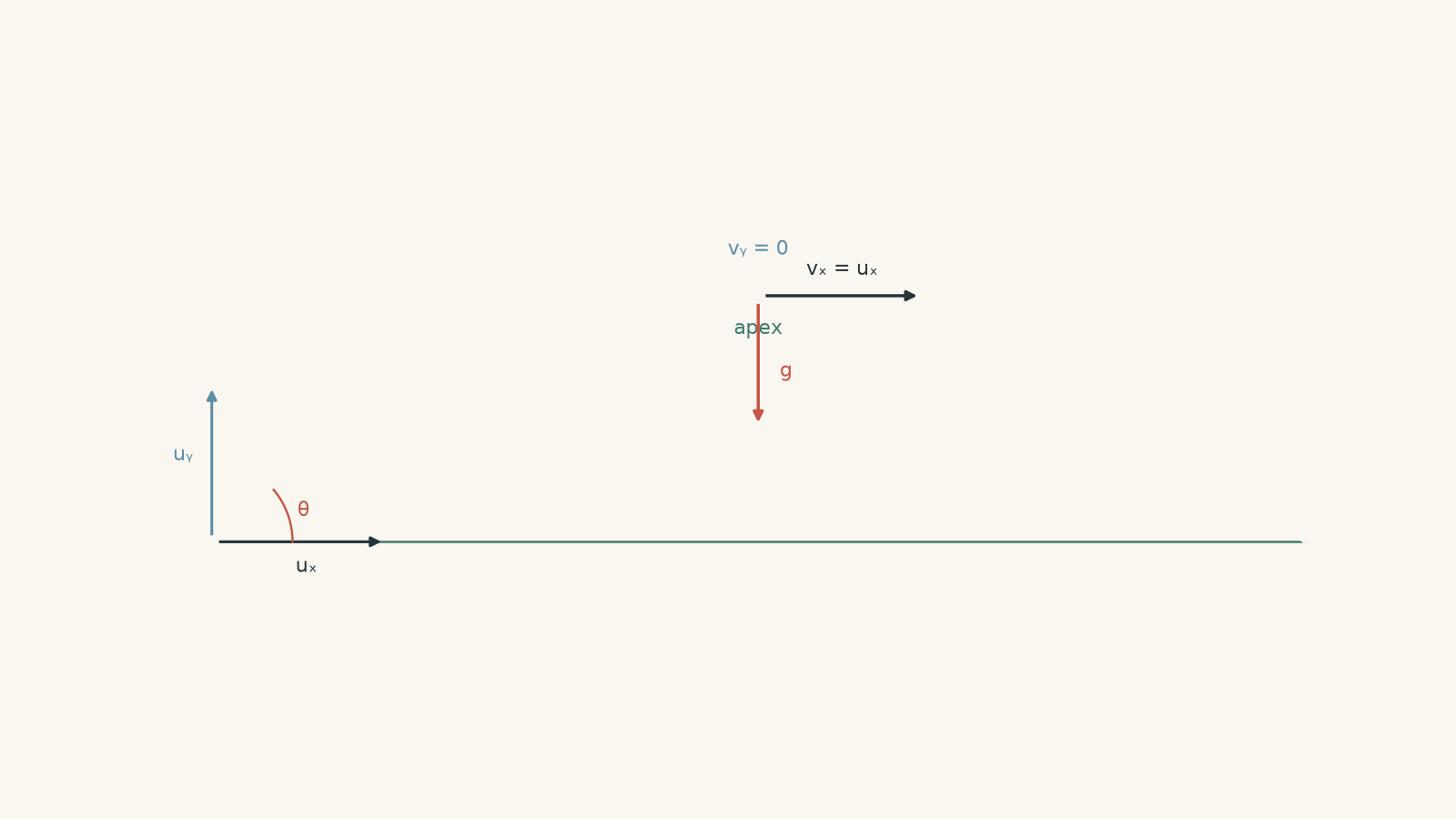
What exactly happens at the top?
Take upwards as the positive vertical direction.
During the ascent:
- the vertical velocity \(v_y\) is positive,
- gravity produces vertical acceleration \(a_y=-g\),
- \(v_y\) steadily decreases.
At maximum height:
| Quantity | Value at the apex |
|---|---|
| Vertical velocity \(v_y\) | \(0\) |
| Horizontal velocity \(v_x\) | still \(u_x\) |
| Vertical acceleration \(a_y\) | \(-g\) |
| Total speed | usually not zero |
Near Earth’s surface, HSC projectile questions normally use \(g=9.8\ \mathrm{m\,s^{-2}}\), unless another value is supplied.
The crucial condition is therefore
\[
v_y=0
\]
not \(v=0\).
02Deriving the maximum-height formula
We want the vertical displacement from the launch point to the apex. Call this \(H\).
The vertical kinematics equation
\[
v_y^2=u_y^2+2a_y\Delta y
\]
is useful because it contains displacement but does not require time.
For the trip from launch to maximum height:
- \(v_y=0\),
- \(a_y=-g\),
- \(\Delta y=H\).
Substituting gives
\[
0^2=u_y^2+2(-g)H
\]
so
\[
0=u_y^2-2gH
\]
and therefore
\[
H=\frac{u_y^2}{2g}
\]
This \(H\) is the maximum height above the launch point.
If the projectile is launched with speed \(u\) at angle \(\theta\), then \(u_y=u\sin\theta\), giving
\[
H=\frac{u^2\sin^2\theta}{2g}
\]
This is the standard maximum-height result for ideal projectile motion.
Notice what the equation is saying physically. A larger initial vertical velocity gives the projectile more upward motion for gravity to remove. Because \(u_y\) is squared, doubling the vertical component produces four times the rise.
If the projectile starts above ground
Suppose the launch point is already at height \(y_0\) above the ground.
The formula
\[
H=\frac{u_y^2}{2g}
\]
still gives only the extra height gained after launch.
The maximum height above the ground is then
\[
y_{\max}=y_0+\frac{u_y^2}{2g}
\]
This distinction causes a lot of avoidable errors. Always ask: does the question want the rise above the launch point, or the maximum height above some reference such as the ground?
03Why time gives the same result
There is another route to the same formula.
From
\[
v_y=u_y+a_yt
\]
the vertical velocity at the top is zero:
\[
0=u_y-gt_{\text{top}}
\]
so
\[
t_{\text{top}}=\frac{u_y}{g}
\]
Now use vertical displacement:
\[
H=u_yt_{\text{top}}-\frac{1}{2}gt_{\text{top}}^2
\]
Substituting \(t_{\text{top}}=u_y/g\),
\[
H=u_y\left(\frac{u_y}{g}\right)
-\frac{1}{2}g\left(\frac{u_y}{g}\right)^2
=\frac{u_y^2}{2g}
\]
Same result.
The velocity-squared equation is usually faster when the question asks only for maximum height. The time method becomes useful when the time to the apex is also needed.
Worked example: Maximum height from launch speed and angle
A projectile is launched from ground level at \(20.0\ \mathrm{m\,s^{-1}}\), \(30.0^\circ\) above the horizontal. Calculate its maximum height above the launch point. Neglect air resistance.
Step 1
\[
u_y=u\sin\theta
=20.0\sin30.0^\circ
=10.0\ \mathrm{m\,s^{-1}}
\]
Only this vertical component determines the rise.
Step 2
\[
H=\frac{u_y^2}{2g}
=\frac{(10.0)^2}{2(9.8)}
=5.10\ \mathrm{m}
\]
Step 3
The projectile rises \(5.10\ \mathrm{m}\) above its launch point before its vertical velocity reaches zero.
It is still travelling horizontally at the apex. Saying that the projectile has a velocity of zero there would be incorrect.
Worked example: Maximum height from an elevated launch
A ball is launched from a balcony \(8.0\ \mathrm{m}\) above the ground with speed \(26.0\ \mathrm{m\,s^{-1}}\) at \(40.0^\circ\) above the horizontal. Find its maximum height above the ground.
Step 1
\[
u_y=u\sin\theta
=26.0\sin40.0^\circ
=16.7\ \mathrm{m\,s^{-1}}
\]
Step 2
\[
H=\frac{u_y^2}{2g}
=\frac{(16.7)^2}{2(9.8)}
=14.3\ \mathrm{m}
\]
Step 3
\[
y_{\max}=8.0+14.3=22.3\ \mathrm{m}
\]
The maximum height is therefore \(22.3\ \mathrm{m}\) above the ground.
The \(14.3\ \mathrm{m}\) result was not wrong. It answered a different question: how far did the ball rise after being launched?
04The most tempting mistake: setting the whole velocity to zero
Suppose a projectile is launched diagonally.
At its highest point,
\[
v_y=0
\]
but, under the ideal projectile model,
\[
v_x=u_x
\]
So its total speed at the top is
\[
v=\sqrt{v_x^2+0^2}=v_x
\]
which is not zero unless the projectile was launched vertically.
Why is the wrong idea so tempting? In ordinary speech, we say a thrown object “stops going up”. That is true. But “stops going up” does not mean “stops moving”.
There is a second trap nearby: some students also set the acceleration to zero at the apex because the vertical velocity is zero. Gravity has not switched off. The acceleration remains approximately \(9.8\ \mathrm{m\,s^{-2}}\) downwards throughout the flight.
A useful comparison is a ball thrown straight upwards. At the exact instant it changes from rising to falling, its velocity is zero, but its downward acceleration is still present. Without that acceleration, it would simply remain floating at the top.
05A compact decision rule
When a maximum-height question appears, work through these decisions in order:
| Given information | What to do |
|---|---|
| Vertical launch speed \(u_y\) | Use it directly |
| Speed \(u\) and launch angle \(\theta\) | Calculate \(u_y=u\sin\theta\) |
| At the natural apex | Set \(v_y=0\) |
| Need rise above launch point | Use \(H=u_y^2/(2g)\) |
| Launch begins at height \(y_0\) | Add \(y_0\) if height above ground is required |
| Ceiling or obstacle is reached first | The calculated natural apex may never actually be reached |
The last row matters. The formula predicts the height the projectile would reach under the model if nothing interrupts its flight. A roof, wall, or other collision can make that theoretical apex physically inaccessible.
06Questions and solutions
Question 1
A projectile is launched at \(24.0\ \mathrm{m\,s^{-1}}\) at \(35.0^\circ\) above the horizontal. Calculate its maximum height above the launch point.
Solution 1
The projectile reaches a maximum height of \(9.67\ \mathrm{m}\) above its launch point.
First resolve the initial velocity vertically:
\[
u_y=u\sin\theta
=24.0\sin35.0^\circ
=13.8\ \mathrm{m\,s^{-1}}
\]
At maximum height, \(v_y=0\). Therefore,
\[
H=\frac{u_y^2}{2g}
=\frac{(13.8)^2}{2(9.8)}
=9.67\ \mathrm{m}
\]
The tempting route is to put the full \(24.0\ \mathrm{m\,s^{-1}}\) into the height formula. That would treat the horizontal component as though gravity had to remove it as the projectile rises. It does not. Maximum height depends on the initial vertical component.
Question 2
A projectile is launched from ground level at \(26.0\ \mathrm{m\,s^{-1}}\). At maximum height, its speed is \(20.0\ \mathrm{m\,s^{-1}}\).
Calculate:
a. its initial vertical velocity,
b. its launch angle above the horizontal, and
c. its maximum height.
Neglect air resistance.
Solution 2
The initial vertical velocity is \(16.6\ \mathrm{m\,s^{-1}}\), the launch angle is \(39.7^\circ\), and the maximum height is \(14.1\ \mathrm{m}\).
At the apex, the vertical velocity is zero. The stated \(20.0\ \mathrm{m\,s^{-1}}\) speed must therefore be the horizontal velocity:
\[
u_x=20.0\ \mathrm{m\,s^{-1}}
\]
The initial speed is the magnitude of the two perpendicular components:
\[
u^2=u_x^2+u_y^2
\]
so
\[
u_y=\sqrt{u^2-u_x^2}
=\sqrt{(26.0)^2-(20.0)^2}
=16.6\ \mathrm{m\,s^{-1}}
\]
For the launch angle,
\[
\tan\theta=\frac{u_y}{u_x}
=\frac{16.6}{20.0}
\]
so
\[
\theta=39.7^\circ
\]
Now calculate the rise:
\[
H=\frac{u_y^2}{2g}
=\frac{(16.6)^2}{19.6}
=14.1\ \mathrm{m}
\]
The tempting interpretation is that a speed of \(20.0\ \mathrm{m\,s^{-1}}\) at maximum height somehow describes the remaining vertical motion. The exact constraint at the apex is \(v_y=0\). Any non-zero speed there must therefore be horizontal.
Question 3
A projectile is launched from ground level and lands back at ground level. Its horizontal range is \(50.0\ \mathrm{m}\), and its maximum height is \(8.00\ \mathrm{m}\).
Determine its launch angle and initial speed.
Assume ideal projectile motion.
Solution 3
The projectile was launched at \(32.6^\circ\) with an initial speed of \(23.2\ \mathrm{m\,s^{-1}}\).
For a projectile that lands at the same vertical level from which it was launched,
\[
R=\frac{u^2\sin2\theta}{g}
\]
where \(R\) is the horizontal range.
Its maximum height is
\[
H=\frac{u^2\sin^2\theta}{2g}
\]
Rather than solving both equations separately for \(u\), compare them. Four times the maximum height is
\[
4H=\frac{2u^2\sin^2\theta}{g}
\]
Using \(\sin2\theta=2\sin\theta\cos\theta\),
\[
R=\frac{2u^2\sin\theta\cos\theta}{g}
\]
Therefore,
\[
\frac{R}{4H}
=\frac{\cos\theta}{\sin\theta}
=\cot\theta
\]
Substitute the measured values:
\[
\cot\theta=\frac{50.0}{4(8.00)}
=1.5625
\]
so
\[
\tan\theta=\frac{1}{1.5625}=0.640
\]
and
\[
\theta=32.6^\circ
\]
Now use the maximum-height equation:
\[
8.00
=\frac{u^2\sin^2(32.6^\circ)}{2(9.8)}
\]
Rearranging,
\[
u
=\sqrt{\frac{2(9.8)(8.00)}{\sin^2(32.6^\circ)}}
=23.2\ \mathrm{m\,s^{-1}}
\]
A tempting route is to assume a \(45^\circ\) launch because \(45^\circ\) is associated with maximum range. But \(45^\circ\) maximises range only when the launch speed is fixed and the launch and landing heights are equal. Nothing here says this particular trajectory has the greatest possible range for its speed. The measured combination of range and height fixes the angle at \(32.6^\circ\).
Question 4
A projectile is launched from a platform \(5.00\ \mathrm{m}\) above the ground.
When it is \(18.0\ \mathrm{m}\) horizontally from the launch point, its velocity has magnitude \(18.0\ \mathrm{m\,s^{-1}}\) and is directed \(20.0^\circ\) above the horizontal.
Determine:
a. the projectile’s maximum height above the ground,
b. its initial speed, and
c. its initial launch angle.
Neglect air resistance.
Solution 4
The maximum height is \(19.0\ \mathrm{m}\) above the ground, the initial speed is \(23.7\ \mathrm{m\,s^{-1}}\), and the launch angle is \(44.4^\circ\).
The measured velocity at \(x=18.0\ \mathrm{m}\) first needs to be resolved into components:
\[
v_x=18.0\cos20.0^\circ
=16.9\ \mathrm{m\,s^{-1}}
\]
\[
v_y=18.0\sin20.0^\circ
=6.16\ \mathrm{m\,s^{-1}}
\]
Because there is no horizontal acceleration in the ideal model,
\[
u_x=v_x=16.9\ \mathrm{m\,s^{-1}}
\]
The time taken to travel \(18.0\ \mathrm{m}\) horizontally is
\[
t=\frac{x}{v_x}
=\frac{18.0}{16.9}
=1.064\ \mathrm{s}
\]
Now work backwards vertically. Using
\[
v_y=u_y-gt
\]
gives
\[
u_y=v_y+gt
=6.16+9.8(1.064)
=16.6\ \mathrm{m\,s^{-1}}
\]
The projectile’s vertical displacement during those \(1.064\ \mathrm{s}\) is
\[
\Delta y
=u_yt-\frac{1}{2}gt^2
\]
\[
\Delta y
=(16.6)(1.064)-\frac{1}{2}(9.8)(1.064)^2
=12.1\ \mathrm{m}
\]
Since it started \(5.00\ \mathrm{m}\) above ground, its height at the observation point is
\[
y=5.00+12.1=17.1\ \mathrm{m}
\]
It is still rising because \(v_y=+6.16\ \mathrm{m\,s^{-1}}\). The remaining rise is
\[
\Delta H
=\frac{v_y^2}{2g}
=\frac{(6.16)^2}{19.6}
=1.93\ \mathrm{m}
\]
Therefore,
\[
y_{\max}=17.1+1.93=19.0\ \mathrm{m}
\]
The initial speed is
\[
u=\sqrt{u_x^2+u_y^2}
=\sqrt{(16.9)^2+(16.6)^2}
=23.7\ \mathrm{m\,s^{-1}}
\]
and the launch angle satisfies
\[
\tan\theta=\frac{u_y}{u_x}
=\frac{16.6}{16.9}
\]
giving
\[
\theta=44.4^\circ
\]
The tempting route is to treat \(18.0\ \mathrm{m\,s^{-1}}\) at \(20.0^\circ\) as the launch velocity. It is not. Those values describe the projectile later in its flight. Gravity has already changed the vertical component, while the horizontal component has remained constant. That difference lets us reconstruct the earlier state.
Question 5
A projectile is launched from a point that we define as height \(0\).
During its flight, it passes through height \(9.00\ \mathrm{m}\) twice: once while rising and once while falling. The two observations occur \(1.60\ \mathrm{s}\) apart, and the projectile moves \(24.0\ \mathrm{m}\) horizontally between them.
Determine:
a. the maximum height above the launch point,
b. the speed at maximum height,
c. the initial vertical velocity,
d. the initial speed, and
e. the launch angle.
Neglect air resistance.
Solution 5
The maximum height is \(12.1\ \mathrm{m}\), the speed at the apex is \(15.0\ \mathrm{m\,s^{-1}}\), the initial vertical velocity is \(15.4\ \mathrm{m\,s^{-1}}\), the initial speed is \(21.5\ \mathrm{m\,s^{-1}}\), and the launch angle is \(45.8^\circ\).
The key is that the projectile passes the same height once on the way up and once on the way down. With constant downward acceleration and no air resistance, those two moments lie symmetrically in time around the apex.
The observations are \(1.60\ \mathrm{s}\) apart, so the time from either observation to the apex is
\[
\frac{1.60}{2}=0.800\ \mathrm{s}
\]
At the first \(9.00\ \mathrm{m}\) crossing, the projectile is moving upwards. Its vertical velocity must fall to zero over the next \(0.800\ \mathrm{s}\):
\[
0=v_y-g(0.800)
\]
Therefore,
\[
v_y=9.8(0.800)
=7.84\ \mathrm{m\,s^{-1}}
\]
The additional rise from the \(9.00\ \mathrm{m}\) level to the apex is
\[
\Delta H
=\frac{v_y^2}{2g}
=\frac{(7.84)^2}{19.6}
=3.136\ \mathrm{m}
\]
So the maximum height is
\[
H_{\max}=9.00+3.136
=12.136\ \mathrm{m}
\]
or \(12.1\ \mathrm{m}\) to three significant figures.
Now use the horizontal information. The horizontal velocity is constant, so
\[
v_x=\frac{\Delta x}{\Delta t}
=\frac{24.0}{1.60}
=15.0\ \mathrm{m\,s^{-1}}
\]
At maximum height \(v_y=0\), so the projectile’s total speed there is simply
\[
v_{\text{apex}}=15.0\ \mathrm{m\,s^{-1}}
\]
To reconstruct the initial vertical velocity, use the known maximum height:
\[
H_{\max}=\frac{u_y^2}{2g}
\]
Therefore,
\[
u_y=\sqrt{2gH_{\max}}
=\sqrt{2(9.8)(12.136)}
=15.4\ \mathrm{m\,s^{-1}}
\]
The initial horizontal velocity is still
\[
u_x=15.0\ \mathrm{m\,s^{-1}}
\]
so the initial speed is
\[
u=\sqrt{u_x^2+u_y^2}
=\sqrt{(15.0)^2+(15.4)^2}
=21.5\ \mathrm{m\,s^{-1}}
\]
Finally,
\[
\tan\theta=\frac{u_y}{u_x}
=\frac{15.4}{15.0}
\]
so
\[
\theta=45.8^\circ
\]
The tempting route is to treat the full \(1.60\ \mathrm{s}\) as the time from the first \(9.00\ \mathrm{m}\) crossing to the apex. That would make the additional height four times too large, because displacement from a turnaround point depends on the square of the time. The crucial constraint is symmetry: equal-height crossings occur on opposite sides of the apex, so the top is halfway between them in time.
There is another useful consequence hidden in the data. We never needed to know the original launch speed before finding the maximum height. The later motion contained enough information to reconstruct it.
07What maximum height lets you understand next
The useful idea is not really the formula \(H=u_y^2/(2g)\). It is the condition behind it: at the natural apex, \(v_y=0\) while gravity is still acting.
Once that is secure, launch-angle questions become much easier. Increasing \(\theta\) changes \(u_y=u\sin\theta\), which changes maximum height, but it also changes the horizontal component and therefore affects flight time and range. That trade-off is the next step in understanding how projectile launch angle affects height, flight time, and range.