
Electric Potential vs Potential Energy: Fix Sign Errors
Confusing electric potential with electric potential energy can lead to costly sign errors in HSC Physics. Learn how positive and negative charges behave in a uniform electric field, with worked examples and a reliable method for calculating energy changes, work, and kinetic energy.
You calculate \(U=qV\), get a number in joules, and label it “electric potential”. Or you replace a positive charge with a negative one and flip the sign of \(V\). Both mistakes come from confusing a property of a location with the energy of a particular charge at that location.
Suppose point P is at \(+80\text{ V}\) relative to a chosen zero. You replace a \(+2.0\,\mu\text{C}\) test charge with a \(-2.0\,\mu\text{C}\) test charge, without changing the sources creating the electric field. What changes: the electric potential, the electric potential energy, or both?
Only the electric potential energy changes. The potential at P stays at \(+80\text{ V}\), while the energy changes from \(+160\,\mu\text{J}\) to \(-160\,\mu\text{J}\). The calculation is simply \(U=qV\).
The important distinction is that the location has a potential, but the charge at that location has a potential energy.
Potential stays fixed; potential energy changes
| Electric potential at P | V = +80 V Same value for either test charge Measured relative to a chosen zero |
|---|---|
| Electric potential energy | U = qV +2.0 μC → +160 μJ −2.0 μC → −160 μJ |
01Diagnose the mix-up
Electric potential and electric potential energy are related, but they are not interchangeable.
| Quantity | What it describes | Equation | Unit |
|---|---|---|---|
| Electric potential, \(V\) | A location in an electric field, relative to a reference | \(V=U/q\) | Volt (V) |
| Potential difference, \(\Delta V\) | The change in potential between two locations | \(\Delta V=V_f-V_i\) | Volt (V) |
| Electric potential energy, \(U\) | The energy associated with a particular charge at a location | \(U=qV\) | Joule (J) |
| Change in potential energy, \(\Delta U\) | The change in energy as that charge moves | \(\Delta U=q\Delta V\) | Joule (J) |
Here, \(q\) is the signed electric charge in coulombs. The subscripts \(i\) and \(f\) mean initial and final.
The electric potential is determined by the source charges and the location, relative to a chosen zero of potential. In the usual HSC model, the test charge is assumed not to disturb the field.
Electric potential energy depends on both the potential and the charge placed there.
For example, if \(V=+80\text{ V}\), then
\[ \begin{aligned} U_+&=(+2.0\times10^{-6})(80)\\ &=+1.6\times10^{-4}\text{ J}\\ &=+160\,\mu\text{J} \end{aligned} \]
For a charge of \(-2.0\,\mu\text{C}\) at the same location,
\[ \begin{aligned} U_-&=(-2.0\times10^{-6})(80)\\ &=-1.6\times10^{-4}\text{ J}\\ &=-160\,\mu\text{J} \end{aligned} \]
The potential hasn’t changed. Only the charge has changed, so the energy changes according to \(U=qV\).
One useful analogy is a height map. The map gives the height of a location, regardless of which object occupies it. The object’s gravitational potential energy then depends on its mass as well as its height.
Electric potential works a little like that map. The crucial difference is that electric charge can be negative, so its potential energy can change in the opposite sense to the potential.
One more qualification: the sign of an absolute potential energy depends on the chosen reference. For predicting motion, focus on the change in potential energy, \(\Delta U\), rather than treating a positive or negative value of \(U\) as a universal label.
02In a uniform electric field, direction determines the potential change
Imagine a uniform electric field. Its strength and direction are constant throughout the region.
The field direction is defined as the direction of the force on a positive test charge. A negative charge experiences a force in the opposite direction.
That gives us two different ideas:
- The electric field determines how potential changes with position.
- The sign of the charge determines how potential changes translate into changes in potential energy.
For a uniform electric field, the potential difference between an initial point and a final point is
\[ \Delta V=-Ed\cos\theta \]
where:
- \(E\) is the electric field strength, measured in \(\text{N C}^{-1}\) or equivalently \(\text{V m}^{-1}\).
- \(d\) is the magnitude of the displacement, measured in metres.
- \(\theta\) is the angle between the electric field direction and the displacement.
- \(\Delta V=V_f-V_i\) is the final potential minus the initial potential.
The negative sign matters. Electric potential decreases in the direction of the electric field, regardless of whether the charge you place there is positive or negative.
Three cases are especially useful:
- Moving along the field: \(\theta=0^\circ\), so \(\Delta V=-Ed\).
- Moving opposite the field: \(\theta=180^\circ\), so \(\Delta V=+Ed\).
- Moving perpendicular to the field: \(\theta=90^\circ\), so \(\Delta V=0\).
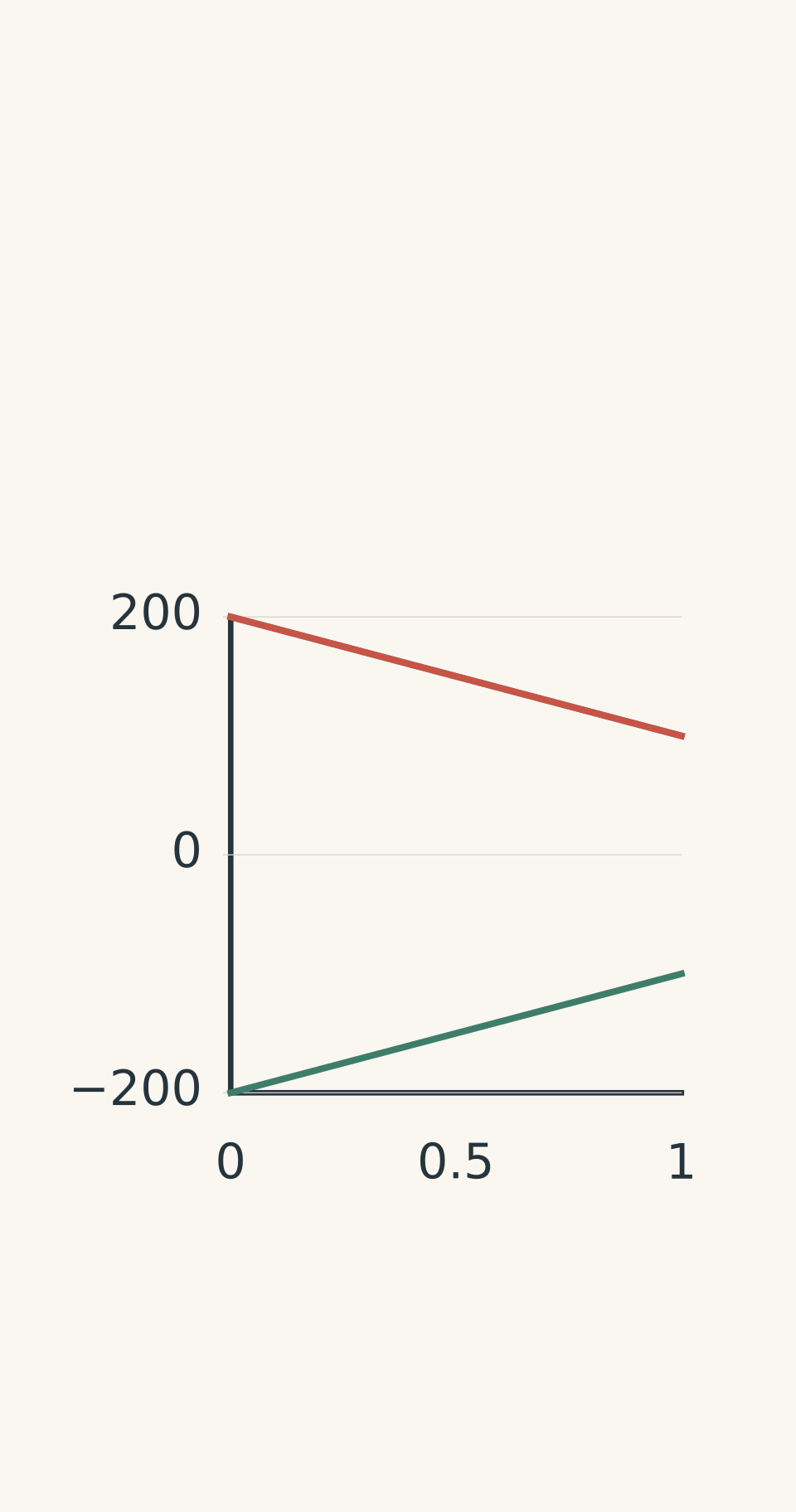
- Potential V (V)
- U for q = +1.0 μC (μJ)
- U for q = −1.0 μC (μJ)
Notice what the graphs tell you. There is one potential profile for the field, but the potential energy changes differently for positive and negative charges.
That is why memorising “potential decreases, so potential energy decreases” will lose you marks. It is only true for a positive charge moving in that direction.
03From potential energy to work and kinetic energy
Now we need to connect the energy change to the motion of the charge.
The change in electric potential energy is
\[ \Delta U=q\Delta V \]
The work done by the electric field is
\[ W_E=-\Delta U=-q\Delta V \]
The minus sign is important. If the field does positive work, the electric potential energy decreases. If the field does negative work, the electric potential energy increases.
The work-energy theorem tells us that
\[ \Delta K=W_{\text{net}} \]
Here, \(K\) is kinetic energy, and \(W_{\text{net}}\) is the total work done by all forces.
If the electric field is the only force doing work, then
\[ \Delta K=W_E=-\Delta U \]
This gives us a reliable way to predict what happens.
The sign pattern to recognise
The following table assumes that the electric field is the only force doing work.
| Motion | Potential change | Positive charge, \(q>0\) | Negative charge, \(q<0\) |
|---|---|---|---|
| Along the field | \(\Delta V<0\) | \(\Delta U<0\); field work positive; \(K\) increases | \(\Delta U>0\); field work negative; \(K\) decreases |
| Opposite the field | \(\Delta V>0\) | \(\Delta U>0\); field work negative; \(K\) decreases | \(\Delta U<0\); field work positive; \(K\) increases |
| Perpendicular to the field | \(\Delta V=0\) | No change in \(U\) or \(K\) due to field work | No change in \(U\) or \(K\) due to field work |
A negative change in kinetic energy means the particle loses kinetic energy. If it is already moving against its electric force, it slows down. A particle released from rest, however, accelerates in the direction of its electric force.
This distinction is easy to miss: moving along the electric field is not necessarily the same as moving along the electric force.
For a positive charge, those directions agree. For a negative charge, they are opposite.
04A decision method you can trust in an exam
When a question involves potential, energy, work, and motion, use this sequence rather than trying to memorise every possible sign combination.
Step 1: Identify the quantity being asked for.
Is it \(V\), \(\Delta V\), \(U\), \(\Delta U\), work, or kinetic energy? Check the units if you’re unsure.
- Potential and potential difference use volts.
- Potential energy and kinetic energy use joules.
- Work also uses joules.
Step 2: Work out the potential difference.
Always write
\[ \Delta V=V_f-V_i \]
For a uniform field, use
\[ \Delta V=-Ed\cos\theta \]
Decide whether the displacement is along, opposite, or perpendicular to the field.
Step 3: Keep the sign of the charge.
Convert the charge to coulombs and retain its positive or negative sign.
For example, \(-3.0\,\mu\text{C}=-3.0\times10^{-6}\text{ C}\), not \(+3.0\times10^{-6}\text{ C}\).
Step 4: Calculate the potential energy change.
Use
\[ \Delta U=q\Delta V \]
Do not replace \(q\) with its magnitude. That would erase the very difference you’re being tested on.
Step 5: Find the work done by the field.
Use
\[ W_E=-\Delta U \]
Work done by the field is the negative of the change in electric potential energy.
Step 6: Find the kinetic energy change.
Use
\[ \Delta K=W_{\text{net}} \]
Only set \(\Delta K=W_E\) when no other force does work. If an external agent also does work, include that contribution.
Solve electric potential questions reliably
- Identify the quantity
V: volts; U, W, K: joules
- Find the potential change
ΔV = V_f − V_i
Along the field, ΔV < 0
- Keep the charge sign
q in coulombs
Never replace a negative charge with its magnitude
- Calculate energy change
ΔU = qΔV
The sign depends on both q and ΔV
- Calculate work and motion
W_E = −ΔU; ΔK = W_net
If only the field does work, ΔK = W_E
- Check physical validity
K_f = K_i + ΔK ≥ 0
Negative final kinetic energy means the assumed endpoint is unreachable
05Worked example: A positive charge moves along the field
A uniform electric field has strength \(300\text{ N C}^{-1}\) and points east. A \(+4.0\,\mu\text{C}\) charge moves \(0.20\text{ m}\) east from point A to point B.
Calculate the potential difference, the change in electric potential energy, the work done by the field, and the change in kinetic energy. Assume no other force does work.
Step 1
The charge moves along the electric field, so \(\theta=0^\circ\).
\[ \begin{aligned} \Delta V&=-Ed\cos\theta\\ &=-(300)(0.20)\cos0^\circ\\ &=-60\text{ V} \end{aligned} \]
The potential drops by \(60\text{ V}\). This result depends on the field and the displacement, not on the sign of the charge.
Step 2
Convert the charge to coulombs:
\[ q=+4.0\times10^{-6}\text{ C} \]
Then use \(\Delta U=q\Delta V\):
\[ \begin{aligned} \Delta U&=(+4.0\times10^{-6})(-60)\\ &=-2.4\times10^{-4}\text{ J}\\ &=-0.24\text{ mJ} \end{aligned} \]
The potential energy decreases by \(0.24\text{ mJ}\).
Step 3
\[ \begin{aligned} W_E&=-\Delta U\\ &=-(-2.4\times10^{-4})\\ &=+2.4\times10^{-4}\text{ J}\\ &=+0.24\text{ mJ} \end{aligned} \]
The field does positive work on the charge.
Step 4
Because the electric field is the only force doing work,
\[ \begin{aligned} \Delta K&=W_E\\ &=+0.24\text{ mJ} \end{aligned} \]
The charge gains \(0.24\text{ mJ}\) of kinetic energy and speeds up.
The reasoning chain is consistent: potential decreases, potential energy decreases, the field does positive work, and kinetic energy increases.
06Worked example: A negative charge moves opposite the field
A uniform electric field has strength \(250\text{ N C}^{-1}\) and points east. A \(-3.0\,\mu\text{C}\) charge moves \(0.40\text{ m}\) west from point B to point A. Its initial kinetic energy is \(0.20\text{ mJ}\).
Calculate the potential difference, the change in potential energy, the work done by the field, and the final kinetic energy. Assume no other force does work.
Step 1
The displacement is opposite to the field, so \(\theta=180^\circ\).
\[ \begin{aligned} \Delta V&=-Ed\cos\theta\\ &=-(250)(0.40)\cos180^\circ\\ &=+100\text{ V} \end{aligned} \]
The potential increases by \(100\text{ V}\).
Step 2
The charge is negative:
\[ q=-3.0\times10^{-6}\text{ C} \]
Therefore,
\[ \begin{aligned} \Delta U&=q\Delta V\\ &=(-3.0\times10^{-6})(+100)\\ &=-3.0\times10^{-4}\text{ J}\\ &=-0.30\text{ mJ} \end{aligned} \]
The potential energy decreases by \(0.30\text{ mJ}\).
This is the result that often catches students out. The potential increases, but the potential energy decreases because \(q\) is negative.
Step 3
\[ \begin{aligned} W_E&=-\Delta U\\ &=-(-3.0\times10^{-4})\\ &=+3.0\times10^{-4}\text{ J}\\ &=+0.30\text{ mJ} \end{aligned} \]
The field does positive work.
Step 4
The work-energy theorem gives
\[ \begin{aligned} \Delta K&=+0.30\text{ mJ}\\ K_f-K_i&=+0.30\text{ mJ}\\ K_f&=0.20+0.30\\ &=0.50\text{ mJ} \end{aligned} \]
The final kinetic energy is \(0.50\text{ mJ}\).
The negative charge speeds up because it moves opposite the electric field, which is the direction of its electric force.
Opposite potential changes, same energy transfer
| Positive charge moving east | q = +4.0 μC Along field: ΔV = −60 V ΔU = −0.24 mJ; W_E = ΔK = +0.24 mJ Electric force points east |
|---|---|
| Negative charge moving west | q = −3.0 μC Against field: ΔV = +100 V ΔU = −0.30 mJ; W_E = ΔK = +0.30 mJ Electric force points west |
07Questions and solutions
Question 1
A uniform electric field of \(150\text{ N C}^{-1}\) points east. A \(+2.0\,\mu\text{C}\) charge moves \(0.40\text{ m}\) east.
Calculate \(\Delta V\), \(\Delta U\), the work done by the electric field, and \(\Delta K\), assuming the field is the only force doing work.
Solution 1
The charge gains \(0.12\text{ mJ}\) of kinetic energy. The potential difference is \(-60\text{ V}\), the potential energy decreases by \(0.12\text{ mJ}\), and the field does \(+0.12\text{ mJ}\) of work.
First, calculate the potential difference:
\[ \begin{aligned} \Delta V&=-Ed\\ &=-(150)(0.40)\\ &=-60\text{ V} \end{aligned} \]
Next, calculate the potential energy change:
\[ \begin{aligned} \Delta U&=q\Delta V\\ &=(+2.0\times10^{-6})(-60)\\ &=-1.2\times10^{-4}\text{ J}\\ &=-0.12\text{ mJ} \end{aligned} \]
The work done by the field is
\[ W_E=-\Delta U=+0.12\text{ mJ} \]
Since the field is the only force doing work,
\[ \Delta K=W_E=+0.12\text{ mJ} \]
The positive charge moves along its electric force, so it loses potential energy and gains kinetic energy.
Question 2
A uniform electric field of \(200\text{ N C}^{-1}\) points east. A \(-5.0\,\mu\text{C}\) charge moves \(0.30\text{ m}\) east. Its initial kinetic energy is \(2.0\text{ mJ}\).
Calculate its final kinetic energy and explain whether it speeds up or slows down. Assume the electric field is the only force doing work.
Solution 2
The charge slows down and finishes with \(1.70\text{ mJ}\) of kinetic energy. Although the potential decreases, the negative charge’s potential energy increases.
The displacement is along the field, so
\[ \begin{aligned} \Delta V&=-Ed\\ &=-(200)(0.30)\\ &=-60\text{ V} \end{aligned} \]
The change in potential energy is
\[ \begin{aligned} \Delta U&=q\Delta V\\ &=(-5.0\times10^{-6})(-60)\\ &=+3.0\times10^{-4}\text{ J}\\ &=+0.30\text{ mJ} \end{aligned} \]
The field does negative work:
\[ W_E=-\Delta U=-0.30\text{ mJ} \]
Therefore,
\[ \begin{aligned} K_f&=K_i+\Delta K\\ &=2.0-0.30\\ &=1.70\text{ mJ} \end{aligned} \]
The kinetic energy remains positive, so the charge can complete the displacement. It slows down because the electric force on a negative charge points west, opposite to its eastward motion.
The trap is to assume that a falling potential always means falling potential energy. That is only true for a positive charge.
Question 3
An external agent moves a \(+1.5\,\mu\text{C}\) charge \(0.25\text{ m}\) west in a uniform electric field of \(400\text{ N C}^{-1}\) pointing east. The charge moves at constant speed.
Calculate the potential difference, the change in potential energy, the work done by the field, and the work done by the external agent. Assume no other force does work.
Solution 3
The external agent does \(+0.15\text{ mJ}\) of work, while the field does \(-0.15\text{ mJ}\) of work. The kinetic energy does not change because the charge moves at constant speed.
The displacement is opposite the field:
\[ \begin{aligned} \Delta V&=-Ed\cos180^\circ\\ &=-(400)(0.25)(-1)\\ &=+100\text{ V} \end{aligned} \]
The potential energy increases:
\[ \begin{aligned} \Delta U&=q\Delta V\\ &=(+1.5\times10^{-6})(100)\\ &=+1.5\times10^{-4}\text{ J}\\ &=+0.15\text{ mJ} \end{aligned} \]
The work done by the field is
\[ W_E=-\Delta U=-0.15\text{ mJ} \]
Because the speed is constant, \(\Delta K=0\). The net work must therefore be zero:
\[ \begin{aligned} W_{\text{net}}&=W_E+W_{\text{ext}}\\ 0&=-0.15+W_{\text{ext}}\\ W_{\text{ext}}&=+0.15\text{ mJ} \end{aligned} \]
The external agent supplies the energy needed to increase the charge’s electric potential energy. The field does negative work, and the two work contributions cancel.
The key correction is that \(\Delta K=W_E\) is not valid when another force also does work. You must use the total work.
Question 4
A uniform electric field of \(500\text{ N C}^{-1}\) points east. A \(-2.0\,\mu\text{C}\) charge moves along the following route:
- \(0.40\text{ m}\) north
- \(0.30\text{ m}\) east
- \(0.10\text{ m}\) west
Its initial kinetic energy is \(0.50\text{ mJ}\). Assume the electric field is the only force doing work.
Calculate the total potential difference, the change in potential energy, the work done by the field, and the final kinetic energy. Explain why using the total path length gives the wrong result.
Solution 4
The charge finishes with \(0.30\text{ mJ}\) of kinetic energy. The total potential difference is \(-100\text{ V}\), and the charge’s potential energy increases by \(0.20\text{ mJ}\).
The field points east, so only the net east-west displacement contributes to the potential difference. The northward displacement is perpendicular to the field and contributes zero.
The net displacement along the field is
\[ d_{\parallel}=0.30-0.10=0.20\text{ m} \]
Therefore,
\[ \begin{aligned} \Delta V&=-Ed_{\parallel}\\ &=-(500)(0.20)\\ &=-100\text{ V} \end{aligned} \]
The potential energy change is
\[ \begin{aligned} \Delta U&=q\Delta V\\ &=(-2.0\times10^{-6})(-100)\\ &=+2.0\times10^{-4}\text{ J}\\ &=+0.20\text{ mJ} \end{aligned} \]
The work done by the field is
\[ W_E=-\Delta U=-0.20\text{ mJ} \]
Hence,
\[ \begin{aligned} K_f&=K_i+\Delta K\\ &=0.50-0.20\\ &=0.30\text{ mJ} \end{aligned} \]
The charge loses kinetic energy because its net displacement is along the field, whereas the electric force on the negative charge points west.
The tempting mistake is to add the three distances and use \(0.80\text{ m}\) in \(\Delta V=-Ed\). That would treat every part of the route as though it were along the field. Potential difference depends on the endpoints, not the total distance travelled. In a uniform field, the northward segment contributes no work, and the eastward and westward segments partly cancel.
Question 5
Two particles have charges \(+2.0\,\mu\text{C}\) and \(-2.0\,\mu\text{C}\). Both start at \(x=0\), moving east in a uniform electric field of \(400\text{ N C}^{-1}\) that also points east. Each has an initial kinetic energy of \(0.18\text{ mJ}\).
Assume no other force does work.
A student claims that both particles will reach \(x=0.25\text{ m}\), with equal-sized but opposite changes in kinetic energy.
Is this physically possible? Calculate the positive particle’s kinetic energy at \(x=0.25\text{ m}\), find the negative particle’s turning point, and describe what happens to its energy after it turns around.
Solution 5
No. The positive particle reaches \(x=0.25\text{ m}\) with \(0.38\text{ mJ}\) of kinetic energy, but the negative particle turns around at \(x=0.225\text{ m}\). It cannot reach \(x=0.25\text{ m}\) under the stated conditions.
The subtlety is that the two particles experience the same potential difference at the same location, but their potential energy changes have opposite signs. For the negative particle, the energy required to reach the proposed endpoint exceeds its initial kinetic energy.
Step 1: Calculate the potential difference to \(x=0.25\text{ m}\).
The displacement is east, along the field:
\[ \begin{aligned} \Delta V&=-Ed\\ &=-(400)(0.25)\\ &=-100\text{ V} \end{aligned} \]
Both particles experience this same potential change because the field and endpoints are the same.
Step 2: Find the positive particle’s final kinetic energy.
For the positive particle,
\[ \begin{aligned} \Delta U_+&=q\Delta V\\ &=(+2.0\times10^{-6})(-100)\\ &=-2.0\times10^{-4}\text{ J}\\ &=-0.20\text{ mJ} \end{aligned} \]
The field does \(+0.20\text{ mJ}\) of work, so
\[ \begin{aligned} K_f&=K_i+W_E\\ &=0.18+0.20\\ &=0.38\text{ mJ} \end{aligned} \]
The positive particle gains kinetic energy and reaches the endpoint.
Step 3: Test whether the negative particle can reach the same endpoint.
For the negative particle,
\[ \begin{aligned} \Delta U_-&=q\Delta V\\ &=(-2.0\times10^{-6})(-100)\\ &=+2.0\times10^{-4}\text{ J}\\ &=+0.20\text{ mJ} \end{aligned} \]
The field does \(-0.20\text{ mJ}\) of work. If the particle could reach the endpoint, its kinetic energy would have to be
\[ \begin{aligned} K_f&=K_i+W_E\\ &=0.18-0.20\\ &=-0.02\text{ mJ} \end{aligned} \]
But kinetic energy cannot be negative. This is not a valid final state. It tells us that the particle cannot reach the assumed endpoint.
The field removes all its initial kinetic energy before it gets there.
Step 4: Find the turning point.
At the turning point, the negative particle’s kinetic energy is zero. Its initial kinetic energy has been converted into an increase in electric potential energy.
For an eastward displacement \(x_t\), the work done by the field on the negative particle is
\[ W_E=-|q|Ex_t \]
At the turning point,
\[ \begin{aligned} K_f&=K_i+W_E\\ 0&=K_i-|q|Ex_t\\ x_t&=\frac{K_i}{|q|E} \end{aligned} \]
Substitute the values, using \(K_i=0.18\text{ mJ}=1.8\times10^{-4}\text{ J}\):
\[ \begin{aligned} x_t&=\frac{1.8\times10^{-4}} {(2.0\times10^{-6})(400)}\\ &=\frac{1.8\times10^{-4}}{8.0\times10^{-4}}\\ &=0.225\text{ m} \end{aligned} \]
The negative particle stops momentarily at \(x=0.225\text{ m}\), before reaching the proposed endpoint.
At that position, the potential change is
\[ \begin{aligned} \Delta V&=-Ex_t\\ &=-(400)(0.225)\\ &=-90\text{ V} \end{aligned} \]
Its potential energy change is
\[ \begin{aligned} \Delta U_-&=q\Delta V\\ &=(-2.0\times10^{-6})(-90)\\ &=+1.8\times10^{-4}\text{ J}\\ &=+0.18\text{ mJ} \end{aligned} \]
All its initial kinetic energy has been converted into electric potential energy.
Step 5: Determine what happens next.
The electric force on the negative particle still points west at the turning point. The particle therefore reverses direction and accelerates west.
As it moves west, the electric potential increases. Because its charge is negative, its potential energy decreases, the field does positive work, and its kinetic energy increases again.
The tempting answer was that both particles could reach the same endpoint with equal-sized, opposite kinetic energy changes. That prediction ignores the physical constraint \(K\geq0\). The positive particle gains kinetic energy, while the negative particle runs out of kinetic energy before reaching the endpoint.
This is the same energy-budget check you’ll use when finding potential differences from point-charge fields: calculate \(\Delta V\) first, multiply by the signed charge, and check that the predicted kinetic energy is physically possible.
08The 10-second self-check
Before submitting an answer, check these five things:
- Have I identified whether the question asks for potential, potential difference, potential energy, energy change, work, or kinetic energy?
- Have I calculated \(\Delta V=V_f-V_i\) using the correct displacement direction?
- Have I kept the sign of \(q\) in \(\Delta U=q\Delta V\)?
- Have I used \(W_E=-\Delta U\) and \(\Delta K=W_{\text{net}}\), rather than assuming field work is always the only work?
- Is the final kinetic energy non-negative? If my calculation gives \(K_f<0\), is the assumed endpoint unreachable?
Once this bookkeeping is reliable, the next useful step is calculating electric potential differences from point charges rather than a uniform field. The energy equations stay the same; only the method for finding \(\Delta V\) changes.