
How to Balance Redox Equations Without Guessing
Learn to balance redox equations by tracking electron transfer with oxidation numbers and half-equations. Follow worked examples to balance atoms and charge in acidic and alkaline solutions.
Suppose you write \(\ce{MnO4^- + Fe^2+ -> Mn^2+ + Fe^3+}\) and call it balanced. The manganese and iron counts match, but four oxygen atoms disappear, and the total charge changes from \(+1\) on the left to \(+5\) on the right. In acidic solution, how do you fix the equation without changing the substances?
Start by tracking electrons. Then balance the atoms and charge using the appropriate coefficients, water, and acid.
Before reading on, predict how many \(\mathrm{Fe}^{2+}\) ions are needed for each \(\ce{MnO4^-}\) ion. Manganese changes from oxidation number \(+7\) to \(+2\), gaining five electrons. Each iron ion changes from \(+2\) to \(+3\), losing one electron. Therefore, five \(\mathrm{Fe}^{2+}\) ions are needed for every \(\ce{MnO4^-}\) ion.
Balance redox by matching electrons
| Manganese: reduction | MnO₄⁻ → Mn²⁺ Oxidation number: +7 → +2 Gains 5 e⁻ per Mn atom |
|---|---|
| Iron: oxidation | Fe²⁺ → Fe³⁺ Oxidation number: +2 → +3 Loses 1 e⁻ per Fe²⁺ ion |
01Redox equations are an electron ledger
A redox reaction involves oxidation and reduction happening together.
- Oxidation is the loss of electrons. The oxidation number increases.
- Reduction is the gain of electrons. The oxidation number decreases.
These processes must balance. If one species loses five electrons, another species must gain five electrons in total.
Think of it like settling a shared bill: the amount leaving one account must arrive in another. The analogy is about accounting, not the physical movement of money. In a redox equation, the electron balance is exact.
Two other terms follow from this:
- The reducing agent donates electrons and is oxidised.
- The oxidising agent accepts electrons and is reduced.
A reducing agent causes another species to be reduced. An oxidising agent causes another species to be oxidised. Their names describe what they do to the other species, not what happens to themselves.
How to calculate oxidation numbers
Oxidation numbers are bookkeeping values used to track electron transfer. They are not always the same as the actual charge on an ion.
For the common HSC examples, use these rules:
| Substance or element | Oxidation-number rule |
|---|---|
| An uncombined element, such as \(\ce{Fe}\) or \(\ce{Cl2}\) | \(0\) |
| A monatomic ion, such as \(\mathrm{Fe}^{2+}\) | Equal to its charge |
| Oxygen in most compounds | \(-2\) |
| Oxygen in a peroxide, such as \(\ce{H2O2}\) | \(-1\) |
| Hydrogen in most compounds | \(+1\) |
| All oxidation numbers in a species | Sum to its overall charge |
The final rule is particularly useful for polyatomic ions.
For example, calculate the oxidation number of manganese in \(\ce{MnO4^-}\). Let it be \(x\).
\[ \begin{aligned} x+4(-2)&=-1\\ x-8&=-1\\ x&=+7 \end{aligned} \]
The sum must equal the ion’s overall charge, \(-1\). Manganese therefore has oxidation number \(+7\), even though the permanganate ion itself has charge \(-1\).
Similarly, for \(\ce{Cr2O7^2-}\), let the oxidation number of chromium be \(x\):
\[ \begin{aligned} 2x+7(-2)&=-2\\ 2x-14&=-2\\ 2x&=12\\ x&=+6 \end{aligned} \]
Notice the factor of two: there are two chromium atoms in each dichromate ion.
Oxidation-number rules
| Elements and ions | Cl₂: 0; Fe²⁺: +2 Uncombined element: 0 Monatomic ion: equals its charge |
|---|---|
| Oxygen and hydrogen | O: usually −2; H: usually +1 Use the usual values, checking for exceptions. |
| Worked example: MnO₄⁻ | x + 4(−2) = −1 → x = +7 Sum of oxidation numbers = overall charge. |
02The oxidation-number method: find the electron ratio first
The most tempting mistake is to start changing coefficients until the equation looks balanced. Instead, establish the electron ratio before worrying about oxygen, hydrogen, or total charge.
Use this sequence:
- Assign oxidation numbers to the elements that change.
- Calculate the increase or decrease in oxidation number per atom.
- Account for how many of those atoms appear in each formula unit.
- Choose coefficients so the total electrons lost equal the total electrons gained.
- Balance the remaining atoms, then check the total charge.
The third step is easy to overlook. If two chromium atoms each gain three electrons, one dichromate ion gains six electrons in total. You must count the atoms, not just the change for one atom.
Worked example: Balance permanganate and iron(II)
Balance \(\ce{MnO4^- + Fe^2+ -> Mn^2+ + Fe^3+}\) in acidic solution.
Step 1
Manganese changes from \(+7\) in \(\ce{MnO4^-}\) to \(+2\) in \(\mathrm{Mn}^{2+}\). It gains five electrons.
Iron changes from \(+2\) in \(\mathrm{Fe}^{2+}\) to \(+3\) in \(\mathrm{Fe}^{3+}\). Each iron ion loses one electron.
Step 2
One manganese atom gains five electrons, while each iron atom loses one. Therefore, five iron(II) ions are needed for each permanganate ion.
The equation now has the correct electron ratio:
\[ \ce{MnO4^- + 5Fe^2+ -> Mn^2+ + 5Fe^3+} \]
This is not yet balanced because oxygen, hydrogen, and charge still need attention.
Step 3
There are four oxygen atoms on the left, so add four water molecules to the right:
\[ \ce{MnO4^- + 5Fe^2+ -> Mn^2+ + 5Fe^3+ + 4H2O} \]
Step 4
Four water molecules contain eight hydrogen atoms. Add eight \(\mathrm{H}^{+}\) ions to the left:
\[ \ce{MnO4^- + 5Fe^2+ + 8H+ -> Mn^2+ + 5Fe^3+ + 4H2O} \]
Step 5
The left-hand charge is
\[ -1+5(+2)+8(+1)=+17 \]
The right-hand charge is
\[ (+2)+5(+3)=+17 \]
Both sides have charge \(+17\), and the numbers of Mn, Fe, O, and H atoms also match.
The balanced equation is therefore
\[ \boxed{ \ce{MnO4^- + 5Fe^2+ + 8H+ -> Mn^2+ + 5Fe^3+ + 4H2O} } \]
The important point is that the electron ratio determined the coefficients of the redox species. Water and \(\mathrm{H}^{+}\) then balanced the oxygen and hydrogen introduced by the acidic solution.
Check the balanced equation
| Reactants | MnO₄⁻ + 5Fe²⁺ + 8H⁺ Mn 1 · Fe 5 · O 4 · H 8 Total charge: +17 |
|---|---|
| Products | Mn²⁺ + 5Fe³⁺ + 4H₂O Mn 1 · Fe 5 · O 4 · H 8 Total charge: +17 |
03The half-equation method: balance the electrons explicitly
The oxidation-number method is efficient when the changes are clear. The half-equation method is particularly useful when several species are involved or when balancing oxygen, hydrogen, and charge becomes complicated.
Instead of balancing the whole reaction at once, separate it into two parts:
- The oxidation half-equation shows electrons being released.
- The reduction half-equation shows electrons being accepted.
Each half-equation must conserve its atoms and charge. You then multiply the half-equations until the electrons lost and gained are equal, add them, and cancel anything appearing on both sides.
Balancing half-equations in acidic solution
Follow this order:
- Split the reaction into oxidation and reduction half-equations.
- Balance all atoms except oxygen and hydrogen.
- Balance oxygen by adding \(\ce{H2O}\).
- Balance hydrogen by adding \(\mathrm{H}^{+}\).
- Balance charge by adding \(\ce{e^-}\).
- Multiply the half-equations to cancel the electrons, then add and simplify.
Electrons belong on the right of an oxidation half-equation because they are released. They belong on the left of a reduction half-equation because they are accepted.
Balance redox half-equations in acid
- Split the reaction
Write oxidation and reduction half-equations.
- Balance other atoms
Balance elements except O and H.
- Balance oxygen
H₂O
Add water to balance O.
- Balance hydrogen
H⁺
Add hydrogen ions to balance H.
- Balance charge
e⁻
Add electrons to balance charge.
- Combine and simplify
Multiply to cancel electrons; add equations and cancel common species.
Worked example: Balance dichromate and sulfite
Balance \(\ce{Cr2O7^2- + SO3^2- -> Cr^3+ + SO4^2-}\) in acidic solution using the half-equation method.
Step 1
Dichromate is reduced to chromium(III):
\[ \ce{Cr2O7^2- -> Cr^3+} \]
Sulfite is oxidised to sulfate:
\[ \ce{SO3^2- -> SO4^2-} \]
Step 2
There are two chromium atoms in dichromate, so put a coefficient of two before \(\mathrm{Cr}^{3+}\).
There are seven oxygen atoms on the left, so add seven water molecules to the right. This gives fourteen hydrogen atoms on the right, which are balanced by adding fourteen \(\mathrm{H}^{+}\) ions to the left.
Finally, balance charge using electrons:
\[ \ce{Cr2O7^2- + 14H+ + 6e^- -> 2Cr^3+ + 7H2O} \]
The left-hand charge is \( -2+14-6=+6\), matching the right-hand charge of \(+6\).
Step 3
Sulfite has three oxygen atoms, while sulfate has four. Add one water molecule to the left to supply the missing oxygen.
That water also introduces two hydrogen atoms, so add two \(\mathrm{H}^{+}\) ions to the right. The right-hand charge is now zero, while the left-hand charge is \(-2\). Add two electrons to the right to balance the charge.
\[ \ce{SO3^2- + H2O -> SO4^2- + 2H+ + 2e^-} \]
This is an oxidation half-equation because electrons appear among the products.
Step 4
The dichromate half-equation consumes six electrons. The sulfite half-equation produces two electrons.
Multiply the entire sulfite half-equation by three. It now produces six electrons, matching the six consumed by dichromate.
Add the two half-equations. The electrons cancel.
Step 5
There are fourteen \(\mathrm{H}^{+}\) ions on the left and six on the right, leaving eight on the left.
There are seven water molecules on the right and three on the left, leaving four on the right.
The balanced equation is
\[ \boxed{ \ce{Cr2O7^2- + 3SO3^2- + 8H+ -> 2Cr^3+ + 3SO4^2- + 4H2O} } \]
Step 6
The left-hand charge is \(-2-6+8=0\). The right-hand charge is \(+6-6=0\).
There are two Cr atoms, three S atoms, sixteen O atoms, and eight H atoms on each side.
The equation is balanced. Notice that the half-equation method has made the electron transfer explicit, while the oxidation-number method would have identified the same ratio: six electrons gained per dichromate ion and two electrons lost per sulfite ion.
04What changes in alkaline solution?
In acidic solution, \(\mathrm{H}^{+}\) is an appropriate balancing species. In alkaline solution, the final equation should not contain \(\mathrm{H}^{+}\) as an unexplained leftover.
A reliable approach is to balance the equation in acid first, then convert it to alkaline conditions.
- Balance the equation using \(\ce{H2O}\), \(\mathrm{H}^{+}\), and \(\ce{e^-}\).
- Add \(\ce{OH^-}\) to both sides, using one \(\ce{OH^-}\) for every remaining \(\mathrm{H}^{+}\).
- Combine \(\ce{H+ + OH^- -> H2O}\).
- Cancel any water molecules appearing on both sides.
For example, if the acid-balanced equation has four \(\mathrm{H}^{+}\) ions on the right, add four \(\ce{OH^-}\) ions to both sides. The four \(\mathrm{H}^{+}\) ions combine with four \(\ce{OH^-}\) ions to form four water molecules. Then simplify the water coefficients.
Convert an acid-balanced half-equation to alkaline form
- Start with the acid equation
2H₂O → O₂ + 4H⁺ + 4e⁻
Four H⁺ ions are on the right.
- Add hydroxide to both sides
+ 4OH⁻ on each side
Preserve atom counts and charge.
- Form water
4H⁺ + 4OH⁻ → 4H₂O
Neutralise all four H⁺ ions.
- Cancel common water
2H₂O → O₂ + 4H₂O + 4e⁻
Cancel 2H₂O from both sides.
- Final alkaline equation
4OH⁻ → O₂ + 2H₂O + 4e⁻
No leftover H⁺; atoms and charge balance.
The common mistake is to replace every \(\mathrm{H}^{+}\) with \(\ce{OH^-}\). That does not conserve the atoms and charge automatically. Neutralise the hydrogen ions, form water, and cancel water only after it appears on both sides.
05When the same element is oxidised and reduced
So far, each example has involved one species being oxidised and another being reduced. But that is not always the case.
Consider the decomposition of hydrogen peroxide:
\[ \ce{2H2O2 -> 2H2O + O2} \]
Oxygen has oxidation number \(-1\) in \(\ce{H2O2}\). In water, it is \(-2\), so some oxygen atoms are reduced. In \(\ce{O2}\), oxygen is \(0\), so other oxygen atoms are oxidised.
The same reactant supplies both the oxidation and reduction processes. This type of reaction is called disproportionation.
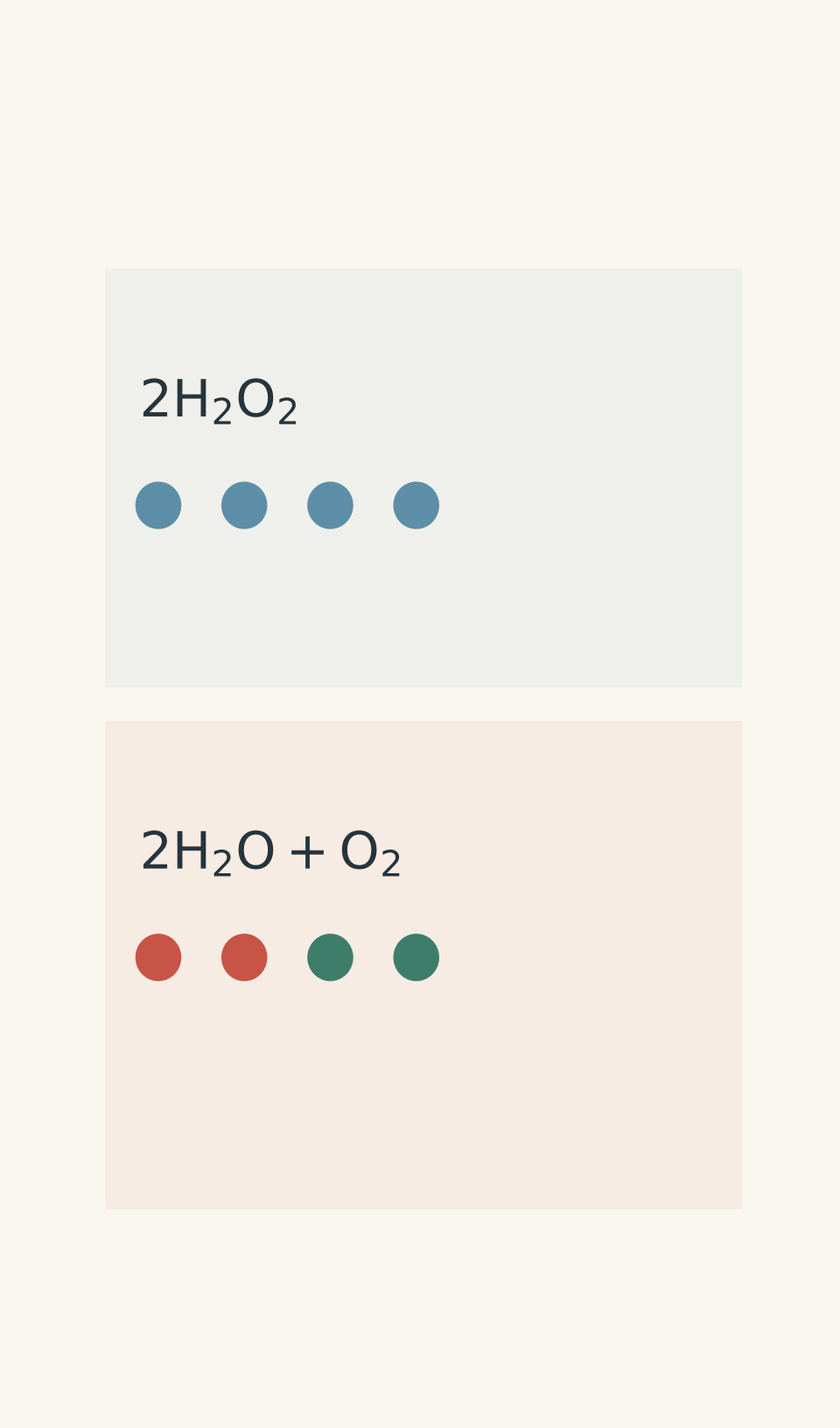
- O (−1)
- O (−2)
- O (0)
This matters because the electron ratio still has to balance, even when the same element appears in two different products. You cannot assume that coefficients are equal simply because there is one reactant species and two product species.
Chlorine provides a useful example. Under the standard HSC model, chlorine reacts with cold, dilute alkali to form chloride and hypochlorite, but with hot, concentrated alkali it forms chloride and chlorate.
Chlorine oxidation states
| Cold, dilute alkali | Cl₂ → Cl⁻ + ClO⁻ Reduction: 0 → −1 Oxidation: 0 → +1 |
|---|---|
| Hot, concentrated alkali | Cl₂ → Cl⁻ + ClO₃⁻ Reduction: 0 → −1 Oxidation: 0 → +5 |
The products and conditions matter. Balancing a proposed equation checks conservation; it does not independently tell you which products a reaction will form.
06A final checklist before you submit
Use this checklist whenever you balance a redox equation.
| Check | What to look for |
|---|---|
| Electron transfer | Total electrons lost equal total electrons gained. |
| Atom count | Every element has the same number of atoms on both sides. |
| Charge | The total charge on the left equals the total charge on the right. |
| Reaction medium | Acidic equations may contain \(\mathrm{H}^{+}\); alkaline equations must be simplified to remove leftover \(\mathrm{H}^{+}\). |
| Final coefficients | Use the smallest whole-number ratio. |
| Chemical model | The species and products match the conditions given in the question. |
Three mistakes deserve particular attention.
- Changing subscripts to balance atoms: never do this. Changing \(\ce{SO3^2-}\) into a formula with a different subscript changes the substance. Adjust coefficients instead.
- Matching oxidation-number changes but ignoring the number of atoms: a coefficient must account for every atom undergoing the change, not just the change per atom.
- Stopping when the atoms balance: ionic equations must conserve charge as well. A balanced equation must pass both checks.
The oxidation-number method and the half-equation method are two ways of enforcing the same conservation rules. Use oxidation numbers to identify the electron ratio quickly, or use half-equations when you need a systematic way to balance atoms and charge. Either way, the final audit is essential.
07Questions and solutions
Question 1
Balance the following redox equation in aqueous solution using oxidation numbers:
\[ \ce{Cl2 + I^- -> Cl^- + I2} \]
Identify which species is oxidised and which is reduced.
Solution 1
The balanced equation is
\[ \boxed{\ce{Cl2 + 2I^- -> 2Cl^- + I2}} \]
Chlorine changes from oxidation number \(0\) in \(\ce{Cl2}\) to \(-1\) in \(\mathrm{Cl}^{-}\). Each chlorine atom gains one electron, so the two chlorine atoms gain two electrons in total.
Iodine changes from \(-1\) in \(\mathrm{I}^{-}\) to \(0\) in \(\ce{I2}\). Each iodide ion loses one electron, so two iodide ions release two electrons.
Therefore, two \(\mathrm{I}^{-}\) ions are needed per \(\ce{Cl2}\) molecule.
There are two chlorine atoms and two iodine atoms on each side. The total charge is \(-2\) on both sides. Chlorine is reduced, and iodide is oxidised.
The tempting mistake is to use one iodide ion because there is one \(\ce{I2}\) molecule on the right. But \(\ce{I2}\) contains two iodine atoms, so two iodide ions are required.
Question 2
In acidic solution, copper reacts with nitrate ions to form copper(II) ions and nitric oxide, \(\ce{NO}\).
Balance the equation:
\[ \ce{NO3^- + Cu -> NO + Cu^2+} \]
Explain how the oxidation-number changes determine the ratio of nitrate ions to copper atoms.
Solution 2
The balanced equation is
\[ \boxed{ \ce{2NO3^- + 3Cu + 8H+ -> 2NO + 3Cu^2+ + 4H2O} } \]
Nitrogen changes from \(+5\) in \(\ce{NO3^-}\) to \(+2\) in \(\ce{NO}\). Each nitrogen atom gains three electrons.
Copper changes from \(0\) to \(+2\), so each copper atom loses two electrons.
The smallest common number of electrons is six. Two nitrate ions gain six electrons in total, while three copper atoms lose six electrons.
Therefore, the initial redox ratio is two nitrate ions to three copper atoms.
Now balance the remaining atoms. Two nitrate ions contain six oxygen atoms, while the two \(\ce{NO}\) molecules contain two. The remaining four oxygen atoms are balanced by adding four \(\ce{H2O}\) molecules to the right.
Those four water molecules contain eight hydrogen atoms, so add eight \(\mathrm{H}^{+}\) ions to the left.
Finally, check charge:
\[ \begin{aligned} \text{Left: }&2(-1)+8(+1)=+6\\ \text{Right: }&3(+2)=+6 \end{aligned} \]
The equation conserves atoms and charge.
The trap is to balance nitrogen and copper, then stop. The electron ratio is necessary, but acidic conditions introduce hydrogen and oxygen balancing as well.
Question 3
In alkaline solution, chromium(III) hydroxide reacts with hypochlorite ions to form chromate ions and chloride ions.
Balance the equation:
\[ \ce{Cr(OH)3 + ClO^- -> CrO4^2- + Cl^-} \]
Show how the half-equation method can be used, and explain why the final equation contains \(\ce{OH^-}\).
Solution 3
The balanced equation is
\[ \boxed{ \ce{2Cr(OH)3 + 3ClO^- + 4OH^- -> 2CrO4^2- + 3Cl^- + 5H2O} } \]
First, determine the oxidation-number changes. Chromium changes from \(+3\) in \(\ce{Cr(OH)3}\) to \(+6\) in \(\ce{CrO4^2-}\), losing three electrons per chromium atom. Chlorine changes from \(+1\) in \(\ce{ClO^-}\) to \(-1\) in \(\mathrm{Cl}^{-}\), gaining two electrons per chlorine atom.
The smallest common electron count is six. Therefore, two chromium atoms are oxidised for every three chlorine atoms reduced.
Step 1: Balance the half-equations in acidic form.
For oxidation, balance chromium, oxygen, hydrogen, and then charge:
\[ \ce{Cr(OH)3 + H2O -> CrO4^2- + 5H+ + 3e^-} \]
For reduction, balance oxygen with water, hydrogen with \(\mathrm{H}^{+}\), and charge with electrons:
\[ \ce{ClO^- + 2H+ + 2e^- -> Cl^- + H2O} \]
Step 2: Equalise the electron counts.
Multiply the oxidation half-equation by two and the reduction half-equation by three. Both then involve six electrons, which cancel when the equations are added.
After cancelling common species, the acid-balanced equation is
\[ \ce{2Cr(OH)3 + 3ClO^- -> 2CrO4^2- + 3Cl^- + H2O + 4H+} \]
Step 3: Convert the equation to alkaline conditions.
There are four \(\mathrm{H}^{+}\) ions on the right. Add four \(\ce{OH^-}\) ions to both sides. On the right, the four hydrogen ions combine with the four hydroxide ions to form four water molecules.
There are now five water molecules on the right in total: the original one plus the four formed during neutralisation.
The final equation is
\[ \ce{2Cr(OH)3 + 3ClO^- + 4OH^- -> 2CrO4^2- + 3Cl^- + 5H2O} \]
Check the charge. The left-hand charge is \(-3-4=-7\), while the right-hand charge is \(-4-3=-7\). Chromium, chlorine, oxygen, and hydrogen atoms also balance.
The important constraint is the reaction medium. An equation balanced in acid can be a useful intermediate step, but the final equation must reflect the stated alkaline conditions.
Question 4
Acidified potassium permanganate oxidises hydrogen peroxide to oxygen gas. The products are manganese(II) sulfate, potassium sulfate, oxygen, and water.
Balance the molecular equation:
\[ \ce{KMnO4 + H2O2 + H2SO4 -> MnSO4 + K2SO4 + O2 + H2O} \]
Explain the electron ratio and why potassium and sulfate ions do not determine it.
Solution 4
The balanced molecular equation is
\[ \boxed{ \ce{2KMnO4 + 5H2O2 + 3H2SO4 -> 2MnSO4 + K2SO4 + 5O2 + 8H2O} } \]
The key is to balance the net ionic redox reaction before adding the spectator ions.
Step 1: Determine the oxidation-number changes.
Manganese changes from \(+7\) in \(\ce{MnO4^-}\) to \(+2\) in \(\mathrm{Mn}^{2+}\). Each manganese atom gains five electrons.
Oxygen in hydrogen peroxide has oxidation number \(-1\), because \(\ce{H2O2}\) is a peroxide. In \(\ce{O2}\), oxygen has oxidation number \(0\). Each oxygen atom therefore loses one electron.
Two permanganate ions gain ten electrons in total. Five hydrogen peroxide molecules contain ten oxygen atoms, which lose ten electrons in total.
The electron ratio is consequently two permanganate ions to five hydrogen peroxide molecules.
Step 2: Balance the net ionic equation.
In acidic solution, the balanced net ionic equation is
\[ \ce{2MnO4^- + 5H2O2 + 6H+ -> 2Mn^2+ + 5O2 + 8H2O} \]
The left-hand charge is \(-2+6=+4\), matching the right-hand charge of \(+4\). Hydrogen and oxygen atoms also balance.
Step 3: Restore the spectator ions.
Two \(\ce{KMnO4}\) units supply two potassium ions and two permanganate ions. The three \(\ce{H2SO4}\) units supply six hydrogen ions and three sulfate ions.
On the product side, the two manganese(II) ions pair with two sulfate ions to form \(\ce{2MnSO4}\). The remaining sulfate ion pairs with the two potassium ions to form \(\ce{K2SO4}\).
The molecular equation is therefore
\[ \ce{2KMnO4 + 5H2O2 + 3H2SO4 -> 2MnSO4 + K2SO4 + 5O2 + 8H2O} \]
Potassium and sulfate do not change oxidation number. They are spectator ions in the net ionic redox reaction, although their quantities must still be correct in the molecular equation.
The subtle point is the peroxide exception. If you incorrectly assign oxygen an oxidation number of \(-2\) in \(\ce{H2O2}\), you will calculate the wrong electron transfer and the wrong coefficient ratio.
Question 5
Chlorine reacts with alkaline solution in different ways under different conditions. For this question, use the standard course model:
- Hot, concentrated alkali produces chloride ions and chlorate ions.
- Cold, dilute alkali produces chloride ions and hypochlorite ions.
For the hot, concentrated reaction, a student proposes equal coefficients for \(\mathrm{Cl}^{-}\) and \(\ce{ClO3^-}\), arguing that both products contain chlorine and that each comes from the same reactant.
Balance the reaction in hot, concentrated alkali. Explain why equal coefficients for the two products fail, and compare the result with the cold, dilute reaction. What does this tell you about the limits of equation balancing?
Solution 5
For hot, concentrated alkali, the balanced equation is
\[ \boxed{ \ce{3Cl2 + 6OH^- -> 5Cl^- + ClO3^- + 3H2O} } \]
The key is that chlorine undergoes disproportionation: some chlorine atoms are reduced, while others are oxidised.
Step 1: Calculate the oxidation numbers.
Chlorine has oxidation number \(0\) in \(\ce{Cl2}\).
In \(\mathrm{Cl}^{-}\), chlorine has oxidation number \(-1\). Each chlorine atom gains one electron.
In \(\ce{ClO3^-}\), oxygen has oxidation number \(-2\). Let the chlorine oxidation number be \(x\):
\[ \begin{aligned} x+3(-2)&=-1\\ x-6&=-1\\ x&=+5 \end{aligned} \]
Chlorine in chlorate therefore changes from \(0\) to \(+5\), losing five electrons.
Step 2: Match the electron transfer.
One chlorine atom oxidised to \(+5\) loses five electrons. Five chlorine atoms reduced to \(-1\) gain five electrons in total.
The product ratio must therefore be five chloride ions to one chlorate ion.
That requires six chlorine atoms altogether: five in chloride and one in chlorate. Since each \(\ce{Cl2}\) molecule contains two chlorine atoms, three \(\ce{Cl2}\) molecules are required.
The chlorine-containing part of the equation is now fixed:
\[ \ce{3Cl2 -> 5Cl^- + ClO3^-} \]
Step 3: Balance oxygen and hydrogen in alkaline solution.
The chlorate ion contains three oxygen atoms. Adding three water molecules to the right supplies another three oxygen atoms and six hydrogen atoms.
The products therefore contain six oxygen atoms and six hydrogen atoms in total. Six \(\ce{OH^-}\) ions on the left supply exactly six oxygen atoms and six hydrogen atoms.
The equation becomes
\[ \ce{3Cl2 + 6OH^- -> 5Cl^- + ClO3^- + 3H2O} \]
Step 4: Check atoms and charge.
There are six chlorine atoms on each side, six oxygen atoms on each side, and six hydrogen atoms on each side.
The left-hand charge is \(-6\). The right-hand charge is \(-5-1=-6\).
Both atom count and charge balance.
Step 5: Compare with cold, dilute alkali.
Under the stated cold, dilute conditions, the oxygen-containing product is hypochlorite, \(\ce{ClO^-}\), rather than chlorate:
\[ \ce{Cl2 + 2OH^- -> Cl^- + ClO^- + H2O} \]
Here, chlorine changes from \(0\) to \(-1\) in chloride and from \(0\) to \(+1\) in hypochlorite. One chlorine atom gains one electron while the other loses one, so equal coefficients for these two products are correct.
For hot, concentrated alkali, the chlorate product changes the oxidation-number increase to \(+5\). One oxidised chlorine atom must now be matched by five reduced chlorine atoms.
That is why the tempting equal-coefficient argument fails. Counting product types tells you nothing about the electron ratio; the oxidation-number changes determine it.
The deeper lesson is that balancing and predicting products are different jobs. Balancing enforces conservation once the reactants and products are specified. Reaction conditions help determine which products are appropriate in the first place. Once an equation is balanced, the next question is whether the reaction is thermodynamically favourable, which requires redox-potential reasoning rather than further coefficient adjustments.