
How to Explain Reaction-Rate Changes in HSC Chemistry
Learn how to explain reaction-rate changes using collision theory, with worked examples, exam-ready reasoning, and practice questions covering concentration, temperature, surface area, and catalysts.
You write, “Increasing concentration increases the rate because there are more collisions. Increasing temperature makes particles move faster. Powder reacts faster because it has a greater surface area. A catalyst lowers activation energy.”
Then the marker writes, “Explain how.”
The problem isn’t necessarily that your chemistry is wrong. It’s that you’ve named the factor without completing the explanation. You haven’t shown how the change affects the number of reactions occurring each second.
Here’s a useful prediction to make before reading on: a catalyst can speed up a reaction without adding reactant particles or heating the mixture. If every rate explanation is simply “there are more collisions”, how does that work?
The missing link is the number of successful collisions per second. Once you understand that idea, you can explain concentration, temperature, surface area, and catalysts without memorising four disconnected answers.
01The missing link: not every collision causes a reaction
Imagine two reactant particles colliding. Does a reaction automatically occur?
No. According to collision theory, the particles must collide with sufficient energy to overcome the activation energy, \(E_a\), of the reaction pathway. For many reactions, they must also have a suitable orientation.
Activation energy is the energy barrier that must be overcome for a reaction to proceed. A collision that doesn’t meet the necessary conditions is unsuccessful, even though the particles have physically collided.
Collision illustration requires an unsupported drawing
| Required visual | Show several individual reactant collisions and their outcomes. Distinguish insufficient-energy collisions from successful collisions. |
|---|---|
| Renderer limitation | Available templates cannot depict individual collision events faithfully. Text panels cannot substitute for the requested particle illustration. |
Reaction rate depends on how many successful collisions occur per unit time. Therefore, an explanation needs to connect the changed condition to either the frequency of collisions, the likelihood that collisions succeed, or both.
That is the central idea behind every explanation in this resource.
02The four factors and their mechanisms
1. Concentration: more particles in the same volume
Suppose you react magnesium with hydrochloric acid. You keep the magnesium surface area, temperature, and volume of acid solution constant, but increase the acid concentration.
Which solution should react faster?
The more concentrated solution should react faster because it contains more reacting particles per unit volume.
At the particle level, this means there are more opportunities for acid particles to collide with the exposed magnesium surface each second. The frequency of collisions increases, so the number of successful collisions per second increases.

- Reactant particles
Notice what has not changed. If the temperature remains constant, the particles’ energy distribution remains approximately the same. The fraction of collisions with sufficient energy to overcome the same activation energy does not increase simply because the concentration increases.
The main change is the frequency of collisions, not the energy of the particles.
For example, magnesium reacting with hydrochloric acid can be represented by:
\[ \ce{Mg + 2HCl -> MgCl2 + H2} \]
Using the same-sized magnesium strip, a higher concentration of hydrochloric acid provides more \(\mathrm{H}^{+}\) ions per unit volume. These ions collide with the magnesium surface more frequently, increasing the frequency of successful reactions and therefore the initial rate.
The explanation to use in an exam:
Increasing the concentration increases the number of reacting particles per unit volume. This increases the frequency of collisions, so the number of successful collisions per second increases and the reaction rate increases.
The mistake to avoid: claiming that increasing concentration gives the particles more kinetic energy. That is the explanation for neither concentration nor surface area.
Also, don’t automatically claim that doubling the concentration doubles the rate. A faster reaction is the qualitative prediction; an exact numerical relationship requires appropriate experimental evidence.
2. Temperature: a greater fraction of collisions can succeed
Now consider the same reaction at two different temperatures, with the same reactant concentrations and magnesium surface area.
Predict what happens when the temperature increases.
The reaction becomes faster. But “the particles move faster” is only the beginning of the explanation.
Increasing temperature increases the particles’ average kinetic energy. They move faster, so collisions occur more frequently. More importantly, a greater fraction of particles have sufficient energy to overcome the activation energy.
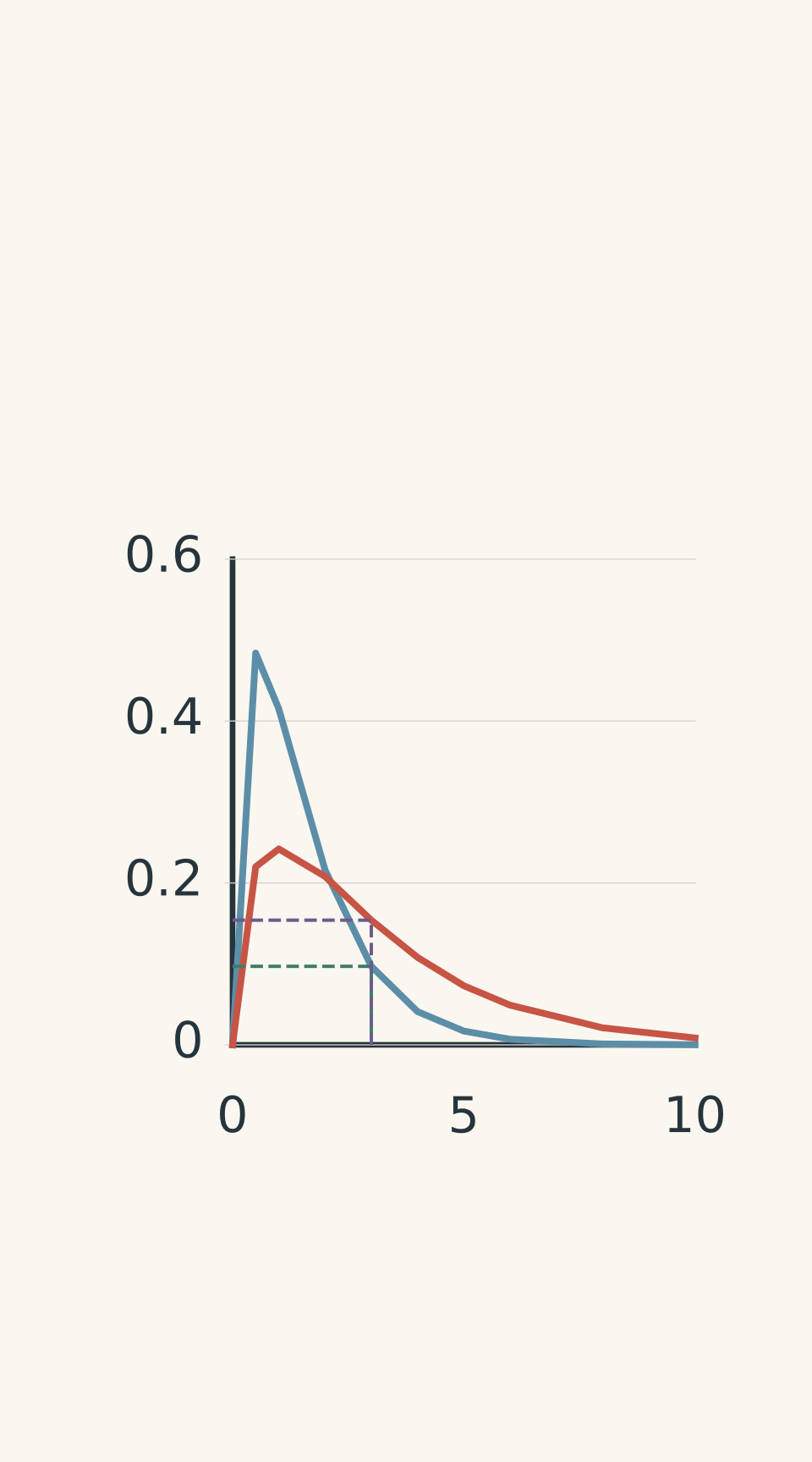
- Lower temperature
- Higher temperature
- Ea threshold, lower temperature
- Ea threshold, higher temperature
Read the graph carefully. The activation-energy threshold stays in the same position for the same reaction pathway. What changes is the fraction of particles with sufficient energy to get past it.
Consequently, a greater proportion of collisions can be successful. Combined with the increase in collision frequency, this produces more successful collisions per second and a faster reaction.
This is why temperature often has a substantial effect on reaction rate. Even a moderate temperature increase can significantly increase the fraction of particles able to overcome the energy barrier.
The explanation to use in an exam:
Increasing the temperature increases the particles’ average kinetic energy and collision frequency. A greater fraction of collisions have sufficient energy to overcome the activation energy, increasing the number of successful collisions per second and therefore the reaction rate.
The mistake to avoid: saying that heating lowers the activation energy. Heating gives particles more kinetic energy; it does not lower the activation energy of the same reaction pathway.
A catalyst, which you’ll meet shortly, changes the available reaction pathway instead.
3. Surface area: more of a solid is available to react
Imagine reacting equal masses of calcium carbonate with excess hydrochloric acid. One sample consists of large chips; the other is finely powdered.
The powder reacts faster, but why?
The important change is the amount of solid surface exposed to the acid.
Same mass, different exposed surface area
| One large piece | Same mass of CaCO₃. Smaller exposed surface area; fewer surface particles accessible to acid. |
|---|---|
| Many small pieces | Same mass of CaCO₃. Greater exposed surface area; more surface particles accessible to acid. |
A reaction between a solid and a solution occurs at the interface where the reactants can make contact. Breaking the solid into smaller pieces exposes more of its surface.
More reacting particles at the solid’s surface are available to interact with particles in the solution. This increases the frequency of collisions at the reaction interface, producing more successful collisions per second and a faster reaction.
The total mass of calcium carbonate hasn’t increased. Nor have the particles suddenly gained kinetic energy. You’ve made more of the existing solid accessible to the other reactant.
The reaction is:
\[ \ce{CaCO3 + 2HCl -> CaCl2 + CO2 + H2O} \]
If both samples contain the same amount of pure calcium carbonate, the acid is in excess, and both samples react completely, they produce the same total amount of carbon dioxide. The powdered sample simply produces it faster.
The explanation to use in an exam:
Increasing the surface area of a solid exposes more reactant particles to the other reactant. This increases the frequency of collisions at the reaction surface, increasing the number of successful collisions per second and the reaction rate.
The mistake to avoid: confusing surface area with concentration. Crushing a solid doesn’t increase the concentration of the solution. It increases the amount of solid surface available for reaction.
4. Catalysts: a different pathway with a lower energy barrier
A catalyst creates a different situation. It can increase the reaction rate without increasing the reactants’ concentration or temperature.
Consider the decomposition of hydrogen peroxide:
\[ \ce{2H2O2 -> 2H2O + O2} \]
Manganese dioxide, \(\ce{MnO2}\), can catalyse this reaction. The catalysed reaction proceeds faster than the uncatalysed reaction under otherwise comparable conditions.
Why?
A catalyst provides an alternative reaction pathway with a lower activation energy.
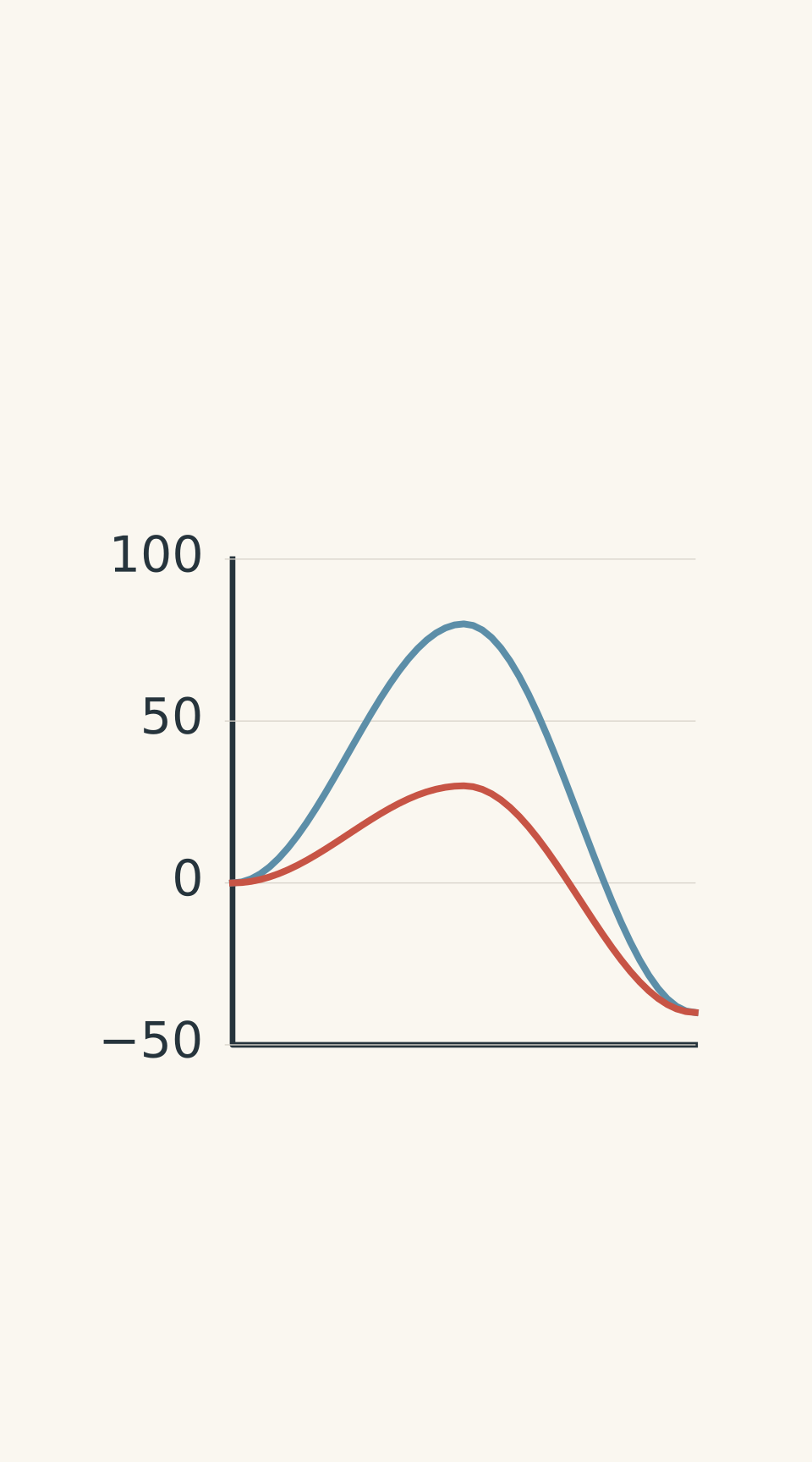
- Uncatalysed (higher Ea)
- Catalysed (lower Ea)
At the same temperature, the reactants have the same energy distribution. However, the lower activation-energy barrier means a greater fraction of particles can overcome the barrier along the catalysed pathway.
More collisions can therefore lead to successful reactions per second, increasing the reaction rate.
Notice the difference between heating and adding a catalyst:
- Heating increases the particles’ kinetic energy and changes their energy distribution.
- A catalyst provides a pathway with a lower activation energy, allowing more particles to react successfully at the same temperature.
A catalyst does not supply kinetic energy to the reactants. It is not consumed overall in the catalysed reaction, and it does not change the overall energy difference between the reactants and products.
There is another important limit: a catalyst increases the rate at which equilibrium is reached, but it does not change the equilibrium composition at a fixed temperature. It speeds up both the forward and reverse reactions.
The explanation to use in an exam:
A catalyst provides an alternative reaction pathway with a lower activation energy. At the same temperature, a greater fraction of collisions can overcome this lower energy barrier, increasing the number of successful collisions per second and the reaction rate.
The mistake to avoid: writing only “the catalyst lowers activation energy”. Explain what the lower activation energy allows to happen at the particle level.
03A quick comparison: what actually changes?
Use this table to choose the correct mechanism before you start writing.
| Factor increased | What changes at the particle level? | What you should connect it to |
|---|---|---|
| Concentration | More reacting particles per unit volume | More frequent collisions |
| Temperature | Greater average kinetic energy and a larger fraction of particles above the activation-energy threshold | More frequent and more successful collisions |
| Surface area of a solid | More exposed solid particles or reaction sites | More collisions at the reaction interface |
| Catalyst present | Alternative pathway with lower activation energy | A greater fraction of collisions can succeed |
The final column is not a substitute for an explanation. It tells you which part of the collision process you need to describe.
04The exam method: build the explanation in four steps
When a question asks you to explain a rate change, follow this sequence.
Build a complete reaction-rate explanation
- Identify the changed factor
Example: hydrochloric acid concentration increases.
- Describe the particle-level change
More reacting particles per unit volume cause more frequent collisions.
- Link to successful collisions per second
At constant temperature, more frequent collisions produce more successful collisions per second.
- State how the reaction rate changes
The reaction rate increases because more successful collisions occur each second.
Step 1: Identify what changed.
State the factor that differs between the conditions. For example, the acid concentration increases while temperature and magnesium surface area remain constant.
Step 2: Describe the physical or chemical mechanism.
Don’t repeat the question. Explain what the changed factor does to the reacting particles, their collisions, or the reaction pathway.
Step 3: Connect the mechanism to successful collisions.
State whether collision frequency increases, whether a greater fraction of collisions can succeed, or both.
Step 4: Finish with the effect on rate.
Make the causal link explicit: more successful collisions per second means a faster reaction; fewer means a slower reaction.
A useful sentence structure is:
“Increasing [factor] causes [particle-level change]. This [increases collision frequency / increases the fraction of collisions able to overcome the activation energy], so the number of successful collisions per second increases and the reaction rate increases.”
Adapt the sentence to the actual mechanism. Don’t force every factor into the same explanation.
05Worked example: comparing two acid concentrations
Two identical magnesium strips are placed in equal volumes of hydrochloric acid at 25°C. One solution has a concentration of \(0.50\ \mathrm{mol\,L^{-1}}\), and the other has a concentration of \(1.00\ \mathrm{mol\,L^{-1}}\). The more concentrated solution has a higher initial reaction rate. Explain why, and state whether collision theory proves that the rate must double.
Step 1
The hydrochloric acid concentration doubles. The temperature, magnesium surface area, and volume of solution are held constant.
Step 2
The more concentrated solution contains more reacting acid particles per unit volume. Consequently, particles collide with the exposed magnesium surface more frequently.
Step 3
Because the temperature is unchanged, the energy distribution and the fraction of collisions with sufficient energy remain approximately the same. However, there are more collisions overall, so more successful collisions occur per second.
Step 4
The more concentrated acid has a higher initial reaction rate because the frequency of successful collisions increases. However, collision theory alone does not establish that doubling the concentration must double the rate. The exact relationship depends on the reaction’s kinetics and must be supported by appropriate evidence.
The key distinction is that a qualitative trend does not automatically establish a quantitative relationship.
06Worked example: temperature and catalyst change together
Hydrogen peroxide decomposes faster in Trial B than in Trial A. Both trials start with the same volume and concentration of hydrogen peroxide.
- Trial A: \(20^\circ\mathrm{C}\), no catalyst.
- Trial B: \(35^\circ\mathrm{C}\), with a manganese dioxide catalyst.
A student concludes that manganese dioxide caused the entire increase in reaction rate. Evaluate the conclusion and explain how the two effects could be investigated separately.
Step 1
Both temperature and catalyst presence differ between the trials. The comparison does not isolate either factor.
Step 2
The higher temperature in Trial B increases the particles’ average kinetic energy and the fraction with sufficient energy to overcome the activation energy.
The manganese dioxide catalyst provides an alternative pathway with a lower activation energy, allowing a greater fraction of particles to react successfully at the same temperature.
Both changes can increase the reaction rate.
Step 3
The conclusion is not justified. Trial B’s higher rate is consistent with both factors contributing, but the comparison cannot establish how much of the increase is due to temperature and how much is due to the catalyst.
Step 4
Use four trials under otherwise identical conditions:
| Trial | Temperature | Catalyst |
|---|---|---|
| A | \(20^\circ\mathrm{C}\) | Absent |
| B | \(35^\circ\mathrm{C}\) | Absent |
| C | \(20^\circ\mathrm{C}\) | Present |
| D | \(35^\circ\mathrm{C}\) | Present |
Compare A with B to investigate the temperature effect without a catalyst. Compare A with C to investigate the catalyst effect at \(20^\circ\mathrm{C}\).
The remaining comparisons allow you to check whether the effect of one factor changes when the other factor is present.
The general lesson is important: when several conditions change together, don’t assign the observed rate change to one factor without evidence.
07Common traps when the wording changes
A memorised sentence can fail when a question adds a condition or asks about a different outcome.
- “The concentration doubles.” Predict a faster rate, but don’t automatically claim a doubled rate.
- “The same mass is powdered.” Explain the increased exposed surface area, not an increase in the amount of reactant.
- “The temperature increases.” Discuss the fraction of collisions with sufficient energy, not just faster particle movement.
- “A catalyst is added.” Explain the lower-energy alternative pathway, not an increase in the reactants’ temperature.
- “The final amount of product is compared.” Separate the rate of formation from the total amount formed. A faster reaction does not necessarily produce more product.
- “The reaction is reversible.” Consider both forward and reverse rates. A catalyst does not shift the equilibrium position at a fixed temperature.
- “Two factors change together.” Explain their mechanisms separately, but don’t claim the evidence isolates their individual effects.
08Questions and solutions
Question 1
Equal masses of calcium carbonate react with excess hydrochloric acid at the same temperature and acid concentration. One sample is made of large chips, and the other is powdered.
Which sample has the higher initial reaction rate? Explain why. Assuming both samples react completely, compare their final amounts of carbon dioxide.
Solution 1
The powdered calcium carbonate has the higher initial reaction rate, but both samples produce the same total amount of carbon dioxide.
Powdering the solid increases its exposed surface area. More calcium carbonate particles are accessible to the acid, increasing the frequency of collisions at the reaction interface. This produces more successful collisions per second and a faster reaction.
However, the samples have equal masses and therefore contain equal amounts of pure calcium carbonate. Since hydrochloric acid is in excess and both samples react completely, the same amount of calcium carbonate reacts in each trial. The balanced equation,
\[ \ce{CaCO3 + 2HCl -> CaCl2 + CO2 + H2O} \]
shows that each mole of calcium carbonate produces one mole of carbon dioxide. The powdered sample produces the gas faster, not in a greater final amount.
Question 2
A reaction occurs faster at \(40^\circ\mathrm{C}\) than at \(20^\circ\mathrm{C}\), with the reactant concentrations and exposed solid surface area held constant.
A student writes:
“The particles move faster at the higher temperature, so they collide more often. Therefore, the reaction rate increases.”
Improve this explanation using collision theory. Explain what happens to the activation energy.
Solution 2
The reaction is faster at \(40^\circ\mathrm{C}\) because collisions occur more frequently and a greater fraction of collisions have sufficient energy to overcome the activation energy.
The student’s explanation identifies one effect of heating: faster-moving particles collide more frequently. However, it misses the crucial change in the energy distribution.
At the higher temperature, a greater fraction of particles have sufficient energy to overcome the activation-energy barrier. Consequently, more collisions are successful each second, increasing the reaction rate.
For the same reaction pathway, the activation energy remains unchanged. Heating changes the particles’ energy distribution, not the height of the activation-energy barrier.
A complete answer therefore links temperature to both collision frequency and the fraction of successful collisions.
Question 3
Two experiments measure the initial rate of hydrogen gas production when identical magnesium strips react with excess hydrochloric acid at the same temperature.
- At \(0.50\ \mathrm{mol\,L^{-1}}\), the initial rate is \(0.18\ \mathrm{cm^3\,s^{-1}}\).
- At \(1.00\ \mathrm{mol\,L^{-1}}\), the initial rate is \(0.30\ \mathrm{cm^3\,s^{-1}}\).
Calculate how many times as large the second initial rate is. A student claims that doubling the concentration must double the reaction rate. Evaluate this claim.
Solution 3
The second initial rate is approximately \(1.67\) times as large, so the data do not support the claim that the rate doubled.
The rate ratio is calculated by dividing the larger rate by the smaller rate:
\[ \begin{aligned} \text{Rate ratio} &= \frac{0.30\ \mathrm{cm^3\,s^{-1}}} {0.18\ \mathrm{cm^3\,s^{-1}}}\\[6pt] &= 1.67 \end{aligned} \]
The units cancel because both rates have the same units.
The second experiment therefore has an initial rate approximately \(1.67\) times that of the first, equivalent to an increase of about 67%.
The higher concentration increases the frequency of collisions between reacting particles, so the qualitative prediction of a faster reaction is correct. However, the measured ratio is not two. More generally, collision theory alone does not establish a universal proportional relationship between concentration and reaction rate.
Question 4
Equal initial amounts of hydrogen peroxide decompose completely at the same temperature, with and without a manganese dioxide catalyst.
The following data are recorded:
| Measurement | With catalyst | Without catalyst |
|---|---|---|
| Time to collect the first \(40\ \mathrm{cm^3}\) of oxygen | 20 s | 80 s |
| Final oxygen volume | \(80\ \mathrm{cm^3}\) | \(80\ \mathrm{cm^3}\) |
Calculate the average rate of oxygen collection up to \(40\ \mathrm{cm^3}\) in each experiment. Explain why the catalyst changes the time taken but not the final gas volume.
Solution 4
The average oxygen collection rate is \(2.0\ \mathrm{cm^3\,s^{-1}}\) with the catalyst and \(0.50\ \mathrm{cm^3\,s^{-1}}\) without it. The catalysed reaction is four times as fast over this measured interval, but both experiments produce the same final volume.
For gas collection, the average rate is the change in gas volume divided by the elapsed time:
\[ r = \frac{\Delta V}{\Delta t} \]
Here, \(r\) is the average gas collection rate, \(\Delta V\) is the change in gas volume, and \(\Delta t\) is the elapsed time.
With the catalyst:
\[ \begin{aligned} r &= \frac{40\ \mathrm{cm^3}}{20\ \mathrm{s}}\\ &= 2.0\ \mathrm{cm^3\,s^{-1}} \end{aligned} \]
Without the catalyst:
\[ \begin{aligned} r &= \frac{40\ \mathrm{cm^3}}{80\ \mathrm{s}}\\ &= 0.50\ \mathrm{cm^3\,s^{-1}} \end{aligned} \]
The ratio of the average rates is:
\[ \frac{2.0}{0.50} = 4.0 \]
The catalyst provides an alternative pathway with lower activation energy, increasing the number of successful reactions per second.
However, the catalyst does not change the stoichiometry of the decomposition reaction or the initial amount of hydrogen peroxide. Since both samples decompose completely, they produce the same total amount of oxygen. The catalyst changes how quickly the product forms, not the final quantity under these conditions.
Question 5
A simple reversible reaction occurs in a sealed, fixed-volume vessel at constant temperature:
\[ \ce{A(g) <=> B(g)} \]
The reaction has reached equilibrium. Assume each direction is a single-step process, the forward rate depends on the concentration of A, and the reverse rate depends on the concentration of B. A catalyst is available that multiplies both forward and reverse rates by the same factor without changing the equilibrium constant.
Two students make opposing claims:
- Student 1: “Adding the catalyst must produce more B because it increases the reaction rate.”
- Student 2: “The reaction is at equilibrium, so its rate is zero and the catalyst has no effect.”
Evaluate both claims.
Then, with the catalyst still present, some A is injected into the vessel. Predict what happens immediately to the forward rate, the reverse rate, and the net direction of reaction. Explain what determines the eventual equilibrium state.
Solution 5
Both students are incorrect. Adding the catalyst increases the forward and reverse reaction rates while leaving them equal at the original equilibrium. Injecting A subsequently causes a net reaction towards B, and the system eventually reaches a new equilibrium.
The key is to distinguish the forward and reverse reaction rates from the net reaction rate.
When the catalyst is added at equilibrium
At equilibrium, the forward and reverse reactions continue to occur. They happen at equal rates, so there is no net change in the concentrations of A and B.
Student 2 is wrong to say that the reaction rate is zero. The net rate is zero, but the individual forward and reverse rates are not.
Adding the catalyst increases both rates by the same factor under the stated assumptions. They remain equal, so there is still no net conversion of A into B. Student 1 is therefore also wrong: the catalyst alone does not increase the equilibrium concentration of B.
When A is injected
The concentration of A increases immediately, while the concentration of B is initially unchanged.
Because the forward rate depends on the concentration of A, the forward rate increases immediately. The reverse rate initially remains unchanged because the concentration of B has not changed and the catalyst is already present.
The forward rate is now greater than the reverse rate. The net reaction proceeds towards B.
As B forms, its concentration increases, raising the reverse reaction rate. The difference between the forward and reverse rates gradually decreases until they become equal again.
At the new equilibrium
The catalyst remains present, but it does not determine the equilibrium composition. The added A changes the amounts of reactants and products available to the system, so the system reaches a new equilibrium with a greater amount of B than before the addition.
The equilibrium constant remains unchanged because the temperature is constant. The catalyst changes how quickly equilibrium is reached, while the addition of A changes the system’s composition and drives the net reaction towards B.
This is the important boundary between kinetics and equilibrium: a factor can increase the rates of individual reactions without necessarily changing the equilibrium position.
09Before you submit an exam answer
Use this quick check to catch the most common lost marks.
- Have I identified the factor that changed?
- Have I explained its effect on particles, collision frequency, energy, or the reaction pathway?
- Have I connected that effect to successful collisions per second?
- Have I stated the resulting change in reaction rate?
- Have I avoided claiming that the rate must change proportionally, that more product must form, or that equilibrium must shift without supporting evidence?
If you can answer all five, your explanation is doing more than listing factors: it is showing the mechanism.
The next useful skill is interpreting rate-time graphs and experimental data. Those questions require you to use the same particle-level reasoning to explain not just why a reaction starts faster, but how its rate changes as reactants are consumed, and how that differs from a change in the final amount of product.