
How to Read Maths Textbooks Without Getting Lost in Symbols
Learn how to translate mathematical symbols into clear statements, recognise quantifiers, track assumptions, and understand why each step in a textbook argument follows. Includes worked examples covering functions, inequalities, and mathematical reasoning.
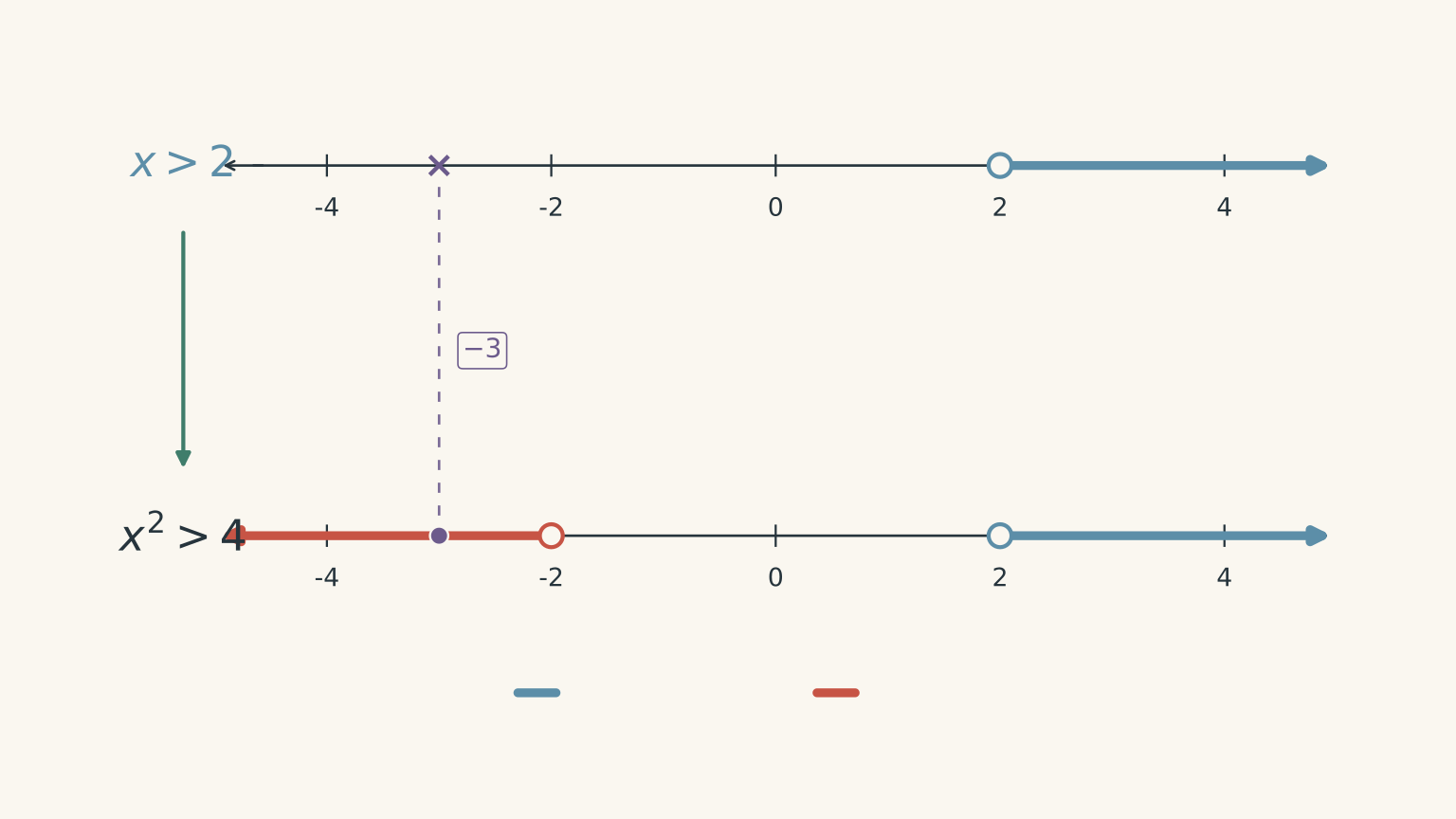
A textbook writes \(x>2\Rightarrow x^2>4\). That statement is true. But suppose the next line reverses the arrow:
\[ x^2>4\Rightarrow x>2 \]
Would you accept it?
Try \(x=-3\). You get \(x^2=9>4\), but \(x>2\) is false. The two statements look almost identical, yet one is correct and the other isn’t.
This is one of the most important skills when reading a mathematics textbook: understanding exactly what the symbols allow you to conclude. You need to recognise the objects being discussed, identify the conditions they must satisfy, and follow the logical connection between one statement and the next.
The trick is to stop reading mathematics as a collection of unfamiliar symbols. Read it as a series of precise sentences.
Due to technical limitations, this figure may display incorrectly or contain inaccuracies. Please check key details against your course materials.
01Start by translating the notation
Mathematical notation is a form of compression. A textbook can communicate an entire sentence using a handful of symbols.
Before trying to understand a complicated paragraph, learn to recognise the basic instructions.
| Symbol | Read it as | What it tells you |
|---|---|---|
| \(x\in A\) | \(x\) belongs to \(A\) | \(x\) is an element of the set \(A\). |
| \(f:A\to B\) | \(f\) maps \(A\) to \(B\) | The inputs belong to \(A\), and outputs belong to \(B\). |
| \(\forall x\) | For every \(x\) | The statement applies to all permitted values of \(x\). |
| \(\exists x\) | There exists an \(x\) | At least one suitable value of \(x\) exists. |
| \(\Rightarrow\) | If … then … | The statement on the left implies the statement on the right. |
| \(\Leftrightarrow\) | If and only if | Both statements imply each other. |
| \(\{x\in A:P(x)\}\) | The set of \(x\) in \(A\) such that \(P(x)\) | The condition \(P(x)\) determines which elements belong to the set. |
You don’t need to memorise every symbol immediately. You do need to know how to translate the ones in front of you.
Let’s look at the most important groups.
01Find the objects and their allowed values
Consider this statement:
\[ f:\mathbb R\to\mathbb R \]
What does it actually tell you?
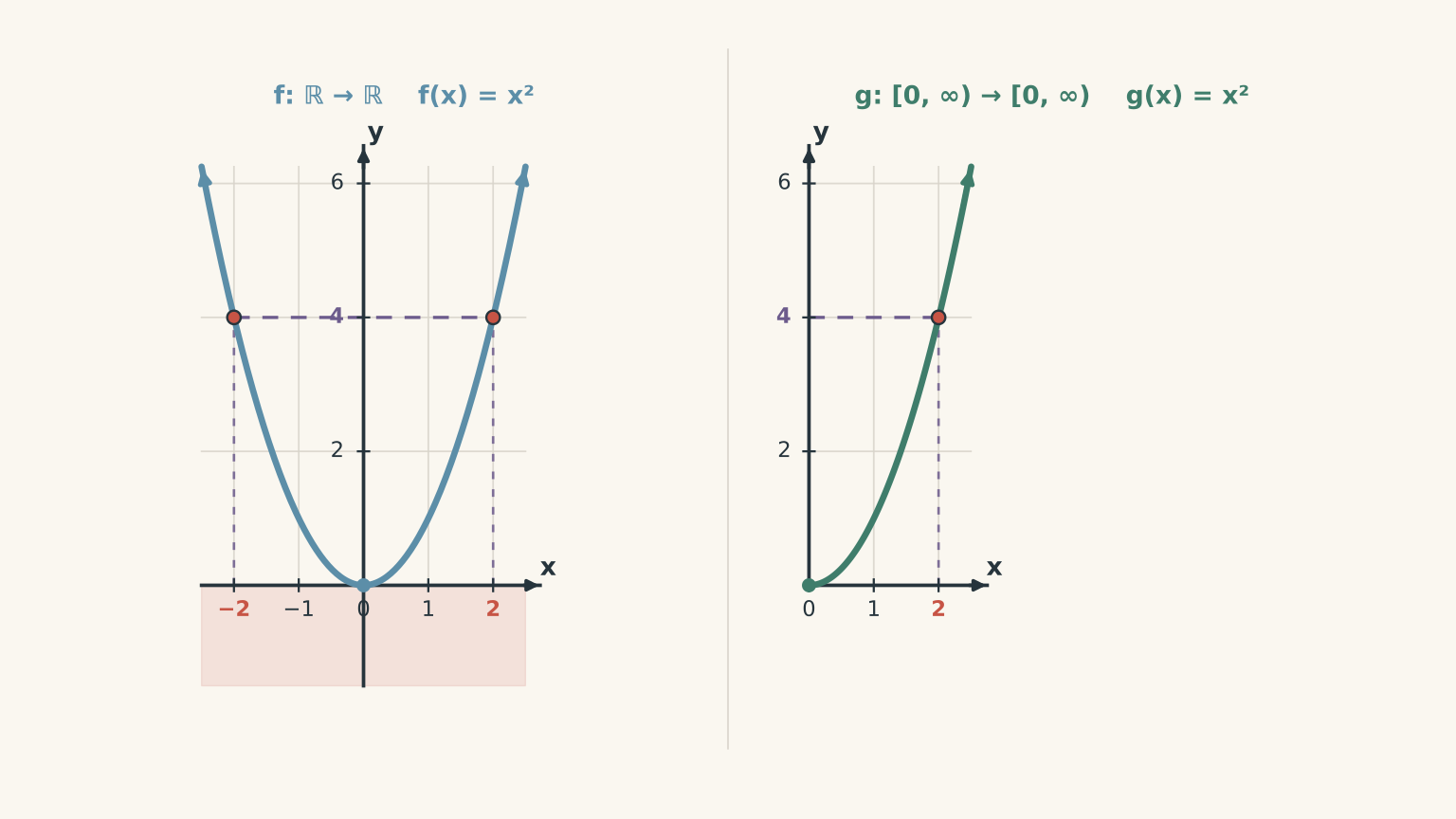
It describes a function \(f\) that takes real numbers as inputs and produces real numbers as outputs.
The set of permitted inputs is called the domain. The set of possible outputs specified by the function definition is called the codomain.
The range is the set of outputs the function actually produces.
These three ideas are related, but they are not interchangeable.
For example, consider:
\[ f(x)=x^2 \]
If the domain is all real numbers, the range is \([0,\infty)\). Squaring a real number can never produce a negative result.
Therefore, if the function is defined as
\[ f:\mathbb R\to\mathbb R \]
its range is not equal to its codomain.
Now change the definition:
\[ g:[0,\infty)\to[0,\infty) \]
\[ g(x)=x^2 \]
The rule is identical, but the function is now restricted to non-negative inputs.
This time, every output has exactly one corresponding input. The range also equals the codomain.
Due to technical limitations, this figure may display incorrectly or contain inaccuracies. Please check key details against your course materials.
This distinction becomes important when studying inverse functions.
A function can only have an inverse function if every output corresponds to exactly one input. That means it must be both:
- One-to-one: Different inputs cannot produce the same output.
- Onto: Every element of the codomain is reached by at least one input.
The domain and codomain are part of the function’s definition. Never assume that the formula alone tells you everything.
Pay attention to interval notation
You will also see intervals used to describe domains.
For example:
- \([2,5]\) includes both 2 and 5.
- \((2,5)\) excludes both 2 and 5.
- \([2,5)\) includes 2 but excludes 5.
- \((-\infty,5]\) includes 5 but extends indefinitely to the left.
Square brackets include an endpoint. Round brackets exclude it.
Infinity always uses a round bracket because infinity is not an actual real number that can be included as an endpoint.
When a textbook states that a function is increasing on \([0,\infty)\), the endpoint \(x=0\) is included. If it says \((0,\infty)\), it isn’t.
That small difference can change whether a mathematical statement is true.
02Recognise who the statement applies to
Two symbols worth recognising immediately are:
\[ \forall \qquad \exists \]
They are called quantifiers. They tell you how many values a mathematical statement is talking about.
The universal quantifier: \(\forall\)
The symbol \(\forall\) means for all or for every.
Consider:
\[ \forall x\in\mathbb R,\quad x^2\geq 0 \]
Read this as:
“For every real number \(x\), its square is greater than or equal to zero.”
This statement is true.
It doesn’t matter whether you choose \(x=3\), \(x=-7\), or \(x=0\). Squaring any real number produces a non-negative result.
A universal statement is demanding. It must work for every permitted value.
This gives you a useful rule:
To disprove a universal statement, you only need one counterexample.
For instance:
\[ \forall x\in\mathbb R,\quad x^2>0 \]
This statement is false because \(x=0\) gives \(x^2=0\).
One counterexample is enough to defeat the claim.
The existential quantifier: \(\exists\)
The symbol \(\exists\) means there exists at least one.
Consider:
\[ \exists x\in\mathbb R:\quad x^2=9 \]
Read this as:
“There exists at least one real number \(x\) such that its square equals 9.”
This statement is true. For example, \(x=3\) satisfies it.
Notice the colon. In this context, it means “such that”.
Unlike a universal statement, an existential statement doesn’t need to work for every value. One valid example is enough to establish that a suitable value exists.
The order of quantifiers matters
Here’s a slightly more subtle example.
Compare these two statements:
\[ \forall x\in\mathbb R,\quad \exists y\in\mathbb R:y>x \]
and
\[ \exists y\in\mathbb R,\quad \forall x\in\mathbb R:y>x \]
They look similar. Are they saying the same thing?
No.
The first says:
“For every real number \(x\), there is some real number \(y\) greater than it.”
This is true. Given any \(x\), you can choose \(y=x+1\).
The second says:
“There is one real number \(y\) that is greater than every real number \(x\).”
This is false. No real number is greater than every other real number.
The difference is that the first allows \(y\) to depend on the value of \(x\). The second requires one fixed value of \(y\) to work for every possible \(x\).
When reading multiple quantifiers, preserve their order. Swapping them can completely change the meaning.
03Understand the connection between mathematical statements
Now let’s return to the arrow from the opening puzzle.
Three symbols are particularly important when following a mathematical argument:
\[ = \qquad \Rightarrow \qquad \Leftrightarrow \]
They communicate different relationships.
Equality: \(=\)
An equality says that two expressions have the same value.
For example:
\[ 2(x+3)=2x+6 \]
Both sides are equal for every real value of \(x\).
Equality is not the same as saying that one expression leads to another. It says they represent the same value.
Implication: \(\Rightarrow\)
The symbol \(\Rightarrow\) means “implies”.
For example:
\[ x>2\Rightarrow x^2>4 \]
If \(x\) is greater than 2, its square must be greater than 4.
However, the arrow only works in this direction.
It does not automatically allow you to conclude that \(x>2\) when you know \(x^2>4\).
Think of implication as a one-way street. You can travel from the left-hand statement to the right-hand statement, but you cannot simply reverse direction.
Equivalence: \(\Leftrightarrow\)
The symbol \(\Leftrightarrow\) means “if and only if”.
It communicates two implications:
\[ A\Rightarrow B \]
and
\[ B\Rightarrow A \]
Both statements must be true.
For example, for real values of \(x\):
\[ x^2>4 \Leftrightarrow x<-2\text{ or }x>2 \]
This is an equivalence because the two conditions describe exactly the same set of real numbers.
When solving equations and inequalities, this distinction matters.
If you move from one line to another using an equivalence, you preserve the complete solution set.
If you only have an implication, you might lose solutions or introduce extra ones. You need to check the conditions.
Watch the words between equations
Textbooks use ordinary English to communicate mathematical reasoning.
These words are worth recognising:
| Word or phrase | Its job |
|---|---|
| Since | Introduces a reason or assumption. |
| Therefore | Introduces a conclusion. |
| Hence | Signals that a result follows from earlier information. |
| Conversely | Introduces the reverse direction of an argument. |
| If and only if | Establishes equivalence in both directions. |
| Provided that | Makes a statement conditional on an assumption. |
| In particular | Applies a general result to a specific case. |
One word deserves special attention: conversely.
If a textbook proves that \(A\Rightarrow B\), it has not yet proved that \(B\Rightarrow A\).
When the author writes “conversely”, they are signalling that the reverse direction needs to be established.
Don’t assume it has already been proved.
Conditions don’t disappear halfway through a proof
Suppose a textbook begins with:
\[ x\geq 0 \]
It then writes:
\[ \sqrt{x^2}=x \]
This is valid because \(x\) is non-negative.
But for an unrestricted real number, the correct statement is:
\[ \sqrt{x^2}=|x| \]
For example, if \(x=-4\),
\[ \sqrt{(-4)^2}=4 \]
not \(-4\).
The original condition is what allows the author to replace \(|x|\) with \(x\).
Whenever you see a new line in a proof, ask yourself:
“What assumption makes this step valid?”
That question will catch many errors before they become confusing.
05Worked example: Decode a function definition
A textbook contains the following extract:
Let \(f:[0,\infty)\to[0,\infty)\) be defined by \(f(x)=x^2\).
For all \(a,b\in[0,\infty)\), if \(a<b\), then \(f(a)<f(b)\).
Hence, \(f\) is strictly increasing and therefore one-to-one.
Also, for every \(y\geq 0\), choosing \(x=\sqrt y\) gives \(f(x)=y\).
Thus, \(f\) is onto its codomain and has an inverse, \(f^{-1}(y)=\sqrt y\).
Translate the extract into plain English. Explain why the inverse exists and what the notation \(f^{-1}\) means.
Step 1
The notation
\[ f:[0,\infty)\to[0,\infty) \]
tells us that the inputs and outputs are non-negative real numbers.
The function rule is \(f(x)=x^2\).
Step 2
The expression
\[ \forall a,b\in[0,\infty) \]
means we are considering every possible pair of non-negative real numbers.
The condition \(a<b\) tells us that the first input is smaller than the second.
The conclusion \(f(a)<f(b)\) tells us that the corresponding output is also smaller.
This is the definition of a strictly increasing function.
We can check that it is true because
\[ \begin{aligned} b^2-a^2&=(b-a)(b+a)\\ &>0 \end{aligned} \]
when \(0\leq a<b\).
Therefore, \(f(a)<f(b)\).
Step 3
A strictly increasing function cannot produce the same output from two different inputs.
If \(a<b\), then \(f(a)<f(b)\). If \(b<a\), then \(f(b)<f(a)\).
Neither situation allows \(f(a)=f(b)\).
Therefore, each output can come from at most one input.
Step 4
The textbook says that for every \(y\geq0\), we can choose
\[ x=\sqrt y \]
This works because
\[ f(\sqrt y)=(\sqrt y)^2=y \]
Since \(\sqrt y\) is non-negative, it belongs to the domain.
Every possible output in the codomain is therefore reached.
This means the function is onto.
Step 5
The function is both one-to-one and onto.
Every output has exactly one corresponding input, so an inverse function exists.
The notation
\[ f^{-1}(y)=\sqrt y \]
means that the inverse takes an output \(y\) and returns the original input.
For example:
\[ f^{-1}(9)=3 \]
Be careful: \(f^{-1}\) does not mean the reciprocal \(1/f(x)\). It means the inverse function.
The key lesson is that each sentence in the extract has a different job. The domain defines the allowed inputs, the universal statement establishes increasing behaviour, and the range argument establishes that an inverse exists.
06Worked example: Read an equivalence involving logarithms
A textbook states:
“For \(u>0\), \(\ln u>0\) if and only if \(u>1\).”
Use this statement to solve:
\[ \ln(2x-1)>0 \]
Explain why the domain restriction matters.
Step 1
The natural logarithm is only defined for positive inputs.
Therefore,
\[ 2x-1>0 \]
Rearranging:
\[ x>\frac12 \]
This is the domain restriction.
Step 2
We are given:
\[ \ln u>0\Leftrightarrow u>1 \]
Why is this true?
The natural logarithm is strictly increasing for positive inputs, and
\[ \ln 1=0 \]
Therefore, its value is positive precisely when its input is greater than 1.
This gives us permission to replace the logarithmic inequality with an equivalent inequality.
Step 3
Our logarithm has input \(2x-1\), so:
\[ \ln(2x-1)>0 \Leftrightarrow 2x-1>1 \]
Rearranging:
\[ 2x>2 \]
\[ x>1 \]
Step 4
We originally required \(x>\frac12\).
Our final result, \(x>1\), automatically satisfies that restriction.
Therefore, the solution is:
\[ \boxed{x>1} \]
The tempting mistake is to confuse the domain condition with the inequality being solved.
The condition \(2x-1>0\) only tells us that the logarithm exists. It does not tell us that the logarithm is positive.
Reading the equivalence properly gives the stronger condition \(2x-1>1\).
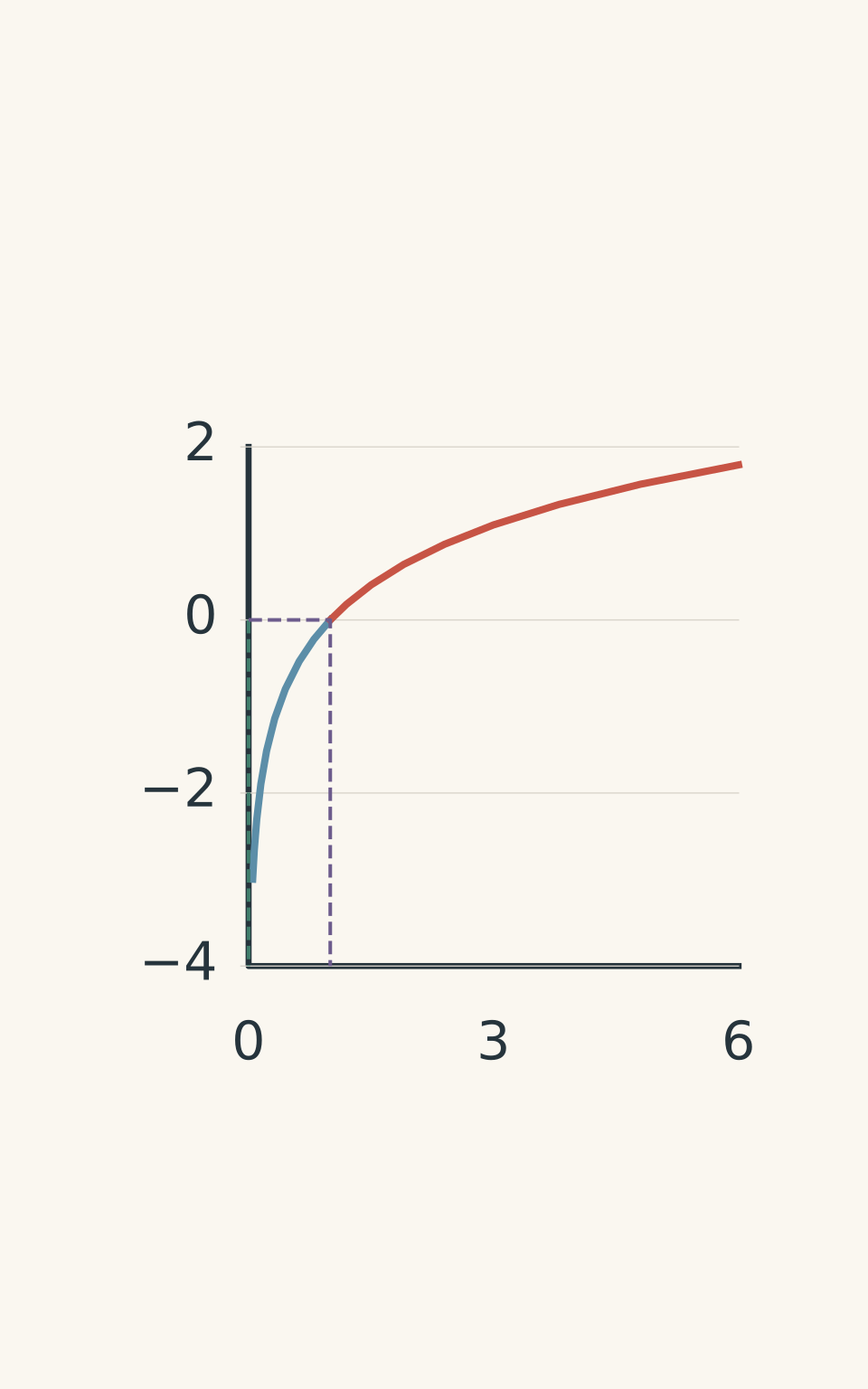
- Defined, non-positive: 0 < u ≤ 1
- Positive output: u > 1
- Vertical asymptote: u = 0
- x-intercept: (1, 0)
Due to technical limitations, this figure may display incorrectly or contain inaccuracies. Please check key details against your course materials.
07A quick routine for reading difficult paragraphs
When a textbook explanation starts feeling like a wall of symbols, don’t immediately read the paragraph again from the beginning.
Stop at the sentence where you became confused.
Work through these four questions:
- What objects are being discussed? Identify the variables, functions, sets, and intervals.
- What values are allowed? Find the domain and any assumptions such as \(x>0\) or \(x\neq0\).
- What is the statement claiming? Translate quantifiers, inequalities, and logical symbols into ordinary English.
- Why does the next line follow? Identify the rule, definition, or assumption that justifies the transition.
You can even write a short translation in the margin.
For example:
\[ \forall x\in\mathbb R,\quad x^2+1>0 \]
Margin note: “Every real number has a square that is at least zero, so adding one makes it strictly positive.”
You have turned a symbolic statement into an argument you can explain.
That is much more useful than simply recognising the symbols.
08Questions and solutions
Question 1
Consider the following statements:
\[ \text{(a)}\quad \forall x\in\mathbb R,\quad x^2+1>0 \]
\[ \text{(b)}\quad \forall x\in\mathbb R,\quad x^2>0 \]
\[ \text{(c)}\quad \exists x\in\mathbb R:\quad x^2=0 \]
Determine whether each statement is true or false.
For each statement, explain what kind of evidence is needed to establish its truth or falsity.
Solution 1
(a) is true, (b) is false, and (c) is true.
The difference comes from the quantifiers.
For (a), we need to establish that the statement works for every real number.
Since the square of any real number is non-negative,
\[ x^2\geq0 \]
Adding one gives:
\[ x^2+1\geq1>0 \]
Therefore, (a) is true for every real \(x\).
For (b), we only need one counterexample to disprove the universal statement.
Choose \(x=0\):
\[ 0^2=0 \]
The result is not greater than zero, so (b) is false.
For (c), we need to find at least one real number that satisfies the condition.
Choosing \(x=0\) gives:
\[ 0^2=0 \]
Therefore, (c) is true.
Remember the distinction: a universal statement requires every permitted value to work, while an existential statement only requires one successful example.
Question 2
A student is solving the equation
\[ x^2=3x \]
They divide both sides by \(x\) and obtain:
\[ x=3 \]
Is this step valid for every real value of \(x\)?
Find the complete solution set and explain how to rewrite the argument without losing a solution.
Solution 2
The complete solution set is \(x=0\) or \(x=3\). Dividing by \(x\) is only valid when \(x\neq0\).
The problem is that the original equation allows \(x=0\).
Substituting gives:
\[ 0^2=3(0) \]
\[ 0=0 \]
So zero is a valid solution.
If we divide by \(x\) without checking whether it is zero, we accidentally remove this solution.
Instead, factorise the original equation:
\[ \begin{aligned} x^2&=3x\\ x^2-3x&=0\\ x(x-3)&=0 \end{aligned} \]
Using the zero-product rule, at least one factor must equal zero.
Therefore,
\[ x=0\quad\text{or}\quad x-3=0 \]
Hence,
\[ \boxed{x=0\text{ or }x=3} \]
Alternatively, you could split the argument into two cases:
- If \(x=0\), the original equation is satisfied.
- If \(x\neq0\), dividing by \(x\) gives \(x=3\).
The important point is that the step from \(x^2=3x\) to \(x=3\) is not an equivalence over all real numbers.
It only describes the non-zero case.
Question 3
A function is defined by
\[ g:(-\infty,0]\to[0,\infty) \]
\[ g(x)=x^2 \]
A student claims:
\[ g^{-1}(9)=3 \]
Their reasoning is that \(3^2=9\).
Is the student correct?
Find the inverse function \(g^{-1}(x)\), and explain why its sign matters.
Solution 3
No. The correct result is \(g^{-1}(9)=-3\), and the inverse function is \(g^{-1}(x)=-\sqrt{x}\) for \(x\geq0\).
The crucial information is the domain:
\[ (-\infty,0] \]
This tells us that the original function only accepts non-positive inputs.
When we solve
\[ x^2=9 \]
we obtain two possible values:
\[ x=\pm3 \]
However, only one of these values belongs to the original domain.
Since \(x\leq0\), we must choose:
\[ x=-3 \]
Therefore,
\[ g^{-1}(9)=-3 \]
For a general output \(y\geq0\), we have:
\[ y=x^2 \]
Taking square roots gives two possible signs, but the original domain requires a non-positive input.
Consequently,
\[ \boxed{g^{-1}(y)=-\sqrt y} \]
The student has treated the formula \(g(x)=x^2\) as if the domain were unrestricted.
But the function is defined by both its rule and its domain. Ignoring the domain gives the wrong inverse.
Question 4
Consider a function
\[ f:[0,\infty)\to[0,\infty) \]
that is strictly increasing.
A textbook draft claims:
“For every \(y\in[0,\infty)\), there exists exactly one \(x\in[0,\infty)\) such that \(f(x)=y\).”
The author argues:
“Because the function is strictly increasing, its graph never turns backwards. Therefore, every possible output must be reached exactly once.”
Is this argument valid?
Test the claim using
\[ f(x)=x+1 \]
Then state the additional condition needed to make the original claim correct. Finally, explain what changes if the codomain is replaced by the actual range of the function.
Solution 4
The argument is incorrect. Strictly increasing guarantees that each output can come from at most one input, but it does not guarantee that every possible output is reached.
Consider the proposed example:
\[ f(x)=x+1 \]
with domain and codomain both equal to \([0,\infty)\).
The function is strictly increasing because increasing \(x\) always increases \(x+1\).
However, its outputs satisfy:
\[ f(x)\geq1 \]
Its actual range is therefore:
\[ [1,\infty) \]
The codomain is still \([0,\infty)\).
In particular, there is no input \(x\geq0\) satisfying:
\[ f(x)=0 \]
The statement claiming that every \(y\) in the codomain has exactly one corresponding input is therefore false.
Why does strict increase not guarantee an inverse over the entire codomain?
The key is to separate two different requirements.
- Strict increase guarantees uniqueness: there cannot be two different inputs producing the same output.
- Being onto guarantees existence: every element of the codomain must actually be reached.
Uniqueness means at most one input.
Existence means at least one input.
Exactly one requires both.
The corrected statement is:
If \(f:[0,\infty)\to[0,\infty)\) is strictly increasing and onto, then for every \(y\in[0,\infty)\), there exists exactly one \(x\in[0,\infty)\) such that \(f(x)=y\).
What if we change the codomain?
For our example, the actual range is \([1,\infty)\).
Suppose we redefine the function as:
\[ f:[0,\infty)\to[1,\infty) \]
\[ f(x)=x+1 \]
Now the codomain equals the range.
Every element of the codomain is reached, so the function is onto. Since it is also strictly increasing, it is one-to-one.
An inverse therefore exists:
\[ f^{-1}(y)=y-1 \]
for \(y\geq1\).
The original formula has not changed. Only the codomain has changed, but that is enough to change whether the function has an inverse defined over its entire codomain.
This is the important distinction: a graph that never turns backwards guarantees that a horizontal line cannot intersect it more than once. It does not guarantee that every horizontal line will intersect it at all.
Once you can read definitions, quantifiers, and logical transitions accurately, you can start doing something more powerful than following a worked example: checking whether the argument itself is valid.
That is the next step in learning mathematical proofs. Instead of asking only, “How did they get this line?”, ask, “What makes this line follow from the previous one, and under which conditions is that reasoning allowed?”
That question will make a real difference when you move into more demanding function proofs, calculus arguments, and unfamiliar HSC examination problems.