
How to Stop Running Out of Time in HSC Exams
Running out of time in HSC exams often comes down to poor pacing, not a lack of knowledge. Learn how to allocate time by marks, use timed checkpoints, prioritise questions, and make better decisions when you're stuck.
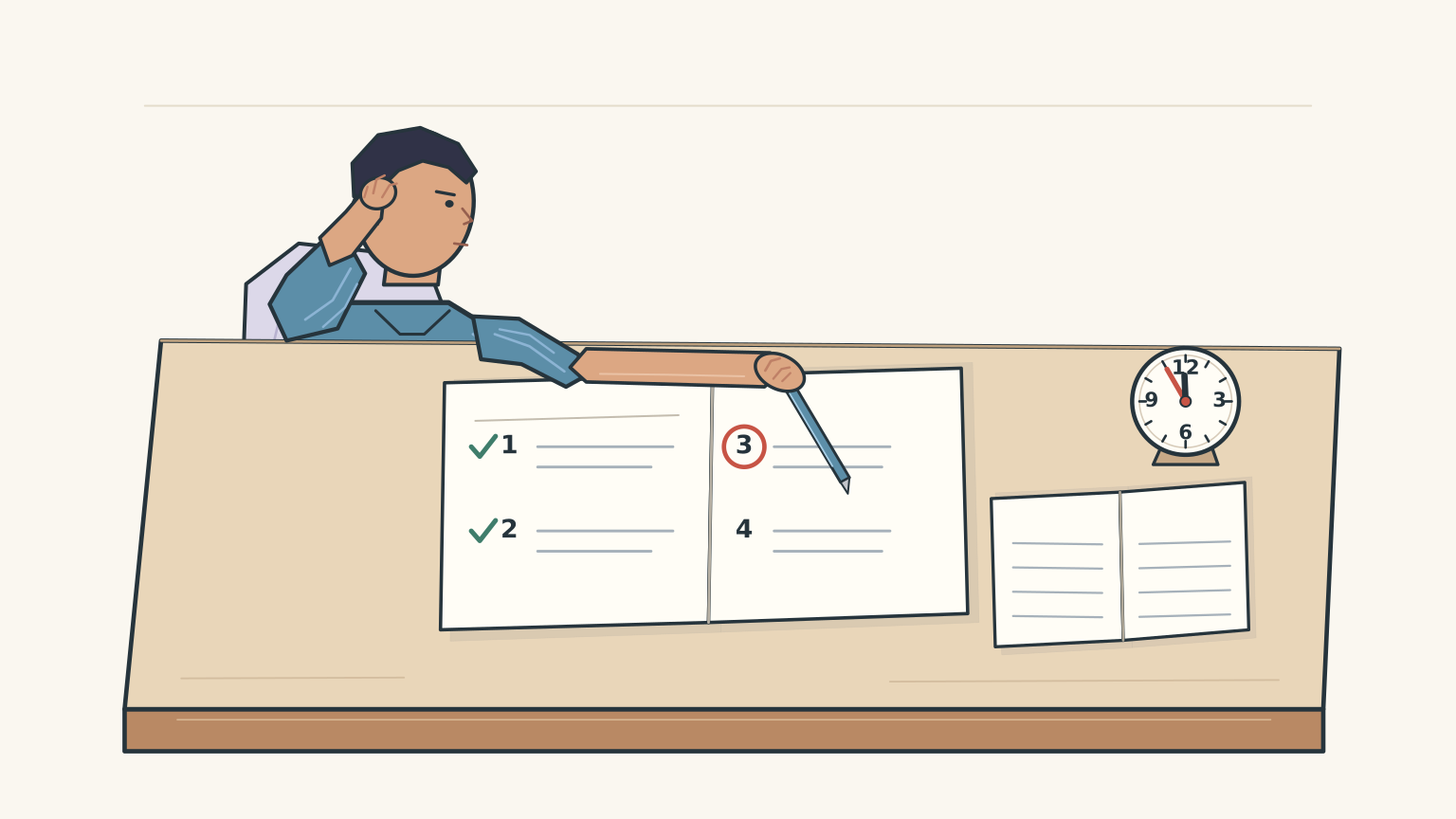
You reach the final 15 minutes of an HSC exam. There are two questions left: a difficult 10-marker and a relatively straightforward 6-marker. You start the 10-marker because it is worth more. Ten minutes later, you’re still stuck, and the 6-marker is untouched.
The problem isn’t necessarily that you write too slowly. It’s that you haven’t controlled how much time each question is allowed to take.
The most reliable way to stop running out of time is to use a marks-based time budget, check your progress at planned checkpoints, and move on when a question stops producing useful marks.
This guide is about managing time once you’re sitting the exam. It isn’t about planning revision between exams on an uneven HSC timetable. The goal here is simple: make the time available in the examination room work as hard as possible.
Due to technical limitations, this figure may display incorrectly or contain inaccuracies. Please check key details against your course materials.
01Give every mark a time budget
Before you start answering, work out approximately how much time you can afford to spend on each mark.
The reasoning is straightforward. If an exam gives you 120 minutes to answer 80 marks, you have an average of 1.5 minutes available per mark.
That doesn’t mean every mark takes exactly 1.5 minutes. Some questions require more reading, calculations, or explanation than others. However, the average gives you a useful starting point.
First, allow some time at the end to check your work.
A reasonable starting point is to reserve around 5-8% of your writing time for checking. You can use this time to:
- Check that you have answered every question.
- Look for unanswered subparts.
- Check signs, units, and significant figures.
- Correct obvious calculation errors.
- Make sure your answers are labelled clearly.
Use the writing time specified in your examination instructions. If reading time is listed separately, don’t include it in your answer-writing calculation. Follow the instructions for your particular paper rather than assuming every examination has identical arrangements.
Your working time is therefore:
\[ T_{\text{working}}=T_{\text{writing}}-T_{\text{review}} \]
Now calculate your average time per mark:
\[ \boxed{ t_{\text{mark}}= \frac{T_{\text{working}}}{M} } \]
where:
- \(t_{\text{mark}}\) is your average time per mark, in minutes.
- \(T_{\text{working}}\) is your available answer-writing time, in minutes.
- \(M\) is the total number of marks in the examination.
To estimate the time available for a particular question, multiply its mark allocation by your average time per mark.
Let’s put this into practice.
Worked example: Calculating your time per mark
An HSC examination has 80 marks and gives you 120 minutes of answer-writing time. You want to reserve 8 minutes for checking.
The paper has three sections worth 20, 30, and 30 marks respectively.
Calculate how much time you should allocate to each section.
Step 1
Subtract your review time from the total writing time.
\[ T_{\text{working}}=120-8 \]
\[ T_{\text{working}}=112\text{ min} \]
Step 2
Divide the 112 working minutes by the 80 available marks.
\[ t_{\text{mark}}=\frac{112}{80} \]
\[ \boxed{t_{\text{mark}}=1.4\text{ min/mark}} \]
You have approximately 1 minute and 24 seconds per mark.
Step 3
Section A is worth 20 marks:
\[ 20\times1.4=28\text{ min} \]
Section B is worth 30 marks:
\[ 30\times1.4=42\text{ min} \]
Section C is worth 30 marks:
\[ 30\times1.4=42\text{ min} \]
Your time budget is:
| Section | Marks | Time allowed |
|---|---|---|
| A | 20 | 28 min |
| B | 30 | 42 min |
| C | 30 | 42 min |
| Checking | – | 8 min |
| Total | 80 | 120 min |
Step 4
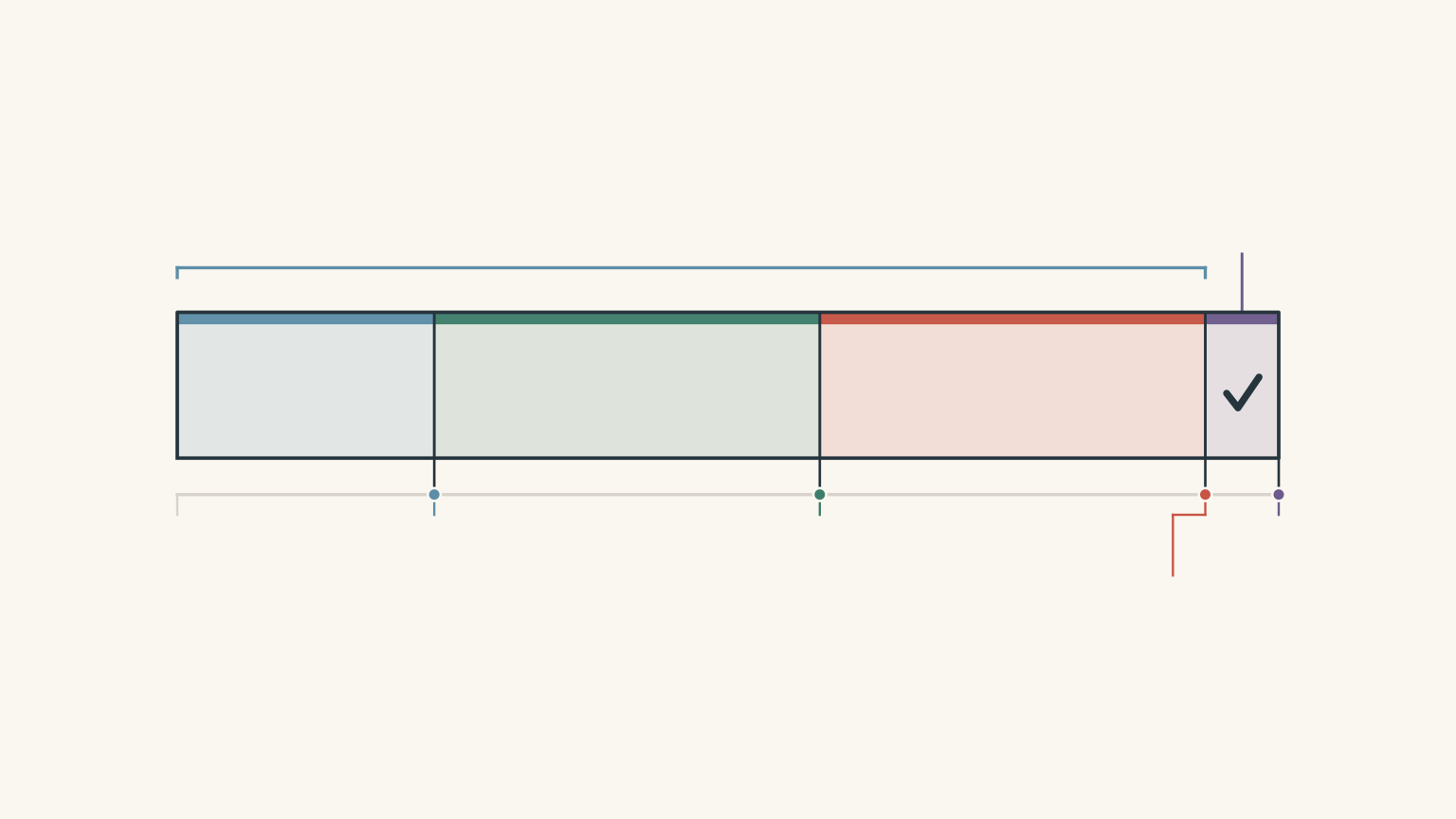
You should aim to finish Section A after 28 minutes, Section B after 70 minutes, and Section C after 112 minutes.
That leaves your final 8 minutes for checking.
The important result is that you now have a clear limit for each section. If Section A takes 40 minutes, you know immediately that something needs to change.
One important qualification: marks are a guide to time, not a perfect measure of difficulty. A 4-mark calculation may be much quicker than a 4-mark explanation involving unfamiliar data.
Use the average to build your budget, then adjust slightly for the actual demands of the questions. If you give one question extra time, you must find that time somewhere else.
Due to technical limitations, this figure may display incorrectly or contain inaccuracies. Please check key details against your course materials.
02Use timed checkpoints to catch problems early
A time budget is only useful if you actually check it.
Many students look at the clock occasionally but don’t compare their progress with the amount of work they should have completed.
Instead, set three checkpoints:
- 25% of your working time.
- 50% of your working time.
- 75% of your working time.
At each checkpoint, compare the marks you have genuinely attempted with the marks you expected to have covered.
For the 80-mark example above, you have 112 minutes of working time.
| Checkpoint | Time elapsed | Target marks covered |
|---|---|---|
| 25% | 28 min | 20 |
| 50% | 56 min | 40 |
| 75% | 84 min | 60 |
| End of writing | 112 min | 80 |
These targets assume the marks are distributed reasonably evenly. If the paper has uneven sections or optional questions, use your section-by-section budget instead.
What counts as marks covered?
Count the marks attached to parts you have genuinely attempted with a relevant calculation, explanation, or method. Don’t count an entire 8-mark question simply because you’ve written something at the top of the page.
You cannot know exactly how many marks you’ve earned during the exam. You can, however, estimate how much of the paper you’ve meaningfully addressed.
What if you’re behind?
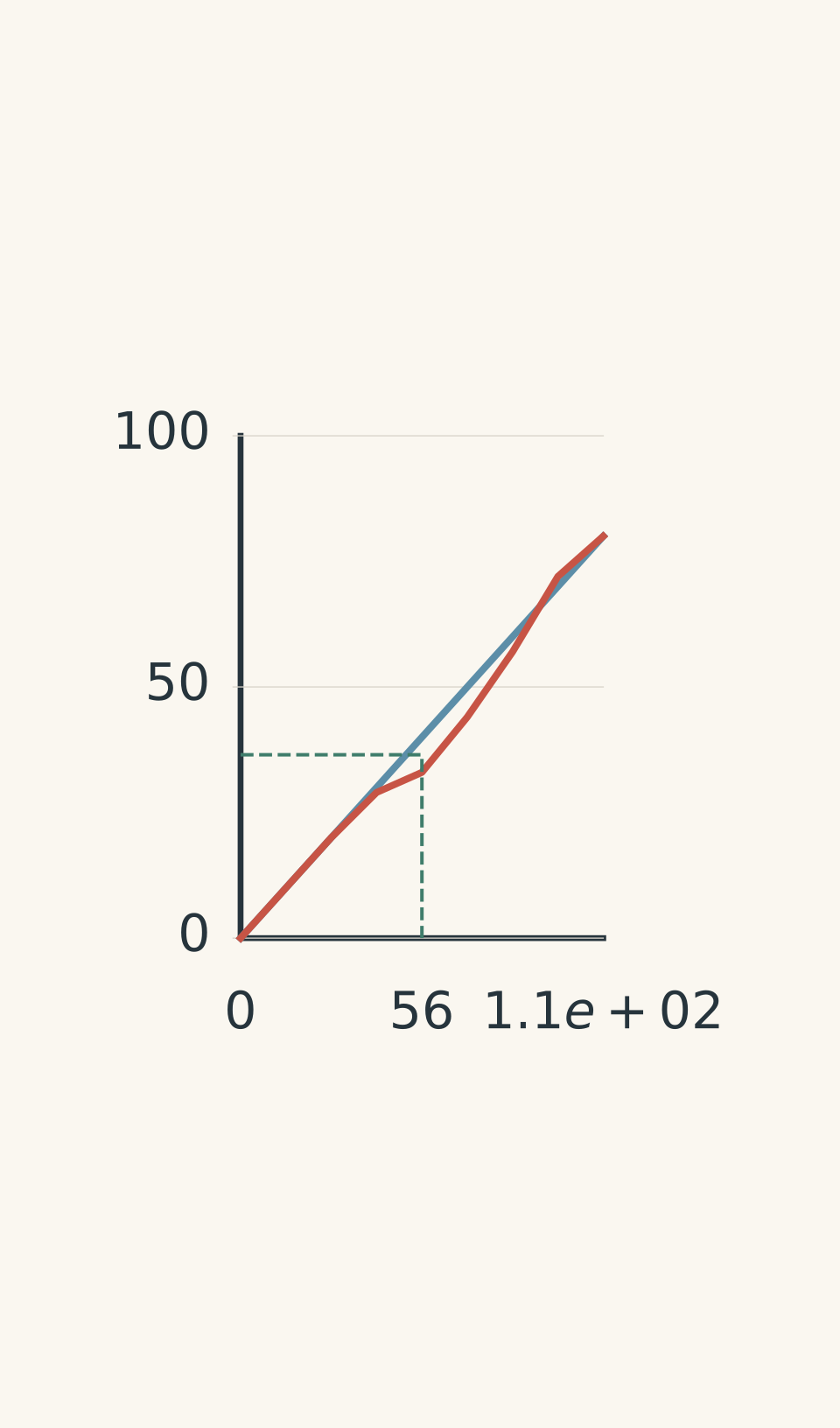
Suppose you reach the halfway checkpoint after 56 minutes, but you’ve only attempted 33 marks instead of the target 40.
You’re seven marks behind.
Your first instinct might be to rush through everything that remains. Resist that temptation.
Instead, work out why you’re behind.
Situation 1: One question has taken too long.
This is usually the easiest problem to fix.
Stop spending time on that question, move to another section, and return if time allows.
Situation 2: You’re spending too long explaining things.
Check whether you’re repeating information that doesn’t earn additional marks.
For example, if a question asks you to explain a physical relationship, state the relevant principle, explain how it applies, and connect it to the result. You don’t need several sentences saying the same thing.
Situation 3: Almost every question is taking longer than expected.
You need to prioritise the remaining questions.
Start with parts where you can identify a clear method. Don’t spend eight minutes trying to solve an unfamiliar problem while several accessible marks remain untouched.
- Target pace
- Actual attempted marks
- 7 marks behind pace
Due to technical limitations, this figure may display incorrectly or contain inaccuracies. Please check key details against your course materials.
Being behind doesn’t mean you’ve failed the exam. It means your original time budget needs adjusting.
The earlier you recognise the problem, the more options you have.
03Know when to move on from a difficult question
One of the biggest causes of poor exam pacing is the feeling that you must finish a question before moving to the next one.
You don’t.
An HSC question might have four parts. You could confidently answer the first three but struggle with the final part.
There is no advantage in sacrificing several easier marks elsewhere just because you want to complete that one question.
A useful approach is to work through the paper in passes.
First pass: Answer what you can do confidently.
Work through questions and subparts where you can identify a clear method or explanation.
If a question has an unfamiliar final part, don’t automatically abandon its earlier parts.
Second pass: Return to questions requiring more thought.
Once you’ve covered the accessible marks, return to the questions you’ve marked for further work.
You can now spend more time on them without worrying that straightforward questions remain untouched.
Final pass: Check your answers.
Use your reserved time to find omissions and correct mistakes.
The two-minute rule
For a difficult question, give yourself a deliberate attempt to understand what it is asking.
Identify:
- What information has been supplied?
- What quantity or conclusion is required?
- Which principle, equation, or method might apply?
- What is the first valid step?
If you’ve spent roughly 1-2 minutes trying to find a starting point and still have no reasonable approach, consider parking the question.
This isn’t a universal two-minute limit. A complicated 10-mark question deserves more planning time than a straightforward 1-mark question.
The important distinction is between thinking productively and repeating the same unsuccessful approach.
If you have already made substantial progress, use your remaining question budget before moving on. If you’ve made no progress, don’t let the question consume the time intended for several others.
Don’t confuse an unfinished answer with a wasted attempt
Even when you cannot finish a question, you may be able to demonstrate some of the required reasoning.
For example:
- In Mathematics, write the relevant equation and show your substitution.
- In Physics, identify the governing law and use a clear, labelled diagram where appropriate.
- In Chemistry, show the relevant chemical equation or explain the chemical principle involved.
These steps can demonstrate valid reasoning even if you cannot reach the final answer.
The aim is not to fill the page. It is to make your working meaningful.
04Reallocate time when you finish questions early
Your time budget shouldn’t be completely rigid.
Suppose you finish two questions faster than expected. You’ve now created extra time that can be used elsewhere.
This is particularly useful when a paper contains a mixture of short questions and longer, multi-step problems.
Worked example: Adjusting your time budget during an exam
An examination has 60 marks and 90 minutes of answer-writing time. You reserve 6 minutes for checking.
You have three questions:
- Question 1 is worth 4 marks.
- Question 2 is worth 8 marks.
- Question 3 is worth 12 marks.
You finish Question 1 in 4 minutes and Question 2 in 9 minutes.
How much additional time can you afford to spend on Question 3?
Step 1
\[ T_{\text{working}}=90-6 \]
\[ T_{\text{working}}=84\text{ min} \]
Step 2
\[ t_{\text{mark}}=\frac{84}{60} \]
\[ \boxed{t_{\text{mark}}=1.4\text{ min/mark}} \]
Step 3
Question 1:
\[ 4\times1.4=5.6\text{ min} \]
Question 2:
\[ 8\times1.4=11.2\text{ min} \]
Question 3:
\[ 12\times1.4=16.8\text{ min} \]
Your approximate budgets are 6, 11, and 17 minutes.
Step 4
Question 1 saved:
\[ 6-4=2\text{ min} \]
Question 2 saved:
\[ 11-9=2\text{ min} \]
You have saved approximately 4 minutes.
Step 5
Question 3 originally had a budget of approximately 17 minutes.
You can now afford to spend up to approximately 21 minutes on it without reducing the time available for the remaining questions or your 6-minute review reserve.
This is useful if Question 3 requires an extra calculation, a more detailed explanation, or careful interpretation of information.
However, you don’t have to spend all four extra minutes. If Question 3 is going smoothly, carry the remaining time forward.
The key idea is that your time budget should respond to your progress.
You aren’t trying to obey a stopwatch at the expense of good answers. You’re trying to prevent one difficult question from taking time away from several other opportunities to earn marks.
05A practical routine to use in every HSC exam
You don’t need a complicated system to manage your time.
Use this routine.
Before writing
- Check the total writing time and total marks.
- Set aside approximately 5-8% of the writing time for checking.
- Calculate your average time per mark.
- Estimate the time available for each section.
- Identify the 25%, 50%, and 75% checkpoints.
- Use any permitted reading time to understand the paper’s structure and identify optional questions, following the examination instructions.
During the examination
- Start with questions where you can make useful progress.
- Keep an eye on your time budget.
- Check your progress at the planned checkpoints.
- If a question stalls, record any useful working and move on.
- Reallocate time when you finish questions early.
- Avoid spending time repeating explanations or polishing answers unnecessarily.
At the end
Check that:
- Every question has been considered.
- Every subpart you intended to answer has an answer.
- Equations and calculations are clearly presented.
- Units and signs are correct.
- Your answers match the quantities requested.
- You haven’t accidentally skipped a page or question.
A final check is particularly useful for catching small errors that have nothing to do with whether you understand the subject.
06Questions and solutions
The following questions test whether you can apply the time-management method in increasingly complicated situations.
Question 1
An HSC examination has 100 marks and 150 minutes of answer-writing time.
You decide to reserve 10 minutes for checking.
(a) Calculate your average working time per mark.
(b) How much time should you initially allocate to a 14-mark question?
Solution 1
Your average working time is 1.4 minutes per mark, giving you approximately 20 minutes for the 14-mark question.
(a) First, subtract the review reserve from the total writing time.
\[ T_{\text{working}}=150-10=140\text{ min} \]
Divide by the total number of marks:
\[ t_{\text{mark}}=\frac{140}{100} \]
\[ \boxed{1.4\text{ min/mark}} \]
(b) Multiply this rate by the question’s mark allocation.
\[ t=14\times1.4 \]
\[ \boxed{t=19.6\text{ min}} \]
You should initially allow approximately 20 minutes.
Remember that this is a starting budget. If the question involves an unusually long explanation or several linked calculations, you may need to adjust the allocation using time saved elsewhere.
Question 2
An examination has 60 marks and 90 minutes of writing time. You reserve 6 minutes for checking.
After 42 minutes of writing time, you have genuinely attempted only 25 marks.
(a) How many marks should you ideally have attempted by this checkpoint?
(b) How many marks are you behind?
(c) What average time per remaining mark would you need to maintain your final review reserve?
(d) Explain how you should adjust your strategy.
Solution 2
You are five marks behind your target and need to average approximately 1.2 minutes per remaining mark. You should prioritise accessible questions rather than rushing indiscriminately.
(a) First, calculate the available working time.
\[ T_{\text{working}}=90-6=84\text{ min} \]
After 42 minutes, you have used exactly half your working time.
You should therefore have attempted approximately half the total marks:
\[ M_{\text{target}}=\frac{60}{2} \]
\[ \boxed{M_{\text{target}}=30} \]
(b) You have attempted 25 marks.
\[ 30-25=5 \]
You are five marks behind your target.
(c) You have 90 − 42 = 48 minutes remaining until the end of writing time.
After preserving the 6-minute review reserve, you have:
\[ 48-6=42\text{ min} \]
You have 60 − 25 = 35 marks remaining.
Your required average rate is:
\[ t_{\text{remaining}}=\frac{42}{35} \]
\[ \boxed{t_{\text{remaining}}=1.2\text{ min/mark}} \]
Your original rate was 1.4 minutes per mark, so you need to work somewhat faster.
(d) Don’t try to recover all five marks by rushing through every remaining question.
Instead, identify whether one difficult question has caused most of the delay. If so, park it and move to questions where you can make progress.
If you’re consistently behind, shorten unnecessary explanations and prioritise the remaining parts with clear methods.
The important point is that you have identified the problem with enough time remaining to respond to it.
Question 3
You are completing a 10-mark question with four parts:
| Part | Marks |
|---|---|
| (a) | 2 |
| (b) | 2 |
| (c) | 2 |
| (d) | 4 |
Your average time per mark is 1.4 minutes, giving the question an initial budget of 14 minutes.
After 12 minutes, you have completed parts (a), (b), and (c). You have spent the last two minutes trying to start part (d), but you still cannot identify a valid first step.
Should you continue working on the question? Explain your decision.
Solution 3
You should park part (d) and move to another question rather than continuing to spend time without making progress.
Your original budget was:
\[ 10\times1.4=14\text{ min} \]
You have already spent 12 minutes and completed 6 marks.
The remaining part is worth 4 marks, but you have not identified a valid starting point despite spending two minutes on it.
You have two minutes left in your original budget.
You could use those two minutes to record any relevant information or equation you can justify. However, if you still cannot identify a productive approach, move on.
Why?
Because the remaining four marks are not automatically worth another six or eight minutes of your time.
You might be able to return later with a clearer approach. Meanwhile, other questions may offer marks that you can secure much more efficiently.
The tempting mistake is to think that leaving a 10-mark question unfinished means wasting the time already spent on it.
It doesn’t. You have completed six marks. Protect them by moving on when the remaining work stops being productive.
Question 4
You have 20 minutes remaining in an HSC examination. You want to reserve the final 4 minutes for checking, leaving 16 minutes for further answers.
You have four unanswered parts:
| Part | Available marks | Estimated time |
|---|---|---|
| Question 7(a) | 4 | 6 min |
| Question 7(b) | 6 | 8 min |
| Question 8 | 4 | 4 min |
| Question 9 | 6 | 6 min |
There is an important detail:
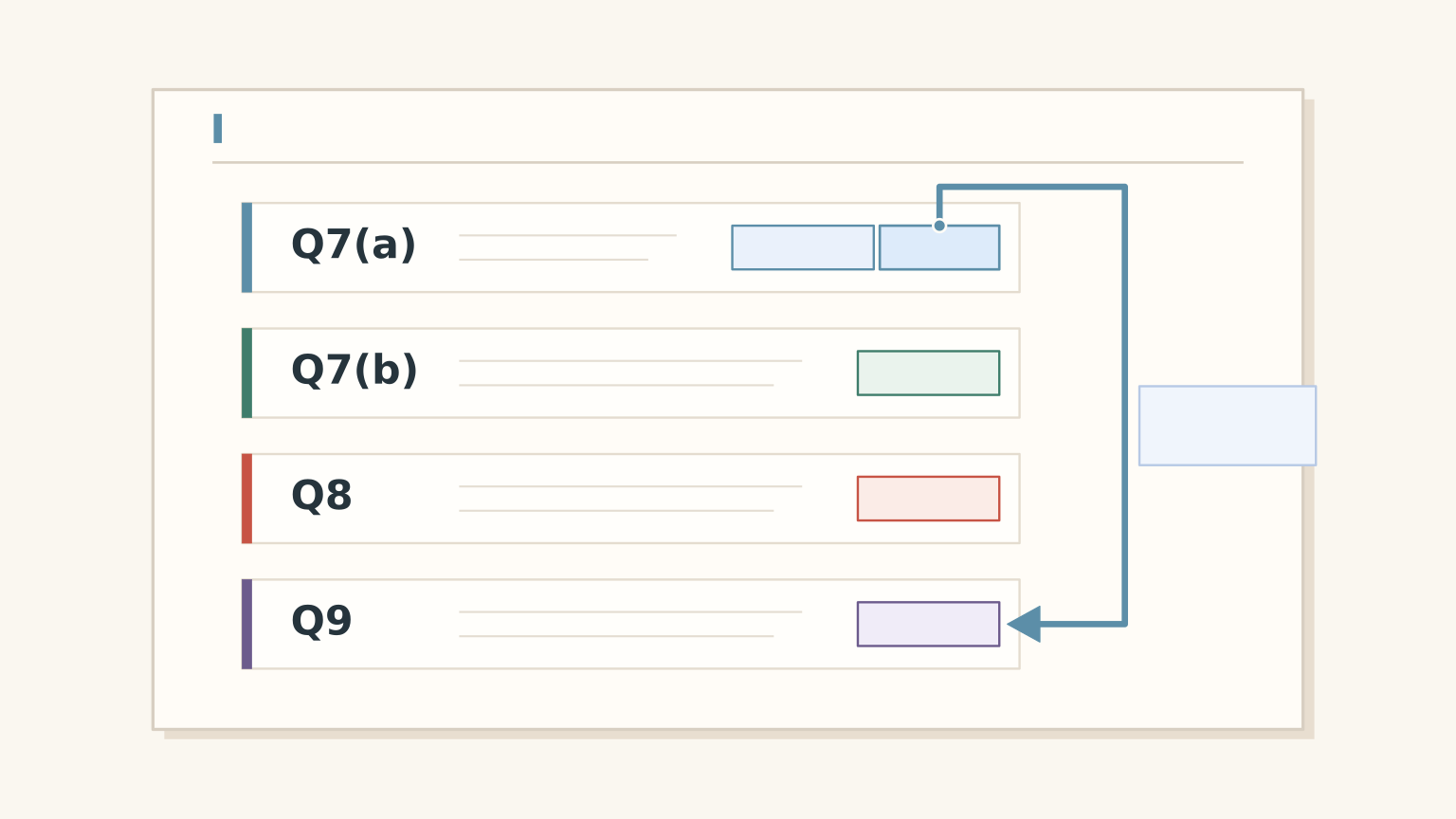
Question 9 requires a numerical result obtained in Question 7(a). If you complete Question 7(a), you can answer Question 9 in 6 minutes. Without that result, you can only confidently earn 1 mark from Question 9 in the same time.
Questions 7(a) and 7(b) are otherwise independent.
Assume the estimated times are reliable and that each completed part earns its stated marks. For this planning problem, don’t count unpredictable partial marks from unfinished parts.
What sequence of questions should you prioritise to maximise the marks you can confidently secure in the remaining 16 minutes? Explain why choosing questions purely by their individual marks-per-minute rates can give the wrong answer.
Due to technical limitations, this figure may display incorrectly or contain inaccuracies. Please check key details against your course materials.
Solution 4
Complete Question 7(a), then Question 9, then Question 8. This secures 14 marks in exactly 16 minutes while preserving your final 4-minute checking reserve.
The important feature is that Question 7(a) unlocks Question 9.
Let’s examine the available options.
Step 1: Consider the individual marks-per-minute rates.
Question 7(a):
\[ \frac{4}{6}=0.67\text{ marks/min} \]
Question 7(b):
\[ \frac{6}{8}=0.75\text{ marks/min} \]
Question 8:
\[ \frac{4}{4}=1\text{ mark/min} \]
At first glance, Question 8 looks like the obvious first choice. Question 7(b) also appears more attractive than Question 7(a).
If you simply rank questions by their individual marks-per-minute rates, Question 7(a) comes last.
But that ranking ignores the dependency between questions.
Step 2: Recognise the value of Question 7(a).
Completing Question 7(a) takes 6 minutes and secures 4 marks.
More importantly, it gives you the numerical result required to complete Question 9.
Question 9 then provides another 6 marks in 6 minutes.
Together, these two parts give you:
\[ 4+6=10\text{ marks} \]
in:
\[ 6+6=12\text{ min} \]
Step 3: Add Question 8.
Question 8 takes another 4 minutes and provides 4 marks.
Your total is now:
\[ 10+4=14\text{ marks} \]
The total time is:
\[ 12+4=16\text{ min} \]
You have used your entire answer-writing allocation while preserving the final 4-minute checking reserve.
Step 4: Compare this with the tempting alternative.
Suppose you choose Question 7(b) first because it offers 6 marks in 8 minutes.
You could then complete Question 8 in another 4 minutes.
You would have used 12 minutes and secured 10 marks.
However, only 4 minutes would remain for answering questions. You would not have enough time to complete Question 7(a), so you could not unlock the full 6 marks available in Question 9.
Your confident return would be lower.
The crucial insight is that the value of a question is not always limited to its own mark allocation.
Sometimes completing one part makes another part much easier or even possible.
This is why marks-per-minute is a useful starting point, but not a mechanical rule for deciding question order. You must also look for relationships between questions, shared results, and information that unlocks later parts.
07The next step: Make each minute count
Managing your time is only half the problem. Once you’ve allocated enough time to a question, you also need to make your working count.
In Mathematics, that means showing enough reasoning to make your method clear, even when you cannot reach the final answer. See How to Earn Method Marks When You Cannot Finish an HSC Maths Question.
In Physics, a well-labelled diagram can communicate important physical relationships without relying entirely on written explanation. See How to Use Diagrams in HSC Physics Written Answers.
For subject-specific timed practice, tutorgum offers online HSC tutoring in Physics, Chemistry, and Maths Extension 1 and Extension 2 for Year 11 and 12 students.
The next time you sit a timed paper, don’t just aim to finish faster. Set your budget, check your progress, and make deliberate decisions about where each remaining minute will do the most good.