
Gas Mixture Mean Molar Mass: Composition and Density
Learn how to calculate the mean molar mass of a gas mixture using mass, mole, or volume composition. Then apply it to calculate gas density, interpret mixture properties, and solve more challenging gas mixture problems.
A cylinder contains 50.0 g of hydrogen gas and 50.0 g of nitrogen gas. What is the mean molar mass of the mixture?
A tempting answer is to average their molar masses:
\[ \frac{2.02+28.0}{2}=15.0\text{ g mol}^{-1} \]
But that assumes the two gases contribute equal numbers of particles. They don’t.
The 50.0 g of hydrogen contains approximately 24.8 mol of molecules, while the 50.0 g of nitrogen contains only 1.79 mol. Most particles in the mixture are therefore hydrogen molecules, pulling the mean molar mass much closer to hydrogen’s value.
The actual mean molar mass is approximately \(3.77\text{ g mol}^{-1}\).
This is the central idea behind gas mixture mean molar mass: the average depends on how many moles of each gas are present, not simply how much mass each gas contributes.
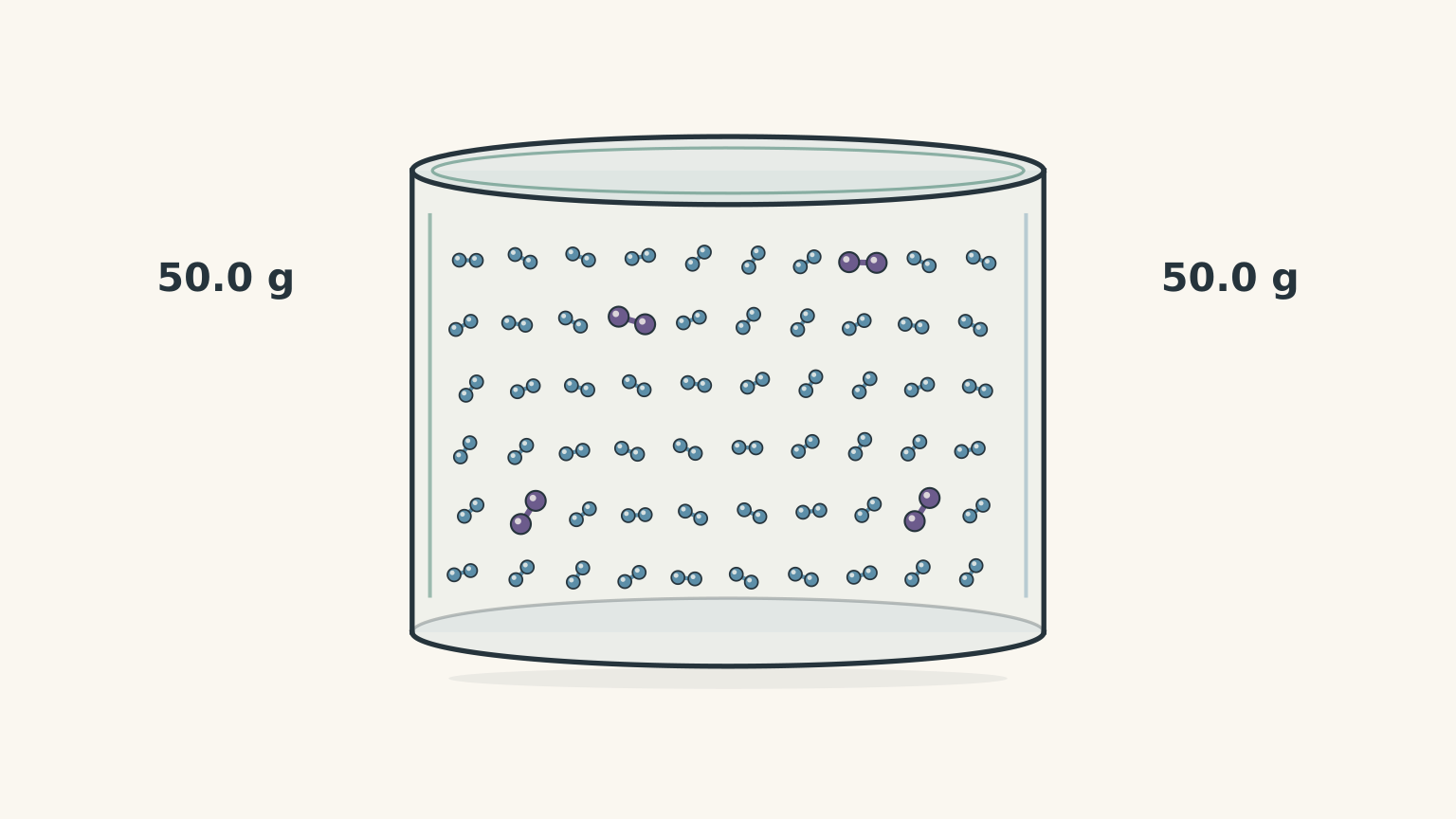
Due to technical limitations, this figure may display incorrectly or contain inaccuracies. Please check key details against your course materials.
01The Year 11 chemistry foundation
This article builds on the Year 11 Quantitative chemistry foundation: determining percentage composition by mass and calculating empirical formulae.
The Chemistry 11-12 Syllabus (2025) is scheduled for implementation in Year 11 from 2028. This article uses that syllabus foundation as a prerequisite entry point.
Calculating the mean molar mass of a gas mixture is an extension beyond the required syllabus content. It is not an additional required assessment skill.
Before developing the extension, recall two important ideas.
Percentage composition by mass
Percentage composition by mass tells us what proportion of a substance’s total mass comes from each component.
For example, a mixture containing 30% carbon dioxide and 70% nitrogen by mass has:
- 30 g of carbon dioxide in every 100 g of mixture.
- 70 g of nitrogen in every 100 g of mixture.
The percentages describe the distribution of mass, not the distribution of particles.
Converting mass into moles
You already know that the amount of a substance can be calculated using:
\[ n=\frac{m}{M} \]
where:
- \(n\) is the amount of substance, measured in mol.
- \(m\) is the mass, measured in g.
- \(M\) is the molar mass, measured in g mol\(^{-1}\).
This conversion is essential because different gases have different molar masses.
A gram of hydrogen represents far more particles than a gram of carbon dioxide.
If you need to revise this conversion, see Moles from Mass and Molar Mass: HSC Chemistry Guide.
02What is the mean molar mass of a gas mixture?
Imagine combining several gases inside one container.
Each gas contributes some mass and some number of moles. The mixture has a total mass and a total amount of gas.
We define its mean molar mass as:
\[ \boxed{\bar M=\frac{m_{\text{total}}}{n_{\text{total}}}} \]
Here, \(\bar M\) represents the mean molar mass of the mixture.
Notice that this definition works regardless of how many different gases are present.
A mixture containing hydrogen, nitrogen, oxygen, and carbon dioxide still has one well-defined mean molar mass.
It does not mean that the gases have formed a new compound. The mixture simply has an average mass per mole of gas particles.
Mass fractions and mole fractions
To calculate the mean molar mass efficiently, we need to distinguish two types of composition.
Mass fraction describes the fraction of the mixture’s total mass contributed by one component.
For component \(i\):
\[ w_i=\frac{m_i}{m_{\text{total}}} \]
Mole fraction describes the fraction of the mixture’s total moles contributed by one component.
For component \(i\):
\[ x_i=\frac{n_i}{n_{\text{total}}} \]
Both fractions add to 1 across the entire mixture:
\[ \sum_i w_i=1 \]
\[ \sum_i x_i=1 \]
The important distinction is their denominator:
- Mass fraction compares component mass with total mass.
- Mole fraction compares component moles with total moles.
A gas can contribute a small percentage of the total mass but a large percentage of the total moles.
This is exactly what happens with hydrogen in the opening example.
Calculating mean molar mass from mole fractions
Suppose a mixture contains two gases, A and B.
The total mass is:
\[ m_{\text{total}}=n_A M_A+n_B M_B \]
The total amount is:
\[ n_{\text{total}}=n_A+n_B \]
Dividing total mass by total moles gives:
\[ \bar M= \frac{n_A M_A+n_B M_B} {n_A+n_B} \]
Since mole fraction is the component’s moles divided by total moles, we can rewrite this as:
\[ \boxed{\bar M=x_A M_A+x_B M_B} \]
For a mixture containing any number of gases:
\[ \boxed{\bar M=\sum_i x_iM_i} \]
This is a mole-fraction-weighted average.
The symbols \(M_i\) represent the molar mass of each individual gas, while \(x_i\) represents its mole fraction.
Calculating mean molar mass from mass fractions
What happens if the question gives percentage composition by mass instead?
We cannot simply substitute mass fractions into the previous equation.
Instead, start with the definition:
\[ \bar M=\frac{m_{\text{total}}}{n_{\text{total}}} \]
For each gas:
\[ n_i=\frac{m_i}{M_i} \]
Therefore:
\[ \bar M= \frac{m_{\text{total}}} {\displaystyle\sum_i\frac{m_i}{M_i}} \]
Using \(w_i=m_i/m_{\text{total}}\), we obtain:
\[ \boxed{ \bar M= \frac{1}{\displaystyle\sum_i\frac{w_i}{M_i}} } \]
This is the key equation when a question provides mass percentages.
Remember that \(w_i\) must be written as a decimal fraction.
For example, 25% by mass becomes \(0.25\), not 25.
Worked example: Mean molar mass from mass composition
A 100.0 g gas mixture contains 20.0 g of helium and 80.0 g of argon. Calculate its mean molar mass and the mole fraction of helium.
Use:
- Helium molar mass = 4.00 g mol\(^{-1}\).
- Argon molar mass = 40.0 g mol\(^{-1}\).
Step 1
For helium:
\[ n_{\mathrm{He}}=\frac{20.0}{4.00} =5.00\text{ mol} \]
For argon:
\[ n_{\mathrm{Ar}}=\frac{80.0}{40.0} =2.00\text{ mol} \]
Step 2
\[ n_{\text{total}}=5.00+2.00 =7.00\text{ mol} \]
Step 3
\[ \bar M=\frac{m_{\text{total}}}{n_{\text{total}}} \]
\[ \bar M=\frac{100.0}{7.00} \]
\[ \boxed{\bar M=14.3\text{ g mol}^{-1}} \]
Step 4
\[ x_{\mathrm{He}}= \frac{n_{\mathrm{He}}}{n_{\text{total}}} \]
\[ x_{\mathrm{He}}=\frac{5.00}{7.00} \]
\[ \boxed{x_{\mathrm{He}}=0.714} \]
The helium mole fraction is 71.4%.
Notice something interesting: helium contributes only 20% of the mixture’s mass, but represents 71.4% of its particles.
This is why mass percentages cannot be treated as mole percentages.
03What if the composition is given by volume?
Gas mixtures introduce another useful relationship.
For ideal gases at the same temperature and pressure, equal volumes contain equal numbers of moles.
This follows from the ideal gas equation:
\[ PV=nRT \]
Rearranging:
\[ \frac{V}{n}=\frac{RT}{P} \]
At constant temperature and pressure, \(RT/P\) is constant. Therefore, volume is directly proportional to the number of moles.
For an ideal gas mixture:
\[ \boxed{x_i=\frac{V_i}{V_{\text{total}}}} \]
Here, \(V_i\) is the volume that the component gas would occupy at the mixture’s temperature and pressure.
This means that volume percentages can be treated as mole percentages, provided the ideal gas approximation applies and the component volumes are compared at the same temperature and pressure.
A quick example
A gas mixture contains:
- 20% carbon dioxide by volume.
- 80% nitrogen by volume.
Assuming ideal gas behaviour:
\[ x_{\mathrm{CO_2}}=0.20 \]
\[ x_{\mathrm{N_2}}=0.80 \]
Using their molar masses:
\[ \bar M= (0.20)(44.0)+(0.80)(28.0) \]
\[ \bar M=8.80+22.4 \]
\[ \boxed{\bar M=31.2\text{ g mol}^{-1}} \]
The calculation is straightforward because the volume percentages can be used directly as mole fractions.
Be careful, though. This shortcut does not apply to mass percentages.
04Using mean molar mass to calculate gas density
Now that we can calculate the mean molar mass, we can determine the density of a gas mixture.
Density describes the mass contained in a particular volume:
\[ \rho=\frac{m}{V} \]
where:
- \(\rho\) is density, measured in kg m\(^{-3}\).
- \(m\) is the total mass, measured in kg.
- \(V\) is the total volume, measured in m\(^3\).
For an ideal gas mixture, we can use the ideal gas equation:
\[ PV=nRT \]
The total number of moles can also be expressed using mean molar mass:
\[ n=\frac{m}{\bar M} \]
Substitute this into the ideal gas equation:
\[ PV=\frac{m}{\bar M}RT \]
Rearranging:
\[ \frac{m}{V}=\frac{P\bar M}{RT} \]
Since density is mass divided by volume:
\[ \boxed{\rho=\frac{P\bar M}{RT}} \]
This is the ideal gas mixture density equation.
The variables are:
| Symbol | Meaning | SI unit |
|---|---|---|
| \(\rho\) | Mixture density | kg m\(^{-3}\) |
| \(P\) | Absolute pressure | Pa |
| \(\bar M\) | Mean molar mass | kg mol\(^{-1}\) |
| \(R\) | Ideal gas constant, 8.314 | J mol\(^{-1}\) K\(^{-1}\) |
| \(T\) | Absolute temperature | K |
One detail matters when substituting values: convert mean molar mass from g mol\(^{-1}\) to kg mol\(^{-1}\).
For example:
\[ 31.4\text{ g mol}^{-1} =0.0314\text{ kg mol}^{-1} \]
Also, temperature must be in kelvin, and pressure must be absolute pressure.
What determines the density of a gas mixture?
Look at the equation:
\[ \rho=\frac{P\bar M}{RT} \]
It tells us that density depends on three things:
- Pressure.
- Temperature.
- Mean molar mass.
At constant pressure and temperature, increasing mean molar mass increases density.
Why? Each mole of the mixture has a greater mass, while the ideal gas model gives the same volume per mole at those conditions.
However, the density of a gas mixture is not determined by composition alone. Changing its pressure or temperature also changes its density.
Worked example: Calculating the density of a gas mixture
A 100.0 g gas mixture contains 30.0 g of carbon dioxide and 70.0 g of nitrogen.
The mixture is held at a pressure of 100.0 kPa and a temperature of 25.0 °C.
Calculate its mean molar mass and density.
Use:
- \(M_{\mathrm{CO_2}}=44.0\text{ g mol}^{-1}\)
- \(M_{\mathrm{N_2}}=28.0\text{ g mol}^{-1}\)
Step 1
For carbon dioxide:
\[ n_{\mathrm{CO_2}}=\frac{30.0}{44.0} =0.682\text{ mol} \]
For nitrogen:
\[ n_{\mathrm{N_2}}=\frac{70.0}{28.0} =2.50\text{ mol} \]
Step 2
\[ n_{\text{total}}=0.682+2.50 \]
\[ n_{\text{total}}=3.182\text{ mol} \]
Step 3
\[ \bar M=\frac{100.0}{3.182} \]
\[ \boxed{\bar M=31.4\text{ g mol}^{-1}} \]
Convert this to kilograms per mole:
\[ \bar M=0.0314\text{ kg mol}^{-1} \]
Step 4
Temperature:
\[ T=25.0+273.15=298.15\text{ K} \]
Pressure:
\[ P=100.0\text{ kPa}=100000\text{ Pa} \]
Step 5
\[ \rho=\frac{P\bar M}{RT} \]
\[ \rho= \frac{(100000)(0.0314)} {(8.314)(298.15)} \]
\[ \boxed{\rho=1.27\text{ kg m}^{-3}} \]
The mixture has a mean molar mass of 31.4 g mol\(^{-1}\) and a density of approximately 1.27 kg m\(^{-3}\) under the stated conditions.
Notice that carbon dioxide makes up 30% of the mass but only about 21.4% of the moles. Its relatively high molar mass means that a smaller number of carbon dioxide molecules contributes a substantial amount of mass.
05Assumptions and common mistakes
The equations developed above use the ideal gas model.
This model assumes that gas particles have negligible volume and that intermolecular forces can be ignored.
It works well for many gases at relatively low pressures and temperatures sufficiently far from condensation.
At high pressures or near condensation, real gases can deviate from ideal behaviour. A more advanced treatment introduces the dimensionless compressibility factor, \(Z\):
\[ \rho=\frac{P\bar M}{ZRT} \]
For an ideal gas, \(Z=1\), giving the equation used throughout this article.
The mixture calculations also assume that the gases do not react with each other and remain in the gas phase.
Common mistakes to avoid
| Mistake | Correct approach |
|---|---|
| Averaging molar masses directly when mass percentages are given | Convert each component’s mass into moles first. |
| Using mass fractions as mole fractions | Remember that they have different denominators. |
| Treating volume percentages as mass percentages | For ideal gases at the same temperature and pressure, volume percentages correspond to mole percentages. |
| Leaving molar mass in g mol\(^{-1}\) when calculating SI density | Convert it to kg mol\(^{-1}\). |
| Using Celsius in the ideal gas equation | Convert temperature to kelvin. |
| Assuming density depends only on composition | Consider pressure and temperature as well. |
A useful decision rule is:
- Given mass percentages? Use \(\bar M=1/\sum(w_i/M_i)\).
- Given mole percentages? Use \(\bar M=\sum x_iM_i\).
- Given ideal gas volume percentages? Convert them into mole fractions.
- Given mean molar mass, pressure, and temperature? Use \(\rho=P\bar M/(RT)\).
06Questions and solutions
The following questions move from standard gas-mixture calculations towards problems where you must combine different types of composition and track a mixture through a change of state.
Question 1
An ideal gas mixture contains 0.250 mol of oxygen and 0.750 mol of nitrogen.
Calculate its mean molar mass.
Use:
- \(M_{\mathrm{O_2}}=32.0\text{ g mol}^{-1}\)
- \(M_{\mathrm{N_2}}=28.0\text{ g mol}^{-1}\)
Solution 1
The mean molar mass is 29.0 g mol\(^{-1}\).
The question provides the number of moles of each gas, so we can use the mole-fraction-weighted average directly.
First, calculate the mole fractions:
\[ x_{\mathrm{O_2}}=\frac{0.250}{1.000}=0.250 \]
\[ x_{\mathrm{N_2}}=\frac{0.750}{1.000}=0.750 \]
Apply the mean molar mass equation:
\[ \bar M=x_{\mathrm{O_2}}M_{\mathrm{O_2}} +x_{\mathrm{N_2}}M_{\mathrm{N_2}} \]
Substitute:
\[ \bar M=(0.250)(32.0)+(0.750)(28.0) \]
\[ \bar M=8.00+21.0 \]
\[ \boxed{\bar M=29.0\text{ g mol}^{-1}} \]
The result lies between the molar masses of oxygen and nitrogen, as expected.
The mixture is closer to nitrogen’s molar mass because nitrogen contributes three times as many moles.
Question 2
A gas mixture contains 40.0% carbon dioxide and 60.0% methane by mass.
The total mass of the mixture is 100.0 g.
Calculate:
(a) The mean molar mass of the mixture.
(b) The mole fraction of carbon dioxide.
(c) The partial pressure of carbon dioxide if the total pressure is 150 kPa.
Use:
- \(M_{\mathrm{CO_2}}=44.0\text{ g mol}^{-1}\)
- \(M_{\mathrm{CH_4}}=16.0\text{ g mol}^{-1}\)
Solution 2
The mean molar mass is 21.5 g mol\(^{-1}\), the carbon dioxide mole fraction is 0.195, and its partial pressure is 29.3 kPa.
Step 1: Convert the component masses into moles.
Carbon dioxide:
\[ n_{\mathrm{CO_2}}=\frac{40.0}{44.0} =0.909\text{ mol} \]
Methane:
\[ n_{\mathrm{CH_4}}=\frac{60.0}{16.0} =3.75\text{ mol} \]
Step 2: Calculate the total number of moles.
\[ n_{\text{total}}=0.909+3.75 \]
\[ n_{\text{total}}=4.659\text{ mol} \]
Step 3: Calculate the mean molar mass.
\[ \bar M=\frac{100.0}{4.659} \]
\[ \boxed{\bar M=21.5\text{ g mol}^{-1}} \]
Step 4: Calculate the mole fraction of carbon dioxide.
\[ x_{\mathrm{CO_2}}= \frac{0.909}{4.659} \]
\[ \boxed{x_{\mathrm{CO_2}}=0.195} \]
Although carbon dioxide contributes 40.0% of the mixture’s mass, it represents only 19.5% of its moles.
Step 5: Calculate the partial pressure.
Dalton’s law states that the partial pressure of a gas is its mole fraction multiplied by the total pressure:
\[ P_i=x_iP_{\text{total}} \]
Therefore:
\[ P_{\mathrm{CO_2}}=(0.195)(150) \]
\[ \boxed{P_{\mathrm{CO_2}}=29.3\text{ kPa}} \]
The partial pressure is not 40% of the total pressure. That would incorrectly use the mass percentage instead of the mole fraction.
Question 3
An ideal gas mixture has the following volume composition:
| Gas | Volume percentage |
|---|---|
| Nitrogen | 70.0% |
| Oxygen | 20.0% |
| Carbon dioxide | 10.0% |
The mixture is at a pressure of 95.0 kPa and a temperature of 35.0 °C.
(a) Calculate its mean molar mass.
(b) Calculate its density.
(c) Determine whether it is denser than pure nitrogen at the same temperature and pressure. Calculate the percentage difference.
Use:
- \(M_{\mathrm{N_2}}=28.0\text{ g mol}^{-1}\)
- \(M_{\mathrm{O_2}}=32.0\text{ g mol}^{-1}\)
- \(M_{\mathrm{CO_2}}=44.0\text{ g mol}^{-1}\)
Solution 3
The mixture has a mean molar mass of 30.4 g mol\(^{-1}\) and a density of 1.13 kg m\(^{-3}\). It is approximately 8.57% denser than pure nitrogen at the same conditions.
Step 1: Convert volume percentages into mole fractions.
Because the mixture behaves ideally, the volume fractions equal the mole fractions.
Therefore:
\[ x_{\mathrm{N_2}}=0.700 \]
\[ x_{\mathrm{O_2}}=0.200 \]
\[ x_{\mathrm{CO_2}}=0.100 \]
Step 2: Calculate the mean molar mass.
\[ \begin{aligned} \bar M={}&(0.700)(28.0)\\ &+(0.200)(32.0)\\ &+(0.100)(44.0) \end{aligned} \]
\[ \bar M=19.6+6.4+4.4 \]
\[ \boxed{\bar M=30.4\text{ g mol}^{-1}} \]
Step 3: Convert the temperature and molar mass into SI units.
\[ T=35.0+273.15=308.15\text{ K} \]
\[ \bar M=0.0304\text{ kg mol}^{-1} \]
\[ P=95000\text{ Pa} \]
Step 4: Calculate the mixture density.
\[ \rho=\frac{P\bar M}{RT} \]
\[ \rho= \frac{(95000)(0.0304)} {(8.314)(308.15)} \]
\[ \boxed{\rho=1.13\text{ kg m}^{-3}} \]
Step 5: Compare this with pure nitrogen.
At identical pressure and temperature, density is directly proportional to molar mass.
Therefore, the ratio of densities is:
\[ \frac{\rho_{\text{mixture}}}{\rho_{\mathrm{N_2}}} = \frac{30.4}{28.0} \]
\[ =1.0857 \]
The percentage increase is:
\[ (1.0857-1)\times100 \]
\[ \boxed{8.57\%} \]
The mixture is denser because oxygen and carbon dioxide increase its mean molar mass above that of pure nitrogen.
Question 4
A gas sample contains only carbon dioxide and nitrogen.
At a temperature of 300.0 K and a pressure of 100.0 kPa, its measured density is 1.282 kg m\(^{-3}\).
Assuming ideal gas behaviour, calculate:
(a) The mean molar mass of the mixture.
(b) The percentage composition by mass of carbon dioxide.
(c) The mole percentage of carbon dioxide.
Use:
- \(M_{\mathrm{CO_2}}=44.0\text{ g mol}^{-1}\)
- \(M_{\mathrm{N_2}}=28.0\text{ g mol}^{-1}\)
Solution 4
The mixture contains approximately 34.4% carbon dioxide by mass, corresponding to 25.0% carbon dioxide by moles. Its mean molar mass is approximately 32.0 g mol\(^{-1}\).
This is an inverse problem: instead of calculating density from composition, we use the measured density to work backwards towards composition.
Step 1: Calculate the mean molar mass using the density equation.
Start with:
\[ \rho=\frac{P\bar M}{RT} \]
Rearrange:
\[ \bar M=\frac{\rho RT}{P} \]
Substitute:
\[ \bar M= \frac{(1.282)(8.314)(300.0)} {100000} \]
\[ \bar M=0.03198\text{ kg mol}^{-1} \]
Convert to g mol\(^{-1}\):
\[ \boxed{\bar M\approx32.0\text{ g mol}^{-1}} \]
Step 2: Determine the mass fraction of carbon dioxide.
Let \(w\) represent the mass fraction of carbon dioxide.
The nitrogen mass fraction must therefore be \(1-w\).
Use the mass-fraction equation:
\[ \frac{1}{\bar M} = \frac{w}{M_{\mathrm{CO_2}}} + \frac{1-w}{M_{\mathrm{N_2}}} \]
Substitute:
\[ \frac{1}{32.0} = \frac{w}{44.0} + \frac{1-w}{28.0} \]
Expanding:
\[ 0.03125= \frac{w}{44.0} +\frac{1}{28.0} -\frac{w}{28.0} \]
Rearranging gives:
\[ w=0.34375 \]
Therefore:
\[ \boxed{w_{\mathrm{CO_2}}=34.4\%} \]
The carbon dioxide mass percentage is approximately 34.4%.
Step 3: Calculate the mole percentage of carbon dioxide.
Imagine a 100 g sample of the mixture.
The component masses are:
\[ m_{\mathrm{CO_2}}=34.4\text{ g} \]
\[ m_{\mathrm{N_2}}=65.6\text{ g} \]
Convert these masses into moles:
\[ n_{\mathrm{CO_2}}=\frac{34.4}{44.0} =0.781\text{ mol} \]
\[ n_{\mathrm{N_2}}=\frac{65.6}{28.0} =2.34\text{ mol} \]
Total moles:
\[ n_{\text{total}}=0.781+2.34 =3.125\text{ mol} \]
Calculate the carbon dioxide mole fraction:
\[ x_{\mathrm{CO_2}}= \frac{0.78125}{3.125} \]
\[ \boxed{x_{\mathrm{CO_2}}=0.250} \]
Therefore, the carbon dioxide mole percentage is 25.0%.
The important trap: It is tempting to treat the mean molar mass as an arithmetic average weighted by mass percentages:
\[ \bar M=wM_{\mathrm{CO_2}}+(1-w)M_{\mathrm{N_2}} \]
That would incorrectly produce 25.0% carbon dioxide by mass.
The reason is that mean molar mass is defined as total mass divided by total moles. Mass percentages must first be converted into mole contributions.
Interestingly, 25.0% is the correct mole percentage, not the mass percentage.
Question 5
A rigid container has a total volume of 3.00 L. It is divided into two compartments by a removable partition.
Both compartments are initially at 300.0 K.
The left compartment has a volume of 2.00 L and a pressure of 100.0 kPa. It contains a mixture of hydrogen and nitrogen, with 50.0% hydrogen and 50.0% nitrogen by mass.
The right compartment has a volume of 1.00 L and a pressure of 200.0 kPa. It contains pure carbon dioxide.
The partition is removed, allowing all gases to mix. The container remains at 300.0 K, and no gas is lost or reacts.
Assume ideal gas behaviour.
(a) A student argues that the left compartment initially contains two-thirds of the total gas because its volume is two-thirds of the container’s volume. Explain why this prediction is incorrect.
(b) Calculate the final mole fractions of hydrogen, nitrogen, and carbon dioxide.
(c) Calculate the final mean molar mass.
(d) Calculate the final pressure and density.
(e) Determine which gas contributes the greatest mass to the final mixture. Calculate its mass percentage.
Use:
- \(M_{\mathrm{H_2}}=2.02\text{ g mol}^{-1}\)
- \(M_{\mathrm{N_2}}=28.0\text{ g mol}^{-1}\)
- \(M_{\mathrm{CO_2}}=44.0\text{ g mol}^{-1}\)
Solution 5
The student’s prediction is incorrect. The two initial compartments contain equal numbers of moles, despite having different volumes.
The final mixture has mole fractions of approximately 0.466 hydrogen, 0.0336 nitrogen, and 0.500 carbon dioxide. Its mean molar mass is 23.9 g mol\(^{-1}\), its final pressure is 133 kPa, and its density is 1.28 kg m\(^{-3}\). Carbon dioxide contributes approximately 92.1% of the total mass.
This question requires two separate conversions: mass composition into mole composition, and initial pressure-volume conditions into mole amounts.
Step 1: Explain why the initial volume ratio does not give the mole ratio.
The student’s argument would be correct if the initial pressures and temperatures were equal.
However, the initial compartments have different pressures.
From the ideal gas equation:
\[ n=\frac{PV}{RT} \]
At the same temperature, the number of moles depends on the product \(PV\), not volume alone.
For the left compartment:
\[ P_LV_L=(100.0)(2.00)=200 \]
For the right compartment:
\[ P_RV_R=(200.0)(1.00)=200 \]
Both products are equal.
Therefore:
\[ n_L=n_R \]
Each compartment initially contributes exactly half the total moles.
Step 2: Convert the left compartment’s mass composition into mole fractions.
The left compartment contains 50.0% hydrogen and 50.0% nitrogen by mass.
Imagine 100 g of this mixture.
This gives:
\[ m_{\mathrm{H_2}}=50.0\text{ g} \]
\[ m_{\mathrm{N_2}}=50.0\text{ g} \]
Convert to moles:
\[ n_{\mathrm{H_2}}=\frac{50.0}{2.02} =24.75\text{ mol} \]
\[ n_{\mathrm{N_2}}=\frac{50.0}{28.0} =1.786\text{ mol} \]
The total is:
\[ n_{\text{total}}=26.54\text{ mol} \]
The hydrogen mole fraction within the left compartment is:
\[ x_{\mathrm{H_2},L} =\frac{24.75}{26.54} =0.933 \]
The nitrogen mole fraction is:
\[ x_{\mathrm{N_2},L} =\frac{1.786}{26.54} =0.0673 \]
The left compartment is therefore approximately 93.3% hydrogen and 6.73% nitrogen by moles.
This is very different from its 50:50 mass composition.
Step 3: Calculate the final mole fractions.
We established that the two compartments initially contain equal numbers of moles.
Therefore, each compartment contributes 50.0% of the final total moles.
The right compartment contains only carbon dioxide, so:
\[ x_{\mathrm{CO_2}}=0.500 \]
Hydrogen contributes half of the left compartment’s mole fraction:
\[ x_{\mathrm{H_2}}=(0.500)(0.933) \]
\[ \boxed{x_{\mathrm{H_2}}=0.466} \]
Similarly, nitrogen contributes:
\[ x_{\mathrm{N_2}}=(0.500)(0.0673) \]
\[ \boxed{x_{\mathrm{N_2}}=0.0336} \]
The final mole fractions are:
| Gas | Final mole fraction |
|---|---|
| Hydrogen | 0.466 |
| Nitrogen | 0.0336 |
| Carbon dioxide | 0.500 |
Check that they add to approximately 1.00.
Step 4: Calculate the final mean molar mass.
Use the mole-fraction-weighted equation:
\[ \begin{aligned} \bar M={}&(0.466)(2.02)\\ &+(0.0336)(28.0)\\ &+(0.500)(44.0) \end{aligned} \]
\[ \bar M\approx23.9\text{ g mol}^{-1} \]
\[ \boxed{\bar M=23.9\text{ g mol}^{-1}} \]
Convert to kilograms per mole:
\[ \bar M=0.0239\text{ kg mol}^{-1} \]
Step 5: Calculate the final pressure.
After removing the partition, the gases occupy the full 3.00 L container.
The final temperature remains 300.0 K.
The ideal gas equation gives:
\[ P_{\text{final}}= \frac{n_{\text{total}}RT}{V_{\text{total}}} \]
Since the initial temperatures were equal and no gas was lost, we can also use:
\[ P_{\text{final}}= \frac{P_LV_L+P_RV_R} {V_{\text{total}}} \]
Substitute:
\[ P_{\text{final}}= \frac{(100.0)(2.00)+(200.0)(1.00)} {3.00} \]
\[ P_{\text{final}}=\frac{400}{3} \]
\[ \boxed{P_{\text{final}}=133.3\text{ kPa}} \]
Step 6: Calculate the final density.
Convert the final pressure into pascals:
\[ P=133300\text{ Pa} \]
Use the ideal gas mixture density equation:
\[ \rho=\frac{P\bar M}{RT} \]
Substitute:
\[ \rho= \frac{(133300)(0.0239)} {(8.314)(300.0)} \]
\[ \boxed{\rho=1.28\text{ kg m}^{-3}} \]
Step 7: Determine which gas contributes the greatest mass.
Carbon dioxide has a mole fraction of 0.500, but this does not mean it contributes 50% of the total mass.
To calculate its mass fraction, use:
\[ w_i=\frac{x_iM_i}{\bar M} \]
For carbon dioxide:
\[ w_{\mathrm{CO_2}}= \frac{(0.500)(44.0)}{23.9} \]
\[ w_{\mathrm{CO_2}}\approx0.921 \]
Therefore:
\[ \boxed{w_{\mathrm{CO_2}}=92.1\%} \]
Carbon dioxide contributes approximately 92.1% of the mixture’s mass.
This is a particularly important result.
Carbon dioxide represents 50.0% of the gas particles but more than 92% of the total mass. Hydrogen represents approximately 46.6% of the particles but contributes only about 3.9% of the mass.
The two percentages describe different properties of the same mixture.
The student’s original mistake was assuming that volume alone determined the initial mole contributions. That only works when the initial temperatures and pressures are equal. The second trap was assuming that equal mass percentages inside the left compartment meant equal mole fractions.
Both assumptions fail here.
Once you can move confidently between mass fractions, mole fractions, mean molar mass, and density, you can tackle more complex gas-mixture problems.
The next useful connection is Dalton’s law of partial pressures. It uses the mole fractions calculated here to determine how much of the total pressure each gas contributes.
See Dalton’s Law of Partial Pressures: Calculations Explained to develop that connection.