
Why Tertiary Alcohols Resist Oxidation: HSC Chemistry
Understand why tertiary alcohols do not undergo ordinary oxidation, unlike secondary alcohols, by examining the hydrogen attached to the carbon bearing the OH group. Explore how tertiary alcohols can still undergo substitution and elimination, with worked examples and HSC-style practice questions.
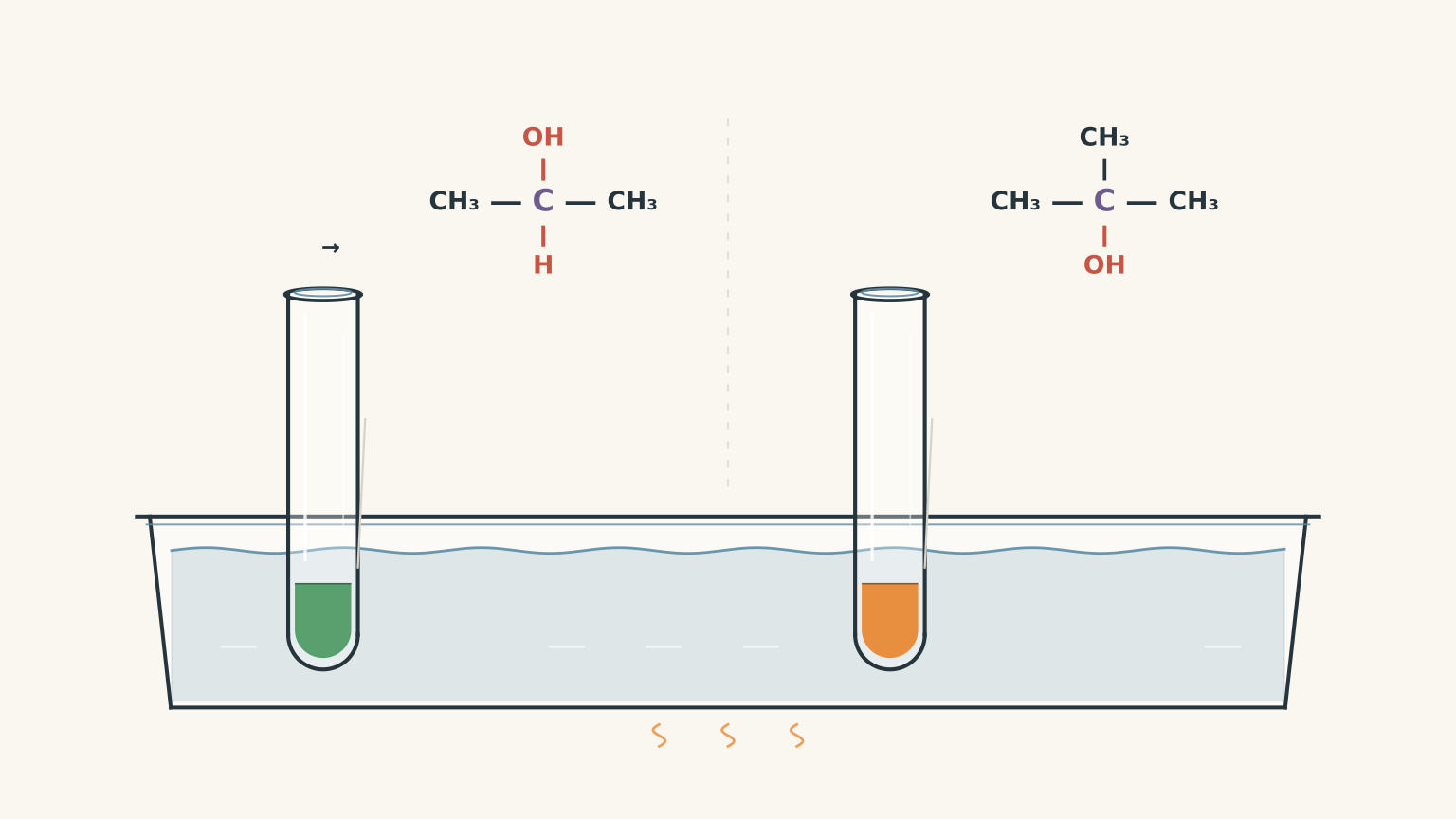
Put propan-2-ol and 2-methylpropan-2-ol into separate test tubes containing warm, acidified potassium dichromate(VI). Predict which one will turn the orange solution green.
The secondary alcohol, propan-2-ol, is oxidised to propanone. The tertiary alcohol, 2-methylpropan-2-ol, does not undergo the usual oxidation reaction under these conditions.
Both molecules contain an -OH group. So why does only one react?
The difference is the number of hydrogen atoms attached to the carbon bonded directly to the -OH group. A secondary alcohol has one of these hydrogen atoms. A tertiary alcohol has none. That missing hydrogen prevents the usual conversion of an alcohol into a carbonyl compound.
Importantly, this does not mean tertiary alcohols are unreactive. They can undergo substitution and elimination reactions, often more readily than secondary alcohols. The key is understanding which bonds each reaction needs to break.
Due to technical limitations, this figure may display incorrectly or contain inaccuracies. Please check key details against your course materials.
01Why does a tertiary alcohol resist oxidation?
The hydrogen that makes the difference
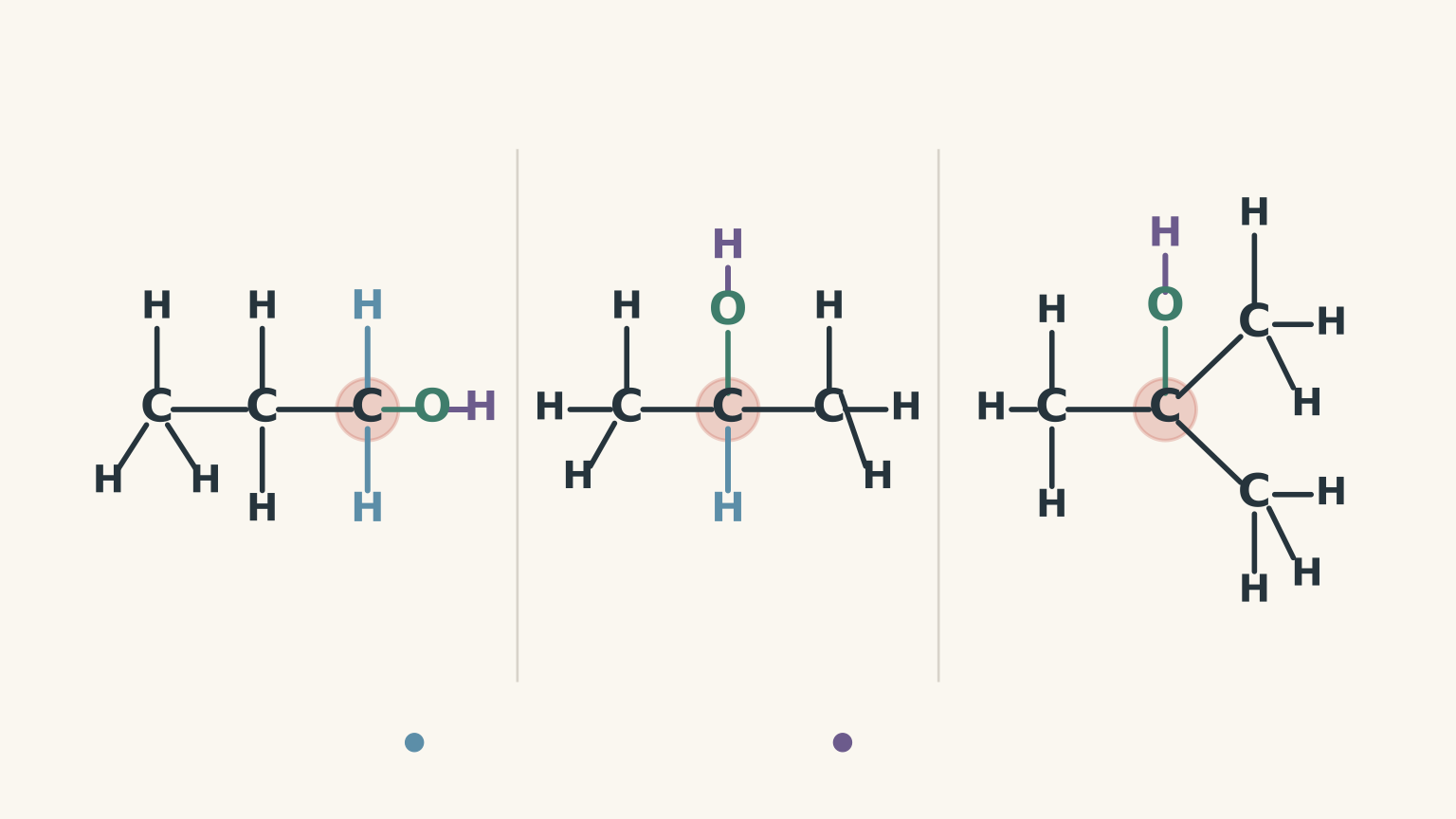
First, identify the carbon atom directly attached to the oxygen in the -OH group. This is sometimes called the carbon bearing the hydroxyl group, or the carbinol carbon.
The number of carbon groups attached to this carbon determines whether an alcohol is primary, secondary, or tertiary.
| Alcohol | Carbon groups attached to the carbon bearing -OH | Hydrogen atoms attached to that carbon |
|---|---|---|
| Primary | 1 | 2 |
| Secondary | 2 | 1 |
| Tertiary | 3 | 0 |
For example:
- Propan-1-ol, \(\ce{CH3CH2CH2OH}\), is primary.
- Propan-2-ol, \(\ce{CH3CH(OH)CH3}\), is secondary.
- 2-methylpropan-2-ol, \(\ce{(CH3)3COH}\), is tertiary.
If you need to refresh the structural classification, see Primary, Secondary and Tertiary Alcohols for HSC Chemistry.
Due to technical limitations, this figure may display incorrectly or contain inaccuracies. Please check key details against your course materials.
Notice something important: a tertiary alcohol still has a hydrogen attached to its oxygen. What it lacks is a hydrogen attached to the carbon directly bonded to that oxygen.
That is the distinction responsible for its resistance to ordinary oxidation.
What actually happens during alcohol oxidation?
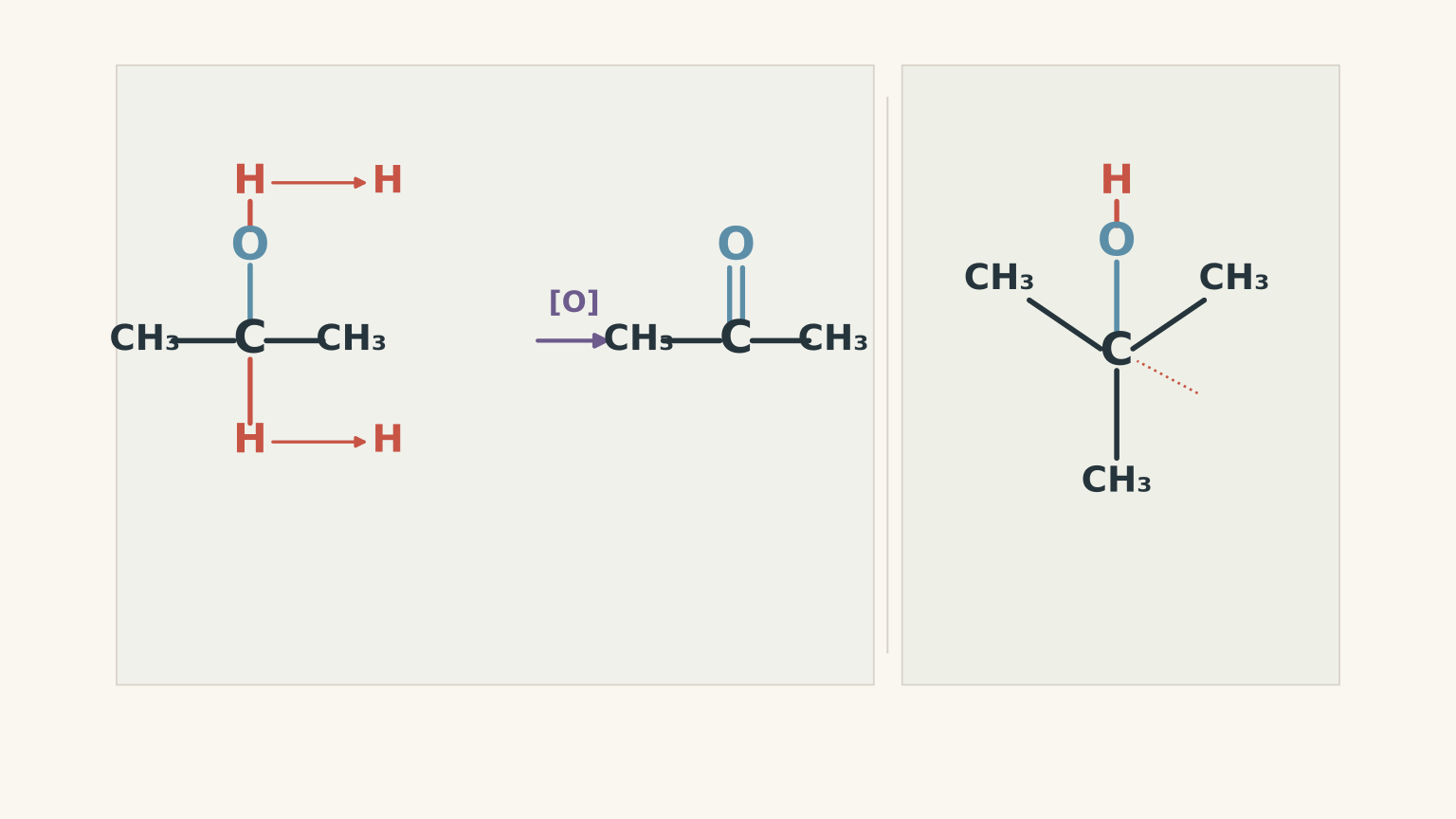
When a primary or secondary alcohol is oxidised to a carbonyl compound, two hydrogen atoms are removed overall:
- One hydrogen comes from the O-H bond.
- The other comes from the C-H bond on the carbon attached to the oxygen.
The carbon-oxygen single bond then becomes a carbon-oxygen double bond.
This produces a carbonyl group, \(\ce{C=O}\).
Consider the oxidation of propan-2-ol:
\[ \ce{CH3CH(OH)CH3 + [O] -> CH3COCH3 + H2O} \]
Propan-2-ol is a secondary alcohol, so its central carbon has one hydrogen available for removal. It can form a carbonyl group, producing propanone.
Now consider 2-methylpropan-2-ol:
\[ \ce{(CH3)3COH} \]
The carbon attached to the oxygen already has three carbon-carbon bonds and one carbon-oxygen bond. It has no hydrogen attached to it.
If the C-O single bond simply became a C=O double bond, the carbon would exceed its normal valency of four. Something else would have to break, such as a carbon-carbon bond.
Ordinary alcohol oxidation does not achieve this simple transformation. Therefore, the tertiary alcohol does not produce a ketone under standard acidified dichromate oxidation conditions.
Due to technical limitations, this figure may display incorrectly or contain inaccuracies. Please check key details against your course materials.
The important distinction is that tertiary alcohols resist the usual oxidation pathway, not every possible chemical reaction involving an oxidising agent. Under sufficiently forcing conditions, reactions involving carbon-carbon bond cleavage or decomposition may occur. These are not the straightforward alcohol-to-ketone reactions expected in the HSC comparison.
Comparing primary, secondary and tertiary alcohol oxidation
The three alcohol classes behave differently when warmed with acidified potassium dichromate(VI).
| Alcohol type | Initial oxidation product | Further oxidation under suitable conditions |
|---|---|---|
| Primary | Aldehyde | Carboxylic acid |
| Secondary | Ketone | No ordinary further oxidation |
| Tertiary | No simple carbonyl product | No ordinary further oxidation |
The oxidising agent is commonly acidified potassium dichromate(VI), which changes from orange to green when chromium(VI) is reduced to chromium(III).
For a secondary alcohol, the ketone forms without breaking the carbon skeleton. For a tertiary alcohol, the required hydrogen on the carbon bearing OH is absent.
For a more detailed treatment of the secondary alcohol pathway, see Secondary Alcohol Oxidation to Ketones: HSC Chemistry.
02What does the oxidation experiment actually show?
Imagine comparing two known alcohol samples in a controlled laboratory investigation.
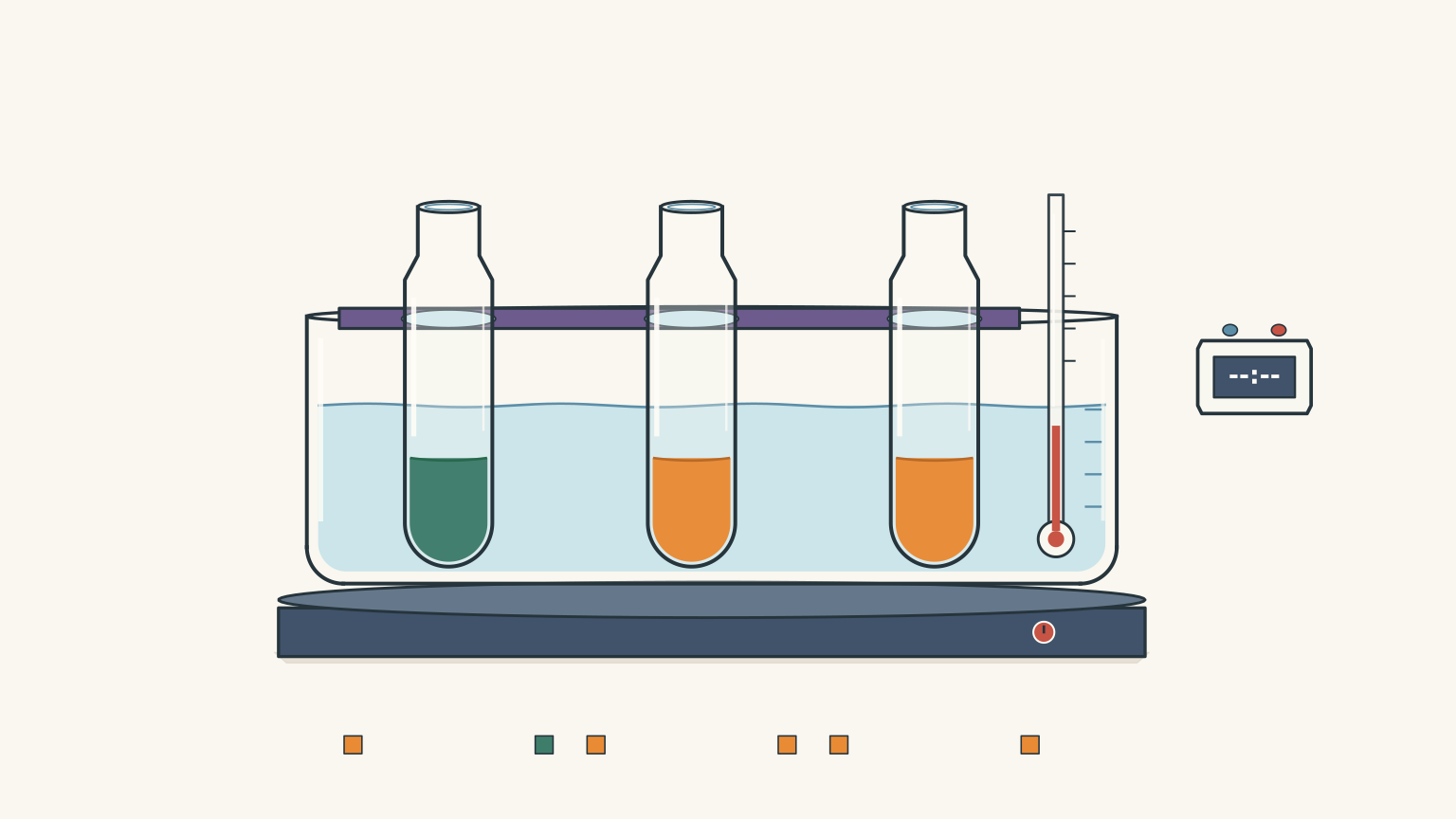
Place equal quantities of propan-2-ol and 2-methylpropan-2-ol into separate, clean test tubes. Add equal quantities of acidified potassium dichromate(VI) solution to each tube.
Place both tubes in the same warm water bath. Keep the temperature, reaction time, reagent concentration, and sample volumes consistent.
The prediction is straightforward: if the presence of an -OH group alone determines whether an alcohol is oxidised, both samples should react. If the carbon-bound hydrogen is essential, only the secondary alcohol should show the usual oxidation.
Due to technical limitations, this figure may display incorrectly or contain inaccuracies. Please check key details against your course materials.
Illustrative observations
The following table shows the expected observations for the comparison. These are illustrative results, not measurements from an actual experiment.
| Sample | Alcohol classification | Initial reagent colour | Expected colour after warming |
|---|---|---|---|
| Propan-2-ol | Secondary | Orange | Green |
| 2-methylpropan-2-ol | Tertiary | Orange | Orange |
| Reagent blank | No alcohol | Orange | Orange |
The green colour indicates that chromium(VI) ions have been reduced to chromium(III) ions.
This supports the conclusion that the secondary alcohol has undergone oxidation, while the tertiary alcohol has not produced a detectable oxidation reaction under the test conditions.
However, there is a limitation: the colour change shows that the oxidising agent has reacted. It does not independently identify the organic product. A separate product-identification test would be needed if the product were unknown.
A poorly designed experiment could also give misleading results. For example, if one tube is heated for longer than the other, the comparison is no longer fair. Other reducing substances in an impure sample could also cause a colour change.
A stronger investigation uses:
- Equal sample volumes and reagent concentrations.
- The same temperature and reaction time.
- A known secondary alcohol as a positive control.
- A reagent blank to check that the oxidising agent is not changing colour independently.
The acidified dichromate reagent requires appropriate laboratory safety precautions because chromium(VI) compounds are hazardous. Alcohols are also flammable, so a teacher-approved water-bath procedure should be used rather than direct heating over a flame.
Worked example: Calculate the amount of oxidising agent required
A student oxidises \(0.300\text{ mmol}\) of propan-2-ol using acidified potassium dichromate(VI). Calculate the volume of \(0.0200\text{ mol L}^{-1}\) dichromate solution required for complete oxidation.
Step 1
\[ \ce{3CH3CH(OH)CH3 + Cr2O7^2- + 8H+} \]
\[ \ce{-> 3CH3COCH3 + 2Cr^3+ + 7H2O} \]
The mole ratio is:
\[ 3:1 \]
Three moles of propan-2-ol react with one mole of dichromate ions.
Step 2
\[ n(\mathrm{Cr_{2}O_{7}}^{2-}) =\frac{0.300}{3} \]
\[ =0.100\text{ mmol} \]
Convert to moles:
\[ n=1.00\times10^{-4}\text{ mol} \]
Step 3
\[ c=\frac{n}{V} \]
Rearrange:
\[ V=\frac{n}{c} \]
Substitute:
\[ V=\frac{1.00\times10^{-4}}{0.0200} \]
\[ V=0.00500\text{ L} \]
Step 4
\[ V=5.00\text{ mL} \]
The required volume is \(5.00\text{ mL}\) of dichromate solution, assuming complete oxidation and no competing reactions.
Notice that this calculation applies to the secondary alcohol because it undergoes the expected oxidation. You cannot simply apply the same mole ratio to a tertiary alcohol that does not undergo this reaction.
03Why tertiary alcohols can still undergo substitution and elimination
Here is where a common misconception appears.
A student learns that tertiary alcohols do not oxidise under ordinary conditions and concludes that they must be generally unreactive.
That conclusion is incorrect.
Oxidation, substitution, and elimination require different bonds to change. The absence of a hydrogen on the carbon bearing OH prevents the usual oxidation pathway, but it does not prevent the other two reactions.
1. Substitution: replacing the hydroxyl group
A tertiary alcohol can react with a hydrogen halide, such as concentrated hydrobromic acid.
For example, 2-methylpropan-2-ol reacts with HBr to form 2-bromo-2-methylpropane:
\[ \ce{(CH3)3COH + HBr -> (CH3)3CBr + H2O} \]
The -OH group is replaced by a bromine atom.
Notice what happens: the carbon-oxygen bond is broken and a carbon-bromine bond forms. The carbon does not need to lose a hydrogen.
This is why the absence of an α-hydrogen does not prevent substitution.
2. Elimination: removing water to form an alkene
Tertiary alcohols can also undergo dehydration, which is an elimination reaction.
Under suitable conditions, such as concentrated sulfuric acid and heating, the alcohol loses water and forms an alkene.
For 2-methylpropan-2-ol:
\[ \ce{(CH3)3COH ->[conc.\ H2SO4,\ heat] CH2=C(CH3)2 + H2O} \]
The product is 2-methylpropene.
But notice which hydrogen is removed.
It comes from a carbon adjacent to the carbon bearing OH, not from the carbon bearing OH itself.
This adjacent carbon is called a beta carbon. A hydrogen attached to it is called a beta hydrogen.
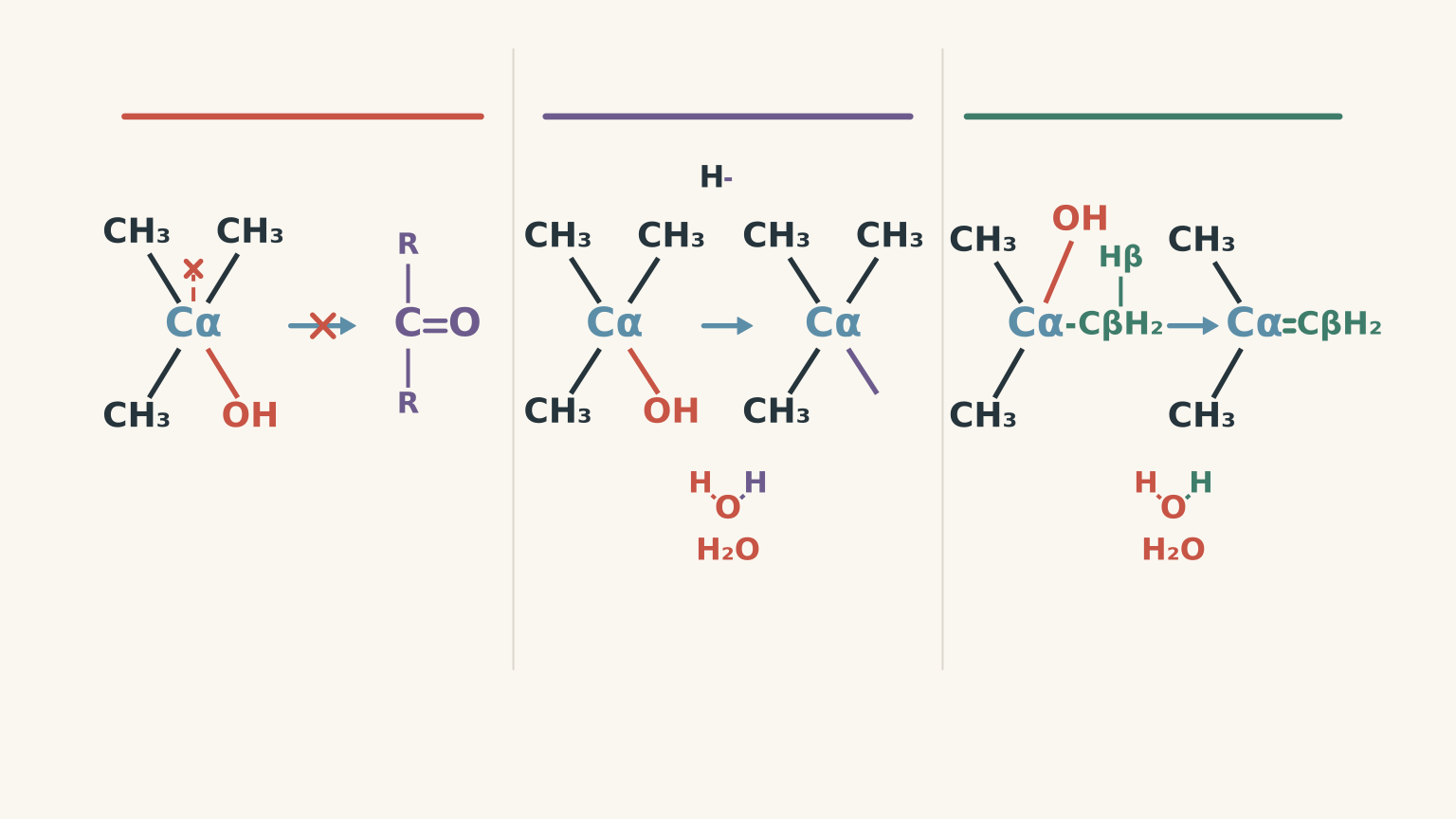
Due to technical limitations, this figure may display incorrectly or contain inaccuracies. Please check key details against your course materials.
Why tertiary alcohols often undergo substitution and elimination readily
Both substitution and elimination can proceed through a positively charged carbon intermediate called a carbocation.
The initial step involves protonating the oxygen atom of the alcohol. This converts the -OH group into water, which is a much better leaving group.
Water then leaves, producing a carbocation.
Tertiary carbocations are relatively stable because three carbon groups help stabilise the positive charge. As a result, tertiary alcohols can undergo these reactions more readily than comparable secondary and primary alcohols under suitable conditions.
The reaction pathway then depends on the conditions:
| Reaction | Typical conditions | What happens? |
|---|---|---|
| Oxidation | Acidified potassium dichromate(VI), warming | Secondary alcohol forms a ketone; tertiary alcohol has no ordinary carbonyl oxidation |
| Substitution | Concentrated HBr, generally at room temperature | Halogen replaces the -OH group |
| Elimination | Concentrated sulfuric acid and heat | Water is removed and an alkene forms |
The carbocation explanation is a useful mechanistic extension. For the 2017 NSW HSC Chemistry syllabus, prioritise writing the correct equations, identifying the products, and stating the reaction conditions. Check your course requirements before treating detailed mechanism labels as examinable content.
Worked example: One tertiary alcohol, three possible reaction conditions
A student is given 2-methylbutan-2-ol, with the structure:
\[ \ce{CH3C(OH)(CH3)CH2CH3} \]
Predict the expected outcome when this alcohol is separately treated with:
- Warm, acidified potassium dichromate(VI).
- Concentrated HBr at room temperature.
- Concentrated sulfuric acid and heat.
Step 1
The carbon bonded to OH is attached to three other carbon atoms. Therefore, the alcohol is tertiary.
It has no hydrogen attached to the carbon bearing OH.
Step 2
The alcohol does not undergo the usual oxidation to a carbonyl compound.
There is no α-hydrogen available to remove, so the ordinary ketone-forming pathway is unavailable.
Step 3
Concentrated HBr replaces the hydroxyl group with bromine.
\[ \ce{CH3C(OH)(CH3)CH2CH3 + HBr} \]
\[ \ce{-> CH3C(Br)(CH3)CH2CH3 + H2O} \]
The product is 2-bromo-2-methylbutane.
Step 4
Concentrated sulfuric acid and heat favour elimination.
There are two different types of adjacent carbon available for removal of a beta hydrogen:
- A methyl group.
- The neighbouring \(\ce{CH2}\) group in the ethyl chain.
Removing a hydrogen from the ethyl-side \(\ce{CH2}\) group produces 2-methylbut-2-ene:
\[ \ce{CH3C(OH)(CH3)CH2CH3} \]
\[ \ce{-> CH3C(CH3)=CHCH3 + H2O} \]
Removing a hydrogen from a methyl group produces 2-methylbut-1-ene:
\[ \ce{CH3C(OH)(CH3)CH2CH3} \]
\[ \ce{-> CH2=C(CH3)CH2CH3 + H2O} \]
The more substituted alkene, 2-methylbut-2-ene, is expected to be the major product under ordinary acid-catalysed dehydration conditions.
Step 5
The same tertiary alcohol behaves differently because each reaction requires a different bond change:
- Oxidation requires an α-hydrogen, which is absent.
- Substitution replaces the C-O bond without requiring a carbon-bound hydrogen.
- Elimination requires a beta hydrogen, which is available.
This is the central distinction: the absence of an α-hydrogen prevents ordinary oxidation, but it does not prevent substitution or elimination.
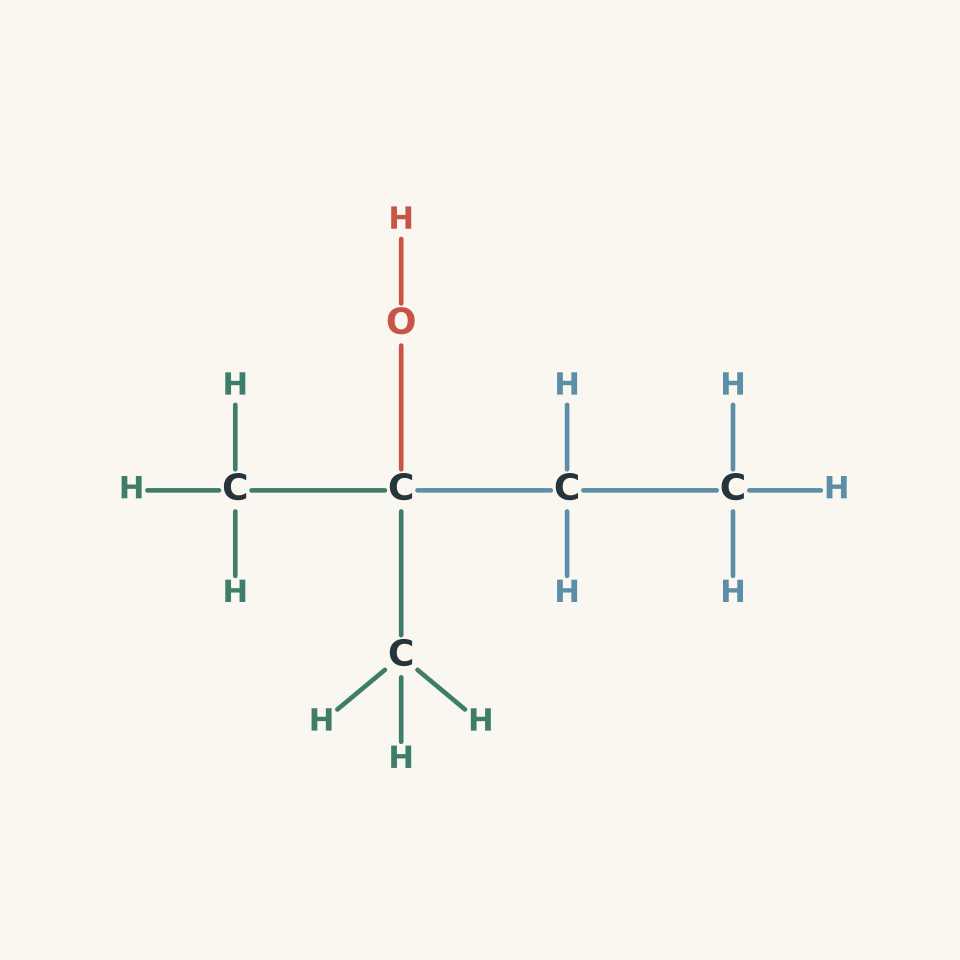
Due to technical limitations, this figure may display incorrectly or contain inaccuracies. Please check key details against your course materials.
04A reliable way to predict the reaction
When you are given an unfamiliar alcohol in an HSC question, use the following decision process.
First: Find the carbon bearing OH.
Count how many other carbon atoms are attached to it. This tells you whether the alcohol is primary, secondary, or tertiary.
Second: Check for an α-hydrogen.
If the question asks about ordinary oxidation to a carbonyl compound, check whether the carbon bearing OH has a hydrogen attached.
- If yes, the usual oxidation pathway is available.
- If no, do not predict an ordinary aldehyde or ketone product.
Third: Check what the reagent is asking the molecule to do.
- Acidified dichromate(VI) tests the usual oxidation pathway.
- HX can replace OH with a halogen.
- Concentrated acid and heat can remove water to form an alkene.
Fourth: For elimination, look for beta hydrogens.
A tertiary alcohol can dehydrate if an adjacent carbon has a hydrogen available for removal. If there are multiple possible beta positions, consider the stability of the resulting alkenes.
The important thing is not to use the alcohol classification as a shortcut for every reaction. Classification tells you about the structure. The reaction conditions tell you which pathway is favoured.
A note on NSW HSC syllabus scope
For students sitting the 2026 and 2027 HSC examinations, the Chemistry Stage 6 Syllabus (2017) remains in use. The Chemistry 11-12 Syllabus (2025) is scheduled for implementation from 2028.
The 2017 syllabus includes alcohol oxidation, dehydration, and substitution with HX, as well as investigation of the oxidation products of primary and secondary alcohols. The explanations above develop the structural reasoning behind those reactions without presenting every mechanistic detail as a required syllabus outcome.
05Questions and solutions
Question 1
Propan-2-ol is warmed with excess acidified potassium dichromate(VI).
State the organic product, describe the expected colour change, and write a simplified balanced reaction equation.
Solution 1
The organic product is propanone, and the dichromate solution changes from orange to green.
Propan-2-ol is a secondary alcohol. Its central carbon has one hydrogen attached, allowing the usual oxidation to a ketone.
The reaction is:
\[ \ce{CH3CH(OH)CH3 + [O] -> CH3COCH3 + H2O} \]
The orange dichromate(VI) ions are reduced to green chromium(III) ions as the alcohol is oxidised.
The key structural feature is the hydrogen attached to the carbon bearing OH.
Question 2
A student has \(0.600\text{ mmol}\) of butan-2-ol. The student adds \(15.0\text{ mL}\) of \(0.0100\text{ mol L}^{-1}\) acidified potassium dichromate(VI).
Assume:
- The acid is present in excess.
- Butan-2-ol is the only substance consuming dichromate.
- The reaction proceeds to completion.
- The ketone is not further oxidised.
Calculate:
a) The maximum amount of butan-2-one produced.
b) The amount of butan-2-ol remaining.
Solution 2
The reaction produces \(0.450\text{ mmol}\) of butan-2-one, leaving \(0.150\text{ mmol}\) of butan-2-ol unreacted.
Step 1: Write the balanced ionic equation.
\[ \ce{3CH3CH(OH)CH2CH3 + Cr2O7^2-} \]
\[ \ce{+ 8H+ -> 3CH3COCH2CH3 + 2Cr^3+ + 7H2O} \]
The mole ratio is:
\[ 3\text{ alcohol}:1\text{ dichromate} \]
Step 2: Calculate the amount of dichromate used.
Convert the volume into litres:
\[ V=15.0\text{ mL}=0.0150\text{ L} \]
Use:
\[ n=cV \]
\[ n=0.0100\times0.0150 \]
\[ n=1.50\times10^{-4}\text{ mol} \]
Therefore:
\[ n(\mathrm{Cr_{2}O_{7}}^{2-})=0.150\text{ mmol} \]
Step 3: Calculate the amount of butan-2-ol that reacts.
The mole ratio is 3:1, so:
\[ n(\text{alcohol reacted})=3(0.150) \]
\[ =0.450\text{ mmol} \]
Step 4: Calculate the amount of butan-2-ol remaining.
Initially:
\[ n=0.600\text{ mmol} \]
Reacted:
\[ n=0.450\text{ mmol} \]
Remaining:
\[ 0.600-0.450=0.150\text{ mmol} \]
Step 5: Determine the amount of ketone formed.
The equation shows a 1:1 mole ratio between butan-2-ol consumed and butan-2-one produced.
Therefore:
\[ n(\text{butan-2-one})=0.450\text{ mmol} \]
The final results are:
- Butan-2-one produced: \(0.450\text{ mmol}\).
- Butan-2-ol remaining: \(0.150\text{ mmol}\).
The important step was recognising that one mole of dichromate oxidises three moles of secondary alcohol, rather than assuming a 1:1 ratio.
Question 3
Two pure alcohol samples, A and B, both have the molecular formula \(\ce{C4H10O}\).
Both are tested using the same warmed, acidified potassium dichromate(VI) procedure.
- Sample A changes the solution from orange to green.
- Sample B produces no visible colour change.
- A known propan-2-ol control also changes the solution from orange to green.
Assume the samples are mixed properly with the reagent and exposed to identical conditions.
a) What is the most likely classification of sample B?
b) Give one possible structural formula for sample B.
c) Can sample A be identified as primary or secondary from the colour change alone? Explain.
d) Identify one limitation of using this colour test to identify an unknown alcohol.
Solution 3
Sample B is most consistent with a tertiary alcohol, specifically 2-methylpropan-2-ol. Sample A could be either primary or secondary.
Part a: Classify sample B.
A tertiary alcohol does not undergo the usual oxidation reaction with acidified dichromate(VI).
Since the positive control reacts, the oxidising agent is functioning under the test conditions. The absence of a colour change for B is therefore consistent with a tertiary alcohol.
Part b: Give a possible structure.
The tertiary alcohol with molecular formula \(\ce{C4H10O}\) is 2-methylpropan-2-ol:
\[ \ce{(CH3)3COH} \]
The carbon bonded to OH is attached to three methyl groups and has no hydrogen atoms.
Part c: Classify sample A.
The colour change shows that the dichromate(VI) ions have been reduced.
Both primary and secondary alcohols can undergo oxidation, so the observation alone cannot distinguish between them.
A primary alcohol initially forms an aldehyde, while a secondary alcohol forms a ketone.
Part d: Explain a limitation.
The colour change does not identify the organic oxidation product.
A separate product-identification method is needed to distinguish an aldehyde from a ketone or to confirm the proposed structure. The test also cannot independently prove that an unknown sample is an alcohol.
Question 4
The tertiary alcohol 3-methylpentan-3-ol is heated with concentrated sulfuric acid.
Its condensed structural formula is:
\[ \ce{CH3CH2C(OH)(CH3)CH2CH3} \]
a) Identify the two possible constitutional alkene products formed by dehydration.
b) State which product is expected to be the major product.
c) Explain your prediction using the structure of the alkenes.
Ignore geometric isomers.
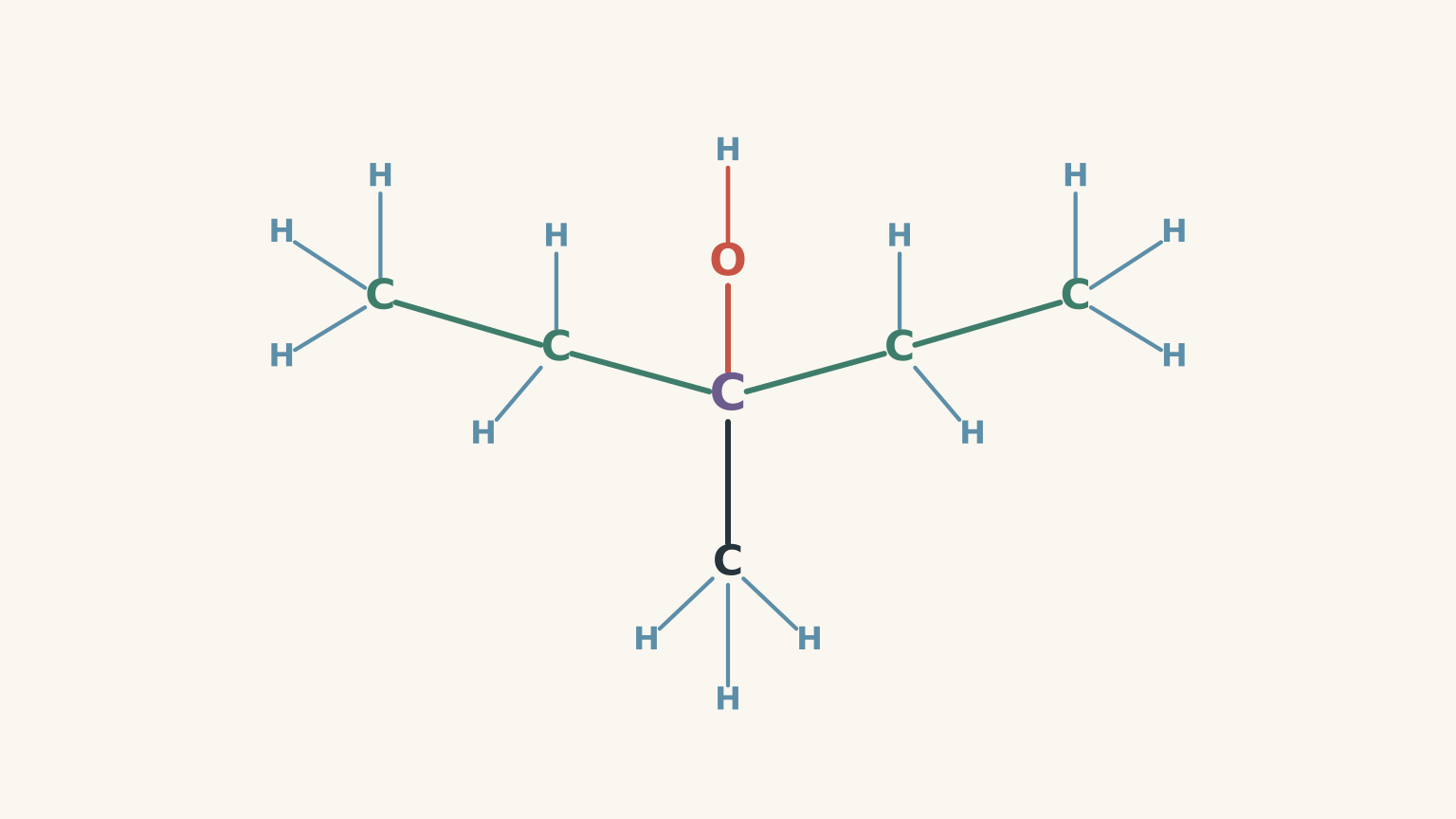
Due to technical limitations, this figure may display incorrectly or contain inaccuracies. Please check key details against your course materials.
Solution 4
The major product is 3-methylpent-2-ene, while 2-ethylbut-1-ene is the other possible constitutional product.
Step 1: Identify the carbon bearing OH.
The central carbon is attached to three carbon groups, so the alcohol is tertiary.
The carbon bearing OH has no hydrogen attached.
Step 2: Identify the available beta positions.
The carbon bearing OH has three adjacent carbon groups:
- One methyl group.
- Two equivalent ethyl groups.
All three adjacent carbons contain hydrogen atoms, so elimination can occur in either of two different ways.
Step 3: Form the first alkene.
Removing a beta hydrogen from either ethyl group produces:
\[ \ce{CH3CH=C(CH3)CH2CH3} \]
This is 3-methylpent-2-ene.
The two ethyl groups are equivalent, so elimination from either side produces the same constitutional alkene.
Step 4: Form the second alkene.
Removing a beta hydrogen from the methyl group produces:
\[ \ce{CH2=C(CH2CH3)2} \]
This is 2-ethylbut-1-ene.
Step 5: Identify the major product.
3-methylpent-2-ene is more substituted around its carbon-carbon double bond.
More substituted alkenes are generally more stable than comparable less substituted alkenes. Under ordinary acid-catalysed dehydration conditions, the more stable alkene is expected to be the major product.
Therefore, 3-methylpent-2-ene is the expected major product.
The important point is that dehydration uses a beta hydrogen. The absence of a hydrogen on the carbon bearing OH does not prevent this reaction.
Question 5
Consider the tertiary alcohol 2,3,3-trimethylbutan-2-ol, with the condensed structural formula:
\[ \ce{CH3C(OH)(CH3)C(CH3)3} \]
A student makes three claims:
- The alcohol cannot undergo ordinary oxidation because the carbon bearing OH has no hydrogen.
- It cannot undergo dehydration for the same reason.
- If dehydration occurs, the most substituted alkene must form between the carbon bearing OH and the adjacent \(\ce{C(CH3)3}\) group.
Evaluate all three claims.
Then predict the organic product when the alcohol is separately treated with:
a) Warm, acidified potassium dichromate(VI).
b) Excess concentrated HBr at room temperature.
c) Concentrated sulfuric acid and heat.
Assume no carbocation rearrangement or carbon-carbon bond cleavage. Ignore stereoisomers.
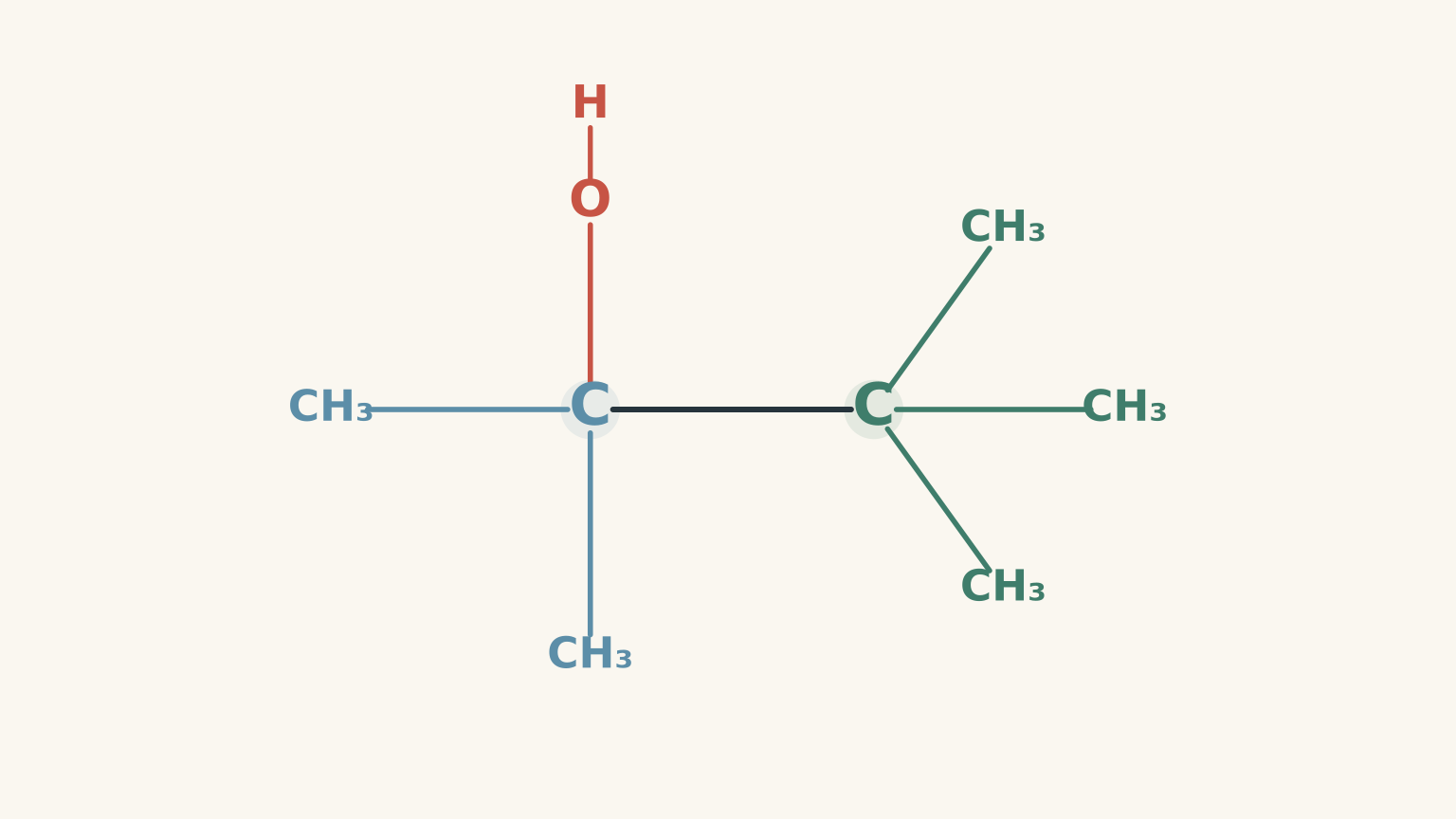
Due to technical limitations, this figure may display incorrectly or contain inaccuracies. Please check key details against your course materials.
Solution 5
Claim 1 is correct, claim 2 is incorrect, and claim 3 predicts an impossible ordinary elimination pathway. The alcohol resists ordinary oxidation, undergoes substitution with HBr, and dehydrates to 2,3,3-trimethylbut-1-ene.
Step 1: Examine the starting structure.
The carbon bearing OH is bonded to three other carbon atoms.
Therefore, the alcohol is tertiary and has no α-hydrogen.
Step 2: Evaluate claim 1.
Claim 1 is correct.
Ordinary oxidation to a carbonyl compound requires removal of a hydrogen from the carbon bearing OH.
Since this hydrogen is absent, the usual oxidation pathway cannot occur.
With warm, acidified potassium dichromate(VI), no ordinary carbonyl oxidation is expected.
Step 3: Evaluate claim 2.
Claim 2 is incorrect.
Dehydration does not require removal of a hydrogen from the carbon bearing OH.
Instead, it requires a beta hydrogen from a carbon adjacent to that carbon.
The molecule has two methyl groups attached to the OH-bearing carbon. Both contain beta hydrogens.
Therefore, elimination is possible.
Step 4: Evaluate claim 3.
Claim 3 is incorrect because the adjacent \(\ce{C(CH3)3}\) carbon is quaternary.
It has four carbon-carbon bonds and no hydrogen atoms.
Although forming a double bond between this carbon and the OH-bearing carbon might appear to produce a highly substituted alkene, there is no beta hydrogen available to remove from the quaternary carbon.
Forming that double bond without breaking another carbon-carbon bond would also violate carbon’s normal valency.
The preference for more substituted alkenes only applies to elimination pathways that are actually possible.
Step 5: Predict the oxidation product.
No ordinary carbonyl oxidation product forms with acidified dichromate(VI).
This is consistent with the absence of an α-hydrogen.
Step 6: Predict the substitution product.
Concentrated HBr replaces the OH group with bromine.
\[ \ce{CH3C(OH)(CH3)C(CH3)3 + HBr} \]
\[ \ce{-> CH3C(Br)(CH3)C(CH3)3 + H2O} \]
The organic product is 2-bromo-2,3,3-trimethylbutane.
This reaction does not require an α-hydrogen because it replaces the carbon-oxygen bond rather than forming a carbonyl group.
Step 7: Predict the dehydration product.
The alcohol loses water, producing a carbocation at the carbon that originally carried OH.
A beta hydrogen can then be removed from either of the two equivalent methyl groups attached to that carbon.
Both pathways produce the same constitutional alkene:
\[ \ce{CH3C(OH)(CH3)C(CH3)3} \]
\[ \ce{-> CH2=C(CH3)C(CH3)3 + H2O} \]
The product is 2,3,3-trimethylbut-1-ene.
There is no alternative alkene formed by elimination towards the adjacent quaternary carbon because that carbon has no beta hydrogen.
Step 8: Compare the three reactions.
The student’s original mistake was treating the absence of an α-hydrogen as if it prevented every reaction involving the alcohol.
In reality:
| Reaction | Required bond change | Result |
|---|---|---|
| Oxidation | Removal of an α-hydrogen and formation of C=O | No ordinary oxidation |
| Substitution | Replacement of C-O with C-Br | 2-bromo-2,3,3-trimethylbutane |
| Elimination | Removal of water and a beta hydrogen | 2,3,3-trimethylbut-1-ene |
The final distinction is especially useful in unfamiliar HSC questions: oxidation depends on an α-hydrogen, while dehydration depends on an available beta hydrogen. Substitution requires neither.
That is why alcohol classification must be considered alongside the reaction conditions and the exact position of the bonds being changed.
The next useful step is learning to predict products from unfamiliar alcohol structures when oxidation, substitution, and dehydration are competing possibilities.