
Why Acetic Acid Is Weak Even Though It Contains Hydrogen
Acetic acid contains hydrogen, but that doesn't make it a strong acid. Learn why it only partially ionises in water, how proton transfer determines acid strength, and how to distinguish acid strength, concentration, amount, and pH using worked HSC Chemistry examples.
Put 0.100 mol L\(^{-1}\) hydrochloric acid and 0.100 mol L\(^{-1}\) acetic acid in separate beakers. Both solutions contain the same concentration of acid, and both acids contain hydrogen. Yet hydrochloric acid has a pH close to 1, while acetic acid has a pH around 2.9. Why?
Acetic acid is weak because only a small proportion of its molecules transfer a proton to water. The number of hydrogen atoms in its chemical formula does not determine its acid strength. In fact, although acetic acid contains four hydrogen atoms, only one is readily donated in ordinary aqueous acid-base reactions.
01The hydrogen atoms in acetic acid are not equivalent
Look at the chemical formula for acetic acid:
\[ \ce{CH3COOH} \]
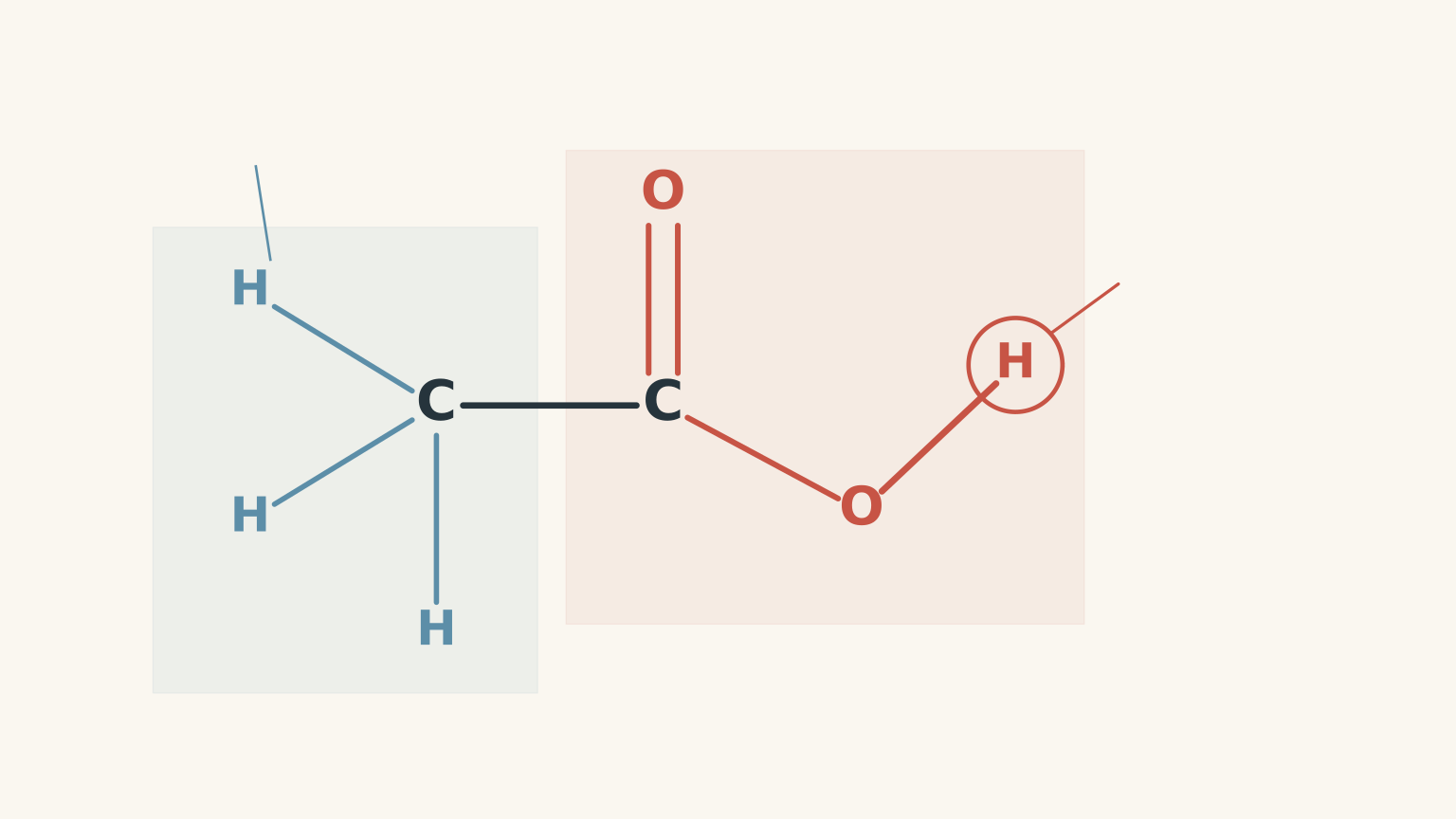
It contains four hydrogen atoms, but they are not all attached to the same type of atom.
Three hydrogen atoms are attached to carbon in the \(\ce{CH3}\) group. The remaining hydrogen is attached to oxygen in the \(\ce{COOH}\) group.
This difference matters.
Oxygen attracts shared electrons much more strongly than carbon does. This makes the O-H bond polar, meaning the hydrogen carries a partial positive charge and can be transferred to another species.
The three C-H bonds in the methyl group do not readily release their hydrogen atoms as protons in water.
Acetic acid is therefore a monoprotic acid: each molecule can donate one proton in the usual aqueous acid-base reaction.
Due to technical limitations, this figure may display incorrectly or contain inaccuracies. Please check key details against your course materials.
However, identifying the acidic hydrogen still doesn’t explain why acetic acid is weak.
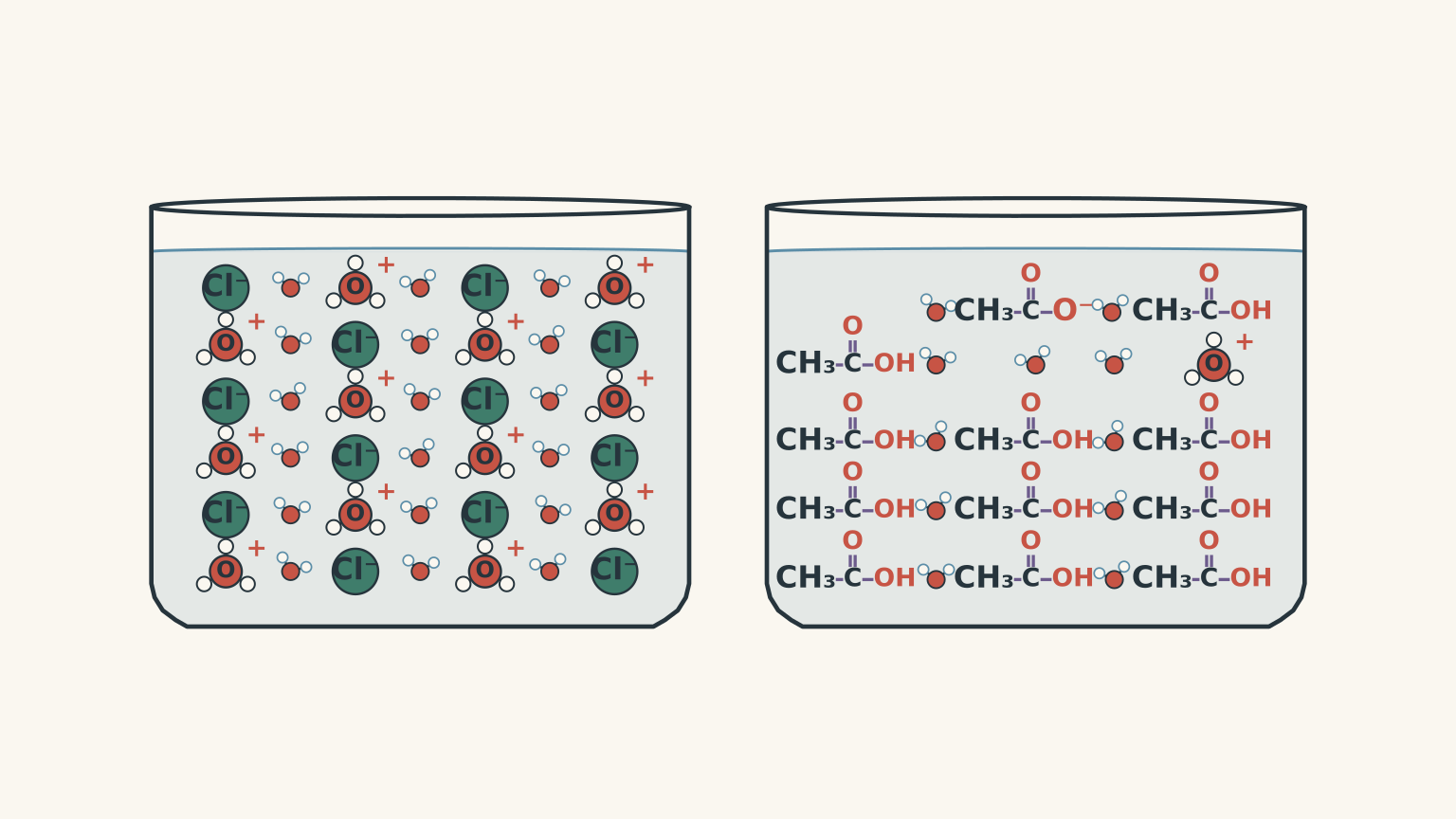
Hydrochloric acid also has just one hydrogen atom, yet it is a strong acid.
The real difference is what happens when each acid meets water.
02What happens when acetic acid dissolves in water?
Think of water as a proton acceptor.
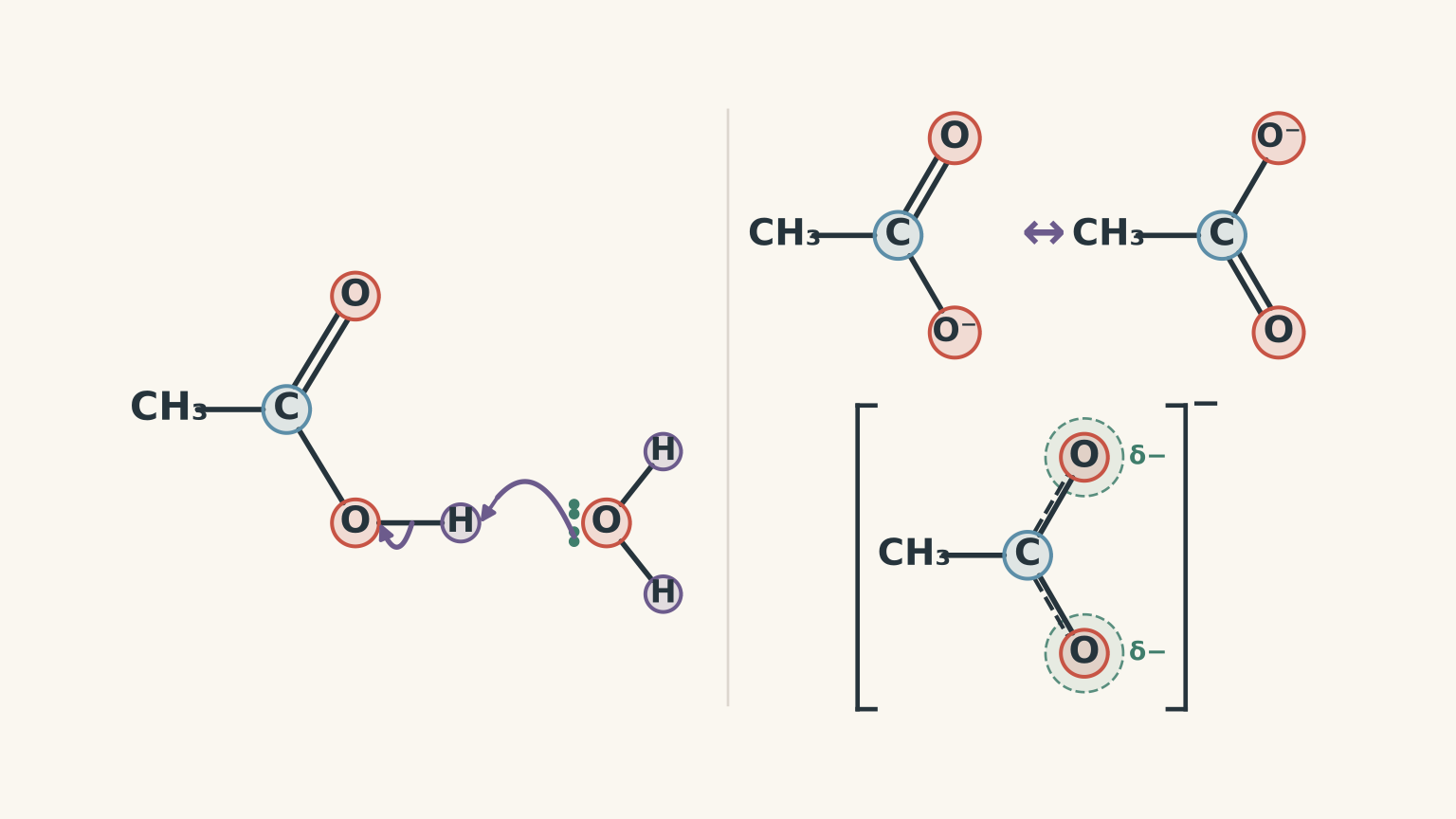
When an acid dissolves in water, it can transfer a proton, \(\mathrm{H}^{+}\), to a water molecule. Water then becomes a hydronium ion, \(\ce{H3O+}\).
Acetic acid undergoes this reaction:
\[ \ce{CH3COOH(aq) + H2O(l) <=> H3O+(aq) + CH3COO-(aq)} \]
Notice the double arrow. It tells us that the reaction is reversible.
Acetic acid can donate a proton to water, but the hydronium ion and acetate ion can also react to reform acetic acid and water.
At equilibrium, both directions continue, but their rates are equal.
For acetic acid, the equilibrium lies strongly towards the left.
This means that most acetic acid molecules remain intact. Only a small proportion exist as hydronium and acetate ions.
Due to technical limitations, this figure may display incorrectly or contain inaccuracies. Please check key details against your course materials.
Identify the conjugate acid-base pairs
The proton transfer also produces two conjugate acid-base pairs.
| Acid | Conjugate base |
|---|---|
| \(\ce{CH3COOH}\) | \(\ce{CH3COO-}\) |
| \(\ce{H3O+}\) | \(\ce{H2O}\) |
A conjugate base is formed when an acid loses a proton.
For example:
\[ \ce{CH3COOH -> CH3COO- + H+} \]
Acetic acid loses one proton and becomes acetate.
Water does the opposite. It accepts a proton and becomes hydronium.
The important point is that acid strength depends on how favourable the overall proton-transfer equilibrium is, not simply whether a molecule contains hydrogen.
If you need a refresher on identifying these pairs, see How to Identify a Conjugate Base After One Proton Is Removed.
Why does the acetate ion matter?
There is another structural feature worth understanding.
When acetic acid loses its proton, it forms the acetate ion, \(\ce{CH3COO-}\).
The negative charge on acetate is delocalised across its two oxygen atoms. This means the charge is spread out rather than being confined to just one oxygen atom.
We represent this using resonance structures:
\[ \ce{CH3-C(=O)-O- <-> CH3-C(-O-)=O} \]
These are two representations of the same acetate ion, not two different ions switching back and forth.
The actual structure has equivalent carbon-oxygen bonds, with the negative charge distributed across both oxygen atoms.
Due to technical limitations, this figure may display incorrectly or contain inaccuracies. Please check key details against your course materials.
This delocalisation stabilises the acetate ion, making proton donation more favourable than it would be if the negative charge were concentrated on one oxygen.
However, the overall equilibrium still favours undissociated acetic acid.
The equilibrium constant confirms this.
03How acid strength is measured: the acid dissociation constant
The acid dissociation constant, \(K_a\), measures the extent to which an acid ionises in water at a particular temperature.
For acetic acid:
\[ K_a = \frac{[\ce{H3O+}][\ce{CH3COO-}]} {[\ce{CH3COOH}]} \]
The square brackets represent equilibrium concentrations, measured in mol L\(^{-1}\).
At 25°C, acetic acid has an approximate acid dissociation constant of:
\[ K_a = 1.8\times10^{-5} \]
This is a small value.
A small \(K_a\) means the equilibrium favours the reactants, so relatively little acetic acid ionises.
Compare this with hydrochloric acid.
Hydrochloric acid undergoes essentially complete ionisation in water:
\[ \ce{HCl(aq) + H2O(l) -> H3O+(aq) + Cl-(aq)} \]
Almost every HCl molecule transfers its proton to water.
This is why hydrochloric acid is strong, while acetic acid is weak.
The distinction is not the number of hydrogen atoms. It is the extent of proton transfer.
For a more detailed explanation of how equilibrium determines acid strength, see How to Explain Acid Strength Using Equilibrium Rather Than pH Alone.
04Strength, concentration, and amount are three different things
This is where students often make mistakes in HSC Chemistry.
Acid strength, concentration, and amount are related, but they describe different properties.
| Property | What it tells you | How it is expressed |
|---|---|---|
| Acid strength | How extensively the acid ionises in water | \(K_a\) |
| Concentration | How much dissolved acid is present per unit volume | \(c=n/V\) |
| Amount | How many moles of acid are present in the sample | \(n=cV\) |
Let’s unpack each one.
1. Acid strength
Acid strength describes the extent of proton transfer to water.
A strong acid ionises almost completely.
A weak acid ionises only partially.
For acetic acid, its small \(K_a\) tells us that most molecules remain undissociated.
2. Concentration
Concentration describes how much acid is dissolved in a given volume of solution.
For example:
- A 0.100 mol L\(^{-1}\) acetic acid solution contains 0.100 mol of acetic acid units per litre.
- A 0.0100 mol L\(^{-1}\) acetic acid solution contains 0.0100 mol per litre.
Both contain the same acid, so both have the same \(K_a\) at the same temperature.
However, the more concentrated solution generally produces a greater hydronium ion concentration and has a lower pH.
A concentrated weak acid can therefore have a lower pH than a very dilute strong acid.
3. Amount
Amount describes the total number of moles of acid in a sample.
It is calculated using:
\[ n=cV \]
where:
- \(n\) = amount of acid, in mol
- \(c\) = concentration, in mol L\(^{-1}\)
- \(V\) = volume, in L
A large volume of dilute acid can contain more total acid than a small volume of concentrated acid.
Neither situation changes the intrinsic acid strength.
An important consequence of dilution
Something slightly counterintuitive happens when you dilute a weak acid.
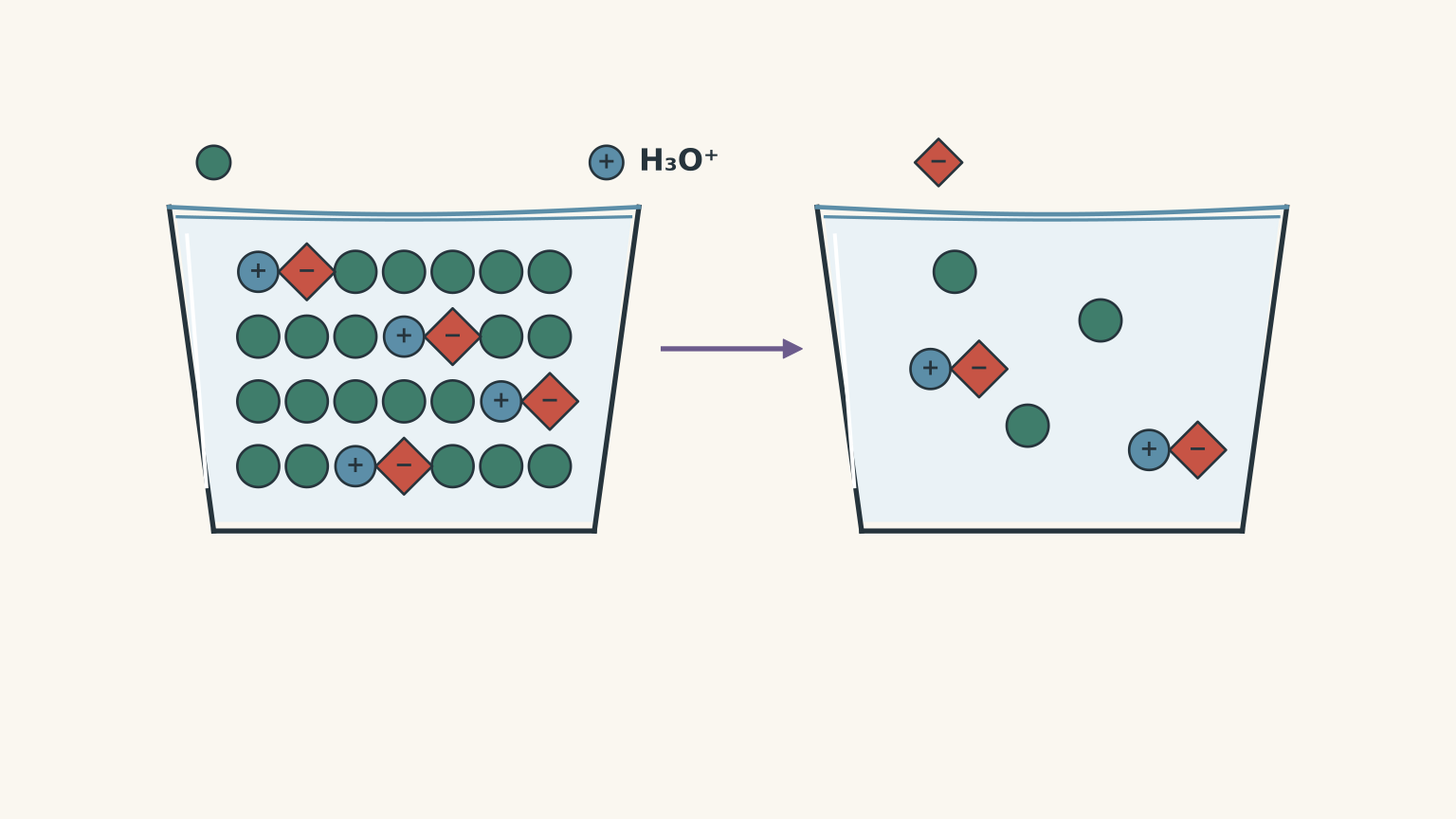
As you add water, the percentage of acid molecules that ionise increases.
However, the hydronium ion concentration decreases, so the pH increases.
These statements are not contradictory.
The percentage ionisation tells you what fraction of the original acid has ionised. The hydronium concentration tells you how much hydronium is present per unit volume.
For a monoprotic weak acid, assuming water contributes a negligible amount of hydronium:
\[ \%\text{ ionisation} = \frac{[\ce{H3O+}]_{\mathrm{eq}}} {c_0} \times100 \]
Here, \(c_0\) is the initial acid concentration.
Due to technical limitations, this figure may display incorrectly or contain inaccuracies. Please check key details against your course materials.
Let’s see how these ideas work in actual calculations.
05How an experiment can distinguish a strong acid from a weak acid
Suppose you have two bottles labelled hydrochloric acid and acetic acid.
You pour the same volume from each bottle into separate beakers and measure their pH values.
Can you immediately conclude which acid is stronger?
Not necessarily.
The problem is that equal volumes do not guarantee equal concentrations.
For example, one bottle might contain 1.0 mol L\(^{-1}\) acid while the other contains 0.010 mol L\(^{-1}\) acid. Their pH values would reflect both acid strength and concentration.
To test acid strength fairly, the concentrations must be controlled.
Revising the experiment
Prepare two aqueous solutions:
- 0.100 mol L\(^{-1}\) hydrochloric acid.
- 0.100 mol L\(^{-1}\) acetic acid.
Keep the temperature the same.
Place each solution in a separate labelled beaker. Connect a calibrated pH probe to a pH meter, immerse the probe in the first solution, and wait for a stable reading.
Rinse the probe with distilled water before repeating the measurement in the second beaker.
The glass electrode responds to the hydrogen ion activity in the solution, which the meter converts into a pH reading.
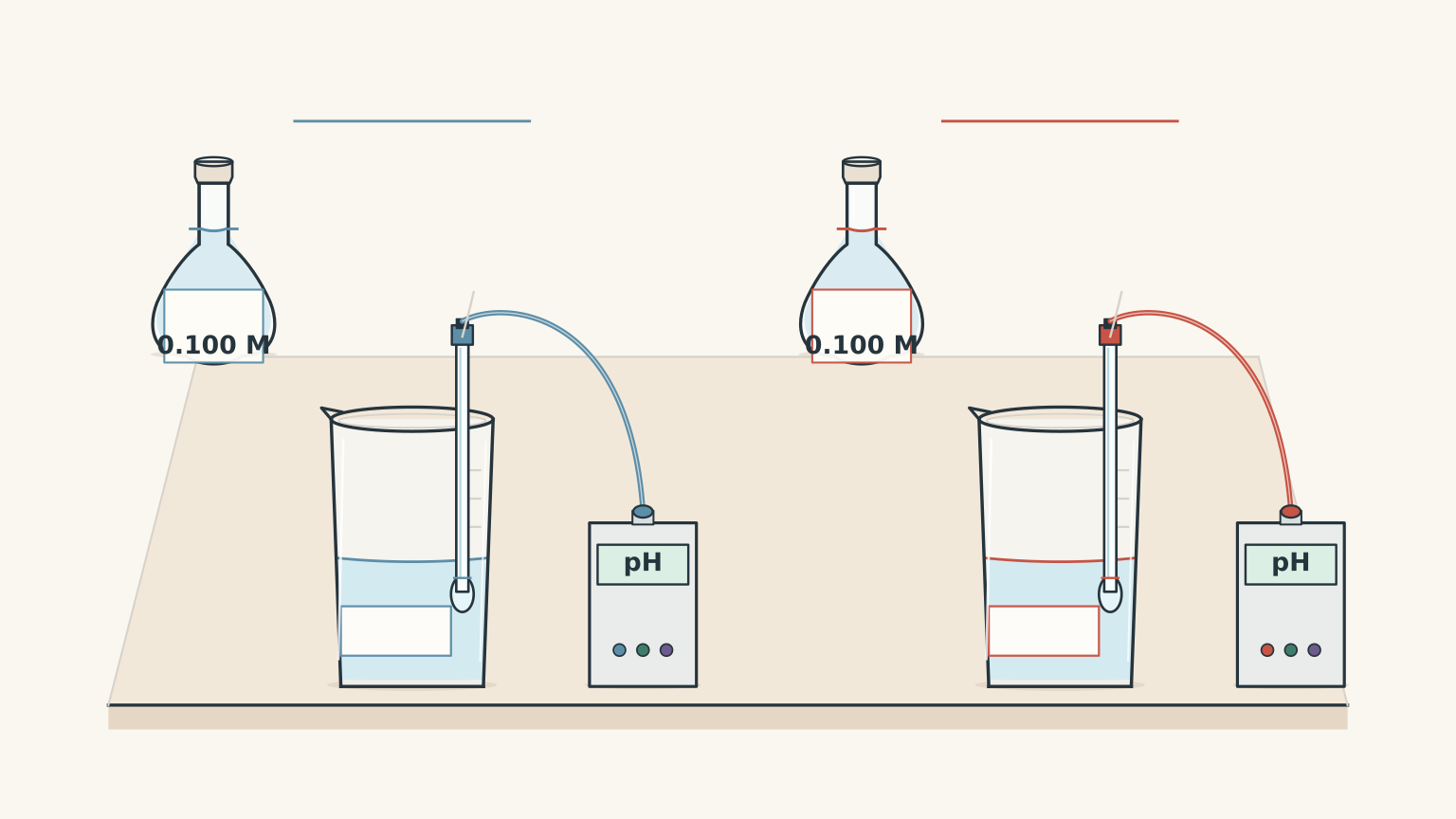
Due to technical limitations, this figure may display incorrectly or contain inaccuracies. Please check key details against your course materials.
What should we predict?
If both acids ionised completely, their hydronium concentrations would be approximately equal to their initial acid concentrations.
Both would produce approximately 0.100 mol L\(^{-1}\) hydronium ions and have a pH close to 1.00, using the ideal dilute-solution approximation.
But acetic acid does not ionise completely.
The following are illustrative HSC-style values, not claimed experimental measurements.
| Solution | Initial concentration | Approximate pH |
|---|---|---|
| Hydrochloric acid | 0.100 mol L\(^{-1}\) | 1.00 |
| Acetic acid | 0.100 mol L\(^{-1}\) | 2.9 |
The higher pH of acetic acid indicates a much lower hydronium concentration.
For acetic acid, a pH of approximately 2.9 corresponds to a hydronium concentration of roughly \(1.3\times10^{-3}\) mol L\(^{-1}\).
That is only about 1.3% of its initial acid concentration.
The comparison supports the conclusion that acetic acid is weak.
There is also an important limitation to this experiment: a pH meter measures the hydronium activity at equilibrium, not the total amount of acid present. It cannot tell you directly how many undissociated acetic acid molecules remain.
That distinction becomes particularly important in acid-base titrations.
06Worked examples
Worked example: Calculate the percentage ionisation of acetic acid
A 0.100 mol L\(^{-1}\) acetic acid solution is prepared at 25°C. Its acid dissociation constant is \(1.8\times10^{-5}\).
Calculate the equilibrium hydronium concentration, pH, and percentage ionisation.
Step 1
\[ \ce{CH3COOH + H2O <=> H3O+ + CH3COO-} \]
Let \(x\) represent the concentration of acetic acid that ionises.
At equilibrium:
- \([\ce{CH3COOH}]=0.100-x\)
- \([\ce{H3O+}]=x\)
- \([\ce{CH3COO-}]=x\)
Step 2
\[ K_a=\frac{x^2}{0.100-x} \]
Since acetic acid is weak, we expect \(x\) to be much smaller than 0.100.
Using the small-\(x\) approximation:
\[ 1.8\times10^{-5} \approx\frac{x^2}{0.100} \]
Rearranging:
\[ x^2=1.8\times10^{-6} \]
\[ x\approx1.34\times10^{-3} \]
Therefore:
\[ [\ce{H3O+}]\approx1.34\times10^{-3} \text{ mol L}^{-1} \]
Step 3
\[ \mathrm{pH}=-\log_{10}[\ce{H3O+}] \]
\[ \mathrm{pH}=-\log_{10}(1.34\times10^{-3}) \]
\[ \boxed{\mathrm{pH}\approx2.87} \]
Step 4
\[ \%\text{ ionisation} = \frac{1.34\times10^{-3}}{0.100} \times100 \]
\[ \boxed{\%\text{ ionisation}=1.34\%} \]
Only approximately 1.34% of the original acetic acid has ionised.
This confirms that acetic acid is weak, even though it contains an acidic hydrogen.
The small-\(x\) approximation is valid here because the calculated percentage ionisation is below 5%.
Worked example: Compare amount, concentration, and pH
Two samples of acetic acid are prepared at 25°C.
- Sample A contains 25.0 mL of 0.100 mol L\(^{-1}\) acetic acid.
- Sample B contains 100.0 mL of 0.0200 mol L\(^{-1}\) acetic acid.
Given \(K_a=1.8\times10^{-5}\), determine which sample contains more acid, which has the lower pH, and which has the greater percentage ionisation.
Step 1
Use:
\[ n=cV \]
For Sample A:
\[ n_A=0.100\times0.0250 \]
\[ n_A=0.00250\text{ mol} \]
For Sample B:
\[ n_B=0.0200\times0.1000 \]
\[ n_B=0.00200\text{ mol} \]
Sample A contains more total acetic acid, even though its volume is smaller.
Step 2
Use the weak acid approximation:
\[ [\ce{H3O+}]\approx\sqrt{K_a c} \]
For Sample A:
\[ [\ce{H3O+}]_A = \sqrt{1.8\times10^{-5}\times0.100} \]
\[ [\ce{H3O+}]_A \approx1.34\times10^{-3} \text{ mol L}^{-1} \]
For Sample B:
\[ [\ce{H3O+}]_B = \sqrt{1.8\times10^{-5}\times0.0200} \]
\[ [\ce{H3O+}]_B \approx6.00\times10^{-4} \text{ mol L}^{-1} \]
Step 3
For Sample A:
\[ \mathrm{pH}_A =-\log_{10}(1.34\times10^{-3}) \]
\[ \boxed{\mathrm{pH}_A\approx2.87} \]
For Sample B:
\[ \mathrm{pH}_B =-\log_{10}(6.00\times10^{-4}) \]
\[ \boxed{\mathrm{pH}_B\approx3.22} \]
Sample A has the lower pH because it has the higher acid concentration.
Step 4
For Sample A:
\[ \%\text{ ionisation} = \frac{1.34\times10^{-3}}{0.100} \times100 \]
\[ =1.34\% \]
For Sample B:
\[ \%\text{ ionisation} = \frac{6.00\times10^{-4}}{0.0200} \times100 \]
\[ =3.00\% \]
Sample B has the greater percentage ionisation, even though it has the higher pH.
The important distinction is that Sample A has a greater hydronium concentration, while Sample B has a greater proportion of its acid molecules ionised.
Both samples contain the same weak acid, so their \(K_a\) values are unchanged.
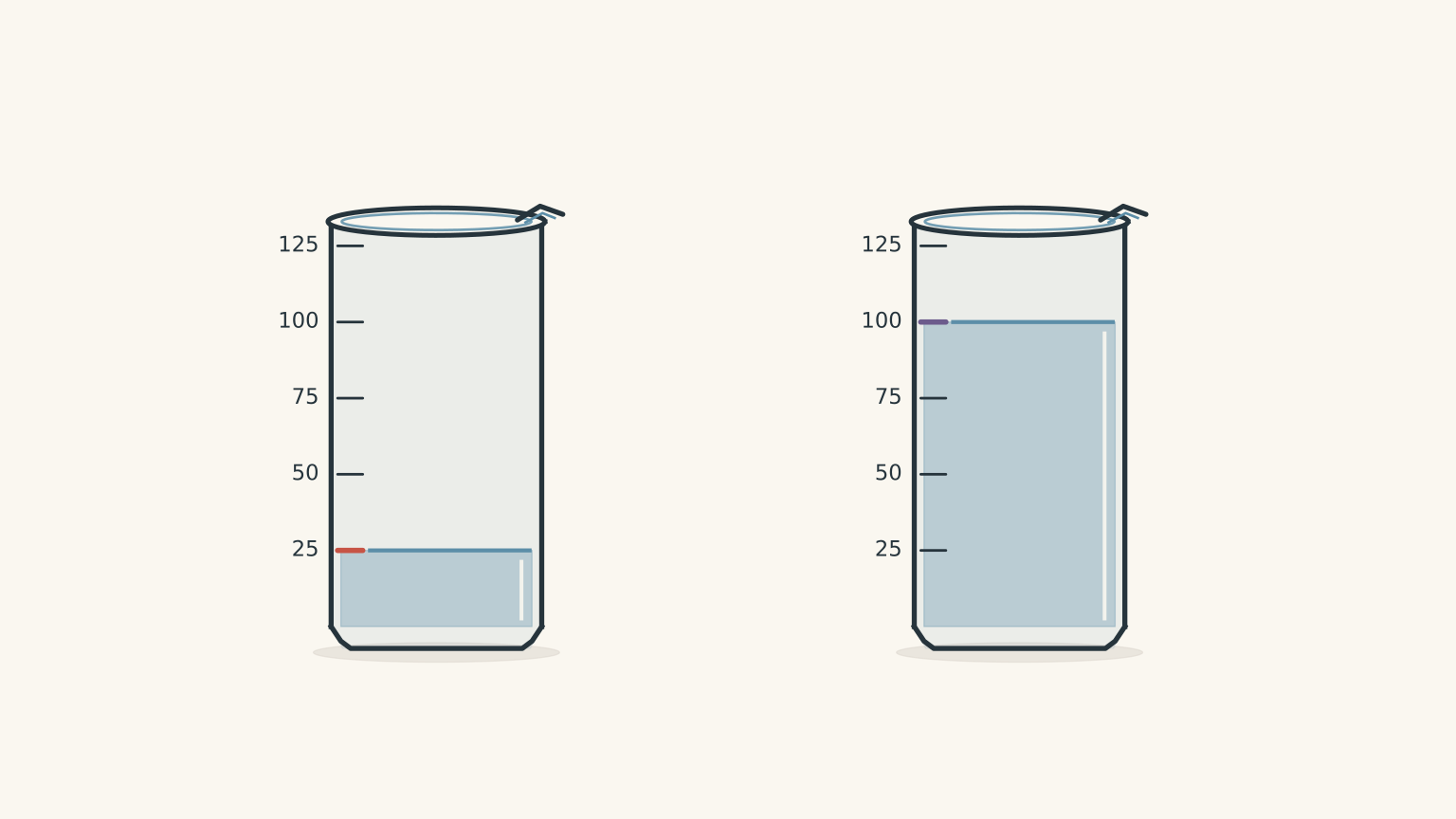
Due to technical limitations, this figure may display incorrectly or contain inaccuracies. Please check key details against your course materials.
07Questions and solutions
Question 1
A student prepares a 0.0200 mol L\(^{-1}\) acetic acid solution. At equilibrium, the hydronium concentration is measured as \(5.9\times10^{-4}\) mol L\(^{-1}\).
a) Write the equilibrium reaction between acetic acid and water.
b) Identify the two conjugate acid-base pairs.
c) Calculate the percentage ionisation of the acid.
Solution 1
The percentage ionisation is 2.95%, and the conjugate pairs are \(\ce{CH3COOH/CH3COO-}\) and \(\ce{H3O+/H2O}\).
a) Equilibrium reaction
\[ \ce{CH3COOH(aq) + H2O(l) <=> H3O+(aq) + CH3COO-(aq)} \]
Acetic acid donates a proton to water, producing acetate and hydronium.
b) Conjugate acid-base pairs
- \(\ce{CH3COOH}\) and \(\ce{CH3COO-}\)
- \(\ce{H2O}\) and \(\ce{H3O+}\)
Each pair differs by one proton.
c) Percentage ionisation
Use:
\[ \%\text{ ionisation} = \frac{[\ce{H3O+}]_{\mathrm{eq}}} {c_0}\times100 \]
Substitute:
\[ = \frac{5.9\times10^{-4}}{0.0200} \times100 \]
\[ \boxed{2.95\%} \]
This means approximately 2.95% of the original acetic acid has ionised. The remaining acid is predominantly undissociated.
Question 2
Two solutions are prepared at 25°C:
- Solution A: 0.0500 mol L\(^{-1}\) hydrochloric acid, with an illustrative pH of 1.30.
- Solution B: 0.0500 mol L\(^{-1}\) acetic acid, with an illustrative pH of 3.03.
a) Calculate the hydronium concentration in each solution.
b) Calculate how many times greater the hydronium concentration is in Solution A.
c) Calculate the percentage ionisation of acetic acid in Solution B.
d) Explain why the two solutions have different pH values despite having the same initial concentration.
Solution 2
Solution A has approximately 54 times the hydronium concentration of Solution B, and the percentage ionisation of acetic acid is approximately 1.87%.
a) Calculate the hydronium concentrations.
Use:
\[ [\ce{H3O+}]=10^{-\mathrm{pH}} \]
For Solution A:
\[ [\ce{H3O+}]_A=10^{-1.30} \]
\[ =0.0501\text{ mol L}^{-1} \]
For Solution B:
\[ [\ce{H3O+}]_B=10^{-3.03} \]
\[ =9.33\times10^{-4}\text{ mol L}^{-1} \]
b) Compare the hydronium concentrations.
\[ \text{Ratio} = \frac{0.0501}{9.33\times10^{-4}} \]
\[ \boxed{\text{Ratio}\approx53.7} \]
Hydrochloric acid produces approximately 54 times the hydronium concentration of acetic acid at the same initial concentration.
c) Calculate percentage ionisation of acetic acid.
\[ \%\text{ ionisation} = \frac{9.33\times10^{-4}}{0.0500} \times100 \]
\[ \boxed{1.87\%} \]
d) Explain the difference.
Both solutions begin with the same acid concentration, but the acids have different strengths.
Hydrochloric acid ionises essentially completely, producing a large hydronium concentration.
Acetic acid only partially ionises, so most molecules remain intact.
Therefore, the acetic acid solution has a higher pH.
Question 3
A student takes 10.0 mL of 0.100 mol L\(^{-1}\) acetic acid and dilutes it to a final volume of 100.0 mL.
The acid dissociation constant is \(1.8\times10^{-5}\) at 25°C.
a) Calculate the initial amount of acetic acid.
b) Calculate the initial and final acid concentrations.
c) Estimate the hydronium concentration and percentage ionisation before and after dilution.
d) A student claims that dilution makes acetic acid stronger because a greater percentage of its molecules ionise. Evaluate this claim.
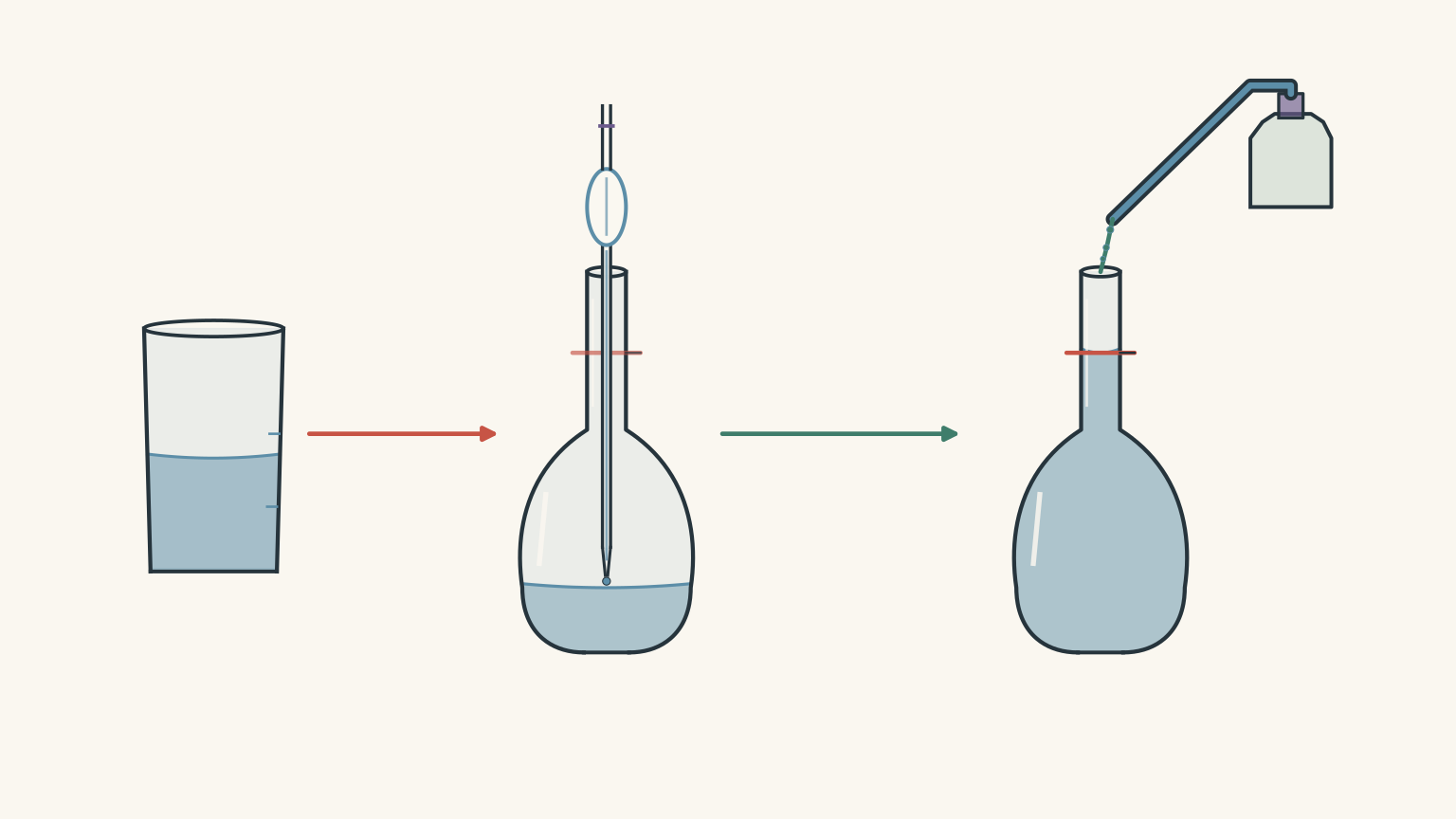
Due to technical limitations, this figure may display incorrectly or contain inaccuracies. Please check key details against your course materials.
Solution 3
Dilution increases the percentage ionisation of acetic acid, but it does not increase its intrinsic acid strength. The acid dissociation constant remains unchanged at constant temperature.
a) Calculate the initial amount.
Use:
\[ n=cV \]
\[ n=0.100\times0.0100 \]
\[ \boxed{n=0.00100\text{ mol}} \]
b) Calculate the concentrations.
Initially:
\[ c_1=0.100\text{ mol L}^{-1} \]
After dilution:
\[ c_2=\frac{0.00100}{0.1000} \]
\[ \boxed{c_2=0.0100\text{ mol L}^{-1}} \]
The amount of acid remains unchanged, but its concentration decreases by a factor of ten.
c) Calculate hydronium concentration and percentage ionisation.
Initially, using:
\[ [\ce{H3O+}]\approx\sqrt{K_a c} \]
\[ [\ce{H3O+}]_1 = \sqrt{1.8\times10^{-5}\times0.100} \]
\[ =1.34\times10^{-3}\text{ mol L}^{-1} \]
Percentage ionisation:
\[ \frac{1.34\times10^{-3}}{0.100} \times100 \]
\[ \boxed{1.34\%} \]
After dilution:
\[ [\ce{H3O+}]_2 = \sqrt{1.8\times10^{-5}\times0.0100} \]
\[ =4.24\times10^{-4}\text{ mol L}^{-1} \]
Percentage ionisation:
\[ \frac{4.24\times10^{-4}}{0.0100} \times100 \]
\[ \boxed{4.24\%} \]
The percentage ionisation increases from 1.34% to 4.24%.
However, the hydronium concentration decreases.
The initial pH is approximately:
\[ \mathrm{pH}_1=2.87 \]
The final pH is approximately:
\[ \mathrm{pH}_2=3.37 \]
d) Evaluate the claim.
The student is confusing percentage ionisation with acid strength.
Dilution causes a greater proportion of the acid molecules to ionise, but the acid itself has not become stronger.
Its \(K_a\) remains approximately \(1.8\times10^{-5}\) at 25°C.
The increase in percentage ionisation is accompanied by a decrease in hydronium concentration and an increase in pH.
Question 4
Consider two aqueous solutions at 25°C:
- Solution X: 0.100 mol L\(^{-1}\) acetic acid.
- Solution Y: 0.00100 mol L\(^{-1}\) hydrochloric acid.
Given \(K_a=1.8\times10^{-5}\) for acetic acid:
a) Calculate the approximate hydronium concentration and pH of Solution X.
b) Calculate the pH of Solution Y.
c) Which solution has the lower pH?
d) Explain why this result does not mean acetic acid is stronger than hydrochloric acid.
Solution 4
Solution X has the lower pH, approximately 2.87, despite acetic acid being weaker than hydrochloric acid.
a) Calculate the hydronium concentration in Solution X.
Using the weak acid approximation:
\[ [\ce{H3O+}]\approx\sqrt{K_a c} \]
\[ =\sqrt{1.8\times10^{-5}\times0.100} \]
\[ =1.34\times10^{-3}\text{ mol L}^{-1} \]
Calculate pH:
\[ \mathrm{pH}=-\log_{10}(1.34\times10^{-3}) \]
\[ \boxed{\mathrm{pH}_X\approx2.87} \]
b) Calculate the pH of Solution Y.
Hydrochloric acid is a strong acid, so it ionises essentially completely.
Therefore:
\[ [\ce{H3O+}]\approx0.00100 \text{ mol L}^{-1} \]
\[ \mathrm{pH}=-\log_{10}(0.00100) \]
\[ \boxed{\mathrm{pH}_Y=3.00} \]
c) Compare the pH values.
Solution X has the lower pH:
\[ 2.87<3.00 \]
Therefore, the acetic acid solution is more acidic in terms of its initial hydronium concentration.
d) Explain why this does not indicate greater acid strength.
The key is that the concentrations are different.
Solution X contains 0.100 mol L\(^{-1}\) acetic acid, whereas Solution Y contains only 0.00100 mol L\(^{-1}\) hydrochloric acid.
The acetic acid solution starts with 100 times the acid concentration.
Even though only approximately 1.34% of the acetic acid ionises, its higher initial concentration allows it to produce slightly more hydronium ions.
Hydrochloric acid remains the stronger acid because it ionises essentially completely.
This question demonstrates why comparing pH values alone is not a reliable way to rank acid strength when the initial concentrations are different.
Question 5
Two 100.0 mL acid samples are prepared at 25°C.
Both have an initial pH of approximately 3.38.
- Sample A contains hydrochloric acid at \(4.15\times10^{-4}\) mol L\(^{-1}\).
- Sample B contains acetic acid at 0.0100 mol L\(^{-1}\).
The acid dissociation constant of acetic acid is \(1.8\times10^{-5}\).
Both samples are separately titrated with 0.0100 mol L\(^{-1}\) sodium hydroxide.
A student argues:
“Both samples have the same pH, so they contain the same amount of acid and must require the same volume of sodium hydroxide to reach equivalence.”
Evaluate the student’s argument. Calculate the volume of sodium hydroxide required to neutralise each sample.
Assume both acids are monoprotic, the reactions proceed to complete neutralisation at equivalence, and ideal concentration calculations apply.
Solution 5
The student’s argument is incorrect. Although both samples have approximately the same initial pH, Sample B requires about 24 times as much sodium hydroxide as Sample A.
The important distinction is between the hydronium ions already present and the total amount of acid available to react.
Step 1: Calculate the total amount of acid in Sample A.
Sample A contains hydrochloric acid.
\[ n=cV \]
\[ n_A=4.15\times10^{-4}\times0.1000 \]
\[ \boxed{n_A=4.15\times10^{-5}\text{ mol}} \]
Hydrochloric acid is essentially completely ionised, so almost all its acid units have already transferred their protons to water.
Step 2: Calculate the total amount of acid in Sample B.
Sample B contains acetic acid.
\[ n_B=cV \]
\[ n_B=0.0100\times0.1000 \]
\[ \boxed{n_B=1.00\times10^{-3}\text{ mol}} \]
Notice the difference.
Sample B contains substantially more total acid, even though its initial pH is the same as Sample A.
Most of the acetic acid molecules are still undissociated.
Step 3: Calculate the volume of sodium hydroxide required for Sample A.
The neutralisation reaction is:
\[ \ce{HCl + NaOH -> NaCl + H2O} \]
The mole ratio is 1:1.
Therefore, the amount of sodium hydroxide required is:
\[ n(\ce{NaOH})=4.15\times10^{-5}\text{ mol} \]
Using:
\[ V=\frac{n}{c} \]
\[ V_A=\frac{4.15\times10^{-5}}{0.0100} \]
\[ V_A=0.00415\text{ L} \]
\[ \boxed{V_A=4.15\text{ mL}} \]
Step 4: Calculate the volume of sodium hydroxide required for Sample B.
The neutralisation reaction is:
\[ \ce{CH3COOH + OH- -> CH3COO- + H2O} \]
Again, the mole ratio is 1:1.
Therefore:
\[ n(\ce{NaOH})=1.00\times10^{-3}\text{ mol} \]
Using:
\[ V=\frac{n}{c} \]
\[ V_B=\frac{1.00\times10^{-3}}{0.0100} \]
\[ V_B=0.100\text{ L} \]
\[ \boxed{V_B=100.0\text{ mL}} \]
Step 5: Explain the surprising result.
The tempting assumption is that equal pH means equal amounts of acid.
But pH measures the hydronium concentration at a particular moment. It does not measure the total amount of acid in the solution.
Sample B contains a large reservoir of undissociated acetic acid molecules.
As sodium hydroxide is added, hydroxide ions react with hydronium ions. This reduces the hydronium concentration, causing the acetic acid equilibrium to shift towards the products.
More acetic acid molecules then transfer their protons to water, allowing further neutralisation.
Eventually, almost all the original acetic acid can be neutralised.
Sample A has no comparable reservoir of undissociated hydrochloric acid because hydrochloric acid has already ionised essentially completely.
The two samples therefore have similar initial pH values but very different total amounts of acid.
This is the crucial distinction: pH measures the hydronium concentration, while titration measures the total amount of acid that can be neutralised.
08Where this leads next
Understanding this difference is essential when studying weak acid-strong base titrations.
A weak acid can have a relatively low initial hydronium concentration while still containing a substantial amount of acid available to react with a base.
That is why its titration curve behaves differently from the curve of a strong acid.
The next useful step is understanding how the equilibrium between acetic acid and acetate changes as sodium hydroxide is added.
See Weak Acid-Strong Base Titrations: HSC Chemistry Guide for how this equilibrium affects the shape of the titration curve and the pH at equivalence.