
Direct Proofs of Number Results for HSC Mathematics Extension 2
Learn how to construct direct proofs using integer definitions, parity, divisibility, and remainders. Includes worked examples and five progressively challenging HSC-style questions with detailed solutions.
Square a few odd integers: \(1^2=1\), \(3^2=9\), \(5^2=25\), and \(7^2=49\). Each square is exactly 1 more than a multiple of 8. Predict what happens when you square \(101\). The result is \(10\,201=8(1275)+1\), so the pattern continues. But why should this work for every odd integer? A direct proof gives us a way to establish that a number result must be true, rather than relying on a growing list of examples.
01Start with definitions, not examples
Before writing a proof, think about what makes a number even or odd.
An even number can be split into complete pairs. An odd number has one left over. For example, eight objects make four complete pairs, while seven objects make three pairs and one leftover.
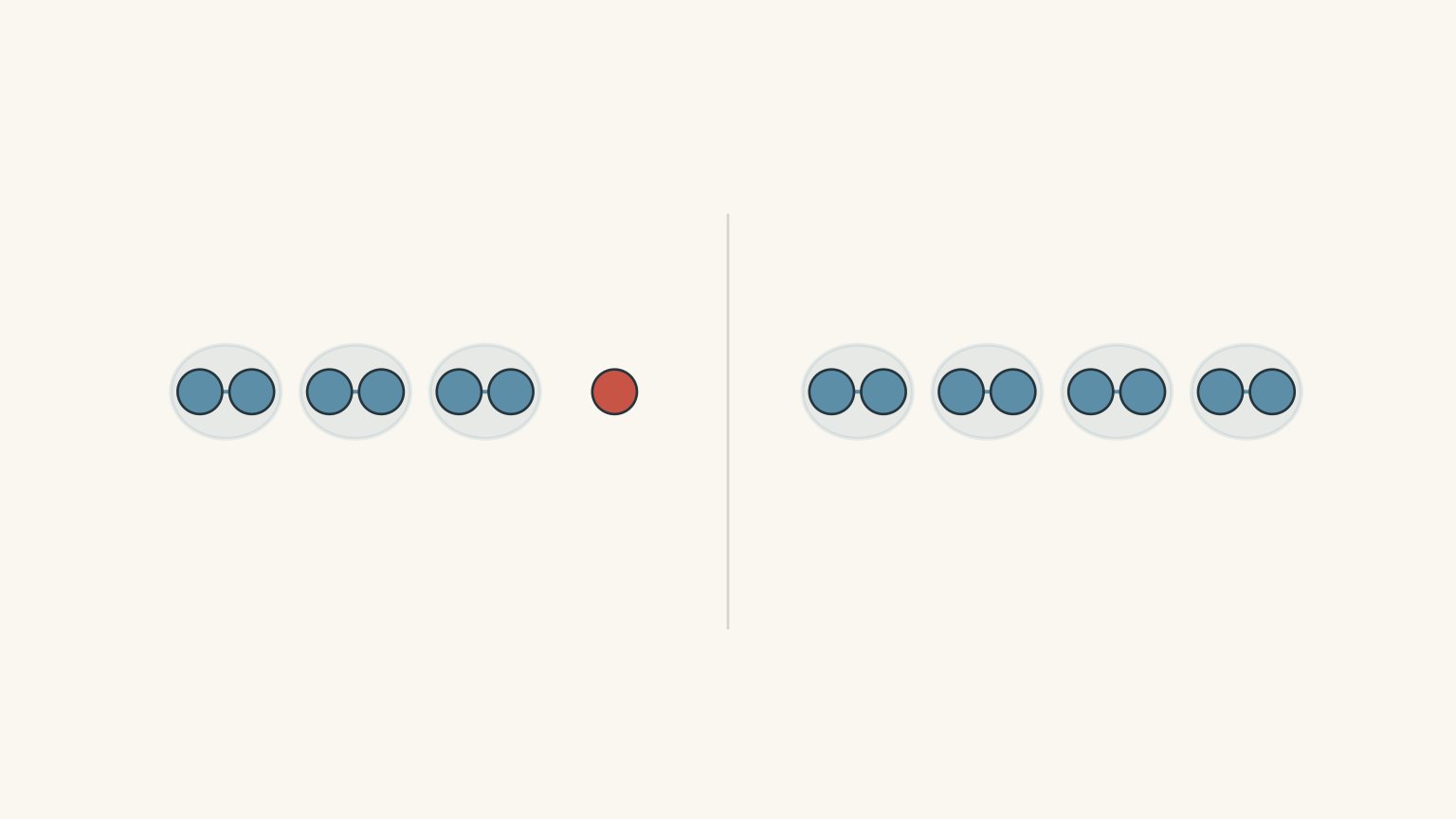
Due to technical limitations, this figure may display incorrectly or contain inaccuracies. Please check key details against your course materials.
This gives us a useful starting point. In mathematics, we express these ideas algebraically:
- An integer is even if it can be written as \(2k\), where \(k\) is an integer.
- An integer is odd if it can be written as \(2k+1\), where \(k\) is an integer.
We write \(k\in\mathbb Z\) to mean that \(k\) belongs to the set of integers.
Notice that \(k\) does not have to be positive. For example,
\[ -3=2(-2)+1 \]
so negative odd integers fit the same definition.
These definitions are the starting point for most direct proofs involving parity.
A useful collection of algebraic forms
Different statements about numbers suggest different ways to write them.
| Mathematical statement | Algebraic form |
|---|---|
| \(n\) is even | \(n=2k\) |
| \(n\) is odd | \(n=2k+1\) |
| \(d\) divides \(n\) | \(n=dk\) |
| \(n\) leaves remainder \(r\) when divided by \(d\) | \(n=dq+r\) |
| Two integers are consecutive | \(n,\ n+1\) |
In these expressions, the letters representing unspecified integers can take any integer value.
One particularly important definition is divisibility. If we want to prove that \(d\) divides \(N\), we must show that
\[ N=dk \]
for some integer \(k\).
It is not enough to say that \(N\) looks divisible by \(d\). We need to establish that the quotient is an integer.
02How a direct proof works
Suppose you need to prove a statement of the form:
If \(P\) is true, then \(Q\) is true.
A direct proof starts by assuming \(P\), then uses algebra and known definitions to establish \(Q\).
The process is:
- Identify the condition you are given.
- Express that condition using an appropriate algebraic definition.
- Simplify or rearrange the expression until it matches the required conclusion.
- Explain why the final expression establishes the result.
The important direction is from the assumption towards the conclusion.
For example, if you are asked to prove that an odd integer has an odd square, start with \(n=2k+1\). Do not begin by assuming that \(n^2\) is odd. That would be assuming the result you are supposed to prove.
Worked example: The sum of two odd integers is even
Question: Prove that the sum of any two odd integers is even.
Step 1
Let the two integers be \(a\) and \(b\).
Since both are odd, there exist integers \(m\) and \(n\) such that
\[ a=2m+1 \]
and
\[ b=2n+1. \]
We use different letters because the two odd integers do not have to be equal.
Step 2
\[ \begin{aligned} a+b &=(2m+1)+(2n+1)\\ &=2m+2n+2\\ &=2(m+n+1). \end{aligned} \]
Step 3
Since \(m\) and \(n\) are integers, \(m+n+1\) must also be an integer.
Therefore, \(a+b\) is twice an integer, which means it is even.
Hence, the sum of any two odd integers is even.
Notice what made this proof work: we did not need to know which odd integers we were adding. The algebra covered every possible pair.
03Consecutive integers and remainders
Another useful idea is that consecutive integers have predictable patterns.
Consider the integers \(8\) and \(9\), or \(14\) and \(15\). One is always even and the other is odd.
Therefore, among any two consecutive integers, exactly one is even.
There is a similar pattern when we consider three consecutive integers and division by 3.
For example:
- \(4,5,6\): one is divisible by 3.
- \(10,11,12\): one is divisible by 3.
- \(-2,-1,0\): one is divisible by 3.
Why does this always happen?
Every integer can be written in the form
\[ n=3q+r \]
where \(q\) is an integer and the remainder \(r\) is one of
\[ r=0,\quad r=1,\quad r=2. \]
These three possible remainders repeat in a cycle. Every group of three consecutive integers therefore contains exactly one multiple of 3.
This is an example of a remainder argument. Instead of testing individual numbers, we consider every possible remainder.
It is particularly useful when a proof involves divisibility by numbers other than 2.
04Proving a more involved number result
Let’s return to the odd-square pattern from the beginning.
An interesting way to picture an odd square is as a square arrangement of dots. A \(5\times5\) square contains 25 dots. Starting with the central dot, the remaining dots can be arranged in successive square borders containing 8 and 16 dots.
Thus,
\[ 25=1+8+16. \]
The number of dots is 1 more than a multiple of 8.
This suggests why odd squares might always leave a remainder of 1 when divided by 8. However, a picture of a \(5\times5\) square only establishes something about 25. We need algebra to prove the general result.
Worked example: The square of an odd integer
Question: Prove that the square of every odd integer is 1 more than a multiple of 8.
Step 1
Let \(n\) be any odd integer.
By definition, there exists an integer \(k\) such that
\[ n=2k+1. \]
Step 2
\[ \begin{aligned} n^2 &=(2k+1)^2\\ &=4k^2+4k+1\\ &=4k(k+1)+1. \end{aligned} \]
We have almost reached the required result. However, we need a multiple of 8, not just a multiple of 4.
Step 3
The integers \(k\) and \(k+1\) are consecutive.
One must be even, so their product must also be even.
Therefore, there exists an integer \(t\) such that
\[ k(k+1)=2t. \]
Substitute this into our expression:
\[ \begin{aligned} n^2 &=4k(k+1)+1\\ &=4(2t)+1\\ &=8t+1. \end{aligned} \]
Step 4
Since \(t\) is an integer, \(8t\) is divisible by 8.
Therefore,
\[ n^2-1=8t. \]
Hence, the square of every odd integer is 1 more than a multiple of 8.
The key move was recognising that the product of two consecutive integers is even. Without that extra observation, the algebra would only have established divisibility by 4.
This proof also works for negative odd integers because the consecutive-integer property holds for negative values too.
05Common mistakes in direct proofs
A few mistakes appear repeatedly when students first learn to construct proofs.
1. Testing examples instead of proving the general result
Showing that \(3^2=9\), \(5^2=25\), and \(7^2=49\) all leave a remainder of 1 when divided by 8 does not prove that every odd square does.
Examples can suggest a result, but a proof must cover an arbitrary integer.
2. Forgetting to establish that something is an integer
Suppose you reach
\[ N=6(k+1). \]
You still need to know that \(k+1\) is an integer. If \(k\) is an integer, this follows immediately.
Make these connections explicit, particularly in divisibility proofs.
3. Using the same variable for unrelated integers
When proving a result about two odd integers, write
\[ a=2m+1,\qquad b=2n+1. \]
Do not automatically use the same integer parameter for both. The two original integers can be different.
4. Proving only one direction of an equivalence
A statement containing if and only if requires two separate arguments.
You must prove:
- The first condition implies the second.
- The second condition implies the first.
Establishing only one direction is not a complete proof.
06Questions and solutions
The following questions build from basic parity arguments towards more involved divisibility proofs. Try each question before reading its solution.
Question 1
Prove that the sum of an even integer and an odd integer is always odd.
Solution 1
The sum is always odd because adding an even integer to an odd integer produces an expression of the form \(2k+1\).
Let the even integer be \(a=2m\), and let the odd integer be \(b=2n+1\), where \(m,n\in\mathbb Z\).
Adding them gives
\[ \begin{aligned} a+b &=2m+(2n+1)\\ &=2(m+n)+1. \end{aligned} \]
Since \(m+n\) is an integer, the result has the form \(2k+1\).
Therefore, \(a+b\) is odd.
The important distinction is that an even number contributes complete pairs, while the odd number contributes one additional unit. That leftover cannot be paired away by adding an even number.
Question 2
Prove that the product of any three consecutive integers is divisible by 6.
Solution 2
The product of any three consecutive integers is always divisible by 6.
Let the three consecutive integers be
\[ n-1,\quad n,\quad n+1, \]
where \(n\in\mathbb Z\).
We need to establish divisibility by both 2 and 3.
Step 1: Establish divisibility by 2.
Among three consecutive integers, at least one must be even because consecutive integers alternate between even and odd.
Therefore,
\[ 2\mid(n-1)n(n+1). \]
Step 2: Establish divisibility by 3.
When three consecutive integers are divided by 3, their remainders must be 0, 1, and 2 in some order.
Therefore, exactly one of the three integers is divisible by 3.
Hence,
\[ 3\mid(n-1)n(n+1). \]
Step 3: Combine the two results.
The product is divisible by both 2 and 3.
Since 2 and 3 are relatively prime, their product must divide the original expression.
Therefore,
\[ 6\mid(n-1)n(n+1). \]
Hence, the product of any three consecutive integers is divisible by 6.
A subtle point here is that the even integer and the multiple of 3 do not have to be the same factor. The product still contains both factors, so it is divisible by their product.
Question 3
Let \(n\) be an integer. Prove that if \(3\mid n^2\), then \(3\mid n\).
Solution 3
If the square of an integer is divisible by 3, the integer itself must be divisible by 3.
The key is to consider all possible remainders when \(n\) is divided by 3.
Step 1: Express \(n\) using the division algorithm.
There exist integers \(q\) and \(r\) such that
\[ n=3q+r, \]
where
\[ r\in\{0,1,2\}. \]
Step 2: Square the expression.
\[ \begin{aligned} n^2 &=(3q+r)^2\\ &=9q^2+6qr+r^2. \end{aligned} \]
The first two terms are divisible by 3.
Therefore, the remainder of \(n^2\) when divided by 3 depends entirely on \(r^2\).
Step 3: Consider the possible remainders.
There are three cases:
- If \(r=0\), then \(r^2=0\), so \(n^2\) is divisible by 3.
- If \(r=1\), then \(r^2=1\), so \(n^2\) leaves remainder 1.
- If \(r=2\), then \(r^2=4\), so \(n^2\) also leaves remainder 1.
Since we are given that \(3\mid n^2\), the remainder cannot be 1.
Therefore, \(r=0\).
Step 4: Return to the original expression.
Since \(r=0\),
\[ n=3q. \]
As \(q\) is an integer, \(n\) is divisible by 3.
Hence,
\[ 3\mid n. \]
The important idea is that checking all possible remainders gives us a complete argument. We have not assumed that a divisible square must have a divisible root; we have established it.
Question 4
Suppose \(a\) and \(b\) are integers such that both \(a+b\) and \(ab\) are even.
Prove that \(a\) and \(b\) must both be even.
Solution 4
Both \(a\) and \(b\) must be even.
The trick is to use the two conditions together. Neither condition alone is sufficient.
Step 1: Use the fact that \(a+b\) is even.
If one of \(a,b\) were even and the other odd, their sum would be odd.
Therefore, \(a\) and \(b\) must have the same parity.
There are only two possibilities:
- Both are even.
- Both are odd.
Step 2: Use the fact that \(ab\) is even.
If both \(a\) and \(b\) were odd, we could write
\[ a=2m+1,\qquad b=2n+1. \]
Their product would then be
\[ \begin{aligned} ab &=(2m+1)(2n+1)\\ &=2(2mn+m+n)+1. \end{aligned} \]
This is odd, contradicting the given condition that \(ab\) is even.
Therefore, \(a\) and \(b\) cannot both be odd.
Step 3: Combine the conditions.
We established that \(a\) and \(b\) have the same parity, but they cannot both be odd.
The only remaining possibility is that both are even.
Hence, \(a\) and \(b\) are both even.
The tempting mistake is to conclude that an even sum means both numbers are even. For example, \(3+5=8\), even though both numbers are odd. The product condition is what eliminates that possibility.
Question 5
Let \(a_1,a_2,\ldots,a_m\) be integers, where \(m\) is a positive integer.
Prove that
\[ 4\mid\left(a_1^2+a_2^2+\cdots+a_m^2\right) \]
if and only if the number of odd integers among \(a_1,a_2,\ldots,a_m\) is divisible by 4.
Hence, determine exactly what this result tells us when \(m=4\).
Solution 5
The statement is true: the sum of the squares is divisible by 4 precisely when the number of odd integers in the list is a multiple of 4.
The key is to understand what an individual square contributes when divided by 4.
Step 1: Establish the possible remainders of an integer square.
Consider any integer \(a\).
If \(a\) is even, write
\[ a=2k. \]
Then
\[ a^2=4k^2. \]
Therefore, an even integer squared leaves remainder 0 when divided by 4.
If \(a\) is odd, write
\[ a=2k+1. \]
Then
\[ \begin{aligned} a^2 &=(2k+1)^2\\ &=4k(k+1)+1. \end{aligned} \]
Since \(k\) and \(k+1\) are consecutive integers, their product is even.
Consequently, \(4k(k+1)\) is divisible by 4.
Therefore, an odd integer squared leaves remainder 1 when divided by 4.
We have established that every integer square has one of two possible remainders:
\[ a^2\equiv \begin{cases} 0\pmod 4 & \text{if }a\text{ is even},\\ 1\pmod 4 & \text{if }a\text{ is odd}. \end{cases} \]
Step 2: Count the odd integers.
Let \(s\) be the number of odd integers among
\[ a_1,a_2,\ldots,a_m. \]
Every even integer contributes a square that is divisible by 4.
Every odd integer contributes a square that is 1 more than a multiple of 4.
Therefore, when we add all the squares, we can collect the multiples of 4 together and write
\[ a_1^2+a_2^2+\cdots+a_m^2=4K+s, \]
where \(K\) is an integer.
Step 3: Prove the forward direction.
Suppose
\[ 4\mid(a_1^2+a_2^2+\cdots+a_m^2). \]
Since the sum is \(4K+s\), divisibility by 4 requires
\[ 4\mid s. \]
Therefore, the number of odd integers in the list must be divisible by 4.
Step 4: Prove the reverse direction.
Now suppose the number of odd integers is divisible by 4.
This means that \(s=4t\) for some integer \(t\).
Substituting into our expression gives
\[ \begin{aligned} a_1^2+\cdots+a_m^2 &=4K+s\\ &=4K+4t\\ &=4(K+t). \end{aligned} \]
Since \(K+t\) is an integer, the sum of squares is divisible by 4.
This establishes both directions of the equivalence.
Step 5: Apply the result when \(m=4\).
If there are exactly four integers, the number of odd integers \(s\) can only be
\[ s\in\{0,1,2,3,4\}. \]
The only values in this set divisible by 4 are
\[ s=0\quad\text{or}\quad s=4. \]
Therefore, if
\[ 4\mid(a^2+b^2+c^2+d^2), \]
then either:
- All four integers are even, or
- All four integers are odd.
In particular, we cannot conclude that all four must be even.
For example,
\[ 1^2+1^2+1^2+1^2=4. \]
All four integers are odd, yet their squared sum is divisible by 4.
This is the important conceptual distinction: divisibility by 4 does not force every individual square to be divisible by 4. It allows four remainder-1 contributions to combine into another multiple of 4.
The number of terms matters. With three squares, only zero odd terms can produce a sum divisible by 4. With four squares, four odd terms are possible as well.
07What to learn next
Direct proofs become much more powerful when you combine parity with systematic remainder arguments.
The expression \(n=dq+r\) is the starting point for modular arithmetic, where you study how numbers behave through their remainders rather than their actual sizes.
Once you are comfortable translating statements into algebraic forms, proving divisibility results becomes less about guessing the right manipulation and more about identifying which mathematical structure makes the conclusion inevitable.