
When to Use ⇒, ⇔ and = in HSC Mathematics Extension 2
Learn the difference between implication, equivalence, and equality, and understand when each symbol is mathematically justified. Includes worked examples and challenging HSC-style questions covering reversible algebra, squaring, and domain restrictions.
Suppose you solve \(x^2=25\) and write
\[ x^2=25\Rightarrow x=5. \]
It looks like a reasonable algebraic step. But you’ve lost a solution: \(x=-5\) also satisfies the original equation.
The calculation \(5^2=25\) is correct. The logical inference is not.
In Mathematics Extension 2, choosing between \(=\), \(\Rightarrow\), and \(\Leftrightarrow\) is part of writing a valid proof. These symbols communicate different mathematical claims, and using the wrong one can make an otherwise correct argument logically incomplete.
Before going further, predict which of these statements are true for real \(x\):
- \(x=5\Rightarrow x^2=25\)
- \(x^2=25\Rightarrow x=5\)
- \(x^2=25\Leftrightarrow (x=5\text{ or }x=-5)\)
The first and third are true. The second is false because \(x=-5\) is a counterexample.
Let’s work out exactly why.
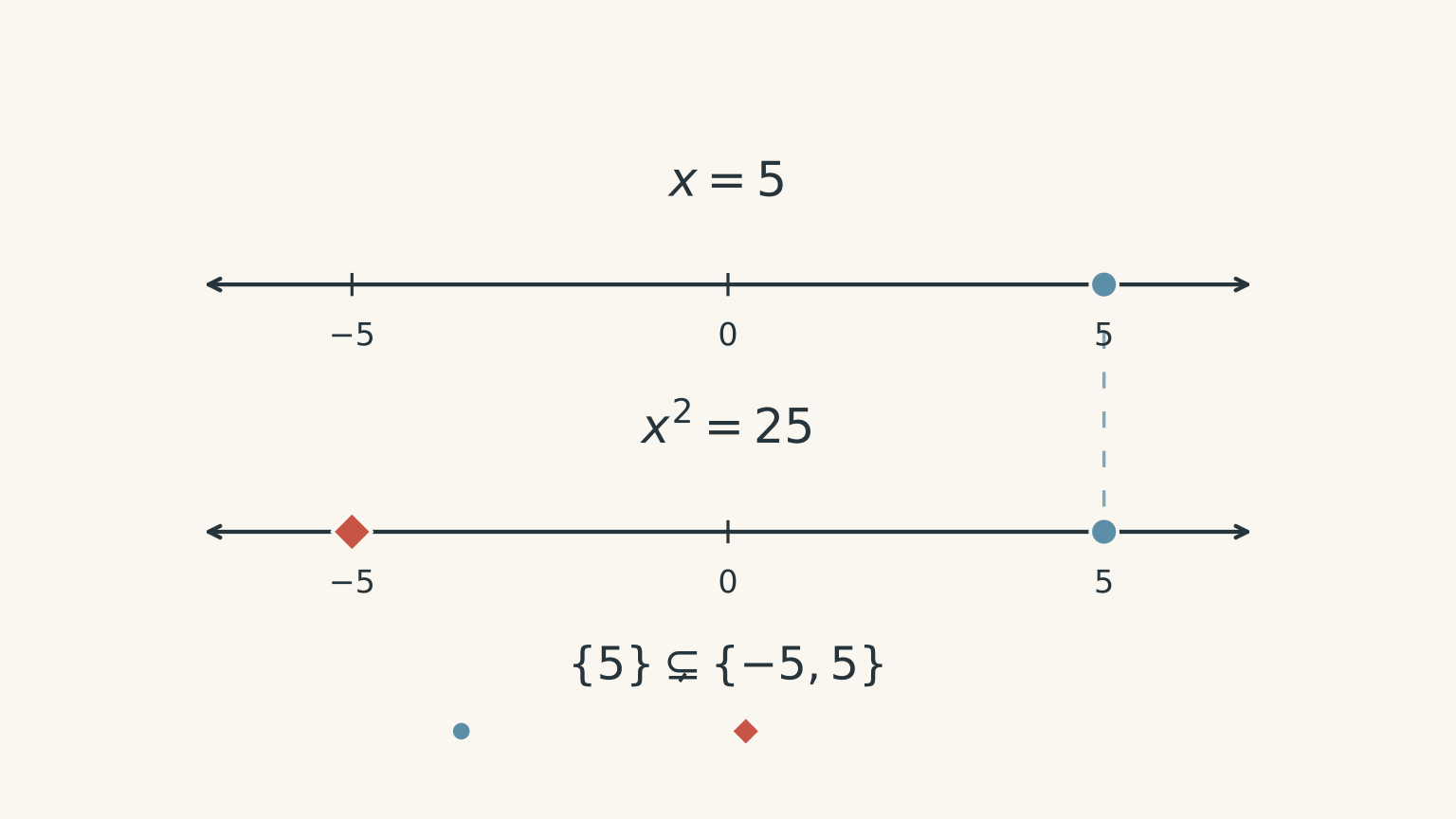
Due to technical limitations, this figure may display incorrectly or contain inaccuracies. Please check key details against your course materials.
01Three symbols, three different jobs
Unless stated otherwise, assume all variables are real.
| Symbol | Meaning | Example |
|---|---|---|
| \(=\) | Two mathematical expressions have the same value. | \(x^2-1=(x-1)(x+1)\) |
| \(\Rightarrow\) | One statement implies another. | \(x=5\Rightarrow x^2=25\) |
| \(\Leftrightarrow\) | Two statements are logically equivalent. | \(x^2=25\Leftrightarrow x=\pm5\) |
The important distinction is that equality compares mathematical values, while implication and equivalence describe relationships between statements.
1. Equality: the two sides have the same value
The equals sign states that the left-hand side and right-hand side represent the same value.
For example,
\[ x^2-1=(x-1)(x+1) \]
is an identity. It is true for every real value of \(x\).
However, consider
\[ x^2-1=0. \]
This is an equation, not an identity. It is true only when \(x=1\) or \(x=-1\).
The distinction matters when solving equations.
We can write:
\[ x^2-1=0 \Leftrightarrow (x-1)(x+1)=0 \Leftrightarrow x=1\text{ or }x=-1. \]
Why are the equivalence symbols appropriate here?
- Factorising the expression does not change its value.
- The zero-product rule tells us that a product is zero if and only if at least one factor is zero.
- Both directions of the argument are valid.
Notice that the equals signs compare expressions within each statement, while the equivalence symbols connect statements about the possible values of \(x\).
You should not use \(=\) as a shortcut for ‘is equivalent to’.
2. Implication: one statement guarantees another
The symbol \(\Rightarrow\) means ‘implies’.
When we write
\[ P\Rightarrow Q, \]
we are claiming that whenever statement \(P\) is true, statement \(Q\) must also be true.
Importantly, we are not claiming that \(Q\) can only be true when \(P\) is true.
Consider:
\[ x=5\Rightarrow x^2=25. \]
This is valid.
If \(x=5\), then substituting gives
\[ x^2=5^2=25. \]
However, the reverse statement is not valid:
\[ x^2=25\not\Rightarrow x=5. \]
The equation \(x^2=25\) also allows \(x=-5\).
This reverse statement is called the converse of the original implication.
A single counterexample is enough to disprove an implication. Here, \(x=-5\) makes the original statement true but its proposed conclusion false.
There is also useful terminology:
- If \(P\Rightarrow Q\), then \(P\) is a sufficient condition for \(Q\).
- \(Q\) is a necessary condition for \(P\).
This language becomes useful when writing longer proofs and explaining why a particular condition guarantees a result.
3. Equivalence: both statements guarantee each other
The symbol \(\Leftrightarrow\) means ‘if and only if’.
When we write
\[ P\Leftrightarrow Q, \]
we are claiming both:
\[ P\Rightarrow Q \]
and
\[ Q\Rightarrow P. \]
In other words, the two statements must have exactly the same truth value for every permitted input.
For equations, this means they have the same solution set over the stated domain.
For example,
\[ x^2=25 \Leftrightarrow x=5\text{ or }x=-5. \]
Both directions work:
- If \(x^2=25\), then \(x=5\) or \(x=-5\).
- If \(x=5\) or \(x=-5\), then \(x^2=25\).
That is a genuine equivalence.
A useful way to remember the difference:
\[ \boxed{ P\Rightarrow Q \quad\text{means one direction} } \]
\[ \boxed{ P\Leftrightarrow Q \quad\text{means both directions} } \]
02When should you use each symbol in an algebraic proof?
This is where the distinction becomes especially important.
Some algebraic operations preserve equivalence. Others can introduce extra solutions or remove valid ones.
The following table is a useful reference when writing your working.
| Algebraic operation | Appropriate relationship | Important condition |
|---|---|---|
| Add or subtract the same expression on both sides | \(\Leftrightarrow\) | Always reversible. |
| Multiply or divide by a nonzero constant | \(\Leftrightarrow\) | The constant must not be zero. |
| Multiply both sides by an expression that could be zero | \(\Rightarrow\) | The reverse may introduce extra solutions. |
| Divide by an expression | \(\Leftrightarrow\) | Only where that expression is nonzero. |
| Square both sides | \(\Rightarrow\) | The reverse requires additional sign information. |
| Factorise an equation equal to zero | \(\Leftrightarrow\) | Use the zero-product rule. |
Let’s examine the two operations that cause the most trouble.
Squaring both sides
Suppose
\[ a=b. \]
Squaring both sides gives
\[ a^2=b^2. \]
This is always valid, so
\[ a=b\Rightarrow a^2=b^2. \]
However, the reverse is not generally true.
For example,
\[ (-3)^2=3^2, \]
but \(-3\ne3\).
In fact,
\[ a^2=b^2 \Leftrightarrow a=b\text{ or }a=-b. \]
Squaring removes information about the signs of the original expressions.
If you already know that both \(a\) and \(b\) are nonnegative, however, then squaring is reversible:
\[ a=b\Leftrightarrow a^2=b^2. \]
That extra condition changes the logical relationship.
Dividing by an expression
Consider the equation
\[ x(x-2)=0. \]
The zero-product rule gives
\[ x=0\text{ or }x=2. \]
Suppose you divide both sides by \(x\). You obtain
\[ x-2=0, \]
giving only \(x=2\).
Where did \(x=0\) go?
You divided by a quantity that could itself be zero. In doing so, you removed a valid solution.
If you want to divide by \(x\), you must first establish that \(x\ne0\), or consider the case \(x=0\) separately.
The general lesson is simple: before writing \(\Leftrightarrow\), check that the operation works in reverse and that you have not changed the allowed domain.
03Worked examples
Worked example: Does one equation imply another?
For real \(x\), let
\[ P:x=2 \]
and
\[ Q:x^2-3x+1=-1. \]
Determine whether \(P\Rightarrow Q\), \(Q\Rightarrow P\), or \(P\Leftrightarrow Q\) is valid.
Step 1
If \(x=2\), substitute into the second statement:
\[ \begin{aligned} x^2-3x+1 &=2^2-3(2)+1\\ &=4-6+1\\ &=-1. \end{aligned} \]
Therefore,
\[ P\Rightarrow Q. \]
Step 2
Start with \(Q\) and solve:
\[ \begin{aligned} x^2-3x+1&=-1\\ x^2-3x+2&=0\\ (x-1)(x-2)&=0\\ x&=1\text{ or }x=2. \end{aligned} \]
Both values satisfy \(Q\), but only \(x=2\) satisfies \(P\).
In particular, \(x=1\) is a counterexample to \(Q\Rightarrow P\).
Step 3
We have established that
\[ \boxed{P\Rightarrow Q} \]
but
\[ P\not\Leftrightarrow Q. \]
The original condition is sufficient to guarantee the second equation, but the second equation does not uniquely determine the original condition.
Worked example: Solve a radical equation without losing equivalence
Solve the equation
\[ \sqrt{x+6}=x \]
for real \(x\).
Step 1
The square root is nonnegative.
Since it equals \(x\), we must have
\[ x\ge0. \]
This condition will be important when we square both sides.
Step 2
We can write the exact equivalence as
\[ \sqrt{x+6}=x \Leftrightarrow \left(x+6=x^2\text{ and }x\ge0\right). \]
Why is this an equivalence rather than just an implication?
If \(x\ge0\) and \(x^2=x+6\), then
\[ \sqrt{x+6} =\sqrt{x^2} =|x| =x. \]
The restriction \(x\ge0\) makes the reverse direction valid.
Step 3
Rearranging,
\[ x^2-x-6=0. \]
Factorising,
\[ (x-3)(x+2)=0. \]
Therefore,
\[ x=3\text{ or }x=-2. \]
Step 4
We require \(x\ge0\), so \(x=-2\) is rejected.
The only solution is
\[ \boxed{x=3}. \]
Notice what happened: squaring produced an extra candidate, but retaining the sign restriction allowed us to write a fully reversible equivalence.
04A reliable method for writing proofs
When working through an algebraic argument, use these checks.
1. State the domain.
Are the variables real, positive, nonzero, or restricted in another way? A transformation may be reversible on one domain but not another.
2. Identify the statements you’re connecting.
Are you showing that one condition guarantees another, or that they are equivalent?
3. Check the reverse direction.
If you write \(\Leftrightarrow\), can you genuinely travel backwards through the argument?
4. Look for lost or added solutions.
Pay particular attention to squaring, cancelling factors, dividing by variables, and taking square roots.
5. Use counterexamples when necessary.
If you suspect an implication is false, find one allowed input for which the starting statement is true but the conclusion is false.
This is often much quicker than attempting to prove a statement that isn’t true.
05Questions and solutions
Question 1
For real \(x\), define
\[ P:x=-5 \]
and
\[ Q:x^2=25. \]
Determine which of the following statements are true:
(a) \(P\Rightarrow Q\)
(b) \(Q\Rightarrow P\)
(c) \(P\Leftrightarrow Q\)
Explain your reasoning.
Solution 1
Only \(P\Rightarrow Q\) is true.
(a) If \(x=-5\), then
\[ x^2=(-5)^2=25. \]
Therefore, \(P\Rightarrow Q\) is true.
(b) The reverse implication is false. For example, \(x=5\) satisfies \(Q\), but does not satisfy \(P\).
Therefore, \(Q\not\Rightarrow P\).
(c) Equivalence requires both directions to be true. Since the reverse implication fails, \(P\Leftrightarrow Q\) is false.
The key point is that \(x^2=25\) has two solutions, whereas \(x=-5\) has only one.
Question 2
Solve the equation
\[ \sqrt{2x+3}=x-1 \]
for real \(x\).
In your solution, write the correct equivalence connecting the original equation to the squared equation, including any necessary restrictions.
Solution 2
The only real solution is
\[ \boxed{x=2+\sqrt6}. \]
Step 1: Establish the necessary sign restriction.
The left-hand side is nonnegative. Therefore, the right-hand side must also be nonnegative:
\[ x-1\ge0. \]
Hence,
\[ x\ge1. \]
This also guarantees that the expression under the square root is nonnegative.
Step 2: Square both sides, retaining the restriction.
The correct equivalence is
\[ \sqrt{2x+3}=x-1 \]
\[ \Leftrightarrow \left(2x+3=(x-1)^2 \text{ and }x\ge1\right). \]
The restriction ensures that taking the square root of both sides in reverse gives \(x-1\), not \(|x-1|\).
Step 3: Expand and solve the quadratic.
\[ \begin{aligned} 2x+3&=(x-1)^2\\ 2x+3&=x^2-2x+1\\ x^2-4x-2&=0. \end{aligned} \]
Using the quadratic formula,
\[ x=\frac{4\pm\sqrt{16+8}}{2}. \]
Therefore,
\[ x=2\pm\sqrt6. \]
Step 4: Apply the restriction.
We require \(x\ge1\).
Since \(2-\sqrt6<1\), this candidate is rejected.
The remaining solution is
\[ \boxed{x=2+\sqrt6}. \]
The important distinction is that the squared equation produces two candidates, but only one satisfies the original equation.
Question 3
For a real parameter \(k\), solve
\[ \frac{x^2-4}{x-2}=x+k \]
for real \(x\).
State the solution set for every possible value of \(k\), taking the original domain into account.
Solution 3
If \(k=2\), every real \(x\ne2\) is a solution. If \(k\ne2\), there are no solutions.
Step 1: Establish the domain.
The denominator cannot equal zero, so
\[ x\ne2. \]
This restriction must remain in the argument, even after factorisation.
Step 2: Factorise the numerator.
\[ \frac{(x-2)(x+2)}{x-2}=x+k. \]
Since \(x\ne2\), cancelling \(x-2\) is valid.
Therefore,
\[ x+2=x+k. \]
This is an equivalence on the restricted domain \(x\ne2\).
Step 3: Simplify.
Subtracting \(x\) from both sides gives
\[ 2=k. \]
Notice that the variable \(x\) has disappeared completely.
Step 4: Consider the parameter cases.
If \(k=2\), the equation becomes
\[ x+2=x+2, \]
which is true for every real \(x\) in the original domain.
Therefore, the solution set is
\[ \mathbb R\setminus\{2\}. \]
If \(k\ne2\), the statement \(2=k\) is false, so no value of \(x\) can satisfy the original equation.
Thus, there are no solutions.
The subtlety is that cancelling a factor is valid only because the original denominator already excludes \(x=2\). Simplifying the expression does not restore a value that was outside its original domain.
Question 4
For real numbers \(x\) and \(y\), suppose
\[ x+y>0. \]
Prove that
\[ x^2\ge y^2 \Leftrightarrow x\ge y. \]
A student suggests that the condition could be weakened to \(x+y\ge0\).
Determine whether this is correct. Also explain what happens when \(x+y<0\).
Solution 4
The equivalence is valid when \(x+y>0\), but it is not valid for the weaker condition \(x+y\ge0\).
Step 1: Factorise the difference of squares.
Start with
\[ x^2-y^2=(x-y)(x+y). \]
Therefore,
\[ x^2\ge y^2 \]
is equivalent to
\[ (x-y)(x+y)\ge0. \]
Step 2: Use the given condition.
We know that
\[ x+y>0. \]
Multiplying or dividing an inequality by a strictly positive quantity preserves its direction.
Consequently,
\[ (x-y)(x+y)\ge0 \Leftrightarrow x-y\ge0. \]
Hence,
\[ \boxed{x^2\ge y^2\Leftrightarrow x\ge y}. \]
Both directions are justified because \(x+y\) is strictly positive.
Step 3: Test the proposed weaker condition.
Suppose we only know
\[ x+y\ge0. \]
The problem occurs when \(x+y=0\).
Consider
\[ x=-1,\qquad y=1. \]
Then
\[ x+y=0, \]
and
\[ x^2=y^2=1. \]
Therefore, \(x^2\ge y^2\) is true.
However,
\[ -1\not\ge1. \]
The proposed equivalence fails.
When \(x+y=0\), the product
\[ (x-y)(x+y) \]
is automatically zero, regardless of the value of \(x-y\). The information needed to infer the sign of \(x-y\) has disappeared.
Step 4: Consider the case \(x+y<0\).
Now we are multiplying or dividing by a negative quantity, so the inequality reverses direction.
Thus,
\[ (x-y)(x+y)\ge0 \Leftrightarrow x-y\le0. \]
Therefore,
\[ \boxed{x^2\ge y^2\Leftrightarrow x\le y} \]
when \(x+y<0\).
This question demonstrates why a condition such as \(x+y>0\) cannot be casually replaced with \(x+y\ge0\). The boundary case changes what you can logically conclude.
Question 5
Fix a real parameter \(a\). For each real \(x\), define the statements
\[ P_a:\sqrt{x^2+a^2}=x+a \]
and
\[ Q_a:x^2+a^2=(x+a)^2. \]
Determine all values of \(a\) for which
\[ P_a\Leftrightarrow Q_a \]
is true for every real \(x\).
A student argues:
“Squaring both sides is never reversible, so \(P_a\) and \(Q_a\) cannot be equivalent for any value of \(a\).”
Assess this argument. Your solution must consider the cases \(a>0\), \(a=0\), and \(a<0\) separately.
Solution 5
The equivalence holds exactly when
\[ \boxed{a>0}. \]
The student’s argument is too broad. Squaring is not generally reversible, but the particular equation may contain enough additional information to make the reverse implication valid.
Step 1: Establish the exact relationship between the two statements.
We know that
\[ \sqrt{x^2+a^2}=x+a \]
implies
\[ x^2+a^2=(x+a)^2. \]
Therefore,
\[ P_a\Rightarrow Q_a \]
for every real \(a\).
However, the reverse direction requires the right-hand side of the original equation to be nonnegative.
Since a square root is always nonnegative, the exact relationship is
\[ P_a \Leftrightarrow \left(Q_a\text{ and }x+a\ge0\right). \]
This sign condition is the information that squaring can remove.
Step 2: Simplify the squared equation.
Expanding \(Q_a\),
\[ x^2+a^2=x^2+2ax+a^2. \]
Cancelling the common terms gives
\[ 2ax=0. \]
Therefore,
\[ Q_a\Leftrightarrow 2ax=0. \]
Now the behaviour depends on the value of \(a\).
Step 3: Consider \(a>0\).
Since \(a\ne0\), the equation
\[ 2ax=0 \]
forces
\[ x=0. \]
At this value,
\[ x+a=a>0. \]
The required sign condition is automatically satisfied.
Substituting \(x=0\) into the original equation gives
\[ \sqrt{0+a^2}=a. \]
Since \(a>0\),
\[ \sqrt{a^2}=a. \]
Therefore, both \(P_a\) and \(Q_a\) have exactly the same solution set:
\[ \{0\}. \]
Hence,
\[ P_a\Leftrightarrow Q_a \]
is true whenever \(a>0\).
Step 4: Consider \(a<0\).
Again, the squared equation forces
\[ x=0. \]
However, at this value,
\[ x+a=a<0. \]
The original equation becomes
\[ \sqrt{a^2}=a. \]
But
\[ \sqrt{a^2}=|a|=-a \]
because \(a<0\).
Therefore, the original equation is false at \(x=0\), even though the squared equation is true.
In fact:
- \(Q_a\) has the solution \(x=0\).
- \(P_a\) has no real solutions.
The two statements are not equivalent.
Step 5: Consider the special case \(a=0\).
This is the case that is easiest to overlook.
The squared equation becomes
\[ x^2=x^2. \]
This is an identity, so it is true for every real \(x\).
However, the original equation becomes
\[ \sqrt{x^2}=x. \]
Using the identity
\[ \sqrt{x^2}=|x|, \]
we obtain
\[ |x|=x. \]
This is true only when
\[ x\ge0. \]
Therefore:
- \(Q_0\) is true for every real number.
- \(P_0\) is true only for nonnegative real numbers.
They are not equivalent.
Final conclusion
The equivalence holds precisely when
\[ \boxed{a>0}. \]
The student’s claim that squaring can never be reversible is incorrect.
Squaring is not generally reversible, but here the squared equation forces \(x=0\) whenever \(a\ne0\). Whether this value satisfies the original sign condition depends entirely on the sign of \(a\).
The special case \(a=0\) is different again because the squared equation becomes an identity rather than an equation with a unique solution.
The next step is to apply this reasoning to proof by cases and parameter problems. Whenever an expression can be positive, negative, or zero, splitting those cases carefully often determines whether an algebraic argument gives an implication or a genuine equivalence.