
Breeder Reactors: How Fertile Material Becomes Nuclear Fuel
Discover how breeder reactors convert fertile uranium and thorium into fissile nuclear fuel. Learn how neutron balance, breeding ratios, and fuel recovery determine whether a reactor produces more usable fuel than it consumes.
A uranium reactor can do something rather surprising: it can consume one type of uranium while producing a different nuclear fuel that can be used in later fission reactions. Under the right conditions, it can produce more fissile material than it consumes. A reactor designed to achieve this is called a breeder reactor.
It sounds a little like getting fuel out of nowhere. But the process has a clear physical explanation. Neutrons released during nuclear fission are used not only to sustain the chain reaction, but also to transform otherwise non-fissile nuclei into fissile ones.
This is an extension topic beyond the required 2025 NSW HSC Physics syllabus, Matter, energy and the cosmos. The Year 12 nuclear physics content provides the starting point, but breeder reactors are not an assessment requirement.
01From an ordinary fission reactor to a breeder reactor
Before looking at how breeding works, we need a working model of an ordinary nuclear reactor.
The central problem is controlling a nuclear chain reaction. A heavy nucleus, such as uranium-235, absorbs a neutron and splits into smaller nuclei. This process releases energy and additional neutrons. Those neutrons can then cause further fission reactions.
The challenge is to maintain a controlled chain reaction while transferring the released energy into a useful form.
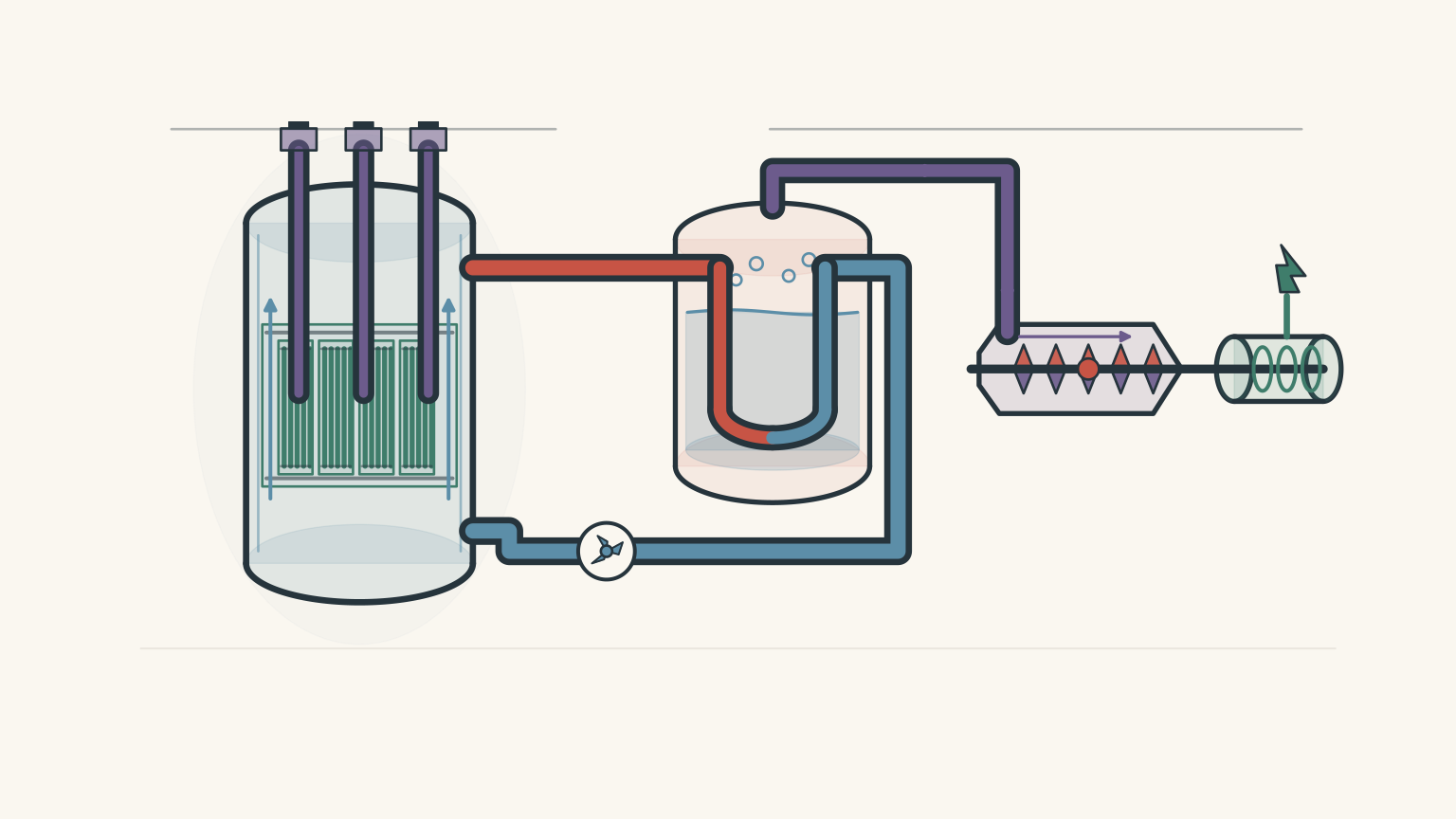
Due to technical limitations, this figure may display incorrectly or contain inaccuracies. Please check key details against your course materials.
Start with the fuel. In a conventional uranium reactor, the fuel usually contains uranium-235 (\(^{235}\mathrm{U}\)), which can undergo fission after absorbing a neutron.
A fission event releases energy and typically two or three additional neutrons. Those neutrons can trigger further fission events, creating a chain reaction.
For a reactor operating at a steady power level, the neutron population must remain stable from one generation to the next. On average, enough neutrons must cause further fissions to replace the previous generation. This condition is called criticality.
The four main components help maintain this process and make the energy useful.
| Component | Function | Common materials |
|---|---|---|
| Fuel | Contains fissile nuclei that undergo fission, releasing energy and neutrons. | Uranium-235, plutonium-239 |
| Control rods | Absorb neutrons to regulate or stop the chain reaction. | Boron, cadmium, hafnium |
| Moderator | Slows fast neutrons, making them more likely to cause fission in certain fuels. | Light water, heavy water, graphite |
| Coolant | Removes heat from the reactor core and transfers it to another part of the power-generation system. | Water, sodium, helium |
The fuel is usually manufactured as ceramic pellets inside sealed metal tubes called fuel rods. Groups of rods form fuel assemblies, which sit inside the reactor core.
The control rods move into or out of the core. Inserting them absorbs more neutrons, reducing the number available to cause fission. Withdrawing them allows more neutrons to remain available for the chain reaction.
The moderator and coolant have different jobs, even though they can be the same material. In many conventional light-water reactors, water performs both functions: it slows neutrons and carries heat away.
The coolant transfers its heat to a steam-generation system. Steam then drives a turbine connected to an electrical generator.
One important prediction: If slowing neutrons helps a conventional reactor, surely every reactor should have a moderator?
Not quite. A moderator is useful when the reactor is designed to operate with slow, or thermal, neutrons. Some reactors are deliberately designed to use fast neutrons instead. This difference becomes important when we look at breeding.
02Fissile and fertile material: two different jobs
To understand how a breeder reactor produces new fuel, we need to distinguish two types of nuclear material.
Fissile material can undergo fission after absorbing a low-energy neutron. It can therefore help sustain a nuclear chain reaction.
Examples include:
- Uranium-235 (\(^{235}\mathrm{U}\))
- Plutonium-239 (\(^{239}\mathrm{Pu}\))
- Uranium-233 (\(^{233}\mathrm{U}\))
Fertile material cannot normally sustain a thermal-neutron chain reaction by itself, but it can absorb a neutron and undergo nuclear transformations that produce fissile material.
Two important fertile isotopes are:
- Uranium-238 (\(^{238}\mathrm{U}\))
- Thorium-232 (\(^{232}\mathrm{Th}\))
There is an important distinction here. Uranium-238 is not fissile in the usual thermal-neutron sense, but it can undergo fission when struck by sufficiently energetic fast neutrons. In the breeding process, however, its important role is usually neutron capture rather than fission.
Natural uranium contains approximately 99.3% uranium-238 and only 0.7% uranium-235.
That means the vast majority of naturally occurring uranium is not directly usable as fissile fuel in a conventional thermal reactor.
But what if we could convert some of that uranium-238 into a fissile isotope?
That’s exactly what breeding aims to achieve.
03Converting uranium-238 into plutonium-239
The most familiar breeder fuel cycle uses uranium-238 to produce plutonium-239.
The process begins when a uranium-238 nucleus absorbs a neutron.
Instead of splitting, the nucleus becomes uranium-239.
The nuclear reaction is:
\[ {}^{238}_{92}\mathrm{U} +{}^{1}_{0}\mathrm{n} \rightarrow {}^{239}_{92}\mathrm{U} +\gamma \]
Here:
- \(^{238}_{92}\mathrm{U}\) is uranium-238.
- \(^{1}_{0}\mathrm{n}\) is a neutron.
- \(^{239}_{92}\mathrm{U}\) is uranium-239.
- \(\gamma\) represents a gamma-ray photon released during the capture process.
The uranium-239 is unstable. It undergoes beta-minus decay.
During beta-minus decay, a neutron inside the nucleus changes into a proton, releasing an electron and an electron antineutrino.
The first decay is:
\[ {}^{239}_{92}\mathrm{U} \rightarrow {}^{239}_{93}\mathrm{Np} +{}^{0}_{-1}\mathrm{e} +\bar{\nu}_e \]
The product is neptunium-239 (\(^{239}\mathrm{Np}\)).
Neptunium-239 is also radioactive, so it undergoes another beta-minus decay:
\[ {}^{239}_{93}\mathrm{Np} \rightarrow {}^{239}_{94}\mathrm{Pu} +{}^{0}_{-1}\mathrm{e} +\bar{\nu}_e \]
The final product is plutonium-239, which is fissile.
In these equations, the upper number is the mass number (protons plus neutrons), while the lower number is the atomic number (protons). Notice that beta-minus decay increases the atomic number by one but leaves the mass number unchanged.
The symbols \(\mathrm{e}\) and \(\bar{\nu}_e\) represent an electron and an electron antineutrino, respectively. Np and Pu are the chemical symbols for neptunium and plutonium.
The complete conversion is therefore:
\[ {}^{238}\mathrm{U} \xrightarrow{\text{neutron capture}} {}^{239}\mathrm{U} \]
\[ \xrightarrow{\beta^-} {}^{239}\mathrm{Np} \xrightarrow{\beta^-} {}^{239}\mathrm{Pu} \]
The process takes time. Uranium-239 has a half-life of approximately 23.5 minutes, while neptunium-239 has a half-life of approximately 2.36 days.
These radioactive decays eventually produce plutonium-239, which can then be used as nuclear fuel.
This is an example of nuclear transmutation: one nuclear species is transformed into another through nuclear reactions and radioactive decay.
The important idea is that uranium-238 has not simply split into smaller nuclei. It has absorbed a neutron and changed into a different element through subsequent radioactive decay.
The newly formed plutonium-239 is now capable of undergoing fission.
04How a breeder reactor produces more fuel
A breeder reactor is designed to use the neutrons released during fission for two purposes:
- Sustain the nuclear chain reaction.
- Convert fertile material into new fissile material.
Consider a reactor with a central region containing fissile fuel and a surrounding region containing fertile uranium-238.
The central region is called the core. The surrounding fertile material is often arranged as a breeding blanket.
When fissile nuclei in the core undergo fission, they release neutrons.
Some neutrons cause further fission reactions inside the core. Others travel into the surrounding uranium-238 blanket, where they can be absorbed.
The absorbed neutrons initiate the conversion process described earlier, eventually producing plutonium-239.
The breeder reactor is effectively using some of the neutrons that would otherwise be lost to produce additional fuel.
However, there is a catch.
Not every neutron becomes a useful new fuel nucleus. Some escape from the reactor, some are absorbed by structural materials, and others are absorbed by control rods or other materials without producing fissile fuel.
The reactor must therefore have a sufficiently favourable neutron balance to produce more fissile material than it destroys.
Criticality and breeding are not the same thing
This is one of the most important distinctions in the topic.
Criticality describes whether a chain reaction can sustain itself.
Breeding describes whether the reactor produces more fissile material than it consumes.
These are separate conditions.
A reactor can be critical without being a breeder. Most conventional thermal reactors operate this way.
A breeder reactor can also be critical. It simply makes better use of the neutrons produced during fission.
Think of the neutrons as a limited budget. Some must be allocated to keeping the chain reaction going. Some are inevitably lost. The remaining neutrons can potentially be used to produce new fuel.
The analogy is useful, but it has a limitation: neutron interactions are probabilistic, and not every neutron captured by fertile material necessarily produces a recoverable fissile nucleus.
The breeding ratio
We can quantify how effectively a reactor produces new fissile material using the breeding ratio, abbreviated as \(BR\).
It is defined as:
\[ BR = \frac{\text{Fissile nuclei produced}} {\text{Fissile nuclei destroyed}} \]
The denominator includes fissile nuclei destroyed through fission and non-fission neutron capture.
The breeding ratio tells us whether the reactor is increasing or decreasing its fissile fuel inventory through nuclear reactions.
| Breeding ratio | Interpretation |
|---|---|
| \(BR<1\) | More fissile material is destroyed than produced. |
| \(BR=1\) | The reactor replaces exactly the fissile material it consumes. |
| \(BR>1\) | More fissile material is produced than destroyed. |
A reactor with a breeding ratio greater than one is called a breeder reactor.
A reactor that produces some new fissile material but consumes more than it produces is called a converter.
Worked example: Calculating the breeding ratio
A reactor produces \(1.26\times10^{24}\) new fissile nuclei from fertile material during a fuel campaign. Over the same period, it destroys \(1.20\times10^{24}\) fissile nuclei.
Calculate the breeding ratio and determine whether the reactor is a breeder.
Step 1
\[ N_{\text{produced}}=1.26\times10^{24} \]
\[ N_{\text{destroyed}}=1.20\times10^{24} \]
Both quantities are numbers of nuclei.
Step 2
\[ BR= \frac{N_{\text{produced}}} {N_{\text{destroyed}}} \]
Step 3
\[ BR= \frac{1.26\times10^{24}} {1.20\times10^{24}} \]
\[ BR=1.05 \]
Step 4
Since \(BR>1\), the reactor is a breeder.
It produces 5% more fissile nuclei than it destroys over the specified period.
The net increase is:
\[ \Delta N=1.26\times10^{24} -1.20\times10^{24} \]
\[ \Delta N=6.0\times10^{22} \text{ nuclei} \]
The reactor has achieved a net increase in its fissile material through nuclear conversion.
05Why fast breeder reactors use fast neutrons
You might have noticed something unusual about the reactor described above.
We introduced a moderator as one of the main components of a conventional fission reactor. Yet fast breeder reactors are specifically designed without one.
Why?
The answer lies in the energy of the neutrons and the type of fuel being used.
In a conventional thermal reactor, neutrons are slowed down so that they are more likely to cause fission in uranium-235.
In a fast reactor, the design deliberately retains a high-energy neutron population. These are called fast neutrons.
The fuel is selected so that a sustained chain reaction can occur without slowing the neutrons first. Plutonium-bearing fuel is commonly used in fast breeder designs.
The fast-neutron spectrum, together with the choice of fuel and reactor arrangement, can provide a more favourable neutron economy for breeding.
A neutron spectrum describes the distribution of neutron energies within the reactor.
The fast reactor can direct a greater proportion of its available neutrons towards fertile material while maintaining the chain reaction.
This is particularly useful when converting uranium-238 into plutonium-239.
However, don’t assume that fast neutrons automatically guarantee breeding. The reactor still has to minimise neutron losses and achieve a sufficiently favourable balance between fissile material produced and destroyed.
What happens to the moderator and coolant?
A fast breeder reactor does not use a moderator because slowing the neutrons would undermine its intended fast-neutron operation.
But it still needs a coolant.
A common choice is liquid sodium.
Sodium is useful because it transfers heat effectively while slowing neutrons much less than ordinary water would.
The distinction is:
- The moderator changes neutron energies.
- The coolant transfers thermal energy away from the reactor core.
- The control rods absorb neutrons to regulate or stop the chain reaction.
All three functions remain conceptually distinct, even when a conventional reactor uses water for both moderation and cooling.
Sodium introduces its own engineering challenges. It reacts strongly with water, so many sodium-cooled designs use an intermediate heat-transfer circuit to keep the primary sodium separate from the water used to generate steam.
The heat can therefore travel from the reactor’s primary coolant to a secondary coolant circuit, then through a heat exchanger to the water-steam system.
06What breeding does not mean
There are a few tempting conclusions that need correcting.
A breeder reactor does not create energy from nothing.
The energy still comes from nuclear fission and the associated change in nuclear binding energy. Breeding changes the quantity of fissile material available for future fission reactions.
Not every reactor that produces plutonium is a breeder.
Conventional thermal reactors also convert some uranium-238 into plutonium-239. However, they generally produce less fissile material than they consume.
The difference is the breeding ratio, not simply whether plutonium is produced.
Fast neutrons are not the only possible route to breeding.
The thorium-232/uranium-233 fuel cycle provides another example.
Thorium-232 can absorb a neutron and eventually become uranium-233 through successive beta-minus decays, in a similar way to the uranium-238/plutonium-239 pathway.
A suitable thermal-neutron reactor can be designed to breed through this thorium fuel cycle, provided its neutron economy is sufficiently favourable.
Therefore, a fast reactor is a common approach to uranium-plutonium breeding, not the definition of breeding itself.
Breeding does not eliminate the need for fuel processing.
The newly formed fissile material must be recovered from irradiated fuel if it is to be fabricated into new fuel.
This process is called reprocessing.
It involves handling highly radioactive materials and requires specialised industrial facilities. It is also one of the major technical, economic, and safety considerations in a closed nuclear fuel cycle.
A breeder reactor’s theoretical ability to produce extra fissile material does not automatically mean that the entire fuel cycle will achieve a net increase in usable fuel.
That final distinction becomes especially important in the harder questions below.
07Questions and solutions
Question 1
A reactor destroys \(4.0\times10^{22}\) fissile nuclei during a particular operating period. During the same period, it produces \(4.8\times10^{22}\) new fissile nuclei.
Calculate the breeding ratio and determine whether the reactor is a breeder.
Solution 1
The breeding ratio is \(1.20\), so the reactor is a breeder.
The breeding ratio is calculated using:
\[ BR= \frac{N_{\text{produced}}} {N_{\text{destroyed}}} \]
Substituting:
\[ BR= \frac{4.8\times10^{22}} {4.0\times10^{22}} \]
\[ BR=1.20 \]
Since the breeding ratio is greater than one, more fissile nuclei are produced than destroyed.
The net increase is:
\[ \Delta N= (4.8-4.0)\times10^{22} \]
\[ \Delta N=8.0\times10^{21} \text{ nuclei} \]
This means the reactor has increased its fissile material inventory through breeding.
Question 2
A simplified fast reactor produces an average of 2.60 neutrons per fission.
For every fission, the neutron balance is as follows:
| Neutron interaction | Average neutrons per fission |
|---|---|
| Cause a further fission in fissile fuel | 1.00 |
| Escape from the reactor | 0.20 |
| Absorbed by control rods and structural materials | 0.25 |
| Absorbed by fissile nuclei without causing fission | 0.15 |
| Captured by uranium-238 | 1.00 |
| Total | 2.60 |
Assume that:
- Each fission destroys one fissile nucleus.
- Each non-fission capture by a fissile nucleus destroys one additional fissile nucleus.
- Every uranium-238 capture eventually produces one plutonium-239 nucleus.
- Other nuclear transformations are negligible.
Determine the breeding ratio and explain whether this reactor is a breeder.
Solution 2
The breeding ratio is approximately \(0.87\), so the reactor is not a breeder.
The tempting approach is to compare the one plutonium-239 nucleus produced through fertile capture with the one fissile nucleus destroyed through fission.
That would suggest a breeding ratio of one.
However, this ignores the additional fissile nuclei destroyed through non-fission neutron capture.
Step 1: Calculate the total fissile material destroyed.
Each fission destroys one fissile nucleus:
\[ N_{\text{fission destroyed}}=1.00 \]
An additional 0.15 fissile nuclei are destroyed through neutron capture without fission.
Therefore:
\[ N_{\text{destroyed}}=1.00+0.15 \]
\[ N_{\text{destroyed}}=1.15 \]
Step 2: Identify the fissile material produced.
There is one neutron capture by uranium-238 per fission.
Under the assumptions given, each capture eventually produces one plutonium-239 nucleus.
Therefore:
\[ N_{\text{produced}}=1.00 \]
Step 3: Calculate the breeding ratio.
\[ BR= \frac{1.00}{1.15} \]
\[ BR\approx0.87 \]
Step 4: Interpret the result.
Since \(BR<1\), the reactor consumes more fissile material than it produces.
It is therefore a converter, not a breeder.
The important point is that producing one new fissile nucleus for every fission is not necessarily enough. Other processes can also destroy fissile material, and those losses must be included in the fuel balance.
Question 3
A student examines a fast breeder reactor and makes the following claim:
“A nuclear reactor must have a moderator to sustain a chain reaction. If this reactor has no moderator, its chain reaction cannot continue. The liquid sodium must therefore be acting as the moderator.”
Explain why this claim is incorrect.
Your response should distinguish the functions of the fuel, moderator, coolant, and control rods, and explain why a fast breeder reactor uses liquid sodium.
Solution 3
The claim is incorrect because a moderator is not essential to every nuclear reactor. A fast breeder reactor is deliberately designed to sustain its chain reaction using fast neutrons.
The student has confused the role of the moderator with the role of the coolant.
The components have separate functions:
- Fuel: Contains fissile nuclei, such as plutonium-239, which undergo fission and release energy and neutrons.
- Moderator: Slows fast neutrons to thermal energies. A fast reactor does not require one because it operates using fast neutrons.
- Coolant: Removes heat from the reactor core. Liquid sodium performs this function in many fast breeder designs.
- Control rods: Absorb neutrons to regulate the chain reaction or shut down the reactor.
Sodium is selected because it transfers heat effectively without significantly slowing the neutrons compared with water.
This allows the reactor to maintain the fast-neutron spectrum needed for its intended operation.
The student is also incorrect in assuming that removing the moderator removes all control over the chain reaction. Control rods remain present and can absorb neutrons to regulate the reactor.
The key distinction is that moderation is a design choice determined by the neutron energy required for the reactor, whereas cooling is necessary to remove the thermal energy generated by fission.
Question 4
Two students are discussing nuclear breeding.
Student A claims:
“Any reactor that converts uranium-238 into plutonium-239 is automatically a breeder reactor.”
Student B claims:
“Breeding can only occur in fast reactors because thermal reactors always require a moderator.”
Evaluate both claims.
In your response, distinguish conversion from breeding and discuss whether the thorium-232/uranium-233 fuel cycle changes the conclusion.
Solution 4
Both students are incorrect.
Student A confuses the production of new fissile material with the net production of fissile material.
Student B assumes that breeding is restricted to fast-neutron reactors, which is not the case.
Evaluating Student A’s claim
A conventional thermal reactor can absorb neutrons in uranium-238 and convert it into plutonium-239.
However, this does not automatically make the reactor a breeder.
The reactor may still destroy more fissile nuclei through fission and neutron capture than it produces through fertile conversion.
For example, a reactor with a breeding ratio of 0.7 produces only 0.7 fissile nuclei for every fissile nucleus destroyed.
It is a converter, not a breeder.
The defining condition is:
\[ BR>1 \]
Evaluating Student B’s claim
Fast breeder reactors are an important approach to breeding, particularly in the uranium-238/plutonium-239 fuel cycle.
However, breeding is not restricted to fast-neutron reactors.
Consider thorium-232.
After absorbing a neutron, thorium-232 can undergo radioactive transformations that eventually produce uranium-233:
\[ {}^{232}_{90}\mathrm{Th} \rightarrow {}^{233}_{92}\mathrm{U} \]
The intermediate nuclei are thorium-233 and protactinium-233, with two beta-minus decays occurring along the pathway.
Uranium-233 is fissile and can be used to sustain a thermal-neutron chain reaction.
A suitably designed thermal reactor can therefore produce more uranium-233 than the fissile material it consumes.
However, this requires a sufficiently favourable neutron balance and an effective fuel-recycling system. Simply using thorium does not guarantee breeding.
Overall conclusion
Student A is wrong because producing some new fissile material does not guarantee a net increase.
Student B is wrong because the possibility of breeding depends on the nuclear reactions and neutron economy, not exclusively on whether a moderator is present.
Question 5
A fast breeder reactor operates at steady criticality throughout a fuel campaign.
During the campaign:
- \(1.00\times10^6\) fissile nuclei are destroyed through fission.
- A further \(0.10\times10^6\) fissile nuclei are destroyed through neutron capture without fission.
- \(1.20\times10^6\) new plutonium-239 nuclei are produced from uranium-238.
Assume the following:
- The newly produced plutonium-239 remains in the discharged fuel and is available for recovery.
- Sufficient time is allowed for the uranium-239 and neptunium-239 decay stages to finish.
- A subsequent industrial fuel-recovery process returns 90% of the newly produced plutonium-239 as usable fissile fuel.
- All other losses and external additions of fissile material are negligible.
Answer the following:
(a) Calculate the in-reactor breeding ratio.
(b) Calculate the number of usable fissile nuclei returned after recovery.
(c) Determine the net change in the usable fissile inventory after accounting for the recovery process.
(d) Explain how the reactor can remain critical during operation while the complete fuel cycle fails to increase its usable fissile inventory.
(e) Is it accurate to describe this system as producing more fissile material than it consumes? Explain the distinction between the reactor’s breeding performance and the performance of its complete fuel cycle.
Solution 5
The reactor is an in-reactor breeder, but the complete fuel cycle does not achieve a net increase in usable fissile material.
Its in-reactor breeding ratio is approximately 1.09. However, after accounting for recovery losses, fewer usable fissile nuclei are returned than were destroyed.
This question requires us to distinguish three different ideas:
- Criticality inside the reactor.
- Breeding within the reactor.
- Net usable fuel production across the complete fuel cycle.
(a) Calculate the in-reactor breeding ratio.
First, calculate the total number of fissile nuclei destroyed.
Both fission and non-fission neutron capture consume fissile material.
\[ N_{\text{destroyed}} = 1.00\times10^6 + 0.10\times10^6 \]
\[ N_{\text{destroyed}} = 1.10\times10^6 \]
The number of new fissile nuclei produced is:
\[ N_{\text{produced}}=1.20\times10^6 \]
Therefore:
\[ BR= \frac{1.20\times10^6} {1.10\times10^6} \]
\[ BR\approx1.09 \]
Since the breeding ratio exceeds one, the reactor qualifies as an in-reactor breeder.
(b) Calculate the usable fissile material returned.
Only 90% of the newly produced plutonium-239 is recovered.
Therefore:
\[ N_{\text{returned}} = 0.90\times1.20\times10^6 \]
\[ N_{\text{returned}} = 1.08\times10^6 \text{ nuclei} \]
The remaining 10% is lost from the usable fuel inventory under the assumptions of the question.
(c) Calculate the net change in usable fissile inventory.
We compare the usable material returned with the total fissile material destroyed.
\[ \Delta N= N_{\text{returned}} - N_{\text{destroyed}} \]
Substituting:
\[ \Delta N= 1.08\times10^6 - 1.10\times10^6 \]
\[ \Delta N=-2.0\times10^4 \text{ nuclei} \]
The negative result means that the complete fuel cycle loses 20,000 usable fissile nuclei.
We can also calculate the effective usable return ratio:
\[ BR_{\text{usable}}= \frac{1.08\times10^6} {1.10\times10^6} \]
\[ BR_{\text{usable}}\approx0.982 \]
This is below one.
Therefore, despite the reactor producing more fissile material than it destroys inside the reactor, the recovery process prevents the complete fuel cycle from achieving a net increase.
(d) Explain how the reactor can remain critical despite the overall fuel loss.
The reactor can remain critical because criticality concerns the neutron population inside the reactor, not the total quantity of fissile material available after reprocessing.
At steady criticality, the chain reaction is self-sustaining.
On average, each generation of fission neutrons produces enough subsequent fissions to maintain the same neutron population.
This condition can be satisfied even if the overall fissile inventory decreases over the longer fuel cycle.
The reactor has sufficient fissile material in its core to maintain the chain reaction during the campaign. It does not need to increase its total fuel inventory to remain critical.
The loss becomes important when the irradiated fuel is processed and prepared for another operating cycle.
(e) Distinguish between in-reactor breeding and whole-cycle fuel production.
The statement that the reactor produces more fissile material than it consumes is correct when referring to its in-reactor breeding ratio.
It produces \(1.20\times10^6\) fissile nuclei while destroying \(1.10\times10^6\).
However, it would be misleading to conclude that the complete nuclear fuel cycle increases its usable fissile inventory.
Only \(1.08\times10^6\) of the newly produced nuclei are recovered, which is less than the \(1.10\times10^6\) destroyed.
This is the conceptual trap: a reactor can achieve a breeding ratio greater than one without the complete fuel cycle achieving net fuel growth.
A successful breeding strategy therefore requires more than favourable nuclear reactions. It also requires an effective system for recovering and recycling the newly produced fissile material.
08What to understand next
The next useful concept is the nuclear fuel cycle, particularly the relationship between neutron economy, fuel reprocessing, and the long-term availability of fissile material.
A breeder reactor is not simply a reactor that produces plutonium. It is a carefully designed system that must sustain fission, convert fertile nuclei, and recover enough of the resulting fissile material to make the process worthwhile.
Keep those three stages separate when analysing breeder reactors. They describe different physical processes, and confusing them is where many otherwise reasonable explanations go wrong.
09Sources and further reading
The following scientific and educational sources support the nuclear physics and reactor-design explanations in this article.
NSW Education Standards Authority – Physics 11-12 Syllabus (2025). The official syllabus overview and Year 12 focus areas.
US Department of Energy – Nuclear Physics and Reactor Theory Handbook, Volume 1. Definitions of fissile and fertile materials, nuclear transmutation, and the uranium-238 and thorium-232 conversion pathways.
International Atomic Energy Agency – Status of Fast Reactor Research and Technology Development. Fast-reactor principles, breeding, neutron economy, fuel recycling, and engineering challenges.
OECD Nuclear Energy Agency – Nuclear Energy Today. Reactor components, moderator and coolant functions, fast reactors, and nuclear fuel cycles.
Argonne National Laboratory – India’s Baseline Plan for Nuclear Energy Self-sufficiency. Uranium-238 conversion pathways, radioactive decay stages, and intermediate half-lives.
Generation IV International Forum – Introduction to Nuclear Reactor Design. Reactor criticality, neutron balance, and the breeding ratio.