
Laser Cooling: How Photons Slow Down Moving Atoms
Discover how lasers can slow down atoms using photon momentum and the Doppler effect. Explore red detuning, velocity-dependent forces, and optical molasses in this accessible extension beyond the HSC Physics syllabus.
A laser beam pushes an atom in the direction the light travels. So how can lasers make a gas of atoms colder?
Imagine an atom drifting to the right between two laser beams travelling in opposite directions. Which beam will it absorb more photons from: the beam travelling with it, or the beam meeting it head-on?
Surprisingly, the head-on beam wins. Its photons push the atom backwards, reducing its speed. The reason has nothing to do with one beam being brighter. It comes down to how the moving atom experiences the frequency of the light.
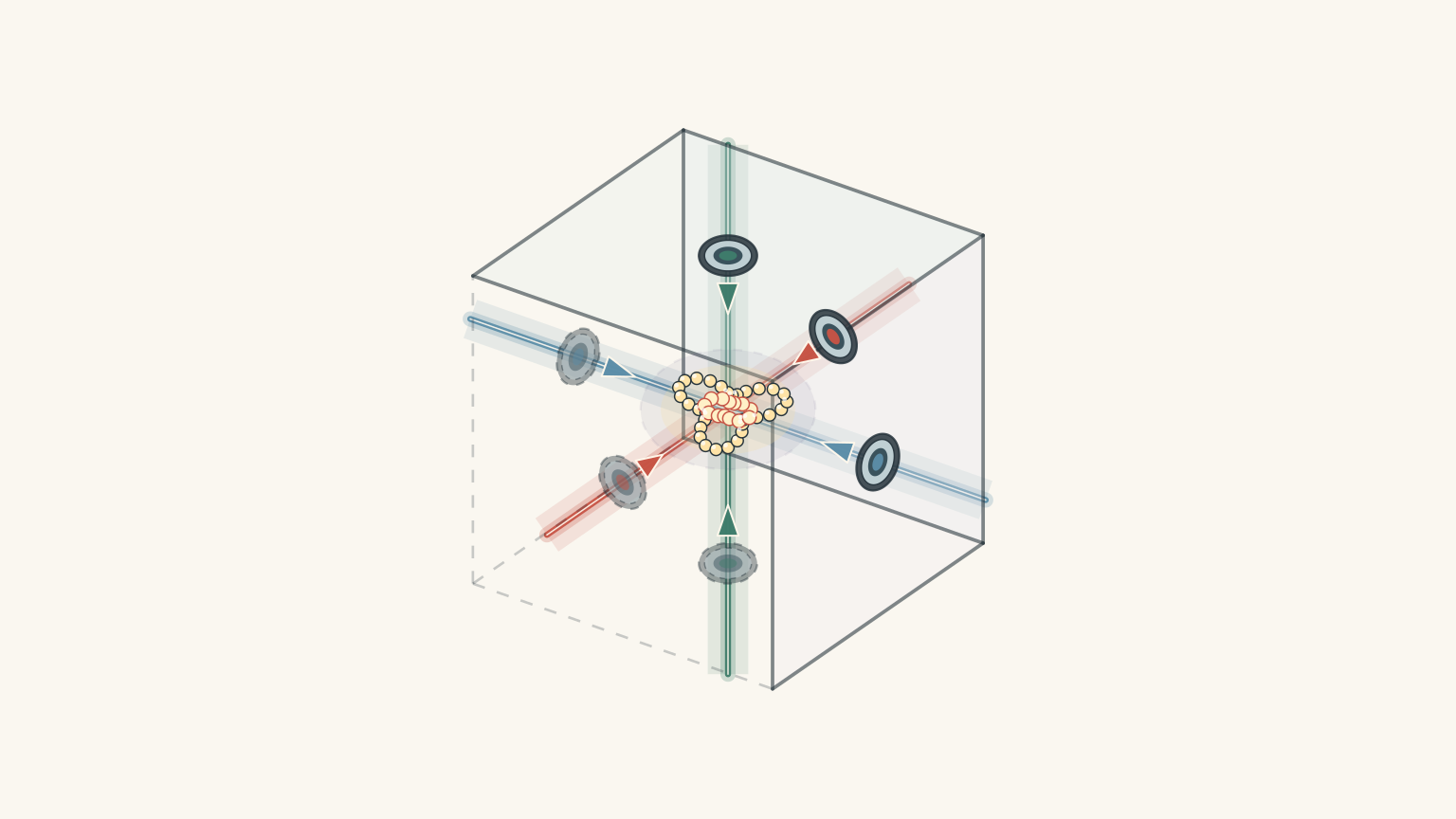
Due to technical limitations, this figure may display incorrectly or contain inaccuracies. Please check key details against your course materials.
A note about the syllabus: Laser cooling and optical molasses are extensions beyond the required HSC Physics syllabus. They are not HSC assessment requirements. The Year 12 Nature of Light focus area in the 2025 NSW Physics syllabus provides the starting knowledge for this article, rather than an expectation that you study laser cooling for the examination. NESA’s syllabus information outlines the relevant course structure and implementation.
The foundation is the photon model of light. We’ll use it to explore how photons transfer momentum to atoms, and how the Doppler effect makes that momentum transfer depend on an atom’s velocity.
01Start with photons: light carries momentum
In the Year 12 photon model, light consists of discrete packets of energy called photons.
The energy of an individual photon is
\[ E_\gamma=hf \]
where:
- \(E_\gamma\) is the photon energy, measured in joules (J)
- \(h\) is Planck’s constant, \(6.63\times10^{-34}\ \mathrm{J\,s}\)
- \(f\) is the photon’s frequency, measured in hertz (Hz).
A photon also carries momentum, even though it has no rest mass.
Its momentum magnitude is
\[ p_\gamma=\frac{h}{\lambda} \]
where \(p_\gamma\) is photon momentum and \(\lambda\) is its wavelength.
The direction of this momentum is the direction in which the photon travels.
This is an important extension of the photon model. Light does not just transfer energy to matter. It can also transfer momentum.
What happens when an atom absorbs a photon?
Suppose an atom absorbs a photon travelling to the right.
The photon transfers momentum to the atom, so the atom receives a small impulse to the right.
When the atom later emits a photon, it recoils in the opposite direction to the emitted photon’s momentum.
In our simplified model, spontaneous emission occurs in random directions, with no preferred direction along the axis we’re studying. This means that the average momentum transferred by emission is zero, even though individual emissions still produce recoil.
The important result is that absorption can provide a consistent momentum transfer in one direction, while spontaneous emission produces random momentum changes.
This is the foundation of laser cooling.
The same photon momentum relationship appears in Compton scattering, where a photon transfers energy and momentum to an electron.
Worked example: Calculate the recoil speed from one absorbed photon
A rubidium-87 atom is travelling to the right at \(0.40\ \mathrm{m\,s^{-1}}\). It absorbs one photon from a laser beam travelling to the left. The photon wavelength is \(780\ \mathrm{nm}\).
Estimate the atom’s velocity immediately after absorption.
Use the atomic mass \(m=1.44\times10^{-25}\ \mathrm{kg}\) and Planck’s constant \(h=6.63\times10^{-34}\ \mathrm{J\,s}\). Ignore spontaneous emission until after the absorption.
Step 1
\[ p_\gamma=\frac{h}{\lambda} \]
Substitute the wavelength:
\[ p_\gamma= \frac{6.63\times10^{-34}} {780\times10^{-9}} \]
\[ p_\gamma=8.50\times10^{-28} \ \mathrm{kg\,m\,s^{-1}} \]
Step 2
The photon travels to the left, so the atom receives momentum to the left.
Taking right as positive,
\[ \Delta p=-8.50\times10^{-28} \ \mathrm{kg\,m\,s^{-1}} \]
Step 3
Using the classical momentum relationship \(\Delta p=m\Delta v\),
\[ \Delta v=\frac{\Delta p}{m} \]
\[ \Delta v= \frac{-8.50\times10^{-28}} {1.44\times10^{-25}} \]
\[ \Delta v=-5.90\times10^{-3} \ \mathrm{m\,s^{-1}} \]
Step 4
\[ v_f=v_i+\Delta v \]
\[ v_f=0.400-0.00590 \]
\[ \boxed{v_f=0.394\ \mathrm{m\,s^{-1}}} \]
The atom is still travelling to the right, but it has slowed down slightly.
One photon produces a very small change in velocity. The interesting part is that a laser can produce enormous numbers of photon absorption and emission events. If the absorption events are biased towards photons travelling against the atom’s motion, the cumulative effect becomes significant.
02Why moving atoms see different light frequencies
We now have a way to change an atom’s momentum. But there’s a problem.
A single laser beam only pushes atoms in one direction. If an atom moves against the beam, the light can slow it down. If it moves with the beam, the light accelerates it.
We need a way to make an atom preferentially absorb photons that oppose its motion, regardless of which direction it travels.
The solution uses two ideas together:
- Atoms absorb light most strongly near particular frequencies.
- The Doppler effect changes the frequency of light measured by a moving atom.
Atomic resonance and red detuning
Atoms have discrete energy levels. An atom can absorb a photon when its energy is close to the energy difference between two allowed atomic states.
For a particular transition, define:
- \(f_0\): the atomic resonance frequency, where absorption is strongest for an atom at rest
- \(f_L\): the frequency of the laser light.
The laser does not need to have exactly the resonance frequency to produce absorption. Atomic absorption lines have a finite linewidth, meaning there is a range of frequencies around resonance where absorption remains significant.
For laser cooling, we choose a laser frequency slightly below the resonance frequency:
\[ f_L<f_0 \]
This is called red detuning.
The detuning is the difference between the laser frequency and the atomic resonance frequency:
\[ \Delta f_L=f_L-f_0 \]
For red-detuned light, \(\Delta f_L\) is negative.
Importantly, red-detuned does not necessarily mean the laser appears red to your eyes. It means its frequency is lower than the particular atomic transition frequency.
The Doppler effect changes the frequency an atom measures
You already know the Doppler effect from sound.
An ambulance approaching you sounds higher in pitch than the same ambulance moving away. The source’s actual frequency hasn’t changed. The frequency you observe depends on relative motion.
Light also experiences a Doppler shift.
For an atom moving towards an incoming light beam, the frequency measured in the atom’s rest frame is approximately
\[ f'\approx f_L\left(1+\frac{v}{c}\right) \]
For an atom moving in the same direction as the light beam,
\[ f'\approx f_L\left(1-\frac{v}{c}\right) \]
where:
- \(f'\) is the frequency measured in the atom’s rest frame
- \(f_L\) is the laser frequency in the laboratory frame
- \(v\) is the atom’s speed along the beam direction
- \(c\) is the speed of light in a vacuum, approximately \(3.00\times10^8\ \mathrm{m\,s^{-1}}\).
These are first-order approximations for speeds much smaller than the speed of light.
The key distinction is:
- Moving towards a beam makes its observed frequency higher.
- Moving in the same direction as a beam makes its observed frequency lower.
For speeds much smaller than \(c\), the approximate magnitude of the Doppler frequency shift is
\[ \Delta f_D\approx\frac{f_Lv}{c} \]
Since \(f_L\approx c/\lambda\) for a laser close to the atomic transition frequency, we can also write
\[ \boxed{\Delta f_D\approx\frac{v}{\lambda}} \]
This relationship is particularly useful in laser cooling.
Even though the atom’s speed is tiny compared with the speed of light, the frequency shift can be important because atomic absorption lines are very narrow.
The connection between laser frequency and spectral width is explored further in Laser Linewidth: Spectral Width, Coherence, and Cavity Modes.
Worked example: Calculate the Doppler shift of a moving atom
A rubidium atom moves to the right at \(100\ \mathrm{m\,s^{-1}}\). It is illuminated by a laser with wavelength \(780\ \mathrm{nm}\).
The laser frequency is \(128\ \mathrm{MHz}\) below the atomic resonance frequency.
Two beams travel in opposite directions. Determine the approximate frequencies measured by the atom for each beam, relative to the atomic resonance frequency.
Step 1
Using
\[ \Delta f_D\approx\frac{v}{\lambda} \]
Substitute:
\[ \Delta f_D= \frac{100}{780\times10^{-9}} \]
\[ \Delta f_D=1.28\times10^8\ \mathrm{Hz} \]
Therefore,
\[ \boxed{\Delta f_D\approx128\ \mathrm{MHz}} \]
Step 2
The atom moves right, so the beam travelling left meets the atom head-on.
The atom measures a higher frequency:
\[ f'_{\mathrm{head-on}}\approx f_L+128\ \mathrm{MHz} \]
The laser is initially 128 MHz below resonance, so
\[ f'_{\mathrm{head-on}}\approx f_0 \]
This beam is now approximately on resonance.
Step 3
The left-to-right beam travels with the atom, so the atom measures a lower frequency:
\[ f'_{\mathrm{co-propagating}} \approx f_L-128\ \mathrm{MHz} \]
Since the original laser frequency was already 128 MHz below resonance,
\[ f'_{\mathrm{co-propagating}} \approx f_0-256\ \mathrm{MHz} \]
This beam is now much further from resonance.
Step 4
The atom absorbs photons much more readily from the beam travelling towards it, because that beam is shifted close to resonance.
The photons from this beam travel to the left, so they transfer leftward momentum to the atom.
The atom therefore experiences a net force to the left, opposing its rightward motion.
This is the central mechanism behind Doppler laser cooling.
03How two laser beams create a braking force
We can now put the pieces together.
Consider an atom between two equal-intensity laser beams travelling in opposite directions. Both beams have the same frequency, and both are slightly red-detuned from the atomic resonance.
For now, we’ll only consider motion along one horizontal axis.
What happens when the atom is stationary?
First, suppose the atom is not moving.
Both beams have the same frequency and intensity. The atom absorbs photons from both directions at equal average rates.
Photons from the left transfer momentum to the right. Photons from the right transfer momentum to the left.
The average momentum transfers cancel, so the net average force is zero.
This is exactly what we would expect from a symmetric arrangement.
What happens when the atom moves to the right?
Now give the atom a small rightward velocity.
The beam travelling towards it is Doppler-shifted upwards in frequency. Because the original laser frequency was below resonance, this shift moves the light closer to the atomic absorption peak.
The beam travelling in the same direction as the atom experiences the opposite shift. Its frequency moves further below resonance.
The atom therefore absorbs more photons from the beam travelling towards it.
Each absorption transfers momentum to the left. The average momentum transferred by spontaneous emission is zero in our simplified model.
The result is a net force to the left.
The atom slows down.
What if the atom moves to the left?
The entire situation reverses.
The beam travelling from the left now meets the atom head-on. Its frequency shifts closer to resonance, producing more photon absorption from that direction.
The resulting momentum transfer points to the right, again opposing the atom’s motion.
The remarkable result is that the arrangement produces a braking force regardless of which direction the atom moves.
The mathematical model
This average braking force is called a damping force.
For sufficiently small velocities, the force is approximately proportional to the atom’s velocity:
\[ \boxed{F_x=-\beta v_x} \]
where:
- \(F_x\) is the average force along the horizontal axis
- \(v_x\) is the atom’s velocity along that axis
- \(\beta\) is a positive damping coefficient that describes the strength of the cooling force.
The negative sign is essential.
If \(v_x\) is positive, the force is negative. If \(v_x\) is negative, the force is positive.
In both cases, the force opposes the motion.
The linear equation is an approximation, not the complete force law.
It works when the Doppler shift is small enough that the scattering-rate difference changes approximately linearly with velocity. At larger velocities, the absorption rates vary nonlinearly with the Doppler-shifted frequencies, and the force no longer follows a straight line.
The simplified model also assumes equal beam intensities, a two-level atom with one relevant transition, and sufficiently low laser intensity that saturation effects can be neglected.
From two beams to three dimensions
An atom in a gas doesn’t just move horizontally. It can move in any direction.
To cool its motion in three dimensions, physicists use three pairs of counter-propagating laser beams:
- One pair along the horizontal \(x\)-axis.
- One pair along the perpendicular \(y\)-axis.
- One pair along the vertical \(z\)-axis.
This gives six beams in total, all overlapping in the same region.
Each pair produces a damping force along its own axis. Together, the beams oppose the atom’s motion in all three dimensions.
This arrangement is called optical molasses.
The name comes from the resemblance to motion through a thick, viscous liquid.
Imagine riding a bicycle through a substance that resists your motion. The faster you move, the stronger the opposing drag force becomes. Optical molasses produces a similar average effect.
There is one important difference: atoms are not actually moving through a liquid. The resistance comes from repeated photon absorption and emission, not collisions with fluid molecules.
The first demonstration of three-dimensional optical molasses was reported by Steven Chu and colleagues in 1985. Their experiment used counter-propagating laser beams to cool neutral sodium atoms to approximately \(240\ \mathrm{\mu K}\) (Chu et al., Physical Review Letters, 1985).
That’s an extraordinary reduction in temperature using light as the cooling mechanism.
04Why laser cooling doesn’t continue forever
So far, the model sounds almost perfect.
An atom moves. The opposing beam becomes more resonant. The atom absorbs more photons from that beam and slows down.
Eventually, the atom approaches zero velocity.
Should it simply stop moving?
Not quite.
Remember that spontaneous emission produces random recoil. Even when the average emitted momentum is zero, individual photons still carry momentum away in different directions.
Each emission gives the atom a small, unpredictable momentum change.
There are therefore two competing effects:
Cooling: The Doppler effect makes the atom absorb more photons from the direction opposing its motion. This reduces its average kinetic energy.
Heating: Random absorption and spontaneous-emission events produce momentum fluctuations. These increase the spread of atomic velocities.
Eventually, the cooling and heating effects balance.
The atom cloud reaches a finite equilibrium temperature rather than absolute zero.
Strictly speaking, temperature describes the distribution of kinetic energies in a collection of atoms. For an individual atom, we track its momentum and kinetic energy instead.
The limitations of the simple model
Our explanation uses a simplified two-level atomic model. Real atoms can have several closely spaced internal energy states, and the polarisation of the laser light can affect which transitions occur.
These extra effects can produce additional cooling mechanisms.
In fact, experiments reported in 1988 demonstrated that atoms could be cooled below the temperature predicted by the basic Doppler-cooling model. This led to the development of more detailed explanations involving atomic internal states and changing light polarisation.
The important lesson is that the Doppler model explains the main velocity-dependent scattering mechanism, but it does not describe every feature of real laser-cooling experiments. See the American Physical Society’s account of sub-Doppler cooling.
Optical molasses is not quite an atom trap
There is another subtle point worth understanding.
The damping force depends on velocity:
\[ F_x=-\beta v_x \]
It does not depend directly on the atom’s position.
Imagine an atom sitting slightly to the right of the centre of the laser beams. If it is stationary, the two opposing beams still produce equal average forces.
There is no reason for the atom to move back towards the centre.
Optical molasses slows atoms down, but it does not automatically hold them at a fixed position. Atoms can gradually diffuse out of the illuminated region.
This distinction becomes important when studying a magneto-optical trap, or MOT. A MOT combines laser cooling with a magnetic field gradient, creating a position-dependent force that pushes atoms back towards the centre as well as slowing their motion.
We’ll return to that distinction in the final question.
05Questions and solutions
These questions move from identifying the cooling direction to analysing momentum transfer, position dependence, and the limits of the Doppler model.
Question 1
Two equal-intensity laser beams travel in opposite directions through an atom. Both beams are red-detuned from the atomic resonance frequency.
The atom moves to the right.
Which beam produces the greater average scattering rate, and what is the direction of the net average force on the atom?
Assume the atom is moving slowly enough for the Doppler-cooling model to apply.
Solution 1
The beam travelling from right to left produces the greater average scattering rate, and the net average force on the atom is directed to the left.
The atom moves right, so it approaches the beam travelling left. In the atom’s rest frame, this beam is Doppler-shifted to a higher frequency.
Because the laser is red-detuned, the frequency increase moves the light closer to the atomic resonance frequency.
The opposite beam travels in the same direction as the atom. Its observed frequency decreases, moving it further away from resonance.
Therefore, the atom absorbs more photons from the leftward-travelling beam.
Those photons transfer leftward momentum to the atom. The average momentum from spontaneous emission is zero in the simplified model.
The resulting force opposes the atom’s rightward motion.
Question 2
A rubidium atom moves to the right at \(70\ \mathrm{m\,s^{-1}}\).
Its relevant atomic transition has a wavelength of \(780\ \mathrm{nm}\). Two equal-intensity counter-propagating laser beams have a frequency \(90\ \mathrm{MHz}\) below the atomic resonance frequency.
Assume the absorption linewidth is a few megahertz.
Calculate:
(a) The magnitude of the Doppler frequency shift.
(b) The approximate detuning of each beam as measured in the atom’s rest frame.
(c) Which beam produces the greater scattering rate, and the direction of the resulting average force.
Assume \(v\ll c\).
Solution 2
The Doppler shift is approximately \(89.7\ \mathrm{MHz}\). The beam travelling towards the atom is almost exactly on resonance, while the other beam is approximately \(179.7\ \mathrm{MHz}\) below resonance. The net average force is therefore directed to the left.
(a) Calculate the Doppler shift.
Use
\[ \Delta f_D\approx\frac{v}{\lambda} \]
Substitute:
\[ \Delta f_D= \frac{70}{780\times10^{-9}} \]
\[ \Delta f_D=8.97\times10^7\ \mathrm{Hz} \]
Therefore,
\[ \boxed{\Delta f_D=89.7\ \mathrm{MHz}} \]
(b) Calculate the frequencies in the atom’s frame.
The laser is initially \(90\ \mathrm{MHz}\) below resonance.
For the beam travelling towards the atom, the frequency increases:
\[ \Delta f_{\mathrm{head-on}} =-90+89.7 \]
\[ \boxed{\Delta f_{\mathrm{head-on}} =-0.3\ \mathrm{MHz}} \]
This beam is almost exactly on resonance.
For the beam travelling with the atom, the frequency decreases:
\[ \Delta f_{\mathrm{co-propagating}} =-90-89.7 \]
\[ \boxed{\Delta f_{\mathrm{co-propagating}} =-179.7\ \mathrm{MHz}} \]
This beam is much further from resonance.
(c) Determine the net force.
The right-to-left beam is much closer to resonance, so its absorption rate is greater.
Its photons transfer momentum to the left.
Therefore, the net average force is
\[ \boxed{F_x<0} \]
The force opposes the atom’s rightward motion, so the atom slows down.
The important feature is that equal laser intensities do not mean equal scattering rates. The atom’s motion changes the frequencies it measures, making the two beams interact differently with it.
Question 3
A sodium-23 atom of mass \(3.82\times10^{-26}\ \mathrm{kg}\) is moving to the right at \(2.0\ \mathrm{m\,s^{-1}}\).
It is illuminated by two counter-propagating laser beams with wavelength \(589\ \mathrm{nm}\).
Over a period of \(0.20\ \mathrm{s}\), the beam travelling to the left produces an average of 35 more photon-scattering cycles per second than the beam travelling to the right.
Estimate the atom’s final average velocity.
Assume:
- Spontaneous emission has zero average momentum along the horizontal axis.
- The difference in scattering rates remains constant during the interval.
- The atom stays within the range where the simplified model is valid.
Use \(h=6.63\times10^{-34}\ \mathrm{J\,s}\).
Solution 3
The atom’s final average velocity is approximately \(1.79\ \mathrm{m\,s^{-1}}\) to the right.
The greater number of leftward-travelling photons transfers a net momentum to the left, reducing the atom’s rightward speed.
Step 1: Calculate the number of excess scattering cycles.
The difference in scattering rate is \(35\ \mathrm{s^{-1}}\).
Over \(0.20\ \mathrm{s}\),
\[ N=35\times0.20 \]
\[ N=7 \]
There are seven more scattering cycles involving photons from the leftward-travelling beam.
Step 2: Calculate the momentum of one photon.
\[ p_\gamma=\frac{h}{\lambda} \]
\[ p_\gamma= \frac{6.63\times10^{-34}} {589\times10^{-9}} \]
\[ p_\gamma=1.13\times10^{-27} \ \mathrm{kg\,m\,s^{-1}} \]
Step 3: Calculate the net momentum change.
Each excess absorption transfers momentum to the left.
Since the average momentum from spontaneous emission is zero,
\[ \Delta p_x=-Np_\gamma \]
\[ \Delta p_x=-7(1.13\times10^{-27}) \]
\[ \Delta p_x=-7.91\times10^{-27} \ \mathrm{kg\,m\,s^{-1}} \]
Step 4: Calculate the change in velocity.
Using
\[ \Delta p_x=m\Delta v_x \]
we obtain
\[ \Delta v_x= \frac{-7.91\times10^{-27}} {3.82\times10^{-26}} \]
\[ \Delta v_x=-0.207\ \mathrm{m\,s^{-1}} \]
Step 5: Calculate the final velocity.
\[ v_f=v_i+\Delta v_x \]
\[ v_f=2.0-0.207 \]
\[ \boxed{v_f=1.79\ \mathrm{m\,s^{-1}}} \]
The atom continues travelling to the right, but its speed has decreased.
Notice that the important quantity was not the total number of photons scattered. It was the difference between the number scattered from each direction.
Question 4
Two equal-intensity, red-detuned laser beams overlap uniformly along a horizontal region extending from \(x=-1.0\ \mathrm{mm}\) to \(x=+1.0\ \mathrm{mm}\).
Two identical atoms are inside this region:
- Atom A is at \(x=+0.60\ \mathrm{mm}\) and is momentarily stationary.
- Atom B is at \(x=0\) and is moving to the right at \(1.5\ \mathrm{m\,s^{-1}}\).
Ignore gravity, beam intensity variations, and collisions.
(a) Compare the average forces on atoms A and B.
(b) Will either atom experience an average force directing it towards \(x=0\)?
(c) If atom B slows to rest before leaving the overlapping beams, must it stop at the centre of the region? Explain.
Solution 4
Atom A experiences zero average force, while atom B experiences an average force to the left. Neither atom is pulled towards the centre simply because of its position.
(a) Compare the forces.
Atom A is stationary.
The two beams have equal intensity and frequency. Therefore, atom A scatters photons from both directions at equal average rates.
Their average momentum transfers cancel:
\[ \boxed{F_A=0} \]
Atom B is moving right.
The beam travelling left is Doppler-shifted closer to resonance, so atom B absorbs more photons from that beam.
Its average force is therefore directed left:
\[ \boxed{F_B<0} \]
(b) Determine whether either atom is pulled towards the centre.
No.
Atom A has zero average force despite being away from the centre.
Atom B experiences a force opposing its velocity, not a force determined by its distance from \(x=0\).
The optical molasses responds to motion, not position.
(c) Determine where atom B stops.
Atom B does not have to stop at the centre.
As it slows down, its rightward velocity decreases. The damping force also decreases because it is approximately proportional to velocity:
\[ F_x=-\beta v_x \]
When the atom reaches zero velocity, the two beams produce equal average momentum transfers, so the average force becomes zero.
Nothing in this arrangement pushes the atom back towards \(x=0\).
It may therefore stop at a position to the right of the centre, depending on how far it travels while slowing down.
This is the key distinction between cooling and trapping:
- Cooling reduces an atom’s velocity.
- Trapping requires a restoring force that depends on position.
Question 5
An ideal one-dimensional cloud of atoms is placed between two equal-intensity, counter-propagating laser beams.
Initially, the cloud contains:
- Equal numbers of atoms moving to the right at speed \(v\).
- Equal numbers of atoms moving to the left at speed \(v\).
- A smaller group of atoms initially at rest.
The speed \(v\) is sufficiently small for the linear Doppler-force model to apply.
Initially, both laser beams are red-detuned. The laser frequency is then abruptly changed so that both beams become blue-detuned by the same amount, without changing their intensities.
Ignore collisions and assume spontaneous-emission directions remain symmetric.
A student makes the following claim:
“The beams still have equal intensity, so their forces cancel. The cloud’s average momentum stays zero, which means its temperature cannot increase.”
Evaluate this claim.
Your answer must explain:
(a) The direction of the average force on atoms initially moving right.
(b) The direction of the average force on atoms initially moving left.
(c) Whether the total average momentum of the cloud changes.
(d) Whether the cloud’s average kinetic energy and temperature increase or decrease.
(e) What happens to the atoms that were initially stationary.
Solution 5
The student’s claim is incorrect. The cloud’s total average momentum can remain zero while its kinetic energy and temperature increase.
This is a particularly important distinction: zero net momentum does not mean zero kinetic energy, and equal beam intensities do not guarantee equal scattering rates for moving atoms.
(a) Atoms initially moving right
With blue-detuned light, the beam travelling in the same direction as the atom is Doppler-shifted to a lower frequency.
This shift moves the light closer to resonance because the laser frequency was initially above resonance.
The beam travelling against the atom’s motion is shifted to an even higher frequency, moving it further away from resonance.
Consequently, the atom absorbs more photons from the rightward-travelling beam.
Those photons transfer rightward momentum.
The average force is therefore in the same direction as the atom’s motion:
\[ \boxed{F_x>0\quad\text{when}\quad v_x>0} \]
The atom speeds up rather than slowing down.
(b) Atoms initially moving left
The situation reverses for atoms moving left.
The beam travelling left is now the co-propagating beam. Its observed frequency shifts downwards towards resonance.
The atom therefore absorbs more photons from this beam.
Those photons transfer momentum to the left.
The average force is
\[ \boxed{F_x<0\quad\text{when}\quad v_x<0} \]
Again, the force acts in the same direction as the atom’s motion.
The atoms moving left speed up to the left.
(c) Total average momentum
The total average momentum remains zero, provided the two moving populations remain symmetric.
Initially, the right-moving atoms have positive momentum and the left-moving atoms have equal negative momentum.
After the frequency change, both groups gain speed in opposite directions.
Their momenta still cancel when averaged over the equally populated groups.
Thus,
\[ \boxed{p_{\mathrm{total}}=0} \]
The centre of mass of the cloud can remain stationary even while the individual atoms accelerate.
(d) Average kinetic energy and temperature
The average kinetic energy increases.
For each moving atom,
\[ K=\frac{1}{2}mv^2 \]
where \(m\) is the atomic mass and \(v\) is the speed.
The blue-detuned force increases the magnitude of the velocity for both groups.
Since kinetic energy depends on the square of speed, both populations gain kinetic energy.
The cloud’s velocity distribution becomes wider, and its average translational kinetic energy increases.
Therefore,
\[ \boxed{\text{Temperature increases}} \]
The crucial mistake in the student’s reasoning was treating total momentum and kinetic energy as interchangeable quantities.
They are not.
Opposite momenta can cancel while the kinetic energies add.
(e) Atoms initially at rest
The atoms initially at rest experience equal average absorption from both beams.
Their mean force is therefore zero.
However, they still undergo individual absorption and spontaneous-emission events.
These events produce random momentum kicks. Even though the average momentum change is zero, the atoms develop a spread of non-zero momenta.
Their kinetic energy can therefore increase through random recoil.
This is the final complication: an atom can experience zero average force while still gaining kinetic energy through random momentum fluctuations.
06What comes next: from cooling to trapping
Optical molasses demonstrates something quite remarkable: light can act as a velocity-dependent brake on atoms.
The mechanism depends on three connected ideas:
- Photons carry momentum, which they transfer to atoms during absorption.
- The Doppler effect changes the frequency an atom measures, depending on its velocity.
- Red-detuned counter-propagating beams create an imbalance in photon scattering that produces a force opposing the atom’s motion.
But cooling alone does not keep atoms in one place.
The next useful concept is the magneto-optical trap (MOT). It builds on optical molasses by adding a magnetic field gradient. The resulting position-dependent changes in atomic resonance make the scattering forces act towards the centre of the trap.
This adds the missing ingredient: a restoring force.
Understanding the difference between velocity-dependent damping and position-dependent restoring forces is the key to understanding how physicists can both cool and confine individual atoms.
07Further reading
- NESA: Physics 11-12 Syllabus (2025) – syllabus structure and implementation information.
- NIST: Trapped Atoms and Laser Cooling – an accessible scientific account of photon momentum transfer, Doppler cooling, and optical molasses.
- Chu et al. (1985): Three-dimensional viscous confinement and cooling of atoms by resonance radiation pressure – the original experimental demonstration of three-dimensional optical molasses.
- American Physical Society: Laser cooling below the Doppler limit – the experimental developments that revealed the limitations of the basic Doppler-cooling model.
- OpenStax: The Compton Effect – further explanation of photon energy and momentum.