
Optical Tweezers
A laser beam can hold a tiny glass bead in water without touching it. Switch the laser off, and the bead is free to drift.
A laser beam can hold a tiny glass bead in water without touching it. Switch the laser off, and the bead is free to drift. Switch it on, and the bead can remain confined to a region smaller than a micrometre.
Predict what is doing the holding. Is the laser simply pushing the bead along the direction of the beam, or can light also pull the bead towards the centre of the beam?
The answer is both. Light transfers momentum to the particle, producing a scattering force, but a tightly focused beam also creates an intensity gradient that can pull the particle towards its brightest region. The balance between these effects makes optical tweezers possible.
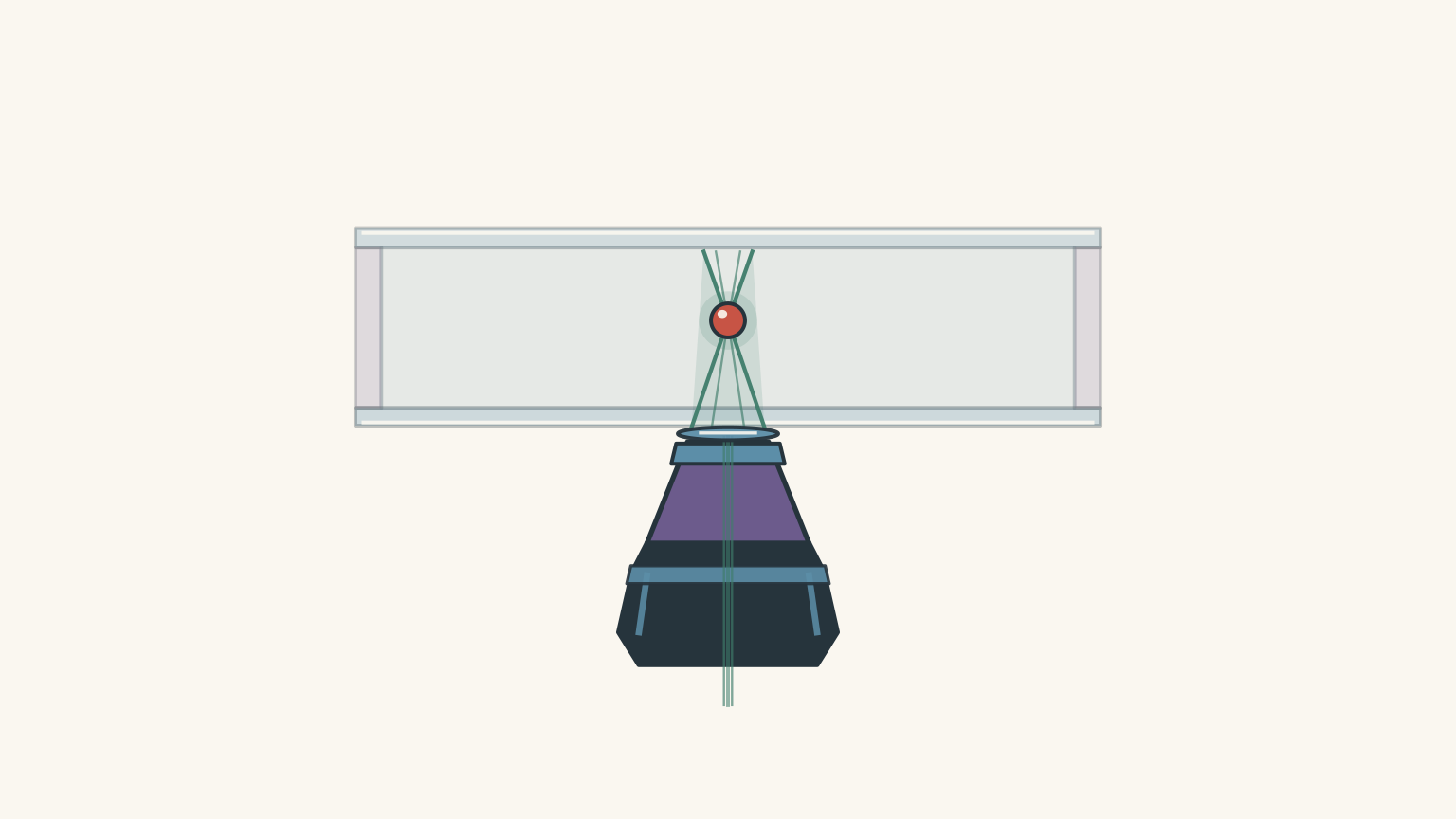
Due to technical limitations, this figure may display incorrectly or contain inaccuracies. Please check key details against your course materials.
Syllabus note: Optical tweezers are an extension beyond the required HSC Physics content. The Year 12 Nature of light focus area provides the starting knowledge, particularly the wave and photon models of light, but optical tweezers are not an HSC assessment requirement. NESA’s 2025 Physics 11-12 syllabus is scheduled for implementation from 2027. See the NESA syllabus and implementation timeline.
01Why an object with mass cannot travel at the speed of light
Before considering how light moves a particle, we need to distinguish the particle from the light itself.
A glass bead, a cell, or a microscopic plastic sphere has rest mass. None can be accelerated to the speed of light in a vacuum, \(c\).
This follows from special relativity.
For an object with rest mass \(m_0\), its total energy is
\[ E=\gamma m_0c^2 \]
where
\[ \gamma=\frac{1}{\sqrt{1-v^2/c^2}} \]
Here:
- \(E\) is the object’s total energy, measured in joules.
- \(m_0\) is its rest mass, measured in kilograms.
- \(v\) is its speed.
- \(c\) is the speed of light in a vacuum, approximately \(3.00\times10^8\text{ m s}^{-1}\).
- \(\gamma\) is the Lorentz factor.
Notice what happens as the object’s speed approaches \(c\).
The quantity \(1-v^2/c^2\) approaches zero, causing \(\gamma\) to increase without limit. Consequently, the energy required to accelerate the object also increases without limit.
Reaching the speed of light would require infinite energy.
A particle with non-zero rest mass must therefore travel below \(c\), regardless of how much energy is supplied.
A photon is different. It has zero rest mass and travels at exactly \(c\) in a vacuum. However, zero rest mass does not mean zero momentum.
That last point is essential to understanding optical tweezers.
02Light carries momentum
You have already encountered two useful models of light in the Nature of light focus area:
- The wave model describes properties such as wavelength, frequency, and intensity.
- The photon model describes light as individual packets of energy.
The energy of a photon is
\[ E_\gamma=hf \]
where \(h\) is Planck’s constant and \(f\) is the photon frequency.
A photon also carries momentum. Its momentum in a vacuum is
\[ p_\gamma=\frac{E_\gamma}{c} =\frac{hf}{c} =\frac{h}{\lambda_0} \]
where:
- \(p_\gamma\) is photon momentum, in \(\text{kg m s}^{-1}\).
- \(\lambda_0\) is the photon’s wavelength in a vacuum.
This is the connection between the particle model of light and the mechanics of optical tweezers.
For a more detailed treatment of photon momentum, see Compton Scattering: Photon Momentum and Wavelength Shifts.
How does a photon transfer momentum?
Imagine a photon travelling towards a small transparent particle.
If the photon is absorbed, its momentum is transferred to the particle. The particle experiences a change in momentum.
If the photon is scattered, its direction changes. Its momentum therefore changes, and the particle receives the corresponding momentum change in the opposite direction.
This follows from conservation of momentum:
\[ \Delta p_{\text{particle}} = -\Delta p_{\text{light}} \]
The force on the particle depends on how quickly this momentum is transferred:
\[ F=\frac{\Delta p}{\Delta t} \]
Here, \(\Delta p\) is the change in momentum and \(\Delta t\) is the time interval over which it occurs.
A continuous laser beam contains an enormous number of photons arriving every second. Although the momentum of an individual visible or infrared photon is tiny, their combined momentum transfer can produce a measurable force.
This is closely related to radiation pressure: electromagnetic radiation exerts a force because it carries momentum. The same underlying idea explains how light can push a solar sail, as discussed in Radiation Pressure: How Light Pushes a Solar Sail.
However, a simple pushing force cannot explain the full behaviour of optical tweezers.
For that, we need to consider how the intensity of the beam changes across space.
03The intensity gradient creates a second force
First, consider a laser beam that has been tightly focused by a lens.
The light is concentrated into a small region. Its intensity is greatest near the centre of the beam and decreases as you move away from that region.
Intensity is the power transferred per unit area:
\[ I=\frac{P}{A} \]
where:
- \(I\) is intensity, measured in \(\text{W m}^{-2}\).
- \(P\) is the beam power, measured in watts.
- \(A\) is the cross-sectional area over which the power is distributed.
Concentrating the same beam power into a smaller area increases its intensity.
More importantly, the intensity now changes significantly over a short distance.
This spatial change is called an intensity gradient.
What happens to a small dielectric particle?
A dielectric is an electrical insulator that can become polarised when placed in an electric field.
When an electromagnetic wave reaches a small dielectric particle, its oscillating electric field slightly shifts the particle’s bound positive and negative charges relative to one another.
This creates an induced electric dipole.
The dipole responds to the local electromagnetic field. If the field is stronger on one side of the particle than the other, the time-averaged forces do not balance perfectly.
For a particle with a higher refractive index than its surrounding liquid, the resulting gradient force points towards the region of higher intensity.
This is the gradient force.
The gradient force can be described qualitatively by
\[ F_{\text{grad}}\propto\alpha\nabla I \]
where:
- \(F_{\text{grad}}\) is the gradient-force magnitude.
- \(\alpha\) is the effective electric polarizability of the particle relative to its surrounding medium.
- \(\nabla I\) represents the spatial intensity gradient, pointing in the direction of greatest increase in intensity.
The polarizability describes how strongly the particle responds to the electric field.
For a small dielectric particle in the usual optical tweezer arrangement, its refractive index is greater than that of the surrounding liquid. Its effective polarizability is positive, so the gradient force pulls it towards higher intensity.
The particle is therefore attracted towards the centre of the focused beam.
There is an important qualification: if the particle has a lower refractive index than its surroundings, the gradient force can point in the opposite direction, towards lower intensity. We will return to this when considering the limitations of optical trapping.
Why does this force matter?
Think about a small bead that has moved slightly to the right of the beam’s central axis.
The intensity is greater to its left. The gradient force therefore acts towards the left, pulling the bead back towards the centre.
If the bead moves to the left instead, the force acts towards the right.
The gradient force is restoring: it opposes the particle’s displacement from the high-intensity region.
This is the crucial difference from the scattering force, which generally pushes the particle along the direction of light propagation.
04How optical tweezers trap a particle in three dimensions
We now have two optical forces:
- The scattering force, which pushes the particle along the direction of the incoming light.
- The gradient force, which pulls a suitable dielectric particle towards regions of higher intensity.
Neither force alone explains a stable three-dimensional trap.
The trick is to focus the laser beam extremely tightly.
An optical tweezer typically uses a microscope objective with a high numerical aperture (NA). A high-NA objective focuses light through a wide range of angles, producing a very small focal region and a steep intensity gradient.
This creates restoring forces in the directions needed to confine the particle.
Trapping sideways
Consider a particle displaced sideways from the beam axis.
The beam’s intensity is greatest at its centre, so the gradient force pulls the particle back towards the axis.
The scattering force acts along the beam, not sideways.
Consequently, the lateral gradient force can restore the particle to the centre.
Trapping along the beam
The axial direction is more interesting.
The gradient force pulls the particle towards the focal region, while the scattering force pushes it downstream, in the direction the beam travels.
For a stable trap, the axial gradient force must be sufficiently strong to overcome the scattering force over the relevant range of positions.
At equilibrium,
\[ F_{\text{grad, axial}} = F_{\text{scatt}} \]
where the two forces act in opposite directions.
The particle is therefore held at a position where the opposing forces balance.
Why isn’t the particle exactly at the focus?
This is a particularly important detail.
At the focal point, the intensity is at its maximum. Along the beam axis, the intensity gradient is therefore zero at that maximum.
The axial gradient force is consequently zero at the exact focus in the ideal symmetric-beam model.
However, the scattering force is still acting downstream.
If the particle were exactly at the focus, there would be an unbalanced downstream force.
The particle therefore settles slightly beyond the focal point, where the upstream axial gradient force balances the downstream scattering force.
This explains why a stable optical trap does not necessarily hold a particle at the brightest point.
What happens when the particle moves?
Near its equilibrium position, the restoring force behaves approximately like the force from a spring.
For a small displacement,
\[ F=-k\Delta x \]
where:
- \(F\) is the restoring force.
- \(k\) is the trap stiffness, measured in \(\text{N m}^{-1}\).
- \(\Delta x\) is the displacement from equilibrium.
The negative sign indicates that the force acts opposite to the displacement.
This approximation is called a harmonic or Hookean trap model. It works for sufficiently small displacements, not for every position around the laser beam.
The particle is not perfectly motionless, either. It experiences random collisions with surrounding liquid molecules, producing Brownian motion.
The optical trap confines the particle despite these fluctuations. If the particle moves too far, however, the restoring force may no longer be sufficient to retain it.
05When is the small-particle model valid?
The explanation above uses an important approximation: the particle is much smaller than the wavelength of the light.
This is known as the Rayleigh regime.
If the particle radius \(a\) is much smaller than the wavelength \(\lambda\) in the surrounding medium,
\[ a\ll\lambda \]
the particle can be approximated as a point dipole.
This makes the induced-dipole explanation particularly useful.
In this approximation, the two force components have different dependencies:
\[ F_{\text{grad}}\propto\alpha\nabla I \]
\[ F_{\text{scatt}}\propto\alpha^2 I \]
The second relationship applies to a small, non-absorbing dielectric sphere in the Rayleigh approximation. Its scattering strength depends on the square of its effective polarizability.
These proportionalities are useful for predicting how the forces change. They are not complete equations for calculating the forces in an arbitrary optical tweezer.
There are also limitations to the point-dipole model.
| Particle size | Appropriate description |
|---|---|
| Much smaller than the wavelength | Rayleigh scattering and the induced-dipole model |
| Comparable to the wavelength | More complete electromagnetic calculations are required |
| Much larger than the wavelength | Ray optics can provide a useful description |
Many practical optical tweezers trap particles whose dimensions are comparable to the wavelength. The simple Rayleigh model therefore explains the underlying ideas but cannot provide accurate force calculations for every real experiment.
The distinction between scattering and gradient forces remains useful beyond the Rayleigh regime, although the exact electromagnetic calculation becomes more complicated.
Neuman and Block’s review, Optical trapping (2004), provides a detailed treatment of these models and their limitations.
06Worked examples
The following examples use illustrative values to practise the physics. They are model calculations, not measurements from a particular optical tweezers experiment.
Worked example: Calculate the momentum transfer from a laser beam
A laser emits light with a vacuum wavelength of 1064 nm and a power of 8.0 mW. It shines onto an object in air, which we approximate as a vacuum for this calculation.
Assume every photon is absorbed by the object.
Calculate:
(a) The momentum of one photon.
(b) The number of photons arriving each second.
(c) The average force exerted on the object.
Use \(h=6.63\times10^{-34}\text{ J s}\) and \(c=3.00\times10^8\text{ m s}^{-1}\).
Step 1
Use the photon momentum equation:
\[ p_\gamma=\frac{h}{\lambda_0} \]
Convert the wavelength into metres:
\[ \lambda_0=1064\times10^{-9}\text{ m} \]
Substitute:
\[ p_\gamma= \frac{6.63\times10^{-34}} {1.064\times10^{-6}} \]
\[ \boxed{p_\gamma=6.23\times10^{-28} \text{ kg m s}^{-1}} \]
Each photon carries a very small amount of momentum.
Step 2
Using
\[ E_\gamma=\frac{hc}{\lambda_0} \]
we obtain
\[ E_\gamma= \frac{(6.63\times10^{-34})(3.00\times10^8)} {1.064\times10^{-6}} \]
\[ E_\gamma=1.87\times10^{-19}\text{ J} \]
Step 3
The laser power is the energy delivered each second.
Therefore,
\[ \dot N=\frac{P}{E_\gamma} \]
where \(\dot N\) is the number of photons arriving per second.
Substitute the values:
\[ \dot N= \frac{8.0\times10^{-3}} {1.87\times10^{-19}} \]
\[ \boxed{\dot N=4.28\times10^{16} \text{ photons s}^{-1}} \]
An enormous number of photons arrive every second.
Step 4
Since every photon is absorbed, each transfers its full forward momentum to the object.
The force is the momentum transferred per second:
\[ F=\dot Np_\gamma \]
\[ F=(4.28\times10^{16}) (6.23\times10^{-28}) \]
\[ F=2.67\times10^{-11}\text{ N} \]
Therefore,
\[ \boxed{F=26.7\text{ pN}} \]
where \(1\text{ pN}=10^{-12}\text{ N}\).
The object experiences a force of 26.7 piconewtons in the direction of the incoming beam.
This is an ideal absorption calculation. A real dielectric particle generally transmits and scatters light rather than absorbing every photon, so the actual momentum transfer depends on the changes in the directions and energies of the outgoing light.
The important result is that a continuous beam can exert a measurable force even though the momentum of each photon is extremely small.
Worked example: Determine the restoring force and trap stiffness
A small dielectric bead is held in a focused laser beam.
The bead is displaced 0.12 μm downstream from its equilibrium position.
At this position:
- The axial gradient force is 7.2 pN upstream.
- The scattering force is 4.8 pN downstream.
Assume the bead is sufficiently close to equilibrium for the restoring force to follow the linear spring model.
Calculate:
(a) The net axial force.
(b) The trap stiffness.
(c) The new net force and stiffness if the laser power is doubled, assuming the beam shape remains unchanged and all optical forces scale linearly with power.
Step 1
The gradient force acts upstream, opposing the displacement. The scattering force acts downstream.
Choose downstream as positive.
\[ F_{\text{net}}= F_{\text{scatt}}-F_{\text{grad}} \]
\[ F_{\text{net}}=4.8-7.2 \]
\[ \boxed{F_{\text{net}}=-2.4\text{ pN}} \]
The negative sign means the net force is 2.4 pN upstream.
The particle is being pulled back towards its equilibrium position.
Step 2
For small displacements, use the spring relationship:
\[ |F|=k|\Delta z| \]
Rearrange:
\[ k=\frac{|F|}{|\Delta z|} \]
Substitute:
\[ k=\frac{2.4\text{ pN}}{0.12\text{ μm}} \]
\[ \boxed{k=20\text{ pN μm}^{-1}} \]
In SI units:
\[ \boxed{k=2.0\times10^{-5}\text{ N m}^{-1}} \]
The trap produces a restoring force of 20 pN per micrometre of small displacement.
Step 3
In the ideal linear model, both the gradient force and the scattering force are proportional to the beam intensity.
Doubling the power therefore doubles both forces:
\[ F_{\text{grad}}=14.4\text{ pN} \]
\[ F_{\text{scatt}}=9.6\text{ pN} \]
The new net force is
\[ F_{\text{net}}=9.6-14.4 \]
\[ \boxed{F_{\text{net}}=-4.8\text{ pN}} \]
The restoring force has doubled.
The new stiffness is also doubled:
\[ \boxed{k=40\text{ pN μm}^{-1}} \]
The equilibrium position does not shift in this idealised model because both opposing forces increase by the same factor at every position.
The trap becomes stiffer, but its equilibrium position remains unchanged.
In a real experiment, heating, gravity, buoyancy, and other effects can modify this behaviour.
07Questions and solutions
The following questions build from photon momentum towards the more subtle relationship between particle properties, intensity gradients, and stable trapping.
Question 1
A laser beam delivers \(3.0\times10^{15}\) photons per second to a small particle.
Each photon transfers its full forward momentum of \(1.2\times10^{-27}\text{ kg m s}^{-1}\) when absorbed.
Calculate the average force exerted on the particle and state its direction.
Solution 1
The average force is \(3.6\times10^{-12}\text{ N}\), directed along the incoming beam.
The force is the rate of momentum transfer:
\[ F=\frac{\Delta p}{\Delta t} \]
For a continuous stream of photons,
\[ F=\dot N\Delta p_\gamma \]
Substitute:
\[ F=(3.0\times10^{15}) (1.2\times10^{-27}) \]
\[ F=3.6\times10^{-12}\text{ N} \]
Therefore,
\[ \boxed{F=3.6\text{ pN}} \]
Every photon transfers momentum in the same direction when absorbed. The resulting force is therefore along the beam.
The important distinction is that the force comes from the momentum transferred each second, not simply from the energy carried by one photon.
Question 2
A small dielectric bead is trapped in a focused laser beam.
At a particular instant, the bead is:
- 0.10 μm to the right of the beam’s central axis.
- 0.15 μm downstream from its equilibrium position.
At this position, the optical forces have the following components:
- The lateral gradient force is 4.0 pN to the left.
- The axial gradient force is 6.0 pN upstream.
- The scattering force is 2.0 pN downstream.
Calculate the magnitude and direction of the resultant optical force.
Explain whether the force tends to restore the bead to equilibrium in both directions.
Solution 2
The resultant force is approximately 5.7 pN, directed diagonally left and upstream. It restores the bead towards equilibrium in both directions.
Step 1: Resolve the forces into perpendicular components.
The lateral gradient force is already given:
\[ F_x=-4.0\text{ pN} \]
The axial gradient force and scattering force act in opposite directions.
Taking downstream as positive:
\[ F_z=2.0-6.0 \]
\[ F_z=-4.0\text{ pN} \]
Both net components are negative.
Step 2: Calculate the resultant magnitude.
The two components are perpendicular, so use Pythagoras’ theorem:
\[ F_{\text{net}}= \sqrt{F_x^2+F_z^2} \]
\[ F_{\text{net}}= \sqrt{(-4.0)^2+(-4.0)^2} \]
\[ F_{\text{net}}=\sqrt{32} \]
\[ \boxed{F_{\text{net}}=5.7\text{ pN}} \]
Step 3: Determine the direction.
The angle relative to the inward lateral direction is
\[ \tan\theta=\frac{|F_z|}{|F_x|} \]
\[ \tan\theta=\frac{4.0}{4.0}=1 \]
\[ \boxed{\theta=45^\circ} \]
The force points 45° upstream from the inward lateral direction.
Step 4: Interpret the result.
The bead is displaced to the right, and the net lateral force points left.
It is also displaced downstream, and the net axial force points upstream.
Both components therefore oppose the bead’s displacement.
Notice that the scattering force has not eliminated the restoring effect. It has reduced the upstream axial force from 6.0 pN to 4.0 pN, but the gradient force is still stronger.
This is how the two optical forces can coexist while producing a stable trap.
Question 3
Two small, transparent, non-absorbing dielectric spheres are placed in water.
The refractive index of water is \(n_m=1.33\).
The spheres have the following properties:
- Sphere A has refractive index \(n_A=1.50\).
- Sphere B has refractive index \(n_B=1.20\).
Both spheres have the same radius, which is much smaller than the wavelength of the laser light.
They are exposed to the same tightly focused Gaussian laser beam.
(a) Explain the direction of the gradient force on each sphere when it is displaced sideways from the beam axis.
(b) Explain why sphere A can be confined laterally by the beam but sphere B cannot be confined in the same way.
(c) A student suggests increasing the laser power substantially to trap sphere B. Evaluate this suggestion.
Solution 3
Sphere A experiences a gradient force towards the beam axis, whereas sphere B experiences a gradient force away from the axis. Simply increasing the laser power cannot reverse the direction of sphere B’s gradient force.
Part (a): Direction of the gradient forces
For sphere A,
\[ n_A>n_m \]
Its refractive index is greater than that of water.
It therefore has positive effective polarizability in the simple Rayleigh model. The gradient force points towards higher intensity.
Sphere A is pulled towards the central beam axis.
For sphere B,
\[ n_B<n_m \]
Its refractive index is lower than that of water.
Its effective polarizability is negative in the same model. The gradient force points towards lower intensity.
Sphere B is pushed away from the central beam axis.
Part (b): Why the trapping behaviour differs
A stable lateral optical trap requires a restoring force.
If sphere A moves sideways, its gradient force acts back towards the beam centre. This provides lateral confinement.
Sphere B experiences the opposite behaviour. Moving it away from the centre does not produce a restoring force towards the axis. Instead, its gradient force pushes it further away from the region of greatest intensity.
The scattering force still acts along the beam direction, but it does not provide the missing lateral restoring force.
Consequently, the conventional single-beam Gaussian optical trap cannot confine sphere B in three dimensions.
Part (c): Would increasing laser power solve the problem?
No. Increasing power increases the magnitude of the optical forces, but it does not change the sign of the particle’s effective polarizability.
The gradient force on sphere B would become stronger in the direction away from the beam axis.
The proposed solution therefore makes the lateral repulsion stronger rather than producing the required restoring force.
Other optical beam configurations can trap low-index particles, but simply increasing the power of this conventional Gaussian beam cannot solve the problem.
Question 4
A dielectric bead is held stationary 0.30 μm downstream of the intensity maximum of a tightly focused laser beam.
A student argues that this cannot be a stable optical trap because the intensity is greatest at the focus. According to the student, the bead should therefore be located exactly at the focal point.
(a) Explain why the bead can be in stable equilibrium downstream of the focus.
(b) Explain why the scattering force is not balanced at the exact focal point.
(c) Predict what is likely to happen if the high-NA objective is replaced with a low-NA objective while the laser power remains unchanged.
Solution 4
The bead can be stably trapped downstream of the focus because the upstream gradient force balances the downstream scattering force at that position.
Part (a): Explain the downstream equilibrium
The intensity decreases as the beam travels beyond its focal point.
A particle downstream of the focus experiences an axial gradient force directed towards the higher-intensity region, which is back towards the focus.
At the same time, the scattering force pushes the particle downstream.
At the equilibrium position,
\[ F_{\text{grad, axial}} = F_{\text{scatt}} \]
The two forces have equal magnitudes and opposite directions.
The net axial force is therefore zero.
The bead does not need to sit at the intensity maximum to be in equilibrium.
Part (b): Consider the exact focal point
At the focal point, the axial intensity gradient is zero in the ideal symmetric-beam model.
Therefore, the axial gradient force is also zero.
However, the scattering force remains directed downstream.
The forces are not balanced, so a particle at the exact focus experiences a net downstream force.
This is why the equilibrium position is displaced beyond the focus.
Part (c): Replace the high-NA objective
The bead is likely to lose its stable axial confinement if the new objective produces an intensity gradient that is too weak.
A low-NA objective generally produces a less tightly focused beam.
This reduces the steepness of the intensity gradient and therefore weakens the axial gradient force relative to the scattering force.
If the gradient force can no longer balance the scattering force, the particle is pushed downstream and escapes the trap.
The important variable is not simply the total laser power. The spatial distribution of that power determines whether a sufficiently strong restoring force can be produced.
Question 5
This question combines the effects of laser power, particle polarizability, and refractive index.
Consider a small, non-absorbing dielectric sphere in the Rayleigh regime.
Its optical forces follow the proportionalities:
\[ F_{\text{grad}}\propto\alpha\nabla I \]
\[ F_{\text{scatt}}\propto\alpha^2I \]
Here, \(\alpha\) is the signed effective polarizability relative to the surrounding liquid.
Initially, the sphere has positive polarizability and is stably trapped. At its axial equilibrium position, the magnitudes of its gradient and scattering forces are both \(F_0\).
Assume:
- The beam shape and wavelength remain unchanged.
- The particle remains much smaller than the wavelength.
- The particle is non-absorbing.
- Gravity, buoyancy, fluid flow, and heating can be neglected.
- A stable force-balance position exists for the replacement particle whenever the question requires one.
Answer the following.
(a) The laser power is doubled without changing the particle. Predict whether the equilibrium position changes and explain what happens to the trap stiffness.
(b) The original sphere is replaced by a sphere of the same radius but with half the original positive polarizability. At the original equilibrium position, calculate the new gradient and scattering forces in terms of \(F_0\). Determine the direction of the resulting net force and explain how the new equilibrium position differs from the original one.
(c) The replacement sphere is now changed to have negative polarizability. Can increasing the laser power produce a stable three-dimensional trap using the same conventional Gaussian beam? Explain why or why not.
Solution 5
Doubling laser power does not shift the ideal equilibrium position, halving positive polarizability changes the force balance and shifts the equilibrium towards the focus, and negative polarizability prevents conventional three-dimensional Gaussian trapping.
The key is that the two optical forces do not depend on polarizability in the same way.
Part (a): Double the laser power
Both the gradient force and scattering force are proportional to the beam intensity.
If the laser power doubles while the beam profile remains unchanged, the intensity doubles at every position.
Therefore,
\[ F_{\text{grad,new}}=2F_0 \]
and
\[ F_{\text{scatt,new}}=2F_0 \]
The two forces remain equal at the original equilibrium position.
The equilibrium position therefore remains unchanged.
However, the restoring force for a given small displacement doubles. Since trap stiffness is the restoring force per unit displacement, the stiffness also doubles.
The trap becomes stronger without changing its ideal equilibrium position.
Part (b): Halve the positive polarizability
Now the particle has
\[ \alpha_{\text{new}}=\frac{\alpha_{\text{old}}}{2} \]
The gradient force is proportional to \(\alpha\).
Therefore, at the original equilibrium position,
\[ F_{\text{grad,new}} = \frac{1}{2}F_0 \]
The scattering force is proportional to \(\alpha^2\).
Therefore,
\[ F_{\text{scatt,new}} = \left(\frac{1}{2}\right)^2F_0 \]
\[ F_{\text{scatt,new}}=\frac{1}{4}F_0 \]
The new forces are therefore:
| Force | New magnitude |
|---|---|
| Gradient force | \(0.50F_0\) |
| Scattering force | \(0.25F_0\) |
The gradient force is now twice as large as the scattering force.
The particle experiences a net force towards the focus.
It therefore moves upstream from its original equilibrium position.
Where will it stop?
It must reach a new position where the gradient and scattering forces balance again.
Because the ratio of gradient force to scattering force has increased, the particle needs a position where the intensity gradient is smaller relative to the local intensity.
On the downstream side of the focus, this occurs closer to the focal point.
The new equilibrium is therefore closer to the focus than the original equilibrium.
Notice the tempting but incorrect prediction: halving the polarizability halves both forces, so the particle should behave exactly as before.
That would be true only if both forces had the same dependence on polarizability. They do not.
The gradient force depends on \(\alpha\), while the scattering force depends on \(\alpha^2\). This changes their relative strengths.
Part (c): Negative polarizability
No. Increasing power cannot produce a conventional stable three-dimensional Gaussian trap for this particle.
A negative polarizability reverses the direction of the gradient force.
Instead of pulling the particle towards the high-intensity centre, the gradient force pushes it towards lower intensity.
The particle therefore experiences a lateral force away from the beam axis.
The scattering force still acts downstream.
Increasing laser power makes both effects stronger, but it does not reverse either force’s direction.
Consequently, the lateral restoring force required for stable three-dimensional confinement is missing.
There is an important boundary case, too. If the particle were perfectly index-matched to its surroundings, its effective polarizability would be approximately zero. In the ideal non-absorbing Rayleigh model, both gradient and scattering interactions would then vanish.
No finite increase in laser power could compensate for the absence of optical contrast in that ideal model.
This is the deeper lesson: a stronger laser does not automatically produce a better trap. The particle’s optical properties determine whether the forces point in the directions needed for confinement.
08Where optical tweezers lead next
Optical tweezers are useful because they turn light into a tool for manipulating and measuring microscopic objects.
Researchers use them to hold individual particles, manipulate biological specimens, and measure extremely small forces. In particular, they can investigate the forces generated by molecular motors and the mechanical properties of biological molecules.
The technique can measure forces on the piconewton scale while detecting particle displacements on the nanometre scale. These applications are discussed in detail in Neuman and Block’s review of optical trapping.
The next useful concept is trap stiffness and Brownian motion.
Once a bead is trapped, its displacement from equilibrium can be measured. If the trap behaves approximately like a spring,
\[ F=-k\Delta x \]
the measured displacement and calibrated stiffness allow researchers to determine the force acting on the bead.
This turns optical tweezers from a way of holding microscopic objects into a precision instrument for investigating the forces that operate inside living cells and other microscopic systems.
09Sources and further reading
The physical models and scientific claims in this article are supported by the following syllabus, university teaching, and research sources.
NSW Education Standards Authority (NESA) – Physics 11-12 Syllabus (2025). Used for the Nature of light focus area and syllabus implementation timeline.
OpenStax, University Physics Volume 3 – The Compton Effect: Momentum of a Photon. Provides the relativistic energy-momentum relationship and the photon momentum equation.
Neuman, K. C. and Block, S. M. (2004) – Optical trapping, Reviews of Scientific Instruments, 75, 2787-2809. A detailed scientific review covering scattering forces, gradient forces, the Rayleigh approximation, trap stability, and practical applications.
Ashkin, A., Dziedzic, J. M., Bjorkholm, J. E., and Chu, S. (1986) – Observation of a single-beam gradient force optical trap for dielectric particles, Optics Letters, 11, 288-290. The original experimental report demonstrating single-beam gradient-force optical trapping of dielectric particles.