
The Stefan-Boltzmann Law: Calculating Radiated Power
Go beyond HSC black-body curves to calculate the total thermal radiation emitted by an object. Learn how temperature, surface area, and emissivity determine radiated power, with worked examples and challenging practice questions.
Imagine a tiny, white-hot object sitting beside a much larger, dull-red object. The tiny object has a much hotter surface, but which one sends more energy into space every second?
Temperature alone cannot answer that question. A hotter surface radiates more energy per square metre, but a much larger object has more surface area doing the radiating. To compare their total energy output, we need to account for both effects.
The Stefan-Boltzmann law does exactly that.
This article is an extension beyond the required Year 12 HSC Physics content. It builds on the 2025 HSC course’s Module 7: The Nature of Light, particularly the analysis of black-body radiation curves and Wien’s displacement law. The Stefan-Boltzmann law is additional physics, not a required HSC assessment formula.
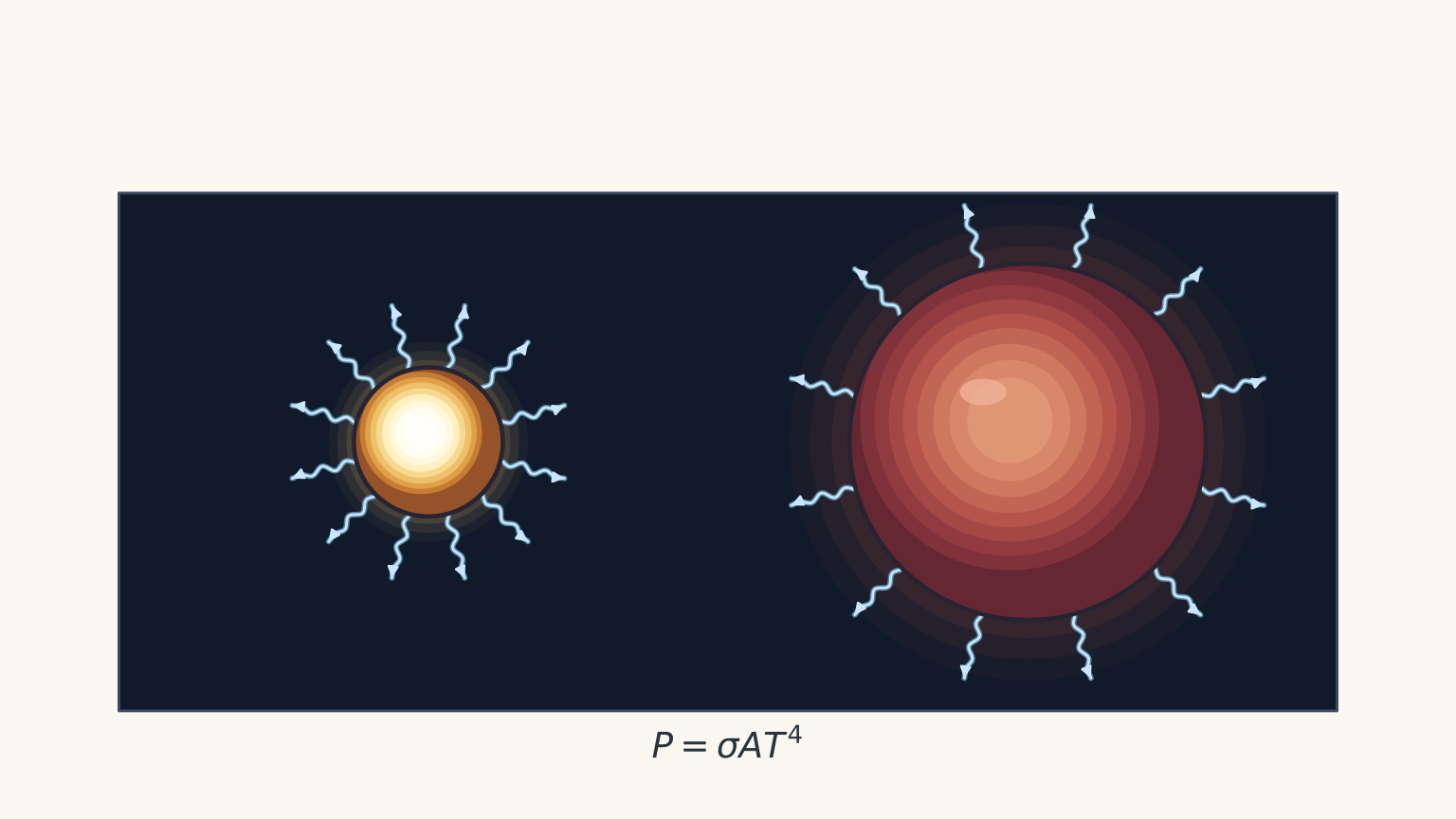
Due to technical limitations, this figure may display incorrectly or contain inaccuracies. Please check key details against your course materials.
01What a black-body curve tells you
You already know that an object’s temperature affects the electromagnetic radiation it emits.
A black body is an idealised object that absorbs all incident electromagnetic radiation and emits the maximum possible thermal radiation for its temperature. Its emitted radiation forms a continuous spectrum, which can be represented by a graph of intensity against wavelength.
Two features of these graphs are particularly important:
- As temperature increases, the peak wavelength decreases. The object emits most strongly at shorter wavelengths.
- The overall intensity increases, meaning that the object emits more energy across its spectrum.
The first relationship is described by Wien’s displacement law:
\[ \lambda_{\max}T=b \]
Here, \(\lambda_{\max}\) is the wavelength at which the emission curve reaches its maximum, \(T\) is the absolute temperature in kelvins, and \(b\) is Wien’s displacement constant, approximately \(2.90\times10^{-3}\ \mathrm{m\,K}\).
But there is another feature worth examining.
Predict: If you compare the entire curves for two black bodies at different temperatures, which one represents more total emitted energy: the curve with the higher peak, or the curve with the greater area underneath it?
The area underneath the curve is the important quantity.
The vertical height of a curve tells you how strongly the object radiates around a particular wavelength. However, radiation is emitted across a whole range of wavelengths.
Adding the contributions from all those wavelengths gives the total emitted power per square metre of the object’s surface.
Think of the curve as a collection of narrow wavelength bands. Each band contributes some energy, and adding all the bands gives the total.
For a properly scaled graph, where the vertical axis represents spectral power per unit wavelength, the area underneath the curve represents the total emitted power per unit surface area. If the graph uses arbitrary intensity units, its area only provides a relative comparison.
The hotter black body has a greater area underneath its curve. We can describe this total emission mathematically using the Stefan-Boltzmann law.
02Introducing the Stefan-Boltzmann law
The Stefan-Boltzmann law states that the total power radiated per unit surface area of a perfect black body is proportional to the fourth power of its absolute temperature.
Mathematically:
\[ M=\sigma T^4 \]
Here:
- \(M\) is the total radiant power emitted per unit surface area, measured in watts per square metre (\(\mathrm{W\,m^{-2}}\)).
- \(\sigma\) is the Stefan-Boltzmann constant.
- \(T\) is the absolute temperature of the object’s surface, measured in kelvins (K).
The Stefan-Boltzmann constant is:
\[ \sigma=5.67\times10^{-8} \ \mathrm{W\,m^{-2}\,K^{-4}} \]
This equation gives the power emitted by each square metre of a black-body surface.
But what if we want the total power emitted by an entire object?
We simply multiply by its radiating surface area, \(A\):
\[ \boxed{P=\sigma AT^4} \]
Here, \(P\) is the total power emitted, measured in watts (W), and \(A\) is the radiating surface area, measured in square metres (\(\mathrm{m^2}\)).
This is the Stefan-Boltzmann law for a perfect black body.
Why does the fourth power matter?
The fourth power creates a much stronger temperature dependence than you might initially expect.
Suppose you double the absolute temperature of a black body while keeping its surface area constant.
Its radiated power changes by:
\[ \frac{P_2}{P_1} = \left(\frac{T_2}{T_1}\right)^4 \]
Substituting the doubled temperature:
\[ \frac{P_2}{P_1}=2^4=16 \]
The object now radiates 16 times as much power.
That is a substantial increase from only doubling the temperature.
The relationship becomes even more interesting when comparing objects of different sizes.
Consider two objects made from the same material, with the same emissivity. Object A has twice the temperature of object B, but only one-tenth of its surface area.
Their total power ratio is:
\[ \frac{P_A}{P_B} = \frac{A_A}{A_B} \left(\frac{T_A}{T_B}\right)^4 \]
\[ =\frac{1}{10}\times2^4 \]
\[ =1.6 \]
Despite having one-tenth the surface area, object A radiates 1.6 times as much total power.
The fourth power of temperature can outweigh a substantial difference in size.
This gives us an important distinction:
- Temperature determines the power radiated per square metre.
- Surface area determines how many square metres contribute to the total.
- Both quantities are needed to calculate total radiated power.
03Real objects: introducing emissivity
So far, we have treated every object as a perfect black body.
Real objects are not perfect black bodies. Their surfaces absorb and emit different amounts of electromagnetic radiation.
A polished metal surface, for example, generally emits less thermal radiation than a suitable matte, high-emissivity surface at the same temperature.
We account for this using a quantity called emissivity, represented by \(\varepsilon\) (epsilon).
Emissivity describes how effectively a real surface emits thermal radiation compared with a perfect black body at the same temperature.
Its value lies between zero and one:
\[ 0\leq\varepsilon\leq1 \]
- \(\varepsilon=1\): perfect black-body emission.
- \(0<\varepsilon<1\): real surface emitting less radiation than a black body.
- \(\varepsilon=0\): idealised surface that emits no thermal radiation.
A surface with an emissivity of 0.80 emits 80% of the power that a black body of the same area and temperature would emit, under the assumed model.
The greybody approximation
For calculations, we will use a simplified model called a greybody.
A greybody is an object whose emissivity is treated as constant across the relevant wavelengths of thermal radiation.
This is an approximation. In real materials, emissivity can depend on wavelength, temperature, surface condition, and direction.
The approximation allows us to use one emissivity value in our calculations rather than analysing the emission at every individual wavelength.
With this assumption, the Stefan-Boltzmann law becomes:
\[ \boxed{P_{\mathrm{emit}}=\varepsilon\sigma AT^4} \]
This is the main equation we will use.
Notice that when \(\varepsilon=1\), it reduces to the perfect black-body equation.
One subtle point is worth remembering: an object’s visible colour does not necessarily tell you its emissivity in the infrared region. A surface that looks black to your eyes is not automatically a perfect thermal radiator.
The emissivity supplied in a question should represent the relevant thermal radiation, not simply the object’s visible appearance.
04Gross emitted power versus net radiative heat loss
There is one more distinction to understand before calculating.
An object does not only emit radiation. It also absorbs radiation arriving from its surroundings.
Imagine holding a warm object in a room. The object emits infrared radiation, but the surrounding walls also emit infrared radiation towards it.
The object therefore experiences two simultaneous processes:
- Radiation leaves its surface.
- Radiation from the surroundings is absorbed by its surface.
The Stefan-Boltzmann equation with emissivity calculates the total power emitted:
\[ P_{\mathrm{emit}}=\varepsilon\sigma AT^4 \]
However, if we want to calculate the net rate at which the object loses energy through radiation, we must subtract the incoming absorbed radiation.
For a greybody inside a large enclosure with uniform surrounding temperature, the net outward radiative power is:
\[ \boxed{ P_{\mathrm{net}} = \varepsilon\sigma A \left(T^4-T_{\mathrm{env}}^4\right) } \]
Here, \(T_{\mathrm{env}}\) is the absolute temperature of the surrounding radiative environment, measured in kelvins.
This equation assumes that the surroundings can be represented by a single uniform temperature and that the same effective emissivity describes emission and absorption.
If the object is hotter than its surroundings, the net radiative power is outward.
If both temperatures are equal, the net radiative power is zero. The object is still emitting radiation, but it absorbs an equal amount from its surroundings.
If the object is colder than its surroundings, it absorbs more radiation than it emits.
Be careful: the temperature terms are raised to the fourth power separately. You must not calculate the difference in temperature first and then raise that difference to the fourth power.
For example, the correct expression is:
\[ T^4-T_{\mathrm{env}}^4 \]
It is not:
\[ (T-T_{\mathrm{env}})^4 \]
Also remember that this equation describes radiative heat transfer only. Conduction and convection may contribute to the object’s overall energy loss as well.
Worked example: calculating the power emitted by a heated plate
A heated metal plate has a radiating surface area of \(0.20\ \mathrm{m^2}\) and a temperature of \(500\ \mathrm{K}\). Its effective emissivity is 0.80.
Calculate the total power emitted by the plate, treating it as a greybody.
Step 1
We are given:
\[ \begin{aligned} A&=0.20\ \mathrm{m^2}\\ T&=500\ \mathrm{K}\\ \varepsilon&=0.80\\ \sigma&=5.67\times10^{-8} \end{aligned} \]
We need to calculate the total emitted power, not the net heat loss. Therefore, we do not need the surrounding temperature.
Step 2
For a greybody:
\[ P_{\mathrm{emit}}=\varepsilon\sigma AT^4 \]
Step 3
\[ P_{\mathrm{emit}} = 0.80(5.67\times10^{-8}) (0.20)(500)^4 \]
First, calculate the temperature to the fourth power:
\[ 500^4=6.25\times10^{10} \]
Therefore:
\[ P_{\mathrm{emit}} = 0.80(5.67\times10^{-8}) (0.20)(6.25\times10^{10}) \]
\[ P_{\mathrm{emit}}=567\ \mathrm{W} \]
Step 4
The total power emitted by the plate is:
\[ \boxed{P_{\mathrm{emit}}=567\ \mathrm{W}} \]
This means the plate emits 567 joules of electromagnetic radiation every second.
Notice that we used the emissivity factor. Without it, we would have calculated the power emitted by a perfect black body rather than the actual modelled surface.
Worked example: a hot sphere inside a cooler enclosure
A spherical metal object has a radius of \(0.10\ \mathrm{m}\) and a surface temperature of \(600\ \mathrm{K}\). Its effective emissivity is 0.90.
The object is placed inside a large enclosure whose internal surfaces are at a uniform temperature of \(300\ \mathrm{K}\).
Calculate:
(a) The total power emitted by the sphere.
(b) The net power lost through radiation.
Step 1
We are given the radius, not the surface area.
For a sphere:
\[ A=4\pi r^2 \]
Substituting:
\[ A=4\pi(0.10)^2 \]
\[ \boxed{A=0.126\ \mathrm{m^2}} \]
We use the entire spherical surface because the object is radiating from all sides.
Step 2
We use:
\[ P_{\mathrm{emit}}=\varepsilon\sigma AT^4 \]
Substituting:
\[ P_{\mathrm{emit}} = 0.90(5.67\times10^{-8}) (0.1257)(600)^4 \]
Since:
\[ 600^4=1.296\times10^{11} \]
We obtain:
\[ \boxed{P_{\mathrm{emit}}\approx831\ \mathrm{W}} \]
The sphere emits approximately 831 W of thermal radiation.
Step 3
The enclosure is at 300 K.
Using the same greybody emissivity model:
\[ P_{\mathrm{absorbed}} = \varepsilon\sigma AT_{\mathrm{env}}^4 \]
Substituting:
\[ P_{\mathrm{absorbed}} = 0.90(5.67\times10^{-8}) (0.1257)(300)^4 \]
\[ \boxed{P_{\mathrm{absorbed}}\approx51.9\ \mathrm{W}} \]
Step 4
The sphere emits more radiation than it absorbs.
Therefore:
\[ P_{\mathrm{net}} = P_{\mathrm{emit}}-P_{\mathrm{absorbed}} \]
\[ P_{\mathrm{net}}=831-51.9 \]
\[ \boxed{P_{\mathrm{net}}\approx779\ \mathrm{W}} \]
The sphere loses approximately 779 W through net radiative heat transfer.
This example demonstrates why total emitted power and net radiative heat loss are different quantities. The sphere emits 831 W, but some of the radiation leaving the enclosure’s walls is absorbed by the sphere.
05Questions and solutions
The following questions build from straightforward calculations towards more demanding applications. Use the greybody model wherever an emissivity is supplied, and assume uniform surface temperatures unless stated otherwise.
Question 1
A perfect black-body radiator has a surface area of \(0.12\ \mathrm{m^2}\) and a temperature of \(450\ \mathrm{K}\).
Calculate its total emitted power.
Solution 1
The total emitted power is approximately 279 W.
Because the object is a perfect black body, its emissivity is 1.
We use:
\[ P_{\mathrm{emit}}=\sigma AT^4 \]
Substituting:
\[ P_{\mathrm{emit}} = (5.67\times10^{-8})(0.12)(450)^4 \]
First:
\[ 450^4=4.100625\times10^{10} \]
Therefore:
\[ P_{\mathrm{emit}} = (5.67\times10^{-8})(0.12) (4.100625\times10^{10}) \]
\[ \boxed{P_{\mathrm{emit}}\approx279\ \mathrm{W}} \]
The object emits approximately 279 joules of electromagnetic radiation every second.
The important detail is that we used the absolute temperature and the entire radiating surface area.
Question 2
A spherical metal component has a radius of \(0.080\ \mathrm{m}\) and a surface temperature of \(500^\circ\mathrm{C}\).
Its effective emissivity is 0.75. It is placed inside a large enclosure whose internal surfaces are maintained at \(25^\circ\mathrm{C}\).
Assume the component behaves as a greybody and that radiative exchange with the enclosure is the only heat-transfer mechanism being considered.
Calculate:
(a) The total power emitted by the component.
(b) The net radiative power lost by the component.
Explain why your answers are different.
Solution 2
The component emits approximately 1.22 kW, but its net radiative power loss is approximately 1.19 kW.
We need to calculate the sphere’s surface area and convert both temperatures into kelvins before applying the equations.
Step 1: Convert the temperatures into kelvins.
For the component:
\[ T=500+273.15 \]
\[ T=773.15\ \mathrm{K} \]
For the surroundings:
\[ T_{\mathrm{env}}=25+273.15 \]
\[ T_{\mathrm{env}}=298.15\ \mathrm{K} \]
We will use 773 K and 298 K in our calculations.
Step 2: Calculate the sphere’s surface area.
The surface area of a sphere is:
\[ A=4\pi r^2 \]
Substituting:
\[ A=4\pi(0.080)^2 \]
\[ \boxed{A=0.0804\ \mathrm{m^2}} \]
Step 3: Calculate the total emitted power.
Using the greybody equation:
\[ P_{\mathrm{emit}}=\varepsilon\sigma AT^4 \]
Substituting:
\[ P_{\mathrm{emit}} = 0.75(5.67\times10^{-8}) (0.0804)(773)^4 \]
\[ \boxed{P_{\mathrm{emit}}\approx1.22\times10^3\ \mathrm{W}} \]
Therefore:
\[ \boxed{P_{\mathrm{emit}}\approx1.22\ \mathrm{kW}} \]
Step 4: Calculate the net radiative power loss.
The component also absorbs radiation from the enclosure.
We therefore use:
\[ P_{\mathrm{net}} = \varepsilon\sigma A (T^4-T_{\mathrm{env}}^4) \]
Substituting:
\[ P_{\mathrm{net}} = 0.75(5.67\times10^{-8})(0.0804) \]
\[ \times(773^4-298^4) \]
\[ \boxed{P_{\mathrm{net}}\approx1.19\times10^3\ \mathrm{W}} \]
Thus:
\[ \boxed{P_{\mathrm{net}}\approx1.19\ \mathrm{kW}} \]
Step 5: Explain the difference.
The component emits approximately 1.22 kW, but it also absorbs approximately 27 W from its surroundings.
The difference between these quantities is its net radiative power loss.
The tempting mistake is to assume that all emitted radiation represents energy lost by the object. This ignores the radiation arriving from the enclosure.
Question 3
Two stars, A and B, are modelled as perfect black bodies with uniform surface temperatures.
Star A has a surface temperature of \(6000\ \mathrm{K}\) and a radius of \(R\).
Star B has a surface temperature of \(4000\ \mathrm{K}\) and a radius of \(3R\).
Calculate:
(a) The ratio of the power emitted per square metre by star A to that emitted per square metre by star B.
(b) The ratio of the total power emitted by star A to that emitted by star B.
(c) Identify which star emits more total power, despite having the lower surface temperature. Explain your reasoning using the Stefan-Boltzmann law.
Solution 3
Star A emits more power per square metre, but star B emits more total power.
We must distinguish between the power emitted per unit surface area and the total power emitted by the entire star.
Step 1: Calculate the ratio of power emitted per square metre.
For a black body:
\[ M=\sigma T^4 \]
Therefore:
\[ \frac{M_A}{M_B} = \frac{\sigma T_A^4}{\sigma T_B^4} \]
The Stefan-Boltzmann constant cancels:
\[ \frac{M_A}{M_B} = \left(\frac{T_A}{T_B}\right)^4 \]
Substituting:
\[ \frac{M_A}{M_B} = \left(\frac{6000}{4000}\right)^4 \]
\[ =1.5^4 \]
\[ \boxed{\frac{M_A}{M_B}=5.0625} \]
Star A emits approximately 5.06 times as much power per square metre as star B.
Step 2: Compare the surface areas.
Both stars are spherical.
Their surface areas are:
\[ A=4\pi R^2 \]
For star A:
\[ A_A=4\pi R^2 \]
For star B:
\[ A_B=4\pi(3R)^2 \]
\[ A_B=36\pi R^2 \]
Therefore:
\[ \frac{A_A}{A_B} = \frac{4\pi R^2}{36\pi R^2} \]
\[ \boxed{\frac{A_A}{A_B}=\frac{1}{9}} \]
Star B has nine times the radiating surface area of star A.
Step 3: Calculate the ratio of total emitted powers.
The Stefan-Boltzmann law gives:
\[ P=\sigma AT^4 \]
Therefore:
\[ \frac{P_A}{P_B} = \frac{A_A}{A_B} \left(\frac{T_A}{T_B}\right)^4 \]
Substituting:
\[ \frac{P_A}{P_B} = \frac{1}{9}(1.5)^4 \]
\[ =\frac{5.0625}{9} \]
\[ \boxed{\frac{P_A}{P_B}=0.5625} \]
Equivalently:
\[ \boxed{\frac{P_B}{P_A}\approx1.78} \]
Star B emits approximately 1.78 times the total power of star A.
Step 4: Explain the physical result.
Star A has the hotter surface, so each square metre emits more energy.
However, star B has nine times the surface area. This more than compensates for its lower emission per square metre.
The important lesson is that a star’s surface temperature alone cannot determine its total luminosity.
A star’s size must also be considered.
Question 4
A thin metal plate is maintained at a uniform temperature of \(500\ \mathrm{K}\).
Both sides of the plate are exposed to a large enclosure whose internal surfaces are at \(300\ \mathrm{K}\).
Each face has an area of \(0.10\ \mathrm{m^2}\).
The emissivity of the front face is 0.90, while the emissivity of the back face is 0.20.
Assume both faces behave as greybodies and exchange radiation with the same enclosure.
Calculate:
(a) The total power emitted by both faces.
(b) The net radiative power lost by the plate.
(c) An engineer incorrectly assumes that the entire \(0.20\ \mathrm{m^2}\) surface area has an emissivity of 0.90. Calculate the net power predicted by this model and explain why it is incorrect.
Solution 4
The plate emits approximately 390 W in total and loses approximately 339 W through net radiation. The engineer’s incorrect model predicts approximately 555 W of net radiative loss.
The important detail is that the two faces have different emissivities. We must calculate their contributions separately or combine them using an area-weighted emissivity.
Step 1: Calculate the combined emissivity-weighted surface area.
For the front face:
\[ \varepsilon_1A_1=0.90(0.10) \]
\[ =0.09\ \mathrm{m^2} \]
For the back face:
\[ \varepsilon_2A_2=0.20(0.10) \]
\[ =0.02\ \mathrm{m^2} \]
Adding these contributions:
\[ \varepsilon_1A_1+\varepsilon_2A_2 \]
\[ =0.09+0.02 \]
\[ \boxed{0.11\ \mathrm{m^2}} \]
This is the effective emissivity-weighted area for the two faces.
Step 2: Calculate the total emitted power.
Both faces have the same temperature, so:
\[ P_{\mathrm{emit}} = \sigma T^4 (\varepsilon_1A_1+\varepsilon_2A_2) \]
Substituting:
\[ P_{\mathrm{emit}} = (5.67\times10^{-8})(500)^4(0.11) \]
Since:
\[ 500^4=6.25\times10^{10} \]
We obtain:
\[ P_{\mathrm{emit}}=389.8\ \mathrm{W} \]
Therefore:
\[ \boxed{P_{\mathrm{emit}}\approx390\ \mathrm{W}} \]
Step 3: Calculate the net radiative power loss.
Both faces absorb radiation from the same enclosure.
Therefore:
\[ P_{\mathrm{net}} = \sigma(T^4-T_{\mathrm{env}}^4) (\varepsilon_1A_1+\varepsilon_2A_2) \]
Substituting:
\[ P_{\mathrm{net}} = (5.67\times10^{-8}) (500^4-300^4)(0.11) \]
First, calculate the difference:
\[ 500^4-300^4 \]
\[ =6.25\times10^{10}-8.10\times10^9 \]
\[ =5.44\times10^{10} \]
Therefore:
\[ P_{\mathrm{net}}=339.3\ \mathrm{W} \]
\[ \boxed{P_{\mathrm{net}}\approx339\ \mathrm{W}} \]
Step 4: Evaluate the engineer’s model.
The engineer assumes that both faces have an emissivity of 0.90.
This gives:
\[ P_{\mathrm{net,wrong}} = 0.90\sigma(0.20) (500^4-300^4) \]
\[ \boxed{P_{\mathrm{net,wrong}}\approx555\ \mathrm{W}} \]
This is an overestimate.
The back face has a much lower emissivity, so treating it as a high-emissivity surface exaggerates its contribution to the total radiation loss.
The correct calculation uses the emissivity of each face separately.
Notice that we could also have used an effective average emissivity of 0.55 across the combined area of \(0.20\ \mathrm{m^2}\). This gives the same correct result because both faces have equal areas.
The broader principle is that different radiating surfaces cannot automatically be treated as having the same emissivity.
Question 5
Two spherical stars, A and B, have been observed using their black-body-like radiation spectra.
Their measured peak wavelengths are:
- Star A: \(400\ \mathrm{nm}\)
- Star B: \(800\ \mathrm{nm}\)
Both stars are modelled as greybodies with wavelength-independent effective emissivities:
\[ \varepsilon_A=0.80 \]
\[ \varepsilon_B=0.40 \]
Their intrinsic total radiated powers have also been determined. Star A emits one-quarter of the total power emitted by star B:
\[ P_A=\frac{1}{4}P_B \]
Assume both stars have uniform surface temperatures and behave as spherical radiators. The quoted power ratio represents their intrinsic luminosities, not their apparent brightness as observed from Earth.
Determine:
(a) The ratio of the surface temperatures of stars A and B.
(b) The ratio of their total radiating surface areas.
(c) The ratio of their radii.
(d) Explain why the hotter star emits less total power, despite having a greater emissivity.
Solution 5
Star A has twice the surface temperature of star B, but its surface area is only one-128th of star B’s. Its radius is approximately 8.84% of star B’s radius.
This problem requires us to connect two different relationships:
- Wien’s displacement law, which relates peak wavelength to temperature.
- The Stefan-Boltzmann law, which relates total power to emissivity, surface area, and temperature.
The tempting approach is to assume that the hotter star must emit more total power. However, that conclusion ignores the difference in surface area.
Step 1: Determine the temperature ratio using Wien’s displacement law.
Wien’s law states:
\[ \lambda_{\max}T=b \]
For both stars:
\[ \lambda_A T_A=\lambda_B T_B \]
Rearranging:
\[ \frac{T_A}{T_B} = \frac{\lambda_B}{\lambda_A} \]
Substituting:
\[ \frac{T_A}{T_B} = \frac{800}{400} \]
\[ \boxed{\frac{T_A}{T_B}=2} \]
Star A has twice the surface temperature of star B.
Step 2: Apply the Stefan-Boltzmann law to both stars.
For star A:
\[ P_A=\varepsilon_A\sigma A_AT_A^4 \]
For star B:
\[ P_B=\varepsilon_B\sigma A_BT_B^4 \]
Taking the ratio:
\[ \frac{P_A}{P_B} = \frac{\varepsilon_A}{\varepsilon_B} \frac{A_A}{A_B} \left(\frac{T_A}{T_B}\right)^4 \]
We are given:
\[ \frac{P_A}{P_B}=\frac14 \]
\[ \frac{\varepsilon_A}{\varepsilon_B} = \frac{0.80}{0.40}=2 \]
And from Step 1:
\[ \frac{T_A}{T_B}=2 \]
Substituting:
\[ \frac14 = 2\frac{A_A}{A_B}(2)^4 \]
Simplifying:
\[ \frac14=32\frac{A_A}{A_B} \]
Rearranging:
\[ \frac{A_A}{A_B} = \frac{1}{128} \]
Therefore:
\[ \boxed{\frac{A_A}{A_B}=\frac{1}{128}} \]
Star A has only one-128th of star B’s total radiating surface area.
Step 3: Calculate the radius ratio.
Both stars are spherical, so:
\[ A=4\pi R^2 \]
Taking the ratio of their surface areas:
\[ \frac{A_A}{A_B} = \frac{4\pi R_A^2}{4\pi R_B^2} \]
The common factors cancel:
\[ \frac{A_A}{A_B} = \left(\frac{R_A}{R_B}\right)^2 \]
Substituting:
\[ \frac{1}{128} = \left(\frac{R_A}{R_B}\right)^2 \]
Taking the square root:
\[ \frac{R_A}{R_B} = \frac{1}{\sqrt{128}} \]
\[ \boxed{\frac{R_A}{R_B}\approx0.0884} \]
Star A has approximately 8.84% of star B’s radius.
Equivalently, star B has a radius approximately 11.3 times greater than star A.
Step 4: Explain why the hotter star emits less total power.
Star A has two advantages in terms of power emitted per square metre:
- Its temperature is twice as high, giving it a temperature contribution of \(2^4=16\).
- Its emissivity is twice as high, giving it an additional factor of 2.
Combining these:
\[ \frac{M_A}{M_B}=2\times16 \]
\[ \boxed{\frac{M_A}{M_B}=32} \]
Star A emits 32 times as much power per square metre as star B.
However, its surface area is only one-128th as large.
Therefore, its total power is:
\[ \frac{P_A}{P_B} = 32\times\frac{1}{128} \]
\[ \boxed{\frac{P_A}{P_B}=\frac14} \]
The result agrees with the measured power ratio.
There is no contradiction. Star A is a much more powerful emitter per square metre, but it has far less emitting surface area.
This is the key distinction between the temperature of an object and its total energy output.
The Stefan-Boltzmann law takes your understanding of black-body curves one step further. Instead of simply identifying which object is hotter, you can estimate how much electromagnetic energy an entire object emits each second.
The next useful step is to investigate how that radiated power changes an object’s temperature over time. By combining radiative heat transfer with mass and specific heat capacity, you can begin modelling how quickly an object cools, while accounting for the additional effects of conduction and convection.