
Projectile Motion: Horizontal and Vertical Motion Explained
Learn how to separate projectile motion into horizontal and vertical components, understand velocity and acceleration, interpret motion graphs, and solve HSC Physics problems involving maximum height, flight time and range.
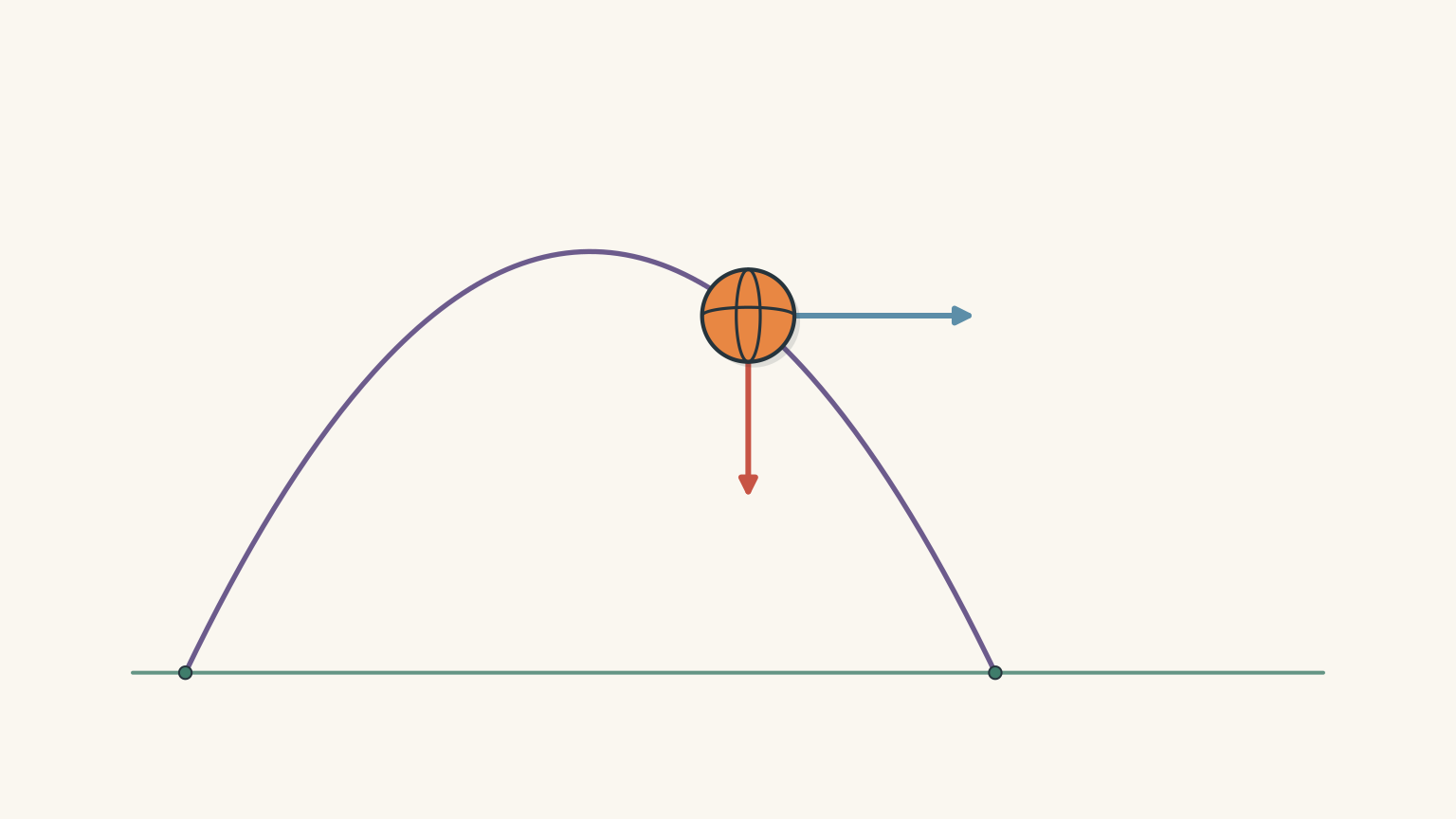
A cricket ball is hit high into the air. You watch it rise, slow down, stop for a moment, and then fall back towards the ground. A common prediction is: “The force must be pushing it forwards while it is moving forwards.” That feels sensible, because the ball is still travelling away from the bat.
But what happens if the only force acting is gravity? Can gravity somehow make the ball keep moving forwards while also pulling it down?
Projectile motion solves this puzzle. It lets us separate the motion into two independent parts: horizontal motion and vertical motion. Once you can see those two motions happening at the same time, many HSC Physics questions become much more organised.
01The first mental model: two motions happening at once
Imagine throwing a tennis ball horizontally from a cliff. Ignore air resistance for a moment.
The ball moves forwards because your hand gave it horizontal velocity. At the same time, gravity pulls it downwards.
Now predict this:
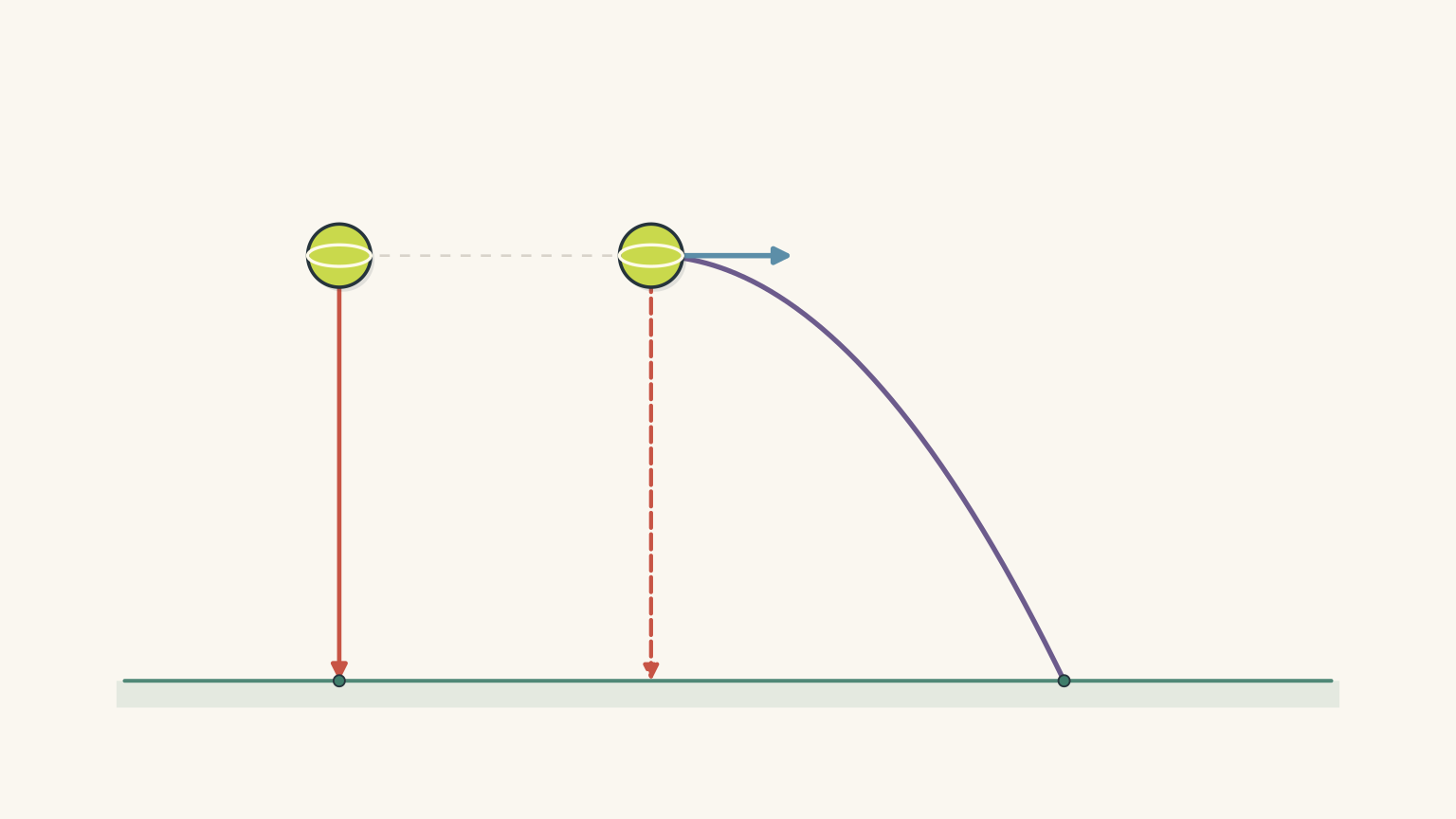
If you throw one ball horizontally and simply drop another ball from the same height at the exact same time, which one reaches the ground first?
Many students predict the dropped ball. It seems reasonable because the thrown ball travels further. But the prediction is wrong.
Both balls hit the ground at the same time.
Why? The horizontal motion does not affect the vertical motion. Both balls start with the same vertical velocity: zero. Both experience the same downward acceleration due to gravity.
The thrown ball just has an extra horizontal component of velocity.
This is the key idea:
- Horizontal direction: usually constant velocity (if air resistance is ignored).
- Vertical direction: accelerated motion due to gravity.
The paths look complicated because the two motions are combined, but the two components can be solved separately.
02Building the vector model
Velocity is a vector. That means it has both:
- a size (speed),
- a direction.
A projectile launched at an angle does not have one mysterious “diagonal velocity”. It has two separate velocity components.
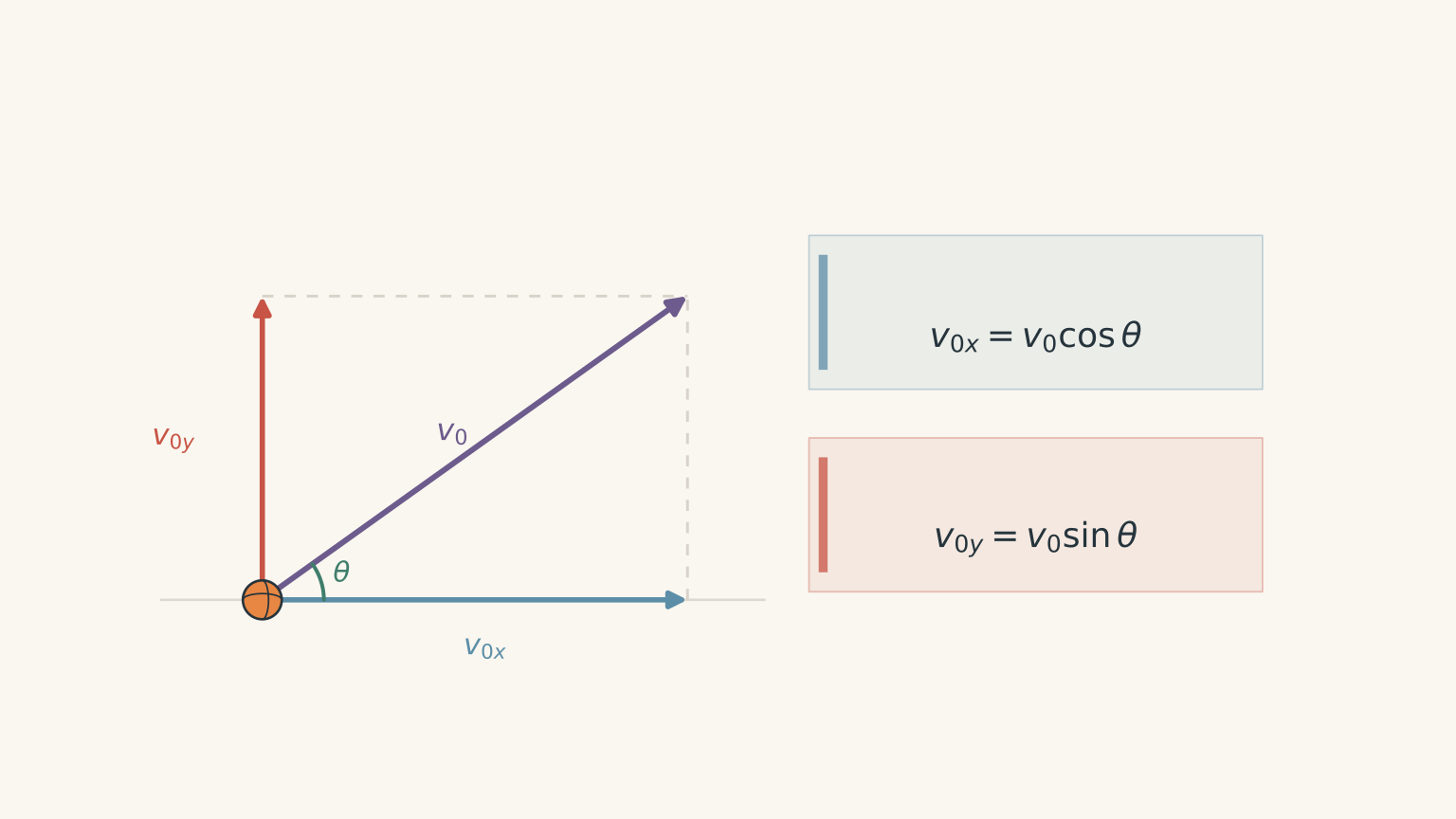
The initial velocity \(v_0\) can be split into:
\[ v_{0x}=v_0\cos\theta \]
\[ v_{0y}=v_0\sin\theta \]
where:
- \(v_{0x}\) is the initial horizontal velocity in metres per second (\(\mathrm{m\,s^{-1}}\)),
- \(v_{0y}\) is the initial vertical velocity in metres per second (\(\mathrm{m\,s^{-1}}\)),
- \(v_0\) is the initial speed,
- \(\theta\) is the launch angle measured above the horizontal.
The horizontal component stays constant:
\[ a_x=0 \]
The vertical component changes because gravity acts downwards:
\[ a_y=-g \]
where \(g\) is the acceleration due to gravity, approximately \(9.8\ \mathrm{m\,s^{-2}}\) near Earth’s surface.
The negative sign depends on your coordinate choice. If upwards is positive, gravity is negative because it points down.
03A useful analogy: two people carrying one idea
Imagine a person walking diagonally across a shopping centre. Their friend says, “You’re moving north and east at the same time.”
That sounds strange, but both descriptions are true. The person has one overall movement, which can be separated into two independent directions.
Projectile motion is similar. The object is not switching between horizontal and vertical movement. Both happen together.
The analogy breaks down because a person can choose to change direction, while a projectile’s acceleration is controlled by forces. A ball cannot decide to “turn” upwards again halfway through its flight.
04Where the simple model is incomplete
The model above assumes:
- air resistance is negligible,
- gravity is constant,
- Earth’s curvature is irrelevant,
- the object is small compared with the distances involved.
For HSC Physics problems, these assumptions are usually appropriate.
Real projectiles are affected by air resistance. A tennis ball and a metal sphere launched at the same speed would not follow exactly the same path. The tennis ball loses more energy to the air, so its path changes.
The simple projectile model is powerful because it isolates the important physics.
05Reading projectile motion graphs
Projectile motion often appears as graphs. Each graph tells a different story.
Position-time graphs
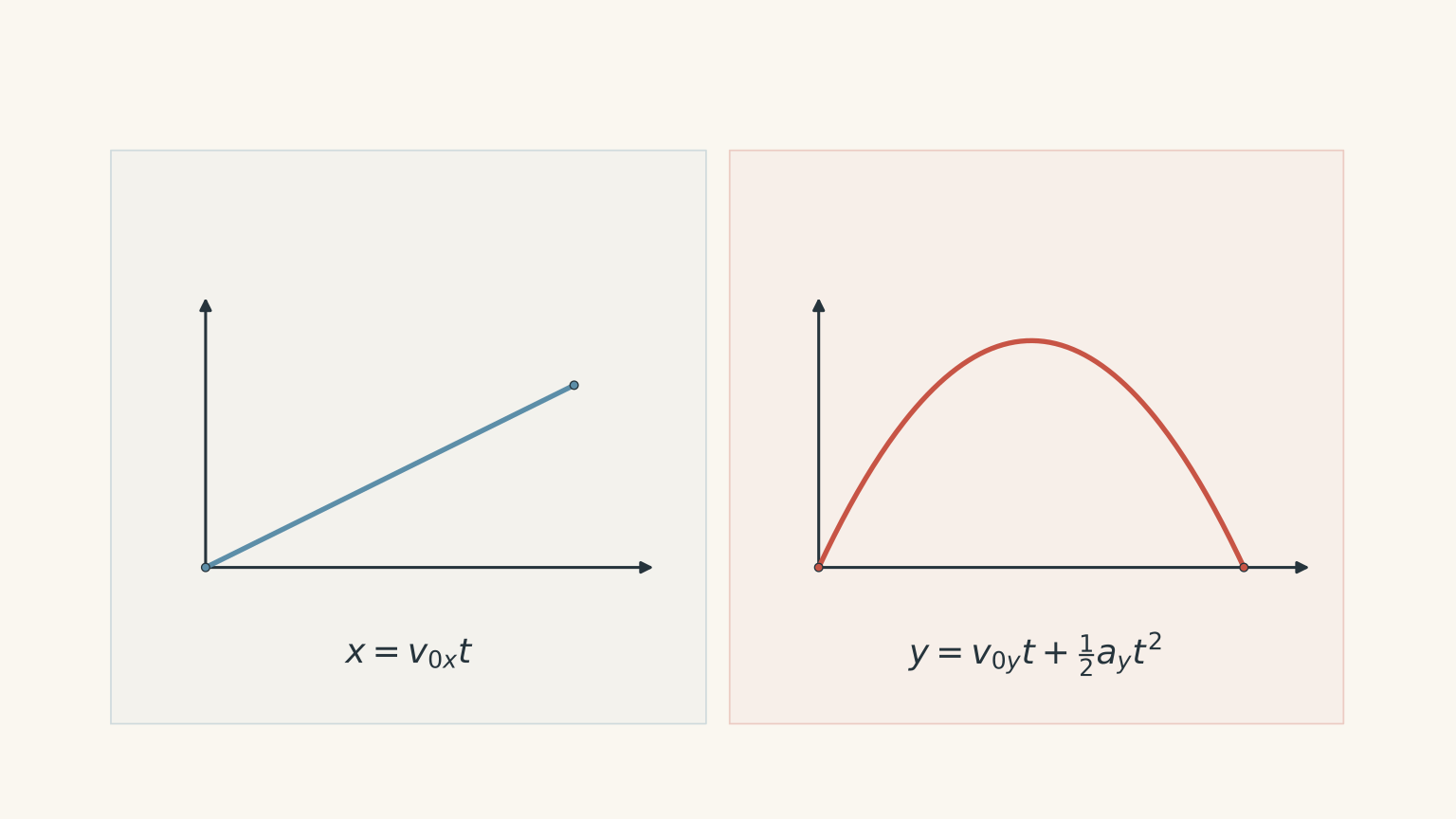
Horizontal displacement increases at a constant rate:
\[ x=v_{0x}t \]
This produces a straight-line graph.
Vertical displacement changes because of acceleration:
\[ y=v_{0y}t+\frac{1}{2}a_yt^2 \]
This produces a curved graph.
Velocity-time graphs
Horizontal velocity remains constant:
\[ v_x=v_{0x} \]
Vertical velocity changes linearly:
\[ v_y=v_{0y}-gt \]
At the highest point of the path:
\[ v_y=0 \]
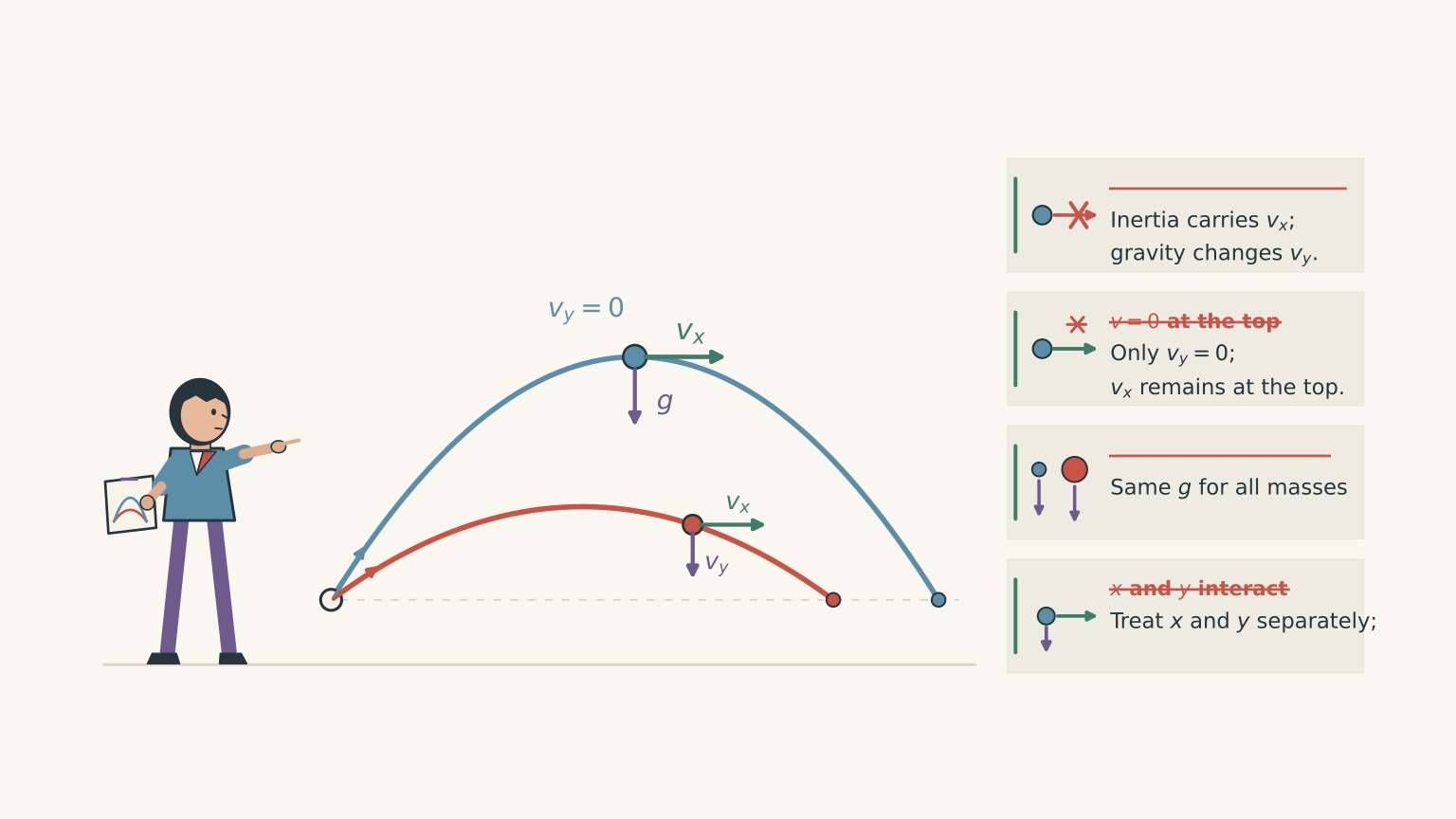
A common mistake is to say “the velocity is zero at the top”. Only the vertical component is zero. The projectile is still moving horizontally.
06Finding the maximum height
At the highest point, the projectile stops moving upwards before starting to fall.
That means:
\[ v_y=0 \]
Use the vertical motion equation:
\[ v_y^2=v_{0y}^2+2a_y\Delta y \]
where:
- \(v_y\) is the final vertical velocity,
- \(v_{0y}\) is the initial vertical velocity,
- \(a_y\) is vertical acceleration,
- \(\Delta y\) is vertical displacement.
At the maximum height:
\[ 0=v_{0y}^2-2g\Delta y \]
so:
\[ \Delta y=\frac{v_{0y}^2}{2g} \]
This only gives the height gained above the launch point.
07Worked example: Finding the maximum height of a projectile
A soccer ball is kicked at \(20\ \mathrm{m\,s^{-1}}\) at an angle of \(30^\circ\) above the horizontal. Find the maximum height reached above the launch point.
Step 1
The vertical component determines how high the ball rises:
\[ v_{0y}=v_0\sin\theta \]
Substitute:
\[ v_{0y}=20\sin30^\circ \]
\[ v_{0y}=10\ \mathrm{m\,s^{-1}} \]
Step 2
At maximum height:
\[ v_y=0 \]
Use:
\[ v_y^2=v_{0y}^2+2a_y\Delta y \]
Substitute:
\[ 0=10^2+2(-9.8)\Delta y \]
\[ 0=100-19.6\Delta y \]
Step 3
\[ \Delta y=\frac{100}{19.6} \]
\[ \Delta y=5.1\ \mathrm{m} \]
The maximum height is:
\[ \boxed{5.1\ \mathrm{m}} \]
The important idea is that the horizontal speed never appeared in the calculation. It affects how far the ball travels, not how high it rises.
08Finding range
The range is the horizontal distance travelled.
Because horizontal acceleration is zero:
\[ \Delta x=v_xt \]
The difficult part is usually finding the flight time.
For a projectile that lands at the same height it was launched, the upward and downward times are equal. The total time is:
\[ t=\frac{2v_{0y}}{g} \]
Then:
\[ \Delta x=v_{0x}t \]
09Worked example: Finding the range of a projectile
A golf ball is launched from ground level at \(25\ \mathrm{m\,s^{-1}}\) at an angle of \(40^\circ\). Ignore air resistance. Find the horizontal range.
Step 1
Horizontal component:
\[ v_{0x}=25\cos40^\circ \]
\[ v_{0x}=19.2\ \mathrm{m\,s^{-1}} \]
Vertical component:
\[ v_{0y}=25\sin40^\circ \]
\[ v_{0y}=16.1\ \mathrm{m\,s^{-1}} \]
Step 2
Because the ball lands at the same height:
\[ t=\frac{2v_{0y}}{g} \]
Substitute:
\[ t=\frac{2(16.1)}{9.8} \]
\[ t=3.29\ \mathrm{s} \]
Step 3
\[ \Delta x=v_{0x}t \]
\[ \Delta x=(19.2)(3.29) \]
\[ \Delta x=63.2\ \mathrm{m} \]
The range is:
\[ \boxed{63.2\ \mathrm{m}} \]
The result means the ball travels about \(63\ \mathrm{m}\) horizontally before returning to its original height.
10The most common projectile motion mistakes
| Mistake | Why it seems reasonable | What actually happens |
|---|---|---|
| “A force must keep pushing the projectile forwards.” | Everyday objects slow down without a push. | Velocity continues due to inertia. A force is only needed to change velocity. |
| “Velocity is zero at the top.” | The object stops rising. | Only \(v_y=0\). Horizontal velocity remains. |
| “A heavier object falls faster.” | Heavy objects feel harder to move. | Without air resistance, all objects have the same gravitational acceleration. |
| “The horizontal and vertical motions affect each other.” | The path looks like one curved motion. | The components are analysed independently and combined. |
11Questions and solutions
Question 1
A ball is launched horizontally from a platform \(45\ \mathrm{m}\) above the ground at \(8.0\ \mathrm{m\,s^{-1}}\). Ignore air resistance. How long does the ball take to reach the ground?
Solution 1
The ball takes \(3.03\ \mathrm{s}\) to reach the ground.
The tempting mistake is to use the horizontal speed of \(8.0\ \mathrm{m\,s^{-1}}\) to find the falling time. Horizontal velocity does not affect vertical motion.
The vertical initial velocity is:
\[ v_{0y}=0 \]
Use:
\[ \Delta y=v_{0y}t+\frac{1}{2}a_yt^2 \]
Substitute:
\[ -45=0+\frac{1}{2}(-9.8)t^2 \]
\[ -45=-4.9t^2 \]
\[ t^2=\frac{45}{4.9} \]
\[ t=3.03\ \mathrm{s} \]
The ball reaches the ground after \(3.03\ \mathrm{s}\).
Question 2
A projectile is launched at \(18\ \mathrm{m\,s^{-1}}\) at \(35^\circ\) above the horizontal. Find its vertical velocity after \(1.2\ \mathrm{s}\).
Solution 2
The vertical velocity after \(1.2\ \mathrm{s}\) is \(0.33\ \mathrm{m\,s^{-1}}\) upwards.
First find the initial vertical velocity:
\[ v_{0y}=18\sin35^\circ \]
\[ v_{0y}=10.3\ \mathrm{m\,s^{-1}} \]
Use:
\[ v_y=v_{0y}+a_yt \]
Substitute:
\[ v_y=10.3+(-9.8)(1.2) \]
\[ v_y=10.3-11.76 \]
\[ v_y=-1.46\ \mathrm{m\,s^{-1}} \]
Therefore the projectile is actually moving downwards at \(1.46\ \mathrm{m\,s^{-1}}\).
The correction is important: a positive initial vertical velocity does not mean the projectile is still rising. Gravity continuously reduces \(v_y\).
Question 3
Two identical balls are launched from the same height. Ball A is launched horizontally at \(15\ \mathrm{m\,s^{-1}}\). Ball B is launched at \(15\ \mathrm{m\,s^{-1}}\) at \(45^\circ\) above the horizontal. Which ball hits the ground first? Explain.
Solution 3
Ball A hits the ground first.
The key constraint is vertical motion. The flight time depends on the initial vertical velocity, not the total speed.
Ball A has:
\[ v_{0y}=0 \]
Ball B has:
\[ v_{0y}=15\sin45^\circ \]
which is positive. Ball B must first rise before falling back to the ground, so it spends longer in the air.
The tempting route is to compare the total launch speeds and say they are equal, so the times should be equal. The mistake is ignoring the vertical component.
Question 4
A projectile is launched from a cliff. It leaves the cliff with a speed of \(22\ \mathrm{m\,s^{-1}}\) at \(25^\circ\) above horizontal. The cliff is \(30\ \mathrm{m}\) above the ground. Find the horizontal distance travelled before impact.
Solution 4
The projectile travels approximately \(60\ \mathrm{m}\) horizontally before impact.
First split the velocity:
\[ v_{0x}=22\cos25^\circ=19.9\ \mathrm{m\,s^{-1}} \]
\[ v_{0y}=22\sin25^\circ=9.30\ \mathrm{m\,s^{-1}} \]
Now use vertical motion. Taking upward as positive:
\[ \Delta y=v_{0y}t+\frac{1}{2}a_yt^2 \]
The projectile starts \(30\ \mathrm{m}\) above the ground:
\[ -30=9.30t-4.9t^2 \]
Rearrange:
\[ 4.9t^2-9.30t-30=0 \]
Solving gives:
\[ t=3.52\ \mathrm{s} \]
Now calculate horizontal distance:
\[ \Delta x=v_{0x}t \]
\[ \Delta x=(19.9)(3.52) \]
\[ \Delta x=70.0\ \mathrm{m} \]
The horizontal distance is:
\[ \boxed{70.0\ \mathrm{m}} \]
The important difference from a ground-to-ground projectile is that the symmetry shortcut cannot be used. The projectile starts and finishes at different heights.
Question 5
A projectile is launched from the ground with a fixed speed of \(30\ \mathrm{m\,s^{-1}}\). A student claims that a \(45^\circ\) launch angle always gives the greatest range because it gives equal horizontal and vertical components. Assess this claim. Assume air resistance is negligible.
Solution 5
The claim is only true when the projectile lands at the same height from which it was launched. It is not a universal rule.
For equal launch and landing heights, the range is:
\[ R=\frac{v_0^2\sin(2\theta)}{g} \]
The maximum occurs when:
\[ \sin(2\theta)=1 \]
which gives:
\[ 2\theta=90^\circ \]
so:
\[ \theta=45^\circ \]
The tempting reasoning is that equal horizontal and vertical components must always be ideal. However, the real constraint is flight time.
If the projectile lands from a raised platform, a larger angle can produce a longer range because the extra vertical velocity increases the time available for horizontal motion.
If the projectile lands below the launch point, a lower angle may be better because too much vertical velocity is used climbing rather than travelling horizontally.
The deeper principle is that range depends on both:
\[ \text{horizontal speed} \times \text{time in the air} \]
A launch angle is not powerful by itself. It changes two competing factors at once: horizontal velocity and flight time.
Understanding this trade-off leads directly into the next major projectile idea: analysing motion using conservation of energy, where the changing speed of an object can be linked to its height and position.