
Should You Take Maths Extension 1 Alongside Maths Advanced?
Find out whether Maths Extension 1 suits your mathematical foundations, problem-solving style, and available study time. Understand NESA course requirements, university prerequisites, assumed knowledge, and how to make a confident HSC subject choice.
Yes, you should consider taking Mathematics Extension 1 alongside Mathematics Advanced if you enjoy solving unfamiliar problems, have reasonably secure algebra and functions skills, and are prepared to spend time working through questions that don’t immediately make sense.
You don’t need to be the top student in your year to succeed in Extension 1. However, you do need more than a good memory for mathematical procedures. Extension 1 rewards students who can connect ideas, recognise patterns, and keep reasoning when a familiar method doesn’t quite work.
The important decision is not whether Extension 1 looks impressive on your subject selection form. It’s whether the additional mathematical challenge is worth the extra workload alongside your other HSC subjects.
01What is the relationship between Mathematics Advanced and Extension 1?
Mathematics Advanced and Mathematics Extension 1 are designed to be studied together. Extension 1 builds on the mathematical knowledge developed in Advanced and introduces additional ideas and more demanding applications.
Think of Mathematics Advanced as developing a collection of mathematical tools. Extension 1 asks you to use those tools in less familiar situations, make connections between different techniques, and construct more detailed mathematical arguments.
For example, you might learn how to differentiate a function in Mathematics Advanced. In Extension 1, you could encounter a problem that requires you to combine differentiation with trigonometry, algebra, or a geometric relationship before you can even begin the calculus.
The difference is not simply that the Extension 1 question contains more calculations. Often, the difficult part is deciding which mathematical ideas belong together.
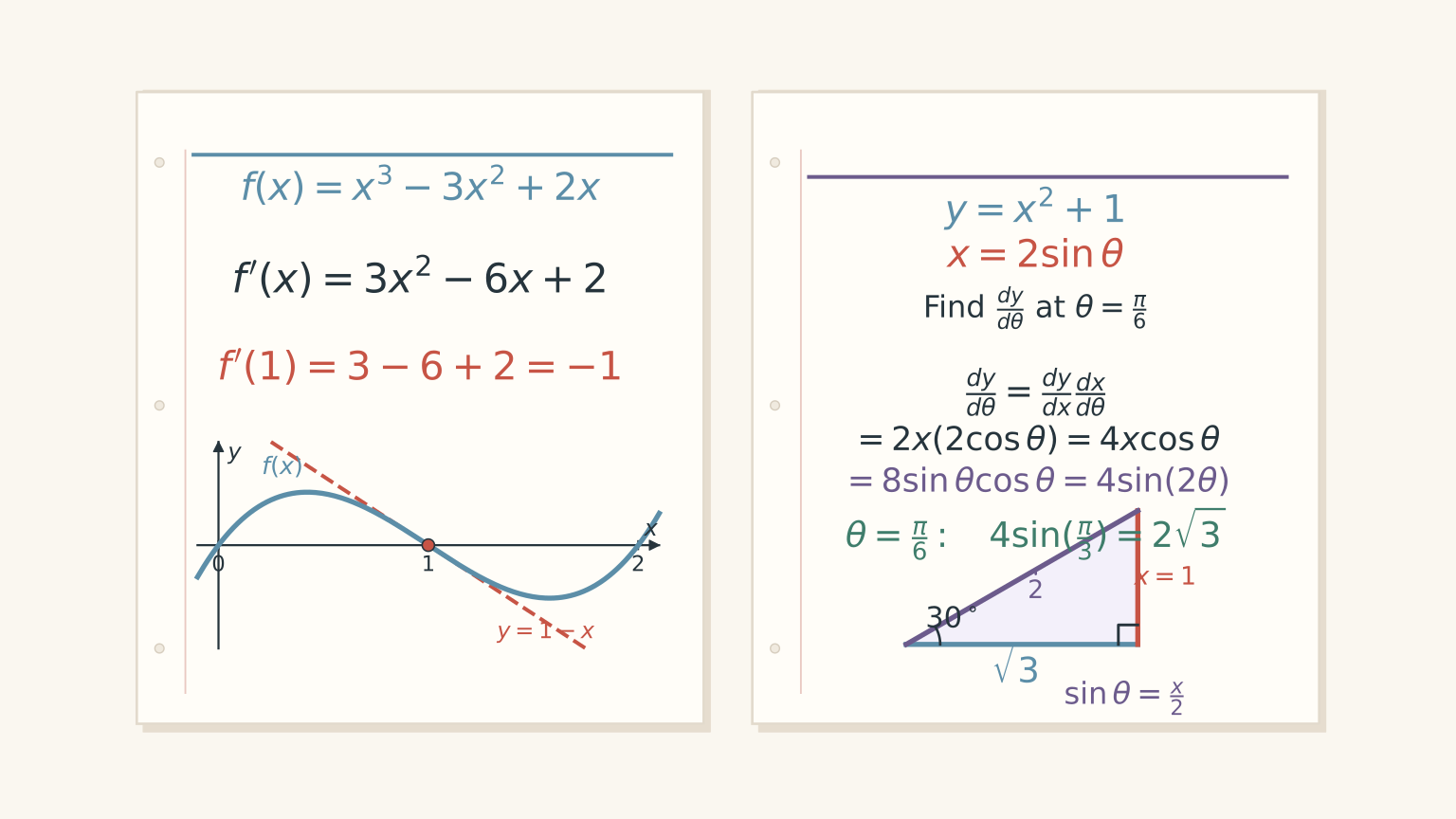
Due to technical limitations, this figure may display incorrectly or contain inaccuracies. Please check key details against your course materials.
Do you have to take Mathematics Advanced to study Extension 1?
Yes. Mathematics Extension 1 is designed as an extension of Mathematics Advanced, not as a separate alternative to it.
Under NESA’s course requirements, the Preliminary Mathematics Extension course is studied concurrently with or after Preliminary Mathematics Advanced. The HSC Mathematics Extension 1 course requires completion of the Preliminary Advanced and Extension 1 courses, alongside HSC Mathematics Advanced.
Extension 1 is a 1-unit course when studied with Mathematics Advanced. Mathematics Advanced is a 2-unit course.
This means that taking both gives you a 3-unit mathematical program, rather than replacing Advanced with a more difficult alternative.
The exact course-completion requirements are set out in NESA’s ACE Rules.
What does Extension 1 actually add?
The additional content develops mathematical reasoning in several areas, including:
- Functions: working with more complex functions and their properties.
- Proof: constructing logical mathematical arguments, including proof by mathematical induction.
- Vectors: representing and analysing quantities with both magnitude and direction.
- Trigonometric functions: developing more advanced relationships and applications.
- Combinatorics: counting arrangements and selections systematically.
- Calculus: extending differentiation and integration techniques and their applications.
- Statistical analysis: exploring additional statistical methods and reasoning.
These areas are drawn from the new Mathematics Extension 1 syllabus (2024), which begins implementation in 2026. The first HSC examination under this syllabus is in 2027. Students sitting the 2026 HSC complete the previous syllabus, so make sure your preparation materials match your examination cohort.
You can check the current course content through the NESA Mathematics Extension 1 syllabus.
02How do you know if you’re suited to Extension 1?
A common mistake is to judge your suitability using your Mathematics results alone.
A student who regularly gets high marks might still struggle with Extension 1 if they rely heavily on memorising worked examples. Another student with slightly lower marks might be well suited because they enjoy investigating difficult problems and can explain why a method works.
Instead, look at how you approach mathematics.
1. Your algebra is reasonably reliable
Algebra is one of the most important foundations for Extension 1.
Consider the equation:
\[ (x+2)(x-3)=0 \]
You should be comfortable expanding, factorising, rearranging, and solving equations without needing to stop at every line.
More importantly, you should recognise when an algebraic expression can be simplified and when a particular form is useful.
In Extension 1, a question might involve several mathematical ideas. If basic algebra is consuming most of your attention, it becomes harder to focus on the unfamiliar reasoning.
You don’t need perfect algebra before starting. You do need to be willing to identify and repair gaps as they appear.
2. You understand why mathematical methods work
Suppose you are asked to differentiate:
\[ f(x)=3x^2+4x-5 \]
You know that:
\[ f'(x)=6x+4 \]
That’s a useful skill. But can you explain what the derivative represents?
The derivative describes the instantaneous rate of change of the function. Geometrically, it gives the gradient of the tangent to the curve at a particular point.
Extension 1 regularly asks you to use mathematical ideas in ways that require this deeper understanding.
If you only remember the differentiation rule, you might recognise a familiar question and solve it quickly. If you understand what differentiation means, you have a much better chance of handling a question that presents the same concept in an unfamiliar way.
3. You can persist when a question doesn’t look familiar
Imagine a question gives you a function and asks you to determine where it reaches a maximum.
You might initially think, “I need to differentiate this.”
That’s a good starting point, but it isn’t the whole solution.
You need to differentiate, solve for stationary points, determine which points are maxima or minima, and interpret the result in the context of the question.
Extension 1 questions can require several such decisions before you reach the answer.
Being comfortable with uncertainty is therefore a useful skill. You should be able to try a method, check whether it is appropriate, and change direction when necessary.
4. You actually enjoy challenging mathematics
This sounds obvious, but it matters.
If you enjoy questions that require several attempts, Extension 1 may suit you. If you strongly prefer questions where you can identify a familiar formula and substitute numbers immediately, you may find the course frustrating.
You don’t have to enjoy every topic. You should, however, find some satisfaction in working through a problem that initially seems difficult.
What should you revise before starting?
You don’t need to teach yourself the Extension 1 syllabus before Year 11. You should, however, make sure the mathematical foundations are reasonably secure.
Use this table as a preparation checklist.
| Skill | What you should be able to do |
|---|---|
| Algebra | Expand brackets, factorise expressions, simplify fractions, and rearrange equations. |
| Quadratics | Solve quadratic equations, recognise their roots, and interpret their graphs. |
| Functions | Identify intercepts, understand domain and range, and describe graph transformations. |
| Trigonometry | Work with exact values, angles, and basic trigonometric relationships. |
| Mathematical reasoning | Explain why a method works and show the steps connecting your working to your answer. |
These are practical readiness indicators, not additional NESA entry requirements.
A useful self-test is to try the following without looking at worked solutions:
- Factorise \(x^2-7x+12\).
- Solve \(3(x-2)=2x+5\).
- Describe the transformations that take \(y=x^2\) to \(y=(x-3)^2+2\).
- Solve \(2\sin\theta=1\) for \(0\leq\theta\leq2\pi\).
If you can solve these accurately and explain your reasoning, you have a useful foundation to build on.
If you struggle with some of them, identify the specific gaps and revise them. Needing revision doesn’t automatically mean Extension 1 is unsuitable.
03How much extra work does Extension 1 involve?
Extension 1 is an additional course, so you need to account for its teaching time, homework, assessments, and examination preparation.
Under the 2024 NESA syllabus, the formal course allocations are:
| Course | Units | Course hours |
|---|---|---|
| Mathematics Advanced Year 11 | 2 | 120 |
| Mathematics Extension 1 Year 11 | 1 | 60 |
| Mathematics Advanced Year 12 | 2 | 120 |
| Mathematics Extension 1 Year 12 | 1 | 60 |
The extra 60 course hours in each year are formal course time, not a prediction of your individual homework requirements.
You should also expect Extension 1 to have its own assessment requirements and HSC examination. When studying both courses, you will need to prepare for the Mathematics Advanced examination as well as the Extension 1 examination.
The challenge is not just finding another hour in your week. It’s maintaining consistent practice when several subjects have assessments approaching at the same time.
A realistic approach to managing the workload
A useful starting routine is:
- After each lesson: Review the examples and attempt to reproduce the main methods without looking at your notes.
- During the week: Complete a focused set of unfamiliar problems. Concentrate on understanding the first step, not just reaching the final answer.
- At the end of the week: Revisit questions you couldn’t solve independently.
- Before assessments: Practise combining topics rather than revising each technique in isolation.
Keep a record of questions that you couldn’t solve and why.
For example, there’s a meaningful difference between making an algebra error, not recognising which concept applies, and understanding the method but being unable to complete the proof. Each problem needs a different response.
When is the workload a warning sign?
Consider these situations:
- You regularly leave Mathematics Advanced homework unfinished.
- You understand examples in class but cannot reproduce them independently.
- You already need most of your available study time to maintain your other subjects.
- You are choosing Extension 1 mainly because your friends are taking it.
- You dislike unfamiliar problems and have little interest in developing that skill.
None of these automatically rules you out.
However, they suggest that you should examine your current study habits before adding another course.
If you cannot consistently complete your existing mathematics work, it may be more useful to strengthen your Advanced foundations first.
04What do NESA, UAC, and universities actually require?
It’s important to separate course eligibility from school selection and university admission. They are different decisions made by different organisations.
1. NESA course requirements
For students entering Year 11 under the 2024 Mathematics Extension 1 syllabus, NESA lists:
- Mathematics Extension 1 Year 11 as a 1-unit course.
- No formal prerequisite for the Year 11 Extension 1 course.
- Mathematics Advanced Year 11 as a corequisite.
A corequisite is a course that must be studied alongside the extension course.
For the HSC course, the requirements are more specific. You must have completed the Preliminary Mathematics Advanced and Mathematics Extension 1 courses, and study HSC Mathematics Advanced concurrently with or before HSC Mathematics Extension 1.
This is why Extension 1 is not simply a subject you can pick up independently in Year 12.
The formal requirements are available in NESA’s course description and ACE Rules. citeturn163938view0turn177884view0
2. Your school’s selection policy
NESA’s formal course requirements are not the same as your school’s subject selection policy.
Your school may have its own arrangements concerning:
- Mathematics Extension 1 placement recommendations.
- Teacher recommendations or internal academic criteria.
- Subject selection deadlines.
- Timetable availability and class organisation.
- How students can access a course that isn’t taught locally.
Ask your Mathematics teacher or subject coordinator which requirements come from NESA and which are specific to your school.
For students entering Year 11 in 2027 at eligible NSW public schools, the NSW Government’s HSC Subject Guarantee provides access to Mathematics Extension 1 through available delivery options. Where the course isn’t offered locally, eligible students may be able to access it through Distance Education or Aurora College.
This is a public-school access initiative, not a universal enrolment guarantee for every NSW student. Confirm eligibility and arrangements with your school. citeturn437490view0
3. University prerequisites and assumed knowledge
You might be considering Extension 1 because you want to study engineering, physics, mathematics, computing, or another degree involving quantitative work.
That’s a reasonable consideration, but don’t assume every degree requires Extension 1.
Universities distinguish between two important terms:
| Term | What it means |
|---|---|
| Course prerequisite | A subject or achievement standard you must satisfy to be eligible for admission. |
| Assumed knowledge | A level of mathematical knowledge the university expects you to have when starting the degree. It is not necessarily an admission requirement. |
For example, a hypothetical engineering degree might require Mathematics Advanced but list Extension 1 as assumed knowledge.
You could still satisfy the admission prerequisite without Extension 1, but you would need to consider how you will develop the assumed mathematical knowledge before starting university.
Some institutions offer bridging courses, although availability and content vary.
Check the actual degree you are interested in, rather than relying on general advice about what engineering or science students usually study.
UAC’s information about Year 12 admission requirements explains the difference between prerequisites and other selection criteria. citeturn608668search1
4. Does Extension 1 automatically improve your ATAR?
No. Taking an additional mathematics course does not guarantee a higher ATAR.
In NSW, the ATAR calculation uses:
- Your best 2 units of English.
- Your best 8 units from your remaining courses.
When Mathematics Advanced and Extension 1 are studied together, Advanced contributes 2 units and Extension 1 contributes 1 unit to the ATAR calculation.
The important detail is that UAC uses scaled marks, not simply the number of courses you study.
If your Extension 1 scaled mark is lower than enough of your other available units, it may not be included in your ATAR aggregate.
Scaling also changes from year to year. A course’s previous scaling performance does not guarantee the same result for your cohort.
The sensible approach is to choose Extension 1 because it suits your mathematical interests, demonstrated ability, and future study plans, rather than treating it as an automatic ATAR advantage.
You can read the current explanation in UAC’s ATAR calculation guide. citeturn820396view2turn820396view3
05Two worked examples: making the decision
Worked example: Strong mathematics marks, but inconsistent foundations
A Year 10 student regularly scores around 85% in mathematics. They enjoy challenging questions but sometimes struggle with factorising expressions and rearranging equations. Should they choose Mathematics Extension 1?
Step 1
An 85% result suggests a reasonable level of achievement, but it doesn’t tell us whether the student has mastered every important foundation.
The factorising and rearranging difficulties need attention.
Step 2
The student enjoys challenging questions. That’s a positive sign because Extension 1 involves unfamiliar problems and multi-step reasoning.
They are also willing to work on their algebra rather than avoid it.
Step 3
The student should revise factorising, solving equations, and manipulating algebraic expressions.
They should also ask their teacher to identify any other gaps before starting Year 11.
Conclusion: Extension 1 is a reasonable option. The student has demonstrated mathematical interest and a good starting level of achievement. Their algebra gaps are preparation targets, not automatic reasons to reject the course.
Worked example: An engineering pathway and a demanding subject combination
A Year 10 student wants to study engineering. They perform consistently well in mathematics and enjoy calculus-style problems.
Their preferred university degree lists Mathematics Advanced as a prerequisite and Mathematics Extension 1 as assumed knowledge. The student is also planning to take Physics and Chemistry and already has a busy study schedule.
Should they take Extension 1?
Step 1
Mathematics Advanced is the prerequisite in this example. Extension 1 is assumed knowledge, not an additional admission hurdle.
The student does not need to take Extension 1 simply to satisfy the stated prerequisite.
Step 2
Extension 1 develops more advanced mathematical reasoning and introduces content that can be useful in further study involving mathematics.
It may therefore be worthwhile for this student’s engineering preparation.
Step 3
Physics, Chemistry, and Mathematics Advanced already require regular problem-solving practice.
Adding Extension 1 means allocating further time to mathematics. The student needs to consider whether that time can be found without undermining their work in other subjects.
Step 4
If the student enjoys the additional mathematics and can manage the workload, Extension 1 is a sensible choice.
If the workload would seriously affect their other subjects, Mathematics Advanced may be the more appropriate option. They can then investigate the university’s recommended preparation and any available bridging support.
Conclusion: Extension 1 is beneficial preparation in this scenario, but it is not a formal admission requirement. The student should take it if the additional mathematical learning justifies the workload.
06A practical decision rule
Use these four questions to make your decision.
Good reasons to take Extension 1
- You enjoy mathematics and want to explore more challenging problems.
- Your algebra, functions, and trigonometry foundations are reasonably secure, or you have a plan to improve them.
- You can commit to regular independent practice.
- The additional content is relevant to your interests or future study plans.
Reasons to reconsider
- You are choosing it mainly because you believe it will automatically improve your ATAR.
- You are already struggling to keep up with Mathematics Advanced.
- You have little interest in mathematical problem-solving.
- The additional workload would take too much time away from subjects that matter to your overall goals.
A useful way to think about the decision is:
Interest + mathematical readiness + available study time = a much better guide than your current mathematics mark alone.
You don’t need to tick every box perfectly. You do need a realistic plan for the areas where you’re less confident.
Check which syllabus applies to your cohort
The Mathematics Advanced and Extension 1 syllabuses have changed, so make sure your preparation materials match your HSC year.
| HSC examination | Applicable syllabus |
|---|---|
| 2026 | Mathematics Advanced and Extension 1 (2017) |
| 2027 onwards | Mathematics Advanced and Extension 1 (2024) |
The 2024 syllabuses began implementation in 2026, with the first HSC examinations under the new syllabuses in 2027.
If you’re entering Year 11 in 2027, use the new syllabus when reviewing course content and preparing for assessments. Older textbooks and past papers can still help develop mathematical skills, but their topic coverage may not match your course exactly. citeturn505288search0turn505288search1
Consider your entire HSC subject combination
Mathematics Extension 1 shouldn’t be considered in isolation.
Think about the assessment styles, workload, and prerequisites across your whole subject combination. This is particularly important if you’re also studying demanding mathematics-based science subjects.
Our guide to How to Compare HSC Subjects Before Making Your Choice explains how to evaluate these factors together.
If you’re still deciding on your science subjects, you might also find these useful:
- Should I Choose HSC Physics? A Practical Year 10 Guide
- Should I Choose HSC Chemistry? A Practical Year 10 Guide
07Questions and solutions
The following scenarios test whether you can apply the course requirements, workload considerations, and university information to actual subject-selection decisions.
Question 1
Alex is entering Year 11 and plans to study Mathematics Advanced. They consistently perform well in algebra and functions, enjoy unfamiliar mathematical problems, and have enough time to practise regularly.
Should Alex consider Mathematics Extension 1? Explain two reasons supporting the decision.
Solution 1
Yes, Alex is a good candidate for Mathematics Extension 1.
There are two particularly strong reasons.
First, Alex has secure mathematical foundations. Algebra and functions are important areas of preparation for Extension 1, so being comfortable with these topics provides a useful starting point.
Second, Alex enjoys unfamiliar problems. Extension 1 involves more demanding mathematical reasoning, so being willing to explore different approaches is valuable.
Alex also has sufficient time for regular practice, which is important when studying an additional course.
There is no requirement that Alex must be the highest-performing student in the year. Their interest, preparation, and ability to manage the workload provide a much more useful basis for the decision.
Question 2
Mia completed Mathematics Advanced in Year 11 but did not study Preliminary Mathematics Extension 1.
At the beginning of Year 12, Mia decides that she wants to add HSC Mathematics Extension 1. Her school explains that some HSC Extension 1 topics can be introduced before all Preliminary Extension 1 topics have been taught.
Can Mia simply skip the Preliminary Extension 1 course and enter the HSC Extension 1 course?
Explain the difference between flexible course programming and the formal course-completion requirements.
Solution 2
No. Mia cannot simply skip the Preliminary Mathematics Extension 1 course and enter HSC Extension 1.
NESA requires satisfactory completion of Preliminary Mathematics Advanced and Preliminary Mathematics Extension 1, alongside concurrent study of HSC Mathematics Advanced, for the HSC Extension 1 course.
The important distinction is between the order in which topics are taught and the courses a student must complete.
NESA allows schools flexibility in programming Mathematics Extension 1. For example, a school may introduce some HSC Extension 1 topics before completing every Preliminary Extension 1 topic.
However, this flexibility does not remove the requirement to complete the Preliminary course.
Mia should speak with her school about her course history and possible arrangements before assuming she can enter the HSC course.
The tempting mistake is to interpret flexibility in teaching order as permission to bypass a course requirement. They are two different things.
Question 3
Noah wants to study a Bachelor of Computing at university.
The course information states:
- Mathematics Advanced is a formal prerequisite.
- Mathematics Extension 1 is assumed knowledge.
Noah is confident in Mathematics Advanced but is concerned that not studying Extension 1 will prevent him from receiving a university offer.
Does Noah need to study Extension 1 to satisfy the stated admission requirements? What should he consider before deciding?
Solution 3
Noah does not need Extension 1 to satisfy the stated prerequisite, but he should consider the mathematical preparation it provides.
The formal prerequisite is Mathematics Advanced.
Assumed knowledge is different. It describes the knowledge a university expects students to bring into their studies, rather than an additional requirement that must necessarily be satisfied for admission.
Therefore, if Noah completes Mathematics Advanced and meets the other admission requirements, the absence of Extension 1 does not automatically make him ineligible.
However, he should investigate:
- Which mathematical concepts the university assumes students understand.
- Whether Extension 1 covers important concepts used in the degree.
- Whether the university offers bridging courses or other preparation.
- Whether he would benefit from the additional mathematical practice before beginning university.
He should also check the requirements for his intended entry year, rather than relying on an older course description.
The key distinction is that a course can be valuable preparation without being compulsory for admission.
Question 4
Ella attends a NSW public high school and plans to enter Year 11 in 2027.
Her school does not run a local Mathematics Extension 1 class. Ella has strong mathematical foundations and wants to study the course.
Another student tells her that she cannot take Extension 1 unless her school offers it.
Is this necessarily correct? Explain what Ella should investigate.
Solution 4
No. The absence of a local class does not necessarily mean Ella cannot access Mathematics Extension 1.
From 2027, the NSW Government’s HSC Subject Guarantee provides eligible public school students with access to Mathematics Extension 1, among other advanced and extension courses.
Students may access courses through different delivery arrangements. If a course is not offered at their local school, eligible students may be able to study it through Distance Education or Aurora College.
Ella should:
- Speak with her school’s subject coordinator.
- Ask about eligibility under the HSC Subject Guarantee.
- Find out which alternative delivery arrangements are available.
- Confirm how lessons, assessments, and course participation will be organised.
She should not assume that a course must be taught physically at her own school for it to be accessible.
Equally, she should not assume that the guarantee automatically confirms her enrolment. She needs to establish the applicable eligibility and delivery arrangements with her school.
This is an example of why it matters to distinguish course availability from formal NESA course requirements and individual school arrangements.
Question 5
Jordan is entering Year 11 in 2027 and is deciding whether to study Mathematics Extension 1 alongside Mathematics Advanced.
Jordan has two university degrees in mind, both of which are genuinely appealing.
- Degree A requires Mathematics Advanced as a formal prerequisite and lists Extension 1 as assumed knowledge.
- Degree B lists Mathematics Extension 1 as a formal prerequisite.
Jordan wants to remain eligible for both degrees.
Jordan’s school confirms that the courses are available, and a trial study schedule suggests that the additional workload is manageable without reducing preparation time for other subjects.
Jordan also believes Extension 1 is pointless if it doesn’t contribute to the ATAR.
Consider the following hypothetical scaled marks, expressed on a one-unit basis:
| Course | Scaled mark per unit |
|---|---|
| Mathematics Advanced | 78 |
| Mathematics Advanced | 78 |
| Mathematics Extension 1 | 72 |
| Other subject unit 1 | 85 |
| Other subject unit 2 | 82 |
| Other subject unit 3 | 80 |
| Other subject unit 4 | 77 |
| Other subject unit 5 | 75 |
| Other subject unit 6 | 73 |
| Other subject unit 7 | 70 |
Jordan studies 12 units in total: 2 units of English, 2 units of Mathematics Advanced, 1 unit of Extension 1, and 7 other non-English units.
UAC uses the best 2 units of English and the best 8 remaining units in the NSW ATAR calculation.
Should Jordan take Extension 1?
Explain:
a) Whether Extension 1 is included in the hypothetical ATAR calculation.
b) Whether that result means Extension 1 has no value.
c) How the different university admission requirements affect the final decision.
Solution 5
Yes. Under the stated assumptions, Jordan should take Extension 1 because it preserves eligibility for Degree B, which is a genuine university preference.
The important insight is that ATAR contribution and university admission requirements are two different considerations.
Part a: Determine whether Extension 1 contributes to the ATAR.
Jordan has 10 non-English units:
- 2 units of Mathematics Advanced.
- 1 unit of Mathematics Extension 1.
- 7 units from other subjects.
Only the best 8 of these 10 units are included.
Arrange the hypothetical scaled marks from highest to lowest:
| Position | Course unit | Scaled mark |
|---|---|---|
| 1 | Other subject 1 | 85 |
| 2 | Other subject 2 | 82 |
| 3 | Other subject 3 | 80 |
| 4 | Advanced unit 1 | 78 |
| 5 | Advanced unit 2 | 78 |
| 6 | Other subject 4 | 77 |
| 7 | Other subject 5 | 75 |
| 8 | Other subject 6 | 73 |
| 9 | Extension 1 | 72 |
| 10 | Other subject 7 | 70 |
The best 8 non-English units exclude Extension 1.
Therefore, under these hypothetical results, Extension 1 does not contribute to Jordan’s ATAR aggregate.
Part b: Does this make Extension 1 worthless?
No.
The ATAR calculation measures a student’s aggregate of scaled course marks. It does not measure every reason a student might choose a course.
Extension 1 can provide additional mathematical knowledge, develop problem-solving skills, and satisfy university prerequisites.
Its value cannot be judged solely by whether its mark appears in the ATAR aggregate.
Part c: Consider both university courses.
Degree A requires Mathematics Advanced, which Jordan is already studying. Extension 1 is assumed knowledge, so it is not an additional formal admission requirement.
Degree B, however, lists Extension 1 as a formal prerequisite.
If Jordan decides not to study Extension 1, they may no longer satisfy the stated admission requirement for Degree B.
Because Jordan genuinely wants to preserve both options, this changes the decision.
The additional course has a clear purpose beyond its possible ATAR contribution.
The final decision is therefore to take Extension 1, provided the stated workload assumptions remain realistic.
If Degree B only listed Extension 1 as assumed knowledge, rather than a formal prerequisite, the decision would be different. Jordan could still meet the stated admission requirements without the course, and would need to weigh the additional preparation against the workload.
This is the important distinction: a subject can be worth studying even when its mark does not contribute to your ATAR. Equally, a subject that scales well is not automatically worth taking if it doesn’t suit your abilities, interests, or available study time.
08So, should you take Mathematics Extension 1?
For most students, the decision comes down to three things:
- Your mathematical foundations: Are you comfortable with algebra, functions, and trigonometry, and willing to improve where necessary?
- Your approach to problem-solving: Do you enjoy working through unfamiliar questions and developing mathematical reasoning?
- Your overall workload: Can you commit to another course without compromising your other HSC subjects?
If the answer to these questions is generally yes, Mathematics Extension 1 is worth serious consideration.
If you’re unsure, speak with your current Mathematics teacher, attempt some unfamiliar mathematical problems, and look at the actual Extension 1 syllabus before making your selection.
Once you’ve decided, the next important step is preparing your algebra, functions, and trigonometry foundations so that you can handle the transition into Year 11 Mathematics Advanced and Extension 1 with confidence.