
Why Magnetic Fields Change a Charged Particle’s Direction, Not Speed
Understand why a magnetic force changes a charged particle’s direction without changing its speed or kinetic energy. Work through force and radius calculations, common misconceptions, and HSC-style practice questions.
You calculate the magnetic force on a moving charge, then conclude that the particle must speed up because a force is acting on it. That is the mistake. A force can change a particle’s velocity without changing its speed, and a magnetic force is a perfect example: when a charged particle moves perpendicular to a uniform magnetic field, the force continually changes its direction of motion while leaving its speed and kinetic energy unchanged.
Force direction determines the effect on motion
| Force parallel to velocity | Can change speed and kinetic energy by doing work. |
|---|---|
| Force perpendicular to velocity | Changes direction; speed and kinetic energy stay constant if the force remains perpendicular. |
| Magnitude is not direction | F = |q|vB For perpendicular motion in a magnetic field, this gives force magnitude only; direction depends on velocity, field direction, and charge sign. |
01The mistake: confusing velocity with speed
Speed tells you how fast an object moves. Velocity tells you how fast it moves and in which direction.
This distinction matters because a force changes velocity whenever it causes acceleration. It does not necessarily make an object move faster.
Imagine jogging at a constant pace while a friend keeps steering you sideways. Your direction changes, but you can maintain the same running speed. The analogy is imperfect: a magnetic force is not a person steering you, and its direction changes continuously to remain perpendicular to your instantaneous velocity.
That is exactly what happens to a charged particle in a uniform magnetic field when its velocity is perpendicular to the field.
- The particle’s velocity direction changes.
- Its speed stays constant.
- Its acceleration is non-zero because its velocity is changing.
- Its kinetic energy stays constant because its speed stays constant.
The common wrong prediction is that a non-zero force must increase speed. The correct prediction depends on the direction of the force relative to the velocity.
02What the magnetic-force formula actually tells you
For a charged particle moving perpendicular to a magnetic field, the magnitude of the magnetic force is
\[ F=|q|vB \]
Here:
- \(F\) is the magnetic force magnitude, in newtons (N).
- \(q\) is the particle’s electric charge, in coulombs (C).
- \(v\) is its speed, in metres per second (\(\mathrm{m\,s^{-1}}\)).
- \(B\) is the magnetic field strength, in tesla (T).
Some HSC notes write this as \(F=qvB\), treating \(q\) as the magnitude of the charge. Writing \(|q|\) makes it clear that a force magnitude cannot be negative.
Notice what this equation does not tell you: it does not specify the direction of the force.
You need the direction rule as well. The magnetic force acts perpendicular to both the particle’s velocity and the magnetic field. Use the right-hand rule for a positive charge, and reverse the resulting force direction for a negative charge.
When the velocity is perpendicular to the field, the force is therefore perpendicular to the velocity.
The more general force-magnitude equation is
\[ F=|q|vB\sin\theta \]
where \(\theta\) is the angle between the velocity and the magnetic field.
When \(\theta=90^\circ\), \(\sin\theta=1\), so the force has its maximum magnitude, \(|q|vB\).
This distinction is worth remembering. The equation \(F=|q|vB\) assumes perpendicular motion. It is not the correct magnitude formula for every possible angle.
03Why the force changes direction, not speed
The key is that the magnetic force is perpendicular to the particle’s instantaneous velocity.
A force transfers energy through work. For a small displacement \(ds\), the work done by a force of magnitude \(F\) is
\[ dW=F\,ds\cos\phi \]
where \(\phi\) is the angle between the force and the displacement.
At each instant, the particle’s tiny displacement is along its velocity. The magnetic force is at \(90^\circ\) to that velocity, so \(\phi=90^\circ\).
Therefore,
\[ dW=F\,ds\cos90^\circ=0 \]
The magnetic force does no work on the particle.
The same result can be expressed using power, which is the rate at which work is done:
\[ P=Fv\cos90^\circ=0 \]
Since the magnetic force does no work, it cannot change the particle’s kinetic energy when it is the only force doing work.
The kinetic energy of a non-relativistic particle is
\[ K=\frac12 mv^2 \]
where \(K\) is kinetic energy in joules (J), and \(m\) is mass in kilograms (kg).
For a particle of constant mass, unchanged kinetic energy means unchanged speed. The particle’s velocity direction can still change.
Direction changes; speed does not
- 01 · Force acts at 90°
Magnetic force is perpendicular to the particle’s instantaneous velocity.
- 02 · Velocity direction changes
The magnetic force changes the direction of velocity, not its magnitude.
- 03 · Force direction updates
As the particle turns, the magnetic force direction changes to remain perpendicular to its instantaneous velocity.
- 04 · Speed and energy stay constant
The force does no work: F·v = 0.
Speed and kinetic energy remain unchanged.
Why acceleration is still happening
You might now wonder how the particle can accelerate if its speed never changes.
Remember that acceleration is the rate of change of velocity, not just the rate of change of speed.
A car travelling around a bend at a constant speed is accelerating because its direction changes. A charged particle in a magnetic field behaves similarly.
The magnetic force changes the direction of the particle’s velocity, producing acceleration even though the particle does not gain or lose kinetic energy.
This is the central distinction:
- A force component parallel to the velocity can change speed.
- A force perpendicular to the velocity changes direction without changing speed.
- The magnetic force is perpendicular to the velocity, so it does no work.
These statements assume that the magnetic force is the only force doing work. An electric field or another force can change the particle’s kinetic energy.
04Connecting magnetic force to circular motion
Now consider a charged particle entering a uniform magnetic field with its velocity perpendicular to the field.
The magnetic force remains perpendicular to the velocity. As the velocity direction changes, the force direction changes too.
Because the field is uniform and the particle’s speed stays constant, the magnetic force has a constant magnitude. It continually acts towards the centre of the circular path.
This is the role of a centripetal force: it changes the direction of motion to produce circular motion.
The required centripetal force is
\[ F_c=\frac{mv^2}{r} \]
where \(r\) is the radius of the circular path, measured in metres (m).
The magnetic force supplies this centripetal force, so we equate the two magnitudes:
\[ |q|vB=\frac{mv^2}{r} \]
Rearrange to make \(r\) the subject:
\[ |q|vBr=mv^2 \]
Cancel one factor of \(v\), then divide by \(|q|B\):
\[ \boxed{r=\frac{mv}{|q|B}} \]
This equation connects the particle’s mass, speed, charge magnitude, and magnetic field strength to the radius of its circular path.
What the radius equation tells you
With all other quantities held constant:
| Change | Effect on radius |
|---|---|
| Double the speed \(v\) | Radius doubles |
| Double the mass \(m\) | Radius doubles |
| Double the charge magnitude \(|q|\) | Radius halves |
| Double the field strength \(B\) | Radius halves |
The equation describes the size of the circular path. It does not tell you the direction in which the particle curves. That depends on the charge sign and the magnetic field direction.
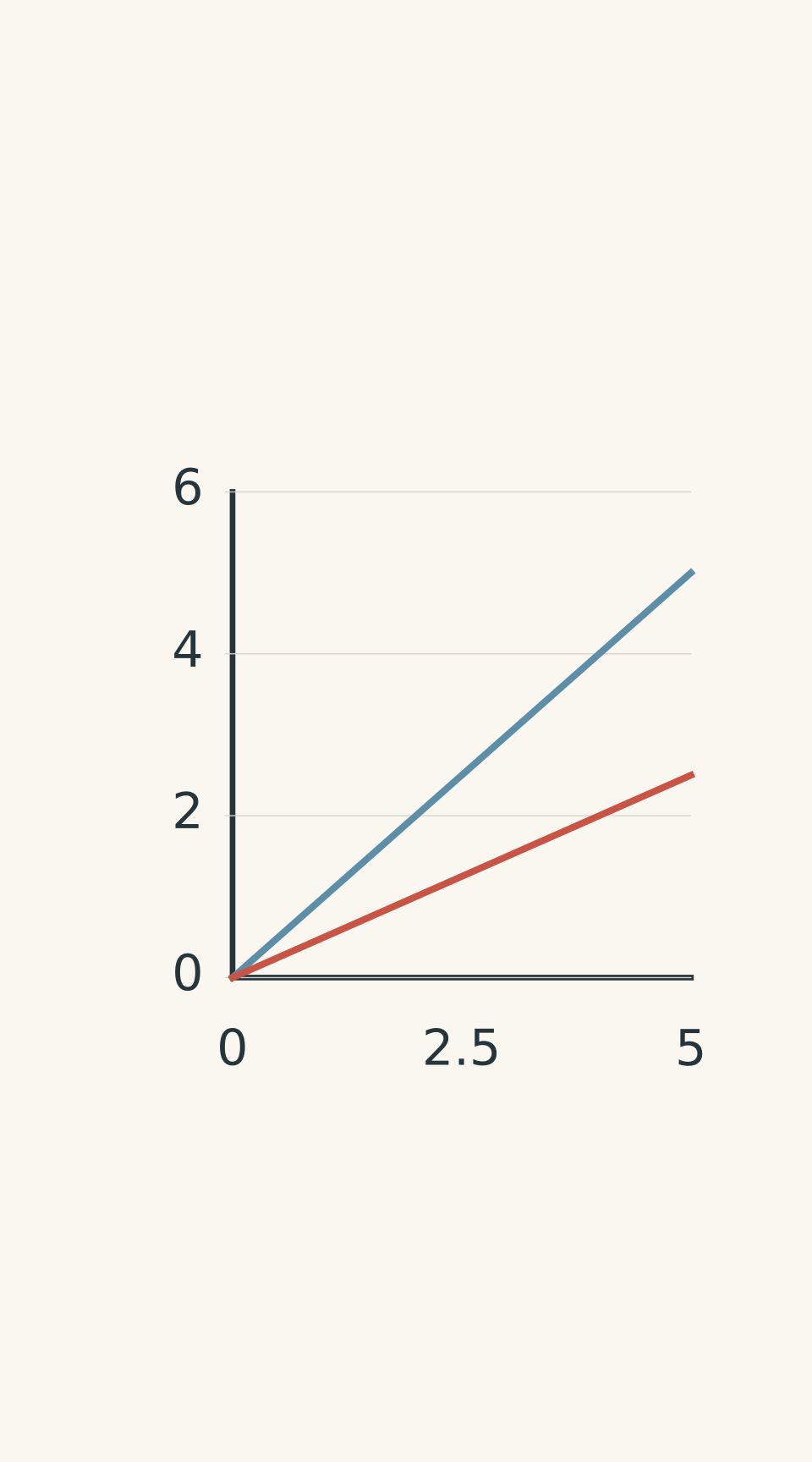
- Magnetic field B
- Magnetic field 2B (half slope)
There is another important detail here. A stronger magnetic field produces a greater force at the same speed, but that does not mean the particle speeds up. The greater force bends the particle’s path more tightly, giving it a smaller radius.
05Edge cases that break memorised shortcuts
The equation \(r=mv/(|q|B)\) is useful, but only when you understand the conditions behind it.
1. What if the velocity is not perpendicular to the field?
If the particle enters at an angle other than \(90^\circ\), split its velocity into two components:
- \(v_\parallel\): the component parallel to the magnetic field.
- \(v_\perp\): the component perpendicular to the magnetic field.
The magnetic force acts on the perpendicular component. The parallel component is unaffected by the magnetic force.
The particle therefore follows a helical path rather than a simple circle. Its speed still stays constant if only the magnetic force acts, but the radius of the helix is determined by the perpendicular component:
\[ r=\frac{mv_\perp}{|q|B} \]
For a velocity making an angle \(\theta\) with the field, \(v_\perp=v\sin\theta\).
How the entry angle changes the motion
| 01 · Perpendicular entry | Entry angle: θ = 90° Parallel component: v_parallel = 0 All velocity is perpendicular to the magnetic field. Result: CIRCULAR MOTION |
|---|---|
| 02 · Oblique entry | Entry angle: 0° < θ < 90° Parallel component: v_parallel ≠ 0 The parallel component remains unchanged; the perpendicular component produces circular motion. Result: HELICAL MOTION |
| 03 · The shared magnetic-force rule | Force magnitude: F = |q|vB sinθ Only the perpendicular velocity component contributes to magnetic force. The parallel component is unaffected. SPEED REMAINS CONSTANT if only the magnetic force acts. |
2. What if the velocity is parallel to the field?
If the velocity is parallel or antiparallel to the magnetic field, then \(\theta=0^\circ\) or \(180^\circ\).
In either case, \(\sin\theta=0\), so the magnetic force is zero. The particle continues in a straight line at constant velocity if no other force acts.
This is why you must check the angle before using \(F=|q|vB\).
3. What if the charge is negative?
A negative charge experiences a force in the opposite direction to the force on a positive charge moving with the same velocity in the same field.
However, the radius equation uses \(|q|\), not signed \(q\). The sign determines the direction of curvature, while the charge magnitude helps determine the radius.
Two particles with the same mass, speed, charge magnitude, and field strength have the same radius even if their charges have opposite signs. They curve in opposite directions.
4. What if the field strength changes?
The magnetic force alone still does no work, so the particle’s speed remains constant. However, the radius can change because
\[ r=\frac{mv}{|q|B} \]
depends on the field strength.
For example, if the field strength doubles while the same particle maintains the same speed, its radius halves. Do not interpret a smaller radius as evidence that the particle has slowed down.
06A dependable method for exam questions
When you encounter a charged particle moving through a magnetic field, use this sequence.
Step 1: Check the angle.
Identify the angle between the velocity and magnetic field. Use \(F=|q|vB\) only for perpendicular motion. Otherwise, include \(\sin\theta\).
Step 2: Separate magnitude from direction.
Calculate the force magnitude first. Then use the appropriate direction rule, reversing the force direction for a negative charge.
Step 3: Decide whether speed can change.
If the force is magnetic and perpendicular to the velocity, it does no work. The particle’s speed and kinetic energy stay constant.
Step 4: Identify the type of motion.
Perpendicular entry into a uniform field produces circular motion. Oblique entry produces helical motion. Parallel entry produces no magnetic force.
Step 5: Choose the correct radius equation.
For perpendicular entry, use
\[ r=\frac{mv}{|q|B} \]
For oblique entry, use \(v_\perp\) in place of \(v\) to find the radius of the helix.
Step 6: Check the result against the physics.
A stronger field should produce a smaller radius if speed and particle properties are unchanged. If a question reports a change in speed, look for an electric field or another force that can do work, or check whether one of your assumptions has changed.
07Worked examples
Worked example: Calculate the magnetic force and radius
A proton moves at \(3.0\times10^6\ \mathrm{m\,s^{-1}}\) perpendicular to a uniform magnetic field of strength \(0.20\ \mathrm T\). Calculate the magnetic force magnitude and the radius of its circular path. State what happens to its speed.
Use \(q=+1.60\times10^{-19}\ \mathrm C\) and \(m=1.67\times10^{-27}\ \mathrm{kg}\).
Step 1
The velocity is perpendicular to the field, so
\[ F=|q|vB \]
Step 2
\[ \begin{aligned} F&=(1.60\times10^{-19})\\ &\quad\times(3.0\times10^6)(0.20)\\ &=9.6\times10^{-14}\ \mathrm N \end{aligned} \]
The magnetic force magnitude is \(9.6\times10^{-14}\ \mathrm N\).
Step 3
Use
\[ r=\frac{mv}{|q|B} \]
Substitute:
\[ \begin{aligned} r&=\frac{(1.67\times10^{-27})(3.0\times10^6)} {(1.60\times10^{-19})(0.20)}\\ &=\frac{5.01\times10^{-21}}{3.20\times10^{-20}}\\ &=0.157\ \mathrm m \end{aligned} \]
The radius is approximately \(0.16\ \mathrm m\).
Step 4
The proton’s speed remains \(3.0\times10^6\ \mathrm{m\,s^{-1}}\) while only the magnetic force acts.
The non-zero force provides the centripetal acceleration needed for circular motion. It changes the direction of the proton’s velocity, but it does no work, so the kinetic energy and speed remain constant.
The tempting wrong route: You might write that the proton accelerates in the direction of its motion because \(F=ma\). The problem is the assumption that acceleration must point along the velocity. Here, the acceleration is perpendicular to the velocity, so the particle turns rather than speeding up.
Worked example: Compare two particles in the same field
Particle A has mass \(2.0\times10^{-26}\ \mathrm{kg}\) and charge \(+1.0\times10^{-19}\ \mathrm C\). Particle B has mass \(6.0\times10^{-26}\ \mathrm{kg}\) and charge \(-2.0\times10^{-19}\ \mathrm C\).
Both enter the same uniform \(0.30\ \mathrm T\) magnetic field at a speed of \(4.0\times10^6\ \mathrm{m\,s^{-1}}\), perpendicular to the field.
Calculate each force magnitude and circular-path radius. Compare the directions of curvature.
Step 1
For particle A,
\[ \begin{aligned} F_A&=|q_A|vB\\ &=(1.0\times10^{-19})(4.0\times10^6)(0.30)\\ &=1.2\times10^{-13}\ \mathrm N \end{aligned} \]
For particle B,
\[ \begin{aligned} F_B&=|q_B|vB\\ &=(2.0\times10^{-19})(4.0\times10^6)(0.30)\\ &=2.4\times10^{-13}\ \mathrm N \end{aligned} \]
Particle B experiences twice the magnetic force magnitude because its charge magnitude is twice as large.
Step 2
For particle A,
\[ \begin{aligned} r_A&=\frac{m_Av}{|q_A|B}\\ &=\frac{(2.0\times10^{-26})(4.0\times10^6)} {(1.0\times10^{-19})(0.30)}\\ &=2.67\ \mathrm m \end{aligned} \]
For particle B,
\[ \begin{aligned} r_B&=\frac{m_Bv}{|q_B|B}\\ &=\frac{(6.0\times10^{-26})(4.0\times10^6)} {(2.0\times10^{-19})(0.30)}\\ &=4.0\ \mathrm m \end{aligned} \]
Particle B has a radius of \(4.0\ \mathrm m\), compared with \(2.67\ \mathrm m\) for particle A.
Step 3
Particle A is positively charged, while particle B is negatively charged. Their force directions are opposite for the same initial velocity and magnetic field, so they curve in opposite directions.
Both particles maintain their original speeds while only the magnetic force acts.
The tempting wrong route: You might conclude that particle B must have half the radius because its charge magnitude is twice as large. That ignores its mass, which is three times larger. The combined effect is a radius \(1.5\) times as large, not half as large.
08Exam self-check
Before committing to an answer, ask yourself:
- Have I checked the angle between velocity and magnetic field?
- Have I used the charge magnitude for force and radius calculations?
- Have I identified the force direction separately from its magnitude?
- Have I explained why the magnetic force does no work?
- Have I distinguished a change in velocity direction from a change in speed?
- If the radius changes, have I checked whether the field strength or speed also changes?
- If the speed changes, have I identified a force that can do work?
09Questions and solutions
Question 1
An electron moves at \(3.0\times10^6\ \mathrm{m\,s^{-1}}\) perpendicular to a uniform magnetic field of strength \(0.010\ \mathrm T\).
Given \(|q|=1.60\times10^{-19}\ \mathrm C\), calculate the magnetic force magnitude. Explain what happens to the electron’s speed and kinetic energy while only the magnetic force acts.
Solution 1
The magnetic force magnitude is \(4.8\times10^{-15}\ \mathrm N\), and the electron’s speed and kinetic energy remain constant.
Because the velocity is perpendicular to the field,
\[ \begin{aligned} F&=|q|vB\\ &=(1.60\times10^{-19})(3.0\times10^6)(0.010)\\ &=4.8\times10^{-15}\ \mathrm N \end{aligned} \]
The magnetic force is perpendicular to the electron’s instantaneous velocity. It changes the direction of motion without doing work, so the kinetic energy remains constant. Since the electron’s mass is unchanged, its speed remains \(3.0\times10^6\ \mathrm{m\,s^{-1}}\).
Question 2
A proton enters a uniform magnetic field perpendicular to the field with a speed of \(3.0\times10^6\ \mathrm{m\,s^{-1}}\). Its circular-path radius is \(0.16\ \mathrm m\) in a field of strength \(0.20\ \mathrm T\).
The proton then enters a second region with the same entry speed. The new field has twice the original strength and is reversed in direction.
Determine:
(a) the new radius,
(b) the ratio of the new magnetic force magnitude to the original force magnitude,
(c) the change in the direction of curvature, and
(d) whether the proton’s speed and kinetic energy change.
Solution 2
The new radius is \(0.080\ \mathrm m\), the magnetic force magnitude doubles, and the curvature reverses. The speed and kinetic energy remain unchanged.
(a) New radius
The same particle enters at the same speed, so only the field strength changes in the radius equation.
\[ \begin{aligned} \frac{r_2}{r_1}&=\frac{B_1}{B_2}\\ r_2&=0.16\times\frac{0.20}{0.40}\\ &=0.080\ \mathrm m \end{aligned} \]
(b) Force ratio
Using \(F=|q|vB\),
\[ \frac{F_2}{F_1}=\frac{B_2}{B_1}=2 \]
The force magnitude doubles because the field strength doubles.
(c) Direction of curvature
The field direction is reversed. For the same positive charge and entry velocity, the magnetic force therefore points in the opposite direction. The proton curves the opposite way.
(d) Speed and kinetic energy
Neither changes. The stronger field produces a greater sideways force and a smaller radius, but the force remains perpendicular to the velocity. The magnetic force does no work.
The trap is assuming that a larger force must produce a greater speed. Here, the larger force produces a tighter curve instead.
Question 3
An ion with charge magnitude \(3.2\times10^{-19}\ \mathrm C\) moves at \(5.0\times10^6\ \mathrm{m\,s^{-1}}\) at an angle of \(30^\circ\) to a uniform magnetic field of strength \(0.20\ \mathrm T\).
(a) Calculate the magnetic force magnitude.
(b) Explain why the ion does not follow a simple circular path.
(c) State whether its speed changes while only the magnetic force acts.
Solution 3
The force magnitude is \(1.6\times10^{-13}\ \mathrm N\). The ion follows a helical path, and its speed remains constant.
(a) Force magnitude
The velocity is not perpendicular to the field, so the sine factor is required.
\[ \begin{aligned} F&=|q|vB\sin\theta\\ &=(3.2\times10^{-19})(5.0\times10^6)\\ &\quad\times(0.20)\sin30^\circ\\ &=1.6\times10^{-13}\ \mathrm N \end{aligned} \]
(b) Shape of the path
The velocity has a component parallel to the field and a component perpendicular to it.
The parallel component is
\[ v_\parallel=v\cos30^\circ =4.33\times10^6\ \mathrm{m\,s^{-1}} \]
The perpendicular component is
\[ v_\perp=v\sin30^\circ =2.50\times10^6\ \mathrm{m\,s^{-1}} \]
The magnetic force changes the perpendicular component’s direction, producing circular motion around the field direction. The parallel component remains unchanged.
The combination produces a helix rather than a simple circle.
(c) Speed
The speed remains constant. Although the components of velocity describe different parts of the motion, the magnetic force is perpendicular to the total instantaneous velocity. It therefore does no work and does not change the kinetic energy.
The tempting mistake is to assume that any motion in a magnetic field must be circular. That is true for perpendicular entry, not for every entry angle.
Question 4
Two particles enter the same uniform magnetic field perpendicular to the field.
Particle A has mass \(m\) and charge \(+q\). Particle B has mass \(4m\) and charge \(-2q\), where \(q\) is a positive charge magnitude.
The particles have equal kinetic energies on entering the field.
Determine:
(a) the ratio \(v_B/v_A\),
(b) the ratio \(F_B/F_A\) of their magnetic force magnitudes,
(c) the ratio \(r_B/r_A\) of their circular-path radii, and
(d) whether they curve in the same direction.
Solution 4
Particle B travels at half the speed of particle A. Their magnetic force magnitudes and radii are equal, but they curve in opposite directions.
(a) Speed ratio
Equal kinetic energies mean
\[ \frac12 mv_A^2=\frac12(4m)v_B^2 \]
Cancel the common factor and rearrange:
\[ v_A^2=4v_B^2 \]
Therefore,
\[ \boxed{\frac{v_B}{v_A}=\frac12} \]
The heavier particle must move more slowly to have the same kinetic energy.
(b) Force ratio
The magnetic force magnitude is proportional to charge magnitude multiplied by speed.
\[ \begin{aligned} \frac{F_B}{F_A} &=\frac{|q_B|v_B}{|q_A|v_A}\\ &=\frac{(2q)(v_A/2)}{qv_A}\\ &=1 \end{aligned} \]
Both particles experience the same force magnitude. Particle B’s doubled charge magnitude is exactly offset by its halved speed.
(c) Radius ratio
Use the circular-path equation:
\[ \begin{aligned} \frac{r_B}{r_A} &=\frac{m_Bv_B}{|q_B|} \frac{|q_A|}{m_Av_A}\\ &=\frac{(4m)(v_A/2)}{2q} \frac{q}{mv_A}\\ &=1 \end{aligned} \]
Their radii are equal. Particle B’s larger mass would increase its radius, but its larger charge magnitude reduces it, while the lower speed also affects the result. Under the equal-kinetic-energy condition, the factors combine to give equal radii.
(d) Direction of curvature
The particles curve in opposite directions because their charges have opposite signs.
The important constraint is equal kinetic energy, not equal speed. If you had assumed equal speeds, you would have reached a different conclusion about their radii.
Question 5
A particle of mass \(m\) and charge magnitude \(q\) moves perpendicular to a uniform magnetic field of strength \(B\) in region A. Its speed is \(v\), its circular-path radius is \(r\), its magnetic force magnitude is \(F\), and its kinetic energy is \(K\).
The particle then passes through a narrow gap containing an electric field that can do work on it. It enters region B, moving perpendicular to a uniform magnetic field of strength \(3B\).
Measurements show that its radius in region B is \(r/2\).
Assume the same particle is used in both regions, its speed is non-relativistic, and there are no energy losses. The electric field acts only in the gap; within each magnetic region, only the magnetic force acts.
Determine:
(a) the ratio \(v_B/v_A\),
(b) the ratio \(K_B/K_A\),
(c) the ratio \(F_B/F_A\), and
(d) the work done by the electric field in the gap, expressed in terms of the initial kinetic energy \(K\).
A student claims the measurements must be impossible because magnetic fields cannot change a particle’s speed. Evaluate this claim.
Solution 5
The measurements are consistent if the electric field increases the particle’s speed in the gap. The speed in region B is \(1.5v\), its kinetic energy is \(2.25K\), and its magnetic force magnitude is \(4.5F\). The electric field does positive work equal to \(1.25K\).
(a) Speed ratio
The radius equation in each region is
\[ r_A=\frac{mv_A}{qB} \]
\[ r_B=\frac{mv_B}{q(3B)} \]
Divide the second equation by the first:
\[ \frac{r_B}{r_A}=\frac{v_B}{3v_A} \]
The measured radius ratio is \(r_B/r_A=1/2\). Therefore,
\[ \begin{aligned} \frac12&=\frac{v_B}{3v_A}\\ \frac{v_B}{v_A}&=\frac32 \end{aligned} \]
The particle must enter region B at \(1.5\) times its original speed.
(b) Kinetic-energy ratio
The particle’s mass is unchanged, so kinetic energy is proportional to the square of speed.
\[ \begin{aligned} \frac{K_B}{K_A} &=\frac{v_B^2}{v_A^2}\\ &=\left(\frac32\right)^2\\ &=\frac94=2.25 \end{aligned} \]
Its kinetic energy increases from \(K\) to \(2.25K\).
(c) Magnetic force ratio
The magnetic force magnitude is proportional to both speed and field strength.
\[ \begin{aligned} \frac{F_B}{F_A} &=\frac{v_BB_B}{v_AB_A}\\ &=\frac32\times3\\ &=\frac92=4.5 \end{aligned} \]
The magnetic force in region B is \(4.5\) times as large as in region A.
Notice that the radius can remain comparatively small even as the force increases substantially. Radius depends on the ratio \(v/B\), while force depends on the product \(vB\).
(d) Work done by the electric field
The work-energy theorem states that net work equals the change in kinetic energy.
\[ W=\Delta K=K_B-K_A \]
Substitute the kinetic energies:
\[ \begin{aligned} W&=\frac94K-K\\ &=\frac54K \end{aligned} \]
The electric field does positive work equal to \(1.25K\), increasing the particle’s kinetic energy.
Evaluating the student’s claim
The claim is incorrect because it confuses what happens inside the magnetic regions with what happens across the entire journey.
The magnetic force does no work in either region. It cannot change the particle’s speed there. However, the electric field in the gap does work and increases the speed before the particle enters region B.
If there were no electric field or other source of work in the gap, the speed would remain \(v\). A field strength of \(3B\) would then produce a radius of \(r/3\), not the measured \(r/2\).
The measurements therefore reveal something important: a change in radius alone does not tell you whether speed has changed. You must account for the magnetic field strength as well.
This is the key idea to carry into combined electric and magnetic fields: identify which force can do work, then use the magnetic-force and radius equations to work out how the particle’s motion changes.