
Why Tertiary Alcohols Resist Ordinary Oxidation
Compare primary, secondary, and tertiary alcohols to understand how their structures determine oxidation products. Learn why tertiary alcohols resist ordinary oxidation through clear explanations, worked examples, and HSC-style practice questions with solutions.
Warm three alcohols with acidified potassium dichromate(VI). Propan-1-ol can form propanal, propan-2-ol forms propanone, but 2-methylpropan-2-ol shows no reaction under ordinary school-laboratory conditions. All three contain an \(-\mathrm{OH}\) group, so why does one behave differently?
Before reading on, predict which structure will resist oxidation. The crucial clue is not whether the alcohol contains a hydrogen bonded to oxygen. It is whether the carbon directly bonded to oxygen has a hydrogen of its own.
Count the hydrogens on the OH-bearing carbon
| Propan-1-ol · Primary | CH₃CH₂[CH₂]OH Highlighted carbon has 2 hydrogen atoms. Can oxidise to propanal, then propanoic acid under suitable conditions. |
|---|---|
| Propan-2-ol · Secondary | CH₃[CH(OH)]CH₃ Highlighted carbon has 1 hydrogen atom. Can oxidise to propanone without breaking C–C bonds. |
| 2-Methylpropan-2-ol · Tertiary | [C(OH)](CH₃)₃ Highlighted carbon has 0 hydrogen atoms. Resists ordinary oxidation to a carbonyl compound; that transformation requires C–C bond cleavage. |
01Start by counting the hydrogens
The three alcohols differ in the arrangement of atoms around the carbon bonded to the hydroxyl group. That local structure determines whether the alcohol can undergo ordinary oxidation to a carbonyl compound.
- Primary alcohol: The carbon bonded to \(-\mathrm{OH}\) is attached to one other carbon. In propan-1-ol, this carbon is \(\ce{CH2OH}\), so it has two hydrogen atoms.
- Secondary alcohol: That carbon is attached to two other carbons. In propan-2-ol, it is \(\ce{CH(OH)}\), so it has one hydrogen atom.
- Tertiary alcohol: That carbon is attached to three other carbons. In 2-methylpropan-2-ol, it has no hydrogen atoms.
The terms primary, secondary, and tertiary describe the structure around the carbon bearing the hydroxyl group. They do not describe how many hydroxyl groups the molecule contains.
This gives us a useful first prediction: primary and secondary alcohols have a hydrogen attached to the carbon that becomes the carbonyl carbon. The tertiary alcohol does not.
02How ordinary oxidation changes an alcohol
A carbonyl group contains a carbon-oxygen double bond, written \(\ce{C=O}\). Aldehydes and ketones both contain this group, but their carbonyl carbons have different arrangements of carbon and hydrogen atoms.
In ordinary alcohol oxidation, the carbon bonded to the hydroxyl group becomes the carbon of the new carbonyl group. The carbon-oxygen single bond becomes a double bond.
A useful school-level model is to track the net change: two hydrogen atoms are removed overall, one associated with the \(\mathrm{O-H}\) group and one from the carbon bonded to oxygen. The oxidising agent accepts electrons as the alcohol is oxidised.
This model predicts the products without requiring you to memorise every reaction mechanism.
Primary alcohols form aldehydes
Propan-1-ol has the structure \(\ce{CH3CH2CH2OH}\). Its hydroxyl-bearing carbon has two hydrogen atoms, so one can be removed as the carbon-oxygen double bond forms.
The product is propanal, an aldehyde:
\[ \ce{CH3CH2CH2OH + [O] -> CH3CH2CHO + H2O} \]
Here, \(\ce{[O]}\) is shorthand for the oxidising capacity supplied by the oxidant. It is not a literal reagent formula.
Secondary alcohols form ketones
Propan-2-ol has the structure \(\ce{CH3CH(OH)CH3}\). Its hydroxyl-bearing carbon has one hydrogen, which allows the carbonyl group to form without breaking either carbon-carbon bond.
The product is propanone, a ketone:
\[ \ce{CH3CH(OH)CH3 + [O] -> CH3COCH3 + H2O} \]
Two alcohols, two carbonyl products
| Primary alcohol: propan-1-ol → propanal | CH₃CH₂[CH₂]OH → CH₃CH₂[CH]=O Starting carbon: 2 attached hydrogen atoms. C–O single bond becomes C=O double bond. Product: propanal, an aldehyde; the carbon skeleton is retained. |
|---|---|
| Secondary alcohol: propan-2-ol → propanone | CH₃[CH](OH)CH₃ → CH₃[C](=O)CH₃ Starting carbon: 1 attached hydrogen atom. C–O single bond becomes C=O double bond. Product: propanone, a ketone; both C–C bonds are retained. |
Notice the pattern. A primary alcohol forms an aldehyde, while a secondary alcohol forms a ketone. Both can undergo the required change in bonding while retaining their carbon skeletons.
Now consider the tertiary alcohol.
03Why a tertiary alcohol cannot form the analogous carbonyl
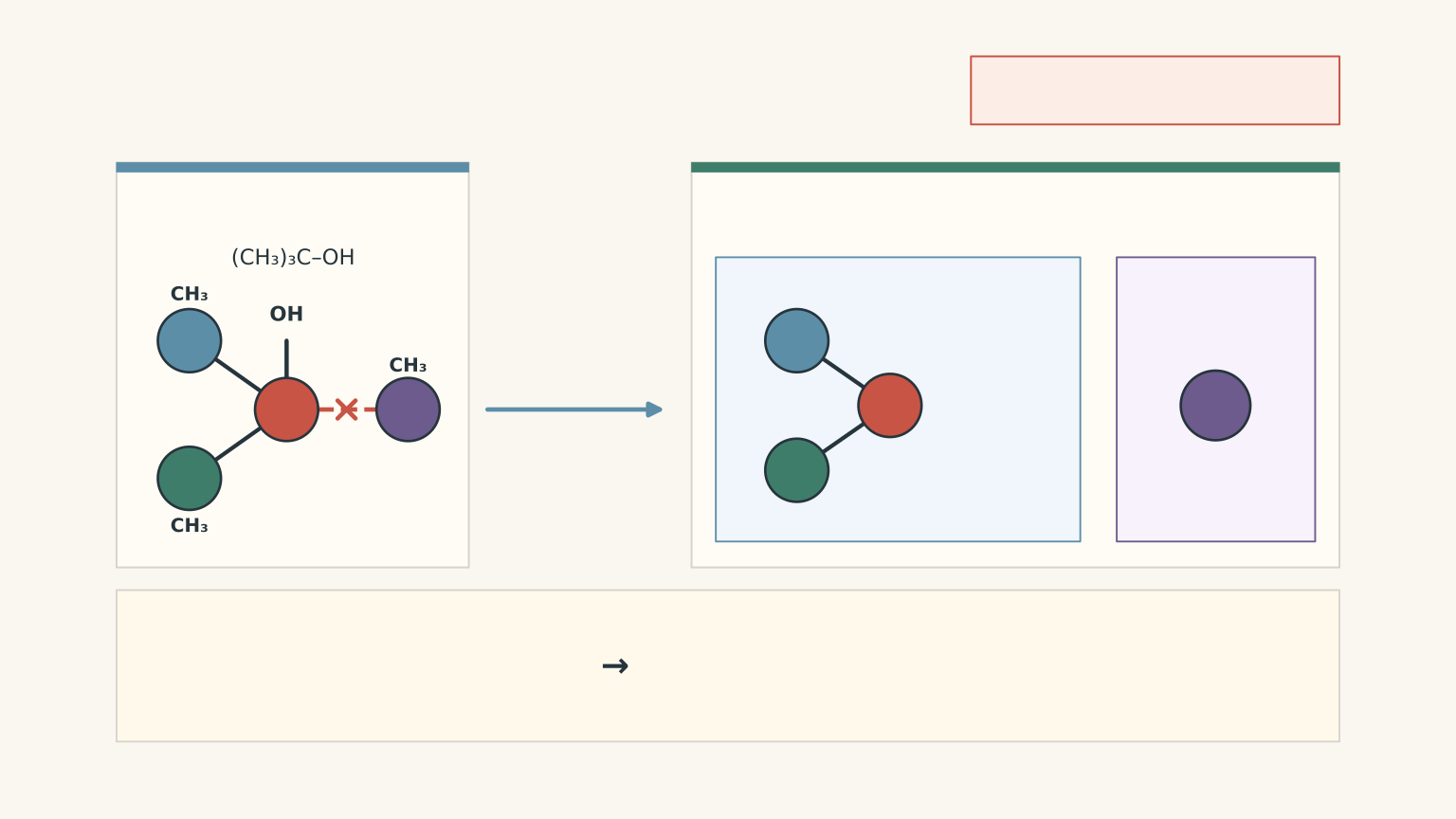
2-methylpropan-2-ol has the structure \(\ce{(CH3)3C-OH}\). Its central carbon is bonded to three other carbons and to the oxygen of the hydroxyl group.
There is a problem if we try to oxidise it in the same way as propan-1-ol or propan-2-ol.
Suppose the central carbon formed a double bond to oxygen while keeping all three carbon-carbon bonds intact. That carbon would have:
- Three single bonds to other carbon atoms.
- One double bond to oxygen.
The total bond order would be five. Ordinary neutral carbon in this structure cannot accommodate that arrangement.
Think of carbon as having four bonding slots. A double bond to oxygen uses two slots, leaving room for only two single bonds to other atoms. The tertiary alcohol’s central carbon already has three carbon neighbours, so one carbon-carbon bond would have to break.
This is a useful bonding analogy, not a literal description of physical slots. The underlying constraint is carbon’s usual valence.
Why the tertiary carbon cannot form C=O without bond cleavage
| Starting structure: 2-methylpropan-2-ol | (CH₃)₃C–OH Central carbon: 3 C–C single bonds + 1 C–O single bond. Total bond order at central carbon = 4; its usual valence is satisfied. The central carbon has 0 attached hydrogen atoms. |
|---|---|
| Hypothetical carbonyl: all C–C bonds retained | (CH₃)₃C=O Central carbon: 3 C–C single bonds + 1 C=O double bond. Total bond order at central carbon = 5; this structure is invalid. At least one C–C bond must break to form C=O at this carbon. |
There is a second way to recognise the problem: the tertiary alcohol has no hydrogen attached to the hydroxyl-bearing carbon. It therefore lacks the C-H bond needed for the usual alcohol-to-carbonyl transformation.
Be precise about which hydrogen is missing. A tertiary alcohol still has an \(\mathrm{O-H}\) hydrogen. It is the hydrogen on the carbon bonded to oxygen that is absent.
Under ordinary school-level oxidation conditions, 2-methylpropan-2-ol does not form an analogous aldehyde or ketone.
04Predicting the products
Use the number of hydrogens attached to the hydroxyl-bearing carbon to make the first prediction. Then check the reaction conditions, particularly for a primary alcohol.
| Alcohol | Hydrogen atoms on the carbon bonded to \(-\mathrm{OH}\) | Product under ordinary oxidation conditions |
|---|---|---|
| Propan-1-ol, primary | 2 | Propanal if distilled off as it forms; propanoic acid under reflux with excess oxidant |
| Propan-2-ol, secondary | 1 | Propanone |
| 2-methylpropan-2-ol, tertiary | 0 | No ordinary oxidation; no analogous carbonyl without C-C bond cleavage |
Why the conditions matter for propan-1-ol
A primary alcohol can undergo further oxidation after its aldehyde forms. This is why the reaction conditions matter.
If you want propanal, you distil it off as it forms, using controlled oxidation conditions. Removing the aldehyde limits its further contact with the oxidising agent.
If you heat propan-1-ol under reflux with excess oxidant, the propanal remains in contact with the oxidising mixture and can be oxidised further to propanoic acid:
\[ \ce{CH3CH2CHO + [O] -> CH3CH2COOH} \]
Alcohol oxidation: structure and conditions determine the products
| Propan-1-ol: distillation | CH₃CH₂CH₂OH + [O] → CH₃CH₂CHO + H₂O Primary alcohol: 2 H atoms on the carbon bearing –OH. Distil propanal as it forms to limit further oxidation. |
|---|---|
| Propan-1-ol: reflux with excess oxidant | CH₃CH₂CH₂OH + 2[O] → CH₃CH₂COOH + H₂O Propanal remains in contact with the oxidising mixture and oxidises further. Final product: propanoic acid. |
| Propan-2-ol: secondary alcohol | CH₃CHOHCH₃ + [O] → CH₃COCH₃ + H₂O 1 H atom on the carbon bearing –OH. Forms propanone, a ketone, under ordinary oxidation conditions. |
| 2-Methylpropan-2-ol: tertiary alcohol | (CH₃)₃COH 0 H atoms on the carbon bearing –OH. No ordinary oxidation: forming a carbonyl would require C–C bond cleavage. |
Propan-2-ol, by contrast, forms propanone under ordinary oxidation conditions. The ketone is not ordinarily oxidised further to a carboxylic acid by the same mild conditions, because further oxidation would require additional changes to the carbon skeleton.
05What would you observe in the laboratory?
A common school-level oxidising agent is acidified potassium dichromate(VI). Its solution is orange. When the dichromate ions are reduced to chromium(III) ions during oxidation of a suitable alcohol, the solution turns green.
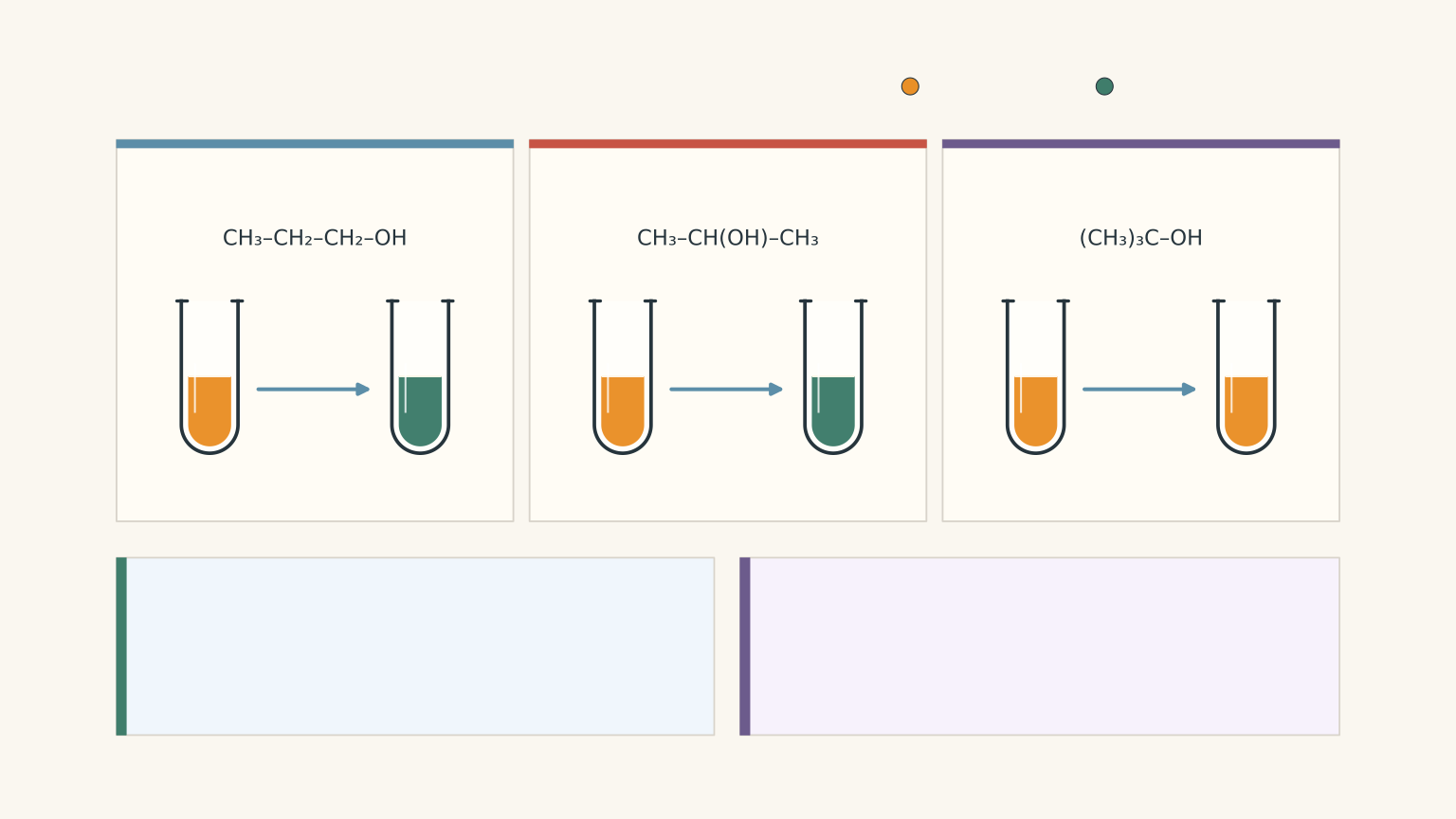
The expected observations are:
- Propan-1-ol: orange to green.
- Propan-2-ol: orange to green.
- 2-methylpropan-2-ol: no usual colour change.
The colour test tells you whether the oxidising agent has reacted under the test conditions. It does not, by itself, distinguish a primary alcohol from a secondary alcohol. You need additional information about the organic product to do that.
Ordinary oxidation versus more severe reactions
Do not turn the rule into an absolute statement that tertiary alcohols can never be oxidised.
The rule concerns ordinary school-level alcohol oxidation: the clean conversion of a primary or secondary alcohol into a carbonyl compound without breaking carbon-carbon bonds.
Under more severe conditions, oxidative degradation can break carbon-carbon bonds. The molecule may then produce smaller organic molecules, carbon dioxide, or a mixture of products, depending on the reaction conditions.
Such reactions do not contradict the structural explanation. They follow a different pathway because the carbon skeleton is no longer necessarily preserved.
06Worked examples
Worked example: Predict the product from propan-2-ol
Propan-2-ol is warmed with acidified potassium dichromate(VI). Predict the main organic product and write the net oxidation equation.
Step 1: Identify the carbon bonded to the hydroxyl group.
In \(\ce{CH3CH(OH)CH3}\), this carbon is attached to two carbon groups and one hydrogen. Propan-2-ol is a secondary alcohol.
Step 2: Check whether the carbonyl group can form without breaking carbon-carbon bonds.
The hydroxyl-bearing carbon has a C-H bond. Its C-O single bond can become a C=O double bond without changing the two carbon-carbon bonds.
Step 3: Name the product and write the equation.
The product is propanone, a ketone:
\[ \ce{CH3CH(OH)CH3 + [O] ->} \]
\[ \ce{CH3COCH3 + H2O} \]
The equation shows that one mole of propan-2-ol can produce one mole of propanone. The structural reason is the presence of a hydrogen on the carbon bonded to oxygen.
Worked example: Choose conditions to obtain propanal
A student wants to produce propanal from propan-1-ol but keeps obtaining propanoic acid. Explain which reaction conditions should be changed and write the relevant equations.
Step 1: Identify the alcohol and its possible first product.
Propan-1-ol is a primary alcohol. Its hydroxyl-bearing carbon has two hydrogen atoms, so it can be oxidised to an aldehyde.
Step 2: Choose conditions that limit further oxidation.
The student should use controlled oxidation conditions and distil the propanal off as it forms. This reduces the time the aldehyde spends in contact with the oxidising agent.
The first oxidation is:
\[ \ce{CH3CH2CH2OH + [O] ->} \]
\[ \ce{CH3CH2CHO + H2O} \]
Step 3: Explain why reflux with excess oxidant gives a different product.
Under reflux, the aldehyde remains in the reaction mixture. With excess oxidant, it can undergo further oxidation:
\[ \ce{CH3CH2CHO + [O] -> CH3CH2COOH} \]
The final product is propanoic acid.
The key distinction is between the structure of the alcohol and the conditions used to control its oxidation. Changing the conditions can determine whether a primary alcohol stops at the aldehyde stage or proceeds to the carboxylic acid stage. It does not give a tertiary alcohol the missing hydrogen required for the ordinary carbonyl-forming process.
07Questions and solutions
Question 1
An alcohol has the structure \(\ce{(CH3)3COH}\). Predict what happens when it is warmed with acidified potassium dichromate(VI) under ordinary school-level conditions. Explain your prediction using the hydrogen count on the carbon bonded to \(-\mathrm{OH}\).
Solution 1
No ordinary oxidation is expected, so the dichromate solution should remain orange. The alcohol is 2-methylpropan-2-ol, a tertiary alcohol, and its hydroxyl-bearing carbon has no hydrogen atoms.
Without a C-H bond on that carbon, the usual transformation into a carbonyl compound cannot occur while preserving all three carbon-carbon bonds. Forming a carbonyl at that carbon would require carbon-carbon bond cleavage.
Question 2
A sample containing \(0.200\ \mathrm{mol}\) of propan-2-ol is oxidised with excess acidified dichromate. After the reaction and separation, \(9.28\ \mathrm{g}\) of propanone is isolated.
Assume the theoretical mole ratio of propan-2-ol to propanone is \(1:1\), and the molar mass of propanone is \(58.0\ \mathrm{g\\,mol^{-1}}\).
Calculate the percentage yield. A student claims that the missing product mass proves that some of the propan-2-ol resisted oxidation. Explain why the calculation does not establish this.
Solution 2
The percentage yield is \(80.0\%\). The isolated mass is lower than the theoretical mass, but that difference does not establish why less product was collected.
Step 1: Calculate the theoretical amount of propanone.
The balanced organic reaction gives a \(1:1\) mole ratio, so complete conversion of \(0.200\ \mathrm{mol}\) of propan-2-ol would produce \(0.200\ \mathrm{mol}\) of propanone.
Step 2: Calculate the theoretical mass.
Using \(m=nM\), where \(m\) is mass, \(n\) is amount in moles, and \(M\) is molar mass:
\[ \begin{aligned} m &= 0.200 \times 58.0\\\ &= 11.6\ \mathrm{g} \end{aligned} \]
Step 3: Calculate the percentage yield.
\[ \begin{aligned} \text{Yield} &= \frac{\text{actual mass}}{\text{theoretical mass}} \times 100\\\ &= \frac{9.28}{11.6}\times 100\\\ &= 80.0\% \end{aligned} \]
The isolated yield may be lower than \(100\%\) because some propanone was lost during separation or transfer, the reaction was incomplete, or side reactions occurred. The yield alone cannot distinguish these possibilities.
Propan-2-ol has the structure needed for ordinary oxidation. A shortfall in isolated product is not evidence that its molecular structure prevents the reaction.
Question 3
A student argues:
“2-methylpropan-2-ol should oxidise to a ketone because its O-H hydrogen can be removed.”
Explain the precise error in this argument. Then explain why forming a carbonyl group at the hydroxyl-bearing carbon would require carbon-carbon bond cleavage.
Solution 3
The argument is incorrect because removing the O-H hydrogen is not sufficient for the usual alcohol-to-carbonyl transformation. The carbon bonded to oxygen must also have a hydrogen available for the ordinary oxidation process.
In 2-methylpropan-2-ol, the central carbon has three single bonds to other carbon atoms and one single bond to oxygen. Turning the C-O bond into a C=O double bond without breaking another bond would give that carbon five bond-order units.
That is incompatible with its usual valence. Since the central carbon has no C-H bond to remove, forming a carbonyl at that carbon requires breaking at least one C-C bond. This is why the alcohol resists ordinary oxidation rather than producing a clean, analogous ketone.
Question 4
Three separate samples are propan-1-ol, propan-2-ol, and 2-methylpropan-2-ol.
When each sample is warmed with acidified potassium dichromate(VI), two solutions change from orange to green and one remains orange. In separate controlled oxidations, with products distilled off as they form, the two reactive samples produce propanal and propanone, respectively.
Identify all three starting alcohols. Explain why the initial colour observations alone were insufficient to identify them all. Finally, state which product propan-1-ol would form under reflux with excess oxidant instead.
Solution 4
The unchanged-orange sample is 2-methylpropan-2-ol, the sample producing propanal is propan-1-ol, and the sample producing propanone is propan-2-ol.
The unchanged orange colour indicates that the tertiary alcohol has not undergone ordinary oxidation under the test conditions. The other two alcohols reduce dichromate(VI) to chromium(III), causing the orange-to-green colour change.
However, both primary and secondary alcohols can produce that same colour change. The colour observation alone therefore cannot distinguish propan-1-ol from propan-2-ol.
The organic products provide the extra information needed:
- Propanal is the aldehyde formed from the primary alcohol, propan-1-ol.
- Propanone is the ketone formed from the secondary alcohol, propan-2-ol.
Under reflux with excess oxidant, propan-1-ol proceeds further through propanal to propanoic acid. This demonstrates why product prediction requires both the alcohol’s structure and the reaction conditions.
Question 5
Suppose a deliberately harsh oxidation of 2-methylpropan-2-ol is reported to produce propanone and carbon dioxide as the only carbon-containing products, with water as the only other product. Treat these products as given for this question; they are not claimed to be the universal products of harsh oxidation.
Two explanations are proposed:
- Explanation A: The alcohol first underwent ordinary oxidation to an intact four-carbon ketone, which then broke apart.
- Explanation B: The result proves that tertiary alcohols undergo ordinary oxidation to carbonyl compounds, just like primary and secondary alcohols.
Evaluate both explanations. Write a balanced net equation using \(\ce{[O]}\), account for all four carbon atoms, and explain what further evidence would be needed to establish the actual reaction pathway.
Solution 5
Neither explanation is justified. The reported products are consistent with oxidative degradation under the stipulated harsh conditions, but they do not establish the reaction pathway or disprove the rule for ordinary school-level oxidation.
Step 1: Check whether ordinary oxidation could first produce an intact ketone at the original tertiary carbon.
The starting alcohol is \(\ce{(CH3)3COH}\). Its central carbon has three C-C bonds and one C-O bond. Changing the latter to a double bond while retaining the three C-C bonds would give five bond-order units.
Therefore, the usual direct alcohol-to-carbonyl transformation cannot produce a carbonyl at that carbon while preserving the original carbon skeleton. Explanation A incorrectly assumes that the normal oxidation step can occur unchanged before the molecule fragments.
A different reaction involving rearrangement would require separate evidence. It cannot simply be assumed from the final products.
Step 2: Balance the overall reaction and account for the carbon atoms.
The stipulated products can be represented by the following balanced net equation:
\[ \ce{(CH3)3COH + 4[O] ->} \]
\[ \ce{CH3COCH3 + CO2 + 2H2O} \]
Check the atoms on both sides:
- Carbon: four atoms in the alcohol, three in propanone, and one in carbon dioxide.
- Hydrogen: ten atoms in the alcohol and ten in the products’ water and propanone.
- Oxygen: five atoms on each side when the four oxygen equivalents represented by \(\ce{[O]}\) are included.
All four carbon atoms are accounted for. The equation shows that the stipulated products can be represented by a balanced overall reaction, but it does not tell us the sequence of bond-breaking and bond-forming steps.
Step 3: Distinguish the reaction conditions.
Explanation B confuses harsh oxidative degradation with ordinary alcohol oxidation. Under the ordinary school-level conditions discussed in this guide, 2-methylpropan-2-ol does not undergo the clean conversion to a carbonyl compound that primary and secondary alcohols can undergo.
Under sufficiently severe conditions, carbon-carbon bond cleavage can occur, allowing smaller carbon-containing products to form. That is a different reaction pathway, not a counterexample to the structural rule.
Step 4: Decide what the evidence actually establishes.
The final product list and balanced net equation establish the overall atom accounting, given the stipulated products. They do not establish whether an intermediate formed, which bond broke first, or whether one product formed before another.
Evidence of intermediates or changes in product composition over time would help distinguish competing reaction pathways. Without such evidence, claiming a particular sequence goes beyond what the results show.
This distinction leads directly to the next useful concept: aldehydes versus ketones. Both contain a carbonyl group, but aldehydes can undergo a second ordinary oxidation to carboxylic acids, while ketones generally resist further oxidation under the same conditions.