
Why the Equivalence Point Is Not Always pH 7
Equal moles of acid and base do not always produce a neutral solution. Learn how salt hydrolysis affects equivalence pH, compare three types of titration, choose suitable indicators, and practise with worked examples and HSC-style questions.
You calculate the moles of acid and base, see that they match, and write “pH = 7 at equivalence”. Your stoichiometry can be perfect and that pH answer can still be wrong. The equivalence point tells you how much acid and base have reacted, not what the remaining ions do in water.
Before reading on, predict the equivalence pH when ethanoic acid is titrated with sodium hydroxide. Is the solution acidic, neutral, or basic? Hold onto your prediction. The answer depends on something that happens after the main neutralisation reaction.
Titration: endpoint versus equivalence
| Titration apparatus | NaOH(aq) → CH₃COOH(aq) + indicator Burette delivers sodium hydroxide dropwise. Conical flask contains ethanoic acid and indicator. |
|---|---|
| Equivalence point — theoretical | n(NaOH) = n(CH₃COOH) The 1:1 reaction has reached its stoichiometric ratio. Defined by reacting amounts, not indicator colour. |
| Endpoint — observed | The indicator changes colour within its transition range. A suitable indicator makes the endpoint close to equivalence, but they may differ. |
01First, separate stoichiometry from pH
The equivalence point is reached when the amount of titrant added is exactly the stoichiometric amount required to react with the original substance, according to the balanced equation.
For ethanoic acid reacting with sodium hydroxide:
\[ \ce{CH3COOH + NaOH -> CH3COONa + H2O} \]
The reaction has a \(1:1\) mole ratio. At equivalence, the ethanoic acid and sodium hydroxide have reacted in that ratio.
But look at what remains: sodium ethanoate, dissolved in water.
\[ \ce{CH3COONa -> Na+ + CH3COO^-} \]
The acid and base have reacted in the correct proportions. That does not mean the resulting solution is neutral.
At \(25\\,^\circ\mathrm{C}\), a neutral solution has equal concentrations of hydronium ions, \(\ce{H3O+}\), and hydroxide ions, \(\mathrm{OH}^{-}\). Its pH is 7.00.
Matching the moles of acid and base does not guarantee these ion concentrations are equal.
02The missing step: check the salt
When a salt dissolves, its ions can behave in different ways. Some are essentially spectators. Others react with water and change the pH.
That second process is called hydrolysis: an ion reacts with water, producing a solution that is more acidic or more basic.
Case 1: Weak acid + strong base
Return to ethanoic acid and sodium hydroxide.
The sodium ion, \(\mathrm{Na}^{+}\), does not appreciably react with water. The ethanoate ion, \(\mathrm{CH_{3}COO}^{-}\), is different.
Ethanoic acid is a weak acid. Its conjugate base, ethanoate, can accept a proton from water:
\[ \ce{CH3COO^- + H2O <=> CH3COOH + OH^-} \]
This reaction produces hydroxide ions, \(\mathrm{OH}^{-}\), making the solution basic.
So, the prediction from the opening question is pH greater than 7 at equivalence.
The original acid has been neutralised stoichiometrically, but its conjugate base is now reacting with water. That is the step the shortcut misses.
A useful mental picture: ethanoate is like the friend who keeps borrowing a proton from water, leaving hydroxide behind each time. The analogy only describes the direction of the process; the equilibrium constant determines how much actually reacts.
Case 2: Strong acid + weak base
Now reverse the strengths. Consider hydrochloric acid reacting with ammonia:
\[ \ce{HCl + NH3 -> NH4Cl} \]
At equivalence, the solution contains ammonium chloride. Its ions are \(\ce{NH4+}\) and \(\mathrm{Cl}^{-}\).
The chloride ion is the conjugate base of a strong acid. It has negligible basicity in water.
The ammonium ion, however, is the conjugate acid of the weak base ammonia. It can donate a proton to water:
\[ \ce{NH4+ + H2O <=> NH3 + H3O+} \]
This reaction produces hydronium ions, \(\ce{H3O+}\), making the solution acidic.
The equivalence pH is therefore less than 7.
Why salt ions change the equivalence pH
| Left panel: Basic hydrolysis | CH₃COO⁻ + H₂O ⇌ CH₃COOH + OH⁻ Ethanoate accepts H⁺ from water. OH⁻ formation makes the solution basic. |
|---|---|
| Spectator ion: Sodium | Na⁺ Remains dissolved in solution. Negligible reaction with water. |
| Right panel: Acidic hydrolysis | NH₄⁺ + H₂O ⇌ NH₃ + H₃O⁺ Ammonium transfers H⁺ to water. H₃O⁺ formation makes the solution acidic. |
| Spectator ion: Chloride | Cl⁻ Remains dissolved in solution. Negligible reaction with water. |
03Compare the three types of titration
The identity of the salt, not simply the equality of the reacting moles, determines whether hydrolysis affects the equivalence pH.
| Acid and base | Salt formed at equivalence | Important ion | Expected pH at 25 °C |
|---|---|---|---|
| Strong acid + strong base | NaCl | Neither \(\mathrm{Na}^{+}\) nor \(\mathrm{Cl}^{-}\) appreciably hydrolyses | Approximately 7 |
| Weak acid + strong base | \(\ce{CH3COONa}\) | \(\mathrm{CH_{3}COO}^{-}\) produces \(\mathrm{OH}^{-}\) | Greater than 7 |
| Strong acid + weak base | \(\ce{NH4Cl}\) | \(\ce{NH4+}\) produces \(\ce{H3O+}\) | Less than 7 |
For a strong acid-strong base titration, such as hydrochloric acid with sodium hydroxide, the salt ions are effectively spectators. Neither ion appreciably reacts with water to alter the pH.
For the other two combinations, one of the salt’s ions is the conjugate of a weak acid or weak base. It reacts with water, so the solution is no longer neutral.
The rule to remember is:
- The conjugate base of a weak acid makes the equivalence solution basic.
- The conjugate acid of a weak base makes the equivalence solution acidic.
- Ions from a strong acid and a strong base generally have negligible hydrolysis, giving an approximately neutral solution.
These predictions assume ordinary aqueous solutions at \(25\\,^\circ\mathrm{C}\). Very dilute solutions may require more careful treatment of water’s own ionisation.
04Read the titration curve, not just the mole ratio
The three reactions also produce different titration curves. A titration curve plots pH against the volume of titrant added.
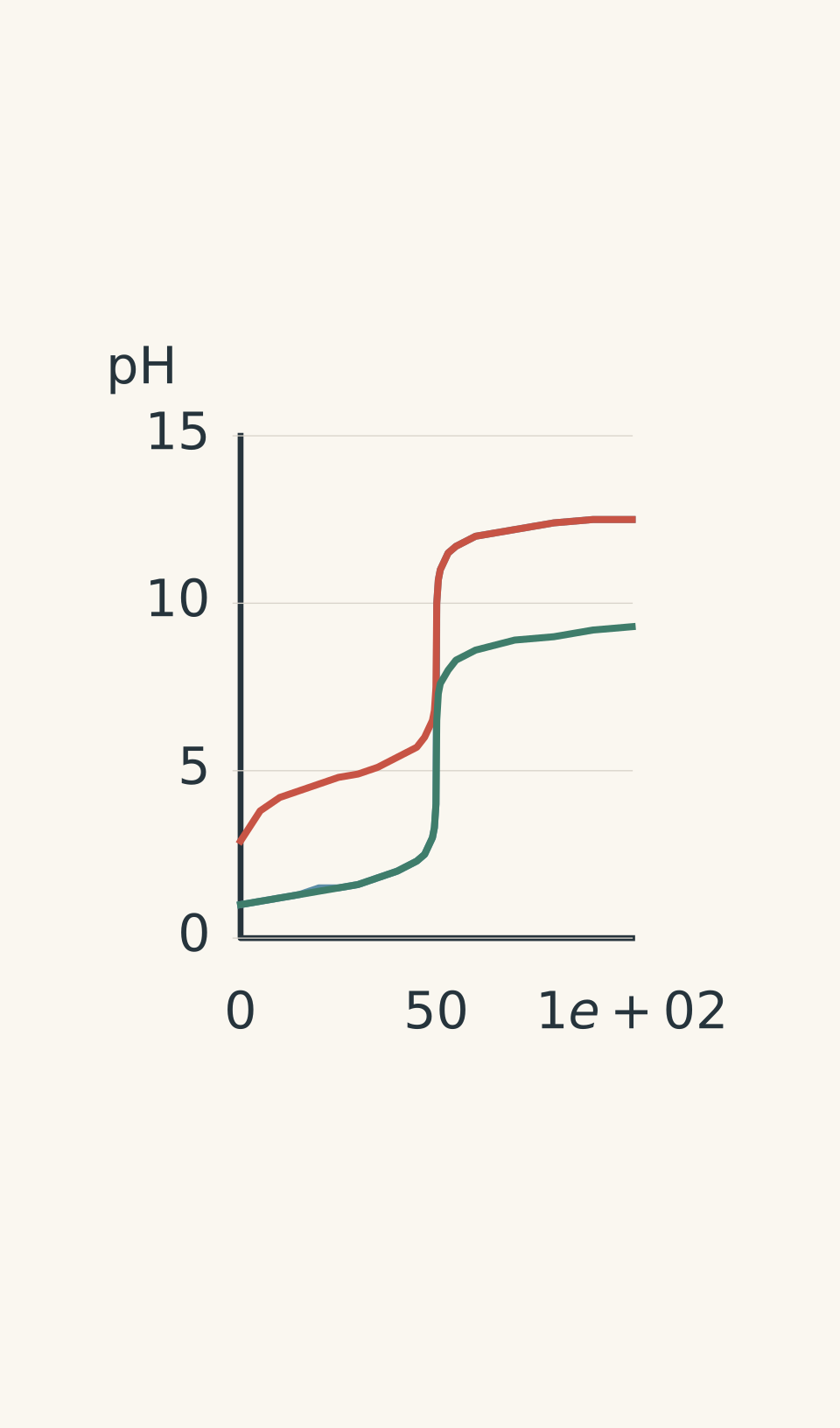
- Strong acid + strong base; equivalence pH 7.0
- Weak acid + strong base; buffer region; equivalence pH ≈ 8.7
- Strong acid + weak base; gentler rise; equivalence pH ≈ 5.3
Strong acid-strong base
The pH starts low when the flask contains a strong acid. As strong base is added, the pH rises sharply near equivalence.
The steep rise passes through pH 7. The equivalence point is approximately neutral at \(25\\,^\circ\mathrm{C}\).
Weak acid-strong base
A weak acid begins at a higher pH than a comparable strong acid because it ionises only partially.
Before equivalence, both the weak acid and its conjugate base are present. This mixture can resist changes in pH, producing a buffer region on the curve.
At equivalence, the weak acid has been neutralised stoichiometrically, but its conjugate base remains. Hydrolysis produces \(\mathrm{OH}^{-}\), so the equivalence point lies above pH 7.
Strong acid-weak base
The curve starts at low pH because the flask contains a strong acid. As the weak base is added, the pH rises.
At equivalence, the conjugate acid of the weak base remains in solution. It produces \(\ce{H3O+}\), so the equivalence point lies below pH 7.
The pH change near equivalence is also generally less pronounced than for a comparable strong acid-strong base titration.
One important boundary: these descriptions apply at equivalence. Once you add excess titrant, the excess acid or base also affects the pH. You cannot keep using a salt-only model after equivalence.
05Equivalence point vs endpoint: don’t confuse them
These terms describe different things.
Equivalence point: the theoretical point at which the titrant has been added in the exact stoichiometric amount required by the reaction.
Endpoint: the experimental point at which an indicator changes colour sufficiently for you to recognise the change.
The endpoint is an observation. The equivalence point is defined by the reaction’s stoichiometry.
They should be close in a well-designed titration, but they are not automatically identical.
Why the indicator matters
An indicator changes colour over a range of pH values, not at one perfectly precise pH. You need its transition range to overlap the steep part of the titration curve near equivalence.
Typical transition ranges are:
| Indicator | Approximate transition range | Suitable application |
|---|---|---|
| Bromothymol blue | pH 6.0-7.6 | Strong acid-strong base |
| Phenolphthalein | pH 8.2-10.0 | Weak acid-strong base |
| Methyl red | pH 4.4-6.2 | Strong acid-weak base |
These are useful choices, not rigid rules for every possible concentration. The actual curve determines whether an indicator is suitable.
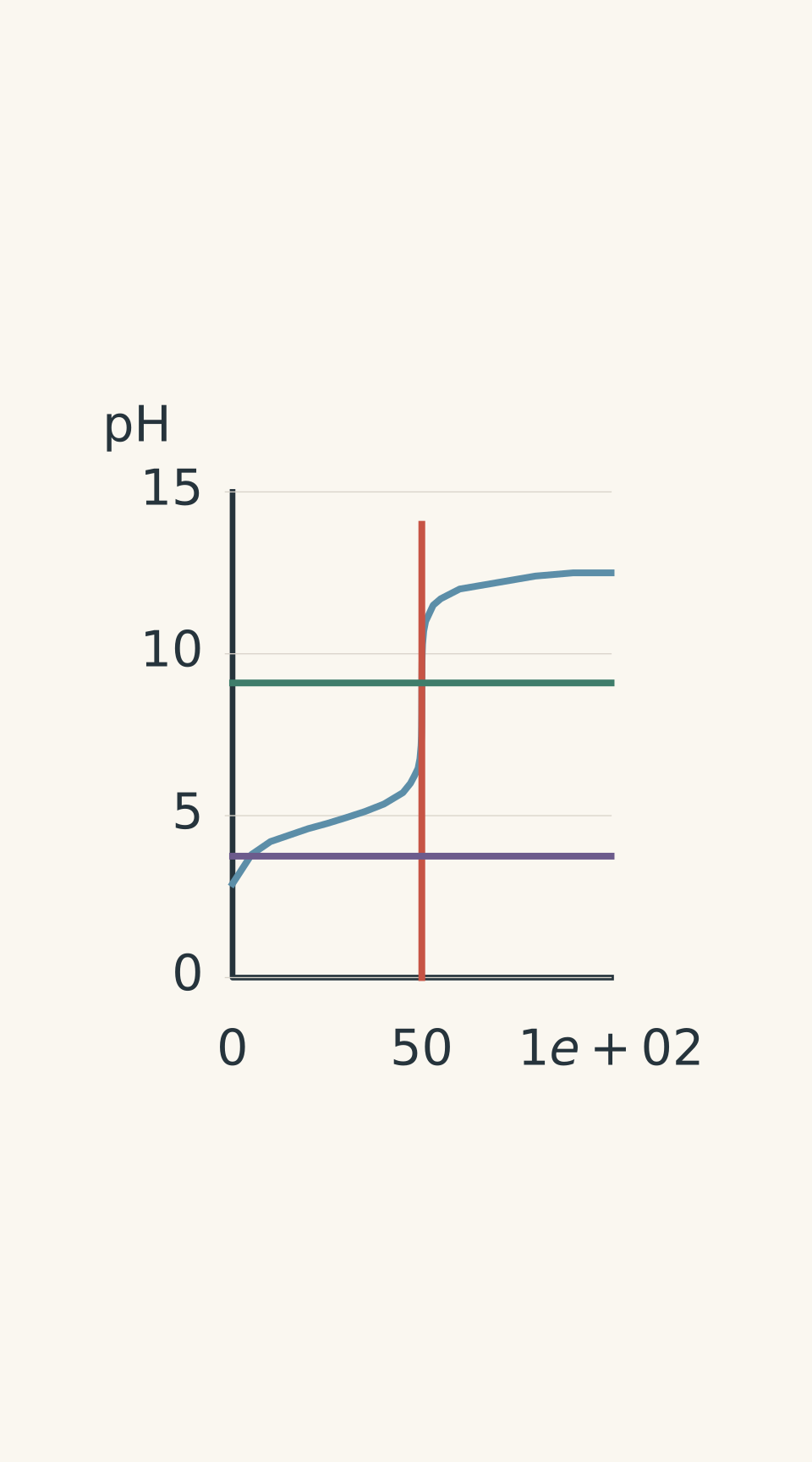
- Titration curve; observed endpoint ≈49.98 mL, pH ≈8.2
- Theoretical equivalence marker: 50.00 mL, pH ≈8.7
- Suitable transition range: phenolphthalein, pH 8.2–10.0; midpoint shown
- Unsuitable transition range: methyl orange, pH 3.1–4.4; midpoint shown
Suppose you titrate a weak acid with a strong base and choose an indicator that changes colour well below the steep rise. The indicator may change before equivalence, so the measured titre is too small.
Choosing an indicator because its colour change occurs around pH 7 is not a universal solution. For a weak acid-strong base titration, the equivalence pH is basic. An indicator whose transition range lies in that basic region is generally more appropriate.
06A decision method you can reuse in exams
When a question asks for the equivalence pH, follow this sequence.
Step 1: Balance the reaction.
Use the balanced equation to find the stoichiometric amount of titrant required. Do not assume equal volumes mean equal moles, or that every acid-base reaction has a \(1:1\) ratio.
Step 2: Identify the salt formed.
Work out which ions remain at equivalence. For a typical aqueous titration, the original acid and base have reacted in the required proportions, and the salt is dissolved in water.
Step 3: Check which ions react with water.
- Conjugate base of a weak acid: produces \(\mathrm{OH}^{-}\), making the solution basic.
- Conjugate acid of a weak base: produces \(\ce{H3O+}\), making the solution acidic.
- Ions from strong acids and strong bases: generally negligible hydrolysis.
Step 4: Predict the pH before calculating it.
At \(25\\,^\circ\mathrm{C}\), predict whether the equivalence solution is acidic, neutral, or basic. If a calculation is required, find the salt concentration using the total solution volume, including the titrant and any water added.
Step 5: Choose an indicator using the curve.
Compare its transition range with the steep pH change near equivalence. Do not automatically select an indicator centred on pH 7.
Titration: From Equation to Indicator
- Balance the equation
Balance atoms and total charge.
- Find equivalence stoichiometry
Use equation coefficients to relate reactant moles.
- Identify salt ions
List the dissolved cation and anion at equivalence.
- Check for hydrolysis
Weak-acid conjugate base → OH⁻; weak-base conjugate acid → H₃O⁺.
Strong-acid/strong-base ions hydrolyse negligibly; weak–weak salts may hydrolyse both ways.
- Predict the pH
Basic hydrolysis raises pH; acidic hydrolysis lowers it.
For weak–weak salts, compare conjugate-ion strengths; neutral pH is 7 at 25 °C.
- Select an indicator
Its transition range must overlap the steep pH change near equivalence.
Do not automatically choose an indicator centred on pH 7.
What if both the acid and base are weak?
Be careful with memorised shortcuts. For a weak acid-weak base reaction, both the conjugate acid and conjugate base can react with water. The pH depends on their relative acid and base strengths, represented by their dissociation constants.
You cannot automatically classify that equivalence solution as acidic or basic without further information.
Also, pH 7 is the neutral value at \(25\\,^\circ\mathrm{C}\). At another temperature, neutrality still means equal hydronium and hydroxide concentrations, but the neutral pH need not be 7.
07Worked example: Find the pH at weak-acid equivalence
A \(25.0\ \mathrm{mL}\) sample of \(0.100\ \mathrm{mol\\,L^{-1}}\) ethanoic acid is titrated with \(0.100\ \mathrm{mol\\,L^{-1}}\) sodium hydroxide. At \(25\\,^\circ\mathrm{C}\), the acid dissociation constant is \(K_a=1.8\times10^{-5}\), and the ionisation constant of water is \(K_w=1.0\times10^{-14}\). Calculate the equivalence volume of sodium hydroxide and the approximate pH at equivalence.
Step 1: Calculate the initial moles of ethanoic acid.
Use \(n=CV\), where \(n\) is the amount in moles, \(C\) is the concentration in \(\mathrm{mol\\,L^{-1}}\), and \(V\) is the volume in litres.
\[ \begin{aligned} n(\ce{CH3COOH}) &= CV\\ &=0.100\times0.0250\\ &=2.50\times10^{-3}\ \mathrm{mol} \end{aligned} \]
Step 2: Find the equivalence volume.
The reaction has a \(1:1\) mole ratio, so \(2.50\times10^{-3}\ \mathrm{mol}\) of sodium hydroxide is required.
\[ \begin{aligned} V(\ce{NaOH}) &=\frac{n}{C}\\ &=\frac{2.50\times10^{-3}}{0.100}\\ &=0.0250\ \mathrm{L}\\ &=25.0\ \mathrm{mL} \end{aligned} \]
The equivalence volume is \(25.0\ \mathrm{mL}\).
Step 3: Calculate the concentration of ethanoate ions at equivalence.
The total volume is \(25.0+25.0=50.0\ \mathrm{mL}\). The moles of ethanoate formed equal the initial moles of ethanoic acid.
\[ \begin{aligned} [\mathrm{CH_{3}COO}^{-}] &=\frac{2.50\times10^{-3}}{0.0500}\\ &=0.0500\ \mathrm{mol\\,L^{-1}} \end{aligned} \]
Step 4: Calculate the basicity of the ethanoate ion.
The base dissociation constant \(K_b\) describes the reaction of a base with water. For a conjugate acid-base pair,
\[ K_aK_b=K_w \]
Therefore,
\[ \begin{aligned} K_b &=\frac{K_w}{K_a}\\ &=\frac{1.0\times10^{-14}}{1.8\times10^{-5}}\\ &=5.56\times10^{-10} \end{aligned} \]
Ethanoate reacts with water to produce hydroxide ions. If \(x\) is the equilibrium concentration of hydroxide produced, the weak-base approximation gives
\[ K_b\approx\frac{x^2}{C} \]
where \(C\) is the initial ethanoate concentration. Rearranging,
\[ \begin{aligned} [\mathrm{OH}^{-}] &\approx\sqrt{K_bC}\\ &=\sqrt{(5.56\times10^{-10})(0.0500)}\\ &=5.27\times10^{-6}\ \mathrm{mol\\,L^{-1}} \end{aligned} \]
The approximation is valid because this change is very small compared with the initial ethanoate concentration.
Step 5: Convert the hydroxide concentration into pH.
The pOH is defined as \(-\log_{10}[\mathrm{OH}^{-}]\). At \(25\\,^\circ\mathrm{C}\), \(\mathrm{pH}+\mathrm{pOH}=14.00\).
\[ \begin{aligned} \mathrm{pOH} &=-\log_{10}(5.27\times10^{-6})\\ &=5.28\\[4pt] \mathrm{pH} &=14.00-5.28\\ &=\boxed{8.72} \end{aligned} \]
The equivalence point occurs at \(25.0\ \mathrm{mL}\), but the pH is approximately \(8.72\), not 7.00.
The tempting route was to use equal moles as proof of neutrality. The corrected route uses the mole ratio to find equivalence, then checks the salt’s hydrolysis to determine the pH.
08Worked example: Strong acid titrated with a weak base
A \(20.0\ \mathrm{mL}\) sample of \(0.150\ \mathrm{mol\\,L^{-1}}\) hydrochloric acid is titrated with \(0.100\ \mathrm{mol\\,L^{-1}}\) ammonia. The base dissociation constant of ammonia is \(K_b=1.8\times10^{-5}\). Calculate the equivalence volume and approximate equivalence pH, then choose a suitable indicator.
Step 1: Calculate the initial moles of hydrochloric acid.
\[ \begin{aligned} n(\ce{HCl}) &=CV\\ &=0.150\times0.0200\\ &=3.00\times10^{-3}\ \mathrm{mol} \end{aligned} \]
Step 2: Find the equivalence volume of ammonia.
The reaction between hydrochloric acid and ammonia has a \(1:1\) mole ratio.
\[ \begin{aligned} V(\ce{NH3}) &=\frac{3.00\times10^{-3}}{0.100}\\ &=0.0300\ \mathrm{L}\\ &=30.0\ \mathrm{mL} \end{aligned} \]
The total volume at equivalence is \(20.0+30.0=50.0\ \mathrm{mL}\).
Step 3: Calculate the ammonium concentration.
At equivalence, the solution contains ammonium chloride. The chloride ion is effectively a spectator, while ammonium can react with water.
\[ \begin{aligned} [\ce{NH4+}] &=\frac{3.00\times10^{-3}}{0.0500}\\ &=0.0600\ \mathrm{mol\\,L^{-1}} \end{aligned} \]
Step 4: Find the acid dissociation constant of ammonium.
The ammonium ion is the conjugate acid of ammonia, so
\[ \begin{aligned} K_a(\ce{NH4+}) &=\frac{K_w}{K_b(\ce{NH3})}\\ &=\frac{1.0\times10^{-14}}{1.8\times10^{-5}}\\ &=5.56\times10^{-10} \end{aligned} \]
For the weak-acid hydrolysis of ammonium, let \(x\) represent the equilibrium concentration of hydronium produced.
\[ \begin{aligned} [\ce{H3O+}] &\approx\sqrt{K_aC}\\ &=\sqrt{(5.56\times10^{-10})(0.0600)}\\ &=5.77\times10^{-6}\ \mathrm{mol\\,L^{-1}} \end{aligned} \]
Step 5: Calculate the pH and select the indicator.
\[ \begin{aligned} \mathrm{pH} &=-\log_{10}(5.77\times10^{-6})\\ &=\boxed{5.24} \end{aligned} \]
The equivalence pH is approximately \(5.24\), so the solution is acidic. Methyl red, with a transition range of approximately pH \(4.4\)-\(6.2\), is a suitable indicator for this titration.
Notice the pattern: the equivalence volume came from stoichiometry, but the equivalence pH came from the behaviour of the ammonium ion.
09Before you submit: a quick self-check
Run through these questions whenever a titration problem asks for pH or indicator choice.
- Have I balanced the reaction and used the correct mole ratio?
- Have I identified the salt formed at equivalence?
- Have I checked whether either ion hydrolyses?
- If calculating pH, have I used the salt concentration after mixing all the solutions?
- If choosing an indicator, does its transition range overlap the steep section of the curve?
If you can answer all five, you have avoided the main traps.
10Questions and solutions
Question 1
At \(25\\,^\circ\mathrm{C}\), \(25.0\ \mathrm{mL}\) of \(0.100\ \mathrm{mol\\,L^{-1}}\) nitric acid is titrated with \(0.100\ \mathrm{mol\\,L^{-1}}\) potassium hydroxide.
Calculate the equivalence volume and state the approximate pH at equivalence. Explain why this pH is expected.
Solution 1
The equivalence volume is \(25.0\ \mathrm{mL}\), and the pH is approximately \(7.00\) at \(25\\,^\circ\mathrm{C}\).
Step 1: Calculate the initial moles of nitric acid.
\[ n(\ce{HNO3})=0.100\times0.0250 =2.50\times10^{-3}\ \mathrm{mol} \]
Step 2: Use the \(1:1\) mole ratio.
The same amount of potassium hydroxide is required:
\[ V(\ce{KOH}) =\frac{2.50\times10^{-3}}{0.100} =0.0250\ \mathrm{L} =25.0\ \mathrm{mL} \]
Step 3: Check the salt.
The reaction forms potassium nitrate, \(\ce{KNO3}\). The ions \(\mathrm{K}^{+}\) and \(\mathrm{NO_{3}}^{-}\) do not appreciably react with water to change the pH.
Because both the acid and base are strong, the equivalence solution is approximately neutral at \(25\\,^\circ\mathrm{C}\). This is the case in which the familiar pH 7 prediction is appropriate.
Question 2
A \(25.0\ \mathrm{mL}\) sample of \(0.0800\ \mathrm{mol\\,L^{-1}}\) methanoic acid, \(\ce{HCOOH}\), is titrated with \(0.100\ \mathrm{mol\\,L^{-1}}\) sodium hydroxide.
At equivalence, the steep pH rise extends from pH \(7.3\) to pH \(10.0\). Three indicators are available:
- Methyl orange: pH \(3.1\)-\(4.4\)
- Bromothymol blue: pH \(6.0\)-\(7.6\)
- Phenolphthalein: pH \(8.2\)-\(10.0\)
Calculate the equivalence volume, predict whether the equivalence solution is acidic or basic, and select the most suitable indicator. Explain why the other two are less suitable.
Solution 2
The equivalence volume is \(20.0\ \mathrm{mL}\), the equivalence solution is basic, and phenolphthalein is the most suitable indicator of the three.
Step 1: Calculate the moles of methanoic acid.
\[ \begin{aligned} n(\ce{HCOOH}) &=CV\\ &=0.0800\times0.0250\\ &=2.00\times10^{-3}\ \mathrm{mol} \end{aligned} \]
Step 2: Calculate the equivalence volume.
Methanoic acid is monoprotic, so it reacts with sodium hydroxide in a \(1:1\) ratio.
\[ \begin{aligned} V(\ce{NaOH}) &=\frac{2.00\times10^{-3}}{0.100}\\ &=0.0200\ \mathrm{L}\\ &=20.0\ \mathrm{mL} \end{aligned} \]
Step 3: Predict the pH from the salt.
The salt is sodium methanoate, \(\ce{HCOONa}\). Its methanoate ion, \(\mathrm{HCOO}^{-}\), is the conjugate base of a weak acid. It reacts with water to produce \(\mathrm{OH}^{-}\), so the equivalence solution is basic.
Step 4: Choose the indicator from the curve.
Phenolphthalein changes colour within the steep pH rise, making it suitable for detecting the endpoint close to equivalence.
Bromothymol blue overlaps only the lower edge of the stated rise, while methyl orange changes colour well below it. Those transition ranges are less suitable for this particular titration.
The key point is that indicator choice depends on the curve’s steep region, not on whether the flask originally contained an acid.
Question 3
A \(0.0400\ \mathrm{mol\\,L^{-1}}\) ammonium chloride solution has a measured pH of \(5.32\) at \(25\\,^\circ\mathrm{C}\).
Estimate the acid dissociation constant, \(K_a\), of the ammonium ion, then calculate the base dissociation constant, \(K_b\), of ammonia. Assume that the change in ammonium concentration is small compared with its initial concentration.
Explain why the solution is acidic even though no excess strong acid is present.
Solution 3
The estimated constants are \(K_a(\ce{NH4+})=5.73\times10^{-10}\) and \(K_b(\ce{NH3})=1.75\times10^{-5}\). The solution is acidic because ammonium ions react with water to produce hydronium ions.
Step 1: Convert pH into hydronium concentration.
Using \(\mathrm{pH}=-\log_{10}[\ce{H3O+}]\),
\[ \begin{aligned} [\ce{H3O+}] &=10^{-5.32}\\ &=4.79\times10^{-6}\ \mathrm{mol\\,L^{-1}} \end{aligned} \]
Step 2: Calculate \(K_a\) for ammonium.
The equilibrium is
\[ \ce{NH4+ + H2O <=> NH3 + H3O+} \]
Let \(x=4.79\times10^{-6}\ \mathrm{mol\\,L^{-1}}\) be the hydronium concentration produced by this reaction. Under the stated approximation,
\[ \begin{aligned} K_a &\approx\frac{x^2}{0.0400}\\ &=\frac{(4.79\times10^{-6})^2}{0.0400}\\ &=5.73\times10^{-10} \end{aligned} \]
Step 3: Calculate \(K_b\) for ammonia.
For a conjugate acid-base pair, \(K_aK_b=K_w\).
\[ \begin{aligned} K_b(\ce{NH3}) &=\frac{K_w}{K_a(\ce{NH4+})}\\ &=\frac{1.0\times10^{-14}}{5.73\times10^{-10}}\\ &=1.75\times10^{-5} \end{aligned} \]
Step 4: Explain the pH.
The chloride ions are spectators. The ammonium ions donate protons to water, increasing the hydronium concentration above that of a neutral solution at \(25\\,^\circ\mathrm{C}\).
The acidity comes from the salt’s conjugate acid, not from leftover hydrochloric acid. This is why a salt solution can be acidic even when the original strong acid has been completely neutralised.
Question 4
In a particular weak acid-strong base titration, stoichiometric calculations establish that the equivalence volume is \(24.80\ \mathrm{mL}\). However, the observed indicator endpoint occurs at \(23.90\ \mathrm{mL}\).
Calculate the volume error and percentage error in the measured titre, relative to the equivalence volume. Explain why the endpoint does not change the true equivalence volume, and state how a more suitable indicator should be selected.
Solution 4
The measured endpoint is \(0.90\ \mathrm{mL}\) early, corresponding to a \(3.63\%\) underestimate of the equivalence volume.
Step 1: Calculate the signed volume error.
\[ \begin{aligned} \text{Volume error} &=V_{\text{measured}}-V_{\text{equivalence}}\\ &=23.90-24.80\\ &=-0.90\ \mathrm{mL} \end{aligned} \]
The negative sign shows that the endpoint occurred before equivalence.
Step 2: Calculate the percentage error.
\[ \begin{aligned} \%\text{ error} &=\frac{-0.90}{24.80}\times100\\ &=-3.63\% \end{aligned} \]
The magnitude of the error is \(3.63\%\).
Step 3: Explain the discrepancy.
The endpoint is determined by an indicator’s colour change. If its transition range occurs before the steep part of the curve, the observed endpoint can occur before the stoichiometric equivalence point.
The endpoint does not alter the balanced reaction or the number of moles required for equivalence. It only affects the experimentally observed titre.
A better indicator has a transition range within the steep pH rise near equivalence. This minimises the volume difference between endpoint and equivalence.
Question 5
At \(25\\,^\circ\mathrm{C}\), \(25.0\ \mathrm{mL}\) of \(0.100\ \mathrm{mol\\,L^{-1}}\) monoprotic weak acid \(\ce{HA}\), with \(K_a=1.0\times10^{-5}\), is titrated with \(0.100\ \mathrm{mol\\,L^{-1}}\) sodium hydroxide.
A second identical sample is diluted with \(75.0\ \mathrm{mL}\) of water before titration. Both samples give a recorded phenolphthalein endpoint of \(25.0\ \mathrm{mL}\) to the nearest \(0.1\ \mathrm{mL}\). Phenolphthalein has a transition range of approximately pH \(8.2\)-\(10.0\).
A student concludes that the equivalence pH must be identical in both flasks because the measured endpoint volumes are the same.
Is the conclusion justified? Calculate the approximate equivalence pH for both samples, and explain how dilution can change the equivalence pH without changing the equivalence volume. Your explanation must also account for the apparently identical indicator endpoints.
Assume ideal solution behaviour, \(K_w=1.0\times10^{-14}\), and that the weak-base approximation is valid for the salt hydrolysis.
Solution 5
No. The conclusion is not justified. Both samples require \(25.0\ \mathrm{mL}\) of sodium hydroxide to reach equivalence, but their approximate equivalence pH values are \(8.85\) and \(8.65\), respectively.
The key is that the amount of acid determines the equivalence volume, while the concentration of the salt formed affects the hydrolysis equilibrium and therefore the pH.
Step 1: Calculate the moles of acid and the equivalence volume.
Both samples initially contain the same amount of acid.
\[ \begin{aligned} n(\ce{HA}) &=CV\\ &=0.100\times0.0250\\ &=2.50\times10^{-3}\ \mathrm{mol} \end{aligned} \]
The reaction between a monoprotic acid and sodium hydroxide has a \(1:1\) mole ratio. Therefore,
\[ \begin{aligned} V(\ce{NaOH}) &=\frac{2.50\times10^{-3}}{0.100}\\ &=0.0250\ \mathrm{L}\\ &=25.0\ \mathrm{mL} \end{aligned} \]
Adding water changes the acid’s concentration, but not its number of moles. Both samples still require \(25.0\ \mathrm{mL}\) of sodium hydroxide for equivalence.
Step 2: Calculate the base dissociation constant of the conjugate base.
The salt contains \(\mathrm{A}^{-}\), the conjugate base of \(\ce{HA}\). It reacts with water to produce hydroxide ions.
\[ \ce{A^- + H2O <=> HA + OH^-} \]
Its base dissociation constant is
\[ \begin{aligned} K_b &=\frac{K_w}{K_a}\\ &=\frac{1.0\times10^{-14}}{1.0\times10^{-5}}\\ &=1.0\times10^{-9} \end{aligned} \]
This value is the same for both samples. What changes on dilution is the concentration of the conjugate base.
Step 3: Calculate the equivalence pH of the undiluted sample.
At equivalence, the total volume is
\[ 25.0+25.0=50.0\ \mathrm{mL} \]
The conjugate base concentration is
\[ \begin{aligned} [\mathrm{A}^{-}] &=\frac{2.50\times10^{-3}}{0.0500}\\ &=0.0500\ \mathrm{mol\\,L^{-1}} \end{aligned} \]
Using the weak-base approximation,
\[ \begin{aligned} [\mathrm{OH}^{-}] &\approx\sqrt{K_b[\mathrm{A}^{-}]}\\ &=\sqrt{(1.0\times10^{-9})(0.0500)}\\ &=7.07\times10^{-6}\ \mathrm{mol\\,L^{-1}} \end{aligned} \]
Therefore,
\[ \begin{aligned} \mathrm{pOH}&=5.15\\\ \mathrm{pH}&=14.00-5.15\\ &=\boxed{8.85} \end{aligned} \]
The undiluted equivalence solution is basic.
Step 4: Calculate the equivalence pH of the diluted sample.
The second sample contains an extra \(75.0\ \mathrm{mL}\) of water before the titration. At equivalence, its total volume is
\[ 25.0+75.0+25.0=125.0\ \mathrm{mL} \]
The moles of conjugate base formed are unchanged, but they are distributed through a larger volume.
\[ \begin{aligned} [\mathrm{A}^{-}] &=\frac{2.50\times10^{-3}}{0.1250}\\ &=0.0200\ \mathrm{mol\\,L^{-1}} \end{aligned} \]
The hydroxide concentration is now
\[ \begin{aligned} [\mathrm{OH}^{-}] &\approx\sqrt{(1.0\times10^{-9})(0.0200)}\\ &=4.47\times10^{-6}\ \mathrm{mol\\,L^{-1}} \end{aligned} \]
Thus,
\[ \begin{aligned} \mathrm{pOH}&=5.35\\\ \mathrm{pH}&=14.00-5.35\\ &=\boxed{8.65} \end{aligned} \]
Dilution reduces the conjugate base concentration, so less hydroxide is produced per litre at equilibrium. The pH moves closer to 7, but the solution remains basic.
Step 5: Explain the identical indicator endpoints.
Both equivalence pH values, \(8.85\) and \(8.65\), fall within phenolphthalein’s transition range of pH \(8.2\)-\(10.0\). The indicator does not report an exact numerical pH; it reports a visible colour change over a range.
Near equivalence, the pH changes sharply with the volume of titrant added. Both samples can therefore produce endpoints that are recorded as \(25.0\ \mathrm{mL}\) to the nearest \(0.1\ \mathrm{mL}\), even though their equivalence pH values differ.
The student’s mistake is treating an unchanged titre as proof of an unchanged pH. The titre reflects the amount of acid present; the equivalence pH also depends on the concentration and behaviour of the salt formed.
This is the final distinction to carry into indicator questions: use stoichiometry to locate equivalence, use hydrolysis to determine its pH, and use the steep section of the titration curve to judge whether the observed endpoint is a reliable estimate of that point.