
Gibbs Free Energy and Reaction Spontaneity for HSC Chemistry
Learn how enthalpy, entropy, and temperature combine in Gibbs free energy to determine whether a reaction is spontaneous under standard conditions.
A reaction can release heat and still fail to be spontaneous. Another reaction can absorb heat and happen anyway. So if you only look at enthalpy, \(\Delta H^\circ\), you can make the wrong prediction.
Before reading on, predict this: if a process absorbs energy from its surroundings, must it be nonspontaneous?
No. Melting above a substance’s melting point is an obvious counterexample. The process can be endothermic and still be thermodynamically favourable. Something else is competing with the energy change.
That something is entropy.
Gibbs free energy combines the enthalpy change and entropy change into one quantity, \(\Delta G^\circ\), which lets us predict whether a reaction is spontaneous under standard conditions.
01Why enthalpy alone is not enough
Suppose a reaction releases energy into its surroundings. That gives it a negative enthalpy change:
\[ \Delta H^\circ < 0 \]
You might reasonably expect the reaction to be spontaneous. Releasing energy is usually favourable.
But now imagine the reaction turns several freely moving gas particles into one tightly organised solid. The system has lost an enormous number of possible arrangements. Its entropy has fallen.
That entropy change can oppose the favourable enthalpy change.
The reverse situation can also occur. A reaction might absorb heat, giving \(\Delta H^\circ > 0\), but create many more possible particle arrangements. At a sufficiently high temperature, that increase in entropy can dominate.
So spontaneity depends on a competition between two effects:
- enthalpy: does the process lower the system’s energy?
- entropy: does the process increase the number of energetically accessible arrangements?
If you need a refresher on what chemists mean by spontaneous, standard conditions, and thermodynamic favourability, see tutorgum’s guide to reaction spontaneity and Gibbs free energy terminology.
02Gibbs free energy combines both effects
For a reaction under standard conditions,
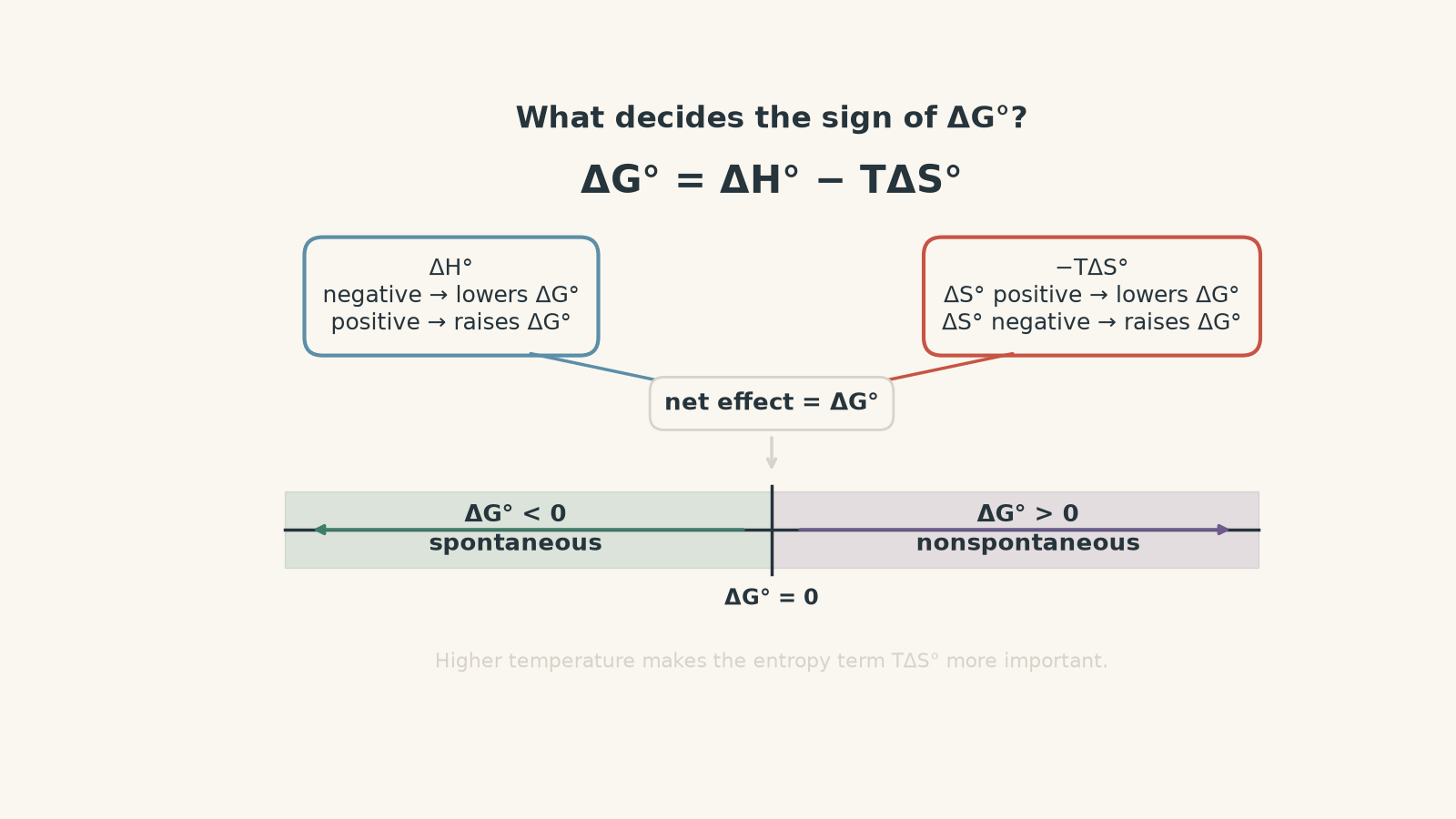
\[ \Delta G^\circ = \Delta H^\circ - T\Delta S^\circ \]
where:
- \(\Delta G^\circ\) is the standard Gibbs free energy change, usually in \(\text{kJ mol}^{-1}\)
- \(\Delta H^\circ\) is the standard enthalpy change, usually in \(\text{kJ mol}^{-1}\)
- \(T\) is the absolute temperature in kelvin, \(\text{K}\)
- \(\Delta S^\circ\) is the standard entropy change, usually in \(\text{J mol}^{-1}\text{K}^{-1}\)
The equation is not just a formula to memorise. Each term has a job.
\(\Delta H^\circ\) represents the enthalpy contribution. A negative value favours the forward reaction.
The term \(T\Delta S^\circ\) represents the entropy contribution at a particular temperature. Because it is subtracted, a positive entropy change makes \(\Delta G^\circ\) more negative and therefore makes the forward reaction more favourable.
Temperature matters because the entropy term is multiplied by \(T\).
You can picture the equation as a tug-of-war. Enthalpy is pulling from one side and the temperature-weighted entropy change is pulling from the other. This analogy is useful for remembering that the two effects compete, but it breaks down if you imagine two literal forces. \(\Delta H^\circ\) and \(T\Delta S^\circ\) are thermodynamic quantities, not forces acting on molecules.
03What the sign of \(\Delta G^\circ\) tells you
Once you calculate \(\Delta G^\circ\), the decision is simple.
| Value of \(\Delta G^\circ\) | Meaning under standard conditions |
|---|---|
| \(\Delta G^\circ < 0\) | Forward reaction is spontaneous |
| \(\Delta G^\circ = 0\) | Boundary between forward and reverse thermodynamic favourability |
| \(\Delta G^\circ > 0\) | Forward reaction is nonspontaneous |
“Spontaneous” does not mean “fast”.
Diamond converting into graphite is the classic sort of distinction to keep in mind: thermodynamics can favour a change while kinetics makes it extremely slow. Gibbs free energy tells you about thermodynamic favourability, not reaction rate.
A large activation energy can stop a spontaneous reaction from happening at an observable rate.
Likewise, “nonspontaneous” does not mean “physically impossible”. It means the forward process is not thermodynamically favoured under the stated conditions. Energy input, reaction coupling, or changed conditions may allow it to occur.
04The unit trap that causes avoidable mistakes
There is one annoying feature of Gibbs free energy calculations.
\(\Delta H^\circ\) is commonly given in \(\text{kJ mol}^{-1}\), while \(\Delta S^\circ\) is commonly given in \(\text{J mol}^{-1}\text{K}^{-1}\).
You cannot subtract joules from kilojoules.
For example, if
\[ \Delta S^\circ = 150\ \text{J mol}^{-1}\text{K}^{-1} \]
convert it before using it with an enthalpy value in kilojoules:
\[ 150\ \text{J mol}^{-1}\text{K}^{-1} = 0.150\ \text{kJ mol}^{-1}\text{K}^{-1} \]
Then multiplying by temperature gives
\[ T\Delta S^\circ = (298\ \text{K})(0.150\ \text{kJ mol}^{-1}\text{K}^{-1}) = 44.7\ \text{kJ mol}^{-1} \]
The kelvin units cancel, leaving the same energy-per-mole units as \(\Delta H^\circ\).
Worked example: Is an exothermic reaction spontaneous at 298 K?
For a reaction,
\[ \Delta H^\circ = -92.0\ \text{kJ mol}^{-1} \]
and
\[ \Delta S^\circ = -198\ \text{J mol}^{-1}\text{K}^{-1}. \]
Determine \(\Delta G^\circ\) at \(298\ \text{K}\), and classify the reaction as spontaneous or nonspontaneous under standard conditions.
Step 1
\[ \Delta S^\circ = -198\ \text{J mol}^{-1}\text{K}^{-1} = -0.198\ \text{kJ mol}^{-1}\text{K}^{-1} \]
Step 2
\[ \begin{aligned} \Delta G^\circ &= \Delta H^\circ-T\Delta S^\circ\\ &= -92.0-(298)(-0.198)\\ &= -92.0+59.0\\ &= -33.0\ \text{kJ mol}^{-1} \end{aligned} \]
Step 3
Because
\[ \Delta G^\circ < 0, \]
the forward reaction is spontaneous under standard conditions at \(298\ \text{K}\).
Notice what happened. The reaction was exothermic, which favoured spontaneity, but its entropy decreased. The entropy change therefore opposed the reaction. At \(298\ \text{K}\), the enthalpy effect was still larger.
05Why temperature can reverse the prediction
Look again at
\[ \Delta G^\circ=\Delta H^\circ-T\Delta S^\circ. \]
\(\Delta H^\circ\) does not have a temperature multiplier in this simplified HSC treatment, but \(\Delta S^\circ\) does.
That means increasing \(T\) makes the entropy contribution more important.
Suppose both \(\Delta H^\circ\) and \(\Delta S^\circ\) are positive.
The positive enthalpy change works against spontaneity:
\[ +\Delta H^\circ \]
but the positive entropy change contributes
\[ -T\Delta S^\circ, \]
which is negative and therefore favours spontaneity.
What happens as temperature rises?
The favourable entropy term gets larger in magnitude. Eventually it can outweigh the unfavourable enthalpy term.
This gives four useful sign combinations.
| \(\Delta H^\circ\) | \(\Delta S^\circ\) | Temperature effect |
|---|---|---|
| negative | positive | spontaneous at all temperatures in this model |
| positive | negative | nonspontaneous at all temperatures in this model |
| negative | negative | favoured at lower temperatures |
| positive | positive | favoured at higher temperatures |
The first two rows are decided immediately because enthalpy and entropy push in the same direction.
The last two are more interesting because the effects compete.
Worked example: Find the temperature where spontaneity changes
Consider the hypothetical decomposition
\[ \ce{XY(s) -> X(s) + Y(g)} \]
with
\[ \Delta H^\circ = +176\ \text{kJ mol}^{-1} \]
and
\[ \Delta S^\circ = +160\ \text{J mol}^{-1}\text{K}^{-1}. \]
Assume these values remain approximately constant over the temperature range considered.
Find the temperature at which the standard Gibbs free energy change becomes zero. Then determine whether the forward reaction is spontaneous at \(900\ \text{K}\) and \(1200\ \text{K}\).
Step 1
Both \(\Delta H^\circ\) and \(\Delta S^\circ\) are positive.
The reaction is therefore expected to become more favourable as temperature increases.
Step 2
\[ \Delta S^\circ = 0.160\ \text{kJ mol}^{-1}\text{K}^{-1} \]
Step 3
\[ \begin{aligned} 0&=\Delta H^\circ-T\Delta S^\circ\\ T\Delta S^\circ&=\Delta H^\circ\\ T&=\frac{\Delta H^\circ}{\Delta S^\circ} \end{aligned} \]
Substitute the values:
\[ T= \frac{176\ \text{kJ mol}^{-1}} {0.160\ \text{kJ mol}^{-1}\text{K}^{-1}} = 1100\ \text{K} \]
So the changeover occurs at \(1100\ \text{K}\).
Step 4
\[ \begin{aligned} \Delta G^\circ &=176-(900)(0.160)\\ &=176-144\\ &=+32\ \text{kJ mol}^{-1} \end{aligned} \]
The reaction is nonspontaneous under standard conditions at \(900\ \text{K}\).
Step 5
\[ \begin{aligned} \Delta G^\circ &=176-(1200)(0.160)\\ &=176-192\\ &=-16\ \text{kJ mol}^{-1} \end{aligned} \]
The reaction is spontaneous under standard conditions at \(1200\ \text{K}\).
The important result is not just “1100 K”. Heating has increased the importance of the positive entropy change until it outweighs the endothermic enthalpy change.
06Why entropy is not simply “disorder”
You will often hear entropy described as disorder. That can occasionally help as a first picture, but it becomes unreliable very quickly.
A better HSC-level model is to think about how many microscopic arrangements are available to the particles while still giving the same overall state.
Gas particles generally have many more available arrangements than particles locked into a solid. Producing more moles of gas often increases entropy. Dissolving, mixing, and changing phase can also affect entropy, although you must consider the actual process rather than apply a slogan.
Imagine four friends squeezed into four assigned seats in a tiny car. There are not many ways to rearrange themselves. Now put them in an almost empty cinema and tell them to sit anywhere. The number of possible arrangements explodes.
That is roughly the role the analogy is playing: more accessible arrangements correspond to greater entropy.
It breaks down because real entropy is not literally about people being messy or choosing seats. It is a thermodynamic quantity related to the number and distribution of microscopic energy arrangements available to the system.
07The most tempting misconception: “exothermic means spontaneous”
Suppose you are told
\[ \Delta H^\circ=-40\ \text{kJ mol}^{-1}. \]
Can you conclude that the reaction is spontaneous?
Not yet.
You still need \(\Delta S^\circ\) and the temperature.
For example, suppose
\[ \Delta S^\circ=-180\ \text{J mol}^{-1}\text{K}^{-1} =-0.180\ \text{kJ mol}^{-1}\text{K}^{-1}. \]
At \(200\ \text{K}\),
\[ \begin{aligned} \Delta G^\circ &=-40-(200)(-0.180)\\ &=-40+36\\ &=-4\ \text{kJ mol}^{-1}. \end{aligned} \]
The reaction is spontaneous.
But at \(300\ \text{K}\),
\[ \begin{aligned} \Delta G^\circ &=-40-(300)(-0.180)\\ &=-40+54\\ &=+14\ \text{kJ mol}^{-1}. \end{aligned} \]
Now it is nonspontaneous under standard conditions.
The reaction did not stop being exothermic. Its enthalpy change is still negative.
The difference is that its negative entropy change becomes a larger thermodynamic penalty as temperature increases.
That is why a statement such as “negative \(\Delta H^\circ\) means spontaneous” is incomplete.
08A reliable way to solve Gibbs free energy questions
When you see a Gibbs free energy problem, use this order.
- Identify \(\Delta H^\circ\), \(\Delta S^\circ\), and \(T\).
- Convert temperature to kelvin if necessary.
- Make the units of \(\Delta H^\circ\) and \(T\Delta S^\circ\) consistent.
- Substitute into \(\Delta G^\circ=\Delta H^\circ-T\Delta S^\circ\).
- Keep the sign of \(\Delta S^\circ\) inside the substitution.
- State whether \(\Delta G^\circ\) is negative, zero, or positive.
- Translate that sign into a statement about spontaneity under the stated conditions.
- Check whether your result makes sense from the signs of \(\Delta H^\circ\) and \(\Delta S^\circ\).
That final check catches a surprising number of mistakes.
If \(\Delta H^\circ<0\) and \(\Delta S^\circ>0\), for example, your calculation should not suddenly produce a positive \(\Delta G^\circ\). Both effects favour the forward reaction.
09Questions and solutions
Question 1
A reaction has
\[ \Delta H^\circ=-125\ \text{kJ mol}^{-1} \]
and
\[ \Delta S^\circ=-210\ \text{J mol}^{-1}\text{K}^{-1}. \]
Calculate \(\Delta G^\circ\) at \(298\ \text{K}\), and determine whether the forward reaction is spontaneous under standard conditions.
Solution 1
The forward reaction is spontaneous at \(298\ \text{K}\), with \(\Delta G^\circ=-62.4\ \text{kJ mol}^{-1}\).
First convert the entropy change:
\[ -210\ \text{J mol}^{-1}\text{K}^{-1} = -0.210\ \text{kJ mol}^{-1}\text{K}^{-1}. \]
Then use
\[ \Delta G^\circ=\Delta H^\circ-T\Delta S^\circ. \]
\[ \begin{aligned} \Delta G^\circ &=-125-(298)(-0.210)\\ &=-125+62.58\\ &=-62.42\ \text{kJ mol}^{-1}. \end{aligned} \]
Therefore,
\[ \Delta G^\circ\approx-62.4\ \text{kJ mol}^{-1}. \]
Because the value is negative, the reaction is spontaneous under standard conditions.
A tempting shortcut is to say “it is exothermic, so it is spontaneous”. That happens to give the correct classification here, but the reasoning is incomplete. The negative entropy change opposes the reaction, and the calculation shows that the favourable enthalpy effect is larger at \(298\ \text{K}\).
Question 2
A reaction has
\[ \Delta H^\circ=+42.0\ \text{kJ mol}^{-1} \]
and
\[ \Delta S^\circ=+135\ \text{J mol}^{-1}\text{K}^{-1}. \]
Assuming both values remain constant with temperature:
a. calculate the temperature at which \(\Delta G^\circ=0\)
b. determine whether the reaction is spontaneous at \(250\ \text{K}\)
c. determine whether it is spontaneous at \(400\ \text{K}\).
Solution 2
The crossover temperature is approximately \(311\ \text{K}\); the reaction is nonspontaneous at \(250\ \text{K}\) and spontaneous at \(400\ \text{K}\).
Convert the entropy change:
\[ \Delta S^\circ = 0.135\ \text{kJ mol}^{-1}\text{K}^{-1}. \]
At the crossover,
\[ \Delta G^\circ=0. \]
Therefore,
\[ \begin{aligned} 0&=\Delta H^\circ-T\Delta S^\circ\\ T&=\frac{\Delta H^\circ}{\Delta S^\circ}\\ &=\frac{42.0}{0.135}\\ &=311\ \text{K}. \end{aligned} \]
At \(250\ \text{K}\),
\[ \begin{aligned} \Delta G^\circ &=42.0-(250)(0.135)\\ &=42.0-33.75\\ &=+8.25\ \text{kJ mol}^{-1}. \end{aligned} \]
So the forward reaction is nonspontaneous at \(250\ \text{K}\).
At \(400\ \text{K}\),
\[ \begin{aligned} \Delta G^\circ &=42.0-(400)(0.135)\\ &=42.0-54.0\\ &=-12.0\ \text{kJ mol}^{-1}. \end{aligned} \]
So it is spontaneous at \(400\ \text{K}\).
The tempting prediction is that an endothermic reaction must always be nonspontaneous. Here, the positive entropy change becomes increasingly important as temperature rises. Above about \(311\ \text{K}\), that entropy contribution outweighs the positive enthalpy change.
Question 3
For the reaction
\[ \ce{2A(g) -> B(g)}, \]
suppose
\[ \Delta H^\circ=-72.0\ \text{kJ mol}^{-1} \]
and
\[ \Delta S^\circ=-150\ \text{J mol}^{-1}\text{K}^{-1}. \]
a. Explain, using the equation for Gibbs free energy, why increasing temperature makes this reaction less thermodynamically favourable.
b. Calculate the crossover temperature.
c. A student claims, “Because the reaction is exothermic, heating must make it more spontaneous because particles have more energy.” Explain the error.
Solution 3
Increasing temperature makes the reaction less thermodynamically favourable because its entropy change is negative, giving a positive entropy penalty in \(\Delta G^\circ\); the crossover temperature is \(480\ \text{K}\).
The Gibbs equation is
\[ \Delta G^\circ=\Delta H^\circ-T\Delta S^\circ. \]
Here,
\[ \Delta S^\circ=-0.150\ \text{kJ mol}^{-1}\text{K}^{-1}. \]
Therefore,
\[ -T\Delta S^\circ=-T(-0.150)=+0.150T. \]
As \(T\) increases, this positive contribution becomes larger. It pushes \(\Delta G^\circ\) upwards and therefore makes the forward reaction less favourable.
For the crossover temperature,
\[ \begin{aligned} 0&=-72.0-T(-0.150)\\ 0&=-72.0+0.150T\\ T&=\frac{72.0}{0.150}\\ &=480\ \text{K}. \end{aligned} \]
Below \(480\ \text{K}\), \(\Delta G^\circ<0\), so the forward reaction is spontaneous under the assumptions given. Above \(480\ \text{K}\), \(\Delta G^\circ>0\).
The student’s argument mixes kinetics with thermodynamics. Higher temperature does give particles greater average kinetic energy and can increase reaction rates, but that does not automatically make \(\Delta G^\circ\) more negative.
The thermodynamic effect of temperature here comes through \(T\Delta S^\circ\). Because the reaction has \(\Delta S^\circ<0\), heating makes the entropy penalty larger.
The decrease in gas particles from two moles of gaseous reactant to one mole of gaseous product is also consistent with the negative entropy change, although the given \(\Delta S^\circ\) value, rather than gas counting alone, is what should be used quantitatively.
Question 4
A reaction can occur through the following two thermodynamic steps:
\[ \ce{A -> B} \]
with
\[ \Delta H^\circ_1=+65\ \text{kJ mol}^{-1}, \qquad \Delta S^\circ_1=+120\ \text{J mol}^{-1}\text{K}^{-1}, \]
followed by
\[ \ce{B -> C} \]
with
\[ \Delta H^\circ_2=-90\ \text{kJ mol}^{-1}, \qquad \Delta S^\circ_2=-40\ \text{J mol}^{-1}\text{K}^{-1}. \]
Assume the values are constant over the temperatures considered.
a. Determine \(\Delta H^\circ\) and \(\Delta S^\circ\) for the overall process
\[ \ce{A -> C}. \]
b. Determine whether the overall process is spontaneous under standard conditions at \(298\ \text{K}\).
c. At the same temperature, determine whether each individual step is spontaneous.
d. A student argues that the overall reaction cannot be spontaneous because one of its steps is nonspontaneous. Evaluate the claim using your results.
Solution 4
The overall reaction \(\ce{A -> C}\) is spontaneous at \(298\ \text{K}\), even though the first thermodynamic step considered by itself is nonspontaneous.
Because enthalpy and entropy are state functions, their changes can be added for the two steps.
For enthalpy,
\[ \begin{aligned} \Delta H^\circ_{\text{overall}} &=\Delta H^\circ_1+\Delta H^\circ_2\\ &=65+(-90)\\ &=-25\ \text{kJ mol}^{-1}. \end{aligned} \]
For entropy,
\[ \begin{aligned} \Delta S^\circ_{\text{overall}} &=\Delta S^\circ_1+\Delta S^\circ_2\\ &=120+(-40)\\ &=80\ \text{J mol}^{-1}\text{K}^{-1}\\ &=0.080\ \text{kJ mol}^{-1}\text{K}^{-1}. \end{aligned} \]
At \(298\ \text{K}\),
\[ \begin{aligned} \Delta G^\circ_{\text{overall}} &=-25-(298)(0.080)\\ &=-25-23.84\\ &=-48.84\ \text{kJ mol}^{-1}. \end{aligned} \]
Therefore, the overall process is spontaneous under standard conditions.
Now consider step 1:
\[ \begin{aligned} \Delta G^\circ_1 &=65-(298)(0.120)\\ &=65-35.76\\ &=+29.24\ \text{kJ mol}^{-1}. \end{aligned} \]
Step 1 is nonspontaneous when considered by itself under these standard-state conditions.
For step 2, convert
\[ -40\ \text{J mol}^{-1}\text{K}^{-1} = -0.040\ \text{kJ mol}^{-1}\text{K}^{-1}. \]
Then
\[ \begin{aligned} \Delta G^\circ_2 &=-90-(298)(-0.040)\\ &=-90+11.92\\ &=-78.08\ \text{kJ mol}^{-1}. \end{aligned} \]
Step 2 is strongly spontaneous.
The tempting route is to treat spontaneity like a chain in which every link must independently have \(\Delta G^\circ<0\). Thermodynamics does not require that conclusion for the overall state change.
In fact,
\[ \begin{aligned} \Delta G^\circ_{\text{overall}} &=\Delta G^\circ_1+\Delta G^\circ_2\\ &=29.24-78.08\\ &=-48.84\ \text{kJ mol}^{-1}. \end{aligned} \]
The favourable second change outweighs the unfavourable first change.
This does not prove a particular reaction mechanism or show that an isolated molecule literally performs these two steps. It shows that free-energy changes, like enthalpy and entropy changes, depend on the initial and final thermodynamic states and can be combined consistently.
Question 5
Three reactions have the following standard thermodynamic data. Assume \(\Delta H^\circ\) and \(\Delta S^\circ\) remain constant over the temperature range considered.
| Reaction | \(\Delta H^\circ\) | \(\Delta S^\circ\) |
|---|---|---|
| \(\ce{P -> Q}\) | \(-48.0\ \text{kJ mol}^{-1}\) | \(-120\ \text{J mol}^{-1}\text{K}^{-1}\) |
| \(\ce{Q -> R}\) | \(+18.0\ \text{kJ mol}^{-1}\) | \(+60\ \text{J mol}^{-1}\text{K}^{-1}\) |
| \(\ce{R -> S}\) | \(+12.0\ \text{kJ mol}^{-1}\) | \(-20\ \text{J mol}^{-1}\text{K}^{-1}\) |
A chemist is interested only in the net change
\[ \ce{P -> S}. \]
a. Calculate \(\Delta H^\circ\) and \(\Delta S^\circ\) for \(\ce{P -> S}\).
b. Determine whether \(\ce{P -> S}\) can ever be spontaneous at a positive temperature under standard conditions.
c. At \(350\ \text{K}\), determine the spontaneity of all three listed reactions individually and of the overall reaction.
d. A student notices that one intermediate step is spontaneous at \(350\ \text{K}\) and argues that heating further should eventually make the whole process spontaneous. Explain why this conclusion fails.
Solution 5
The overall reaction \(\ce{P -> S}\) is nonspontaneous at every positive temperature in this model, even though some of its component state changes can individually be spontaneous.
First add the enthalpy changes:
\[ \begin{aligned} \Delta H^\circ_{\text{overall}} &=-48.0+18.0+12.0\\ &=-18.0\ \text{kJ mol}^{-1}. \end{aligned} \]
Now add the entropy changes:
\[ \begin{aligned} \Delta S^\circ_{\text{overall}} &=-120+60-20\\ &=-80\ \text{J mol}^{-1}\text{K}^{-1}\\ &=-0.080\ \text{kJ mol}^{-1}\text{K}^{-1}. \end{aligned} \]
So
\[ \Delta G^\circ_{\text{overall}} = -18.0-T(-0.080). \]
Therefore,
\[ \Delta G^\circ_{\text{overall}} = -18.0+0.080T. \]
At first glance, this appears to mean the process is spontaneous at sufficiently low temperature, not nonspontaneous at every positive temperature. We therefore need to find the crossover instead of relying on the sign pattern alone.
Set
\[ \Delta G^\circ_{\text{overall}}=0. \]
\[ \begin{aligned} 0&=-18.0+0.080T\\ T&=\frac{18.0}{0.080}\\ &=225\ \text{K}. \end{aligned} \]
Therefore, the correct classification is:
- below \(225\ \text{K}\), the overall process is spontaneous
- at \(225\ \text{K}\), \(\Delta G^\circ=0\)
- above \(225\ \text{K}\), the overall process is nonspontaneous.
That correction is important. The overall reaction has \(\Delta H^\circ<0\) and \(\Delta S^\circ<0\), so enthalpy favours it while entropy opposes it. It cannot be nonspontaneous at every positive temperature.
At \(350\ \text{K}\), calculate each reaction.
For \(\ce{P -> Q}\),
\[ \begin{aligned} \Delta G^\circ &=-48.0-(350)(-0.120)\\ &=-48.0+42.0\\ &=-6.0\ \text{kJ mol}^{-1}. \end{aligned} \]
So \(\ce{P -> Q}\) is spontaneous.
For \(\ce{Q -> R}\),
\[ \begin{aligned} \Delta G^\circ &=18.0-(350)(0.060)\\ &=18.0-21.0\\ &=-3.0\ \text{kJ mol}^{-1}. \end{aligned} \]
So \(\ce{Q -> R}\) is also spontaneous.
For \(\ce{R -> S}\),
\[ \begin{aligned} \Delta G^\circ &=12.0-(350)(-0.020)\\ &=12.0+7.0\\ &=+19.0\ \text{kJ mol}^{-1}. \end{aligned} \]
So \(\ce{R -> S}\) is nonspontaneous.
For the complete process,
\[ \begin{aligned} \Delta G^\circ_{\text{overall}} &=-18.0-(350)(-0.080)\\ &=-18.0+28.0\\ &=+10.0\ \text{kJ mol}^{-1}. \end{aligned} \]
Therefore, \(\ce{P -> S}\) is nonspontaneous at \(350\ \text{K}\).
You can check the calculation by adding the individual Gibbs free energy changes:
\[ -6.0+(-3.0)+19.0=+10.0\ \text{kJ mol}^{-1}. \]
The student’s claim about further heating fails because the overall entropy change is negative. Increasing temperature therefore increases the positive term
\[ -T\Delta S^\circ, \]
making the overall \(\Delta G^\circ\) more positive, not less.
The trap is to look at the one step with \(\Delta H^\circ>0\) and \(\Delta S^\circ>0\), notice that heating helps that step, and assume heating must also help the total process.
It does not. The overall process has its own total \(\Delta H^\circ\) and \(\Delta S^\circ\). Those totals determine how its Gibbs free energy changes with temperature.
This is the deeper reason Gibbs free energy is useful: it stops you from judging a reaction by one favourable feature in isolation.
Once you are comfortable with \(\Delta G^\circ=\Delta H^\circ-T\Delta S^\circ\), the next useful step is to connect free energy with equilibrium. A reaction can be thermodynamically favoured without going completely to products, and equilibrium tells us where the competing forward and reverse processes settle. Gibbs free energy provides the bridge between the direction a reaction tends to move and the equilibrium state it approaches.