
Arrhenius Acid-Base Theory for HSC Chemistry
Learn how Arrhenius theory defines acids and bases in aqueous solution, how to identify them from equations, and where the model reaches its limits.
A bottle of hydrogen chloride gas and a bottle of hydrochloric acid both contain \(\ce{HCl}\), but only one behaves as an Arrhenius acid. Why?
The difference is water.
Before reading on, predict this: if dry \(\ce{HCl(g)}\) contains hydrogen, should it count as an acid under Arrhenius theory?
No. The Arrhenius model is specifically about what substances do in aqueous solution. Hydrogen chloride becomes an Arrhenius acid when it dissolves in water and produces hydrogen ions.
That small restriction – in water – is the key to both the usefulness and the limitations of Arrhenius acid-base theory.
01The problem Arrhenius theory solves
Suppose you are given these aqueous substances:
- \(\ce{HCl(aq)}\)
- \(\ce{NaOH(aq)}\)
- \(\ce{NaCl(aq)}\)
All three contain ions. So simply saying “acids and bases are ionic substances” won’t work.
We need a better rule: which ions does each substance produce when it enters water?
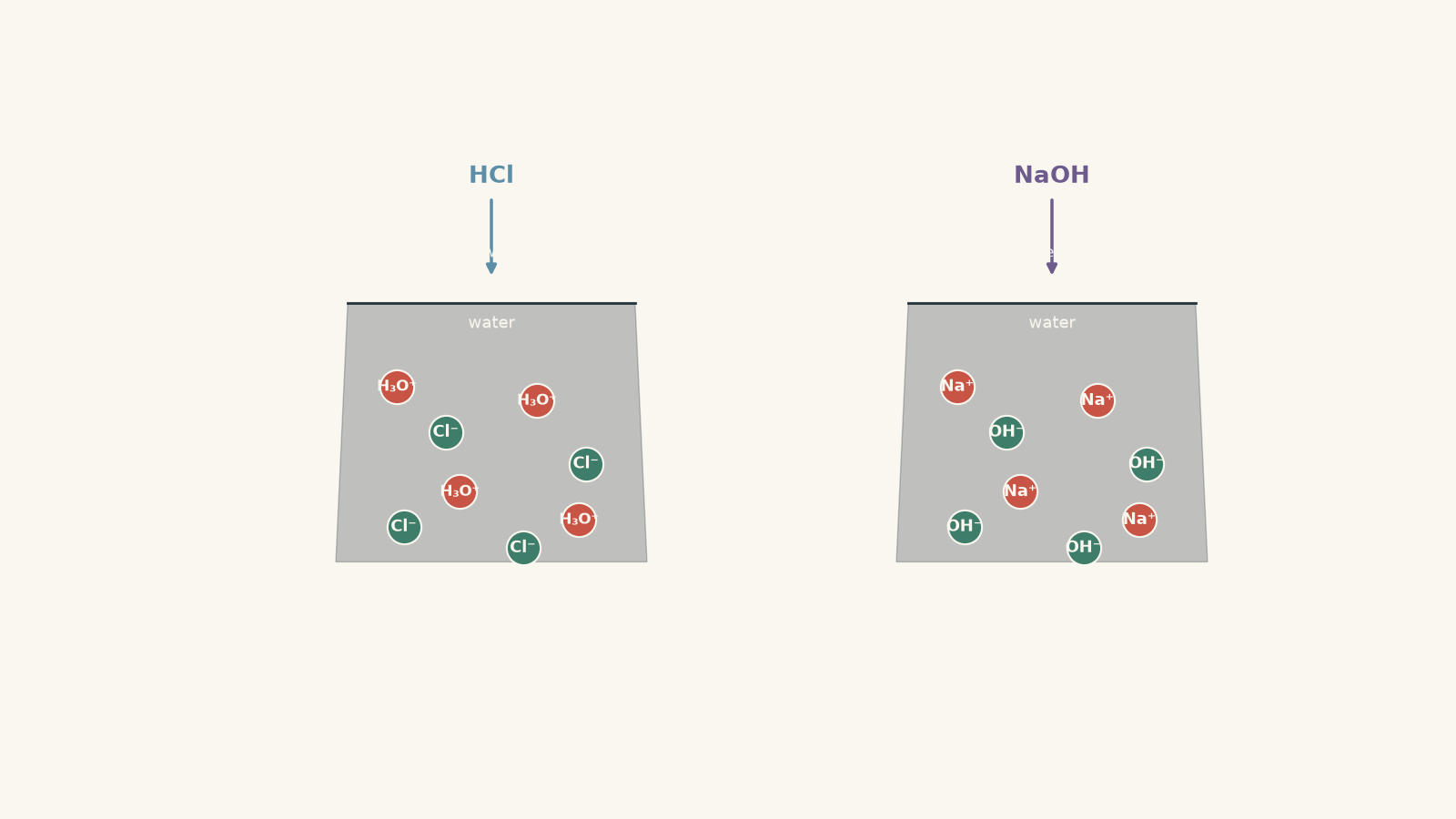
Hydrochloric acid ionises:
\[ \ce{HCl(aq) -> H+(aq) + Cl-(aq)} \]
Sodium hydroxide dissociates:
\[ \ce{NaOH(aq) -> Na+(aq) + OH-(aq)} \]
Sodium chloride dissociates too:
\[ \ce{NaCl(aq) -> Na+(aq) + Cl-(aq)} \]
The useful pattern is now visible. The acid produces \(\mathrm{H}^{+}\). The base produces \(\ce{OH-}\). Sodium chloride does neither.
That is the central idea behind the Arrhenius model.
02The Arrhenius definitions
An Arrhenius acid is a substance that produces hydrogen ions, \(\mathrm{H}^{+}\), when dissolved in water.
An Arrhenius base is a substance that produces hydroxide ions, \(\ce{OH-}\), when dissolved in water.
For example:
\[ \ce{HNO3(aq) -> H+(aq) + NO3-(aq)} \]
Nitric acid is an Arrhenius acid because it produces \(\mathrm{H}^{+}\) in aqueous solution.
Meanwhile:
\[ \ce{KOH(aq) -> K+(aq) + OH-(aq)} \]
Potassium hydroxide is an Arrhenius base because it produces \(\ce{OH-}\).
A useful first mental model is to imagine dropping different substances into a swimming pool. Arrhenius theory ignores almost everything about the substance and asks one question: does putting it into the water add \(\mathrm{H}^{+}\) or \(\ce{OH-}\)?
That picture is useful, but incomplete. Acids do not literally release bare protons that float around alone in water.
03What does \(\ce{H+(aq)}\) actually mean?
A hydrogen ion is essentially a proton. In water, a bare proton is strongly attracted to the lone pairs of electrons on water molecules, so we more accurately represent acid behaviour using the hydronium ion, \(\ce{H3O+}\).
For hydrochloric acid:
\[ \ce{HCl(aq) + H2O(l) -> H3O+(aq) + Cl-(aq)} \]
So when HSC Chemistry equations use \(\ce{H+(aq)}\), treat it as convenient shorthand for an acidic proton carried by water.
You may therefore see both:
\[ \ce{HCl(aq) -> H+(aq) + Cl-(aq)} \]
and
\[ \ce{HCl(aq) + H2O(l) -> H3O+(aq) + Cl-(aq)} \]
The second representation gives a more realistic picture of what happens in aqueous solution.
04Ionisation and dissociation are not quite the same thing
This distinction is useful when writing equations.
An ionic solid such as sodium hydroxide already contains \(\mathrm{Na}^{+}\) and \(\ce{OH-}\) ions. Water separates those ions:
\[ \ce{NaOH(s) -> Na+(aq) + OH-(aq)} \]
This is dissociation.
Hydrogen chloride is molecular before it enters water. Its interaction with water produces ions:
\[ \ce{HCl(g) + H2O(l) -> H3O+(aq) + Cl-(aq)} \]
This is ionisation.
For Arrhenius theory, the important outcome is still the same: acidic solutions contain increased \(\ce{H3O+}\), while basic solutions contain increased \(\ce{OH-}\).
05Do acids have to contain hydrogen?
An Arrhenius acid needs to produce \(\mathrm{H}^{+}\) in water, so the substances you meet as straightforward Arrhenius acids do contain ionisable hydrogen.
But spotting an H in a formula is not enough.
Consider methane, \(\ce{CH4}\). It contains four hydrogen atoms. Does that make it an Arrhenius acid?
No. Methane does not ionise in water to produce \(\mathrm{H}^{+}\).
Similarly, ethanol contains hydrogen:
\[ \ce{C2H5OH} \]
but ordinary ethanol does not behave as an Arrhenius acid simply because its formula includes H.
The rule is about behaviour in water, not pattern-matching a chemical formula.
06Do bases have to contain \(\ce{OH}\) in their formula?
For the simplest Arrhenius bases studied at this level, hydroxides such as \(\ce{NaOH}\), \(\ce{KOH}\), and \(\ce{Ba(OH)2}\) fit the model neatly because they dissociate to release \(\ce{OH-}\).
For example:
\[ \ce{Ba(OH)2(aq) -> Ba^2+(aq) + 2OH-(aq)} \]
One mole of \(\ce{Ba(OH)2}\) produces two moles of hydroxide ions if dissociation is complete.
But this exposes one of the limitations of the simplest Arrhenius model. Ammonia, \(\ce{NH3}\), clearly forms a basic solution even though its formula contains no \(\ce{OH}\):
\[ \ce{NH3(aq) + H2O(l) <=> NH4+(aq) + OH-(aq)} \]
The hydroxide ion is formed because ammonia reacts with water rather than because an \(\ce{OH-}\) group simply dissociates from ammonia.
You may encounter broader descriptions of an Arrhenius base as a substance that increases the concentration of \(\ce{OH-}\) in water. Under that broader wording, ammonia can be accommodated. However, the simple “metal hydroxide dissociates to give \(\ce{OH-}\)” model does not explain how ammonia behaves.
That is one reason chemistry later uses the Brønsted-Lowry model.
07Worked example: Identifying an Arrhenius acid and base
A student dissolves hydrogen bromide, \(\ce{HBr}\), and calcium hydroxide, \(\ce{Ca(OH)2}\), separately in water. Classify each substance using Arrhenius theory and write an equation supporting your classification.
Step 1
Hydrogen bromide ionises in water:
\[ \ce{HBr(aq) -> H+(aq) + Br-(aq)} \]
It produces \(\mathrm{H}^{+}\), so it is an Arrhenius acid.
Step 2
\[ \ce{Ca(OH)2(aq) -> Ca^2+(aq) + 2OH-(aq)} \]
It produces \(\ce{OH-}\), so it is an Arrhenius base.
Step 3
Each formula unit of \(\ce{Ca(OH)2}\) produces two hydroxide ions. That matters whenever concentrations or neutralisation quantities are calculated.
The result is not based on the words “acid” or “hydroxide” appearing in the names. It comes from the ions produced in aqueous solution.
08Using concentration with the Arrhenius model
Once you know how many \(\mathrm{H}^{+}\) or \(\ce{OH-}\) ions a substance produces, you can connect the chemical equation to concentration.
Suppose a strong monoprotic acid such as \(\ce{HCl}\) has concentration \(0.0200\ \mathrm{mol\,L^{-1}}\).
Its ionisation is:
\[ \ce{HCl(aq) -> H+(aq) + Cl-(aq)} \]
The mole ratio is \(1:1\), so complete ionisation gives:
\[ [\mathrm{H}^{+}] = 0.0200\ \mathrm{mol\,L^{-1}} \]
The square brackets mean “concentration of”.
Do not automatically use a \(1:1\) relationship for every acid or base. The chemical equation decides the ratio.
Worked example: Finding hydroxide concentration
A \(0.0350\ \mathrm{mol\,L^{-1}}\) solution of barium hydroxide, \(\ce{Ba(OH)2}\), is assumed to dissociate completely. Find the concentration of hydroxide ions.
Step 1
\[ \ce{Ba(OH)2(aq) -> Ba^2+(aq) + 2OH-(aq)} \]
Step 2
One mole of \(\ce{Ba(OH)2}\) produces two moles of \(\ce{OH-}\).
Therefore:
\[ [\ce{OH-}] = 2[\ce{Ba(OH)2}] \]
Step 3
\[ [\ce{OH-}] = 2(0.0350\ \mathrm{mol\,L^{-1}}) = 0.0700\ \mathrm{mol\,L^{-1}} \]
So the hydroxide ion concentration is \(0.0700\ \mathrm{mol\,L^{-1}}\).
The important idea is not the multiplication by two itself. The coefficient of 2 in the chemical equation tells us that twice as many moles of hydroxide ions are produced as moles of barium hydroxide that dissociate.
09Why acids and bases neutralise each other
Arrhenius theory also gives a simple picture of neutralisation.
An acid provides \(\mathrm{H}^{+}\). A base provides \(\ce{OH-}\). When they mix, those ions react:
\[ \ce{H+(aq) + OH-(aq) -> H2O(l)} \]
For example:
\[ \ce{HCl(aq) + NaOH(aq) -> NaCl(aq) + H2O(l)} \]
The \(\mathrm{Na}^{+}\) and \(\mathrm{Cl}^{-}\) ions remain in solution, while \(\mathrm{H}^{+}\) and \(\ce{OH-}\) form water.
You can picture \(\mathrm{H}^{+}\) and \(\ce{OH-}\) as two people at a party who immediately pair off and leave the dance floor. The remaining ions are still standing around, spectacularly uninvolved. In chemical language, those uninvolved ions are spectator ions.
The analogy breaks because ions are not making choices, and neutralisation is an electrostatic chemical process, not a dating strategy.
If you want to see how this reaction is used in practical settings, the next useful step is neutralisation in everyday and industrial processes.
10Where the Arrhenius model stops working well
A scientific model is useful because it simplifies reality. That also means you need to know its boundaries.
The Arrhenius model works especially well for familiar acid-base reactions in water:
| Situation | Does the simple Arrhenius model handle it well? | Why? |
|---|---|---|
| \(\ce{HCl}\) in water | Yes | It produces \(\mathrm{H}^{+}\)/\(\ce{H3O+}\) |
| \(\ce{NaOH}\) in water | Yes | It dissociates to produce \(\ce{OH-}\) |
| Acid + metal hydroxide in water | Yes | \(\mathrm{H}^{+}\) reacts with \(\ce{OH-}\) |
| Acid-base reaction outside aqueous solution | Poorly | The theory is defined around aqueous ions |
| Basic behaviour of \(\ce{NH3}\) | Only awkwardly in its simplest form | \(\ce{NH3}\) has no \(\ce{OH-}\) to dissociate |
| Reactions involving proton transfer without \(\ce{OH-}\) | Poorly | The model is too narrow |
This is an important scientific habit: do not reject a model just because a later model is broader.
Arrhenius theory correctly describes a large and useful group of aqueous acid-base reactions. It simply cannot describe every reaction chemists want to call acid-base chemistry.
11The most tempting misconception: acid means “contains H”
Imagine two substances:
\[ \ce{HCl} \]
and
\[ \ce{CH4} \]
Both contain hydrogen. Only one is an Arrhenius acid in water.
Why does the shortcut feel tempting? Chemical formulas often give clues to behaviour, and many common acids begin with H. But the definition is not structural. It is experimental and chemical: what ions are produced when the substance interacts with water?
The same warning applies to bases. Seeing \(\ce{OH}\) in a formula can be a useful clue for metal hydroxides, but classification ultimately comes from chemical behaviour.
A reliable decision process is:
- Check that the situation is aqueous.
- Determine what happens when the substance enters water.
- If it produces or increases \(\mathrm{H}^{+}\)/\(\ce{H3O+}\), it shows Arrhenius acid behaviour.
- If it produces or increases \(\ce{OH-}\), it shows Arrhenius base behaviour.
- If the substance behaves as an acid or base but this description feels forced, the Arrhenius model may have reached its limit.
12Questions and solutions
Question 1
A solution of potassium hydroxide has a concentration of \(0.150\ \mathrm{mol\,L^{-1}}\).
Using Arrhenius theory:
a. classify potassium hydroxide as an acid or base,
b. write its dissociation equation, and
c. determine \([\ce{OH-}]\), assuming complete dissociation.
Solution 1
Potassium hydroxide is an Arrhenius base, and its hydroxide ion concentration is \(0.150\ \mathrm{mol\,L^{-1}}\).
It dissociates according to:
\[ \ce{KOH(aq) -> K+(aq) + OH-(aq)} \]
The equation shows a \(1:1\) mole ratio between \(\ce{KOH}\) and \(\ce{OH-}\).
Therefore:
\[ [\ce{OH-}] = [\ce{KOH}] = 0.150\ \mathrm{mol\,L^{-1}} \]
A tempting mistake is to call \(\ce{KOH}\) a base simply because its formula ends in OH. That clue works here, but the actual Arrhenius reason is that it produces hydroxide ions in aqueous solution.
Question 2
A student prepares \(250.0\ \mathrm{mL}\) of \(0.0400\ \mathrm{mol\,L^{-1}}\) calcium hydroxide, \(\ce{Ca(OH)2}\), and assumes complete dissociation.
a. Calculate the amount, in moles, of \(\ce{Ca(OH)2}\) present.
b. Calculate the amount of \(\ce{OH-}\) produced.
c. Determine \([\ce{OH-}]\).
d. Explain why the hydroxide concentration is not equal to the original calcium hydroxide concentration.
Solution 2
The solution contains \(0.0100\ \mathrm{mol}\) of \(\ce{Ca(OH)2}\), which produces \(0.0200\ \mathrm{mol}\) of \(\ce{OH-}\), giving \([\ce{OH-}] = 0.0800\ \mathrm{mol\,L^{-1}}\).
For part a, convert the volume to litres:
\[ 250.0\ \mathrm{mL} = 0.2500\ \mathrm{L} \]
Using \(n=cV\), where \(n\) is amount in moles, \(c\) is concentration in \(\mathrm{mol\,L^{-1}}\), and \(V\) is volume in litres:
\[ n(\ce{Ca(OH)2}) =(0.0400\ \mathrm{mol\,L^{-1}})(0.2500\ \mathrm{L}) =0.0100\ \mathrm{mol} \]
The dissociation equation is:
\[ \ce{Ca(OH)2(aq) -> Ca^2+(aq) + 2OH-(aq)} \]
For part b, one mole of \(\ce{Ca(OH)2}\) produces two moles of \(\ce{OH-}\):
\[ n(\ce{OH-}) =2(0.0100\ \mathrm{mol}) =0.0200\ \mathrm{mol} \]
For part c:
\[ [\ce{OH-}] =\frac{0.0200\ \mathrm{mol}}{0.2500\ \mathrm{L}} =0.0800\ \mathrm{mol\,L^{-1}} \]
For part d, the concentrations differ because each formula unit of calcium hydroxide contains two hydroxide ions. Complete dissociation therefore produces two moles of \(\ce{OH-}\) for every mole of \(\ce{Ca(OH)2}\).
The tempting route is to copy the stated \(0.0400\ \mathrm{mol\,L^{-1}}\) concentration directly. That ignores the stoichiometric coefficient in the dissociation equation.
Question 3
Three sealed containers contain:
- Container A: dry \(\ce{HCl(g)}\)
- Container B: \(\ce{HCl}\) dissolved in water
- Container C: \(\ce{CH4}\) dissolved as far as possible in water
A student claims that all three contain Arrhenius acids because every substance listed contains hydrogen.
Assess this claim.
Solution 3
The claim is incorrect: only Container B clearly contains an Arrhenius acid under the model.
In Container B, hydrogen chloride interacts with water:
\[ \ce{HCl(aq) + H2O(l) -> H3O+(aq) + Cl-(aq)} \]
The concentration of hydronium ions increases, so \(\ce{HCl}\) displays Arrhenius acid behaviour.
Container A contains dry hydrogen chloride gas. Arrhenius theory defines acid-base behaviour in aqueous solution, so the absence of water places this situation outside the model’s normal scope.
Container C contains methane. Although methane contains hydrogen atoms, it does not ionise in water to produce \(\mathrm{H}^{+}\) or \(\ce{H3O+}\).
The tempting reasoning is to classify substances by formula alone. That fails because Arrhenius classification depends on what the substance does in water, not merely on whether hydrogen appears in its formula.
Question 4
Two colourless aqueous solutions, X and Y, are tested.
Solution X was made by dissolving \(\ce{NaOH}\) in water.
Solution Y was made by dissolving \(\ce{NH3}\) in water.
Measurements show that both solutions contain more \(\ce{OH-}\) than pure water.
A student argues:
“X is an Arrhenius base, but Y cannot be a base because \(\ce{NH3}\) contains no oxygen.”
Another student argues:
“Both must behave identically under Arrhenius theory because both solutions contain hydroxide ions.”
Evaluate both arguments. Your answer must distinguish what Arrhenius theory can describe from what it explains well.
Solution 4
X is a straightforward Arrhenius base, while Y demonstrates why the simplest Arrhenius definition becomes awkward; neither student’s argument is fully satisfactory.
For X:
\[ \ce{NaOH(aq) -> Na+(aq) + OH-(aq)} \]
The hydroxide ion is already part of the ionic compound and is released by dissociation. This fits the simple Arrhenius model directly.
For Y:
\[ \ce{NH3(aq) + H2O(l) <=> NH4+(aq) + OH-(aq)} \]
Ammonia causes the hydroxide ion concentration to increase, even though \(\ce{NH3}\) contains neither oxygen nor an \(\ce{OH}\) group.
The first student’s argument fails because a chemical formula alone does not decide acid-base behaviour. The observation that \(\ce{NH3}\) produces a basic aqueous solution cannot be dismissed simply because its formula lacks oxygen.
The second student’s conclusion goes too far in the opposite direction. The two substances do not produce \(\ce{OH-}\) by the same mechanism. Sodium hydroxide dissociates directly. Ammonia reacts with water.
A broader Arrhenius wording – that a base increases \([\ce{OH-}]\) in aqueous solution – can classify both as bases. But the simple Arrhenius picture of a hydroxide compound dissociating to release \(\ce{OH-}\) explains X much more naturally than Y.
This limitation motivates the Brønsted-Lowry model, which describes ammonia by focusing on proton transfer rather than requiring hydroxide to be present in the original substance.
Question 5
A student is told that an unknown substance Q behaves as follows:
- Pure Q contains no \(\ce{OH-}\) ions.
- When Q is added to water, the final solution has a higher \([\ce{OH-}]\) than the original water.
- When Q is placed in a non-aqueous solvent, it reacts with an acid even though no hydroxide ions are present.
- The reaction in the non-aqueous solvent involves transfer of a proton from the acid to Q.
The student concludes:
“The Arrhenius model has been disproved because Q can act as a base without containing hydroxide.”
Is that conclusion justified? Explain what can and cannot be inferred about Q using Arrhenius theory alone, and identify the conceptual change needed for a model that explains both observations.
Solution 5
The Arrhenius model has not been disproved; the evidence shows that its scope is too narrow to describe all of Q’s base behaviour.
In water, Q increases \([\ce{OH-}]\). Under a broader Arrhenius description, that observation can support classifying Q as a base in aqueous solution. However, if Q contains no hydroxide ions, the simple dissociation picture
\[ \ce{MOH(aq) -> M+(aq) + OH-(aq)} \]
cannot explain the mechanism.
The second observation is more decisive. Q also reacts as a base in a non-aqueous solvent where hydroxide ions are absent. Arrhenius theory is built around the production of \(\mathrm{H}^{+}\) and \(\ce{OH-}\) in water, so this reaction lies outside its intended scope.
The tempting conclusion is that one counterexample destroys Arrhenius theory. That confuses a model’s range of applicability with its correctness inside that range. Arrhenius theory can still accurately describe reactions such as:
\[ \ce{HCl(aq) + NaOH(aq) -> NaCl(aq) + H2O(l)} \]
What Q reveals is that “base” can describe a broader chemical role than “substance that gives hydroxide ions in water”.
The proton-transfer observation gives the needed clue. A broader model can define an acid as a proton donor and a base as a proton acceptor. That is the central move made by Brønsted-Lowry theory.
So the important progression is not “Arrhenius was wrong, therefore replace it”. It is:
\[ \text{useful aqueous model} \rightarrow \text{recognise its boundary} \rightarrow \text{adopt a broader proton-transfer model} \]
That next model explains why substances such as ammonia can behave as bases without carrying an \(\ce{OH-}\) group, and why acid-base reactions can occur even when water is not the solvent.