
Dissolution of Ionic Compounds in Water for HSC Chemistry
Learn how ionic compounds dissolve in water through lattice separation, hydration, and ion-dipole attractions. Includes worked examples, energy changes, misconceptions, and challenging HSC-style questions.
Put calcium chloride into water and the solution can warm up. Dissolve ammonium nitrate instead and it can cool down. Both solids are breaking apart into ions, so why does one process release heat while the other absorbs it?
Before reading on, predict what must be happening. Pulling positive and negative ions apart requires energy because opposite charges attract. If that were the whole story, every ionic compound should cool the water as it dissolves.
That prediction fails because the ions do not simply separate and float around alone. Water molecules surround them and form new attractions. Dissolution is a competition between energy absorbed while separating the ionic lattice and energy released when the separated ions become hydrated.
01What water actually does at the crystal surface
An ionic solid is a three-dimensional lattice of positive and negative ions. In solid sodium chloride, for example, \(\mathrm{Na}^{+}\) and \(\mathrm{Cl}^{-}\) ions are held together by electrostatic attraction.
Water can interfere because a water molecule is polar.
The oxygen end carries a partial negative charge, \(\delta-\), while the hydrogen ends carry partial positive charges, \(\delta+\). The molecule is neutral overall, but its charge is unevenly distributed.
So what orientation would you expect when water approaches a positive ion?
The oxygen end points towards it. Around a negative ion, the hydrogen ends tend to point inwards instead.
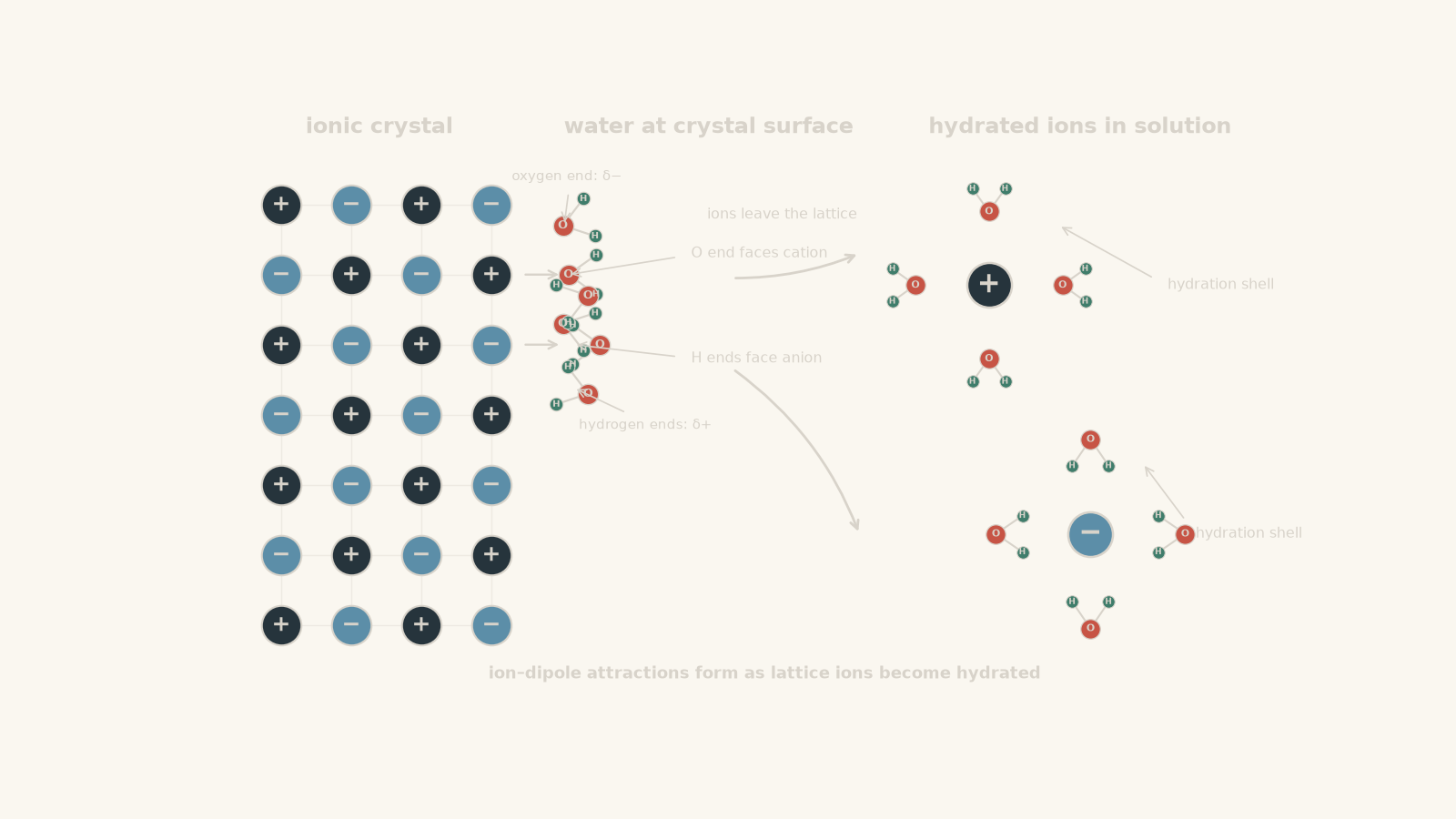
You can picture water molecules as tiny, constantly moving two-ended objects that know which end they would rather point at each ion. That is useful for visualising the orientation, but water molecules are not little bar magnets: the attraction here comes from electric charges and partial charges, and the molecules are continually rotating, colliding, and exchanging positions.
At the surface of the crystal, several things happen together:
- Water molecules approach exposed ions.
- Their partially charged ends orient around those ions.
- Ion-dipole attractions form between the ions and water.
- These attractions help overcome the ion-ion attractions holding surface ions in the lattice.
- Ions leave the crystal and become surrounded by water molecules.
- The hydrated ions spread through the solution.
That surrounding process is called hydration. Hydration is simply solvation where the solvent is water.
For sodium chloride, we represent the overall dissolution as
\[ \ce{NaCl(s) -> Na+(aq) + Cl-(aq)} \]
The state symbol \(\ce{(aq)}\) matters. It does not mean “a bare ion somewhere in liquid water”. It means the ion is dissolved in water and interacting strongly with surrounding water molecules.
The hydration shell is also not a permanent cage. Individual water molecules enter and leave the region around an ion rapidly.
Dissolution is not the same as ionisation
An ionic solid already contains ions before it enters the water. Sodium chloride does not have to create \(\mathrm{Na}^{+}\) and \(\mathrm{Cl}^{-}\) ions from neutral sodium and chlorine atoms.
Instead, the existing ions separate from the lattice. This is often described as dissociation.
So
\[ \ce{CaCl2(s) -> Ca^2+(aq) + 2Cl-(aq)} \]
describes one formula unit of calcium chloride producing one hydrated calcium ion and two hydrated chloride ions.
Calling this process “ionisation” can be misleading. Ionisation is more appropriate when neutral particles form ions.
02The energy competition behind dissolution
Now return to the original puzzle. Why can one dissolving salt heat the water while another cools it?
There are two major energy changes to track.
| Process | What is happening? | Energy change |
|---|---|---|
| Lattice separation | Oppositely charged ions are pulled apart | Energy is absorbed |
| Hydration | Ion-dipole attractions form between ions and water | Energy is released |
Separating an ionic lattice is endothermic because energy must be supplied to work against electrostatic attraction.
Hydrating the separated ions is exothermic because forming attractive ion-dipole interactions lowers the energy of the system.
At the particle level, the surrounding water also has to rearrange. In the simplified thermochemical cycle used for calculations, these solvent effects are included in the hydration enthalpies.
A useful energy equation is
\[ \Delta H_{\text{sol}}= \Delta H_{\text{lattice, separation}} + \sum \Delta H_{\text{hyd}} \]
where:
- \(\Delta H_{\text{sol}}\) is the molar enthalpy of dissolution,
- \(\Delta H_{\text{lattice, separation}}\) is the energy required to separate one mole of the ionic lattice, and
- \(\Delta H_{\text{hyd}}\) is the enthalpy change when separated ions become hydrated.
Here, lattice separation has a positive sign and hydration enthalpies have negative signs.
Be careful with the term lattice enthalpy. Different data sets can define it in opposite directions. Some give lattice formation, which is negative, while others give lattice separation, which is positive. In an exam calculation, use the process and sign specified in the data rather than memorising a sign without checking its meaning.
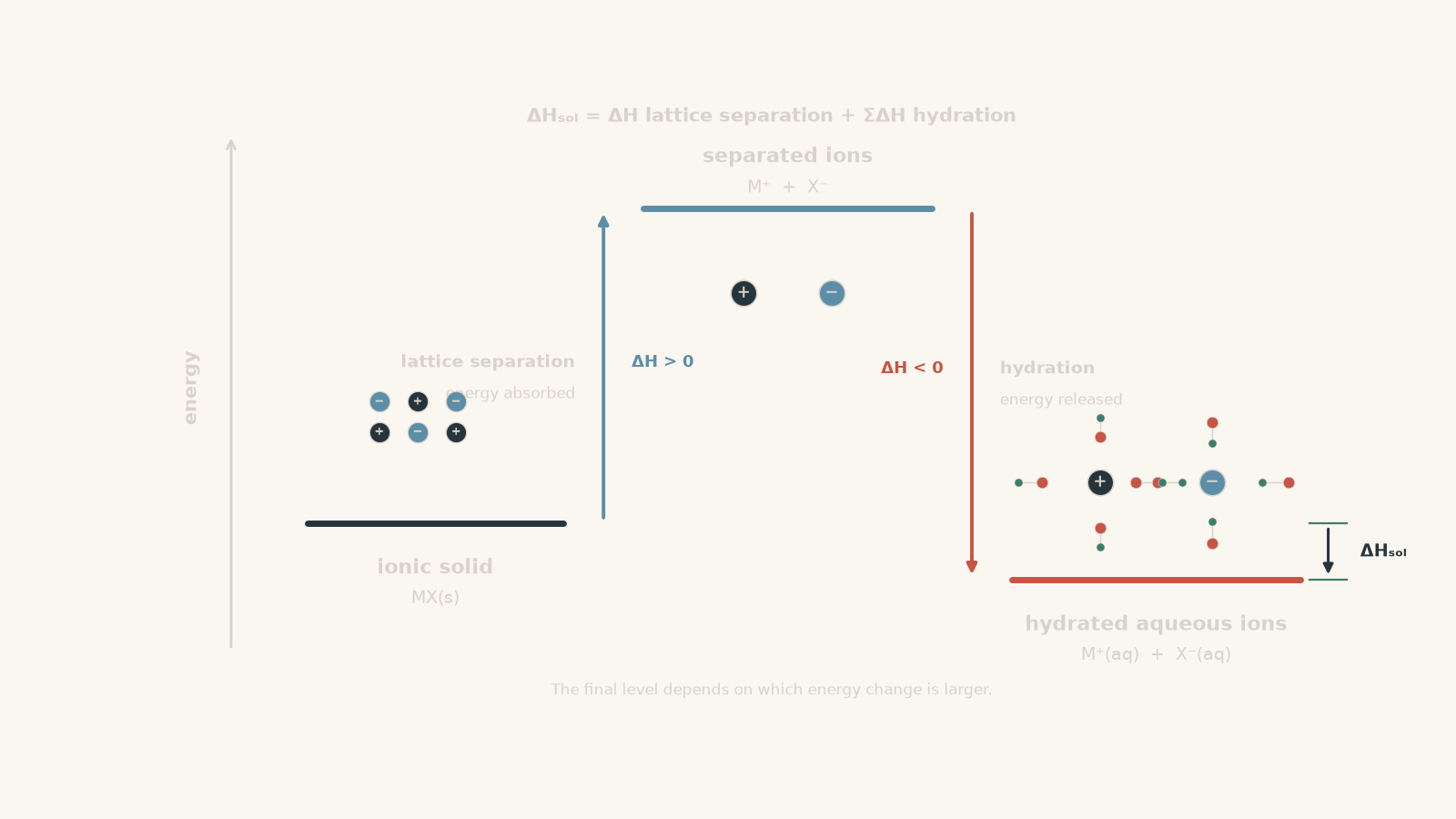
If hydration releases more energy than lattice separation requires
Suppose separating the lattice requires \(+700\text{ kJ mol}^{-1}\), while hydration releases \(-760\text{ kJ mol}^{-1}\).
Then
\[ \Delta H_{\text{sol}} = (+700)+(-760) = -60\text{ kJ mol}^{-1} \]
The overall dissolution is exothermic. Heat is transferred from the dissolving process to the surroundings, so the solution tends to warm.
If lattice separation requires more energy than hydration releases
Suppose instead that
\[ \Delta H_{\text{lattice, separation}}=+700\text{ kJ mol}^{-1} \]
and
\[ \sum\Delta H_{\text{hyd}}=-670\text{ kJ mol}^{-1}. \]
Then
\[ \Delta H_{\text{sol}} = (+700)+(-670) = +30\text{ kJ mol}^{-1} \]
The dissolution is endothermic. The process obtains energy from its surroundings, so the solution tends to cool.
This explains why dissolving different salts can cause opposite temperature changes even though both involve separating ions.
03Why ionic charge and size matter
Electrostatic attraction becomes stronger when charges are larger and when charged particles are closer together.
That gives us an important idea: ions with a high charge density tend to interact strongly.
A small \(\mathrm{Mg}^{2+}\) ion, for example, attracts nearby water molecules much more strongly than a large singly charged ion would. Its hydration is therefore strongly exothermic.
But there is a catch.
Highly charged, small ions can also form very strong ionic lattices. So the same feature that strengthens ion-water attraction can strengthen ion-ion attraction in the crystal.
This is why a rule such as “smaller ions dissolve better” or “higher charges make a salt less soluble” is not reliable by itself. Both sides of the energy competition can change.
You have to compare the attractions being broken with the attractions being formed.
04Worked example: finding enthalpy of dissolution from a temperature change
A student dissolves \(5.85\text{ g}\) of \(\ce{NaCl}\) in \(100.0\text{ g}\) of water. The temperature falls from \(22.50^\circ\text{C}\) to \(21.60^\circ\text{C}\). Assume the final solution has a specific heat capacity of \(4.18\text{ J g}^{-1}\text{ K}^{-1}\), no heat is exchanged with the surroundings, and the calorimeter absorbs negligible heat. Calculate the molar enthalpy of dissolution of \(\ce{NaCl}\). Use \(M(\ce{NaCl})=58.44\text{ g mol}^{-1}\).
Step 1
\[ \Delta T=21.60-22.50=-0.90\text{ K} \]
A temperature change in kelvin has the same numerical size as a temperature change in degrees Celsius.
Step 2
The mass being warmed or cooled is approximately the mass of water plus dissolved salt:
\[ m=100.0+5.85=105.85\text{ g} \]
Using \(q=mc\Delta T\),
\[ q_{\text{solution}} =(105.85)(4.18)(-0.90) =-398\text{ J} \]
The solution loses approximately \(398\text{ J}\).
Step 3
Under the assumptions in the question,
\[ q_{\text{dissolution}}=-q_{\text{solution}}=+398\text{ J} \]
The positive sign is important. Dissolution absorbed energy, which is why the solution cooled.
Step 4
\[ n=\frac{m}{M} =\frac{5.85}{58.44} =0.1001\text{ mol} \]
Step 5
\[ \Delta H_{\text{sol}} = \frac{0.398\text{ kJ}}{0.1001\text{ mol}} = +3.98\text{ kJ mol}^{-1} \]
So the measured molar enthalpy of dissolution is approximately
\[ \boxed{\Delta H_{\text{sol}}=+4.0\text{ kJ mol}^{-1}} \]
The result means that dissolving one mole of \(\ce{NaCl}\) under these conditions absorbs about \(4.0\text{ kJ}\) from the surroundings.
The temperature drop is not evidence that “the salt contains coldness”. Energy is being taken from the thermal motion of the solution as the dissolution process occurs.
05Worked example: separating lattice and hydration effects
For a hypothetical ionic compound \(\ce{MX2}\), the lattice separation enthalpy is \(+2180\text{ kJ mol}^{-1}\). The hydration enthalpies are \(-1450\text{ kJ mol}^{-1}\) for \(\mathrm{M}^{2+}\) and \(-350\text{ kJ mol}^{-1}\) for each \(\mathrm{X}^{-}\) ion.
Calculate the enthalpy of dissolution. Then determine how much heat is absorbed or released when \(0.200\text{ mol}\) dissolves.
Step 1
The dissolution equation is
\[ \ce{MX2(s) -> M^2+(aq) + 2X-(aq)} \]
Each mole therefore produces one mole of \(\mathrm{M}^{2+}\) and two moles of \(\mathrm{X}^{-}\).
Step 2
\[ \sum\Delta H_{\text{hyd}} = (-1450)+2(-350) = -2150\text{ kJ mol}^{-1} \]
Step 3
\[ \Delta H_{\text{sol}} = (+2180)+(-2150) = +30\text{ kJ mol}^{-1} \]
The dissolution is slightly endothermic.
Notice what the small \(+30\text{ kJ mol}^{-1}\) result is hiding. More than \(2000\text{ kJ mol}^{-1}\) is involved in each side of the competition. The final number is small because two much larger energy changes nearly cancel.
Step 4
\[ q=n\Delta H =(0.200)(+30) =+6.0\text{ kJ} \]
Dissolving \(0.200\text{ mol}\) absorbs \(6.0\text{ kJ}\). In an insulated container, that energy would come mainly from the solution, so its temperature would fall.
06A positive enthalpy does not mean a salt cannot dissolve
This is one of the most tempting wrong conclusions.
If \(\Delta H_{\text{sol}}>0\), dissolution absorbs heat. It does not automatically mean dissolution is impossible.
Why not?
Enthalpy is only part of the thermodynamic story. Separating an ordered crystal into ions dispersed through a solution also changes how the particles can be arranged. That dispersal can favour dissolution even when the enthalpy change is positive.
At HSC level, the important decision rule is:
- use \(\Delta H_{\text{sol}}\) to predict the direction of heat transfer,
- do not use its sign alone to decide whether a compound is soluble.
A compound can dissolve substantially while cooling the water.
07Solubility and dissolving rate are different ideas
Imagine adding salt to water and stirring vigorously. The solid disappears faster.
Has stirring necessarily increased its solubility?
No.
Stirring usually increases the rate of dissolution because fresh solvent is brought into contact with the solid and dissolved ions are moved away from its surface. It does not usually change the equilibrium amount that can dissolve at a fixed temperature.
This distinction becomes important in saturated solutions.
A saturated solution is not one in which the particles have stopped moving. Ions can still leave the solid while dissolved ions return to the lattice. At equilibrium, these opposing processes occur at equal overall rates.
So “saturated” means there is no net dissolution under those conditions, not that dissolution has become physically impossible.
08A useful HSC explanation structure
When asked to explain why an ionic compound dissolves in water, build the answer in this order:
- State that water is polar.
- Explain the orientation of water around cations and anions.
- Identify ion-dipole attractions between water and the ions.
- Explain that these attractions compete with the ionic lattice attractions.
- State that ions can leave the lattice and become hydrated.
- If energy is relevant, compare energy absorbed in lattice separation with energy released during hydration.
- Do not infer solubility from the sign of \(\Delta H_{\text{sol}}\) alone.
This gives the marker an actual mechanism. Saying only “water is polar, so ionic substances dissolve” skips the difficult part: why water-ion attractions can overcome the attractions inside the solid.
09Common misconceptions worth removing
| Tempting idea | What actually happens |
|---|---|
| Water turns the ionic solid into ions | The solid already contains ions; water separates and hydrates them |
| Cations attract the hydrogen end of water | Cations attract the partially negative oxygen end |
| Anions attract the oxygen end | Anions attract the partially positive hydrogen ends |
| Every ionic compound dissolves well in water | Some ionic lattices are too favourable relative to the hydrated state, so only small amounts dissolve |
| Endothermic dissolution means insoluble | A positive \(\Delta H_{\text{sol}}\) describes heat flow, not solubility by itself |
| Stirring increases solubility | Stirring normally increases dissolution rate, not equilibrium solubility |
| An “insoluble” salt has absolutely no ions in solution | In chemistry, insoluble usually means very low solubility rather than literally zero |
10Questions and solutions
Question 1
Calcium bromide dissolves in water.
a. Write an equation for its dissolution.
b. Describe how water molecules are oriented around each type of ion.
c. Identify the main attraction between the dissolved ions and water.
Solution 1
Calcium bromide dissociates into one hydrated calcium ion and two hydrated bromide ions, with the oxygen ends of water directed towards \(\mathrm{Ca}^{2+}\) and the hydrogen ends directed towards \(\mathrm{Br}^{-}\).
The dissolution equation is
\[ \ce{CaBr2(s) -> Ca^2+(aq) + 2Br-(aq)} \]
Around \(\mathrm{Ca}^{2+}\), the partially negative oxygen atoms of nearby water molecules tend to point towards the ion.
Around \(\mathrm{Br}^{-}\), the partially positive hydrogen atoms tend to point towards the ion.
The attraction involved is an ion-dipole attraction.
A common mistake is to reverse the orientation because oxygen is “the negative atom”. The useful rule is to match opposite charges: a positive ion attracts the negative end of the water dipole, while a negative ion attracts the positive end.
Question 2
A student dissolves \(7.45\text{ g}\) of \(\ce{KCl}\) in \(120.0\text{ g}\) of water. The temperature decreases from \(24.8^\circ\text{C}\) to \(21.7^\circ\text{C}\).
Assume the solution has a specific heat capacity of \(4.18\text{ J g}^{-1}\text{ K}^{-1}\), the calorimeter absorbs negligible heat, and no heat is transferred to the external surroundings.
Calculate the molar enthalpy of dissolution of \(\ce{KCl}\). Use \(M(\ce{KCl})=74.55\text{ g mol}^{-1}\), and explain the result using lattice separation and hydration.
Solution 2
The molar enthalpy of dissolution is approximately \(+16.5\text{ kJ mol}^{-1}\), so the dissolution is endothermic and absorbs energy from the solution.
First, calculate the temperature change:
\[ \Delta T=21.7-24.8=-3.1\text{ K} \]
The total solution mass is approximately
\[ m=120.0+7.45=127.45\text{ g} \]
The heat change of the solution is
\[ \begin{aligned} q_{\text{solution}} &=mc\Delta T\\ &=(127.45)(4.18)(-3.1)\\ &=-1.65\times10^3\text{ J}\\ &=-1.65\text{ kJ} \end{aligned} \]
Therefore,
\[ q_{\text{dissolution}}=+1.65\text{ kJ} \]
The amount of \(\ce{KCl}\) is
\[ n=\frac{7.45}{74.55}=0.0999\text{ mol} \]
Hence
\[ \begin{aligned} \Delta H_{\text{sol}} &=\frac{q}{n}\\ &=\frac{1.65}{0.0999}\\ &=+16.5\text{ kJ mol}^{-1} \end{aligned} \]
At the particle level, energy is absorbed to separate \(\mathrm{K}^{+}\) and \(\mathrm{Cl}^{-}\) ions from the lattice, while energy is released when those ions become hydrated. The positive net enthalpy tells us that the energy required for lattice separation and the associated reorganisation is greater than the energy released by hydration.
The tempting error is to give \(q=-1.65\text{ kJ}\) as the heat of dissolution because the calculated solution heat is negative. The negative value belongs to the solution. The dissolving process gains the energy that the solution loses.
Question 3
Two hypothetical 1:1 ionic compounds, \(\ce{PQ}\) and \(\ce{RS}\), have the following data.
| Compound | Lattice separation enthalpy | Total hydration enthalpy |
|---|---|---|
| \(\ce{PQ}\) | \(+640\text{ kJ mol}^{-1}\) | \(-690\text{ kJ mol}^{-1}\) |
| \(\ce{RS}\) | \(+850\text{ kJ mol}^{-1}\) | \(-820\text{ kJ mol}^{-1}\) |
Both compounds are experimentally observed to dissolve to substantial concentrations in water at \(25^\circ\text{C}\).
a. Calculate \(\Delta H_{\text{sol}}\) for each compound.
b. Predict which dissolution would tend to warm the solution and which would tend to cool it.
c. A student argues that the observation for \(\ce{RS}\) must be wrong because an endothermic dissolution cannot occur spontaneously. Explain why this conclusion is invalid.
d. Can the data above be used to conclude that \(\ce{PQ}\) is more soluble than \(\ce{RS}\)? Explain.
Solution 3
\(\ce{PQ}\) has \(\Delta H_{\text{sol}}=-50\text{ kJ mol}^{-1}\) and tends to warm the solution, while \(\ce{RS}\) has \(\Delta H_{\text{sol}}=+30\text{ kJ mol}^{-1}\) and tends to cool it. The positive enthalpy for \(\ce{RS}\) neither prevents dissolution nor allows the two solubilities to be ranked.
For \(\ce{PQ}\),
\[ \begin{aligned} \Delta H_{\text{sol}} &=(+640)+(-690)\\ &=-50\text{ kJ mol}^{-1} \end{aligned} \]
Its dissolution is exothermic.
For \(\ce{RS}\),
\[ \begin{aligned} \Delta H_{\text{sol}} &=(+850)+(-820)\\ &=+30\text{ kJ mol}^{-1} \end{aligned} \]
Its dissolution is endothermic.
The observation that \(\ce{RS}\) dissolves substantially is not a contradiction. A positive enthalpy means energy is absorbed during dissolution. It does not mean the dissolved state cannot be thermodynamically favourable overall. The dispersal of ions and the equilibrium between solid and solution also matter.
The data also show why looking only at lattice strength can fail. \(\ce{RS}\) requires \(850\text{ kJ mol}^{-1}\) to separate its lattice, much more than \(\ce{PQ}\), but its hydration is also much more exothermic.
You therefore cannot rank the solubilities from these enthalpy data alone.
The tempting route is to use one number as if it controlled the whole process: “larger lattice enthalpy means lower solubility” or “more negative dissolution enthalpy means higher solubility”. Dissolution depends on the overall equilibrium, not one energetic contribution in isolation.
Question 4
A beaker at \(25.0^\circ\text{C}\) contains a saturated solution of an ionic compound \(\ce{AB}\), with excess solid \(\ce{AB}\) remaining at the bottom. Dissolution of \(\ce{AB}\) is endothermic, and its solubility increases with temperature over the range considered.
Pure water, also at \(25.0^\circ\text{C}\), is rapidly added. The beaker is then thermally insulated.
a. Describe the sequence of changes in the solution immediately after the water is added.
b. Explain why the temperature does not have to remain at \(25.0^\circ\text{C}\), even though both the original solution and added water began at that temperature.
c. After a new equilibrium is reached in the insulated beaker, the mixture is externally heated back to exactly \(25.0^\circ\text{C}\) without losing any water. Assume excess solid still remains. Compare the final dissolved concentration and the final total amount of dissolved \(\ce{AB}\) with their values before the water was added.
Solution 4
Adding water first makes the solution unsaturated, causing more \(\ce{AB}\) to dissolve; that endothermic dissolution cools the mixture and partly opposes further dissolution. Once the system is returned to \(25.0^\circ\text{C}\), the saturated concentration returns to its original \(25.0^\circ\text{C}\) value, but the total amount of dissolved \(\ce{AB}\) is greater because more water is present.
Before the addition, the system is at dynamic equilibrium:
\[ \ce{AB(s) <=> A+(aq) + B-(aq)} \]
There is no net dissolution, but ions are still moving between solid and solution.
When pure water is added, the dissolved ions are diluted. Their concentrations immediately fall below the values required for saturation at \(25.0^\circ\text{C}\). The solution is therefore temporarily unsaturated, and net dissolution begins.
As more solid dissolves, energy is absorbed because the dissolution is endothermic. Since the vessel is insulated, that energy must come mainly from the thermal energy of the mixture. Its temperature therefore falls even though both liquids started at the same temperature.
That cooling creates a second effect. The question tells us that this compound is less soluble at lower temperature. As the mixture cools, the equilibrium amount that can remain dissolved falls relative to what it would have been at \(25.0^\circ\text{C}\). This opposes the dissolution caused by dilution.
The new insulated equilibrium is therefore produced by linked changes: dilution favours more dissolution, but the resulting endothermic cooling reduces the solubility and pushes back against that change.
When the system is later brought back to \(25.0^\circ\text{C}\), this cooling effect disappears. Because excess solid remains, the solution can again reach its saturation concentration at \(25.0^\circ\text{C}\).
Thus, under the same-temperature equilibrium conditions, the final saturated concentration is the same as it was originally, assuming the usual concentration approximation and unchanged pressure.
However, there is now more solvent. A similar saturated concentration occupying a larger amount of solution contains a greater total number of moles of dissolved \(\ce{AB}\).
The first tempting answer is “nothing can dissolve because the solution was saturated”. Saturation only describes the equilibrium under the original conditions. Adding water changes those conditions immediately.
The second tempting answer is “the temperature stays at \(25^\circ\text{C}\) because everything started at \(25^\circ\text{C}\)”. That ignores the enthalpy of the process that begins after mixing. Chemical and physical changes can transfer energy even when the substances initially have identical temperatures.
Question 5
A hypothetical 1:1 ionic compound \(\ce{MX}\) has
\[ \Delta H_{\text{lattice, separation}}=+680\text{ kJ mol}^{-1} \]
and hydration enthalpies
\[ \Delta H_{\text{hyd}}(\mathrm{M}^{+})=-420\text{ kJ mol}^{-1} \]
and
\[ \Delta H_{\text{hyd}}(\mathrm{X}^{-})=-300\text{ kJ mol}^{-1}. \]
A supersaturated solution is prepared, and \(0.100\text{ mol}\) of \(\ce{MX}\) then crystallises. Treat any heat involved in removing or evaporating water as a separate process.
a. Calculate \(\Delta H_{\text{sol}}\) for \(\ce{MX}\).
b. Calculate the enthalpy change associated with crystallising \(0.100\text{ mol}\) of \(\ce{MX}\).
c. A student says, “Crystallisation forms strong ionic attractions, so crystallisation must always release heat.” Explain precisely why that reasoning fails for this compound.
d. If the crystallisation occurs in a thermally insulated solution, explain how the resulting temperature change can feed back on further crystallisation. Assume the temperature dependence of solubility follows the expected direction for the negative dissolution enthalpy over this range.
Solution 5
Dissolution has \(\Delta H_{\text{sol}}=-40\text{ kJ mol}^{-1}\), so crystallisation has \(\Delta H_{\text{cryst}}=+40\text{ kJ mol}^{-1}\); crystallising \(0.100\text{ mol}\) therefore absorbs \(4.0\text{ kJ}\). The surprising result occurs because removing ions from their hydration environments costs more energy than lattice formation releases.
For dissolution,
\[ \begin{aligned} \Delta H_{\text{sol}} &=\Delta H_{\text{lattice, separation}} +\Delta H_{\text{hyd}}(\mathrm{M}^{+}) +\Delta H_{\text{hyd}}(\mathrm{X}^{-})\\ &=(+680)+(-420)+(-300)\\ &=-40\text{ kJ mol}^{-1} \end{aligned} \]
Dissolution is therefore exothermic.
Crystallisation is the reverse overall process:
\[ \ce{M+(aq) + X-(aq) -> MX(s)} \]
Reversing a process reverses the sign of its enthalpy change, so
\[ \Delta H_{\text{cryst}}=+40\text{ kJ mol}^{-1}. \]
For \(0.100\text{ mol}\),
\[ \begin{aligned} q &=n\Delta H\\ &=(0.100)(+40)\\ &=+4.0\text{ kJ} \end{aligned} \]
So the crystallisation process absorbs \(4.0\text{ kJ}\).
Why does this not contradict the fact that forming an ionic lattice releases energy?
Because lattice formation is only one part of crystallisation.
Start with the hydrated ions. Before \(\mathrm{M}^{+}\) and \(\mathrm{X}^{-}\) can occupy the solid lattice, their favourable interactions with surrounding water have to be undone.
Reversing hydration requires
\[ +420+300=+720\text{ kJ mol}^{-1}. \]
Forming the ionic lattice is the reverse of lattice separation, so it releases
\[ -680\text{ kJ mol}^{-1}. \]
The net change is
\[ (+720)+(-680)=+40\text{ kJ mol}^{-1}. \]
The student’s reasoning notices the \(-680\text{ kJ mol}^{-1}\) lattice-formation step but misses the larger \(+720\text{ kJ mol}^{-1}\) dehydration requirement.
This is the same competition as dissolution viewed backwards.
There is another layer. Because crystallisation is endothermic here, an insulated solution tends to cool as crystals form.
The original dissolution is exothermic. Over the temperature range specified, lowering the temperature therefore favours greater solubility. As crystallisation cools the solution, the equilibrium can shift towards keeping more ions dissolved.
That reduces the supersaturation and opposes further crystal growth.
So one process can create feedback against itself:
- supersaturation causes crystallisation,
- crystallisation absorbs heat,
- the solution cools,
- lower temperature increases the solubility for this exothermic dissolution,
- the driving force for further crystallisation decreases.
The conceptual hinge is that “forming a crystal” is not energetically identical to “forming ionic attractions”. The hydrated ions must first give up favourable ion-water interactions, and those interactions can be strong enough to reverse the sign you might initially expect.
11What this idea lets you understand next
Once you can picture the competition between lattice attraction and hydration, solubility stops being a rule to memorise and becomes an equilibrium to analyse.
The next step is learning how experimental patterns are summarised in solubility rules and precipitation tests. For sparingly soluble solids, the same dissolving process can then be treated quantitatively using the solubility product, \(K_{sp}\), including calculations of solubility from \(K_{sp}\).
The particle picture remains the same: ions are continually leaving and returning to the solid. \(K_{sp}\) simply gives you a way to describe where that competition settles at equilibrium.