
The Photoelectric Equation: HSC Physics Explained Clearly
Learn how to use Kmax = hf - φ as an energy-conservation equation, and connect it to threshold frequency, wavelength, intensity, and stopping potential.
Shine brighter light on a metal and you might expect the ejected electrons to come out faster. More light means more energy, right? That prediction sounds sensible, but the photoelectric effect does something stranger: a very bright low-frequency beam can eject no electrons at all, while a much dimmer high-frequency beam can eject electrons with substantial kinetic energy.
Before reading on, predict what matters more for the maximum energy of an emitted electron: the brightness of the light, or its frequency. The answer is frequency. The photoelectric equation explains why by treating each photon-electron interaction as an energy-conservation problem.
01Start with the energy budget
Light arrives in photons. Each photon carries a discrete amount of energy
\[ E_{\text{photon}}=hf \]
where:
- \(E_{\text{photon}}\) is the energy of one photon, in joules (J),
- \(h=6.626\times10^{-34}\ \text{J s}\) is Planck’s constant, and
- \(f\) is the frequency of the light, in hertz (Hz).
If the idea that light arrives in energy packets is unfamiliar, it is worth reviewing Planck’s quantisation of light energy first.
Now suppose one photon is absorbed by one electron in a metal. The electron cannot simply leave with all of the photon’s energy. Some energy must first be used to free the electron from the metal.
That minimum escape energy is the metal’s work function, \(\phi\).
Any photon energy left over can become kinetic energy of the emitted electron.
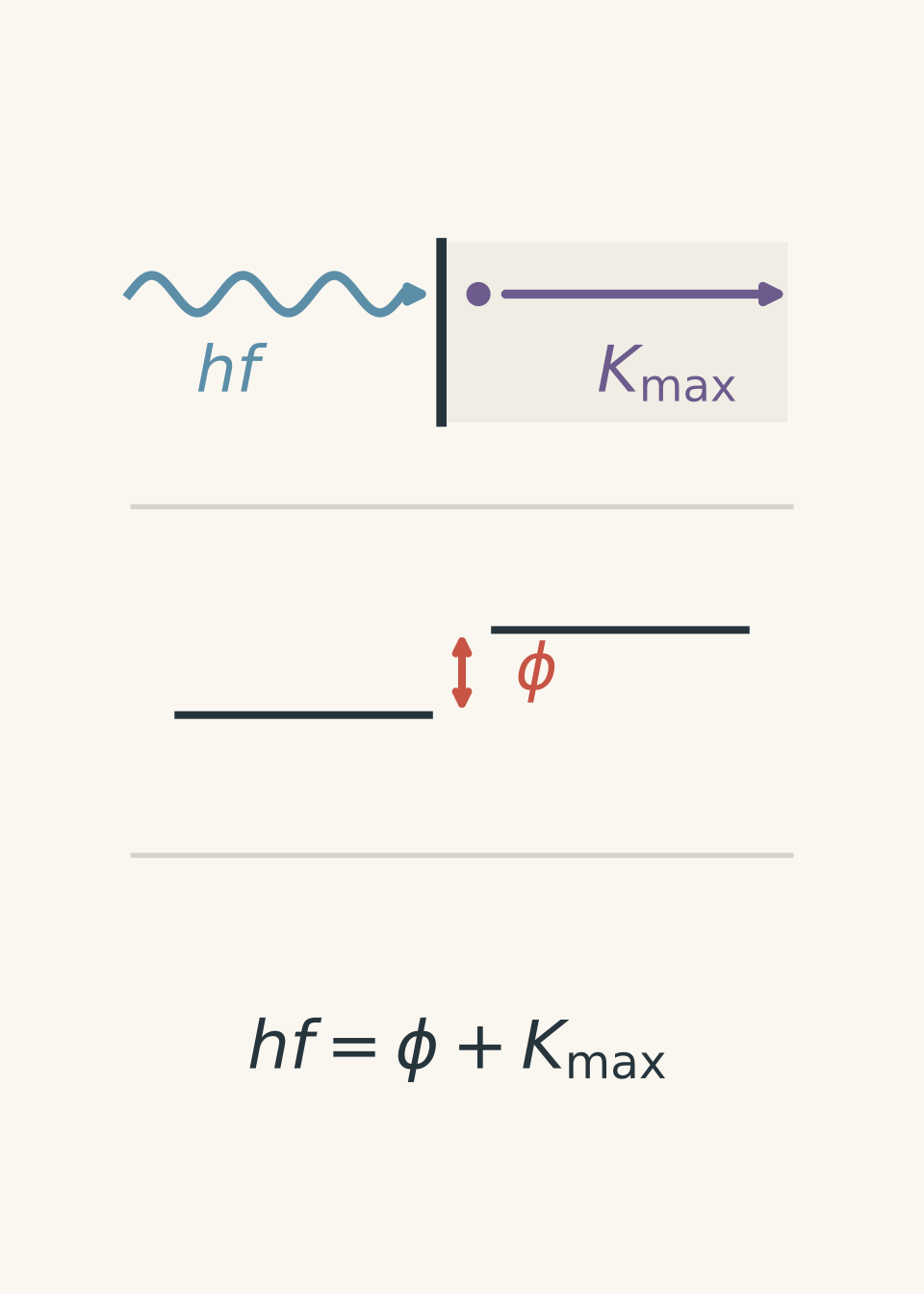
Think of the work function as a cover charge at a slightly unreasonable nightclub. A photon turns up carrying energy \(hf\). The electron needs to pay \(\phi\) just to get out. Whatever is left becomes its kinetic energy.
If the photon brings less than the cover charge, being part of a huge crowd does not help. In the ordinary HSC photoelectric model, several low-energy photons do not pool their money to free one electron.
The analogy breaks there. Photons are not tiny people queueing at a door, and real electrons occupy quantum energy states inside the metal. But the energy accounting is exactly the useful part.
02The photoelectric equation
Applying conservation of energy gives
\[ hf=\phi+K_{\max} \]
so
\[ K_{\max}=hf-\phi \]
where:
- \(K_{\max}\) is the maximum kinetic energy of an emitted photoelectron, in joules,
- \(h\) is Planck’s constant,
- \(f\) is the frequency of the incident light, and
- \(\phi\) is the work function of the metal.
This equation is not saying that every emitted electron leaves with \(K_{\max}\). Real photoelectrons can emerge with a range of kinetic energies because electrons begin in different states and may lose energy while travelling through the material.
The equation gives the maximum possible kinetic energy.
That word, maximum, matters.
Worked example: Find the maximum speed of a photoelectron
Ultraviolet light of frequency \(8.00\times10^{14}\ \text{Hz}\) shines on a metal with work function \(2.20\ \text{eV}\). Find the maximum kinetic energy and maximum speed of the emitted electrons.
Use:
\[ 1\ \text{eV}=1.602\times10^{-19}\ \text{J} \]
and electron mass \(m_e=9.11\times10^{-31}\ \text{kg}\).
Step 1
\[ E=hf =(6.626\times10^{-34})(8.00\times10^{14}) =5.30\times10^{-19}\ \text{J} \]
It is convenient to convert this to electron volts:
\[ E=\frac{5.30\times10^{-19}}{1.602\times10^{-19}} =3.31\ \text{eV} \]
Each photon therefore supplies \(3.31\ \text{eV}\).
Step 2
\[ K_{\max}=hf-\phi =3.31-2.20 =1.11\ \text{eV} \]
In joules,
\[ K_{\max} =(1.11)(1.602\times10^{-19}) =1.78\times10^{-19}\ \text{J} \]
Step 3
For a non-relativistic electron,
\[ K_{\max}=\frac12m_ev_{\max}^2 \]
so
\[ v_{\max} =\sqrt{\frac{2K_{\max}}{m_e}} =\sqrt{\frac{2(1.78\times10^{-19})}{9.11\times10^{-31}}} =6.24\times10^5\ \text{m s}^{-1} \]
The fastest emitted electrons have kinetic energy \(1.11\ \text{eV}\), corresponding to a speed of about \(6.24\times10^5\ \text{m s}^{-1}\).
The energy calculation comes first. The speed calculation is just another way of describing the leftover energy.
03Why there is a threshold frequency
Now change the first example. Imagine gradually lowering the frequency of the light.
What happens when the photon energy becomes exactly equal to the work function?
Then
\[ hf=\phi \]
and therefore
\[ K_{\max}=0 \]
This defines the threshold frequency, \(f_0\):
\[ hf_0=\phi \]
so
\[ f_0=\frac{\phi}{h} \]
At frequencies below \(f_0\),
\[ hf<\phi \]
and one photon does not carry enough energy to free an electron.
No photoelectrons are emitted in the standard one-photon photoelectric effect.
This is where the classical “brighter light means more energy” idea fails badly. You can increase the intensity of below-threshold light enormously and still fail to eject electrons, because increasing intensity gives you more photons rather than increasing the energy of each photon.
Frequency changes energy; intensity changes photon number
For monochromatic light, meaning light of one frequency, the distinction is:
| Change | What happens to individual photons? | Main photoelectric effect |
|---|---|---|
| Increase frequency | Each photon has more energy | \(K_{\max}\) increases |
| Decrease frequency below \(f_0\) | Each photon has insufficient energy | Emission stops |
| Increase intensity at fixed \(f>f_0\) | Photon energy stays the same; more photons arrive | More electrons can be emitted per second |
| Increase intensity at fixed \(f<f_0\) | Still more photons, but each is below threshold | No ordinary photoelectric emission |
The statement about photocurrent assumes the apparatus is operating normally and has not reached a saturation limit.
The key decision rule is simple:
Frequency controls the energy available per photon. Intensity mainly controls how many photons arrive.
04Wavelength form of the equation
Photoelectric questions do not always give frequency. They often give wavelength.
Since
\[ c=f\lambda \]
we have
\[ f=\frac{c}{\lambda} \]
where \(c=3.00\times10^8\ \text{m s}^{-1}\) is the speed of light and \(\lambda\) is wavelength in metres.
Substituting this into \(E=hf\),
\[ E_{\text{photon}}=\frac{hc}{\lambda} \]
and therefore
\[ K_{\max}=\frac{hc}{\lambda}-\phi \]
This form makes an important relationship visible: shorter wavelength means greater photon energy.
The threshold wavelength, \(\lambda_0\), occurs when the photon has just enough energy to overcome the work function:
\[ \phi=\frac{hc}{\lambda_0} \]
so
\[ \lambda_0=\frac{hc}{\phi} \]
Be careful with the direction of the inequality. Because photon energy increases as wavelength decreases:
- \(\lambda<\lambda_0\): emission occurs,
- \(\lambda=\lambda_0\): electrons are just at the threshold,
- \(\lambda>\lambda_0\): no emission occurs.
Students often reverse this because they remember that “larger” usually means “more”. For wavelength, larger means lower frequency and therefore lower photon energy.
05Stopping potential measures the fastest electrons
A photoelectric experiment can place a reverse voltage across the apparatus to oppose the emitted electrons.
Increase this reverse voltage until even the most energetic photoelectrons cannot reach the collector. That voltage is the stopping potential, \(V_s\).
Moving an electron through a potential difference \(V_s\) changes its energy by
\[ E=eV_s \]
where \(e=1.602\times10^{-19}\ \text{C}\) is the magnitude of the electron’s charge.
At the stopping potential,
\[ K_{\max}=eV_s \]
Combining this with the photoelectric equation gives
\[ eV_s=hf-\phi \]
This is useful experimentally because a voltage measurement tells us about the maximum kinetic energy.
If \(K_{\max}\) is expressed in electron volts, the numerical relationship is especially convenient. An electron with \(2.4\ \text{eV}\) of maximum kinetic energy requires a stopping potential of \(2.4\ \text{V}\).
Worked example: Use wavelength and stopping potential
Light of wavelength \(250\ \text{nm}\) shines on a metal with work function \(2.80\ \text{eV}\).
Find:
- the maximum kinetic energy of the photoelectrons, and
- the stopping potential.
Then predict what happens to the stopping potential if the light intensity is doubled without changing its wavelength.
Step 1
\[ 250\ \text{nm}=250\times10^{-9}\ \text{m} \]
Step 2
\[ E=\frac{hc}{\lambda} =\frac{(6.626\times10^{-34})(3.00\times10^8)} {250\times10^{-9}} =7.95\times10^{-19}\ \text{J} \]
Converting to electron volts,
\[ E=\frac{7.95\times10^{-19}}{1.602\times10^{-19}} =4.96\ \text{eV} \]
Step 3
\[ K_{\max}=4.96-2.80=2.16\ \text{eV} \]
So the fastest photoelectrons leave with \(2.16\ \text{eV}\) of kinetic energy.
Step 4
Using \(K_{\max}=eV_s\),
\[ V_s=2.16\ \text{V} \]
Step 5
The wavelength and frequency have not changed, so the energy of each photon has not changed.
Therefore \(K_{\max}\) remains \(2.16\ \text{eV}\), and the stopping potential remains
\[ V_s=2.16\ \text{V} \]
More photons arrive each second, so the photoelectric current may increase, but the fastest individual electrons do not gain extra energy.
That is one of the most important distinctions in this topic: current measures something about the number of emitted charges, whereas stopping potential reveals their maximum energy.
06Reading a \(K_{\max}\) against frequency graph
The photoelectric equation
\[ K_{\max}=hf-\phi \]
has the form of a straight line.
Compare it with
\[ y=mx+b \]
For a graph of \(K_{\max}\) against \(f\):
- gradient \(=h\),
- vertical intercept \(=-\phi\),
- horizontal intercept \(=f_0\).
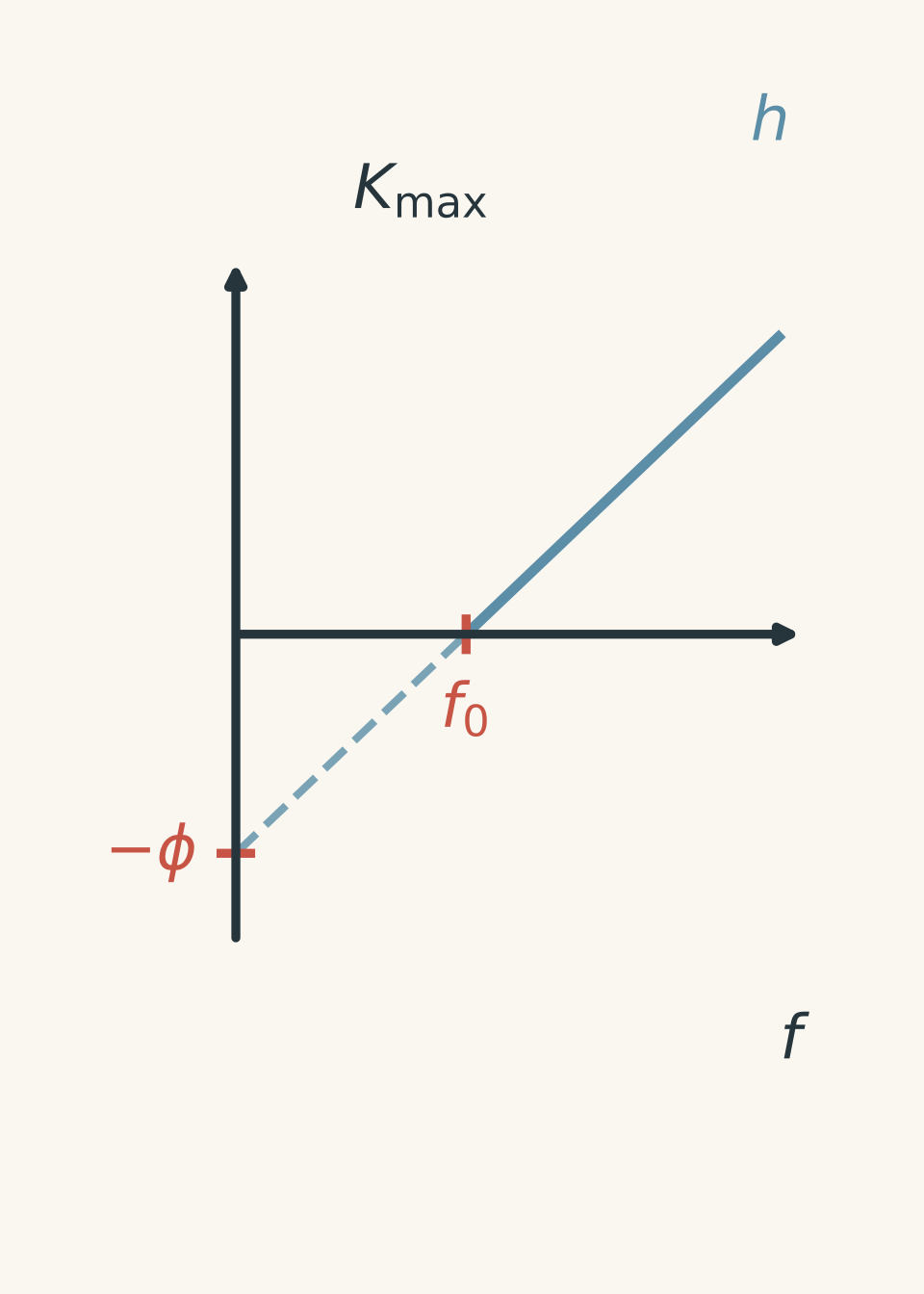
The physical graph only contains photoelectric data for \(K_{\max}\geq0\). A negative value from the equation does not mean an electron emerges with “negative kinetic energy”. It means the photon does not have enough energy for emission.
That is a useful example of mathematics extending beyond the physical region of a model.
If stopping potential is plotted against frequency instead, begin with
\[ eV_s=hf-\phi \]
and divide by \(e\):
\[ V_s=\frac{h}{e}f-\frac{\phi}{e} \]
The gradient is then \(h/e\), not \(h\).
07The most tempting wrong explanation
Suppose light above the threshold frequency is shining on a metal. You double its intensity.
A common prediction is:
The metal receives twice as much energy, so each electron should come out with twice as much kinetic energy.
The first part is incomplete rather than completely wrong. The metal can receive more energy per second.
But that does not mean each photon carries more energy.
At fixed frequency,
\[ E_{\text{photon}}=hf \]
is unchanged.
Higher intensity means a greater energy delivery rate because more photons are arriving. Under the simple photoelectric model, each electron absorbs one photon. So more photons can produce more photoelectrons, but the energy budget for each individual interaction remains
\[ hf=\phi+K \]
The distinction is between total energy transferred to many electrons and energy transferred in one photon-electron event.
This is why the photoelectric effect was so important to the quantum model of light. Classical wave reasoning naturally connects intensity with energy delivery, but it does not by itself give the observed threshold-frequency behaviour. The broader problem emerged from the same period of physics as the failure of classical theory to describe black-body radiation.
08A compact method for photoelectric calculations
When you meet a numerical photoelectric question, do not reach immediately for every equation you remember. Follow the energy.
- Find the photon energy using \(E=hf\) or \(E=hc/\lambda\).
- Compare photon energy with the work function.
- If \(E<\phi\), there is no ordinary photoelectric emission.
- If \(E\geq\phi\), calculate
\[ K_{\max}=E-\phi \]
- Only then convert \(K_{\max}\) into whatever the question asks for, such as speed or stopping potential.
This order catches a surprisingly common error: calculating a negative \(K_{\max}\) and then continuing as though an electron had actually been emitted.
09Questions and solutions
Question 1
A metal has a work function of \(2.30\ \text{eV}\). It is illuminated with light of frequency \(7.50\times10^{14}\ \text{Hz}\).
Determine whether photoelectrons are emitted and, if so, calculate their maximum kinetic energy.
Use \(h=6.626\times10^{-34}\ \text{J s}\) and \(1\ \text{eV}=1.602\times10^{-19}\ \text{J}\).
Solution 1
Photoelectrons are emitted, with a maximum kinetic energy of approximately \(0.802\ \text{eV}\).
First find the photon energy:
\[ E=hf =(6.626\times10^{-34})(7.50\times10^{14}) =4.97\times10^{-19}\ \text{J} \]
Convert this to electron volts:
\[ E=\frac{4.97\times10^{-19}}{1.602\times10^{-19}} =3.10\ \text{eV} \]
Since
\[ 3.10\ \text{eV}>2.30\ \text{eV} \]
the photon energy exceeds the work function, so emission occurs.
The maximum kinetic energy is
\[ K_{\max}=hf-\phi =3.10-2.30 =0.802\ \text{eV} \]
The tempting mistake is to compare the light’s frequency directly with the work function. They are different physical quantities with different units. Convert the frequency into photon energy first.
Question 2
Light of wavelength \(300\ \text{nm}\) produces a stopping potential of \(1.25\ \text{V}\) when incident on a metal.
- Determine the work function of the metal in electron volts.
- Calculate its threshold wavelength.
- The intensity of the \(300\ \text{nm}\) light is then tripled. State what happens to the stopping potential and explain why.
Use \(c=3.00\times10^8\ \text{m s}^{-1}\).
Solution 2
The work function is approximately \(2.88\ \text{eV}\), the threshold wavelength is about \(430\ \text{nm}\), and tripling the intensity does not change the \(1.25\ \text{V}\) stopping potential.
For the incident photon,
\[ E=\frac{hc}{\lambda} \]
so
\[ E= \frac{(6.626\times10^{-34})(3.00\times10^8)} {300\times10^{-9}} =6.626\times10^{-19}\ \text{J} \]
Converting to electron volts,
\[ E=\frac{6.626\times10^{-19}}{1.602\times10^{-19}} =4.14\ \text{eV} \]
Using the given stopping potential,
\[ K_{\max}=eV_s \]
so the maximum kinetic energy is numerically \(1.25\ \text{eV}\).
Therefore,
\[ \phi=E-K_{\max} =4.14-1.25 =2.89\ \text{eV} \]
Using unrounded constants gives approximately \(2.88\ \text{eV}\).
At the threshold wavelength,
\[ \phi=\frac{hc}{\lambda_0} \]
so, converting the work function to joules,
\[ \lambda_0 =\frac{hc}{\phi} \approx4.30\times10^{-7}\ \text{m} =430\ \text{nm} \]
Tripling the intensity increases the number of photons arriving per second, but it does not change their wavelength or frequency. Each photon therefore still carries the same energy.
Hence \(K_{\max}\) and \(V_s\) remain unchanged. The photocurrent may increase if the apparatus is not already saturated.
The tempting route is to treat three times the intensity as three times the photon energy. It is instead mainly three times the rate of energy delivery through a larger photon flux.
Question 3
A metal has a work function of \(2.50\ \text{eV}\). It is illuminated simultaneously by:
- red light of wavelength \(600\ \text{nm}\), and
- ultraviolet light of wavelength \(250\ \text{nm}\).
Determine which beam can eject electrons and calculate the maximum kinetic energy produced by each beam.
The red beam is then made 1000 times more intense while the ultraviolet beam is unchanged. Under the ordinary one-photon photoelectric model, explain what happens to the maximum kinetic energy and stopping potential.
Solution 3
Only the \(250\ \text{nm}\) ultraviolet photons can eject electrons. They produce \(K_{\max}\approx2.46\ \text{eV}\), corresponding to a stopping potential of about \(2.46\ \text{V}\). Making the \(600\ \text{nm}\) beam 1000 times more intense does not change either value.
For \(600\ \text{nm}\) light,
\[ E_{\text{red}} =\frac{hc}{\lambda} =\frac{(6.626\times10^{-34})(3.00\times10^8)} {600\times10^{-9}} \]
which gives approximately
\[ E_{\text{red}}=2.07\ \text{eV} \]
But
\[ 2.07\ \text{eV}<2.50\ \text{eV} \]
so an individual red photon cannot overcome the work function. No ordinary photoelectric emission is produced by that beam.
For the ultraviolet light,
\[ E_{\text{UV}} =\frac{hc}{250\times10^{-9}} \approx4.96\ \text{eV} \]
so
\[ K_{\max} =4.96-2.50 =2.46\ \text{eV} \]
Therefore,
\[ V_s\approx2.46\ \text{V} \]
Making the red beam much brighter only increases the arrival rate of red photons. Each still carries about \(2.07\ \text{eV}\), which is below the \(2.50\ \text{eV}\) work function.
The tempting argument is that enough weak photons should eventually combine their energy to eject an electron. That is not the interaction assumed in the HSC photoelectric model: one electron absorbs one photon. Multiphoton photoemission can occur under specialised, extremely intense conditions, but that is a different physical regime and is not what this question describes.
Question 4
A clean metal surface is illuminated with light of frequency \(8.00\times10^{14}\ \text{Hz}\). Its measured stopping potential is \(1.10\ \text{V}\).
The surface is then chemically treated, changing its work function. Light of frequency \(9.50\times10^{14}\ \text{Hz}\) now gives exactly the same stopping potential of \(1.10\ \text{V}\).
- Determine the work function before and after treatment.
- Calculate the change in work function.
- Predict the stopping potential after treatment if the original \(8.00\times10^{14}\ \text{Hz}\) light is used again.
- Could increasing the intensity of that original light restore the stopping potential to \(1.10\ \text{V}\)? Explain.
Solution 4
The work function increases from approximately \(2.21\ \text{eV}\) to \(2.83\ \text{eV}\), an increase of \(0.620\ \text{eV}\). After treatment, the original frequency gives a stopping potential of only about \(0.480\ \text{V}\), and increasing its intensity cannot restore \(1.10\ \text{V}\).
For the clean surface, the photon energy is
\[ E_1=hf_1 \]
In electron volts,
\[ E_1 = \frac{(6.626\times10^{-34})(8.00\times10^{14})} {1.602\times10^{-19}} \approx3.31\ \text{eV} \]
Since the stopping potential is \(1.10\ \text{V}\),
\[ K_{\max,1}=1.10\ \text{eV} \]
Therefore,
\[ \phi_1 =E_1-K_{\max,1} =3.31-1.10 =2.21\ \text{eV} \]
After treatment,
\[ E_2 = \frac{(6.626\times10^{-34})(9.50\times10^{14})} {1.602\times10^{-19}} \approx3.93\ \text{eV} \]
The stopping potential is again \(1.10\ \text{V}\), so
\[ \phi_2 =3.93-1.10 =2.83\ \text{eV} \]
Hence the work function has increased by
\[ \Delta\phi =2.83-2.21 =0.620\ \text{eV} \]
Now use the original photon energy of \(3.31\ \text{eV}\) on the treated surface:
\[ K_{\max} =3.31-2.83 =0.480\ \text{eV} \]
Therefore,
\[ V_s\approx0.480\ \text{V} \]
Increasing the intensity cannot return \(V_s\) to \(1.10\ \text{V}\), because the energy of each \(8.00\times10^{14}\ \text{Hz}\) photon remains \(3.31\ \text{eV}\). More photons can increase the number of emitted electrons, but they do not increase the maximum energy per electron.
The tempting conclusion is that equal stopping potentials imply equal work functions. That would only follow if the photon frequencies were also equal. Here the second photons carry more energy, and the larger work function removes exactly that extra energy from the photoelectrons.
Question 5
A metal with work function \(2.00\ \text{eV}\) is illuminated by a source containing two monochromatic components:
- component A has frequency \(5.50\times10^{14}\ \text{Hz}\),
- component B has frequency \(9.00\times10^{14}\ \text{Hz}\).
The optical intensity of component A is 100 times the optical intensity of component B.
Assume both components illuminate the same area, every above-threshold photon has the same probability of causing photoemission, and all emitted electrons are collected unless a stopping voltage prevents them from reaching the collector.
- Find the maximum kinetic energy of electrons emitted by each component.
- Determine the stopping potential of the combined beam.
- Determine which component produces most of the photoelectrons. Your reasoning must take account of photon energy, not just optical intensity.
- Component B is removed with a filter. Estimate the percentage decrease in photocurrent and determine the new stopping potential.
- Explain why a very small change in photocurrent can accompany a very large change in stopping potential.
Solution 5
Component A produces about \(0.275\ \text{eV}\) photoelectrons and component B produces about \(1.72\ \text{eV}\) photoelectrons. Component B therefore sets the combined stopping potential at about \(1.72\ \text{V}\), even though component A produces more than 99% of the emitted electrons. Removing B reduces the photocurrent by only about \(0.61\%\), but drops the stopping potential to about \(0.275\ \text{V}\).
For component A,
\[ E_A = \frac{hf_A}{e} = \frac{(6.626\times10^{-34})(5.50\times10^{14})} {1.602\times10^{-19}} \approx2.27\ \text{eV} \]
so
\[ K_{\max,A} =2.27-2.00 =0.275\ \text{eV} \]
For component B,
\[ E_B = \frac{hf_B}{e} = \frac{(6.626\times10^{-34})(9.00\times10^{14})} {1.602\times10^{-19}} \approx3.72\ \text{eV} \]
so
\[ K_{\max,B} =3.72-2.00 =1.72\ \text{eV} \]
Both components are above threshold.
The stopping potential must prevent even the most energetic electrons from reaching the collector. Those electrons come from component B, so
\[ V_s\approx1.72\ \text{V} \]
Now consider the number of photons.
Intensity is energy delivered per unit area per unit time. If \(I\) is intensity, the photon arrival rate per unit area is proportional to
\[ \frac{I}{hf} \]
because higher-energy photons require more energy per photon.
Given
\[ I_A=100I_B \]
the ratio of photon arrival rates is
\[ \frac{N_A}{N_B} = \frac{I_A/(hf_A)}{I_B/(hf_B)} = 100\frac{f_B}{f_A} \]
so
\[ \frac{N_A}{N_B} = 100\left(\frac{9.00\times10^{14}} {5.50\times10^{14}}\right) \approx164 \]
Under the stated equal-emission-probability assumption, component A therefore produces about 164 photoelectrons for every one produced by B.
The fraction due to B is
\[ \frac{1}{164+1}\approx0.0061 \]
or about
\[ 0.61\% \]
Removing component B therefore decreases the photocurrent by only about \(0.61\%\).
But once B is gone, the most energetic remaining photoelectrons are those produced by A. The new stopping potential is therefore
\[ V_s\approx0.275\ \text{V} \]
The trap is to assume that the light producing most of the electrons must also determine the stopping potential.
It does not.
Photocurrent is strongly connected to how many electrons arrive at the collector. Stopping potential is set by the most energetic electrons present, even if those electrons form only a tiny fraction of the total.
This is the deeper lesson behind \(K_{\max}=hf-\phi\): conservation of energy applies to each photon-electron interaction. Once that is clear, threshold frequency, wavelength limits, stopping potential, and the different effects of frequency and intensity all become consequences of the same energy budget.