
Secondary Alcohol Oxidation to Ketones: HSC Chemistry
Learn how to predict ketone products from secondary alcohol oxidation, track the structural change, and avoid common product-prediction mistakes.
Suppose you oxidise butan-2-ol. One student draws butanal because “oxidising an alcohol makes a carbonyl”. Another draws butan-2-one.
Before deciding, look only at the carbon carrying the \(\ce{-OH}\) group. It is bonded to two other carbon atoms. Could that carbon suddenly become the end carbon of an aldehyde without breaking or rearranging a carbon-carbon bond?
No. That one observation is enough to predict the product: a secondary alcohol oxidises to a ketone.
01Start with the carbon carrying the OH group
Consider butan-2-ol:
\[ \ce{CH3-CH(OH)-CH2-CH3} \]
The carbon carrying \(\ce{-OH}\) is attached to:
- a \(\ce{CH3}\) group,
- a \(\ce{CH2CH3}\) group,
- the oxygen of \(\ce{-OH}\), and
- one hydrogen.
Because it is bonded to two other carbon atoms, it is a secondary alcohol.
That classification is the key to the oxidation product.
A useful picture is to treat the carbon skeleton like a seating plan. During the oxidation, the carbon carrying \(\ce{-OH}\) keeps the same two carbon neighbours. What changes is its bonding to oxygen and hydrogen. This is only a way to track the overall structural change, not the actual reaction mechanism; real oxidation occurs through several reagent-dependent steps.
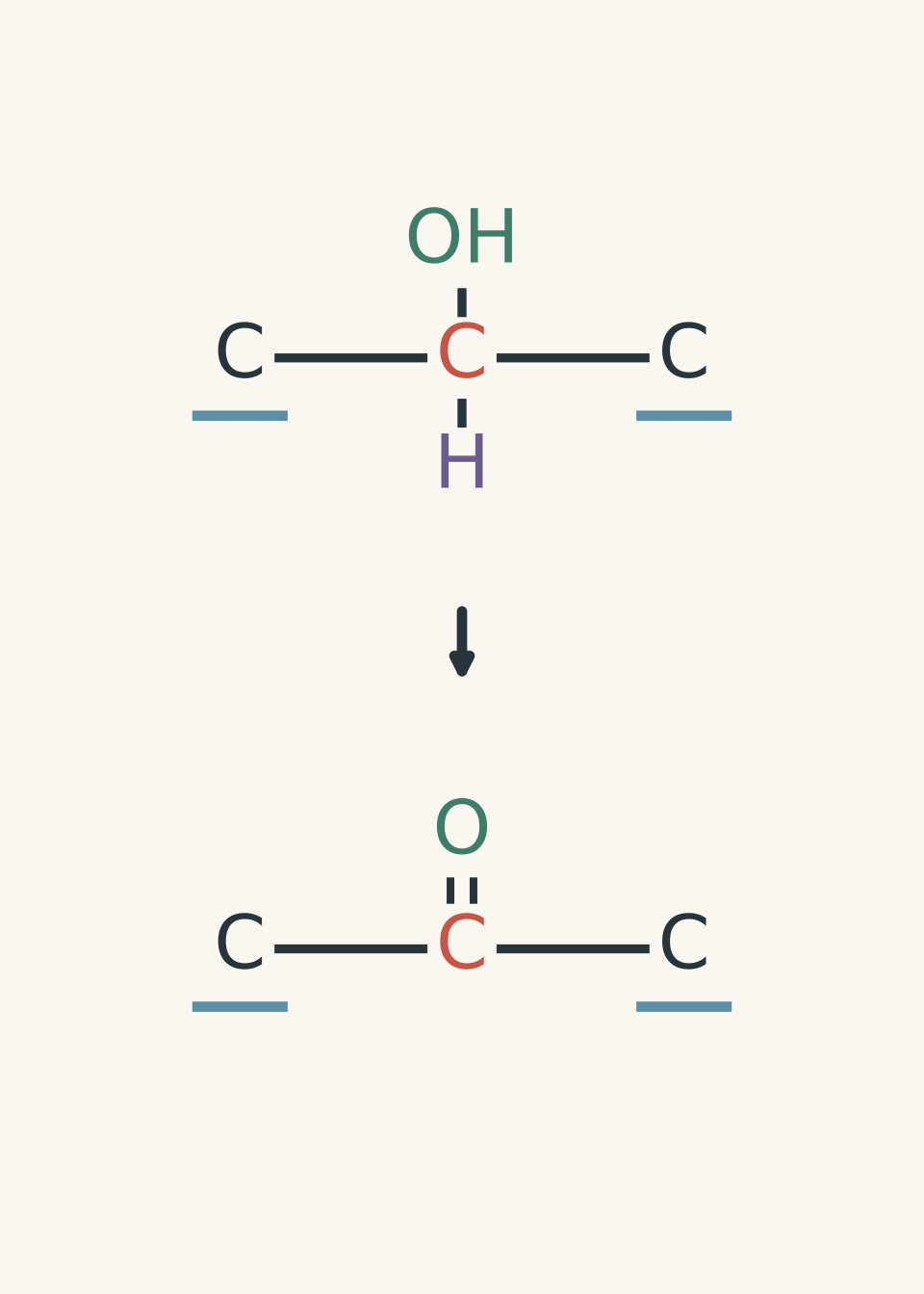
For simple alcohol oxidation questions, use this decision rule:
| Carbon carrying \(\ce{-OH}\) is bonded to… | Alcohol type | Usual oxidation product |
|---|---|---|
| one carbon atom | primary | aldehyde, then carboxylic acid |
| two carbon atoms | secondary | ketone |
| three carbon atoms | tertiary | no straightforward oxidation under usual HSC conditions |
If identifying the alcohol type itself is still taking too long, revise primary, secondary and tertiary alcohols first.
02What actually changes during oxidation?
For a secondary alcohol, the important local structure is:
\[ \ce{R-CH(OH)-R'} \]
Here, \(R\) and \(R'\) represent carbon-containing groups.
After oxidation, it becomes:
\[ \ce{R-C(=O)-R'} \]
The overall reaction is commonly represented as:
\[ \ce{R-CH(OH)-R' + [O] -> R-C(=O)-R' + H2O} \]
The symbol \(\ce{[O]}\) represents an oxidising agent rather than a literal free oxygen atom.
Track the change carefully. In the net reaction:
- the hydrogen attached directly to the alcohol carbon is removed,
- the hydrogen from the \(\ce{-OH}\) group is removed,
- the carbon-oxygen single bond becomes a carbon-oxygen double bond, and
- the carbon skeleton remains unchanged.
The product contains a carbonyl group, \(\ce{C=O}\).
Because the carbonyl carbon is still bonded to two other carbon atoms, the product is a ketone.
This is also why simply memorising “alcohol plus oxidant gives carbonyl” isn’t enough. Both aldehydes and ketones contain carbonyl groups. You need to track what is attached to the carbonyl carbon.
03A secondary alcohol does not become an aldehyde
This is the most tempting mistake.
Take butan-2-ol again:
\[ \ce{CH3-CH(OH)-CH2-CH3} \]
You might remember that alcohol oxidation can produce an aldehyde and draw butanal:
\[ \ce{CH3CH2CH2CHO} \]
But compare the carbon skeletons.
In butan-2-ol, the alcohol carbon is the second carbon in the chain. In butanal, the carbonyl carbon is at the end.
Getting from one to the other would require rearranging which carbons are connected. Ordinary oxidation of the alcohol does not do that.
Instead:
\[ \ce{CH3-CH(OH)-CH2-CH3 -> CH3-C(=O)-CH2-CH3} \]
The product is butan-2-one.
A good exam habit is therefore:
- Find the carbon carrying \(\ce{-OH}\).
- Count how many carbon atoms are directly attached to it.
- Keep the carbon skeleton fixed.
- Replace the secondary-alcohol unit \(\ce{-CH(OH)-}\) with \(\ce{-C(=O)-}\).
- Name the resulting ketone.
That method is more reliable than trying to remember product names separately.
Worked example: Oxidising butan-2-ol
Predict the organic product when butan-2-ol is oxidised using an acidified oxidising agent. Give the product’s name and write an overall equation using \(\ce{[O]}\).
Step 1
Butan-2-ol has the structure:
\[ \ce{CH3-CH(OH)-CH2-CH3} \]
The carbon carrying \(\ce{-OH}\) is bonded to two other carbons, so the alcohol is secondary.
Step 2
The sequence of four carbon atoms remains the same.
Step 3
\[ \ce{CH3-CH(OH)-CH2-CH3 -> CH3-C(=O)-CH2-CH3} \]
The carbonyl carbon is bonded to two carbon groups, so the product is a ketone.
Step 4
The product is butan-2-one.
Step 5
\[ \ce{CH3CH(OH)CH2CH3 + [O] -> CH3COCH2CH3 + H2O} \]
The important result is not just the name. The second carbon stays the second carbon. Its \(\ce{C-O}\) single bond becomes a \(\ce{C=O}\) double bond as two hydrogens are removed overall.
04Naming the ketone product
Once you have drawn the correct product, naming it is usually straightforward.
For a ketone:
- choose the longest carbon chain containing the carbonyl carbon,
- replace the alkane ending
-ewith-one, - number the chain so the carbonyl carbon gets the lowest possible number, and
- then locate and name any branches.
The position of the carbonyl group matters.
For example:
\[ \ce{CH3COCH2CH2CH3} \]
is pentan-2-one, while
\[ \ce{CH3CH2COCH2CH3} \]
is pentan-3-one.
Both have the molecular formula \(\ce{C5H10O}\), but they are different structural isomers.
Worked example: Oxidising a branched secondary alcohol
Predict and name the product formed when 3-methylpentan-2-ol is oxidised. Write the condensed structural formula of the product.
Step 1
3-methylpentan-2-ol is:
\[ \ce{CH3-CH(OH)-CH(CH3)-CH2-CH3} \]
The carbon carrying \(\ce{-OH}\) is carbon 2. It is attached to two carbons, so this is a secondary alcohol.
Step 2
Do not move the methyl branch. Oxidation changes the functional group, not the carbon skeleton.
Step 3
\[ \ce{CH3-CH(OH)-CH(CH3)-CH2-CH3 -> CH3-C(=O)-CH(CH3)-CH2-CH3} \]
Step 4
The parent chain still contains five carbons. Numbering from the end nearest the carbonyl gives the ketone carbon number 2 and the methyl branch number 3.
The product is 3-methylpentan-2-one.
The overall oxidation can be represented as:
\[ \ce{CH3CH(OH)CH(CH3)CH2CH3 + [O] -> CH3COCH(CH3)CH2CH3 + H2O} \]
The harder part here is not the oxidation itself. It is resisting the temptation to redraw or renumber the carbon skeleton before you have produced the ketone.
05Does oxidation add another oxygen atom?
The word “oxidation” often makes students expect the organic molecule to gain oxygen.
That happens in some reactions, but it is not a safe definition.
For a simple saturated secondary alcohol becoming a ketone, both the alcohol and the ketone contain one oxygen atom.
For example:
\[ \ce{C4H10O -> C4H8O} \]
Butan-2-ol has formula \(\ce{C4H10O}\). Butan-2-one has formula \(\ce{C4H8O}\).
The organic molecule has lost two hydrogen atoms overall.
More generally, for an acyclic saturated monohydric secondary alcohol containing \(n\) carbon atoms:
\[ C_nH_{2n+2}O \rightarrow C_nH_{2n}O \]
So why is this still oxidation?
In organic chemistry, oxidation can be recognised by an increase in bonding from carbon to an electronegative atom such as oxygen, or a decrease in carbon-hydrogen bonding. Here, the alcohol carbon changes from a single bond to oxygen to a double bond to oxygen, while losing its hydrogen.
The carbon has been oxidised even though the organic product has not gained an extra oxygen atom.
06Why does the ketone usually stop there?
Suppose you use excess acidified potassium dichromate and heat under reflux. A primary alcohol can continue from an aldehyde to a carboxylic acid.
Shouldn’t a secondary alcohol’s ketone also keep oxidising?
Under the usual HSC treatment, no.
Look at the carbonyl carbon of a ketone:
\[ \ce{R-C(=O)-R'} \]
It is bonded to two carbon groups. There is no hydrogen attached directly to that carbon.
A carboxylic acid carbonyl carbon has a different arrangement:
\[ \ce{R-C(=O)-OH} \]
For a ketone to become a carboxylic acid, one of its carbon-carbon bonds would generally have to be broken. That is a much more substantial change than the ordinary alcohol oxidation being considered.
So under the standard conditions used in HSC product-prediction questions, secondary alcohols oxidise to ketones, and those ketones resist further oxidation.
This is different from primary alcohol oxidation, where the carbonyl carbon of the aldehyde still has a hydrogen available for further oxidation. The comparison is worked through in Primary Alcohol Oxidation Products: Aldehydes and Acids.
07Questions and solutions
Question 1
Pentan-2-ol is oxidised using acidified potassium dichromate.
a. Name the organic product.
b. Write its condensed structural formula.
c. Write an overall equation using \(\ce{[O]}\).
Solution 1
The product is pentan-2-one, with condensed structural formula \(\ce{CH3COCH2CH2CH3}\).
Pentan-2-ol is:
\[ \ce{CH3CH(OH)CH2CH2CH3} \]
The carbon carrying \(\ce{-OH}\) is bonded to two other carbon atoms, so it is a secondary alcohol. Secondary alcohols oxidise to ketones.
Keeping the carbon skeleton unchanged:
\[ \ce{CH3CH(OH)CH2CH2CH3 + [O] -> CH3COCH2CH2CH3 + H2O} \]
The \(\ce{CH(OH)}\) group on carbon 2 becomes \(\ce{C(=O)}\), so the carbonyl remains at carbon 2.
A common mistake is to produce pentanal. That would place the carbonyl at the end of the chain and therefore change which carbon carries the functional group. Ordinary oxidation does not rearrange the carbon skeleton.
Question 2
An alcohol has the condensed structural formula:
\[ \ce{CH3CH2CH(CH3)CH(OH)CH3} \]
It is oxidised using an acidified oxidising agent.
a. Classify the alcohol as primary, secondary, or tertiary.
b. Draw or write the condensed structural formula of the organic product.
c. Name the product.
d. Explain exactly what changes around the carbon that originally carried the \(\ce{-OH}\) group.
Solution 2
The alcohol is secondary, and it forms 3-methylpentan-2-one, \(\ce{CH3CH2CH(CH3)COCH3}\).
First number the original chain from the end nearest the \(\ce{-OH}\) group. The alcohol is 3-methylpentan-2-ol.
The carbon carrying \(\ce{-OH}\) is attached to two other carbon atoms and one hydrogen, so it is secondary.
Its oxidation is:
\[ \ce{CH3CH2CH(CH3)CH(OH)CH3 + [O] -> CH3CH2CH(CH3)COCH3 + H2O} \]
Around the reacting carbon, two hydrogens are removed overall: one from the \(\ce{-OH}\) group and one attached directly to that carbon. The carbon-oxygen single bond becomes a carbon-oxygen double bond.
The carbon-carbon connections do not change.
When the product is named, the chain is numbered from the end nearest the ketone carbonyl. This gives 3-methylpentan-2-one.
The tempting error is to let the branch or functional group “move” while drawing the product. Nothing in this oxidation justifies a carbon skeleton rearrangement.
Question 3
Three alcohols are heated separately under reflux with excess acidified potassium dichromate:
- pentan-2-ol,
- pentan-3-ol, and
- 2-methylbutan-2-ol.
For each alcohol, predict the organic oxidation product under the usual HSC assumptions. Then explain why using excess oxidant and reflux does not simply turn the ketone products into carboxylic acids.
Solution 3
Pentan-2-ol forms pentan-2-one, pentan-3-ol forms pentan-3-one, and 2-methylbutan-2-ol undergoes no straightforward oxidation under the usual HSC conditions.
For pentan-2-ol:
\[ \ce{CH3CH(OH)CH2CH2CH3 + [O] -> CH3COCH2CH2CH3 + H2O} \]
The product is pentan-2-one.
For pentan-3-ol:
\[ \ce{CH3CH2CH(OH)CH2CH3 + [O] -> CH3CH2COCH2CH3 + H2O} \]
The product is pentan-3-one.
Both starting alcohols are secondary because their \(\ce{-OH}\)-bearing carbon is attached to two carbon atoms and one hydrogen.
In 2-methylbutan-2-ol, however, the carbon carrying \(\ce{-OH}\) is bonded to three carbon atoms:
\[ \ce{CH3C(OH)(CH3)CH2CH3} \]
It has no hydrogen attached to that carbon. The ordinary oxidation pathway that converts \(\ce{CH(OH)}\) into \(\ce{C=O}\) therefore cannot occur without breaking a carbon-carbon bond.
Excess oxidant does not change this structural constraint.
The ketones from the first two reactions also do not simply continue to carboxylic acids. Their carbonyl carbons are bonded to two carbon atoms and have no carbonyl-carbon hydrogen. Further oxidation would generally require carbon-carbon bond cleavage, which is not part of the usual secondary-alcohol oxidation considered in HSC questions.
The tempting route is to reason that “more oxidant means more oxidation”. Reagent quantity matters only when another accessible oxidation step exists. For a primary alcohol, it does. For a normal ketone under these conditions, it does not.
Question 4
A pure, saturated, acyclic, monohydric secondary alcohol is completely converted to its ketone.
The initial alcohol has a mass of \(7.412\ \mathrm{g}\). After oxidation, isolation, and complete drying, the ketone has a mass of \(7.210\ \mathrm{g}\).
Assume the only organic reaction is:
\[ \ce{secondary alcohol + [O] -> ketone + H2O} \]
Use \(M(\ce{H}) = 1.008\ \mathrm{g\,mol^{-1}}\).
a. Explain why the organic product can have a lower mass even though the reaction is an oxidation.
b. Estimate the number of moles of alcohol that reacted.
c. Determine the molecular formula and identity of the alcohol.
d. Identify the ketone product.
Solution 4
The alcohol is butan-2-ol, \(\ce{C4H10O}\), and the product is butan-2-one, \(\ce{C4H8O}\). The organic mass falls because each alcohol molecule loses two hydrogen atoms when it becomes a ketone.
The tempting prediction is that oxidation must increase the organic molecule’s mass by adding oxygen. But a secondary alcohol and its ketone contain the same number of oxygen atoms.
The formula changes from:
\[ C_nH_{2n+2}O \]
to:
\[ C_nH_{2n}O \]
So each mole of alcohol loses the mass of two moles of hydrogen atoms from the organic molecule.
The observed mass loss is:
\[ 7.412\ \mathrm{g} - 7.210\ \mathrm{g} = 0.202\ \mathrm{g} \]
The molar mass decrease per mole is:
\[ 2(1.008\ \mathrm{g\,mol^{-1}}) =2.016\ \mathrm{g\,mol^{-1}} \]
Therefore:
\[ n = \frac{0.202\ \mathrm{g}} {2.016\ \mathrm{g\,mol^{-1}}} \approx 0.100\ \mathrm{mol} \]
The alcohol’s molar mass is therefore approximately:
\[ M = \frac{7.412\ \mathrm{g}} {0.100\ \mathrm{mol}} \approx 74.1\ \mathrm{g\,mol^{-1}} \]
For a saturated acyclic monohydric alcohol:
\[ C_nH_{2n+2}O \]
Trying \(n=4\):
\[ M(\ce{C4H10O}) = 4(12.01)+10(1.008)+16.00 \approx 74.1\ \mathrm{g\,mol^{-1}} \]
So the molecular formula is \(\ce{C4H10O}\).
The saturated secondary alcohol with this formula is butan-2-ol:
\[ \ce{CH3CH(OH)CH2CH3} \]
Its oxidation product is butan-2-one:
\[ \ce{CH3CH(OH)CH2CH3 + [O] -> CH3COCH2CH3 + H2O} \]
The strange-looking mass decrease is therefore exactly what the structural change predicts. “Oxidation” describes the change in bonding and oxidation state, not a guarantee that the isolated organic compound becomes heavier.
Question 5
Pentane-1,4-diol has the structure:
\[ \ce{HOCH2CH2CH2CH(OH)CH3} \]
It is heated under reflux with excess acidified potassium dichromate.
Student A notices the secondary alcohol group and predicts:
\[ \ce{HOCH2CH2CH2COCH3} \]
Student B notices the primary alcohol group and predicts:
\[ \ce{HOOCCH2CH2CH(OH)CH3} \]
Assume complete oxidation of each oxidisable alcohol group and no carbon-carbon bond cleavage.
a. Decide whether either student has predicted the final major organic product correctly.
b. Give the final condensed structural formula and name of the product.
c. Explain how this result is consistent with the rule that secondary alcohols oxidise to ketones.
Solution 5
Neither student is correct. The final product is \(\ce{HOOCCH2CH2COCH3}\), named 4-oxopentanoic acid.
The key is to inspect each alcohol group separately rather than classifying the whole molecule with one label.
At the left-hand end:
\[ \ce{-CH2OH} \]
the alcohol carbon is attached to only one other carbon. It is a primary alcohol.
Under reflux with excess oxidant, a primary alcohol is oxidised through the aldehyde stage to a carboxylic acid:
\[ \ce{-CH2OH -> -CHO -> -COOH} \]
At the other alcohol site:
\[ \ce{-CH(OH)-} \]
the alcohol carbon is attached to two carbon atoms. It is secondary, so it becomes a ketone carbonyl:
\[ \ce{-CH(OH)- -> -C(=O)-} \]
Applying both changes to the original molecule gives:
\[ \ce{HOCH2CH2CH2CH(OH)CH3 -> HOOCCH2CH2COCH3} \]
Student A correctly oxidised the secondary alcohol but ignored the primary alcohol, even though excess oxidant under reflux allows that site to continue to the carboxylic acid.
Student B correctly oxidised the primary alcohol but left the secondary alcohol unchanged even though it is also readily oxidised.
The final naming needs one more piece of reasoning. The molecule contains both a carboxylic acid group and a ketone carbonyl. The carboxylic acid is the principal functional group, so the parent name ends in -oic acid. The additional ketone carbonyl is described using the prefix oxo-.
Numbering from the carboxylic acid carbon gives the extra carbonyl at carbon 4, so the name is 4-oxopentanoic acid.
This does not contradict the rule that secondary alcohols oxidise to ketones. The local secondary-alcohol site really has become a ketone carbonyl. The subtle point is that a molecule containing that carbonyl does not always use -one as its main suffix when a higher-priority functional group is also present.
That local way of thinking is the useful next step. Instead of asking only “what type of molecule is this?”, inspect each reactive carbon and track what happens to it. That becomes essential when HSC reaction pathways contain branching, several functional groups, or a sequence of oxidation steps.