
Qualitative Tests for Aqueous Cations: HSC Chemistry Guide
Learn how chemists identify unknown aqueous cations using observable evidence. This guide explains flame tests, precipitation reactions, and complex ion formation for HSC Chemistry.
A clear solution can contain several different metal ions. You are given a colourless liquid, and someone tells you it contains one of these ions: \(\mathrm{Ba}^{2+}\), \(\mathrm{Ca}^{2+}\), \(\mathrm{Mg}^{2+}\), \(\mathrm{Pb}^{2+}\), \(\mathrm{Ag}^{+}\), \(\mathrm{Cu}^{2+}\), \(\mathrm{Fe}^{2+}\), or \(\mathrm{Fe}^{3+}\).
How would you identify it?
You might predict that the ions should be easy to tell apart because they are different elements. That prediction makes sense, but there is a problem: many aqueous solutions are colourless, and the ions themselves are usually invisible. Chemists need to create an observable change.
The key idea is simple: make the ion reveal itself.

Qualitative analysis is the process of identifying what substances are present without measuring an exact amount. For aqueous cations, HSC Chemistry focuses on three main clues:
- flame colour,
- formation of a precipitate,
- formation of a coloured complex ion.
Each test gives a different piece of evidence. The strongest identification usually comes from combining several tests rather than relying on one observation.
01Building the first model: turning invisible ions into evidence
Imagine trying to identify people in a crowded room where everyone is wearing the same clothes. You cannot identify them by appearance alone. You need to ask questions that produce different responses.
Metal ions behave similarly. The ion is present in solution, but we need to create a reaction where different ions behave differently.
For example, if a solution contains \(\mathrm{Cu}^{2+}\), adding hydroxide ions causes a blue solid to form:
\[ \ce{Cu^2+(aq) + 2OH-(aq) -> Cu(OH)2(s)} \]
The solid \(\ce{Cu(OH)2}\) is called a precipitate. A precipitate is an insoluble ionic compound that forms from ions dissolved in solution.
A first simplified model is:
Add a reagent → observe a change → identify possible ions.
This works well, but it is incomplete. Different ions can sometimes produce similar observations. For example, several ions form hydroxide precipitates. The chemist must consider colour, solubility, and further reactions.
02Test 1: Flame tests reveal certain metal ions
Some metal ions emit characteristic colours when heated in a flame. The heat excites electrons in the metal atoms, and when those electrons return to lower energy levels, they release light.
The colour depends on the energy difference between electron states.
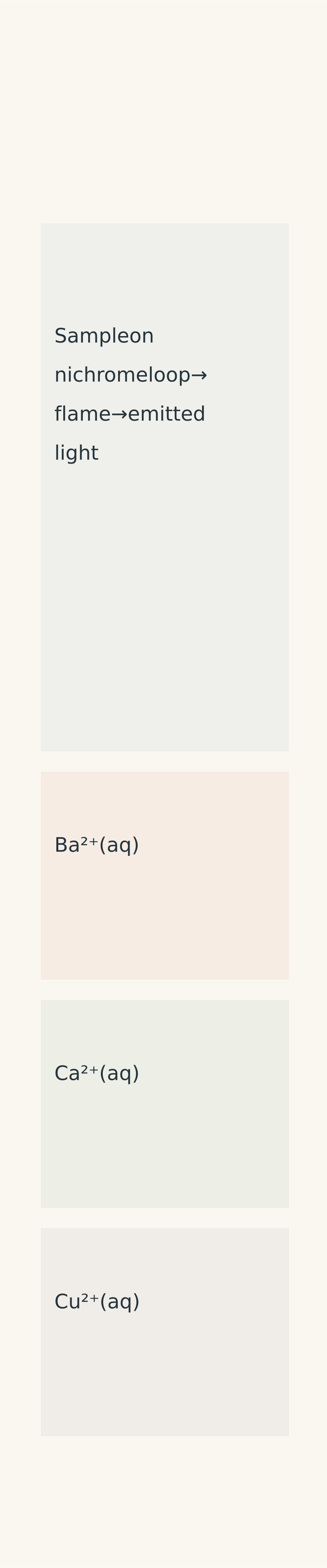
A flame test is useful because the colours are distinctive:
| Ion | Flame colour |
|---|---|
| \(\mathrm{Ba}^{2+}\) | Apple green |
| \(\mathrm{Ca}^{2+}\) | Orange-red |
| \(\mathrm{Cu}^{2+}\) | Blue-green |
Other ions in this list are not usually identified by a simple flame colour in the HSC context.
A common mistake is thinking the flame colour proves the ion is present. It does not. Contamination from another substance can produce misleading colours. A flame test is evidence, not a final answer.
You can explore the specific chemistry behind this test in the tutorgum guide on Flame Tests for Aqueous Cations.
03Test 2: Precipitation reactions
A precipitation test works by adding a reagent that reacts with a possible cation to form an insoluble compound.
A typical reagent is sodium hydroxide solution, \(\ce{NaOH(aq)}\), which provides hydroxide ions:
\[ \ce{NaOH(aq) -> Na+(aq) + OH-(aq)} \]
The sodium ions usually remain spectators. The hydroxide ions do the important work.
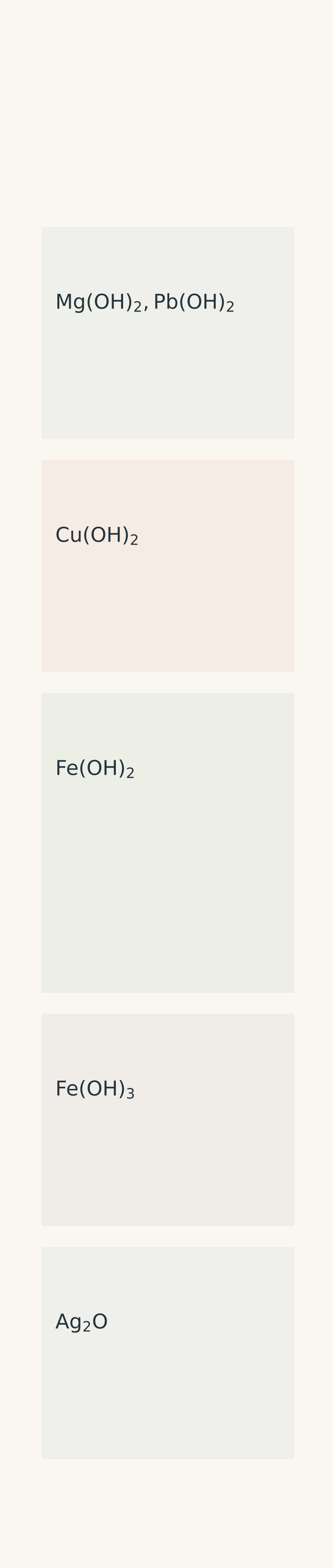
Hydroxide precipitates
| Ion | Observation with \(\ce{OH^-}\) |
|---|---|
| \(\mathrm{Mg}^{2+}\) | White precipitate |
| \(\mathrm{Pb}^{2+}\) | White precipitate |
| \(\mathrm{Cu}^{2+}\) | Blue precipitate |
| \(\mathrm{Fe}^{2+}\) | Green precipitate (often turns brown in air) |
| \(\mathrm{Fe}^{3+}\) | Brown precipitate |
The equations show why the observations occur.
For magnesium:
\[ \ce{Mg^2+(aq) + 2OH-(aq) -> Mg(OH)2(s)} \]
For iron(III):
\[ \ce{Fe^3+(aq) + 3OH-(aq) -> Fe(OH)3(s)} \]
The trap is assuming every white precipitate means the same ion. Several ions can form white solids, so a second test is often needed.
04Test 3: Complexation creates new colours
Some metal ions can react with ligands to form complex ions.
A ligand is a molecule or ion that donates a pair of electrons to a metal ion. In HSC Chemistry, the most important example here is excess ammonia solution.
Copper(II) is a good example.
First, adding a small amount of ammonia produces a light blue precipitate:
\[ \ce{Cu^2+(aq) + 2OH-(aq) -> Cu(OH)2(s)} \]
But adding excess ammonia dissolves the precipitate and forms a deep blue complex:
\[ \ce{Cu^2+(aq) + 4NH3(aq) -> [Cu(NH3)4]^2+(aq)} \]
The solution changes from light blue to dark blue.
This is a useful confirmation because it uses the chemical behaviour of the ion, not just its appearance.
05A decision pathway for unknown cations
When identifying an unknown solution, avoid random testing. Use a logical sequence.

A practical approach:
- Use a flame test if the ion could be \(\mathrm{Ba}^{2+}\), \(\mathrm{Ca}^{2+}\), or \(\mathrm{Cu}^{2+}\).
- Add sodium hydroxide solution and record the precipitate colour.
- Add excess sodium hydroxide or ammonia if needed to separate similar observations.
- Compare the full pattern of results.
The important word is pattern. One observation rarely identifies an ion with certainty.
06Worked example: Identify a metal ion from observations
Worked example: Unknown solution gives a blue precipitate with hydroxide
A student adds sodium hydroxide solution to an unknown aqueous solution. A blue precipitate forms. Identify the most likely cation.
Step 1
A blue hydroxide precipitate is characteristic of copper(II) hydroxide.
\[ \ce{Cu^2+(aq) + 2OH-(aq) -> Cu(OH)2(s)} \]
Step 2
Magnesium and lead hydroxides are white. Iron(II) hydroxide is green, and iron(III) hydroxide is brown.
Step 3
The most likely cation is:
\[ \boxed{\ce{Cu^2+(aq)}} \]
The blue precipitate is evidence because copper(II) ions form the insoluble compound \(\ce{Cu(OH)2}\).
Worked example: Using multiple tests to identify an unknown
An unknown solution gives an apple-green flame. Adding sodium hydroxide produces a white precipitate. Identify the ion.
Step 1
An apple-green flame indicates \(\mathrm{Ba}^{2+}\).
Step 2
Barium hydroxide is soluble enough that a strong white precipitate is not expected with sodium hydroxide under normal HSC conditions. The white precipitate observation suggests another ion may be involved or that the flame observation may have been affected by contamination.
Step 3
The correct scientific response is not to force an answer. Repeat the flame test with a clean wire loop and perform another confirmatory test.
This is an important habit in analytical chemistry: unexpected results are not ignored; they are investigated.
07Common misconceptions
“The colour of the solution tells me the ion”
Sometimes it helps, but many aqueous metal ions are colourless or very pale.
For example, \(\mathrm{Cu}^{2+}\) solutions are often blue, but \(\mathrm{Fe}^{2+}\) and \(\mathrm{Fe}^{3+}\) can have colours that depend on concentration and conditions.
“A precipitate means the reaction is finished”
A precipitate only tells you that an insoluble substance formed. The next question is whether it dissolves in excess reagent.
For example, copper hydroxide dissolves in excess ammonia because a soluble complex ion forms.
“One test is enough”
A good chemist looks for multiple pieces of supporting evidence. This is the same idea used in more advanced analytical techniques such as atomic absorption spectroscopy, where the signal from atoms is used to identify and measure metals: Atomic Absorption Spectroscopy for HSC Chemistry.
08Questions and solutions
Question 1
An unknown solution produces a blue-green flame during a flame test. Which cation is most likely present?
Solution 1
The most likely cation is \(\mathrm{Cu}^{2+}\).
The blue-green flame is a characteristic observation for copper ions in the HSC qualitative analysis context. However, the flame test should be considered alongside other tests because contamination can produce misleading colours.
The conclusion is:
\[ \boxed{\ce{Cu^2+(aq)}} \]
The key idea is that the flame colour is evidence from electron energy changes, not a direct view of the ion.
Question 2
A solution forms a brown precipitate when sodium hydroxide is added. Identify the cation and write the ionic equation.
Solution 2
The cation is \(\mathrm{Fe}^{3+}\), and the ionic equation is:
\[ \ce{Fe^3+(aq) + 3OH-(aq) -> Fe(OH)3(s)} \]
The brown precipitate is iron(III) hydroxide.
A tempting mistake is choosing \(\mathrm{Fe}^{2+}\) because it is also an iron ion. The difference is that iron(II) hydroxide is green, while iron(III) hydroxide is brown.
Question 3
An unknown solution forms a white precipitate with sodium hydroxide. The precipitate remains after adding excess sodium hydroxide. The solution also forms a cream precipitate when silver nitrate is added. Identify the ion.
Solution 3
The ion is \(\mathrm{Ag}^{+}\).
The white hydroxide precipitate result alone is not enough because \(\mathrm{Mg}^{2+}\) and \(\mathrm{Pb}^{2+}\) can also give white precipitates. The important extra evidence is the reaction with silver nitrate.
Silver ions form a cream precipitate of silver bromide if bromide ions are present, but silver ions themselves are usually tested through halide reactions rather than hydroxide formation. The observations given are inconsistent with a single cation identification because \(\mathrm{Ag}^{+}\) does not form a typical stable hydroxide precipitate used in this analysis.
The correct conclusion is that the data are insufficient or contradictory. A reliable identification requires another confirmatory test, such as observing silver halide formation with an appropriate anion.
The trap is forcing every observation into a memorised table instead of checking whether the chemistry fits.
Question 4
A solution is suspected to contain either \(\mathrm{Cu}^{2+}\) or \(\mathrm{Mg}^{2+}\). Both tests begin with sodium hydroxide.
Predict the observations for each ion and explain how ammonia can help distinguish them.
Solution 4
The ions can be distinguished because copper(II) forms a coloured complex with ammonia, while magnesium does not.
With sodium hydroxide:
For copper:
\[ \ce{Cu^2+(aq) + 2OH-(aq) -> Cu(OH)2(s)} \]
A blue precipitate forms.
For magnesium:
\[ \ce{Mg^2+(aq) + 2OH-(aq) -> Mg(OH)2(s)} \]
A white precipitate forms.
If excess ammonia is added:
- copper(II) hydroxide dissolves and forms a deep blue complex:
\[ \ce{Cu^2+(aq) + 4NH3(aq) -> [Cu(NH3)4]^2+(aq)} \]
- magnesium does not produce this characteristic deep blue complex.
The tempting route is to stop after seeing “a precipitate”. The important constraint is that the precipitate colour and later complex formation provide extra information.
Question 5
A student receives an unknown solution. Their results are:
- Flame test: no obvious colour.
- Sodium hydroxide: a white precipitate forms.
- Excess sodium hydroxide: precipitate remains.
- Excess ammonia: no change.
- The student concludes the ion must be \(\mathrm{Mg}^{2+}\).
Evaluate the conclusion. Is it justified? Explain how a careful chemist would reason.
Solution 5
The conclusion that the ion is definitely \(\mathrm{Mg}^{2+}\) is not justified.
The observations are consistent with magnesium, but they are not unique enough to prove it.
The reasoning is:
- A white hydroxide precipitate suggests ions such as \(\mathrm{Mg}^{2+}\) or \(\mathrm{Pb}^{2+}\).
- The precipitate remaining in excess sodium hydroxide helps rule out some amphoteric hydroxides, but it does not automatically prove magnesium.
- The lack of reaction with ammonia supports magnesium, because copper(II) would form a deep blue complex, but it still does not create absolute certainty.
A careful chemist would perform an additional test. For example, a flame test or another suitable precipitation reaction could provide extra evidence.
The tempting route is to match a few observations to the first familiar table entry. The deeper reasoning is recognising that identification requires a unique pattern of results, not just a plausible match.
Qualitative tests are the foundation for more advanced analytical decisions. Once you understand how observations connect to chemical behaviour, techniques such as colourimetry and instrumental analysis become much easier to interpret. You can continue with Colourimetry: Calculate Concentration and Evaluate Data.