
Nuclear fission: fission products, neutrons and energy
Learn how heavy nuclei split, why neutrons can sustain a chain reaction, and how mass difference becomes released nuclear energy.
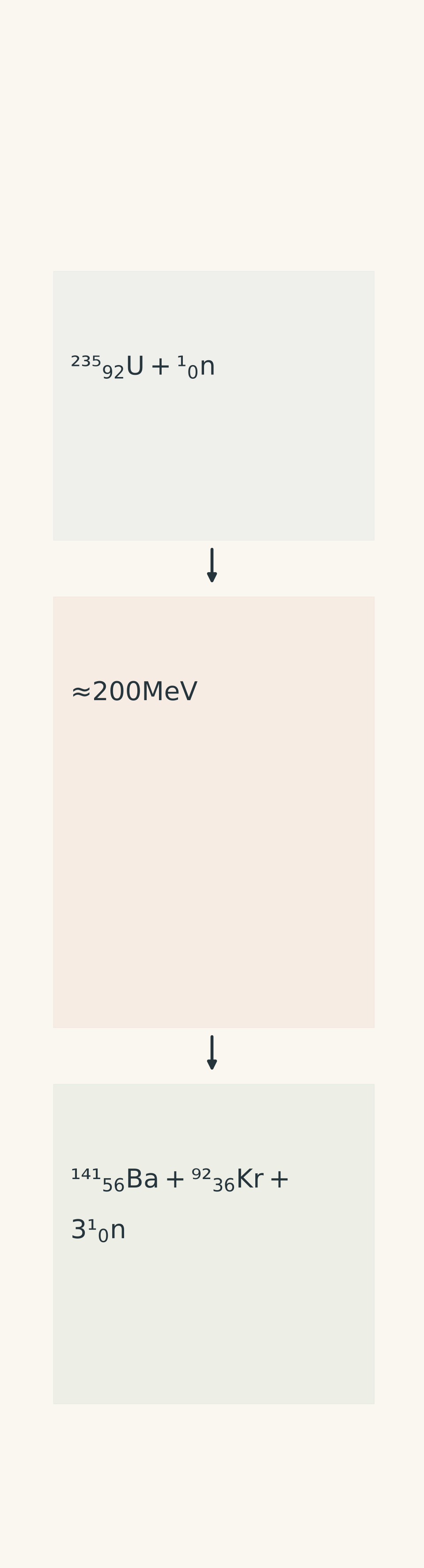
Suppose a neutron enters a uranium-235 nucleus and the nucleus splits into two smaller nuclei. Three more neutrons fly out, and roughly 200 MeV of energy is released. Where did that energy come from? And why can those three neutrons make the process happen again?
Those questions are the useful way into nuclear fission. The important idea is not simply that a big nucleus “breaks apart”. You need to track what the products are, where the neutrons come from, and why the final particles have less rest mass than the starting system.
01What actually happens during fission?
Start with a uranium-235 nucleus. It has 92 protons and 143 neutrons.
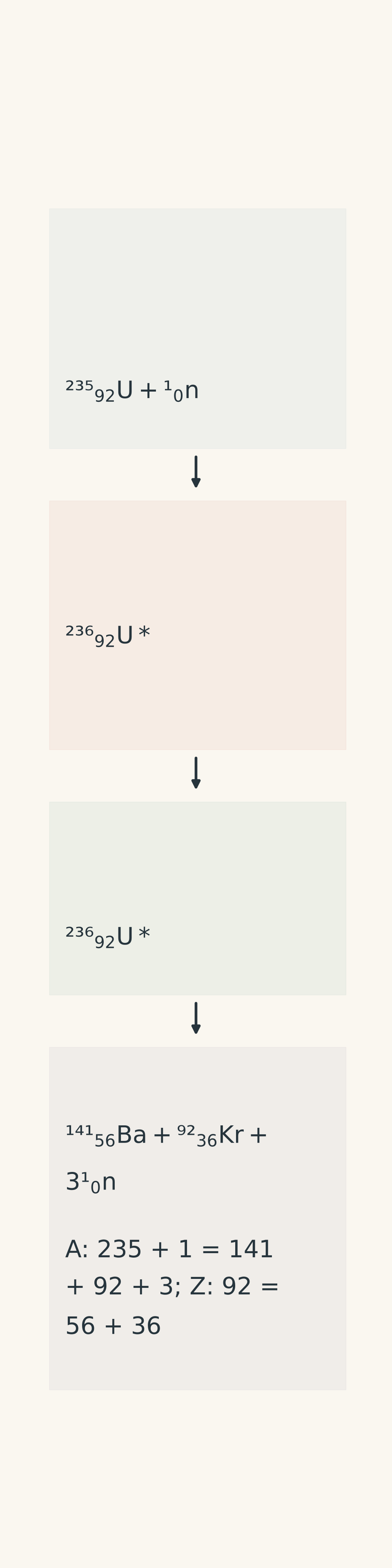
A neutron can be absorbed by the nucleus:
\[ {}^{235}_{92}\mathrm{U}+{}^{1}_{0}\mathrm{n} \rightarrow {}^{236}_{92}\mathrm{U}^{*} \]
The asterisk means the uranium-236 nucleus is in an excited state. It has extra energy and is unstable enough that it can deform and split.
The neutron is useful here because it has no electric charge. It does not face the electrostatic repulsion that a positively charged proton would face when approaching the positively charged uranium nucleus.
Picture the nucleus stretching
A useful first model is to picture the heavy nucleus as a crowded blob of nucleons. If it becomes sufficiently excited, it can stretch into a dumbbell shape and then separate.
There is a competition going on.
- The strong nuclear force holds nearby nucleons together.
- The electrostatic force makes the positively charged protons repel one another.
- In a very heavy nucleus, there are many protons, so the total electrostatic repulsion is substantial.
Imagine a very crowded group trying to squeeze around a tiny table. The people at opposite ends are not interacting with each other very strongly, but they are still trying to get away from the crowd. Splitting into two groups can become easier than staying in one awkward arrangement.
The analogy breaks down because a nucleus is a quantum system, not a collection of people, and the strong nuclear force has a very short range. Still, it gives you the right first picture: fission involves a heavy nucleus becoming sufficiently deformed that the balance of nuclear attraction and proton repulsion favours separation.

02The fission products are not always the same
A common mistake is to imagine that uranium-235 always splits into two equal halves.
It doesn’t.
A fission event can produce many different combinations of two medium-mass nuclei, provided the conservation laws are satisfied. The two large nuclei are called fission fragments, and they are generally radioactive.
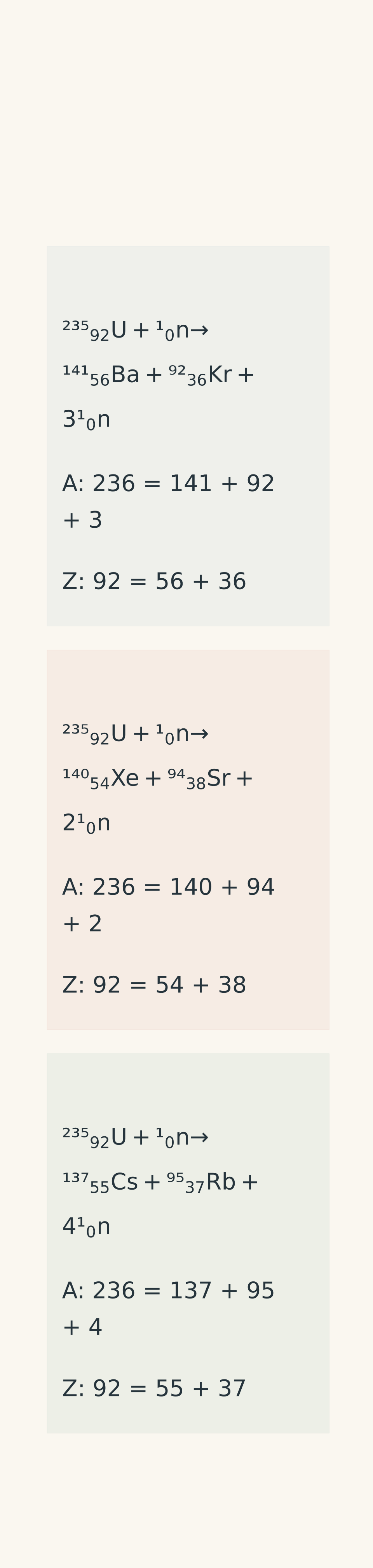
One possible fission reaction is:
\[ {}^{235}_{92}\mathrm{U} + {}^{1}_{0}\mathrm{n} \rightarrow {}^{141}_{56}\mathrm{Ba} + {}^{92}_{36}\mathrm{Kr} + 3\,{}^{1}_{0}\mathrm{n} + \text{energy} \]
Check the numbers.
The total mass number before the reaction is:
\[ 235+1=236 \]
After the reaction:
\[ 141+92+3=236 \]
The total atomic number before the reaction is:
\[ 92+0=92 \]
After the reaction:
\[ 56+36=92 \]
So both quantities balance.
Here, \(A\) is the mass number, the total number of protons and neutrons, and \(Z\) is the atomic number, the number of protons.
That gives you an important exam distinction:
| Quantity | What happens in the nuclear equation? |
|---|---|
| Mass number \(A\) | Conserved |
| Atomic number \(Z\) | Conserved |
| Electric charge | Conserved |
| Rest mass | Not necessarily conserved |
That last row is where the energy comes from.
Worked example: balancing a fission equation
A uranium-235 nucleus absorbs one neutron and fissions into barium-141, krypton-92, and \(x\) neutrons. Determine \(x\) and write the balanced nuclear equation.
Step 1
The incoming neutron has mass number 1, so:
\[ 235+1=141+92+x \]
Therefore:
\[ 236=233+x \]
\[ x=3 \]
Step 2
Uranium has atomic number 92, while barium and krypton have atomic numbers 56 and 36:
\[ 92=56+36 \]
So the atomic number is already balanced. Neutrons have atomic number 0.
Step 3
\[ {}^{235}_{92}\mathrm{U} + {}^{1}_{0}\mathrm{n} \rightarrow {}^{141}_{56}\mathrm{Ba} + {}^{92}_{36}\mathrm{Kr} + 3\,{}^{1}_{0}\mathrm{n} + \text{energy} \]
Step 4
The three free neutrons are not created from nowhere. They are nucleons that were part of the starting system and end up outside the two fission fragments.
This is why balancing mass number is so useful: it forces you to account for every proton and neutron.
03So where does the energy come from?
Here is the surprising part.
The products have a slightly smaller total rest mass than the reactants.
That does not violate conservation of energy. The missing rest mass has become other forms of energy, mainly the kinetic energy of the fission fragments.
The relationship is Einstein’s:
\[ E=mc^2 \]
where \(E\) is energy, \(m\) is mass, and \(c\) is the speed of light in a vacuum.
Because \(c^2\) is enormous, even a tiny decrease in mass corresponds to a large amount of energy.
Binding energy gives the physical reason
It is useful to make the explanation more precise.
The fission products are generally more tightly bound per nucleon than the original very heavy nucleus. In other words, their nucleons sit in a lower-energy nuclear arrangement.
The difference in energy between the initial and final arrangements is released.
You can think of it like moving from a high shelf to a lower shelf. The object loses gravitational potential energy as it drops. In fission, the nucleus moves to a lower-energy nuclear arrangement, and the difference appears as released energy.
The analogy is only about energy levels. A nucleus is not literally dropping through space.
For heavy nuclei such as uranium, fission moves the nucleons towards nuclei with a higher binding energy per nucleon. This increase in binding is the underlying reason fission can release energy.
If the idea of mass defect is unfamiliar, the tutorgum guide to mass defect and nuclear binding energy works through the calculation in more detail.
What happens to the released energy?
The energy from a fission event is not all carried by one thing.
A typical fission event releases about 200 MeV in total, although the exact amount varies between fission events.
Most of that energy initially appears as kinetic energy of the two heavy fission fragments. The fragments shoot apart because they are both positively charged and strongly repel each other.
Some energy also appears as:
- kinetic energy of the emitted neutrons,
- gamma radiation,
- energy associated with the later radioactive decay of the fission products.
As the fast particles interact with surrounding material, their kinetic energy is transferred to the material. In a reactor, this ultimately becomes thermal energy that can be used to heat water and produce steam.
Worked example: converting fission mass defect into energy
Suppose one fission event has a mass difference of \(0.214\,\mathrm{u}\) between its reactants and products. Estimate the energy released in joules and MeV.
Take:
\[ 1\,\mathrm{u}=1.66\times10^{-27}\,\mathrm{kg} \]
and
\[ c=3.00\times10^8\,\mathrm{m\,s^{-1}} \]
Also use:
\[ 1\,\mathrm{MeV}=1.60\times10^{-13}\,\mathrm{J} \]
Step 1
\[ \Delta m = 0.214\times1.66\times10^{-27} \]
\[ \Delta m = 3.55\times10^{-28}\,\mathrm{kg} \]
Step 2
\[ E = (3.55\times10^{-28}) (3.00\times10^8)^2 \]
\[ E \approx 3.20\times10^{-11}\,\mathrm{J} \]
Step 3
\[ E = \frac{3.20\times10^{-11}} {1.60\times10^{-13}} \]
\[ E \approx 200\,\mathrm{MeV} \]
Step 4
One fission releases roughly \(3.2\times10^{-11}\,\mathrm{J}\), or about \(200\,\mathrm{MeV}\).
That sounds tiny because one nucleus is tiny. The important point is that a macroscopic amount of nuclear fuel contains an enormous number of nuclei, so the total energy can be very large.
04What are the emitted neutrons doing?
The neutrons are the part of fission that can turn one nuclear reaction into many.
In the example above, one fission produces three neutrons. Those neutrons can interact with other uranium-235 nuclei and cause further fission.
That creates a chain reaction.
But be careful with the wording.
Three neutrons are not the same thing as three further fissions.
A neutron might:
- cause another fission,
- escape from the material,
- be absorbed without causing fission,
- or interact in another way.
So the important quantity is not simply “neutrons produced per fission”. What matters is how many of those neutrons successfully produce further fissions.

For a simple chain-reaction model, the multiplication factor, \(k\), describes how the number of fissions changes from one generation to the next.
If \(k>1\), the number of fissions tends to increase.
If \(k=1\), the chain reaction is self-sustaining at roughly the same rate.
If \(k<1\), the reaction tends to die away.
The real behaviour of a reactor is more complicated than this simple model, but the idea is extremely useful.
A quick way to diagnose a fission question
When you see a fission problem, separate the information into three boxes:
1. Fission products
Two main, usually radioactive, nuclei are produced.
2. Neutrons
Usually two or three prompt neutrons are emitted per fission, depending on the particular fission event.
3. Energy
The products have lower total rest mass and greater total binding energy, so the mass difference is released as energy.
If you keep those three outputs separate, several common mistakes disappear.
05Why are fission products radioactive?
The fission fragments often have too many neutrons for a stable nucleus of their size.
They therefore undergo radioactive decay as they move towards more stable nuclear configurations.
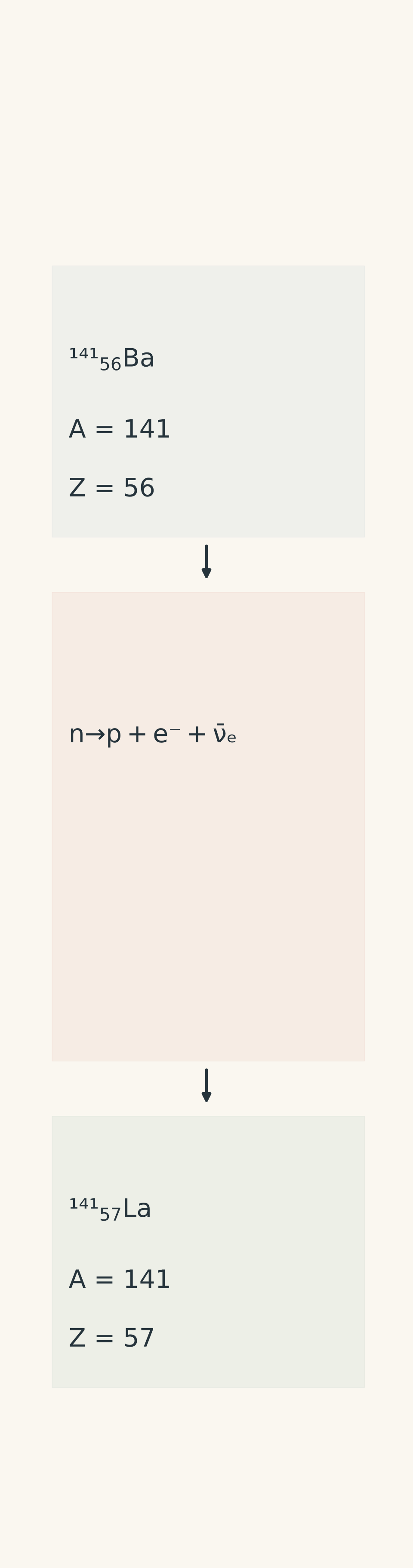
One common pathway is beta-minus decay. In beta-minus decay, a neutron changes into a proton, while an electron is emitted.
For example, barium-141 can undergo:
\[ {}^{141}_{56}\mathrm{Ba} \rightarrow {}^{141}_{57}\mathrm{La} + {}^{0}_{-1}\mathrm{e} + \bar{\nu}_e \]
The mass number stays at 141 because the total number of nucleons has not changed.
The atomic number increases from 56 to 57 because one neutron has become a proton.
The emitted electron is the beta-minus particle, and \(\bar{\nu}_e\) represents an electron antineutrino.
This is a useful connection to beta decay and nuclear equations.
The important timing distinction is this:
Fission happens first. Radioactive decay of the fission products can happen afterwards.
So when a problem mentions beta or gamma radiation from fission products, don’t automatically treat it as part of the original splitting event. Some of the energy is released promptly during fission, while some is released later as unstable products decay.
06The most tempting misconception
A student might say:
“The nucleus splits, so the energy comes from the neutrons smashing into it.”
That is not the main explanation.
The incoming neutron is important because it can trigger the fission process, particularly when it is absorbed by a suitable fissile nucleus. But the large energy release comes from the difference between the initial and final nuclear energy states.
Another student might say:
“Three neutrons come out, so three more nuclei must split.”
Again, no.
The emitted neutrons only make a chain reaction possible. Whether the chain reaction grows depends on what happens to those neutrons afterwards.
And a third student might say:
“Mass is conserved, so there can’t be a mass defect.”
The correction is that mass number is conserved in the nuclear equation, while rest mass can decrease. Nuclear reactions conserve total mass-energy, not rest mass on its own.
07Questions and solutions
Question 1
A uranium-235 nucleus absorbs a neutron and produces xenon-140, strontium-94, and \(x\) neutrons.
Determine \(x\), and verify that the atomic numbers are conserved.
Solution 1
The number of emitted neutrons is 2, because conservation of mass number gives:
\[ 235+1=140+94+x \]
\[ 236=234+x \]
Therefore:
\[ x=2 \]
The atomic-number check is:
\[ 92=54+38 \]
so charge is also conserved.
The balanced reaction is:
\[ {}^{235}_{92}\mathrm{U} + {}^{1}_{0}\mathrm{n} \rightarrow {}^{140}_{54}\mathrm{Xe} + {}^{94}_{38}\mathrm{Sr} + 2\,{}^{1}_{0}\mathrm{n} + \text{energy} \]
The tempting mistake is to focus only on the two large fragments and forget that some nucleons leave as free neutrons. The mass-number calculation forces you to account for them.
Question 2
A particular fission event has a mass defect of \(0.214\,\mathrm{u}\).
Calculate the energy released in:
(a) joules, and
(b) MeV.
Then explain why the fission products have lower total rest mass than the reactants.
Solution 2
The energy released is approximately \(3.2\times10^{-11}\,\mathrm{J}\), or \(200\,\mathrm{MeV}\). The products have lower rest mass because they form a more tightly bound nuclear arrangement.
Step 1: Convert the mass defect to kilograms.
\[ \Delta m = 0.214\times1.66\times10^{-27} \]
\[ \Delta m = 3.55\times10^{-28}\,\mathrm{kg} \]
Step 2: Apply Einstein’s mass-energy equation.
\[ E=\Delta mc^2 \]
\[ E = (3.55\times10^{-28}) (3.00\times10^8)^2 \]
\[ E \approx 3.20\times10^{-11}\,\mathrm{J} \]
Step 3: Convert to MeV.
\[ E = \frac{3.20\times10^{-11}} {1.60\times10^{-13}} \]
\[ E\approx200\,\mathrm{MeV} \]
The physical reason for the release is that the fission products have a greater binding energy per nucleon than the original heavy nucleus. The final nuclear system therefore has lower rest-mass energy. The difference appears as kinetic energy, radiation, and other released energy.
The trap is saying that the mass has simply “disappeared”. It has not. Its rest-mass energy has been transferred into other forms of energy.
Question 3
In one generation of a chain reaction, 100 fissions occur. Each fission releases exactly 3 neutrons.
Of the resulting 300 neutrons:
- 20% escape,
- 30% are absorbed without causing fission,
- the remainder cause one further fission each.
Assume the same proportions apply in every generation.
Determine:
(a) the number of fissions in the next generation,
(b) the number of fissions in the generation after that, and
(c) whether the chain reaction is growing or dying away.
Solution 3
There are 150 fissions in the next generation and 225 in the following generation, so the chain reaction is growing.
Step 1: Find the fraction of neutrons that cause fission.
The escaping and non-fission absorption fractions total:
\[ 20\%+30\%=50\% \]
So 50% of the neutrons cause fission.
Step 2: Find the number of next-generation fissions.
There are 300 neutrons:
\[ N_1=300\times0.50 \]
\[ N_1=150 \]
So 150 fissions occur in the next generation.
Step 3: Find the neutrons produced by those 150 fissions.
Each produces 3 neutrons:
\[ 150\times3=450 \]
Step 4: Apply the same 50% success rate.
\[ N_2=450\times0.50 \]
\[ N_2=225 \]
So the next generation contains 225 fissions.
The reaction is growing because each generation produces more fissions than the previous one:
\[ 100\rightarrow150\rightarrow225 \]
In this simplified model, the multiplication factor is:
\[ k=3\times0.50=1.5 \]
Since \(k>1\), the number of fissions increases.
The tempting route is to see three neutrons per fission and assume three further fissions. The missing constraint is what happens to each neutron. Production of neutrons is only the first half of the chain-reaction story.
Question 4
A fission event produces the radioactive fission product \({}^{141}_{56}\mathrm{Ba}\).
A student claims:
“Because the fission has already released energy, the barium product must be stable.”
Evaluate this claim. Write a suitable beta-minus decay equation for barium-141, and state what happens to its mass number, atomic number, and neutron number.
Solution 4
The claim is incorrect. Barium-141 can undergo beta-minus decay because the fission product is neutron-rich and can become more stable by converting a neutron into a proton.
A simplified nuclear equation is:
\[ {}^{141}_{56}\mathrm{Ba} \rightarrow {}^{141}_{57}\mathrm{La} + {}^{0}_{-1}\mathrm{e} + \bar{\nu}_e \]
Step 1: Track the mass number.
The mass number remains:
\[ 141\rightarrow141 \]
A beta-minus decay does not remove a nucleon from the nucleus.
Step 2: Track the atomic number.
The atomic number increases:
\[ 56\rightarrow57 \]
This happens because one neutron becomes one proton.
Step 3: Track the neutron number.
Initially:
\[ N=141-56=85 \]
After decay, the daughter has:
\[ N=141-57=84 \]
So the neutron number decreases by one, while the proton number increases by one.
Step 4: Connect this to fission energy.
The original fission event and the later radioactive decay are separate stages. Fission produces the unstable barium nucleus. The barium can then release additional energy through beta and possibly gamma decay as it moves towards a more stable state.
The trap is treating “fission product” as meaning “stable product”. Fission products are often radioactive precisely because the split produces nuclei with an unfavourable neutron-to-proton ratio.
Question 5
Two idealised fissile systems, A and B, start with the same 100 fissions.
For this question, assume the following average behaviour is exact in every generation:
| System A | System B | |
|---|---|---|
| Neutrons produced per fission | 3 | 2 |
| Fraction of neutrons causing another fission | 55% | 80% |
| Energy released per fission | 190 MeV | 220 MeV |
Assume that neutrons which do not cause fission have no further effect.
Determine:
(a) which system produces more fissions in the next generation,
(b) which system releases more energy in the next generation,
(c) which system releases more energy during the fifth generation, and
(d) explain why your answer to (b) can differ from your answer to (a).
Solution 5
System A produces more fissions in each later generation because its neutron multiplication factor is larger, but System B releases more energy per fission. System B produces more energy in the first few generations, while System A eventually overtakes it because its fission population grows faster. By the fifth generation, System A releases slightly more energy.
Step 1: Find the multiplication factor for each system.
For A, each fission produces 3 neutrons, and 55% cause another fission:
\[ k_A=3\times0.55 \]
\[ k_A=1.65 \]
For B:
\[ k_B=2\times0.80 \]
\[ k_B=1.60 \]
So A has the larger multiplication factor.
Step 2: Find the next generation.
Starting from 100 fissions:
\[ N_{A,1}=100\times1.65=165 \]
\[ N_{B,1}=100\times1.60=160 \]
Therefore, A produces more fissions in the next generation.
Step 3: Calculate the energy released in that generation.
For A:
\[ E_{A,1}=165\times190 \]
\[ E_{A,1}=31\,350\,\mathrm{MeV} \]
For B:
\[ E_{B,1}=160\times220 \]
\[ E_{B,1}=35\,200\,\mathrm{MeV} \]
Therefore, B releases more energy in the next generation.
This is the hinge in the problem. B has fewer fissions, but each fission releases more energy.
Step 4: Track the fifth generation.
The number of fissions in generation \(n\) is obtained by multiplying by the relevant \(k\) for each generation.
For A:
\[ N_{A,5} = 100(1.65)^5 \]
\[ N_{A,5} \approx1223 \]
For B:
\[ N_{B,5} = 100(1.60)^5 \]
\[ N_{B,5} \approx1049 \]
Now calculate the energy released in that generation.
For A:
\[ E_{A,5} = 1223\times190 \]
\[ E_{A,5} \approx232\,000\,\mathrm{MeV} \]
For B:
\[ E_{B,5} = 1049\times220 \]
\[ E_{B,5} \approx231\,000\,\mathrm{MeV} \]
So by the fifth generation, System A releases slightly more energy.
The tempting route is to choose B because \(220\,\mathrm{MeV}\) is greater than \(190\,\mathrm{MeV}\). That only compares the energy released by one fission. It ignores how many fissions occur.
The deeper constraint is that energy per fission and neutron multiplication are different quantities. A system can release more energy whenever a fission occurs but still have a slower-growing chain reaction. Here, A’s larger multiplication factor eventually produces enough additional fissions to overcome its lower energy per fission.
In a real reactor, this simple model is incomplete. Neutron energy, geometry, neutron leakage, absorption, fuel composition, and control systems all affect the chain reaction. But the distinction remains essential: neutrons control how the number of fissions changes, while the energy released per fission depends on the nuclear energy difference between the initial and final states.
08The three ideas to keep together
When you explain nuclear fission in an HSC response, connect the pieces rather than listing them separately:
- A neutron can be absorbed by a heavy fissile nucleus, producing an excited nucleus.
- The excited nucleus can deform and split into two fission fragments.
- The fragments are not necessarily equal and are often radioactive.
- Two or three prompt neutrons are commonly emitted, creating the possibility of a chain reaction.
- The final nuclear products have lower total rest mass and greater total binding energy.
- The mass difference becomes released energy, mainly as kinetic energy of the fission fragments.
- The radioactive fission products can later undergo beta and gamma decay, releasing additional energy.
The next useful step is to connect this microscopic picture to reactor behaviour: once you can identify where the fission products, neutrons, and energy go, you can understand why neutron moderation and control determine whether a chain reaction dies away, remains steady, or grows.