
Photoelectric Effect Evidence: Threshold Frequency & Emission
Learn why threshold frequency and immediate electron emission challenge the classical wave model, and how the photon model explains the evidence.
Suppose a metal does not emit electrons when you shine a bright, low-frequency beam onto it. You make the beam even brighter. Still nothing. Then you switch to a much dimmer beam with a higher frequency, and electrons are emitted almost immediately. Why can a dim beam work when a bright one fails? This is the puzzle at the heart of the photoelectric effect.

The two observations we need to explain are:
- there is a threshold frequency below which electrons are not emitted, regardless of intensity
- above that threshold, electrons are emitted with no measurable delay, even when the light is very dim (openstax.org)
Both observations are difficult for the classical wave model of light. The photon model explains them naturally.
01Start with the wave model
Before introducing photons, imagine the older classical picture.
Light is treated as a continuous electromagnetic wave. The intensity of the wave tells us how quickly energy is being delivered to a given area. A more intense wave carries more energy per unit area per second.
Now imagine an electron inside a metal. It is held in the metal, so some minimum amount of energy is needed to remove it.
Under a continuous-wave picture, the electron could gradually absorb energy from the incoming wave. If the light is weak, the energy would arrive slowly. Given enough time, the electron should eventually collect enough energy to escape.

That gives the classical model a fairly simple prediction:
If you cannot eject an electron with weak light, make the light brighter or wait longer.
It sounds reasonable. But the experiment refuses to cooperate.
The problem becomes clearer if we separate frequency from intensity.
In the classical wave picture, changing intensity changes the amount of energy being delivered. There is no built-in rule saying that each individual chunk of light must contain a particular amount of energy based on frequency.
That is exactly what the photoelectric effect reveals to be missing.
02Evidence 1: threshold frequency
For a particular metal, there is a minimum frequency of incident light required to produce photoelectric emission. This is called the threshold frequency, written \(f_0\).
If
\(f < f_0\)
there is no photoelectric emission, even if the light is made much more intense.
If
\(f > f_0\)
photoelectric emission can occur.
This is a sharp boundary. It is not simply a matter of the light being “strong enough”.

Why is that a problem for waves?
Suppose a metal has a threshold frequency of \(6.0\times10^{14}\,\text{Hz}\).
You shine light of frequency \(5.0\times10^{14}\,\text{Hz}\) onto it.
Now make the beam 100 times more intense.
The classical prediction would be that the much larger energy flow should eventually give an electron enough total energy to escape. But experimentally, increasing the intensity of below-threshold light does not produce ordinary one-photon photoelectric emission. (openstax.org)
The photon model gives a much cleaner explanation.
The key idea from Planck’s quantisation is that electromagnetic radiation can exchange energy in discrete packets called photons. The energy of one photon is
\(E_\gamma = hf\)
where:
- \(E_\gamma\) is the photon energy in joules, \(\text{J}\)
- \(h\) is Planck’s constant, \(6.63\times10^{-34}\,\text{J s}\)
- \(f\) is the frequency of the light in hertz, \(\text{Hz}\)
So frequency now has a direct physical meaning: it determines the energy carried by each photon.
If you want the step that leads into this idea, see Planck’s Quantisation of Light Energy.
The work function
The metal has a work function, written \(\phi\). It is the minimum energy required to remove an electron from the metal surface.
At the threshold, the photon has exactly enough energy to remove the electron, with no kinetic energy left over:
\(hf_0=\phi\)
Therefore,
\(f_0=\frac{\phi}{h}\)
This equation explains why the threshold frequency belongs to the metal, not the lamp.
A metal with a larger work function needs more energetic photons, so it has a higher threshold frequency.
A useful way to picture this is to treat the work function like an entry fee. In the photon model, each photon arrives with its own payment. Frequency determines the value of the payment; intensity determines how many photons arrive.
A photon that does not have enough energy cannot pay the entry fee. Sending more identical low-energy photons does not make any one of them more energetic.
The analogy breaks down because photons are not literal coins, and electrons are not standing outside a nightclub. The useful part is simply the distinction between energy per photon and number of photons.
Frequency and wavelength
Because
\(c=f\lambda\)
where \(c\) is the speed of light in vacuum, and \(\lambda\) is wavelength in metres, a threshold frequency also corresponds to a threshold wavelength.
Higher frequency means:
- higher photon energy
- shorter wavelength
Lower frequency means:
- lower photon energy
- longer wavelength
So if a question gives wavelength instead of frequency, remember that shorter wavelength means more energetic photons.
03Evidence 2: immediate emission
Now consider the second observation.
Light above the threshold frequency is switched on, and electrons are emitted essentially immediately. This remains true even when the light intensity is very low. (openstax.org)

At first, this might seem like a small detail. It isn’t.
What would the wave model predict?
If energy is transferred continuously, a low-intensity beam delivers energy slowly.
Suppose an electron needs a certain amount of energy before it can escape. At high intensity, that energy could build up relatively quickly. At low intensity, the same amount of energy should take longer to accumulate.
So the classical wave model predicts a time delay, particularly when the intensity is very low.
But the experiment does not show this build-up period.
The electron does not sit there thinking, “I’m about 30% charged up; give me another few minutes.”
Instead, once suitable radiation reaches the surface, emission occurs without a measurable energy-accumulation delay.
The photon explanation
In the photon model, an electron does not need to collect energy gradually from many wave cycles.
A sufficiently energetic photon interacts with an electron and transfers its energy in a single interaction. If
\(hf>\phi\)
the photon has enough energy to free the electron.
The remaining energy becomes kinetic energy:
\(K_{\max}=hf-\phi\)
where \(K_{\max}\) is the maximum kinetic energy of an emitted electron, measured in joules.
This explains the lack of delay. There is no need to build up energy over time.
There is one subtle point worth keeping straight.
Immediate emission does not mean a detector must register an electron the instant you switch on an extremely dim lamp. At very low intensity, photons arrive less frequently, so you might have to wait for a suitable photon to arrive. The important observation is that there is no extra delay caused by an electron gradually accumulating energy after that photon arrives.
That distinction is exactly what the experiment is testing.
04Put the two pieces of evidence together
The two observations attack different parts of the classical wave prediction.
| Observation | Classical continuous-wave expectation | Photon explanation |
|---|---|---|
| Below a threshold frequency, no emission occurs | Any frequency should eventually be able to deliver enough total energy if the exposure is strong or long enough | Each photon below threshold has insufficient energy to remove an electron |
| Emission has no measurable delay, even at low intensity | Low intensity should mean slower energy accumulation and a longer delay | One sufficiently energetic photon can transfer enough energy in one interaction |
| Increasing intensity above threshold gives more emission | More energy is delivered | More photons arrive per second, so more electrons can be emitted |
The first two observations are the key evidence in this guide. Together, they show why the classical continuous-wave description is incomplete for this energy-transfer process. (openstax.org)
This does not mean that light stops behaving like a wave. Interference and diffraction are still real wave phenomena. The important conclusion is that the exchange of electromagnetic energy with matter is quantised.
05The most common misconception
A very common prediction is:
“More intense light means more energetic electrons.”
For the ordinary photoelectric effect, that is wrong.
At a fixed frequency, increasing intensity means more photons arrive per second. It does not increase the energy of each photon.
So, for light with \(f>f_0\):
- increasing frequency increases photon energy and \(K_{\max}\)
- increasing intensity increases the number of emitted electrons, and therefore the photocurrent
- increasing intensity does not increase \(K_{\max}\)
The clean memory rule is:
Frequency controls energy per photon. Intensity controls how many photons arrive.
Don’t turn that into “frequency is more important than intensity”. They control different things.
06A reliable HSC decision rule
When you see a photoelectric-effect question, check the frequency first.
| Condition | Result |
|---|---|
| \(ff_0\) | Photoelectric emission occurs; \(K_{\max}>0\) |
| Increase intensity at fixed \(f>f_0\) | More electrons emitted, but same \(K_{\max}\) |
| Increase frequency at fixed intensity | Each photon has more energy, so \(K_{\max}\) increases |
For a long-response question, don’t just write “this proves photons exist”. Build the causal chain:
- State the experimental observation.
- State what the classical wave model predicts.
- Explain the contradiction.
- Explain how quantised photons resolve it.
That is much stronger than naming the model and moving on.
07Worked example: finding a threshold frequency
A metal has a work function of \(2.30\,\text{eV}\). Calculate its threshold frequency. Then determine the threshold wavelength.
Step 1
At threshold, the photon has exactly the work-function energy:
\(hf_0=\phi\)
So
\(f_0=\frac{\phi}{h}\)
Using \(h=4.14\times10^{-15}\,\text{eV s}\),
\(f_0=\frac{2.30\,\text{eV}}{4.14\times10^{-15}\,\text{eV s}}\)
Step 2
\(f_0=5.56\times10^{14}\,\text{Hz}\)
So the metal requires a frequency of about \(5.56\times10^{14}\,\text{Hz}\) or higher for photoelectric emission.
Step 3
Use
\(c=f\lambda\)
where \(c=3.00\times10^8\,\text{m s}^{-1}\).
Therefore,
\(\lambda_0=\frac{c}{f_0}\)
\(\lambda_0=\frac{3.00\times10^8}{5.56\times10^{14}}\)
\(\lambda_0=5.40\times10^{-7}\,\text{m}\)
or
\(\lambda_0=540\,\text{nm}\)
Step 4
Light with a wavelength longer than \(540\,\text{nm}\) has a frequency below the threshold, so it cannot produce ordinary photoelectric emission from this metal, regardless of how intense it is.
Light with a wavelength shorter than \(540\,\text{nm}\) has a frequency above the threshold and can eject electrons.
08Worked example: frequency changes the electron energy
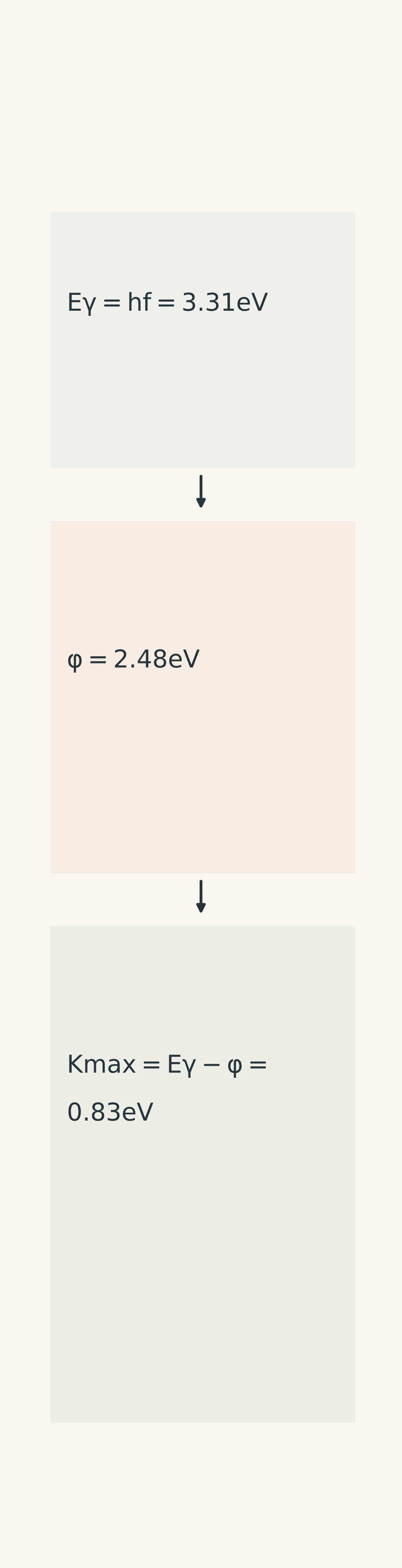
A metal has a threshold frequency of \(6.0\times10^{14}\,\text{Hz}\). It is illuminated with light of frequency \(8.0\times10^{14}\,\text{Hz}\). Calculate the work function and the maximum kinetic energy of the emitted electrons. What happens to the maximum kinetic energy if the light intensity is doubled?
Step 1
At threshold,
\(\phi=hf_0\)
Using \(h=4.14\times10^{-15}\,\text{eV s}\),
\(\phi=(4.14\times10^{-15})(6.0\times10^{14})\)
\(\phi=2.48\,\text{eV}\)
So \(2.48\,\text{eV}\) is the minimum energy needed to remove an electron.
Step 2
\(E_\gamma=hf\)
\(E_\gamma=(4.14\times10^{-15})(8.0\times10^{14})\)
\(E_\gamma=3.31\,\text{eV}\)
Step 3
The photon first supplies the \(2.48\,\text{eV}\) needed to free the electron. The rest becomes kinetic energy.
\(K_{\max}=E_\gamma-\phi\)
\(K_{\max}=3.31-2.48\)
\(K_{\max}=0.83\,\text{eV}\)
Step 4
Using \(1\,\text{eV}=1.60\times10^{-19}\,\text{J}\),
\(K_{\max}=(0.83)(1.60\times10^{-19})\)
\(K_{\max}=1.33\times10^{-19}\,\text{J}\)
Step 5
The frequency has not changed, so the energy of each photon has not changed. Therefore, \(K_{\max}\) remains
\(1.33\times10^{-19}\,\text{J}\)
Doubling the intensity means more photons arrive per second, so more electrons can be emitted per second. The maximum kinetic energy does not double.
For the full numerical treatment of this energy balance, see The Photoelectric Equation.
09Questions and solutions
Question 1
A metal has a threshold frequency of \(5.5\times10^{14}\,\text{Hz}\). Light with a frequency of \(4.0\times10^{14}\,\text{Hz}\) is shone onto the metal. The intensity of the light is then increased by a factor of 100.
Will photoelectric emission begin? Explain why.
Solution 1
No, photoelectric emission will not begin. The light remains below the threshold frequency, and increasing intensity does not increase the energy of each photon.
Step 1: Compare the frequencies.
\(4.0\times10^{14}<5.5\times10^{14}\,\text{Hz}\)
So
\(ff_0\), so emission occurs.
Step 3: Calculate the incident photon energy.
\(E_\gamma=hf\)
\(E_\gamma=(4.14\times10^{-15})(8.00\times10^{14})\)
\(E_\gamma=3.31\,\text{eV}\)
Step 4: Find the maximum kinetic energy.
\(K_{\max}=E_\gamma-\phi\)
\(K_{\max}=3.31-2.60\)
\(K_{\max}=0.712\,\text{eV}\)
Convert to joules:
\(K_{\max}=(0.712)(1.60\times10^{-19})\)
\(K_{\max}=1.14\times10^{-19}\,\text{J}\)
Step 5: Consider the fourfold intensity increase.
The frequency is unchanged, so the energy of each photon remains \(3.31\,\text{eV}\). Therefore \(K_{\max}\) remains \(1.14\times10^{-19}\,\text{J}\).
The higher intensity means more photons arrive per second, so more electrons are emitted per second, assuming the experiment is not limited by collection or saturation.
The trap is to multiply \(K_{\max}\) by four. Intensity changes the number of photons, not the energy carried by each photon.
Question 3
An experiment produces a graph of maximum photoelectron kinetic energy against incident frequency. The graph crosses the frequency axis at \(6.2\times10^{14}\,\text{Hz}\).
Two light sources are then used on the same metal:
- Source A has frequency \(5.8\times10^{14}\,\text{Hz}\) and high intensity.
- Source B has frequency \(7.0\times10^{14}\,\text{Hz}\) and low intensity.
A student says:
“Source A should eject electrons because it is much more intense. If it doesn’t work immediately, the electrons can absorb energy for longer.”
Assess this statement. Calculate the work function of the metal and the maximum kinetic energy of electrons emitted by Source B.
Solution 3
The student is incorrect: Source B produces photoelectrons, while Source A produces none. The work function is approximately \(2.57\,\text{eV}\), and Source B produces electrons with a maximum kinetic energy of approximately \(0.33\,\text{eV}\).
Step 1: Read the threshold frequency from the graph.
The x-intercept is the threshold frequency:
\(f_0=6.2\times10^{14}\,\text{Hz}\)
Step 2: Compare Source A with the threshold.
\(5.8\times10^{14}<6.2\times10^{14}\,\text{Hz}\)
So Source A is below threshold.
No matter how intense Source A is, its photons do not have enough energy to remove electrons in the ordinary photoelectric process.
Step 3: Calculate the work function.
At threshold,
\(\phi=hf_0\)
\(\phi=(4.14\times10^{-15})(6.2\times10^{14})\)
\(\phi=2.57\,\text{eV}\)
Step 4: Check Source B.
\(7.0\times10^{14}>6.2\times10^{14}\,\text{Hz}\)
So Source B is above threshold and can eject electrons.
Step 5: Calculate the photon energy from Source B.
\(E_\gamma=hf\)
\(E_\gamma=(4.14\times10^{-15})(7.0\times10^{14})\)
\(E_\gamma=2.90\,\text{eV}\)
Step 6: Find the maximum kinetic energy.
\(K_{\max}=E_\gamma-\phi\)
\(K_{\max}=2.90-2.57\)
\(K_{\max}=0.33\,\text{eV}\)
The student’s reasoning fails because it treats intensity as if it increases the energy of an individual photon. It does not. Source A has more photons arriving per second, but every photon is still below the energy required to eject an electron.
Source B is dimmer, but each photon has enough energy to eject an electron.
Question 4
A metal is illuminated with light at a frequency above its threshold frequency. The intensity is reduced by a factor of \(10^6\). Even at the much lower intensity, electrons are observed to be emitted with no measurable delay once the light reaches the metal.
A student argues:
“This doesn’t challenge the wave model. The wave reaches the metal immediately, so the electron can start absorbing energy immediately.”
Explain why this argument confuses two different timescales. What should the classical continuous-wave model predict as the intensity becomes very small, and why does the photon model avoid this problem?
Solution 4
The student has confused the travel time of the light with the time required for an electron to accumulate enough energy to escape. The classical wave model predicts a longer energy-accumulation delay at lower intensity, whereas the photon model requires no such accumulation.
Step 1: Identify the first timescale.
The light must travel from the source to the metal. That travel time is not what the photoelectric-effect observation is testing.
Once the radiation reaches the surface, the question is whether the electron must wait while energy builds up.
Step 2: Apply the classical wave prediction.
In the continuous-wave model, energy is transferred gradually.
Reducing the intensity by a factor of \(10^6\) reduces the rate at which energy is delivered to the surface.
If an electron needs a fixed minimum energy to escape, a lower energy-transfer rate should mean a longer time to accumulate that energy.
So the classical model predicts an increasingly noticeable delay as the light becomes weaker.
Step 3: Compare with the observation.
Experimentally, there is no measurable energy-accumulation delay, even for very low intensities. (openstax.org)
This is the key contradiction.
Step 4: Apply the photon model.
In the photon model, the electron does not need to collect small amounts of energy from many wave cycles.
A photon with
\(hf>\phi\)
already carries enough energy to eject the electron in one interaction.
Therefore, reducing the intensity makes suitable photons arrive less frequently, but it does not make the interaction itself take longer.
That last distinction is important. At extremely low intensity, you may wait longer for the next photon to arrive. That waiting time is not the same as an electron slowly storing energy after a photon has arrived.
Question 5
A metal has a threshold frequency of
\(5.0\times10^{14}\,\text{Hz}\).
Two monochromatic light beams illuminate equal areas of the metal. Both have the same total intensity of \(10\,\text{W m}^{-2}\).
- Beam A consists entirely of light with frequency \(1.0\times10^{15}\,\text{Hz}\).
- Beam B consists of two components. Half of its intensity is at \(1.0\times10^{15}\,\text{Hz}\), and the other half is at \(4.0\times10^{14}\,\text{Hz}\).
Assume the metal is clean, the experiment is in the ordinary single-photon regime, collection is complete, and every above-threshold photon has the same probability of causing photoemission.
Determine:
- whether each beam produces photoelectrons
- the maximum kinetic energy of the emitted electrons from each beam
- which beam produces more photoelectrons per second, and by what factor.
Explain why the fact that the two beams have equal total intensity does not mean they produce the same number of photoelectrons.
Solution 5
Both beams produce photoelectrons with the same maximum kinetic energy, but Beam A produces twice as many photoelectrons per second as Beam B. The crucial point is that equal intensity means equal energy delivered per unit area per second, not equal numbers of photons.
Step 1: Find the work function.
The threshold frequency is
\(f_0=5.0\times10^{14}\,\text{Hz}\)
At threshold,
\(\phi=hf_0\)
Using \(h=4.14\times10^{-15}\,\text{eV s}\),
\(\phi=(4.14\times10^{-15})(5.0\times10^{14})\)
\(\phi=2.07\,\text{eV}\)
Step 2: Find the energy of a high-frequency photon.
Both beams contain photons at
\(f_H=1.0\times10^{15}\,\text{Hz}\)
so
\(E_H=hf_H\)
\(E_H=(4.14\times10^{-15})(1.0\times10^{15})\)
\(E_H=4.14\,\text{eV}\)
These photons are above threshold.
Step 3: Find the energy of the low-frequency photons.
Beam B also contains photons at
\(f_L=4.0\times10^{14}\,\text{Hz}\)
Since
\(4.0\times10^{14}<5.0\times10^{14}\,\text{Hz}\)
these photons are below threshold.
They cannot produce ordinary photoelectric emission.
So Beam B does produce electrons, but only its high-frequency component contributes to that emission.
Step 4: Find the maximum kinetic energy.
For either beam, the highest-energy photons have \(f=1.0\times10^{15}\,\text{Hz}\).
Therefore,
\(K_{\max}=E_H-\phi\)
\(K_{\max}=4.14-2.07\)
\(K_{\max}=2.07\,\text{eV}\)
So both beams can produce electrons with
\(K_{\max}=2.07\,\text{eV}\)
or, in joules,
\(K_{\max}=(2.07)(1.60\times10^{-19})\)
\(K_{\max}=3.31\times10^{-19}\,\text{J}\)
Step 5: Work out the photon rate for Beam A.
Intensity is energy delivered per unit area per unit time.
For monochromatic light, the photon rate per unit area is
\(\frac{\dot N}{A}=\frac{I}{E_\gamma}\)
where \(\dot N\) is the number of photons arriving per second, \(A\) is area, and \(I\) is intensity in \(\text{W m}^{-2}\).
The high-frequency photon energy in joules is
\(E_H=(4.14)(1.60\times10^{-19})\)
\(E_H=6.62\times10^{-19}\,\text{J}\)
Beam A has \(10\,\text{W m}^{-2}\) of this high-frequency light, so
\(\frac{\dot N_A}{A}=\frac{10}{6.62\times10^{-19}}\)
\(\frac{\dot N_A}{A}=1.51\times10^{19}\,\text{photons m}^{-2}\text{s}^{-1}\)
Step 6: Work out the useful photon rate for Beam B.
Only half of Beam B’s intensity is above threshold.
Therefore, only
\(5\,\text{W m}^{-2}\)
is carried by the high-frequency photons that can eject electrons.
So
\(\frac{\dot N_B}{A}=\frac{5}{6.62\times10^{-19}}\)
\(\frac{\dot N_B}{A}=7.54\times10^{18}\,\text{photons m}^{-2}\text{s}^{-1}\)
This is exactly half the useful photon rate of Beam A.
Therefore,
\(\frac{\dot N_A}{\dot N_B}=2\)
and, under the assumptions in the question, Beam A produces twice as many photoelectrons per second.

The tempting answer is “same intensity, so same number of electrons”. The hidden problem is that a high-frequency photon carries more energy than a low-frequency photon. For the same energy flux, fewer high-energy photons are needed.
The even more important point is that Beam B’s below-threshold photons are not able to make up the difference. In the ordinary single-photon model, they cannot combine with one another to create a more energetic photon. They simply do not cause photoelectric emission.
This is the deeper version of the frequency-versus-intensity distinction: frequency sets the energy carried by each photon, while intensity tells you how much total radiation energy arrives. If the frequency changes, equal intensity does not necessarily mean equal photon number.
Once threshold frequency and immediate emission make sense, the next useful step is the full photoelectric equation and stopping potential. That is where the experimental evidence becomes a quantitative tool for finding photon energy, work function, and maximum electron kinetic energy.