
How Scattering Shows Protons and Neutrons Are Composite
Learn how electron scattering experiments revealed internal structure inside protons and neutrons, and why the evidence supports the quark model.
Suppose you have a sealed box. You cannot open it, but you can fire particles at it and record where they bounce. If the box were one smooth object, the scattering pattern should follow one prediction. If there were smaller objects inside, some collisions would reveal them.
That is essentially the problem physicists faced with the proton and neutron. At low resolution, a nucleon can look like one compact particle. At high enough momentum transfer, electrons behave as though they are scattering from point-like constituents inside it. That change in scattering behaviour is the key evidence that protons and neutrons are composite, not fundamental particles.
Electron scattering probes nucleon structure
- Incoming electron beam
Electrons enter from the left and strike a nucleon target.
- Scattered electrons
Electrons leave at different angles relative to the incoming beam.
- Detector measurements
The detector records scattering angle θ and outgoing energy E′, not an image of the nucleon.
01Scattering is a microscope
A scattering experiment works because a particle can act as a probe of another particle’s structure.
Think about two students standing shoulder-to-shoulder on the other side of a football oval. From far away, they might look like one silhouette. Move closer, and you can distinguish two people.
The electron does something similar, except it does not take a photograph. Its scattering pattern contains information about the size and structure of the thing it hit.
The important quantity is the electron’s de Broglie wavelength:
\[ \lambda = \frac{h}{p} \]
where:
- \(\lambda\) is the de Broglie wavelength, in metres,
- \(h\) is Planck’s constant, \(6.63\times10^{-34}\ \mathrm{J\,s}\),
- \(p\) is the electron’s momentum, in \(\mathrm{kg\,m\,s^{-1}}\).
A shorter wavelength allows smaller features to be probed.
So the first prediction is straightforward:
Higher electron momentum → shorter wavelength → finer spatial resolution.
This is useful, but it is not the whole story. In a scattering experiment, we also care about momentum transfer: how much the electron’s momentum changes during the collision. A large deflection generally means a larger momentum transfer, so large-angle scattering can probe shorter-distance structure more effectively than a tiny deflection using the same beam.
Worked example: choosing a better probe
An electron beam has momentum \(2.0\times10^{-19}\ \mathrm{kg\,m\,s^{-1}}\). Calculate its de Broglie wavelength. A hypothetical feature inside a nucleon has a size of \(1.0\times10^{-15}\ \mathrm{m}\). Is this electron beam a good probe of that feature?
Step 1
\[ \lambda=\frac{h}{p} \]
Step 2
\[ \lambda = \frac{6.63\times10^{-34}\ \mathrm{J\,s}} {2.0\times10^{-19}\ \mathrm{kg\,m\,s^{-1}}} \]
Step 3
\[ \lambda=3.32\times10^{-15}\ \mathrm{m} \]
Step 4
The wavelength is about \(3.3\times10^{-15}\ \mathrm{m}\), while the feature is \(1.0\times10^{-15}\ \mathrm{m}\). The wavelength is longer than the feature, so the probe is too coarse to resolve it cleanly.
The useful idea is not simply “high energy is good”. It is short wavelength means better spatial resolution.
Shorter wavelength gives finer spatial resolution
| Long wavelength: λ = 3.32 × 10⁻¹⁵ m | λ > 1.0 × 10⁻¹⁵ m feature The wavelength is longer than the feature scale. The probe is too coarse to resolve that internal feature cleanly. |
|---|---|
| Short wavelength: λ = 0.50 × 10⁻¹⁵ m | λ < 1.0 × 10⁻¹⁵ m feature The shorter wavelength provides finer spatial resolution. Smaller nucleon-scale structure becomes more accessible to the probe. |
02The first clue: nucleons have a measurable size
Before physicists could talk seriously about quarks, scattering experiments had already shown that protons were not behaving like perfectly point-like objects.
In an elastic scattering experiment, the electron changes direction, but the target remains the same particle in the same internal state.
For example:
\[ e^- + p \rightarrow e^- + p \]
The electron’s scattering angle and energy can be measured. From many such events, physicists can determine how the proton responds to the electromagnetic probe.
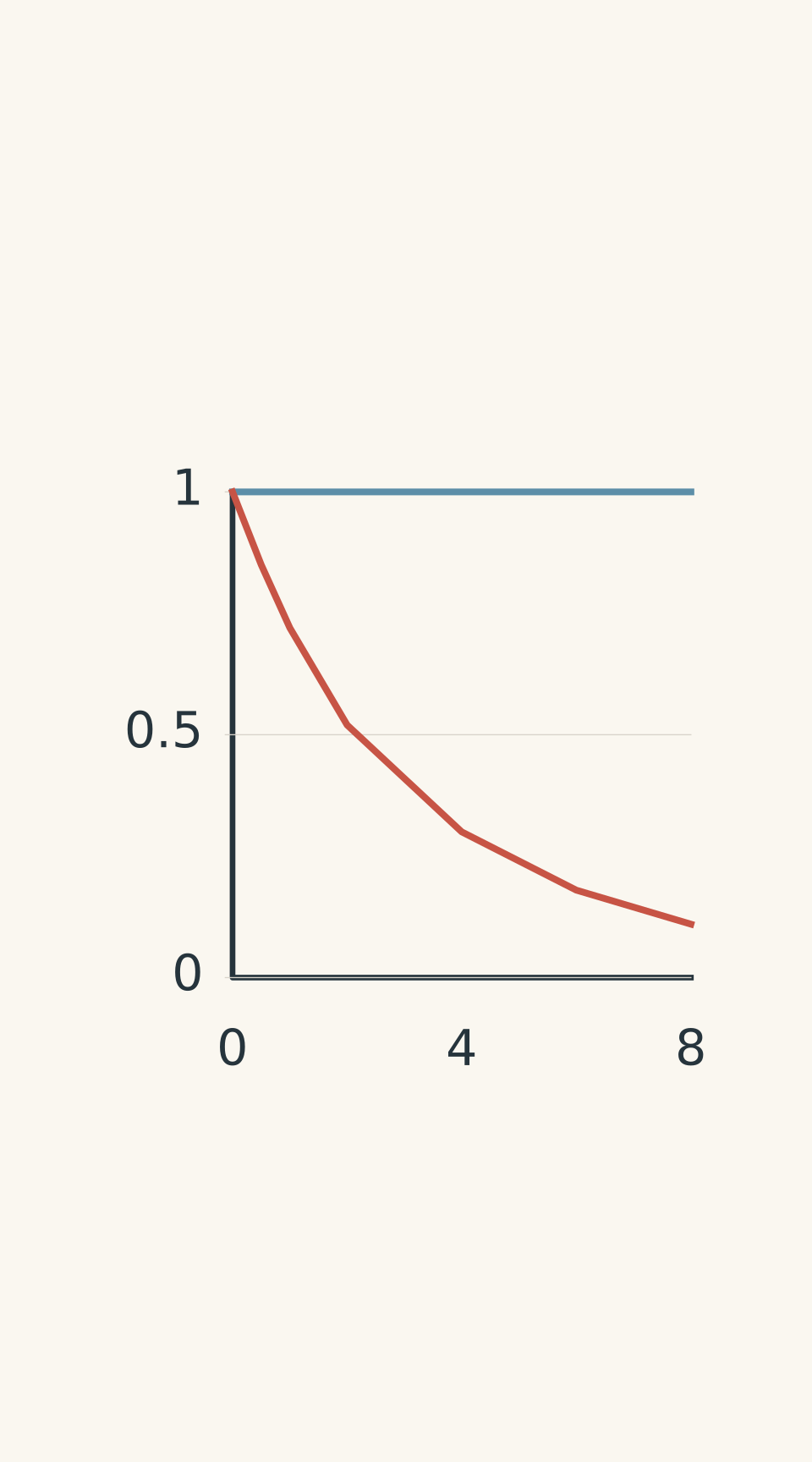
A point-like proton and an extended proton do not give exactly the same scattering pattern.
The difference is described using form factors. A form factor is a quantity that captures how the proton’s internal charge and magnetic distributions modify the scattering compared with a point-like particle.
Experiments led by Robert Hofstadter in the 1950s found that the proton had a finite electromagnetic size rather than behaving as a perfect point. Similar electron-scattering work gave information about neutron structure.
- Point-like nucleon
- Extended nucleon
This is important evidence, but there is a limit to what it tells us.
A proton having a finite size does not automatically mean it contains three quarks.
A smooth blob could also have a finite size. At this stage, the evidence says:
The nucleon has internal spatial structure.
It does not yet tell us exactly what that structure is.
That distinction is worth remembering in an HSC response. Finite size is evidence of structure, not by itself proof of quarks.
03The decisive step: deep inelastic scattering
Physicists then increased the energy of the electron beam and looked much more closely.
The basic apparatus was still simple in principle:
- accelerate electrons to very high momentum,
- fire them at a proton or neutron target,
- measure the energy and direction of the scattered electron,
- examine how often different scattering outcomes occur.
The electron is a particularly useful probe because it is a lepton and does not experience the strong nuclear force. That makes its electromagnetic interaction with the target easier to interpret.
At high momentum transfer, the experiment enters the regime of deep inelastic scattering.
“Inelastic” means the target does not simply remain unchanged. Energy and momentum are transferred into the target, which can become excited or break up into other particles.
“Deep” refers to the very large momentum transfer involved, allowing the electron to probe much smaller distances inside the nucleon.
Deep inelastic scattering
- Incoming electron
High-energy electron beam enters from the left.
- Nucleon
Electron transfers energy and momentum to the proton or neutron.
- Scattered electron
Electron emerges at a large angle and enters a detector.
- Collision products
Excited target produces hadrons that continue forward from the collision.
Now make a prediction.
If the proton were a smooth, structureless object, increasing the resolution should continue to reveal the behaviour of that single object.
But if the proton contained much smaller, localised constituents, a sufficiently energetic electron could scatter from one of those constituents.
That second possibility is what the experiments revealed.
The late-1960s SLAC experiments found electron scattering consistent with point-like constituents inside the proton. Further experiments on nucleons, including bound neutrons, supported the same basic picture. The work became a crucial part of the experimental foundation of the quark model.
04Why large-angle scattering matters
A common mistake is to write:
“Large-angle scattering proves that the proton contains quarks.”
Not quite.
A point particle can scatter through a large angle too. The important evidence is the pattern of scattering compared with the prediction for a structureless particle.
At high momentum transfer, there were significant inelastic events in which the electron behaved as though it had interacted with a small, point-like constituent rather than the entire nucleon as one smooth object.
The proton could then break up into other particles. The scattered electron carried away measurable information about the collision.
Worked example: why the scattering angle matters
An electron beam has momentum \(5.0\times10^{-19}\ \mathrm{kg\,m\,s^{-1}}\). In one detector, electrons are measured after small-angle scattering. In another, the same beam is used to measure electrons scattered through much larger angles.
Which type of event gives stronger information about short-distance structure? Calculate the electron’s wavelength first.
Step 1
\[ \lambda=\frac{h}{p} \]
Step 2
\[ \lambda = \frac{6.63\times10^{-34}\ \mathrm{J\,s}} {5.0\times10^{-19}\ \mathrm{kg\,m\,s^{-1}}} \]
Step 3
\[ \lambda=1.33\times10^{-15}\ \mathrm{m} \]
So both detectors are using the same wavelength.
Step 4
The electron’s initial momentum is the same, but a large-angle collision changes the electron’s momentum direction by much more. Therefore, the momentum transfer is larger.
Step 5
Larger momentum transfer corresponds to probing shorter distances. Therefore, the large-angle events are generally more sensitive to small-scale internal structure.
The important trap is that short wavelength and large momentum transfer are related ideas, but they are not identical. Two experiments can use the same electron beam and still probe the nucleon differently because the scattering angle changes the momentum transfer.
Same incoming momentum, different momentum transfer
| Small-angle scattering | pᵢ = same; Δpₑ = p_f − pᵢ is small Electron changes direction only slightly. Momentum transferred to the nucleon is −Δpₑ. |
|---|---|
| Large-angle scattering | pᵢ = same; Δpₑ = p_f − pᵢ is large Electron changes direction substantially. Larger momentum transfer probes shorter distances more sensitively. |
05The surprising clue: scaling
Deep inelastic scattering produced another important observation.
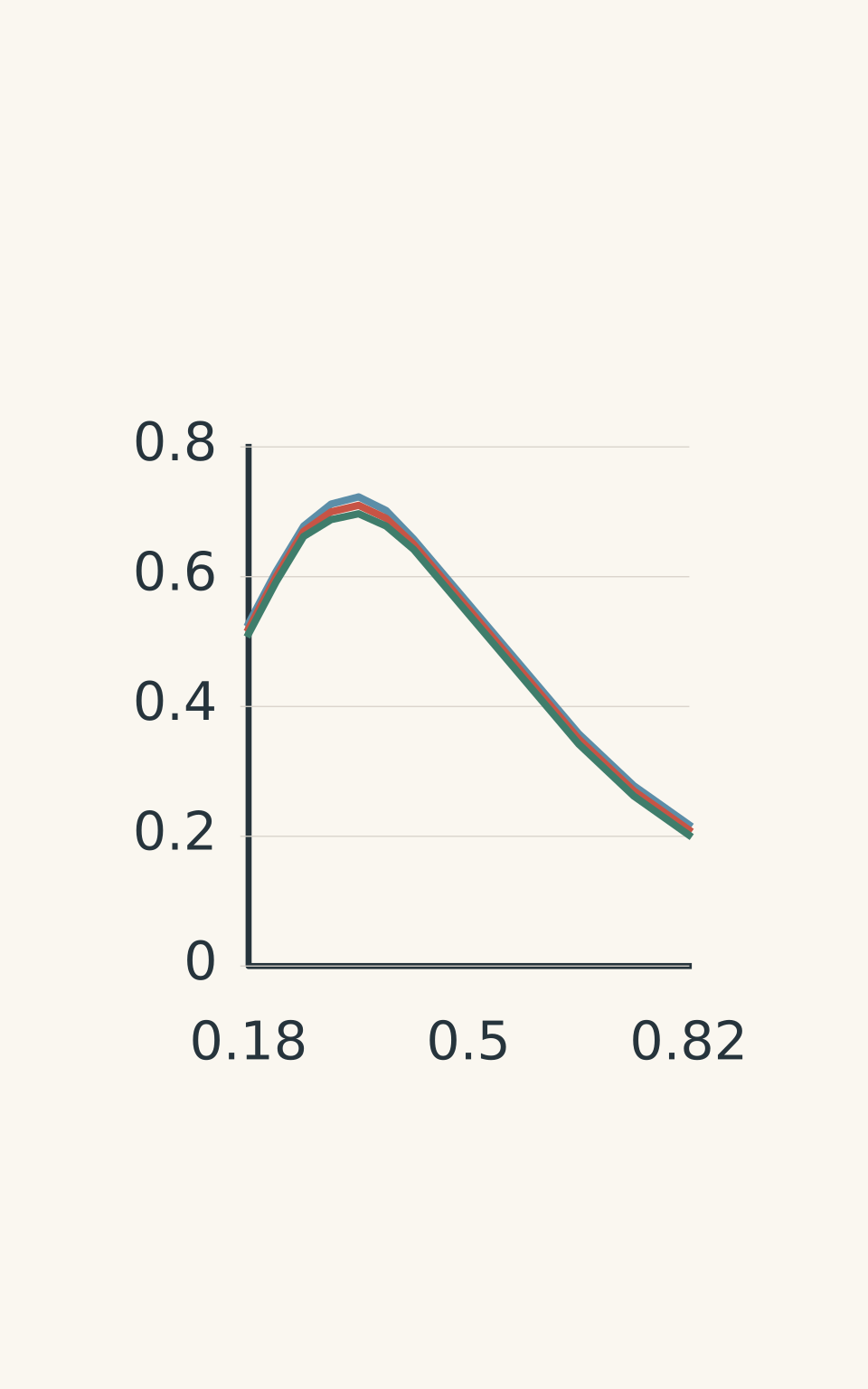
The raw scattering data depend on things such as the electron’s energy, scattering angle, and the energy transferred to the nucleon. Physicists found that when the results were reorganised using a suitable dimensionless variable called Bjorken \(x\), data from different experimental conditions approximately lined up.
In the simple parton model, \(x\) can be interpreted as the fraction of the nucleon’s momentum carried by the constituent struck by the electron.
This approximate independence from the absolute beam energy is called scaling, or Bjorken scaling.
- 6 GeV
- 12 GeV
- 18 GeV
Why is that interesting?
Imagine a large object made from several small pieces. At sufficiently high resolution, a very fast probe can interact with one small piece during a very short collision. The pieces can behave approximately as though they are separate for the instant of the interaction.
That is the parton model.
The scaling behaviour was therefore strong evidence that the electron was scattering from point-like constituents inside the nucleon, rather than from one continuous blob. The original SLAC experiments found approximately scaling structure functions and point-like behaviour.
The word approximately matters.
Real nucleons are not just three perfectly stationary dots. The modern description includes quarks, antiquarks, and gluons, with interactions between them. Small departures from ideal scaling are part of the richer quark-and-gluon picture rather than evidence against compositeness.
06From “point-like constituents” to quarks
The experiments initially established the existence of point-like constituents, often called partons.
Their measured properties were consistent with quarks. Later experiments and the development of the Standard Model established the quark interpretation. The SLAC deep inelastic scattering programme was recognised in the 1990 Nobel Prize in Physics for its role in developing the quark model.
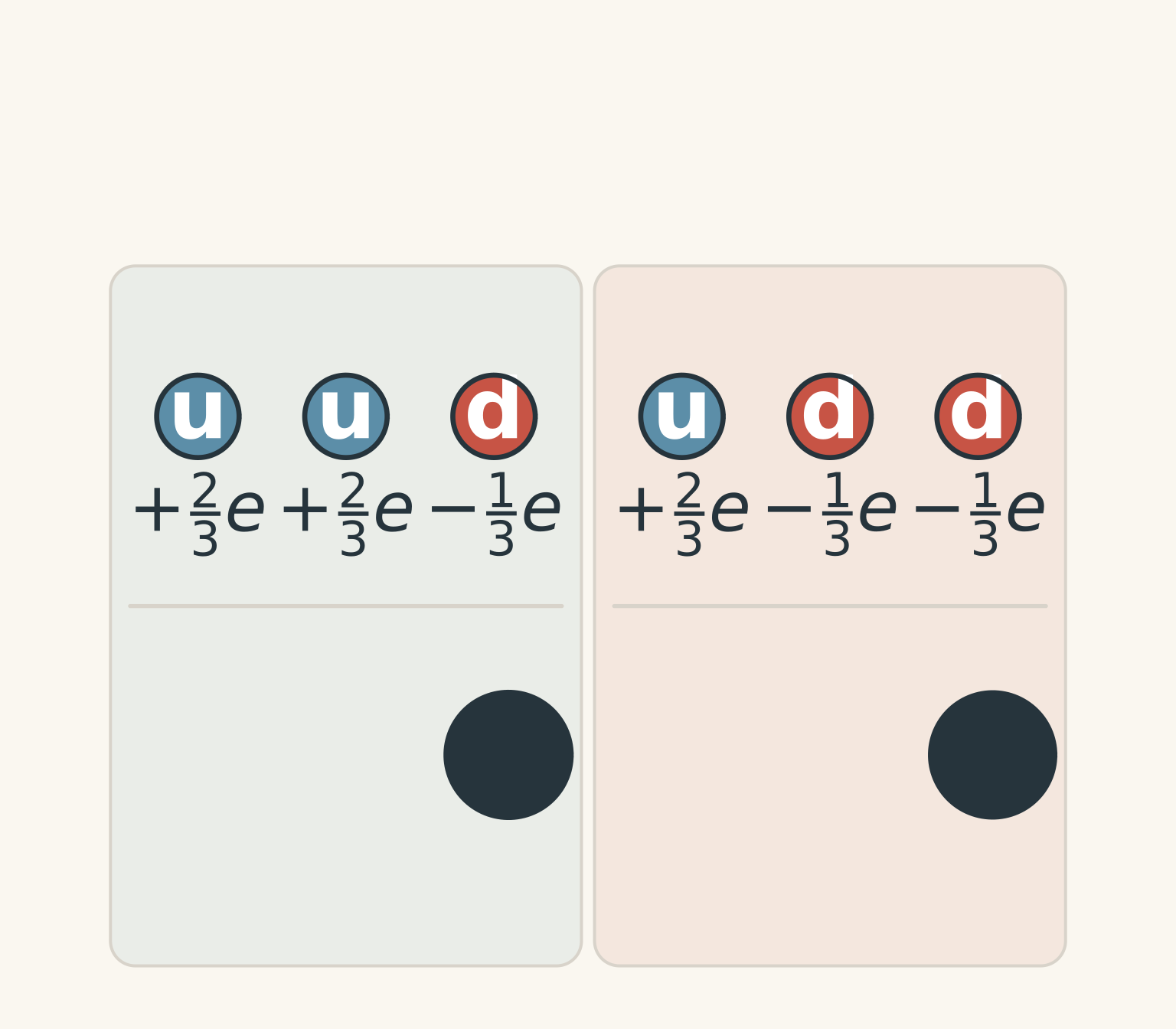
For HSC purposes, the familiar valence-quark compositions are:
\[ \text{proton}=uud \]
\[ \text{neutron}=udd \]
The up quark has charge \(+\frac{2}{3}e\), while the down quark has charge \(-\frac{1}{3}e\), where \(e\) is the elementary charge.
For the proton:
\[ +\frac{2}{3}e+\frac{2}{3}e-\frac{1}{3}e=+e \]
For the neutron:
\[ +\frac{2}{3}e-\frac{1}{3}e-\frac{1}{3}e=0 \]
So the neutron being electrically neutral does not mean it has no internal charged structure.
An electron can interact electromagnetically with charged constituents inside a neutron even though the total charge of the neutron is zero. The internal charges can produce a non-trivial scattering pattern.
One precision point: writing a proton as \(uud\) does not mean it is literally three little balls sitting permanently inside the proton. The notation gives its valence-quark content. The full internal structure also involves gluons and quark-antiquark pairs.
07What each scattering result tells you
It helps to separate the evidence rather than treating “scattering” as one single experiment.
| Observation | What it tells us |
|---|---|
| Elastic scattering differs from a point-particle prediction | The nucleon has finite internal electromagnetic structure |
| Higher momentum transfer probes smaller distances | Accelerated particles can investigate sub-nucleon structure |
| Large-angle inelastic scattering occurs | Electrons can interact strongly with localised constituents and transfer substantial energy and momentum |
| Approximate scaling is observed | The response is consistent with point-like, approximately quasi-free constituents |
| Proton and neutron scattering patterns differ | Their internal charge and constituent distributions are different |
| Results are consistent with \(uud\) and \(udd\) | The quark model provides a successful description of proton and neutron composition |
The strongest argument is therefore a chain of evidence.
High-energy electrons have short de Broglie wavelengths, allowing small distances to be probed. At large momentum transfer, deep inelastic scattering reveals point-like constituents inside nucleons. Approximate scaling supports the picture that these constituents behave quasi-freely during the short collision. The different proton and neutron responses are consistent with their different quark content. Therefore, protons and neutrons are composite rather than fundamental particles.
08The misconception to avoid
“The experiment photographed three quarks inside the proton.”
No.
The experiment measured scattering outcomes. Physicists inferred internal structure from how often electrons scattered at particular angles and energies.
Also, quarks are not normally observed flying freely out of a proton. The strong interaction confines quarks inside hadrons. When a high-energy collision disturbs a quark, the final state develops into observable hadrons.
So a strong HSC response should use language such as:
- “the results were consistent with point-like constituents”,
- “the scattering provided evidence for internal structure”,
- “the constituents were identified with quarks in the Standard Model”.
That is more accurate than saying “scientists saw quarks directly”.
09The HSC decision rule
When a question asks how scattering shows that protons or neutrons are composite, build the answer in this order:
- Probe: High-energy electrons have short de Broglie wavelengths, so they can investigate very small distances.
- Scattering: At high momentum transfer, electrons undergo large-angle, inelastic scattering from nucleons.
- Observation: The scattering behaviour is consistent with interactions with point-like constituents inside the nucleon.
- Scaling: Approximate scaling supports the idea that these constituents behave approximately independently during the very short interaction.
- Conclusion: The nucleon cannot be a single fundamental, structureless particle.
- Identification: The constituents are consistent with quarks, giving the valence compositions \(uud\) for the proton and \(udd\) for the neutron.
The trap is to stop at step 2. “The proton was smashed” is not the evidence. The detailed scattering pattern is the evidence.
10Questions and solutions
Question 1
An electron has momentum \(2.0\times10^{-19}\ \mathrm{kg\,m\,s^{-1}}\). Calculate its de Broglie wavelength. A hypothetical feature inside a nucleon has a size of \(1.0\times10^{-15}\ \mathrm{m}\).
Is the electron’s wavelength shorter or longer than the feature?
Solution 1
The electron’s wavelength is \(3.31\times10^{-15}\ \mathrm{m}\), so it is longer than the feature and is not a sufficiently fine probe to resolve it cleanly.
Using
\[ \lambda=\frac{h}{p} \]
with \(h=6.63\times10^{-34}\ \mathrm{J\,s}\) and \(p=2.0\times10^{-19}\ \mathrm{kg\,m\,s^{-1}}\),
\[ \lambda = \frac{6.63\times10^{-34}} {2.0\times10^{-19}} = 3.31\times10^{-15}\ \mathrm{m} \]
The feature is \(1.0\times10^{-15}\ \mathrm{m}\), so
\[ 3.31\times10^{-15} > 1.0\times10^{-15} \]
The probe wavelength is too large compared with the feature. Increasing the electron momentum would reduce the wavelength and improve the spatial resolution.
Question 2
A student writes:
“Large-angle electron scattering proves that the proton contains smaller particles.”
Explain why this statement is incomplete. What observation from elastic scattering actually provides evidence that the proton has internal structure?
Solution 2
Large-angle scattering by itself does not prove that the proton is composite; the important evidence is that the measured scattering behaviour differs from the prediction for a point-like proton.
A point-like charged particle can undergo large-angle scattering. Therefore, simply detecting an electron at a large angle is not enough.
In elastic electron-proton scattering, physicists compared the measured scattering pattern with the prediction for a point-like target. The proton’s electromagnetic form factors showed a dependence on momentum transfer that indicated a finite spatial distribution of charge and magnetisation.
That means the proton does not behave like a perfectly structureless point particle.
The reasoning is therefore:
\[ \text{measured form-factor behaviour} \neq \text{point-particle prediction} \]
so the proton has internal spatial structure.
This is an important first step, but it does not by itself identify quarks. Deep inelastic scattering provides stronger evidence for point-like constituents.
Question 3
An electron beam has momentum \(6.0\times10^{-19}\ \mathrm{kg\,m\,s^{-1}}\).
(a) Calculate its de Broglie wavelength.
(b) The beam produces large-angle inelastic scattering from both proton and neutron targets. Explain why the neutron’s electrical neutrality does not prevent this scattering.
(c) Use the quark charges to show how the proton can have charge \(+e\) while the neutron has zero net charge.
Solution 3
The wavelength is \(1.11\times10^{-15}\ \mathrm{m}\), and the neutron can still scatter because its internal constituents carry electric charge even though their total charge cancels.
(a) Calculate the wavelength
Use
\[ \lambda=\frac{h}{p} \]
\[ \lambda = \frac{6.63\times10^{-34}\ \mathrm{J\,s}} {6.0\times10^{-19}\ \mathrm{kg\,m\,s^{-1}}} \]
\[ \lambda=1.11\times10^{-15}\ \mathrm{m} \]
This is on the order of a nucleon’s size, so the beam is capable of probing nucleon-scale structure.
(b) Explain the neutron scattering
The tempting prediction is that a neutral neutron should not interact electromagnetically with an electron.
That would only be true if the neutron were a completely structureless neutral object.
The neutron has internal charged constituents. An electron can interact with these charges even though the total charge of the neutron is zero. The scattering therefore provides information about the neutron’s internal structure.
(c) Check the quark charges
For the proton, \(uud\):
\[ +\frac{2}{3}e+\frac{2}{3}e-\frac{1}{3}e =+e \]
For the neutron, \(udd\):
\[ +\frac{2}{3}e-\frac{1}{3}e-\frac{1}{3}e =0 \]
So the different net charges do not require completely different types of constituents. They can arise from different combinations of up and down quarks.
The important evidence is that both nucleons show internal structure in scattering, while their different responses are consistent with their different constituent charge distributions.
Question 4
Consider the following simplified set of hypothetical scattering results.
| Experiment | Probe | Observation |
|---|---|---|
| A | Long wavelength | Mostly elastic scattering |
| B | Shorter wavelength | Elastic scattering differs from the point-particle prediction |
| C | Much shorter wavelength and high momentum transfer | Many large-angle inelastic events |
| D | Same high-energy conditions at several beam energies | Structure-function curves approximately overlap when plotted against Bjorken \(x\) |
| E | High-energy scattering from a neutron | Point-like inelastic behaviour is observed, but the distribution differs from the proton |
Three models are proposed:
- Model 1: the nucleon is a fundamental point particle.
- Model 2: the nucleon is an extended but smooth object with no smaller constituents.
- Model 3: the nucleon contains point-like constituents.
Which model best explains all the observations? Explain what the observations rule out, rather than simply naming the model.
Solution 4
Model 3, a nucleon containing point-like constituents, best explains the complete set of observations.
Experiment B already creates a problem for Model 1. If the nucleon were a perfect point particle, its elastic scattering should follow the point-particle prediction. The observed form-factor behaviour instead indicates finite internal structure.
Experiment C goes further. The large-angle inelastic events show that the electron can transfer substantial energy and momentum to the nucleon, producing a response consistent with localised constituents rather than only a smooth overall distribution.
Experiment D is particularly important because approximate scaling supports the idea that the electron is scattering from point-like constituents that behave approximately independently during the very short interaction.
Experiment E then shows that this internal structure is not identical for the proton and neutron. Their different scattering behaviour is consistent with different constituent charge distributions, as expected from \(uud\) and \(udd\).
Model 2 can explain why the nucleon has a finite size, but it struggles with the high-momentum-transfer evidence for point-like constituents and the approximate scaling behaviour.
Model 1 fails even earlier because it cannot account for the observed finite-size effects.
The full argument is therefore:
\[ \text{finite structure} \rightarrow \text{point-like constituents} \rightarrow \text{scaling} \rightarrow \text{different proton/neutron responses} \]
Together, these observations strongly support the composite-nucleon model.
Question 5
A high-energy electron beam has a de Broglie wavelength of \(0.10\ \mathrm{fm}\), where \(1\ \mathrm{fm}=10^{-15}\ \mathrm{m}\). This wavelength is much shorter than the approximate size of a nucleon.
The same beam is used in two detector arrangements.
- Arrangement A: the detector accepts only electrons scattered through about \(1^\circ\). Almost no inelastic events are recorded.
- Arrangement B: the detector accepts electrons scattered through much larger angles. Many inelastic events are recorded, and the data show approximate scaling when plotted against Bjorken \(x\).
A student concludes:
“Arrangement A disproves quarks. The wavelength is already much smaller than the proton, so the experiment should definitely have seen the quarks. Since almost nothing happened, the proton must be fundamental.”
Evaluate this argument carefully. Explain why the same beam can provide very different information in A and B, and state which observations provide the stronger evidence for composite nucleons.
Solution 5
The student’s conclusion is incorrect: a short wavelength is not enough by itself. Arrangement B provides the stronger evidence because it produces large momentum transfer, inelastic scattering, and approximate scaling.
The student’s first step is reasonable. A wavelength of \(0.10\ \mathrm{fm}\) is very short compared with a nucleon, so the electron has the potential to probe very small distances.
The mistake is treating wavelength as the only factor controlling the information obtained from a scattering event.
In Arrangement A, the electron is deflected by only about \(1^\circ\). Its momentum therefore changes direction by only a small amount. The momentum transfer is consequently small compared with a large-angle collision.
So although the electron could have very fine spatial resolution because of its short wavelength, the particular collisions selected by Arrangement A do not strongly disturb or resolve the nucleon’s short-distance structure.
This is the subtle point:
A short-wavelength probe does not guarantee a large momentum transfer in every scattering event.
Arrangement B changes the situation. The same incoming electron beam is used, so its initial wavelength is unchanged. But large-angle scattering involves a much larger change in the electron’s momentum. This gives access to shorter-distance structure.
The fact that many of these events are inelastic is then important. The nucleon is not merely recoiling as one unchanged object. Energy and momentum are being transferred into its internal degrees of freedom and collision products.
The approximate scaling provides another independent piece of evidence. When the high-energy data are organised using Bjorken \(x\), their approximate overlap is consistent with scattering from point-like constituents whose behaviour depends on their momentum fraction rather than on the overall size of the proton as one smooth object.
Therefore, Arrangement A does not contradict the composite-nucleon model. It simply selects collisions with relatively small momentum transfer.
Arrangement B gives the stronger evidence because the observations form a connected chain:
\[ \text{large momentum transfer} \rightarrow \text{short-distance probe} \rightarrow \text{inelastic scattering from localised constituents} \rightarrow \text{approximate scaling} \]
That is why the conclusion that protons and neutrons are composite comes from the scattering pattern and its dependence on experimental conditions, not from the wavelength alone.
Once this scattering evidence is clear, the next useful step is to connect the internal constituents to the particle families they form. For that, see Quarks and Hadrons: How Protons, Neutrons and Mesons Form.