
Nonaqueous Titrations: Analysing Weak Acids and Bases
Learn why weak acids and bases may be analysed in solvents other than water, how solvent choice affects titration endpoints, and how to calculate concentrations. This extension builds on Year 12 HSC acid-base chemistry but goes beyond the required syllabus.
A very weak organic base is dissolved in water and titrated with a standard acid. The reaction is slow to produce a useful change in the measured signal, and the endpoint is difficult to locate. Yet the same compound can be analysed much more reliably when the chemist replaces water with another solvent.
The compound has not changed. The solvent has.
This is the central idea behind nonaqueous titrations: changing the solvent can change how readily an acid donates a proton, how readily a base accepts one, and how clearly the equivalence point can be detected.
Year 12 acid-base chemistry provides the foundation for understanding this method, but nonaqueous titrations are an extension beyond the required HSC syllabus content. They are not an additional assessment requirement.
01Start with the aqueous titration model
In Year 12 Chemistry, you study how acids and bases behave in water, including weak acid equilibria, titration curves, and calculations using titration data.
Consider a weak monoprotic acid, HA, dissolved in water.
It partially ionises according to:
\[ \ce{HA + H2O <=> H3O+ + A-} \]
The acid dissociation constant is:
\[ K_a=\frac{[\ce{H3O+}][\mathrm{A}^{-}]}{[\ce{HA}]} \]
A small \(K_a\) means that only a small proportion of the acid molecules transfer their protons to water at equilibrium.
When a strong base is added, the hydroxide ions react with the acid:
\[ \ce{HA + OH- -> A- + H2O} \]
As the titration proceeds, the amount of HA decreases and the amount of its conjugate base, A⁻, increases.
For a monoprotic acid, the equivalence point occurs when the moles of hydroxide added equal the initial moles of acid.
\[ n(\ce{OH-})=n(\ce{HA}) \]
This is the stoichiometric foundation of the concentration calculations you already know.
Why can a very weak acid be difficult to titrate?
Imagine titrating a relatively strong weak acid and an extremely weak acid with the same strong base.
Both reactions may have a recognisable equivalence point, but the very weak acid can produce a much smaller change in pH around equivalence.
For sufficiently weak acids, the equivalence-region jump can become too small to locate reliably.
The same general problem can occur when titrating extremely weak bases with strong acids.
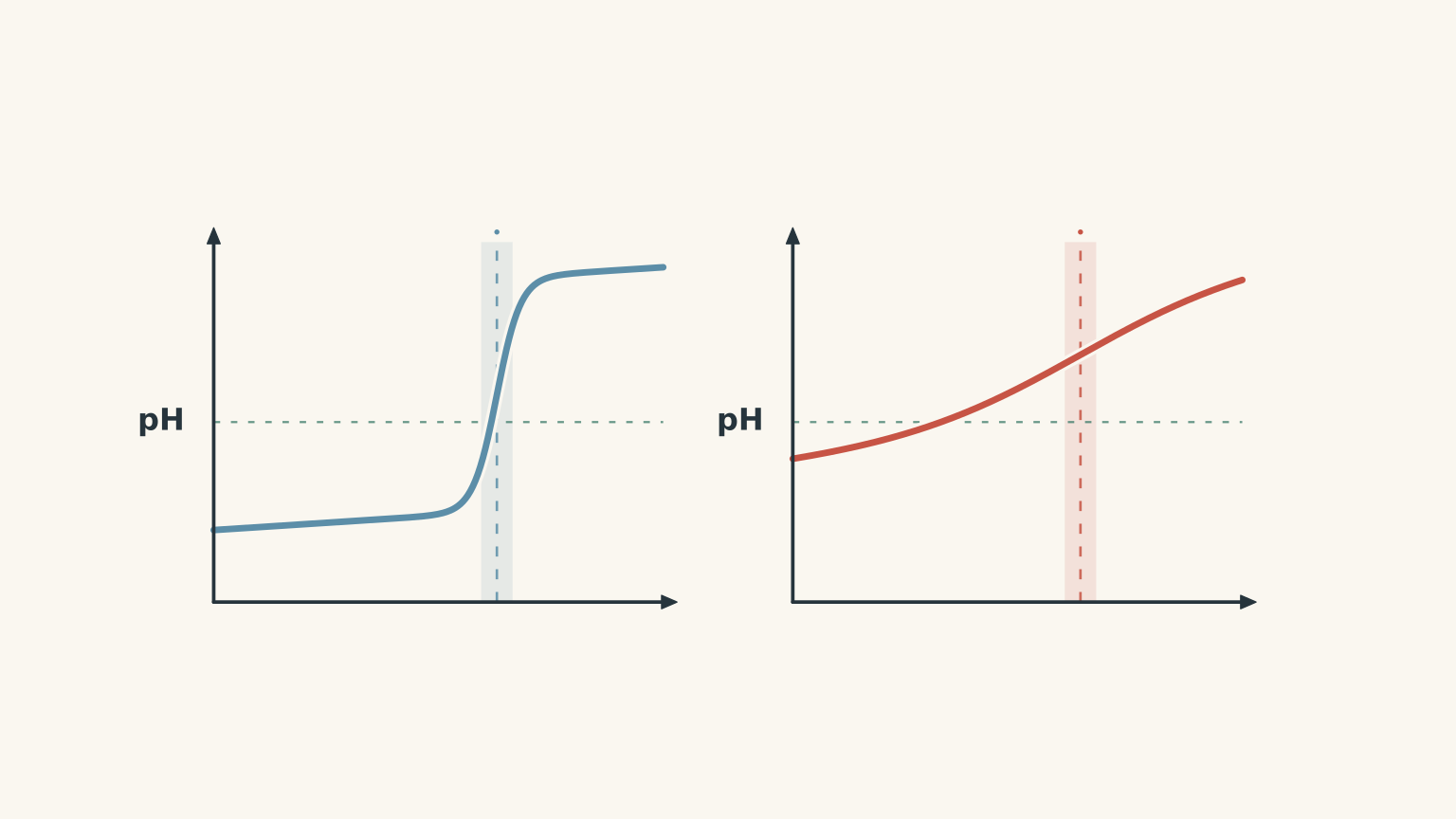
Due to technical limitations, this figure may display incorrectly or contain inaccuracies. Please check key details against your course materials.
You might predict that simply using a more concentrated titrant would solve the problem.
It can reduce the volume required and may reduce dilution, but it does not necessarily solve the underlying equilibrium problem. The solvent still controls the proton-transfer behaviour of the analyte.
That leads to a more interesting possibility: change the solvent itself.
02The solvent is part of the acid-base reaction
Water is not just a container in which acids and bases happen to react.
It actively participates in proton transfer.
For example, when an acid dissolves in water, a water molecule accepts its proton. When a base reacts with water, a water molecule may donate a proton.
Different solvents have different abilities to donate and accept protons.
Consequently, the same chemical substance can behave as a stronger or weaker acid or base in different solvents.
This is called a solvent effect.
Predict what happens in a more basic solvent
Suppose a weak acid HA is transferred from water into a solvent that is more willing to accept protons.
Would you expect more or fewer HA molecules to donate their protons?
More.
The new solvent is a better proton acceptor, so the equilibrium can shift towards the products.
\[ \ce{HA + S <=> A- + SH+} \]
Here:
- HA is the acid being analysed.
- S is a neutral solvent molecule acting as a proton acceptor.
- A⁻ is the conjugate base of HA.
- SH⁺ is the protonated solvent.
The solvent has helped the weak acid transfer its proton.
The opposite idea applies to a weak base. A solvent that is more willing to donate protons can make protonation of the weak base more favourable.
The important point is that acid and base strength is not determined by the solute alone.
It depends on the solute-solvent combination.
The solvent levelling effect
You may already know that strong acids such as hydrochloric acid and perchloric acid behave similarly in water.
This is because they transfer their protons almost completely to water, producing hydronium ions.
Water effectively makes these acids appear equally strong.
This is known as the solvent levelling effect.
A different solvent can produce a different levelling effect. Some solvents allow differences between acid or base strengths to become more apparent.
A solvent that reveals differences in strength is sometimes called a differentiating solvent.
This is particularly useful when:
- An acid is too weak to produce a reliable aqueous titration endpoint.
- A base is too weak to be protonated sufficiently in water.
- Two acids or bases have similar strengths in water and cannot be distinguished easily.
For a deeper explanation of why the solvent changes apparent acid strength, see The Solvent Levelling Effect: Why Acids Behave Differently.
03A more precise model: solvent autoprotolysis
We can make the solvent model more precise by considering what happens when solvent molecules react with one another.
Some solvents can both donate and accept protons. These are called amphiprotic solvents.
Represent a neutral amphiprotic solvent molecule as HS.
One HS molecule can donate a proton, while another accepts it:
\[ \ce{2HS <=> H2S+ + S-} \]
This reaction is called autoprotolysis.
It is the nonaqueous equivalent of water’s self-ionisation:
\[ \ce{2H2O <=> H3O+ + OH-} \]
The autoprotolysis constant of the solvent is represented by \(K_s\).
For the simplified concentration-based model:
\[ K_s=[\ce{H2S+}][\mathrm{S}^{-}] \]
The solvent’s autoprotolysis constant describes the extent to which the solvent produces its protonated and deprotonated forms.
For water, this is the familiar ionic product of water, \(K_w\).
The distinction is important because the solvent determines the range of acid-base conditions that can be observed.
Why does the autoprotolysis constant matter?
Consider two suitable solvents with different autoprotolysis constants.
If the second solvent has a smaller \(K_s\), its intrinsic production of protonated and deprotonated solvent species is less extensive.
All else being equal, this can allow a larger change in the measured potential around the equivalence point.
That makes the endpoint easier to locate.
There is a limitation to this model.
Not every nonaqueous solvent is amphiprotic. Some commonly used analytical solvents, including dimethylformamide (DMF) and dimethyl sulfoxide (DMSO), are aprotic but can still act as proton acceptors.
The equations above provide a useful model for understanding amphiprotic solvents. They are not a complete description of every nonaqueous system.
A more rigorous treatment also considers ion activities and interactions between the solute and solvent. For HSC-level reasoning, the main idea is that the solvent’s own acid-base behaviour affects the analyte’s behaviour and the measurable endpoint.
04Choosing a solvent for a weak acid or base
This is where the theory becomes useful.
You cannot simply choose any organic liquid and expect a better titration.
The solvent must have the right acid-base properties for the substance being analysed.
Titrating a very weak base
Suppose the analyte is a weak organic base, B.
In an acidic solvent, the base can accept a proton more readily.
A classic analytical system uses:
- Glacial acetic acid as the solvent.
- Perchloric acid as the titrant.
Perchloric acid is a very strong acid in this medium.
The reaction can be understood in two stages.
First, perchloric acid protonates acetic acid:
\[ \ce{HClO4 + CH3COOH -> CH3COOH2+ + ClO4-} \]
The protonated acetic acid then transfers its proton to the weak base:
\[ \ce{B + CH3COOH2+ -> BH+ + CH3COOH} \]
Combining these equations gives the overall reaction:
\[ \ce{B + HClO4 -> BH+ + ClO4-} \]
The weak base accepts a proton and forms its conjugate acid.
The acetic acid is regenerated, so it acts as the reaction medium rather than being consumed in the overall neutralisation.
This method is widely used to analyse amines and other weak organic bases, including compounds found in pharmaceutical products.
A practical example is the determination of triethanolamine using perchloric acid in glacial acetic acid. The method is described in a Metrohm application note on nonaqueous titration of weak bases.
Titrating a very weak acid
Now reverse the problem.
Suppose the analyte is a very weak acid, HA.
You want a solvent that accepts protons readily but does not compete strongly as a proton donor.
Suitable basic media can include:
- Ethylenediamine.
- Dimethylformamide (DMF).
- Dimethyl sulfoxide (DMSO).
The exact choice depends on the analyte and the analytical method.
A strong nonaqueous base can then be used as the titrant. Examples include:
- Tetrabutylammonium hydroxide (TBAOH).
- Lithium methoxide.
The acid transfers its proton more readily in the selected medium, allowing its concentration to be determined through neutralisation.
Comparing the two systems
| Feature | Weak base analysis | Weak acid analysis |
|---|---|---|
| Analyte | Weak base B | Weak acid HA |
| Desired solvent behaviour | Relatively weak proton acceptor | Relatively weak proton donor |
| Typical solvent | Glacial acetic acid | DMF or ethylenediamine |
| Typical titrant | Perchloric acid | TBAOH or lithium methoxide |
| Main reaction | Protonation of B | Deprotonation of HA |
Notice the relationship.
A weak base needs a suitable proton-donating environment. A weak acid needs a suitable proton-accepting environment.
The solvent must also dissolve the analyte, avoid unwanted reactions, and allow the titration products to remain suitable for measurement.
It is not enough for a solvent to make the acid or base appear stronger. It must also allow a reliable analytical result.
05How is the endpoint detected?
Changing the solvent also changes how you interpret the titration curve.
In an aqueous titration, you commonly plot pH against the volume of titrant added.
In nonaqueous titrations, the measured response is often an electrode potential, \(E\), plotted against titrant volume, \(V\).
The equivalence point is identified by the sharp change in the measured signal.
The maximum rate of potential change is particularly useful:
\[ \frac{\Delta E}{\Delta V} \]
Here:
- \(E\) is the measured electrode potential, usually in millivolts.
- \(V\) is the volume of titrant added.
- \(\Delta E/\Delta V\) describes how rapidly the potential changes as titrant is added.
A large value indicates a steep section of the titration curve.
Why not just use pH 7 as the endpoint?
Because pH 7 is associated with neutral aqueous conditions at approximately 25 °C.
A nonaqueous solvent has its own acid-base equilibria and its own autoprotolysis behaviour.
Its neutral point is not automatically pH 7, and an electrode reading in an organic solvent cannot simply be interpreted using the usual aqueous pH scale.
This is why potentiometric methods often focus on the change in electrode potential rather than looking for a particular pH value.
Indicators can also be used, but their colour changes depend on the solvent.
An indicator suitable for an aqueous titration may not produce a reliable endpoint in a nonaqueous medium.
For this reason, the International Pharmacopoeia’s nonaqueous titration methods emphasise selecting the appropriate indicator or using potentiometric endpoint detection.
For a refresher on the difference between an indicator endpoint and the equivalence point, see How to Choose an Indicator from a Titration Curve.
06Worked example: finding the concentration of a weak base
A chemist analyses a weak monobasic amine, B, using perchloric acid in glacial acetic acid.
A 20.00 mL aliquot of the sample requires 18.60 mL of 0.0800 mol L⁻¹ perchloric acid to reach the blank-corrected equivalence point.
Calculate the concentration of B.
Step 1
The weak base accepts one proton from perchloric acid.
\[ \ce{B + HClO4 -> BH+ + ClO4-} \]
The mole ratio is 1:1.
Step 2
Use:
\[ n=cV \]
where \(n\) is the amount in moles, \(c\) is concentration in mol L⁻¹, and \(V\) is volume in litres.
Convert the volume:
\[ 18.60\text{ mL}=0.01860\text{ L} \]
Substitute:
\[ \begin{aligned} n(\ce{HClO4}) &=0.0800\times0.01860\\ &=0.001488\text{ mol} \end{aligned} \]
Step 3
At equivalence:
\[ n(\ce{B})=n(\ce{HClO4}) \]
Therefore:
\[ n(\ce{B})=0.001488\text{ mol} \]
Step 4
The original aliquot has a volume of 0.02000 L.
\[ \begin{aligned} c(\ce{B}) &=\frac{n}{V}\\ &=\frac{0.001488}{0.02000}\\ &=0.0744\text{ mol L}^{-1} \end{aligned} \]
The concentration of the weak base is:
\[ \boxed{0.0744\text{ mol L}^{-1}} \]
The solvent has improved the conditions for protonation, but the concentration calculation still uses the balanced reaction and the mole ratio.
That part of titration chemistry has not changed.
07Worked example: determining the purity of a weak acid
A solid sample contains a weak monoprotic acid, HA, with a molar mass of 180.0 g mol⁻¹.
A 0.2500 g sample is dissolved in a suitable nonaqueous solvent and titrated with 0.05000 mol L⁻¹ tetrabutylammonium hydroxide.
The sample titration requires 27.40 mL of titrant.
A separate blank determination requires 0.30 mL.
Calculate the percentage purity of HA by mass.
Step 1
The acid is monoprotic, so each molecule donates one proton.
\[ \ce{HA + OH- -> A- + H2O} \]
The mole ratio between HA and the base titrant is 1:1.
Step 2
The blank accounts for background consumption of titrant by the solvent and reagents.
\[ V_{\text{corrected}} =V_{\text{sample}}-V_{\text{blank}} \]
\[ =27.40-0.30 \]
\[ =27.10\text{ mL} \]
Convert to litres:
\[ 27.10\text{ mL}=0.02710\text{ L} \]
Step 3
\[ \begin{aligned} n(\text{base}) &=cV\\ &=0.05000\times0.02710\\ &=0.001355\text{ mol} \end{aligned} \]
Step 4
Because the reaction ratio is 1:1:
\[ n(\ce{HA})=0.001355\text{ mol} \]
Step 5
Use:
\[ m=nM \]
where \(m\) is mass in grams and \(M\) is molar mass in g mol⁻¹.
\[ \begin{aligned} m(\ce{HA}) &=0.001355\times180.0\\ &=0.2439\text{ g} \end{aligned} \]
Step 6
\[ \begin{aligned} \%\text{ purity} &=\frac{\text{mass of pure HA}} {\text{mass of sample}}\times100\\ &=\frac{0.2439}{0.2500}\times100\\ &=97.56\% \end{aligned} \]
The percentage purity is:
\[ \boxed{97.6\%} \]
The blank correction is important. Without it, the solvent’s background consumption of titrant would be incorrectly attributed to the acid sample.
08Limitations and experimental considerations
Nonaqueous titrations are useful, but changing the solvent introduces additional variables.
A successful method needs more than a favourable acid-base equilibrium.
| Consideration | Why it matters |
|---|---|
| Solubility | The analyte must dissolve sufficiently for a quantitative reaction. |
| Chemical compatibility | The solvent must not react with the analyte or titrant in an unwanted way. |
| Water content | Water can change the solvent composition and proton-transfer equilibria. |
| Carbon dioxide | Atmospheric CO₂ can interfere with some nonaqueous titrations, particularly those using basic titrants. |
| Endpoint detection | Indicators and electrodes must be suitable for the selected solvent. |
| Titrant standardisation | The actual concentration must be known accurately. |
| Temperature | Organic solvents can expand significantly with temperature, affecting solution concentrations. |
A blank determination is often necessary to account for background reactions.
The titrant should also be standardised using conditions appropriate to the analytical method.
These are specialist laboratory procedures. Perchloric acid, strong alkoxide bases, and organic solvents can present serious chemical hazards and require trained personnel, suitable facilities, and validated laboratory controls.
The International Pharmacopoeia provides examples of these analytical requirements, including blank determinations, potentiometric endpoint detection, and protection against atmospheric carbon dioxide.
09Questions and solutions
The following questions move from standard concentration calculations to more demanding reasoning about solvent selection, endpoint interpretation, and competing chemical models.
Question 1
A 25.00 mL aliquot of a weak monobasic base, B, is dissolved in glacial acetic acid.
It is titrated with 0.1000 mol L⁻¹ perchloric acid. The blank-corrected endpoint occurs after 16.40 mL of titrant has been added.
Calculate the concentration of B.
Assume that each molecule of B accepts one proton and that the neutralisation reaction is quantitative.
Solution 1
The concentration of B is 0.06560 mol L⁻¹.
The key is to use the 1:1 mole ratio between the weak base and perchloric acid.
Step 1: Write the balanced reaction.
\[ \ce{B + HClO4 -> BH+ + ClO4-} \]
Step 2: Calculate the moles of perchloric acid.
Convert the volume into litres:
\[ 16.40\text{ mL}=0.01640\text{ L} \]
Then:
\[ \begin{aligned} n(\ce{HClO4}) &=cV\\ &=0.1000\times0.01640\\ &=0.001640\text{ mol} \end{aligned} \]
Step 3: Determine the moles of B.
At equivalence, the 1:1 ratio gives:
\[ n(\ce{B})=0.001640\text{ mol} \]
Step 4: Calculate the concentration.
The original sample volume is 0.02500 L.
\[ \begin{aligned} c(\ce{B}) &=\frac{0.001640}{0.02500}\\ &=0.06560\text{ mol L}^{-1} \end{aligned} \]
The answer is:
\[ \boxed{0.06560\text{ mol L}^{-1}} \]
Remember that the total volume after adding titrant is not the original sample volume used in this concentration calculation. You are determining the concentration of B in the original aliquot.
Question 2
A solid sample contains a weak monoprotic acid, HA, with a molar mass of 150.0 g mol⁻¹.
A 0.3000 g sample is dissolved in a suitable nonaqueous solvent and titrated using 0.05000 mol L⁻¹ tetrabutylammonium hydroxide.
The titration requires 36.20 mL of base.
A separate blank determination requires 0.20 mL of base.
Calculate the percentage purity of HA by mass.
Assume that the acid reacts quantitatively with the base in a 1:1 mole ratio.
Solution 2
The sample is 90.00% pure HA by mass.
The important step is correcting the titrant volume before calculating the amount of acid.
Step 1: Calculate the corrected titrant volume.
\[ V_{\text{corrected}}=36.20-0.20 \]
\[ =36.00\text{ mL} \]
Convert to litres:
\[ V=0.03600\text{ L} \]
Step 2: Calculate the moles of base.
\[ \begin{aligned} n(\text{base}) &=cV\\ &=0.05000\times0.03600\\ &=0.001800\text{ mol} \end{aligned} \]
Step 3: Determine the moles of acid.
The reaction is:
\[ \ce{HA + OH- -> A- + H2O} \]
The mole ratio is 1:1.
Therefore:
\[ n(\ce{HA})=0.001800\text{ mol} \]
Step 4: Calculate the mass of pure HA.
\[ \begin{aligned} m(\ce{HA}) &=nM\\ &=0.001800\times150.0\\ &=0.2700\text{ g} \end{aligned} \]
Step 5: Calculate the percentage purity.
\[ \begin{aligned} \%\text{ purity} &=\frac{0.2700}{0.3000}\times100\\ &=90.00\% \end{aligned} \]
Therefore:
\[ \boxed{90.00\%} \]
A common mistake is to use the full 36.20 mL. That would count titrant consumed by the blank as though it had reacted with the analyte.
Question 3
A sample contains two different weak monobasic bases, B₁ and B₂, dissolved in a suitable nonaqueous solvent.
In water, their acid-base strengths are sufficiently similar that their individual equivalence points cannot be resolved reliably.
A different solvent is selected. In this solvent, the two bases can be titrated separately because their protonation equilibria are sufficiently different.
The mixture is titrated using 0.1000 mol L⁻¹ acid.
The potentiometric titration curve gives two equivalence points:
- First equivalence point: 12.00 mL.
- Second equivalence point: 29.00 mL.
Assume that B₁ is the more basic species in the selected solvent and that each base accepts one proton.
Calculate the concentration of each base in the original 25.00 mL sample.
Solution 3
The concentrations are:
\[ \boxed{[\ce{B1}]=0.0480\text{ mol L}^{-1}} \]
\[ \boxed{[\ce{B2}]=0.0680\text{ mol L}^{-1}} \]
The important distinction is that the second equivalence point represents the total amount of both bases, not just B₂.
Step 1: Interpret the first equivalence point.
B₁ is the more basic species, so it is protonated first.
Its reaction is:
\[ \ce{B1 + H+ -> B1H+} \]
At the first equivalence point, all B₁ has reacted.
Calculate the moles of acid added:
\[ \begin{aligned} n(\ce{B1}) &=0.1000\times0.01200\\ &=0.001200\text{ mol} \end{aligned} \]
Step 2: Calculate the total moles of both bases.
At the second equivalence point, both B₁ and B₂ have been protonated.
\[ \begin{aligned} n_{\text{total}} &=0.1000\times0.02900\\ &=0.002900\text{ mol} \end{aligned} \]
Step 3: Calculate the moles of B₂.
Subtract the amount of B₁ from the total:
\[ \begin{aligned} n(\ce{B2}) &=0.002900-0.001200\\ &=0.001700\text{ mol} \end{aligned} \]
Step 4: Calculate the concentration of B₁.
The original sample volume is 0.02500 L.
\[ \begin{aligned} c(\ce{B1}) &=\frac{0.001200}{0.02500}\\ &=0.0480\text{ mol L}^{-1} \end{aligned} \]
Step 5: Calculate the concentration of B₂.
\[ \begin{aligned} c(\ce{B2}) &=\frac{0.001700}{0.02500}\\ &=0.0680\text{ mol L}^{-1} \end{aligned} \]
The two concentrations are therefore 0.0480 mol L⁻¹ and 0.0680 mol L⁻¹.
The deeper idea is that a differentiating solvent can reveal separate protonation steps that were difficult to distinguish in water.
However, this only works if the solvent produces sufficiently separated equilibria and the endpoints can be measured reliably.
Question 4
A 30.00 mL sample containing a weak monobasic base B is titrated with 0.0600 mol L⁻¹ perchloric acid in a nonaqueous medium.
The titration is monitored potentiometrically.
The following measurements are recorded near the equivalence region.
| Titrant volume (mL) | Electrode potential (mV) |
|---|---|
| 17.80 | 112 |
| 18.00 | 128 |
| 18.20 | 192 |
| 18.40 | 206 |
A separate blank determination requires 0.10 mL of titrant.
a) Identify the interval with the greatest rate of potential change.
b) Estimate the equivalence-point volume using the midpoint of that interval.
c) Calculate the concentration of B in the original sample, correcting for the blank.
d) Explain why the equivalence point should not be identified by looking for pH 7.
Solution 4
The concentration of B is 0.0360 mol L⁻¹.
The steepest interval is between 18.00 mL and 18.20 mL. Its midpoint gives an estimated equivalence volume of 18.10 mL before blank correction.
Step 1: Calculate the potential change per unit volume for each interval.
Between 17.80 and 18.00 mL:
\[ \frac{\Delta E}{\Delta V} =\frac{128-112}{18.00-17.80} \]
\[ =80\text{ mV mL}^{-1} \]
Between 18.00 and 18.20 mL:
\[ \frac{\Delta E}{\Delta V} =\frac{192-128}{18.20-18.00} \]
\[ =320\text{ mV mL}^{-1} \]
Between 18.20 and 18.40 mL:
\[ \frac{\Delta E}{\Delta V} =\frac{206-192}{18.40-18.20} \]
\[ =70\text{ mV mL}^{-1} \]
The greatest rate of potential change occurs between 18.00 and 18.20 mL.
Step 2: Estimate the equivalence-point volume.
Using the midpoint of the steepest interval:
\[ V_{\text{eq}}=\frac{18.00+18.20}{2} \]
\[ =18.10\text{ mL} \]
Step 3: Correct for the blank.
\[ V_{\text{corrected}}=18.10-0.10 \]
\[ =18.00\text{ mL} \]
Convert to litres:
\[ V=0.01800\text{ L} \]
Step 4: Calculate the moles of perchloric acid.
\[ \begin{aligned} n(\ce{HClO4}) &=cV\\ &=0.0600\times0.01800\\ &=0.001080\text{ mol} \end{aligned} \]
Step 5: Calculate the concentration of B.
The reaction is 1:1, so:
\[ n(\ce{B})=0.001080\text{ mol} \]
The original sample volume is 0.03000 L.
\[ \begin{aligned} c(\ce{B}) &=\frac{0.001080}{0.03000}\\ &=0.0360\text{ mol L}^{-1} \end{aligned} \]
Therefore:
\[ \boxed{c(\ce{B})=0.0360\text{ mol L}^{-1}} \]
Part d: The equivalence point is not identified by pH 7 because the titration occurs in a nonaqueous solvent.
The solvent has different acid-base equilibria from water, so the aqueous neutral pH value cannot be transferred directly.
Instead, the sharp change in electrode potential provides the endpoint information.
Question 5
An unknown sample contains acidic substances dissolved in a nonaqueous solvent.
A standardised 0.05000 mol L⁻¹ strong base is used to titrate a 25.00 mL aliquot.
The potentiometric curve shows two clearly separated equivalence points:
- First equivalence point: 10.00 mL.
- Second equivalence point: 20.00 mL.
Assume that:
- There are no side reactions.
- All acidic protons react quantitatively with the titrant.
- Both equivalence points are correctly identified.
- Only the equivalence-point volumes are available; no independent molecular identification data are provided.
Two chemical models are proposed.
Model A: The sample contains one diprotic acid, H₂A, which donates its two protons in separate, distinguishable steps.
\[ \ce{H2A -> HA- -> A^2-} \]
Model B: The sample contains two different monoprotic acids, HA and HB. Their acid strengths differ sufficiently in this solvent that they produce separate equivalence points.
Determine:
a) The total number of moles of acidic protons neutralised by the second equivalence point.
b) The concentration of H₂A if Model A is correct.
c) The concentrations of HA and HB if Model B is correct.
d) Whether the titration data prove that the sample contains one diprotic acid or two monoprotic acids. Justify your conclusion.
Solution 5
The titration data cannot distinguish Model A from Model B. Both models are consistent with the two equivalence-point volumes.
This is a question about what titration actually measures.
A titration measures the amount of reacting substance in terms of its stoichiometric relationship with the titrant. It does not automatically identify the molecular structure responsible for each proton-transfer step.
Step 1: Calculate the total moles of acidic protons neutralised.
At the second equivalence point, 20.00 mL of base has been added.
Convert to litres:
\[ 20.00\text{ mL}=0.02000\text{ L} \]
Calculate the moles of base:
\[ \begin{aligned} n(\text{base}) &=cV\\ &=0.05000\times0.02000\\ &=0.001000\text{ mol} \end{aligned} \]
Therefore, the total amount of acidic protons neutralised is:
\[ \boxed{0.001000\text{ mol}} \]
This result applies to both models.
Step 2: Calculate the concentration if Model A is correct.
For one diprotic acid molecule, the first equivalence point corresponds to removal of one proton per molecule.
Therefore, at the first equivalence point:
\[ n(\ce{H2A})=n(\text{base}) \]
\[ \begin{aligned} n(\ce{H2A}) &=0.05000\times0.01000\\ &=0.0005000\text{ mol} \end{aligned} \]
The concentration of H₂A is:
\[ \begin{aligned} c(\ce{H2A}) &=\frac{0.0005000}{0.02500}\\ &=0.02000\text{ mol L}^{-1} \end{aligned} \]
Thus, under Model A:
\[ \boxed{c(\ce{H2A})=0.02000\text{ mol L}^{-1}} \]
The second equivalence point confirms that two moles of base are required per mole of H₂A.
\[ n(\text{base})=2n(\ce{H2A}) \]
Step 3: Calculate the concentrations if Model B is correct.
Under Model B, the first equivalence point corresponds to complete neutralisation of the more acidic monoprotic component, HA.
Therefore:
\[ n(\ce{HA})=0.0005000\text{ mol} \]
Its concentration is:
\[ \begin{aligned} c(\ce{HA}) &=\frac{0.0005000}{0.02500}\\ &=0.02000\text{ mol L}^{-1} \end{aligned} \]
The second equivalence point represents the total amount of both acids.
Therefore:
\[ n(\ce{HA})+n(\ce{HB})=0.001000\text{ mol} \]
Subtract the amount of HA:
\[ \begin{aligned} n(\ce{HB}) &=0.001000-0.0005000\\ &=0.0005000\text{ mol} \end{aligned} \]
Its concentration is:
\[ \begin{aligned} c(\ce{HB}) &=\frac{0.0005000}{0.02500}\\ &=0.02000\text{ mol L}^{-1} \end{aligned} \]
Thus, under Model B:
\[ \boxed{c(\ce{HA})=c(\ce{HB})=0.02000\text{ mol L}^{-1}} \]
Step 4: Decide whether the molecular composition can be identified.
It cannot.
The tempting interpretation is that two equivalence points must represent two different acids.
That conclusion is not justified.
A single diprotic acid can produce two separate equivalence points because it donates its protons in two distinguishable stages.
Alternatively, two monoprotic acids can produce two equivalence points if their acid strengths differ sufficiently in the selected solvent.
Both models consume the same total amount of titrant and reproduce the supplied equivalence volumes.
To identify the actual molecular composition, additional evidence is needed. Techniques such as spectroscopy or chromatographic separation could provide information that the titration volumes alone cannot.
This is the important distinction:
A titration curve reveals proton-transfer behaviour. It does not necessarily reveal how many different molecules are responsible for that behaviour.
10Where to go next
Nonaqueous titration extends the aqueous acid-base model by introducing the solvent as an active participant in proton transfer.
The most useful decision to remember is:
- For a very weak base, choose a suitable acidic medium that allows effective protonation.
- For a very weak acid, choose a suitable basic medium that allows effective deprotonation.
- Use a solvent and measurement method that produce a reliable endpoint.
- Calculate concentration from the balanced reaction and the corrected titrant volume, not from an assumed aqueous pH.
The next useful step is understanding how solvent choice affects acid-base speciation and endpoint detection. Those ideas connect directly to Acid-Base Speciation Diagrams: Reading Species vs pH and the selection of suitable indicators.
11Scientific references and further reading
The following sources support the solvent models, analytical examples, and experimental considerations discussed in this extension.
NSW Education Standards Authority (NESA) – Chemistry 11-12 Syllabus (2025). Identifies Acid-base reactions as a Year 12 focus area and outlines the syllabus implementation schedule.
World Health Organization – The International Pharmacopoeia, 13th edition (2025): Non-aqueous titration. Describes nonaqueous acid-base titration methods, suitable solvents and titrants, blank determinations, and potentiometric endpoints.
Metrohm – Nonaqueous titration of weak bases with perchloric acid (2024). Provides an analytical example involving triethanolamine and explains the proton-transfer mechanism in glacial acetic acid.
David Harvey, Analytical Chemistry 2.1 – Acid-Base Titrations. Develops the equilibrium model for nonaqueous solvents and explains solvent autoprotolysis and its effect on titration curves.