
Acid-Base Properties of Surfaces: Protonation and PZC
Explore how mineral oxide surfaces gain and lose protons, how pH determines their electrical charge, and why different minerals behave differently in water. Includes worked examples, surface equilibria, adsorption mechanisms, and challenging extension questions.
Put a grain of quartz (\(\ce{SiO2}\)) and a grain of aluminium oxide (\(\ce{Al2O3}\)) into the same water at pH 7. Would you expect both mineral surfaces to be electrically neutral?
Not necessarily. Representative measurements place the point of zero charge of quartz near pH 2.9, while gamma-alumina has a reported value near pH 8.5. At pH 7, the quartz surface tends to carry a negative charge, while the alumina surface tends to carry a positive charge.
The water has the same pH around both minerals. The difference comes from how their surfaces interact with protons.
This is the central idea behind the acid-base properties of surfaces: atoms at the outside of a solid can gain or lose protons, changing the electrical charge of the surface without requiring the entire solid to dissolve.
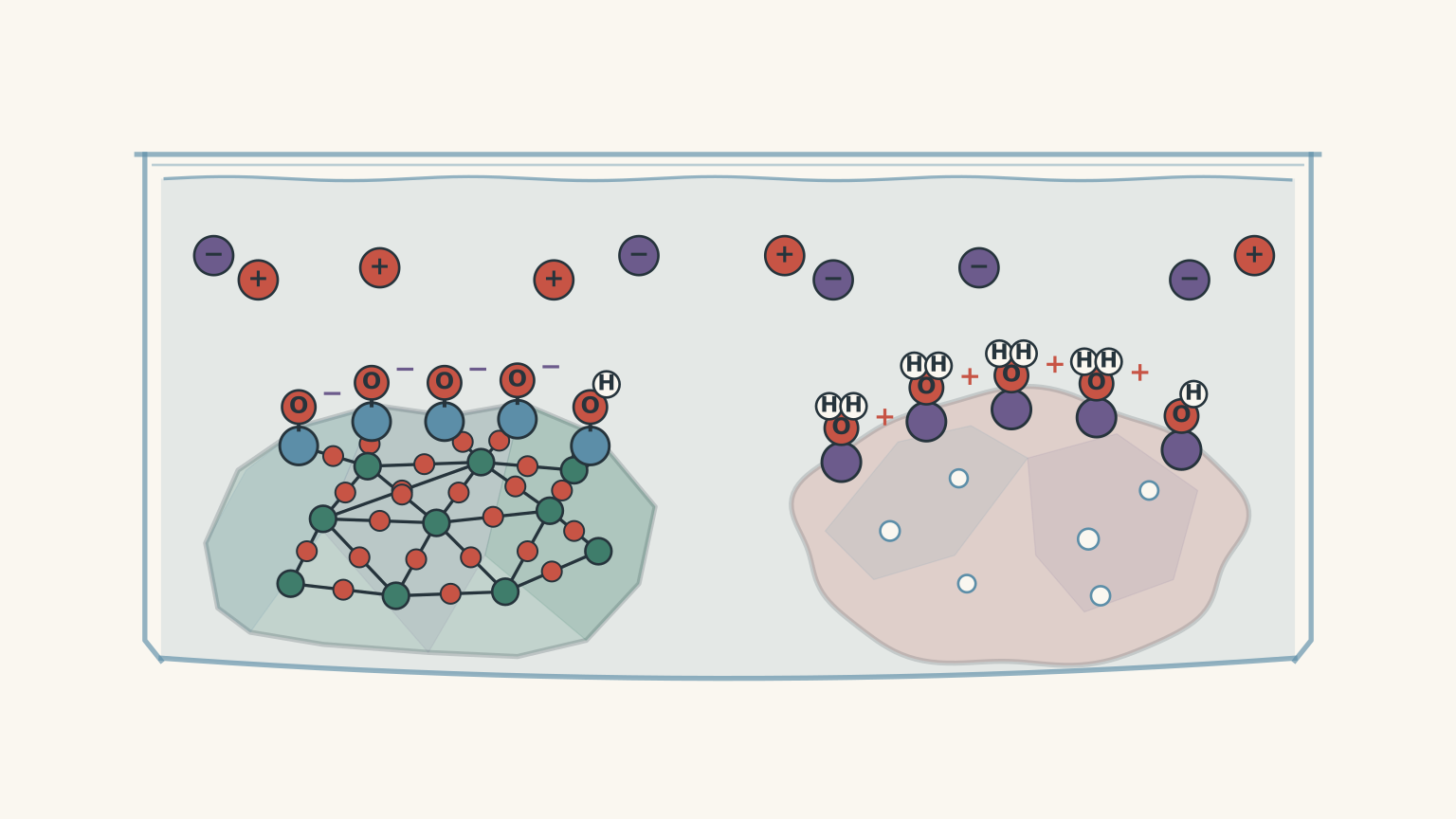
Due to technical limitations, this figure may display incorrectly or contain inaccuracies. Please check key details against your course materials.
Scope note: Surface protonation and deprotonation are an extension beyond the required Year 12 acid-base syllabus content. This is not an HSC assessment requirement. The Year 12 acid-base material provides the prerequisite knowledge for understanding the additional chemistry developed here. NESA’s Chemistry 11-12 Syllabus (2025) is scheduled for implementation from 2028.
01The acid-base model you already know
Before looking at a solid surface, recall what acids and bases do in ordinary chemical reactions.
Under Brønsted-Lowry theory:
- An acid donates a proton, \(\mathrm{H}^{+}\).
- A base accepts a proton, \(\mathrm{H}^{+}\).
Common inorganic acids include hydrochloric acid, nitric acid, and sulfuric acid. In water, they donate protons to water molecules, producing hydronium ions.
For example:
\[ \ce{HCl + H2O -> H3O+ + Cl-} \]
Common bases include sodium hydroxide and potassium hydroxide. These soluble metal hydroxides dissociate in water, supplying hydroxide ions.
\[ \ce{NaOH -> Na+ + OH-} \]
The hydroxide ions accept protons to form water.
Metal oxides can also behave as bases. Magnesium oxide, for example, reacts with acid:
\[ \ce{MgO + 2H+ -> Mg^2+ + H2O} \]
Some metal oxides, including aluminium oxide and zinc oxide, are amphoteric. They can react with both acids and sufficiently strong bases.
| Substance | Acid-base behaviour |
|---|---|
| Hydrochloric acid, \(\ce{HCl}\) | Donates protons in water and reacts with bases. |
| Sulfuric acid, \(\ce{H2SO4}\) | Donates protons and neutralises bases. |
| Sodium hydroxide, \(\ce{NaOH}\) | Supplies hydroxide ions, which accept protons. |
| Magnesium oxide, \(\ce{MgO}\) | Basic oxide that neutralises acids. |
| Aluminium oxide, \(\ce{Al2O3}\) | Amphoteric oxide that reacts with acids and strong bases. |
You can revisit the distinction between aqueous Arrhenius behaviour and proton transfer in Arrhenius Acid-Base Theory for HSC Chemistry.
The important idea for this article is that proton transfer does not have to involve two dissolved substances.
A solid surface can participate in proton transfer too.
02Why mineral surfaces have acid-base properties
Consider a crystal of aluminium oxide or iron oxide.
Inside the crystal, metal ions are surrounded by neighbouring oxygen atoms. These bonds help maintain the solid’s structure.
At the surface, however, some metal centres have fewer neighbouring atoms than they would inside the crystal. They have available coordination positions that can interact with water.
When the mineral contacts water, water molecules can attach to these exposed sites. Proton rearrangement can produce hydroxyl groups bonded to the surface.
A hydroxyl group is a group containing an oxygen atom bonded to a hydrogen atom, written \(\ce{-OH}\).
These surface hydroxyl groups are important because they can participate in acid-base reactions.
We represent a general hydroxyl group attached to a mineral surface as:
\[ \equiv\mathrm{SOH} \]
Each part of this notation has a purpose:
- \(S\) represents a generic atom or structural centre in the mineral surface, commonly a metal such as aluminium or iron, or silicon.
- \(\mathrm{OH}\) represents the surface-bound hydroxyl group.
- \(\equiv\) indicates that the site is bonded into the solid framework.
The letter \(S\) is a generic symbol here, not the chemical symbol for sulfur.
For example, an iron oxide surface may contain groups represented as \(\equiv\mathrm{FeOH}\), while an aluminium oxide surface may contain \(\equiv\mathrm{AlOH}\).
Notice that \(\equiv\mathrm{SOH}\) is not the same thing as a free hydroxide ion, \(\ce{OH-}\), floating in water. The hydroxyl group is attached to the solid.
This attachment does not prevent it from accepting or donating a proton.
03Protonation: when a surface gains a proton
Imagine adding acid to a suspension containing mineral particles.
The concentration of hydronium ions increases. These ions can transfer protons to hydroxyl groups on the mineral surface.
The surface hydroxyl group accepts a proton:
\[ \equiv\mathrm{SOH}+\mathrm{H^+} \rightleftharpoons \equiv\mathrm{SOH_2^+} \]
This process is called protonation.
Look at what has happened:
- The original surface group was neutral.
- It accepted an additional proton.
- It now has a positive charge.
The group has become \(\equiv\mathrm{SOH_2^+}\).
The mineral itself has not necessarily dissolved. The metal centre remains attached to the solid. Only the protonation state of the surface site has changed.
When the solution becomes more acidic, protonation is generally favoured.
04Deprotonation: when a surface loses a proton
Now consider the opposite situation.
Suppose the mineral is placed in a more alkaline solution. The concentration of hydronium ions decreases, and the solution favours proton removal from surface hydroxyl groups.
The surface hydroxyl group can donate a proton:
\[ \equiv\mathrm{SOH} \rightleftharpoons \equiv\mathrm{SO^-}+\mathrm{H^+} \]
This process is called deprotonation.
The surface group loses a proton and becomes negatively charged.
The three possible states of this simplified surface site are therefore:
| Surface species | State | Charge |
|---|---|---|
| \(\equiv\mathrm{SOH_2^+}\) | Protonated | +1 |
| \(\equiv\mathrm{SOH}\) | Neither additionally protonated nor deprotonated | 0 |
| \(\equiv\mathrm{SO^-}\) | Deprotonated | −1 |
A particularly important consequence follows.
The same surface hydroxyl group can behave as either an acid or a base.
It accepts a proton in acidic conditions and donates a proton in sufficiently alkaline conditions. It is therefore amphoteric.
This is related to the amphoteric behaviour of metal hydroxides, but the process being described here is specifically a proton transfer at a solid surface, rather than the dissolution of a bulk metal hydroxide.
05How pH changes the charge of a mineral surface
We can now return to the original problem.
Why can two minerals in the same solution have opposite surface charges?
The answer is that different mineral surfaces have different tendencies to accept and release protons.
Increasing the acidity of a solution generally favours protonation. Increasing the alkalinity generally favours deprotonation.
However, the pH at which a particular surface has zero net charge depends on the mineral and its surface chemistry.
The point of zero charge
The point of zero charge (PZC) is the condition at which the net electrical charge density of a surface is zero.
For an oxide in an aqueous solution, it is commonly expressed as a particular pH, written \(\mathrm{pH}_{\mathrm{PZC}}\).
It gives us a useful way to predict the overall surface charge.
| Relationship between pH and PZC | Typical net surface charge | Favoured electrostatic attraction |
|---|---|---|
| pH below PZC | Positive | Anions |
| pH equal to PZC | Zero | No overall electrostatic preference |
| pH above PZC | Negative | Cations |
Why does this happen?
Below the PZC, protonated sites contribute enough positive charge to produce a positive net surface charge.
Above the PZC, deprotonated sites contribute enough negative charge to produce a negative net surface charge.
At the PZC, the positive and negative contributions balance.
Importantly, this does not mean every individual surface site is neutral. Positively and negatively charged sites can still exist simultaneously.
Different minerals have different PZCs
Consider some representative values reported in university geochemistry teaching material.
| Mineral or oxide | Formula | Representative PZC |
|---|---|---|
| Quartz | \(\ce{SiO2}\) | 2.9 |
| Gamma-alumina | \(\ce{Al2O3}\) | 8.5 |
| Hematite | \(\ce{Fe2O3}\) | 8.5 |
| Goethite | \(\ce{FeOOH}\) | 9.3 |
These are representative values, not universal constants. The exact PZC can vary with the mineral phase, surface preparation, temperature, and solution composition. citeturn764441view2turn764441view0
Notice the difference between quartz and gamma-alumina.
At pH 7:
- Quartz is above its PZC of 2.9, so its surface tends to be negatively charged.
- Gamma-alumina is below its PZC of 8.5, so its surface tends to be positively charged.
This is why the assumption that all mineral surfaces are neutral at pH 7 is incorrect.
Worked example: Predict the charge on an alumina surface
A sample of gamma-alumina has a measured point of zero charge of pH 8.5. It is placed in an aqueous solution with a pH of 6.0.
Predict the net charge of the surface and identify whether it will electrostatically favour positive or negative ions.
Step 1
The solution has:
\[ \mathrm{pH}=6.0 \]
The surface has:
\[ \mathrm{pH}_{\mathrm{PZC}}=8.5 \]
Since \(6.0<8.5\), the solution is below the PZC.
Step 2
Below the PZC, protonation is favoured sufficiently to produce a positive net surface charge.
Therefore, the alumina surface is positively charged overall.
Step 3
Opposite electrical charges attract.
The positively charged surface will therefore electrostatically favour anions, which are negatively charged ions.
For example, chloride ions, \(\mathrm{Cl}^{-}\), may be attracted towards the surface.
The important qualification is that electrostatic attraction does not guarantee adsorption. Whether an ion actually binds depends on other chemical interactions too.
06A more precise model: surface acid dissociation constants
So far, we have described the effect of pH qualitatively.
We can make the model more precise using equilibrium constants.
The two surface reactions can be written as acid dissociation equilibria:
\[ \equiv\mathrm{SOH_2^+} \rightleftharpoons \equiv\mathrm{SOH}+\mathrm{H^+} \]
\[ \equiv\mathrm{SOH} \rightleftharpoons \equiv\mathrm{SO^-}+\mathrm{H^+} \]
Each reaction has its own acid dissociation constant:
- \(K_{a1}\) describes the loss of a proton from the positively charged site.
- \(K_{a2}\) describes the loss of a proton from the neutral site.
The corresponding pKa values are:
\[ \mathrm{p}K_{a1}=-\log_{10}K_{a1} \]
\[ \mathrm{p}K_{a2}=-\log_{10}K_{a2} \]
A lower pKa indicates a greater tendency for the relevant proton to dissociate under the specified equilibrium conditions.
These equilibria give us three useful regions:
| pH region | Predominant surface species |
|---|---|
| Below \(\mathrm{p}K_{a1}\) | \(\equiv\mathrm{SOH_2^+}\) |
| Between the two pKa values | \(\equiv\mathrm{SOH}\) |
| Above \(\mathrm{p}K_{a2}\) | \(\equiv\mathrm{SO^-}\) |
These are predominance regions, not sudden switches. All three species can coexist, depending on the pH.
How are pKa and PZC related?
For a simplified surface containing just one type of equivalent hydroxyl site, we can derive a useful relationship.
At the point of zero charge, the positively charged and negatively charged site populations balance:
\[ [\equiv\mathrm{SOH_2^+}] = [\equiv\mathrm{SO^-}] \]
Here, square brackets represent the effective amounts of each surface species.
Using the two acid dissociation equilibria, the simplified result is:
\[ \boxed{ \mathrm{pH}_{\mathrm{PZC}} = \frac{\mathrm{p}K_{a1}+\mathrm{p}K_{a2}}{2} } \]
This relationship assumes equivalent sites, ideal equilibrium behaviour, and no other significant sources of surface charge.
It is not a universal formula for real minerals. Real surfaces can contain multiple types of hydroxyl groups, and electrostatic interactions can affect the equilibria.
Nevertheless, it gives us a useful starting model.
Worked example: Calculate the proportions of surface species
A hypothetical oxide surface has one type of hydroxyl site with:
\[ \mathrm{p}K_{a1}=4.5 \]
\[ \mathrm{p}K_{a2}=8.5 \]
Estimate the proportions of protonated, neutral, and deprotonated sites at pH 7.0. Also determine the overall sign of the surface charge.
Step 1
Using the Henderson-Hasselbalch relationship for the first dissociation:
\[ \mathrm{pH} = \mathrm{p}K_{a1} + \log_{10} \left( \frac{[\equiv\mathrm{SOH}]}{[\equiv\mathrm{SOH_2^+}]} \right) \]
Substituting:
\[ 7.0=4.5+ \log_{10} \left( \frac{[\equiv\mathrm{SOH}]}{[\equiv\mathrm{SOH_2^+}]} \right) \]
Therefore:
\[ \frac{[\equiv\mathrm{SOH}]}{[\equiv\mathrm{SOH_2^+}]} =10^{2.5} \approx316 \]
There are approximately 316 neutral sites for every protonated site.
Step 2
For the second dissociation:
\[ \frac{[\equiv\mathrm{SO^-}]}{[\equiv\mathrm{SOH}]} = 10^{\mathrm{pH}-\mathrm{p}K_{a2}} \]
Substituting:
\[ =10^{7.0-8.5} \]
\[ =10^{-1.5} \approx0.0316 \]
For every 316 neutral sites, there are approximately:
\[ 316\times0.0316\approx10 \]
deprotonated sites.
Step 3
The ratio of protonated, neutral, and deprotonated sites is approximately:
\[ 1:316:10 \]
The total number of relative site units is:
\[ 1+316+10=327 \]
Step 4
Protonated:
\[ \frac{1}{327}\times100 \approx0.31\% \]
Neutral:
\[ \frac{316}{327}\times100 \approx96.6\% \]
Deprotonated:
\[ \frac{10}{327}\times100 \approx3.06\% \]
Step 5
Each protonated site contributes one positive charge, and each deprotonated site contributes one negative charge.
Therefore, the average charge per site, expressed in units of the elementary charge, is:
\[ q=\frac{1-10}{327} \]
\[ q\approx-0.0275 \]
The surface has a slightly negative net charge.
Although most sites are neutral, there are more negatively charged sites than positively charged sites.
This is a useful distinction: the most abundant surface species does not necessarily determine the sign of the net surface charge.
07What does surface charge actually change?
Changing the charge of a mineral surface has consequences beyond the surface itself.
It influences how dissolved ions interact with the mineral.
Consider two situations.
A positively charged surface
Suppose an oxide surface is below its PZC.
Protonation has produced a positive net charge.
Negatively charged ions, or anions, are electrostatically attracted towards the surface.
Examples include:
- Chloride ions, \(\mathrm{Cl}^{-}\).
- Nitrate ions, \(\ce{NO3-}\).
- Phosphate-containing anions.
This can increase the likelihood that anions accumulate near the mineral.
A negatively charged surface
Now suppose the same mineral is placed above its PZC.
Deprotonation has produced a negative net charge.
Positively charged ions, or cations, are electrostatically attracted towards the surface.
Examples include:
- Calcium ions, \(\mathrm{Ca}^{2+}\).
- Magnesium ions, \(\mathrm{Mg}^{2+}\).
- Zinc ions, \(\mathrm{Zn}^{2+}\).
This can increase the likelihood that cations accumulate near the mineral.
Electrostatic attraction is not the whole story
Here is where the simple model needs another layer.
An ion does not have to be electrostatically attracted to a surface to form a chemical bond with it.
Some dissolved ions can interact directly with surface hydroxyl groups. They form chemical surface complexes, a process known as surface complexation.
For example, a dissolved zinc ion can bind to an iron oxide surface through an oxygen atom:
\[ \equiv\mathrm{FeOH}+\mathrm{Zn^{2+}} \rightleftharpoons \equiv\mathrm{FeOZn^+}+\mathrm{H^+} \]
The zinc ion forms a surface-bound complex, and a proton is released.
This is different from an ion simply being attracted towards a charged surface.
The interaction involves chemical bonding and changes the surface chemistry itself.
Phosphate ions can also form strong surface complexes with iron oxides through their oxygen atoms. This is important in soils and environmental chemistry, where mineral surfaces influence how much phosphate remains dissolved in water.
The distinction is important:
- Electrostatic attraction describes how electrical charges influence the movement and accumulation of ions near a surface.
- Specific adsorption involves chemical interactions or bonding between dissolved species and surface sites.
Both processes can operate simultaneously. citeturn764441view3turn982340view1
08Where the simple model becomes incomplete
The three-state model is useful, but a real mineral surface is more complicated than a collection of identical hydroxyl groups.
There are two particularly important limitations.
1. Not every hydroxyl group has the same acidity
Imagine looking at the surface of a mineral at the atomic level.
Some hydroxyl groups are attached to metal atoms at corners or edges. Others sit on flatter crystal faces. Their surrounding atoms and bonding arrangements can be different.
As a result, their tendencies to accept or donate protons can differ.
They may have different pKa values.
A 2021 study published in Nature directly investigated the acidity of individual hydroxyl groups on an indium oxide surface. It demonstrated that different local surface hydroxyl environments can have distinct acidities. Related measurements were also made on titanium dioxide and zirconium oxide. citeturn501460search3
This means that a real mineral surface may have a distribution of acid-base sites rather than one perfectly defined type.
The simple model is most useful when thinking about a relatively uniform population of hydroxylated oxide sites.
It becomes less accurate when the surface contains many different site types.
There is another important restriction.
Some minerals, particularly layered silicate clays, can have permanent structural charge caused by substitutions within their crystal lattices. Their total charge is not explained solely by protonation and deprotonation of surface hydroxyl groups.
The surface hydroxyl model therefore describes an important type of mineral surface chemistry, not every source of charge in every mineral.
2. The point of zero charge is not always the isoelectric point
These two terms sound almost identical, but they describe different measurements.
The point of zero charge (PZC) is the pH at which the net surface charge density is zero.
The isoelectric point (IEP) is the pH at which the zeta potential is zero.
Zeta potential describes the electrical potential at the slipping plane of a particle. The slipping plane is the approximate boundary between the liquid moving with the particle and the surrounding bulk liquid.
Why might these two pH values differ?
When a mineral surface becomes charged, dissolved ions gather around it. This produces an electrical double layer.
Some ions can accumulate close to the surface, while others form a more spread-out cloud in the surrounding solution.
The electrical potential at the slipping plane therefore does not necessarily represent the charge directly at the mineral surface.
If other ions specifically adsorb onto the surface, they can change the charge distribution and shift the IEP relative to the PZC.
For example, strongly adsorbing phosphate anions can make the electrokinetic potential more negative, changing the pH at which the zeta potential reaches zero.
The two values can coincide under suitable conditions, particularly when proton and hydroxide interactions dominate and the background electrolyte does not specifically adsorb.
However, they should not automatically be treated as identical. Their definitions and dependence on solution conditions are distinguished in IUPAC recommendations. citeturn764441view0
This distinction becomes particularly important when interpreting experimental measurements.
09Questions and solutions
Question 1
A hydrated aluminium oxide surface has a measured PZC of 8.5.
The mineral is placed in a solution with a pH of 5.5.
Determine:
a) Whether the surface has a positive or negative net charge.
b) Whether the surface will electrostatically favour cations or anions.
Solution 1
The surface has a positive net charge and will electrostatically favour anions.
a) Determine the charge.
Compare the pH with the PZC:
\[ 5.5<8.5 \]
The solution is below the point of zero charge.
Protonation is therefore favoured sufficiently to produce a positive net surface charge.
b) Determine the electrostatic attraction.
A positively charged surface attracts negatively charged ions.
Therefore, anions are electrostatically favoured.
The key is to compare the solution pH with the mineral’s PZC, rather than assuming that all mineral surfaces behave the same way at a particular pH.
Question 2
Quartz and gamma-alumina particles are suspended separately in solutions with the same pH of 7.0.
Their representative PZC values are:
| Mineral | PZC |
|---|---|
| Quartz | 2.9 |
| Gamma-alumina | 8.5 |
A student makes two claims:
- Both surfaces must be neutral because they are in solutions at pH 7.0.
- The mineral with the higher PZC must always adsorb more anions, regardless of the solution pH.
Evaluate both claims.
Identify the expected net surface charge of each mineral at pH 7.0, and explain why the second claim is not necessarily correct.
Solution 2
Both claims are incorrect.
Quartz is expected to have a negative net surface charge, while gamma-alumina is expected to have a positive net surface charge. However, a higher PZC alone does not guarantee greater anion adsorption.
Step 1: Evaluate the quartz surface.
For quartz:
\[ \mathrm{pH}=7.0 \]
\[ \mathrm{PZC}=2.9 \]
Since:
\[ 7.0>2.9 \]
the quartz surface is above its PZC.
Deprotonation is favoured, producing a negative net surface charge.
Quartz will therefore electrostatically favour cations.
Step 2: Evaluate the gamma-alumina surface.
For gamma-alumina:
\[ \mathrm{pH}=7.0 \]
\[ \mathrm{PZC}=8.5 \]
Since:
\[ 7.0<8.5 \]
the alumina surface is below its PZC.
Protonation is favoured, producing a positive net surface charge.
Gamma-alumina will therefore electrostatically favour anions.
Step 3: Evaluate the second claim.
A higher PZC means that a surface can remain positively charged over a higher pH range, all else being equal.
However, actual adsorption depends on more than the PZC.
Important factors include:
- The pH of the solution relative to the PZC.
- The concentration and chemical form of the dissolved ions.
- The number and type of available surface sites.
- The presence of competing ions.
- Specific chemical bonding between ions and surface groups.
For example, an ion may form a strong chemical surface complex even when electrostatic attraction alone would not predict substantial adsorption.
The PZC is therefore a useful predictor of surface charge, not a complete measurement of adsorption capacity.
Question 3
An oxide mineral has a PZC of pH 7.0.
It is suspended in water containing dissolved \(\mathrm{M}^{2+}\) and \(\mathrm{X}^{-}\) ions.
The solution initially has a pH of 9.0. It is then acidified until its pH reaches 5.0.
Assume:
- The mineral does not dissolve.
- The concentrations and chemical forms of both ions remain unchanged.
- Neither ion undergoes specific chemical adsorption.
- Only electrostatic attraction is being considered.
Predict which ion is electrostatically favoured:
a) At pH 9.0.
b) At pH 5.0.
c) At pH 7.0.
Explain what happens to the surface as the solution passes through its PZC.
Solution 3
At pH 9.0, the mineral favours \(\mathrm{M}^{2+}\). At pH 5.0, it favours \(\mathrm{X}^{-}\). At pH 7.0, there is no overall electrostatic preference.
a) At pH 9.0
The solution is above the PZC:
\[ 9.0>7.0 \]
The surface undergoes greater deprotonation and has a negative net charge.
It therefore electrostatically favours the positive \(\mathrm{M}^{2+}\) ions.
b) At pH 5.0
The solution is below the PZC:
\[ 5.0<7.0 \]
Protonation is favoured, producing a positive net surface charge.
The surface therefore electrostatically favours the negative \(\mathrm{X}^{-}\) ions.
c) At pH 7.0
The solution is at the PZC.
The positive and negative surface charge contributions balance, giving zero net surface charge.
There is consequently no overall electrostatic preference for either ion.
This does not mean that every individual surface site is neutral or that no ion can interact with the surface.
As the pH decreases from 9.0 to 5.0, the surface progressively becomes less negative, passes through zero net charge, and eventually becomes positive.
The crucial point is that the surface charge can reverse as a result of protonation and deprotonation, even though the dissolved ions themselves have not changed.
Question 4
An iron oxide mineral is investigated using two different techniques.
The results are:
| Measurement | Solution conditions | Measured pH |
|---|---|---|
| Point of zero charge | Nitrate background electrolyte | 7.2 |
| Isoelectric point | Phosphate-containing solution | 5.1 |
A student argues that the measurements cannot both be correct because both are supposed to identify the pH at which the surface has zero charge.
Explain why the two results can differ.
In your answer:
a) Distinguish between the PZC and IEP.
b) Explain how phosphate adsorption can contribute to the difference.
c) Identify the condition under which the two values may coincide.
Solution 4
Both measurements can be correct because the PZC and IEP describe different electrical properties of the solid-water interface.
a) Distinguish between the measurements.
The PZC identifies the pH at which the net surface charge density is zero.
The IEP identifies the pH at which the zeta potential is zero.
The first concerns the charge at the mineral surface itself. The second concerns the electrical potential at the slipping plane in the surrounding liquid.
These are related, but they are not necessarily identical.
b) Explain the effect of phosphate adsorption.
Phosphate ions can specifically adsorb onto iron oxide surfaces.
This means that they can form chemical interactions with surface sites rather than simply being attracted through electrostatic forces.
The adsorbed phosphate contributes negative charge to the interfacial region and can change the electrical potential experienced at the slipping plane.
Consequently, the zeta potential can reach zero at a different pH from the one at which the mineral’s surface charge density reaches zero.
In this example, the phosphate-containing solution produces a lower measured IEP.
c) Identify when the values may coincide.
The PZC and IEP may coincide when protonation and deprotonation are the dominant processes controlling surface charge, and the surrounding electrolyte does not specifically adsorb.
The key condition is that other adsorbed ions must not significantly alter the relationship between the actual surface charge and the electrokinetic potential.
The tempting assumption is that both measurements are simply different ways of finding the same zero-charge pH.
They are not. One measures surface charge, while the other describes the electrokinetic behaviour of the particle in solution.
Question 5
An oxide mineral has two different populations of hydroxyl surface sites.
The two populations are chemically distinct, but each follows the same simplified three-state protonation model.
Their properties are:
| Site population | Fraction of total sites | \(\mathrm{p}K_{a1}\) | \(\mathrm{p}K_{a2}\) |
|---|---|---|---|
| A | 60% | 4.0 | 8.0 |
| B | 40% | 6.0 | 10.0 |
For each population, the relative weights of the protonated, neutral, and deprotonated forms are:
\[ w_+=1 \]
\[ w_0=10^{\mathrm{pH}-\mathrm{p}K_{a1}} \]
\[ w_-=10^{2\mathrm{pH}-\mathrm{p}K_{a1}-\mathrm{p}K_{a2}} \]
Here, \(w_+\), \(w_0\), and \(w_-\) represent the relative populations of positively charged, neutral, and negatively charged sites respectively.
Assume:
- The two site populations are independent.
- Every site contributes the same magnitude of charge when protonated or deprotonated.
- There are no specifically adsorbed ions.
- Electrostatic interactions between sites are ignored.
- The bulk pH controls both populations.
A student estimates the overall PZC by calculating the weighted average of the two individual PZCs:
\[ \mathrm{pH}_{\mathrm{PZC}} = 0.60(6.0)+0.40(8.0) \]
\[ =6.8 \]
Is this the actual PZC of the combined mineral surface?
Determine the overall PZC to approximately two decimal places, and explain why averaging the two individual PZCs does not necessarily give the correct answer.
Solution 5
The actual PZC is approximately pH 6.91, not pH 6.80.
The reason is that the PZC depends on the combined positive and negative charge contributions of the two site populations, not the weighted average of their individual PZC values.
Step 1: Establish the charge contribution of each population.
For each site population, the average charge per site, expressed in units of the elementary charge, is:
\[ q=\frac{w_+-w_-}{w_++w_0+w_-} \]
The neutral sites contribute zero charge, while the protonated and deprotonated sites contribute equal and opposite charges.
Therefore, for the combined surface:
\[ q_{\mathrm{total}}=0.60q_A+0.40q_B \]
The overall PZC occurs when:
\[ q_{\mathrm{total}}=0 \]
Step 2: Calculate the charge contributions at pH 6.90.
For population A:
\[ w_+=1 \]
\[ w_0=10^{6.90-4.0} \approx794.33 \]
\[ w_-=10^{13.80-4.0-8.0} \approx63.10 \]
Therefore:
\[ q_A= \frac{1-63.10}{1+794.33+63.10} \]
\[ q_A\approx-0.0723 \]
For population B:
\[ w_+=1 \]
\[ w_0=10^{6.90-6.0} \approx7.94 \]
\[ w_-=10^{13.80-6.0-10.0} \approx0.00631 \]
Therefore:
\[ q_B= \frac{1-0.00631}{1+7.94+0.00631} \]
\[ q_B\approx+0.1110 \]
Step 3: Combine the two populations.
\[ q_{\mathrm{total}} = 0.60(-0.0723)+0.40(0.1110) \]
\[ q_{\mathrm{total}}\approx+0.0010 \]
The surface is still slightly positively charged at pH 6.90.
Step 4: Test a slightly higher pH.
Repeating the calculation at pH 6.91 gives approximately:
\[ q_A=-0.0740 \]
\[ q_B=+0.1088 \]
Combining them:
\[ q_{\mathrm{total}} = 0.60(-0.0740)+0.40(0.1088) \]
\[ q_{\mathrm{total}}\approx-0.0009 \]
The surface is now slightly negatively charged.
The zero-charge point therefore lies between pH 6.90 and 6.91.
Interpolating gives:
\[ \boxed{\mathrm{pH}_{\mathrm{PZC}}\approx6.91} \]
Step 5: Explain why the weighted average failed.
The student’s calculation assumes that averaging the individual zero-charge pH values also averages the actual charge contributions.
That assumption is incorrect.
Each population has a different relationship between pH and its protonated, neutral, and deprotonated fractions.
The charge changes non-linearly with pH. The two populations therefore contribute different amounts of positive and negative charge at any particular pH.
For example, at pH 6.8:
\[ q_A\approx-0.0578 \]
\[ q_B\approx+0.1362 \]
The combined charge is:
\[ q_{\mathrm{total}} \approx 0.60(-0.0578)+0.40(0.1362) \]
\[ q_{\mathrm{total}}\approx+0.0198 \]
The surface is still positively charged at the student’s predicted PZC.
This is the important conceptual result:
The PZC of a heterogeneous surface is determined by the sum of its actual charge contributions, not by averaging the pH values at which its individual site populations become neutral.
The same principle applies when modelling real minerals with many different types of hydroxyl groups.
10Where this leads next
You can now explain why a mineral surface can become positively or negatively charged, even though the solid itself has not dissolved.
You can also predict how changing pH influences the attraction of dissolved cations and anions, and recognise why the PZC alone cannot describe every adsorption reaction.
The next useful concept is quantitative surface complexation: combining the number of available surface sites, their acid-base equilibria, and the binding strength of dissolved ions to predict how much of a substance remains in solution.
That takes the chemistry from simply predicting the charge of a mineral surface to understanding how mineral surfaces influence water chemistry, soil chemistry, and environmental contaminant movement.
11Scientific references and further reading
The explanations and models in this article are informed by the following scientific and educational sources.
NSW Education Standards Authority (NESA) – Chemistry 11-12 Syllabus (2025). The official syllabus and implementation information.
Pennsylvania State University – Lesson 3: Surface Complexation. University teaching material covering surface protonation, deprotonation, equilibrium models, and points of zero charge.
OECD Nuclear Energy Agency – Modelling in Aquatic Chemistry, Chapter VII. An authoritative treatment of mineral-water interfaces, surface hydroxyl groups, and surface complexation.
International Union of Pure and Applied Chemistry (IUPAC) – Nomenclature, Symbols, Definitions and Measurements for Electrified Interfaces in Aqueous Dispersions of Solids. Recommendations defining surface charge, PZC, and IEP.
Wagner et al. (2021) – Direct assessment of the acidity of individual surface hydroxyls, Nature, 592, 722-725. Primary research investigating differences in the acidity of individual hydroxyl groups on oxide surfaces.