
Conformational Analysis of Substituted Cyclohexanes
Explore how axial and equatorial substituents affect cyclohexane stability. Learn to compare conformational energies using A-values, predict favoured chair structures, and calculate equilibrium populations.
Two chair drawings of methylcyclohexane contain exactly the same atoms and bonds. Yet they are not equally stable. At room temperature, approximately 95% of methylcyclohexane molecules favour the arrangement in which the methyl group occupies an equatorial position.
Why should changing the position of one group make such a difference if no bonds are broken?
The answer involves steric interactions between atoms that are not directly bonded. These interactions can be estimated using experimental energy data, allowing chemists to predict which three-dimensional arrangements of substituted cyclohexanes are most stable.
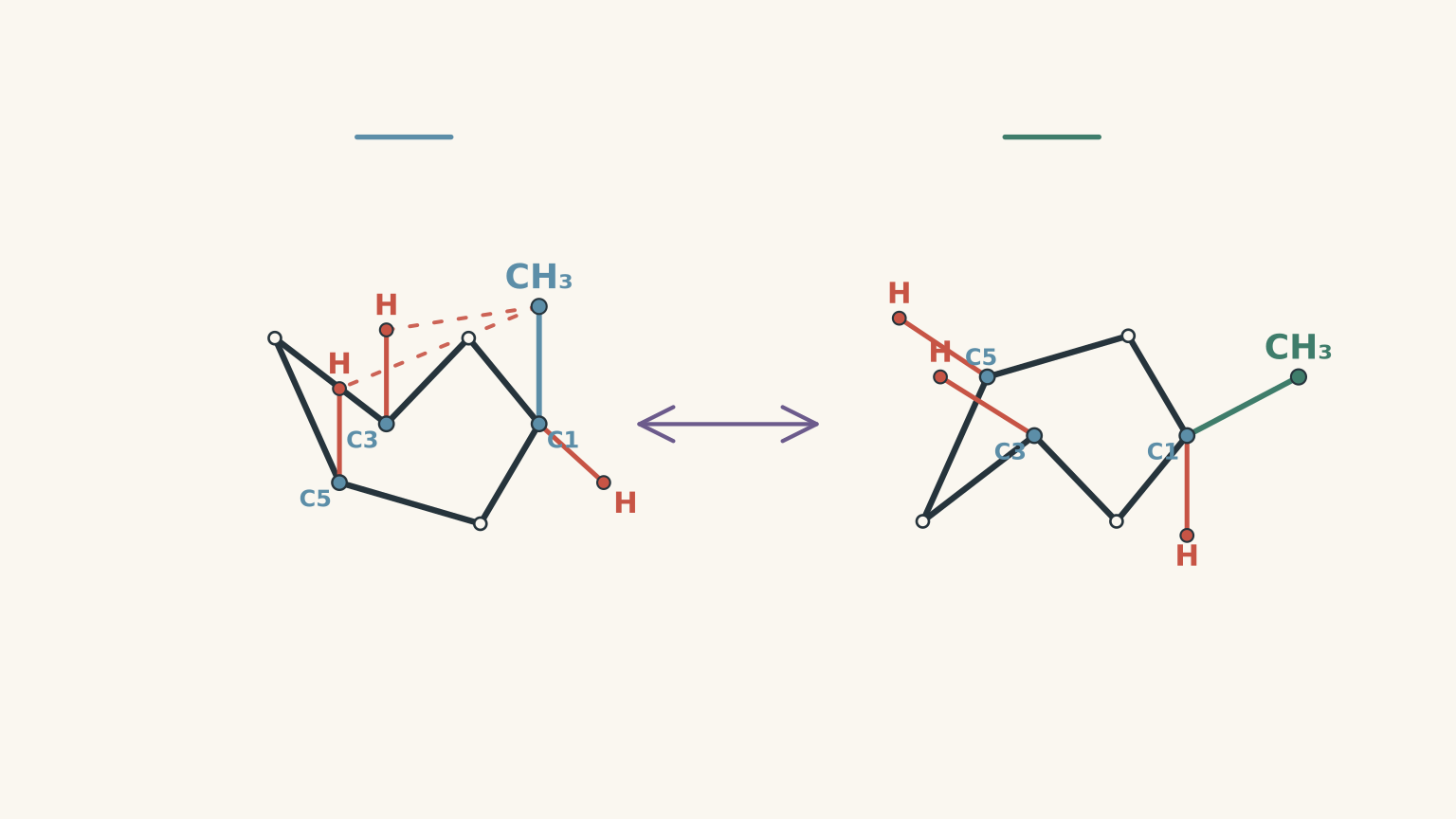
Due to technical limitations, this figure may display incorrectly or contain inaccuracies. Please check key details against your course materials.
01Where this topic fits in the HSC syllabus
The starting point is your Year 12 Organic Chemistry knowledge.
The Chemistry 11-12 Syllabus (2025) includes a practical investigation comparing the chemical properties of alkanes and alkenes. This develops an understanding of how bonding influences chemical behaviour.
An alkane contains carbon-carbon single bonds, whereas an alkene contains at least one carbon-carbon double bond. The double bond allows alkenes to undergo addition reactions under conditions where alkanes are relatively unreactive.
Conformational analysis asks a different question.
Instead of investigating how a molecule reacts, we investigate how its atoms are arranged in three dimensions and how that arrangement affects stability.
Conformational analysis of substituted cyclohexanes goes beyond the required HSC syllabus. It is an extension of your Organic Chemistry knowledge, not an additional assessment requirement.
One timing detail: NESA schedules implementation of the 2025 Chemistry syllabus from 2028, with the first HSC examination under the new syllabus in 2029. You can check the official NESA syllabus information.
02How chemists established the chair structure
The problem with drawing a flat hexagon
Cyclohexane contains six carbon atoms joined in a ring.
A simple structural drawing represents this as a hexagon. However, this drawing does not accurately represent the molecule’s three-dimensional shape.
Each carbon atom in cyclohexane is \(sp^3\)-hybridised. Its preferred bond angles are approximately \(109.5^\circ\), rather than the \(120^\circ\) angles required by a perfectly flat hexagonal ring.
A flat arrangement would also produce unfavourable eclipsing interactions between neighbouring bonds.
Chemists therefore needed to determine whether the ring actually adopted a non-planar structure.
In 1890, Hermann Sachse proposed non-planar chair and boat structures. Later work developed the idea that cyclohexane could change between different conformations.
The important question was no longer simply whether these shapes were geometrically possible. It was which shape the molecule actually preferred.
The experiment: gas-phase electron diffraction
Odd Hassel investigated the structure of cyclohexane using gas-phase electron diffraction.
This technique allowed chemists to investigate the geometry of free molecules rather than relying only on structures observed in crystals.
The apparatus works through a relatively straightforward sequence.
- A sample of cyclohexane is introduced as vapour into a low-pressure chamber.
- A narrow beam of high-speed electrons passes through the vapour.
- Electrons are scattered by the molecules.
- The scattered electrons reach a detector or photographic recording surface.
- The resulting diffraction pattern is analysed to determine distances between atoms and infer molecular geometry.
What should the experiment show?
If cyclohexane were planar, its diffraction pattern would be consistent with a flat arrangement of the six carbon atoms.
If it adopted a chair structure, the pattern would instead reflect a non-planar arrangement of atoms.
The observations supported the non-planar chair structure as the preferred arrangement.
There was also an important practical challenge. Hassel’s first purchased diffraction apparatus did not work as intended. He and Christen Finbak subsequently constructed their own apparatus, allowing the gas-phase investigation to proceed. The problem was with the measurement equipment, not a reason to abandon the molecular model.
Other experimental evidence followed. In 1942, Shin-ichiro Mizushima reported evidence from Raman and infrared spectroscopy consistent with the chair form of cyclohexane.
The historical development is discussed in this 2024 review of the discovery of molecular conformations.
Why the boat structure is less stable
Hassel and Ottar’s 1947 paper, The Structure of Molecules Containing Cyclohexane or Pyranose Rings, provides an interesting geometric comparison.
Their analysis considered the distance between non-bonded hydrogen atoms in different arrangements.
In a boat-like structure, one pair of hydrogen atoms could approach approximately \(1.83\) Å, assuming normal tetrahedral bond angles.
For comparison, their discussion used approximately \(2.5\) Å as a typical separation between non-bonded hydrogen atoms in a stable staggered arrangement.
The difference is:
\[ 2.50-1.83=0.67\ \text{Å} \]
This is approximately 27% shorter than the comparison distance.
That is a substantial amount of crowding at the molecular scale.
Importantly, this calculation is a geometric estimate, not a direct measurement of repulsive energy. It helps explain why the boat structure is less favourable.
The chair arrangement keeps the atoms further apart and allows the carbon-carbon bonds to adopt staggered arrangements.
You can read the original Hassel and Ottar research paper.
In 1950, Derek Barton developed conformational analysis into a systematic way of understanding how molecular shape influences chemical behaviour. Hassel and Barton later shared the 1969 Nobel Prize in Chemistry for their contributions.
Barton’s Nobel lecture on the principles of conformational analysis explains how these ideas became important in organic chemistry, particularly in understanding steroids and other naturally occurring molecules.
03Understanding axial and equatorial positions
Now that we have established why cyclohexane adopts a chair structure, we can investigate how substituents affect its stability.
Each carbon atom in a cyclohexane chair has two possible positions for a substituent:
- Axial: approximately parallel to the vertical axis of the ring.
- Equatorial: directed outwards, roughly around the perimeter of the ring.
Each carbon has one axial position and one equatorial position.
What happens during a ring flip?
Cyclohexane can change between its two chair conformations through a process called a ring flip, or chair-to-chair ring inversion.
During this process:
- Every axial position becomes equatorial.
- Every equatorial position becomes axial.
- The up/down orientation of each substituent remains unchanged.
This final point is particularly important.
A substituent pointing upwards before a ring flip still points upwards afterwards. Only its axial or equatorial position changes.
The ring flip does not produce a different constitutional or configurational isomer. It produces another conformation of the same molecule.
At room temperature, chair interconversion is rapid. The activation barrier for unsubstituted cyclohexane is approximately \(45\ \mathrm{kJ\,mol^{-1}}\).
Do not confuse this activation barrier with the energy difference between two chair conformations. They describe different things:
- The activation barrier describes the energy needed to move between conformations.
- The conformational energy difference describes how much more stable one conformation is than the other.
We will use the second quantity shortly.
Conformation versus configuration
These terms are easy to confuse.
Conformation describes the three-dimensional arrangement of atoms that can change without breaking bonds.
Configuration describes the fixed spatial arrangement of substituents that cannot be changed simply by rotating bonds or flipping a ring.
For substituted cyclohexanes, this distinction is especially useful when discussing cis and trans arrangements.
- Cis means two substituents are on the same face of the ring.
- Trans means they are on opposite faces.
A ring flip does not change cis into trans.
This is closely related to the distinction between molecular shape and stereochemical configuration covered in tutorgum’s guide to R and S configuration.
04Why axial substituents are usually less stable
Consider methylcyclohexane again.
Imagine that a methyl group is attached to carbon 1, or C1.
There are two possible chair conformations:
- The methyl group is axial.
- The methyl group is equatorial.
Predict which arrangement should be more stable.
The equatorial arrangement is more stable because it avoids two particularly close non-bonded interactions.
1,3-diaxial interactions
When the methyl group occupies an axial position at C1, it approaches the axial hydrogen atoms attached to C3 and C5.
These interactions are called 1,3-diaxial interactions.
The name describes the relative positions of the atoms around the ring.
The axial methyl group experiences two unfavourable close contacts:
- One with an axial hydrogen on C3.
- One with an axial hydrogen on C5.
These interactions increase the energy of the axial conformation.
A useful analogy is carrying a large backpack through a crowded train aisle. The backpack does not form any new connections with the people around it, but its position forces everything closer together.
The analogy has a limit: atoms are not hard objects physically touching. Steric repulsion arises from interactions between their electron clouds when they are forced too close.
The equatorial methyl group avoids the two particularly unfavourable axial contacts.
It is therefore lower in energy.
Why does substituent size matter?
The effect becomes more pronounced as the substituent becomes bulkier.
Consider the following groups:
- Methyl, \(\ce{-CH3}\)
- Ethyl, \(\ce{-CH2CH3}\)
- Isopropyl, \(\ce{-CH(CH3)2}\)
- tert-Butyl, \(\ce{-C(CH3)3}\)
As the group becomes larger, placing it in an axial position generally creates more severe steric interactions.
However, size is not the only factor. Bond lengths, molecular geometry, polarity, and electronic interactions can also affect conformational preference.
05Quantifying conformational preference: A-values
Chemists use a quantity called an A-value to describe the preference of a substituent for an equatorial rather than an axial position.
The A-value is the free-energy difference between the two conformations of a monosubstituted cyclohexane.
It is defined as:
\[ A_X=G_{\mathrm{ax}}-G_{\mathrm{eq}} \]
Where:
- \(A_X\) is the A-value of substituent \(X\).
- \(G_{\mathrm{ax}}\) is the molar Gibbs free energy of the axial conformation.
- \(G_{\mathrm{eq}}\) is the molar Gibbs free energy of the equatorial conformation.
A positive A-value means that the axial conformation has a higher free energy.
Therefore, the equatorial conformation is favoured.
A larger positive A-value indicates a stronger preference for the equatorial position.
Comparing substituents using energy data
The following table uses representative steric-interaction estimates from OpenStax.
The first energy column gives the approximate cost of one 1,3-diaxial contact between a substituent and an axial hydrogen. The A-value estimate assumes two such contacts.
| Substituent | Cost per contact (kJ mol⁻¹) | Approximate A-value (kJ mol⁻¹) |
|---|---|---|
| \(\ce{-F}\) | 0.5 | 1.0 |
| \(\ce{-Cl}\) | 1.0 | 2.0 |
| \(\ce{-Br}\) | 1.0 | 2.0 |
| \(\ce{-OH}\) | 2.1 | 4.2 |
| \(\ce{-CH3}\) | 3.8 | 7.6 |
| \(\ce{-CH2CH3}\) | 4.0 | 8.0 |
| \(\ce{-CH(CH3)2}\) | 4.6 | 9.2 |
| \(\ce{-C6H5}\) | 6.3 | 12.6 |
| \(\ce{-C(CH3)3}\) | 11.4 | 22.8 |
| \(\ce{-CN}\) | 0.4 | 0.8 |
These are approximate teaching values, not universal constants. Experimental A-values can differ slightly between sources and conditions.
The underlying steric-interaction data are discussed in OpenStax’s treatment of monosubstituted cyclohexanes.
A few comparisons are worth noticing.
Methyl versus tert-butyl
The approximate A-value of methyl is \(7.6\ \mathrm{kJ\,mol^{-1}}\), while tert-butyl is \(22.8\ \mathrm{kJ\,mol^{-1}}\).
The axial tert-butyl group therefore carries approximately three times the conformational energy penalty of an axial methyl group.
Chlorine versus methyl
The approximate A-value of chlorine is only \(2.0\ \mathrm{kJ\,mol^{-1}}\).
Although chlorine is a relatively large atom, its longer carbon-chlorine bond means that the group is positioned further from some of the nearby axial hydrogens.
This illustrates why A-values cannot be predicted using molecular mass or atom count alone.
How are A-values measured?
The preference for one conformation can be investigated experimentally using nuclear magnetic resonance spectroscopy (NMR).
In an NMR experiment, a sample is placed in a strong magnetic field and exposed to radiofrequency radiation. The resulting signals depend on the magnetic environments of particular atomic nuclei.
The axial and equatorial environments are not identical.
However, cyclohexane undergoes rapid ring inversion at ordinary temperatures. Consequently, the observed NMR signals can represent an average of the different conformations rather than two completely separate sets of signals.
Chemists can use variable-temperature NMR measurements to investigate these equilibria.
For example, variable-temperature carbon-13 NMR studies use changes in chemical shifts as the temperature changes. By comparing the measurements with suitable conformationally restricted reference compounds, researchers can estimate the relative energies of the conformations.
A relevant example is the study by Abraham and Ribeiro, A variable temperature 13C NMR study of conformational equilibria in methyl substituted cycloalkanes.
The experimental idea is important: chemists do not simply look at a molecular drawing and assign an energy.
They use measurements to estimate how strongly the equilibrium favours one conformation.
Relating A-values to equilibrium populations
Suppose a molecule can exist in two chair conformations:
- Axial, with higher free energy.
- Equatorial, with lower free energy.
The equilibrium constant is defined as:
\[ K_{\mathrm{eq}}= \frac{[\mathrm{eq}]}{[\mathrm{ax}]} \]
The relationship between the free-energy difference and equilibrium constant is:
\[ \Delta G^\circ=-RT\ln K_{\mathrm{eq}} \]
Since the A-value is \(G_{\mathrm{ax}}-G_{\mathrm{eq}}\), this becomes:
\[ A_X=RT\ln K_{\mathrm{eq}} \]
Or:
\[ K_{\mathrm{eq}}=e^{A_X/(RT)} \]
Where:
- \(K_{\mathrm{eq}}\) is the equatorial-to-axial population ratio.
- \(R\) is the gas constant, \(8.314\ \mathrm{J\,K^{-1}\,mol^{-1}}\).
- \(T\) is the absolute temperature in kelvin.
- \(A_X\) is the A-value in joules per mole.
- \(e\) is the base of the natural logarithm.
At \(298\ \mathrm{K}\):
\[ RT=8.314\times298 \]
\[ RT=2478\ \mathrm{J\,mol^{-1}} \]
This is approximately \(2.48\ \mathrm{kJ\,mol^{-1}}\).
The equation tells us something important: even a relatively small energy difference can produce a substantial difference in the equilibrium populations.
Worked example: Estimating an A-value from an equilibrium measurement
An NMR investigation estimates that a substituted cyclohexane has an equatorial-to-axial population ratio of 20:1 at \(298\ \mathrm{K}\).
Calculate its approximate A-value.
Step 1
\[ K_{\mathrm{eq}}=\frac{[\mathrm{eq}]}{[\mathrm{ax}]}=20 \]
Step 2
\[ A_X=RT\ln K_{\mathrm{eq}} \]
Step 3
\[ A_X=8.314\times298\times\ln(20) \]
\[ A_X=7422\ \mathrm{J\,mol^{-1}} \]
Convert to kilojoules:
\[ A_X=7.42\ \mathrm{kJ\,mol^{-1}} \]
Step 4
The measured preference corresponds to an A-value of approximately \(7.4\ \mathrm{kJ\,mol^{-1}}\).
This is close to the approximate methyl A-value of \(7.6\ \mathrm{kJ\,mol^{-1}}\).
The equatorial conformation is strongly favoured, with approximately 95% of molecules occupying that conformation.
06Analysing cyclohexanes with multiple substituents
So far, we have considered molecules with only one substituent.
What happens when two or more groups are attached to the ring?
The problem becomes more interesting because a ring flip changes the positions of every substituent simultaneously.
A bulky group may strongly favour the equatorial position, even if this forces another, smaller group into an axial position.
The correct approach is to compare the total conformational energy of both chair structures.
The first approximation: Add the A-values
For a first estimate, add the A-values of all axial substituents in each chair.
\[ G_{\mathrm{chair}}^{\mathrm{approx}} \approx \sum_{\mathrm{axial\ groups}} A_i \]
Here, \(A_i\) represents the A-value of each axial substituent.
The chair with the lower total axial penalty is generally favoured.
This approximation assumes that the substituent effects are independent. We will examine why that assumption sometimes fails.
Why cis and trans relationships matter
The relationship between substituents determines which chair arrangements are possible.
For disubstituted cyclohexanes, the following patterns are useful:
| Substitution pattern | First chair | Ring-flipped chair |
|---|---|---|
| 1,2-cis | a,e | e,a |
| 1,2-trans | a,a | e,e |
| 1,3-cis | a,a | e,e |
| 1,3-trans | a,e | e,a |
| 1,4-cis | a,e | e,a |
| 1,4-trans | a,a | e,e |
Here:
- a = axial
- e = equatorial
The order corresponds to the two substituents at the numbered carbon positions.
The key observation is that some substitution patterns allow both groups to be equatorial, while others do not.
For example, trans-1,4-disubstitution can produce a diequatorial chair. Cis-1,4-disubstitution cannot.
This is why you should establish the cis/trans relationship before deciding which chair is most stable.
The complete relationships are also summarised in OpenStax’s discussion of disubstituted cyclohexanes.
Worked example: Choosing the most stable chair of a substituted cyclohexane
Consider cis-1-tert-butyl-4-chlorocyclohexane.
The approximate A-values are:
- tert-Butyl: \(22.8\ \mathrm{kJ\,mol^{-1}}\)
- Chlorine: \(2.0\ \mathrm{kJ\,mol^{-1}}\)
Determine which chair conformation is more stable and calculate the approximate equilibrium ratio at \(298\ \mathrm{K}\).
Step 1
Because the molecule is cis-1,4-disubstituted, each chair must have one axial and one equatorial substituent.
The two possibilities are:
- tert-Butyl equatorial, chlorine axial.
- tert-Butyl axial, chlorine equatorial.
Both cannot be equatorial.
Step 2
For the first chair:
\[ G_1\approx A_{\ce{Cl}} \]
\[ G_1\approx2.0\ \mathrm{kJ\,mol^{-1}} \]
For the second chair:
\[ G_2\approx A_{\ce{tBu}} \]
\[ G_2\approx22.8\ \mathrm{kJ\,mol^{-1}} \]
Step 3
\[ \Delta G=22.8-2.0 \]
\[ \Delta G=20.8\ \mathrm{kJ\,mol^{-1}} \]
The first chair is lower in free energy by approximately \(20.8\ \mathrm{kJ\,mol^{-1}}\).
Step 4
\[ K=\exp\left(\frac{20800}{8.314\times298}\right) \]
\[ K\approx4.4\times10^3 \]
The ratio is approximately:
\[ 4400:1 \]
Step 5
The conformation with equatorial tert-butyl and axial chlorine is overwhelmingly favoured.
Approximately 99.98% of the molecules occupy this conformation under the assumptions of the model.
Notice the important result: chlorine occupies the axial position even though equatorial positions are generally preferred.
The reason is that the energy penalty for axial tert-butyl is much greater than the penalty for axial chlorine.
The molecule chooses the less unfavourable overall arrangement, not a rule that every substituent must be equatorial.
07When the simple energy model breaks down
Adding A-values is useful, but it is an approximation.
It assumes that the energetic contribution of one substituent is independent of the other substituents.
That is not always true.
Consider trans-1,2-dimethylcyclohexane.
A simple calculation might suggest that its diequatorial conformation has an energy advantage of:
\[ 2\times7.6=15.2\ \mathrm{kJ\,mol^{-1}} \]
However, the diequatorial conformation also contains an unfavourable gauche interaction between the two methyl groups.
The axial conformation has four methyl-hydrogen 1,3-diaxial interactions, each costing approximately \(3.8\ \mathrm{kJ\,mol^{-1}}\).
The diequatorial conformation has one methyl-methyl gauche interaction, also costing approximately \(3.8\ \mathrm{kJ\,mol^{-1}}\).
Therefore, the actual comparison in this simplified interaction model is:
\[ E_{\mathrm{diaxial}}=4(3.8)=15.2 \]
\[ E_{\mathrm{diequatorial}}=3.8 \]
The difference is:
\[ \Delta E=15.2-3.8 \]
\[ \Delta E=11.4\ \mathrm{kJ\,mol^{-1}} \]
The diequatorial conformation remains strongly favoured, but its advantage is smaller than the simple addition of two A-values predicts.
This is a useful warning: compare the total interactions in both conformations, not just the number of axial groups.
Other limitations include:
- Electronic interactions between substituents.
- Dipole-dipole interactions.
- Hydrogen bonding.
- Changes in molecular geometry caused by bulky groups.
- Solvent and temperature effects.
In some highly constrained molecules, even the usual preference for a chair can be overcome by other structural interactions. Fused rings and complex natural products can require more sophisticated conformational models.
For ordinary substituted cyclohexanes, however, the A-value model provides a useful first approximation.
08Questions and solutions
The following questions progress from basic equilibrium calculations to more demanding applications of conformational analysis.
Question 1
Bromocyclohexane has an approximate A-value of \(2.0\ \mathrm{kJ\,mol^{-1}}\).
At \(298\ \mathrm{K}\), calculate:
a) The equilibrium ratio of equatorial to axial conformations.
b) The percentage of molecules with bromine in the equatorial position.
Assume that only the two chair conformations need to be considered.
Solution 1
The equatorial conformation is favoured, with an equilibrium ratio of approximately 2.2:1 and around 69% of molecules having equatorial bromine.
Step 1: Identify the relevant quantities.
\[ A=2000\ \mathrm{J\,mol^{-1}} \]
\[ T=298\ \mathrm{K} \]
\[ R=8.314\ \mathrm{J\,K^{-1}\,mol^{-1}} \]
Step 2: Calculate the equilibrium constant.
\[ K_{\mathrm{eq}}=e^{A/(RT)} \]
Substituting:
\[ K_{\mathrm{eq}}= e^{2000/(8.314\times298)} \]
\[ K_{\mathrm{eq}}\approx2.24 \]
Therefore:
\[ \frac{[\mathrm{eq}]}{[\mathrm{ax}]} =2.24:1 \]
Step 3: Calculate the percentage in the equatorial conformation.
\[ \%\mathrm{eq}= \frac{K_{\mathrm{eq}}}{1+K_{\mathrm{eq}}} \times100 \]
\[ =\frac{2.24}{3.24}\times100 \]
\[ \boxed{69.1\%} \]
The remaining approximately 30.9% occupies the axial conformation.
Interpretation: Bromine prefers the equatorial position, but its preference is relatively modest compared with a bulky alkyl group such as tert-butyl.
Question 2
Consider trans-1,4-diethylcyclohexane.
Each ethyl group has an approximate A-value of \(8.0\ \mathrm{kJ\,mol^{-1}}\).
At \(298\ \mathrm{K}\):
a) Identify the two possible chair arrangements.
b) Calculate the approximate free-energy difference between them.
c) Calculate the equilibrium ratio of the more stable chair to the less stable chair.
d) Explain why the result is consistent with the equatorial preference of ethyl groups.
Assume that the A-values are additive and that additional substituent interactions can be neglected.
Solution 2
The diequatorial conformation is strongly favoured, with an approximate energy advantage of \(16.0\ \mathrm{kJ\,mol^{-1}}\) and an equilibrium ratio of about 640:1.
Step 1: Identify the possible conformations.
For trans-1,4-disubstitution, the two chair conformations are:
- Both ethyl groups equatorial.
- Both ethyl groups axial.
A ring flip exchanges these arrangements.
Step 2: Calculate the total axial penalty.
For the diequatorial conformation:
\[ G_{\mathrm{dieq}}\approx0 \]
For the diaxial conformation:
\[ G_{\mathrm{diax}}\approx2(8.0) \]
\[ G_{\mathrm{diax}}\approx16.0\ \mathrm{kJ\,mol^{-1}} \]
Step 3: Calculate the energy difference.
\[ \Delta G=16.0-0 \]
\[ \boxed{\Delta G=16.0\ \mathrm{kJ\,mol^{-1}}} \]
Step 4: Calculate the equilibrium ratio.
\[ K= e^{16000/(8.314\times298)} \]
\[ K\approx638 \]
Therefore:
\[ \boxed{\text{Diequatorial:diaxial}\approx638:1} \]
The diequatorial population is approximately:
\[ \frac{638}{639}\times100 \]
\[ \boxed{99.8\%} \]
Step 5: Explain the result.
Both ethyl groups are bulky enough that placing them axial produces a substantial steric penalty.
The diequatorial chair avoids these two axial penalties.
This example also shows why identifying the substitution pattern is essential. The trans-1,4 arrangement allows both groups to occupy equatorial positions simultaneously.
Question 3
A variable-temperature NMR investigation of a monosubstituted cyclohexane estimates that its equilibrium population at \(298\ \mathrm{K}\) consists of:
- 83% equatorial conformer.
- 17% axial conformer.
a) Calculate the approximate A-value of the substituent.
b) Is the calculated value closer to the approximate A-value of chlorine (\(2.0\ \mathrm{kJ\,mol^{-1}}\)) or hydroxyl (\(4.2\ \mathrm{kJ\,mol^{-1}}\))?
c) Explain why the A-value does not represent the activation energy for ring inversion.
Solution 3
The estimated A-value is approximately \(3.9\ \mathrm{kJ\,mol^{-1}}\), which is closer to the hydroxyl value.
However, this result does not uniquely identify the substituent, and it does not provide the activation energy for ring inversion.
Step 1: Calculate the equilibrium constant.
\[ K_{\mathrm{eq}}=\frac{83}{17} \]
\[ K_{\mathrm{eq}}\approx4.88 \]
Step 2: Rearrange the equilibrium equation.
\[ A=RT\ln K_{\mathrm{eq}} \]
Step 3: Substitute the values.
\[ A=8.314\times298\times\ln(4.88) \]
\[ A\approx3929\ \mathrm{J\,mol^{-1}} \]
Therefore:
\[ \boxed{A\approx3.9\ \mathrm{kJ\,mol^{-1}}} \]
Step 4: Compare the substituent values.
The calculated value is closer to hydroxyl:
\[ |4.2-3.9|=0.3 \]
Compared with chlorine:
\[ |3.9-2.0|=1.9 \]
The measured preference is therefore more consistent with the approximate hydroxyl value.
However, A-values are affected by molecular environment and experimental conditions. The comparison alone cannot prove the chemical identity of the substituent.
Step 5: Distinguish conformational energy from activation energy.
The A-value measures the free-energy difference between the axial and equatorial conformations.
The activation energy for ring inversion measures the energy required to reach the transition state between those conformations.
These are different quantities.
A molecule can have a relatively small energy difference between its two chair conformations while still having a substantial barrier to interconversion.
Question 4
Consider trans-1,2-dimethylcyclohexane.
Each methyl group has an approximate A-value of \(7.6\ \mathrm{kJ\,mol^{-1}}\).
A student calculates that the diequatorial conformation must be more stable by:
\[ 2(7.6)=15.2\ \mathrm{kJ\,mol^{-1}} \]
However, a more detailed interaction model gives the following information:
- The diequatorial conformation contains one methyl-methyl gauche interaction costing \(3.8\ \mathrm{kJ\,mol^{-1}}\).
- The diaxial conformation contains four methyl-hydrogen 1,3-diaxial interactions, each costing \(3.8\ \mathrm{kJ\,mol^{-1}}\).
a) Calculate the total steric energy of each conformation using the supplied interaction data.
b) Determine the actual energy difference.
c) Calculate the approximate equilibrium ratio at \(298\ \mathrm{K}\).
d) Explain why simply adding the two A-values gives an incorrect result.
Solution 4
The diequatorial conformation is favoured by approximately \(11.4\ \mathrm{kJ\,mol^{-1}}\), giving an equilibrium ratio of approximately 100:1.
The student’s calculation overestimates the preference because it ignores the methyl-methyl gauche interaction in the diequatorial conformation.
Step 1: Calculate the energy of the diequatorial conformation.
There is one gauche interaction:
\[ E_{\mathrm{dieq}}=3.8\ \mathrm{kJ\,mol^{-1}} \]
Step 2: Calculate the energy of the diaxial conformation.
There are four 1,3-diaxial interactions:
\[ E_{\mathrm{diax}}=4(3.8) \]
\[ E_{\mathrm{diax}}=15.2\ \mathrm{kJ\,mol^{-1}} \]
Step 3: Calculate the actual energy difference.
\[ \Delta E=15.2-3.8 \]
\[ \boxed{\Delta E=11.4\ \mathrm{kJ\,mol^{-1}}} \]
Step 4: Calculate the equilibrium ratio.
\[ K=e^{11400/(8.314\times298)} \]
\[ K\approx99.6 \]
Therefore:
\[ \boxed{\text{Diequatorial:diaxial}\approx100:1} \]
The diequatorial population is approximately 99%.
Step 5: Explain the limitation of the simple A-value model.
The student’s calculation assumes that the diequatorial conformation has zero steric penalty.
That assumption is incorrect.
Although the diequatorial conformation avoids the four methyl-hydrogen contacts, the two methyl groups still experience a gauche interaction.
The correct comparison includes the interactions in both conformations.
This is the central limitation of treating A-values as completely independent contributions: substituents can interact with each other directly.
Question 5
Consider cis-1-tert-butyl-4-methylcyclohexane.
The approximate A-values are:
\[ A_{\ce{tBu}}=22.8\ \mathrm{kJ\,mol^{-1}} \]
\[ A_{\ce{CH3}}=7.6\ \mathrm{kJ\,mol^{-1}} \]
A student makes four claims:
- A ring flip should eventually produce a conformation with both substituents equatorial.
- Heating the molecule should eventually make the methyl-equatorial conformation more stable.
- If the configuration at C4 is inverted, changing the molecule from cis-1,4 to trans-1,4, the A-values prove that the trans isomer is exactly \(7.6\ \mathrm{kJ\,mol^{-1}}\) more stable.
- The difference between the two chair energies tells us how quickly the ring flips.
Assume that only the two chair conformations are considered, the A-values are additive, and their values remain approximately constant between 298 K and 350 K.
Evaluate all four claims.
Calculate the equilibrium ratios at both temperatures and explain which claims are correct.
Solution 5
The dominant conformation has tert-butyl equatorial and methyl axial. None of the four claims is completely correct.
The problem requires us to distinguish stereochemical configuration, conformational preference, equilibrium populations, and reaction kinetics.
Step 1: Establish which conformations are possible.
The molecule is cis-1,4-disubstituted.
This means that its two chair conformations must have:
- One axial and one equatorial substituent.
- The reverse arrangement after a ring flip.
It cannot have both substituents equatorial.
The two possibilities are:
| Conformation | tert-Butyl | Methyl |
|---|---|---|
| A | Equatorial | Axial |
| B | Axial | Equatorial |
The up/down relationship remains unchanged during the ring flip.
Therefore, claim 1 is incorrect.
Step 2: Compare the conformational energy penalties.
For conformation A, the only axial penalty comes from methyl:
\[ G_A\approx7.6\ \mathrm{kJ\,mol^{-1}} \]
For conformation B, the axial penalty comes from tert-butyl:
\[ G_B\approx22.8\ \mathrm{kJ\,mol^{-1}} \]
The difference is:
\[ \Delta G=22.8-7.6 \]
\[ \boxed{\Delta G=15.2\ \mathrm{kJ\,mol^{-1}}} \]
Conformation A is strongly favoured.
This is a compromise: the molecule places its much bulkier tert-butyl group equatorial, even though doing so forces methyl into an axial position.
Step 3: Calculate the equilibrium ratio at 298 K.
\[ K_{298}= e^{15200/(8.314\times298)} \]
\[ K_{298}\approx462 \]
Therefore:
\[ \boxed{A:B\approx462:1} \]
The percentage in conformation A is:
\[ \frac{462}{463}\times100 \]
\[ \boxed{99.8\%} \]
The molecule overwhelmingly favours the chair with equatorial tert-butyl.
Step 4: Calculate the equilibrium ratio at 350 K.
First calculate the thermal energy term:
\[ RT=8.314\times350 \]
\[ RT=2909.9\ \mathrm{J\,mol^{-1}} \]
Now calculate the ratio:
\[ K_{350}= e^{15200/2909.9} \]
\[ K_{350}\approx186 \]
Therefore:
\[ \boxed{A:B\approx186:1} \]
The percentage in conformation A is approximately:
\[ \frac{186}{187}\times100 \]
\[ \boxed{99.5\%} \]
Heating reduces the strength of the population preference under the assumptions of the question.
However, it does not reverse that preference.
Claim 2 is incorrect.
Step 5: Consider what happens if the configuration changes from cis to trans.
This is the most important stereochemical distinction in the problem.
In a trans-1,4-disubstituted cyclohexane, the two chair conformations are:
- Diequatorial.
- Diaxial.
The diequatorial conformation is now possible.
Its approximate axial penalty is zero, while the diaxial conformation has a total penalty of:
\[ G_{\mathrm{diax}}=22.8+7.6 \]
\[ G_{\mathrm{diax}}=30.4\ \mathrm{kJ\,mol^{-1}} \]
Within the trans isomer, the diequatorial conformation is therefore strongly favoured.
However, this does not prove that the trans configurational isomer is exactly \(7.6\ \mathrm{kJ\,mol^{-1}}\) more stable than the cis isomer.
Why not?
Because A-values compare axial and equatorial conformations of a substituent. They do not independently measure the total free-energy difference between two different configurational isomers.
Changing cis into trans can also change direct substituent interactions, molecular geometry, and other energetic contributions.
The simplified model predicts that the trans diequatorial arrangement avoids the \(7.6\ \mathrm{kJ\,mol^{-1}}\) axial penalty associated with methyl in the preferred cis chair. That is not necessarily the complete free-energy difference between the two molecules.
Claim 3 is incorrect.
Step 6: Distinguish equilibrium energy from the ring-flip activation barrier.
The \(15.2\ \mathrm{kJ\,mol^{-1}}\) difference tells us how much lower one chair is than the other.
It does not tell us the energy of the transition state between them.
To calculate the ring-flip rate, we would need information about the activation free energy, \(\Delta G^\ddagger\).
Two molecules can have the same equilibrium ratio but very different rates of interconversion if their activation barriers differ.
Claim 4 is therefore incorrect.
The final result demonstrates why conformational analysis requires more than simply placing the largest group equatorial. You must first establish which configurations are possible, compare the energies of the actual conformations, and distinguish equilibrium preference from the rate of interconversion.
09Where to take this next
Conformational analysis becomes particularly useful when predicting chemical reactivity.
For example, E2 elimination reactions involving cyclohexane rings generally require an anti-periplanar arrangement between the leaving group and a neighbouring hydrogen.
In a chair cyclohexane, this commonly requires a trans-diaxial arrangement.
A substituent that strongly favours one chair can therefore influence whether the molecule adopts the geometry needed for a reaction.
That is the next useful connection: understanding how molecular shape controls reaction mechanisms, rather than simply determining which structure has the lowest energy.
Continue with tutorgum’s guide to E1 and E2 reactions.