
Open-Book vs Closed-Book HSC Practice: When to Use Each
Learn when to use open-book and closed-book practice for HSC preparation. Discover how to combine both methods to build understanding, improve recall, and prepare for independent exam performance.
Your notes are open, the textbook is beside you, and you get the question right. Then you close everything and try a similar question. Suddenly, you cannot remember which equation to use or how to start the working.
Which practice session was useful?
Both. But they trained different skills.
Use open-book practice when you are learning a concept, developing a method, or correcting a misunderstanding. Use closed-book practice when you want to test whether you can remember, select, and apply that knowledge independently. The most effective approach is to use both, changing the conditions as your understanding improves.
For new material, start with support and gradually remove it. For familiar material, start with an unaided attempt, use your notes to fix mistakes, and then try again without help.
01What is the difference between open-book and closed-book practice?
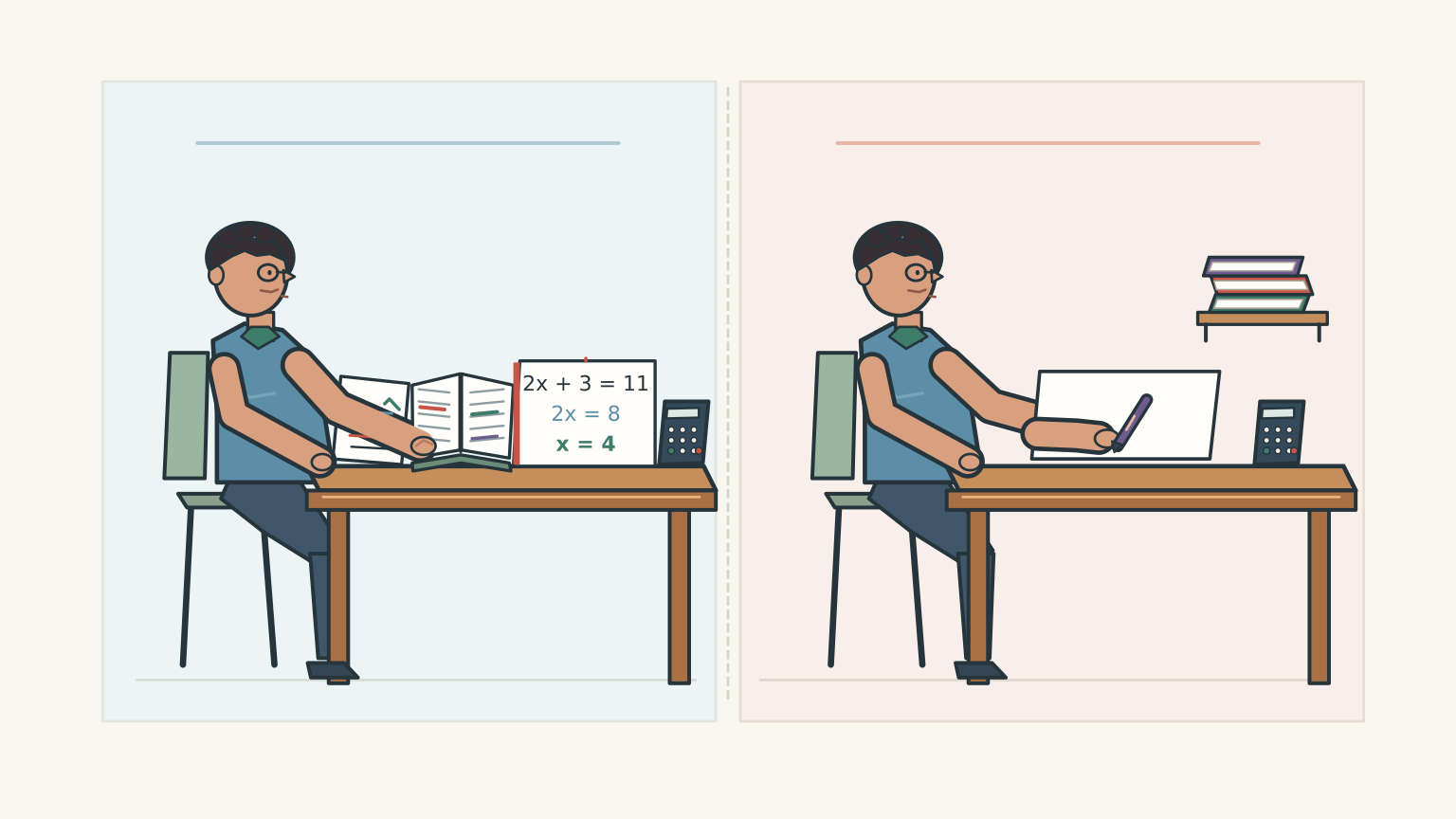
Think of open-book practice as learning to ride a bike with training wheels. You have some support while you develop the skills you need. You can check a method, revisit a definition, or look at a worked example when you get stuck.
Closed-book practice removes those supports. You have to remember the relevant information and work out what to do next without relying on your notes.
The analogy has one important limitation: removing every support is not necessarily the goal. Some HSC examinations provide official reference materials. You need to learn how to use those materials, too.
The two practice methods develop different abilities:
| Open-book practice | Closed-book practice |
|---|---|
| Builds understanding of unfamiliar concepts | Tests independent understanding |
| Helps you follow and develop methods | Tests whether you can reproduce methods |
| Allows immediate checking of information | Requires retrieval from memory |
| Helps identify and correct misconceptions | Reveals gaps in knowledge and reasoning |
| Supports learning new problem-solving techniques | Builds confidence with unfamiliar questions |
Neither method is automatically better. Their usefulness depends on what you are trying to achieve.
Due to technical limitations, this figure may display incorrectly or contain inaccuracies. Please check key details against your course materials.
Why closed-book practice is important
There is a difference between recognising an answer and being able to produce it.
Imagine reading a worked Mathematics Extension question. Every line makes sense. You understand why the student differentiated the function, substituted the boundary condition, and simplified the result.
Now cover the solution and try to reproduce the method.
Can you remember the first step? Can you explain why that step works? Can you complete the question without looking?
This is where closed-book practice becomes valuable.
It uses a process called retrieval practice. Retrieval practice means deliberately bringing information back from memory rather than simply looking at it again.
Research by Roediger and Karpicke found that testing yourself can improve longer-term retention compared with repeatedly studying the same material. The benefit is not limited to measuring what you know. The act of retrieving information also helps strengthen learning.
You can read more in their research paper, Test-Enhanced Learning: Taking Memory Tests Improves Long-Term Retention.
This is also why repeatedly reading your notes can be misleading. The material starts to look familiar, so you feel as though you know it. But familiarity does not guarantee that you can recall it independently.
02When should you use open-book practice?
Open-book practice is most useful when you are still developing your understanding of a topic.
For example, suppose you have just learnt how to solve equilibrium calculations in Chemistry. You understand the general idea, but you are not yet confident about setting up an equilibrium expression or organising your calculations.
Trying to complete ten questions without notes might not be particularly productive. You could spend most of your time repeating the same mistake.
Instead, use your notes as a learning tool.
How to use open-book practice properly
Follow this process:
Step 1: Attempt the question before looking at your notes.
Read the question and decide what information you need. Even if you are unsure, try to identify the relevant concept or first step.
Step 2: Consult your notes when you need specific information.
Find the relevant definition, equation, worked example, or explanation. Avoid reading the entire chapter again when you only need to check one idea.
Step 3: Understand why the method works.
Do not simply copy the solution.
Ask yourself why a particular equation applies, why a certain substitution is valid, or why a specific chemical expression has that form.
Step 4: Complete the question yourself.
Once you understand the next step, return to your own working. Keep the solution covered and finish the question independently.
Step 5: Try a similar question.
Use the same resources if necessary, but attempt a different question. This checks whether you can apply the method rather than simply reproduce the example.
Due to technical limitations, this figure may display incorrectly or contain inaccuracies. Please check key details against your course materials.
Worked scenario: Learning an equilibrium calculation in Chemistry
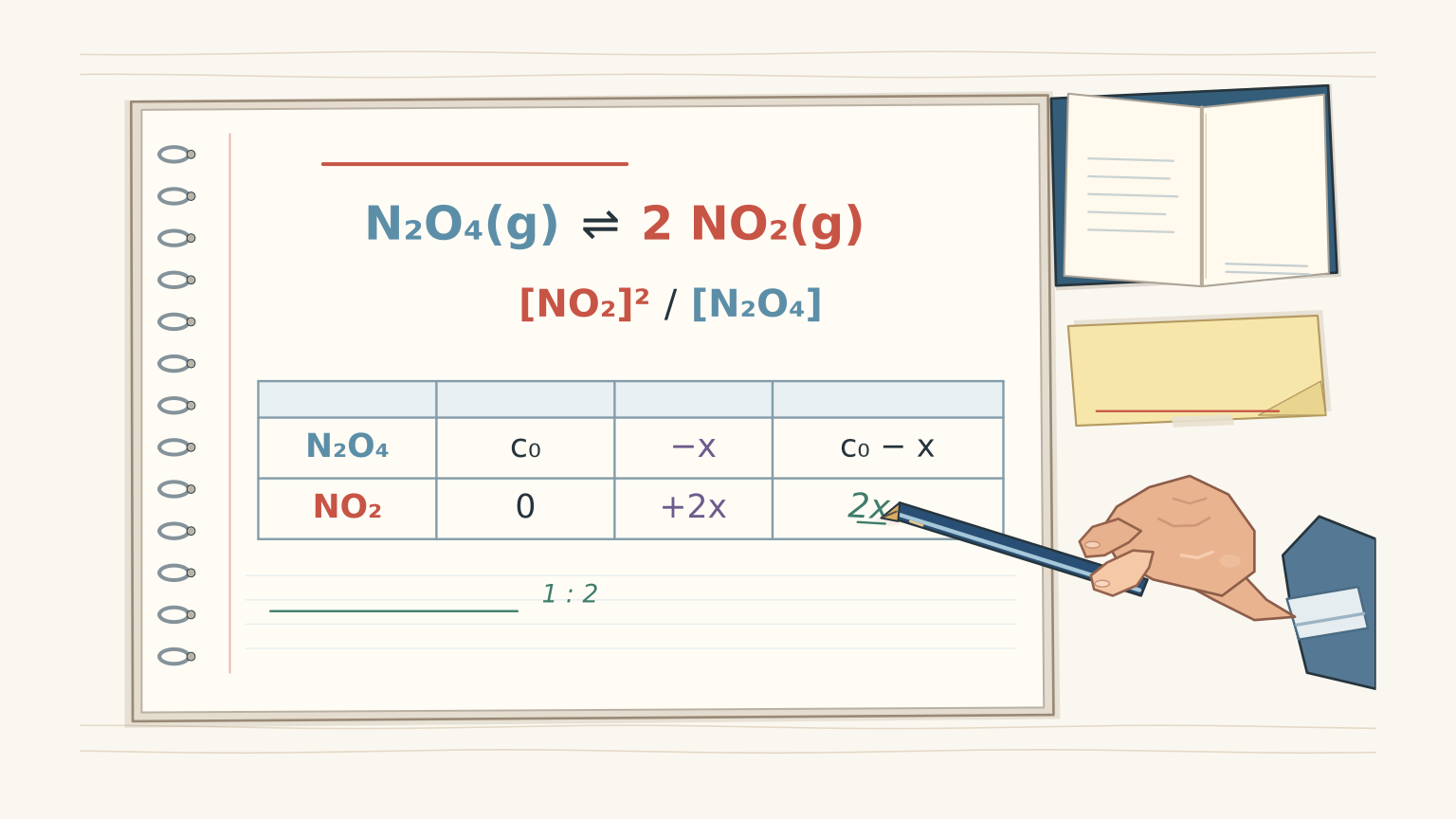
Imagine you are learning to calculate equilibrium concentrations using an ICE table.
You know that you need to consider the initial concentrations, the changes that occur as equilibrium is approached, and the final equilibrium concentrations. However, you are unsure how to construct the equilibrium expression.
An effective open-book session would look like this:
- Open your notes and find an example of an ICE table.
- Review the balanced chemical equation and identify the coefficients.
- Check how those coefficients determine the powers in the equilibrium expression.
- Attempt a new question using the same approach.
- Compare your working with the explanation and correct any mistakes.
The important part is understanding why the expression is constructed in that way.
Once you can explain the method, close your notes and attempt a different equilibrium calculation.
If you cannot set up the expression without help, return to your notes and identify the missing concept. Do not simply memorise the previous answer.
Open-book practice has done its job when you can gradually solve more of the problem without needing to consult your resources.
Open-book practice is particularly useful when:
- You have just learnt a new topic.
- You are unsure how to select the correct formula or method.
- You keep making the same conceptual mistake.
- You need to understand the reasoning behind a worked example.
- You are learning how different parts of a topic connect.
It is also useful when reviewing difficult questions after a practice paper. You can use your notes and textbook to understand exactly where your reasoning went wrong.
03When should you use closed-book practice?
Closed-book practice becomes increasingly important once you have developed a reasonable understanding of the material.
Its main purpose is to test whether you can retrieve and apply knowledge independently.
This is particularly important for HSC preparation. In an examination, you cannot pause to read through your class notes whenever you forget how to approach a question.
You need to recognise what the question is asking, select an appropriate method, and construct a response yourself.
How to use closed-book practice properly
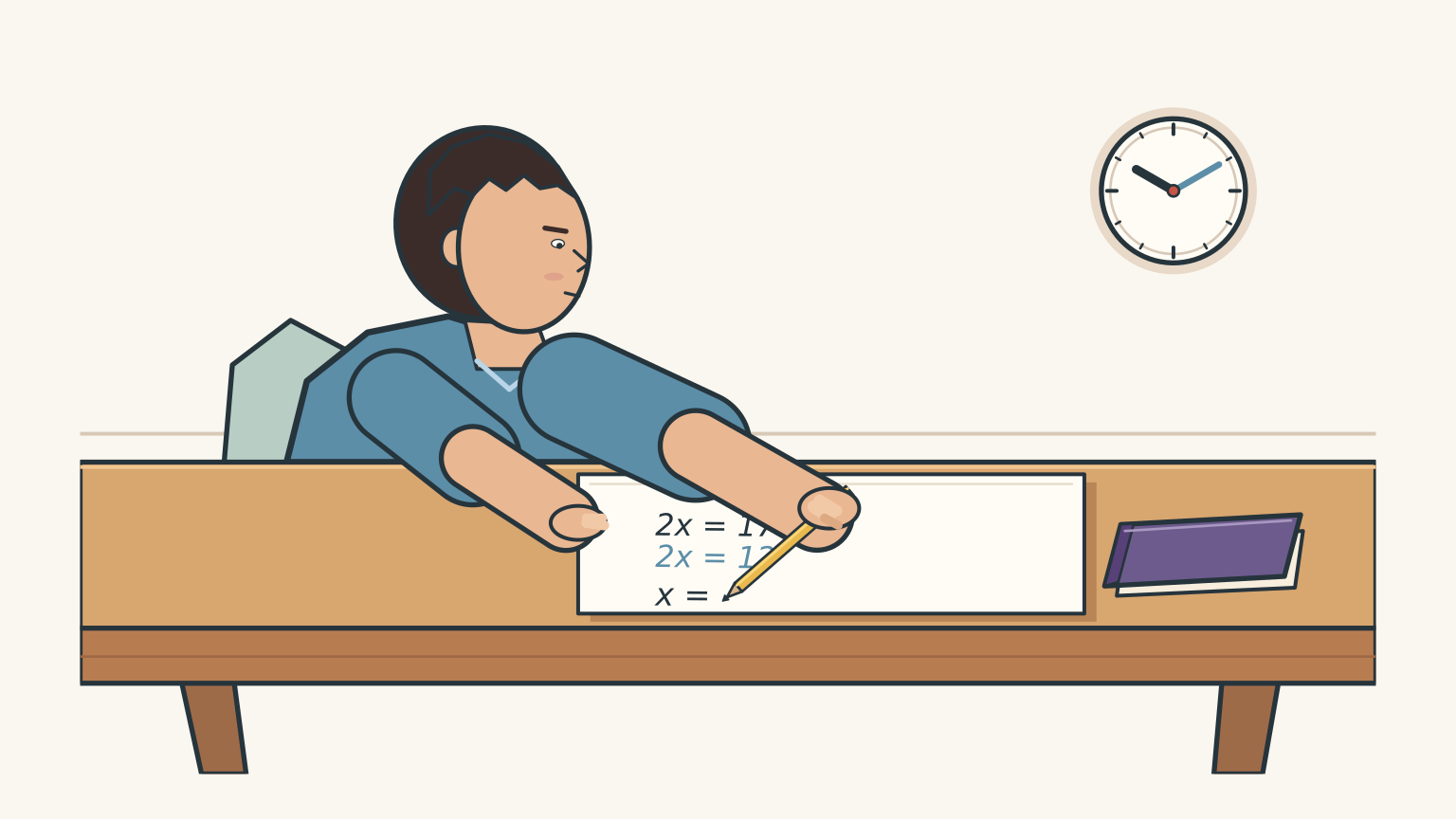
Step 1: Put away your personal notes and worked solutions.
Keep only the equipment and reference materials appropriate for the practice conditions.
Step 2: Attempt a fresh question.
Choose a question you have not already memorised. Try to recall the relevant information and construct your own solution.
Step 3: Resist the urge to check every step.
If you get stuck, give yourself a reasonable opportunity to work through the problem. You do not need to immediately open your textbook.
However, if you genuinely do not understand the underlying concept, there is little benefit in staring at a blank page indefinitely.
Step 4: Mark your work honestly.
Compare your response with the correct solution or marking guidelines. Identify exactly where your reasoning stopped working.
Step 5: Correct the mistake and try again.
Revisit your notes to understand the error. Then close them and attempt a new question that tests the same skill.
This final step is important. Reading the correct solution does not prove that you can produce it independently.
Due to technical limitations, this figure may display incorrectly or contain inaccuracies. Please check key details against your course materials.
Worked scenario: A Mathematics Extension proof
Suppose you are studying a proof technique in Mathematics Extension 1 or Extension 2.
You have worked through several examples with your textbook open. You understand the structure of the proofs and can follow the reasoning.
Now try a fresh proof question without looking at your notes.
You should be able to:
- Identify the relevant mathematical result or definition.
- Decide which proof technique is appropriate.
- Construct the argument in a logical order.
- Justify the important steps.
- Reach the required conclusion.
Suppose you can remember the general approach but cannot justify one of the intermediate steps.
That is useful information.
Open your textbook and identify the mathematical principle you have missed. Understand how it connects to the proof, then close the textbook and write the argument again.
The aim is not to memorise the exact proof. It is to develop the ability to construct a valid argument when the question changes.
What about Physics?
Physics provides another good example of why closed-book practice matters.
You might remember several equations from a topic but still struggle to choose the correct one when faced with an unfamiliar situation.
For example, knowing Newton’s second law does not automatically tell you how to analyse a system of connected objects.
You need to identify the forces, choose an appropriate system, apply the relevant physical principles, and interpret the result.
Closed-book practice helps you test whether you can make those decisions independently.
However, remember that an actual HSC Physics examination provides certain reference materials. Practising without your personal notes does not mean you should ignore the official formulae and data sheets when preparing for the examination.
04The best approach: Combine both methods
The biggest mistake is treating open-book and closed-book practice as competing strategies.
They work best as parts of the same learning process.
A useful sequence is:
- Learn: Use open-book practice to understand the concept and follow a worked example.
- Apply: Attempt a new question using your notes when necessary.
- Retrieve: Close your notes and solve another question independently.
- Review: Mark your work and use your resources to correct errors.
- Re-test: Return to the topic later and attempt a fresh question without personal notes.
This sequence gives you support when you need it and gradually increases the amount of independent work you can complete.
A practical 30-minute study session
Suppose you are revising a topic you have already learnt but do not feel completely confident with.
You could organise your session like this:
| Time | Activity | Purpose |
|---|---|---|
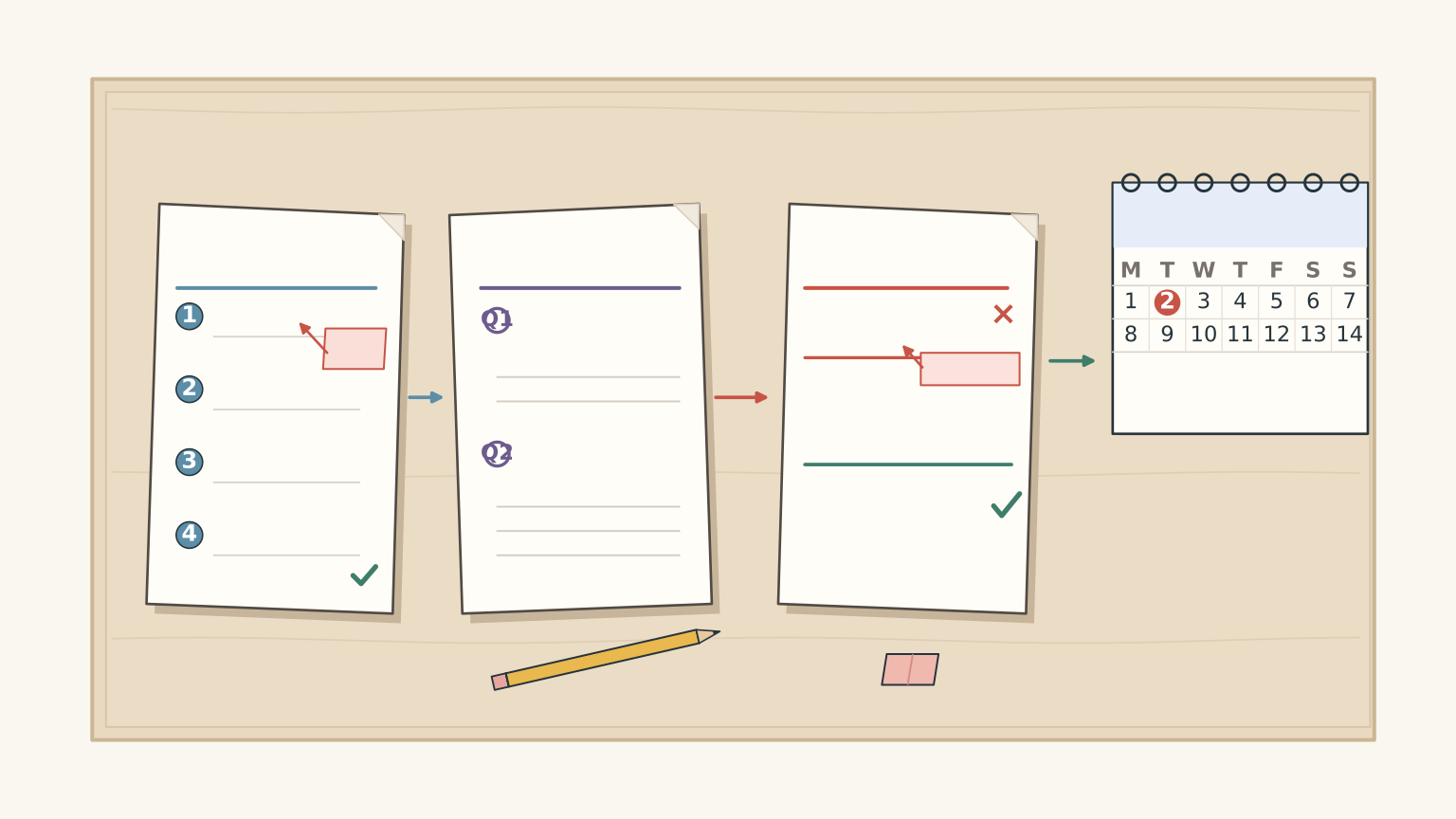
| 0-8 minutes | Attempt two questions without personal notes | Identify what you can recall |
| 8-15 minutes | Mark your answers and review notes | Understand mistakes |
| 15-25 minutes | Work through a similar question using targeted support | Repair gaps in understanding |
| 25-30 minutes | Close your notes and redo a difficult question | Check independent understanding |
The next day, attempt another question from the same topic without looking at your notes.
This last step introduces spaced practice: revisiting information after a gap rather than completing all your revision in one sitting.
Spacing and retrieval practice are both supported by the Australian Education Research Organisation’s guide to spacing and retrieval practice.
Due to technical limitations, this figure may display incorrectly or contain inaccuracies. Please check key details against your course materials.
05Open-book versus closed-book: Which should you choose?
Use the following guide when deciding how to approach your next study session.
| Your current situation | Best practice method |
|---|---|
| You have just learnt a new concept | Open-book, initially untimed |
| You understand the explanation but cannot reproduce the method | Closed-book attempt followed by open-book correction |
| You keep making the same conceptual mistake | Open-book review, followed by a fresh closed-book question |
| You can solve questions but struggle to remember important information | Closed-book retrieval practice |
| You can solve questions accurately but too slowly | Timed closed-book practice |
| You are preparing for an examination | Timed practice using the actual permitted exam materials |
One particularly important distinction is that closed-book practice does not have to be timed.
You can attempt a question without notes while taking as much time as you need to develop your reasoning.
Once you can complete questions accurately, introduce time limits gradually.
This allows you to separate two different problems:
- You do not know how to solve the question.
- You know how to solve it but cannot complete it efficiently.
Those problems require different solutions.
06What does this mean for actual HSC examinations?
There is an important distinction between choosing closed-book practice and following the actual HSC examination rules.
The NSW HSC written examinations are not open-book examinations in the usual sense.
According to NESA’s 2026 HSC Rules and Procedures, students cannot bring paper, printed material, or written material into the examination room. This includes personal notes and printed study sheets.
However, some examinations provide official reference materials as part of the examination paper.
For example:
- Physics: The examination specifications provide a data sheet, formulae sheet, and Periodic Table.
- Chemistry: The examination specifications also provide a data sheet, formulae sheet, and Periodic Table.
- Mathematics Extension 1: A reference sheet is provided.
- Mathematics Extension 2: A reference sheet is provided.
These are materials supplied for the examination. They are not permission to bring your own annotated formula sheets or textbook.
You can check the relevant information in NESA’s published 2026 HSC Rules and Procedures and its current course-specific examination specifications:
Be careful when choosing past papers. Different student cohorts are transitioning to new syllabuses at different times.
As at 15 November 2026, NESA’s implementation schedules identify the following first HSC examination years for the replacement syllabuses:
| Course | First HSC examination under replacement syllabus |
|---|---|
| Mathematics Extension 1 | 2027 |
| Mathematics Extension 2 | 2027 |
| Physics | 2028 |
| Chemistry | 2029 |
The distinction matters when selecting past papers and reference materials. Always match your practice resources to the syllabus your cohort is studying.
For school-based assessments, follow the specific conditions in your school’s assessment notification. An open-book school task does not mean that the external HSC examination has the same conditions.
07Questions and solutions
Question 1
A student consistently scores around 90% when completing Mathematics questions with their textbook open. However, when attempting similar questions without notes, their accuracy drops to approximately 50%.
Should they continue using open-book practice or switch entirely to closed-book practice?
Solution 1
They should use both methods, but focus on identifying and correcting the gaps revealed by closed-book practice.
The 90% result shows that the student can complete questions with access to support. It does not establish that they can independently recall the relevant methods or apply them to unfamiliar questions.
The 50% result provides a more useful indication of their current independent understanding.
They should examine their incorrect answers and identify the cause of each mistake.
For example:
- Did they forget an important equation?
- Did they misunderstand the question?
- Did they choose an inappropriate method?
- Did they understand the method but make an execution error?
They should then use their notes to correct the specific problem before attempting another question without assistance.
Switching entirely to closed-book practice would not necessarily help if the student still has significant gaps in their understanding.
Question 2
A student can solve most Mathematics Extension questions correctly without looking at their notes. However, they regularly take twice as long as the recommended examination time.
Should they return to open-book practice?
Solution 2
They should continue using closed-book practice but gradually introduce time limits.
Their main problem is no longer necessarily a lack of knowledge or understanding. They can already retrieve the relevant methods and apply them correctly.
The difficulty is completing the work efficiently.
They should begin by practising small groups of questions under reasonable time limits. As their accuracy and fluency improve, they can progress to longer timed sections and eventually full examination papers.
They should also examine where they are losing time.
For example, repeatedly reconsidering which formula to use suggests a method-selection problem. Spending too long simplifying an expression may indicate that their algebraic fluency needs improvement.
Opening their notes during every practice question is unlikely to address these difficulties.
They need to practise making decisions and carrying out familiar methods independently.
08The best way to prepare for the HSC
Open-book practice helps you learn how to solve a problem. Closed-book practice checks whether you can solve it independently.
Neither should disappear from your study routine.
A sensible progression is to begin with supported learning, move towards independent attempts, and eventually introduce realistic examination time limits.
Once you can complete unfamiliar questions accurately without personal notes, your next challenge is applying those skills across a full examination paper.
That means practising question selection, time management, and checking your work under pressure.
For the next stage of your preparation, see How to Stop Running Out of Time in HSC Exams and How to Check an HSC Exam Paper in the Final Ten Minutes.
The goal is not simply to become comfortable studying with your notes closed. It is to become capable of using your knowledge independently, including when an examination question looks different from anything you have practised before.