
聲音強度與距離:HSC 物理中的平方反比定律
了解聲音強度為甚麼會隨距離增加而減少、幾何擴散如何產生平方反比關係,以及這個模型在甚麼情況下適用。
Translate this verified tutorgum resource into Traditional Chinese (zh-hant).
Requirements:
- Preserve meaning, equations, Markdown structure, links and factual qualifications.
- Keep “tutorgum” lowercase and untranslated.
- Do not add facts, remove caveats, or translate URLs.
- Use language natural to an educated senior-secondary student.
- Equations may contain English explanatory text. Translate that text naturally while preserving valid LaTeX and the mathematical meaning.
- Preserve every equation, URL, heading, table and list. Do not reorder or shorten the article.
- Preserve every standalone
[IMAGE: ...]instruction exactly as written in English, including its position. Do not translate, remove or rewrite these instructions; they are hidden production markers and will not be shown to readers. - Return the complete article, not a summary or shortened adaptation.
Return only the complete translated Markdown article body. Do not return JSON, metadata, commentary, or a fenced code block.
Use \(…\) for inline mathematics and […] for display mathematics, never dollar-sign delimiters. Write LaTeX normally with one backslash. The Markdown is not inside JSON. Do not use raw HTML or an H1 heading.
ENGLISH TITLE: Sound Intensity and Distance: Inverse-Square Law for HSC Physics
ENGLISH EXCERPT: Learn why sound intensity decreases with distance, how geometric spreading produces the inverse-square relationship, and when that model applies.
VERIFIED ENGLISH MARKDOWN:
Stand 1 m from a small speaker, then move to 2 m away. The sound intensity falls, but by how much?
A tempting prediction is “half”, because you’ve doubled the distance. For an ideal point source spreading sound equally in all directions, that prediction is wrong. At twice the distance, the intensity is only one quarter as large.
The reason isn’t that the source suddenly loses three quarters of its power. The same sound power has to spread across a much larger area.
01Picture the sound spreading out
Imagine a tiny sound source floating in a huge open space. It sends sound equally in every direction.
A moment after a vibration leaves the source, the disturbance has reached points on a small sphere around it. Later, it reaches a larger sphere.
The sound energy is spreading over the surface of each sphere.
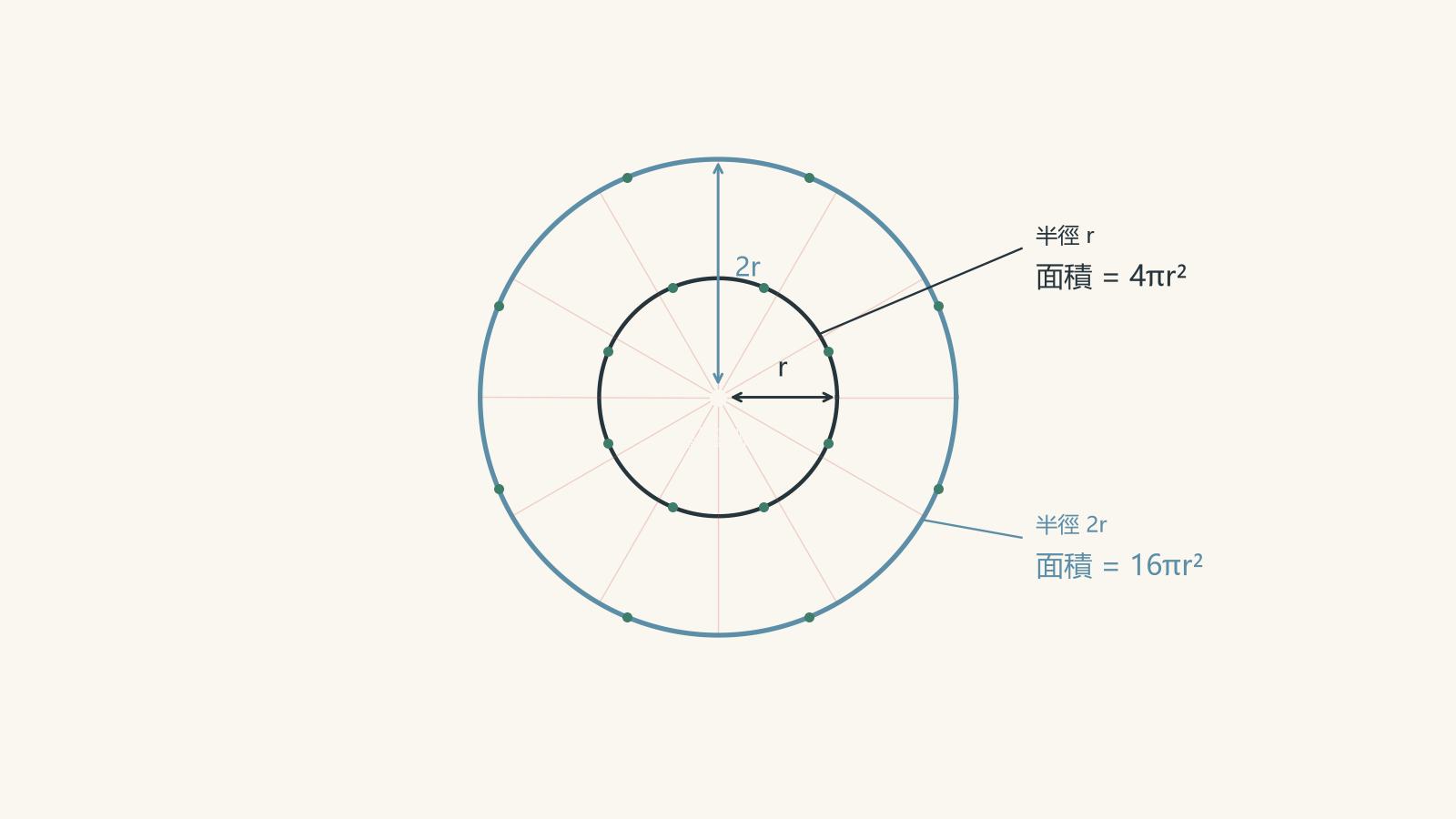
A useful mental model is paint spread over an expanding balloon. Suppose the same amount of paint somehow has to cover the balloon’s entire surface as it inflates. As the balloon gets larger, the paint layer becomes thinner.
For sound, power plays the role of the amount of paint, and the spherical surface area tells us how widely that power has been spread.
The analogy isn’t exact. Sound isn’t a coating sitting on a surface. Energy is continuously travelling through space. But the balloon picture gets the geometry right.
02What intensity actually measures
Sound intensity, \(I\), tells us how much sound power passes through each square metre.
In general,
\[
I = \frac{P}{A}
\]
where:
- \(I\) is intensity in watts per square metre, \(\text{W m}^{-2}\)
- \(P\) is sound power in watts, \(\text{W}\)
- \(A\) is the area through which that power is passing, in square metres, \(\text{m}^2\)
This is worth separating from everyday words like “loudness”.
Intensity is a physical quantity. It measures power per unit area.
How loud a sound seems depends on human hearing as well, so perceived loudness and physical intensity are not the same thing.
03Where the inverse-square relationship comes from
For an ideal point source radiating equally in every direction, the sound passes through a sphere of radius \(r\).
The surface area of a sphere is
\[
A = 4\pi r^2
\]
so the intensity is
\[
I = \frac{P}{4\pi r^2}
\]
This is the inverse-square relationship.
The important part is
\[
I \propto \frac{1}{r^2}
\]
provided the sound power \(P\) stays constant and the sound spreads spherically.
The phrase inverse square means that intensity depends on the reciprocal of the square of distance.
If distance doubles,
\[
I \propto \frac{1}{2^2} = \frac{1}{4}
\]
If distance triples,
\[
I \propto \frac{1}{3^2} = \frac{1}{9}
\]
If distance becomes four times greater,
\[
I \propto \frac{1}{4^2} = \frac{1}{16}
\]
So the intensity falls much faster than \(1/r\).
Why does doubling distance give four times the area?
Take a sphere at distance \(r\):
\[
A_1 = 4\pi r^2
\]
Now double the radius to \(2r\):
\[
A_2 = 4\pi(2r)^2 = 16\pi r^2
\]
Compare the areas:
\[
\frac{A_2}{A_1}
= \frac{16\pi r^2}{4\pi r^2}
= 4
\]
The same power is now spread over four times the area, so the power per square metre becomes one quarter as large.
That’s the whole geometric reason for the inverse square.
04A quicker comparison equation
Often, you don’t know the sound power and don’t need it.
Suppose the intensity is \(I_1\) at distance \(r_1\), then \(I_2\) at distance \(r_2\).
For spherical spreading,
\[
I_1 = \frac{P}{4\pi r_1^2}
\]
and
\[
I_2 = \frac{P}{4\pi r_2^2}
\]
Taking the ratio cancels \(P\) and \(4\pi\):
\[
\frac{I_2}{I_1}
=
\frac{r_1^2}{r_2^2}
\]
or
\[
\frac{I_2}{I_1}
=
\left(\frac{r_1}{r_2}\right)^2
\]
This form is usually the fastest way to compare intensities at two distances.
Worked example: Find the intensity from a point source
A small sound source produces \(3.0\ \text{W}\) of acoustic power and radiates uniformly in all directions. Calculate the sound intensity \(2.0\ \text{m}\) from the source.
步驟 1
\[
I = \frac{P}{4\pi r^2}
\]
Here, \(P = 3.0\ \text{W}\) and \(r = 2.0\ \text{m}\).
步驟 2
\[
I
=
\frac{3.0}{4\pi(2.0)^2}
=
\frac{3.0}{16\pi}
\]
步驟 3
\[
I = 5.97\times10^{-2}\ \text{W m}^{-2}
\]
To two significant figures,
\[
\boxed{I = 6.0\times10^{-2}\ \text{W m}^{-2}}
\]
At a distance of \(2.0\ \text{m}\), each square metre receives about \(0.060\ \text{W}\) of sound power under the ideal spherical-spreading model.
05The most common mistake: treating distance as a simple inverse
A student sees the source move from 3 m away to 6 m away and thinks:
The distance doubled, so the intensity halves.
That would be correct if \(I\) were proportional to \(1/r\).
It isn’t.
For a point source,
\[
I \propto \frac{1}{r^2}
\]
so
\[
\frac{I_2}{I_1}
=
\left(\frac{3}{6}\right)^2
=
\left(\frac{1}{2}\right)^2
=
\frac{1}{4}
\]
The intensity becomes one quarter of its original value.
A useful habit is to ask: what happened to the area?
If the distance doubled, the radius of the imaginary sphere doubled. Its area increased by \(2^2 = 4\), so the intensity fell by a factor of 4.
Worked example: Predict the intensity at a new distance
A microphone measures a sound intensity of \(2.4\times10^{-4}\ \text{W m}^{-2}\) at a distance of \(5.0\ \text{m}\) from a small source. Assume spherical spreading and negligible absorption. What intensity should it measure at \(12\ \text{m}\)?
步驟 1
\[
\frac{I_2}{I_1}
=
\left(\frac{r_1}{r_2}\right)^2
\]
Here,
\[
I_1 = 2.4\times10^{-4}\ \text{W m}^{-2},\quad
r_1 = 5.0\ \text{m},\quad
r_2 = 12\ \text{m}
\]
步驟 2
\[
I_2
=
I_1\left(\frac{r_1}{r_2}\right)^2
\]
步驟 3
\[
I_2
=
(2.4\times10^{-4})
\left(\frac{5.0}{12}\right)^2
\]
\[
I_2
=
(2.4\times10^{-4})(0.1736)
=
4.17\times10^{-5}\ \text{W m}^{-2}
\]
To two significant figures,
\[
\boxed{I_2 = 4.2\times10^{-5}\ \text{W m}^{-2}}
\]
Moving from \(5.0\ \text{m}\) to \(12\ \text{m}\) reduces the intensity to about \(17\%\) of its original value.
Notice that the distance increased by a factor of \(12/5 = 2.4\), while the intensity fell by a factor of \(2.4^2 = 5.76\).
06When the inverse-square law is actually appropriate
The equation
\[
I = \frac{P}{4\pi r^2}
\]
looks exact, but it describes an idealised situation.
It works well when the source can reasonably be treated as a point source, and its sound energy spreads approximately equally through three-dimensional space.
Several assumptions are hiding inside the model:
| Assumption | Why it matters |
|---|---|
| The source behaves approximately like a point | The wavefronts can then become approximately spherical |
| The source power stays constant | Otherwise intensity could change because the source itself changed |
| Sound spreads freely in three dimensions | This gives the spherical area \(4\pi r^2\) |
| Absorption is negligible | Real air can remove some sound energy as it travels |
| Reflections are unimportant | Walls, floors, and other surfaces can redirect sound towards the detector |
| The source is not strongly directional | A directional source does not send equal power in every direction |
This means the inverse-square law is a model for geometric spreading, not a promise that every real sound measurement must follow \(1/r^2\) perfectly.
A room is not empty space
Imagine measuring a speaker in a furnished room.
The microphone receives sound directly from the speaker, but it can also receive sound reflected from walls, the floor, and the ceiling. At larger distances, those reflected contributions can become significant.
So if the measured intensity fails to fall by exactly a factor of four when the distance doubles, that doesn’t automatically mean the inverse-square reasoning was wrong. It may mean the physical situation doesn’t satisfy the model’s assumptions.
07Point source does not mean “literally a point”
No real speaker has zero size.
Calling something a point source means its physical dimensions are small enough, compared with the distances being considered, that treating all of its sound as coming from one position is a useful approximation.
Suppose a large speaker array is 3 m tall. Measuring only 1 m away from it is very different from measuring hundreds of metres away. Up close, different parts of the array are at noticeably different distances from the microphone, and the wavefront may not resemble a sphere centred on one point.
Far enough away, the entire array may behave much more like one compact source.
So before using \(I\propto1/r^2\), ask a physical question before an algebraic one:
Is spherical spreading a sensible model here?
08Intensity is not the same as wave amplitude
There is another tempting mix-up.
For a spherical wave, some wave amplitudes decrease approximately as
\[
\frac{1}{r}
\]
while intensity decreases as
\[
\frac{1}{r^2}
\]
That is not a contradiction.
Intensity is related to the square of the wave amplitude. In a simplified sound-wave model,
\[
I \propto A^2
\]
where \(A\) represents a suitable measure of amplitude.
So if amplitude falls approximately as \(1/r\),
\[
I \propto
\left(\frac{1}{r}\right)^2
=
\frac{1}{r^2}
\]
This distinction becomes important whenever a question switches between amplitude and energy transfer.
09Questions and solutions
Question 1
A small sound source radiates uniformly in open space. A detector is moved from \(4.0\ \text{m}\) to \(8.0\ \text{m}\) from the source. What happens to the sound intensity?
Solution 1
The intensity becomes one quarter of its original value.
For spherical spreading,
\[
I \propto \frac{1}{r^2}
\]
so
\[
\frac{I_2}{I_1}
=
\left(\frac{r_1}{r_2}\right)^2
=
\left(\frac{4.0}{8.0}\right)^2
=
\frac{1}{4}
\]
Therefore,
\[
\boxed{I_2 = 0.25I_1}
\]
The common trap is to say that doubling the distance halves the intensity. That ignores the fact that the spherical area grows with \(r^2\), not \(r\).
Question 2
At \(6.0\ \text{m}\) from a point source, the sound intensity is \(7.5\times10^{-5}\ \text{W m}^{-2}\). At what distance would the intensity be \(1.2\times10^{-5}\ \text{W m}^{-2}\), assuming ideal spherical spreading?
Solution 2
The required distance is approximately \(15\ \text{m}\).
Start with
\[
\frac{I_2}{I_1}
=
\left(\frac{r_1}{r_2}\right)^2
\]
Substitute the known quantities:
\[
\frac{1.2\times10^{-5}}{7.5\times10^{-5}}
=
\left(\frac{6.0}{r_2}\right)^2
\]
The intensity ratio is
\[
0.16
=
\left(\frac{6.0}{r_2}\right)^2
\]
Take the square root:
\[
0.40 = \frac{6.0}{r_2}
\]
so
\[
r_2 = \frac{6.0}{0.40}
= 15\ \text{m}
\]
Therefore,
\[
\boxed{r_2 = 15\ \text{m}}
\]
The intensity has fallen to \(16\%\) of its original value. Because \(0.16 = 0.4^2\), the new distance must be \(1/0.4 = 2.5\) times farther from the source.
Question 3
A source produces an intensity of \(1.2\times10^{-3}\ \text{W m}^{-2}\) at \(2.0\ \text{m}\). A student predicts that the intensity at \(4.0\ \text{m}\) will be \(3.0\times10^{-4}\ \text{W m}^{-2}\).
The measured intensity is instead \(4.0\times10^{-4}\ \text{W m}^{-2}\).
Does this measurement show that geometric spreading is incorrect? Explain one physical reason for the difference.
Solution 3
No. The result shows that the real situation does not perfectly match the assumptions of the simple inverse-square model.
The student’s ideal prediction is correct:
\[
I_2
=
I_1
\left(\frac{r_1}{r_2}\right)^2
\]
\[
I_2
=
(1.2\times10^{-3})
\left(\frac{2.0}{4.0}\right)^2
\]
\[
I_2
=
(1.2\times10^{-3})(0.25)
=
3.0\times10^{-4}\ \text{W m}^{-2}
\]
However, the measured value is larger:
\[
4.0\times10^{-4}\ \text{W m}^{-2}
\]
One possible explanation is reflection. If the experiment occurs near walls or other surfaces, the detector can receive reflected sound as well as sound travelling directly from the source.
Other possible explanations include directional emission, background sound, measurement uncertainty, or the source not behaving like an ideal point source.
The trap is treating the inverse-square equation as a rule that every measurement must obey. It applies when its physical assumptions are reasonable.
Question 4
A sound source normally emits acoustic power \(P\). Its power is reduced to \(0.80P\), while a detector is moved from distance \(r\) to \(0.90r\).
Assuming spherical spreading, is the final intensity greater than, less than, or approximately equal to the original intensity? Calculate the ratio.
Solution 4
The final intensity is slightly less than the original intensity, with \(I_2/I_1 \approx 0.99\).
Both power and distance have changed, so we must keep both factors in the intensity equation:
\[
I = \frac{P}{4\pi r^2}
\]
Initially,
\[
I_1 = \frac{P}{4\pi r^2}
\]
Finally,
\[
I_2
=
\frac{0.80P}{4\pi(0.90r)^2}
\]
Take the ratio:
\[
\frac{I_2}{I_1}
=
\frac{0.80P}{4\pi(0.90r)^2}
\cdot
\frac{4\pi r^2}{P}
\]
\[
\frac{I_2}{I_1}
=
\frac{0.80}{0.90^2}
=
\frac{0.80}{0.81}
=
0.988
\]
Therefore,
\[
\boxed{\frac{I_2}{I_1}\approx0.99}
\]
The intensity is about \(1.2\%\) lower than before, so it is very nearly unchanged.
This is a useful reminder that moving closer increases intensity, but a simultaneous decrease in source power can offset that effect. Looking only at the distance would give the wrong conclusion.
Question 5
A student places a microphone \(1.0\ \text{m}\) from the centre of a large loudspeaker array that is \(4.0\ \text{m}\) wide. They measure intensity \(I\).
They then argue that moving the microphone to \(2.0\ \text{m}\) must produce an intensity of exactly \(I/4\).
Identify the hidden assumption in the student’s argument and explain why the conclusion is not guaranteed.
Solution 5
The hidden assumption is that the loudspeaker array can be treated as a point source producing approximately spherical wavefronts over those distances. That assumption may not be valid.
The inverse-square prediction would be
\[
\frac{I_2}{I_1}
=
\left(\frac{1.0}{2.0}\right)^2
=
\frac{1}{4}
\]
but that equation assumes spherical spreading from an effectively point-like source.
Here, the source is \(4.0\ \text{m}\) wide, while the microphone is only \(1.0\ \text{m}\) or \(2.0\ \text{m}\) away. Different parts of the array are therefore at substantially different distances from the microphone. Treating the whole array as one point is a poor approximation.
The microphone may also be in a region where the sound field has a more complicated spatial pattern.
Therefore,
\[
\boxed{I_2 \text{ is not guaranteed to equal } I/4}
\]
The difficult part of this question is not calculating the inverse square. It is noticing that the inverse-square model must be justified before it is used.
10What this idea lets you do next
Geometric spreading gives you a way to connect energy transfer, wave amplitude, and distance.
The key chain is:
\[
\text{greater distance}
\rightarrow
\text{larger spherical area}
\rightarrow
\text{less power per unit area}
\rightarrow
\text{lower intensity}
\]
For an ideal point source,
\[
\boxed{I = \frac{P}{4\pi r^2}}
\]
and therefore
\[
\boxed{I\propto\frac{1}{r^2}}
\]
The next useful step is to connect this physical intensity to the decibel scale. That introduces a logarithmic way of describing intensity ratios, which explains why a large change in physical intensity does not correspond to an equally large numerical change in sound level.