
Coulomb’s Law for HSC Physics: Force and Direction
Learn how to calculate electrostatic force between point charges, determine its direction, and combine multiple forces using vector reasoning.
Two tiny charged objects are held 20 cm apart. You double the charge on one object, but at the same time double the distance between them. Does the electric force get bigger, smaller, or stay the same?
A tempting guess is “the changes cancel”. They don’t. Charge and distance affect electric force in different ways. The force is directly proportional to charge, but it follows an inverse-square relationship with distance. Doubling one charge multiplies the force by 2, while doubling the distance divides it by \(2^2 = 4\). The final force is therefore half as large.
That relationship is Coulomb’s law. The calculation itself is usually straightforward. The harder HSC skill is knowing what the number means: which way does the force point, which signs belong in the calculation, and what changes when more than two charges are present?
01Start with the physical picture
Imagine two small charged spheres far enough apart that we can treat each sphere as though all its charge were concentrated at one point.
There are only two possibilities:
- charges with the same sign repel
- charges with opposite signs attract
So two positive charges push apart. Two negative charges also push apart. A positive and a negative charge pull towards each other.
Before doing any mathematics, predict the direction.
Suppose a positive charge sits on the left and a negative charge sits on the right.
Which way is the force on the positive charge?
Towards the negative charge, so to the right.
Which way is the force on the negative charge?
Towards the positive charge, so to the left.
The forces point in opposite directions, but they have equal magnitudes. This is consistent with Newton’s third law.
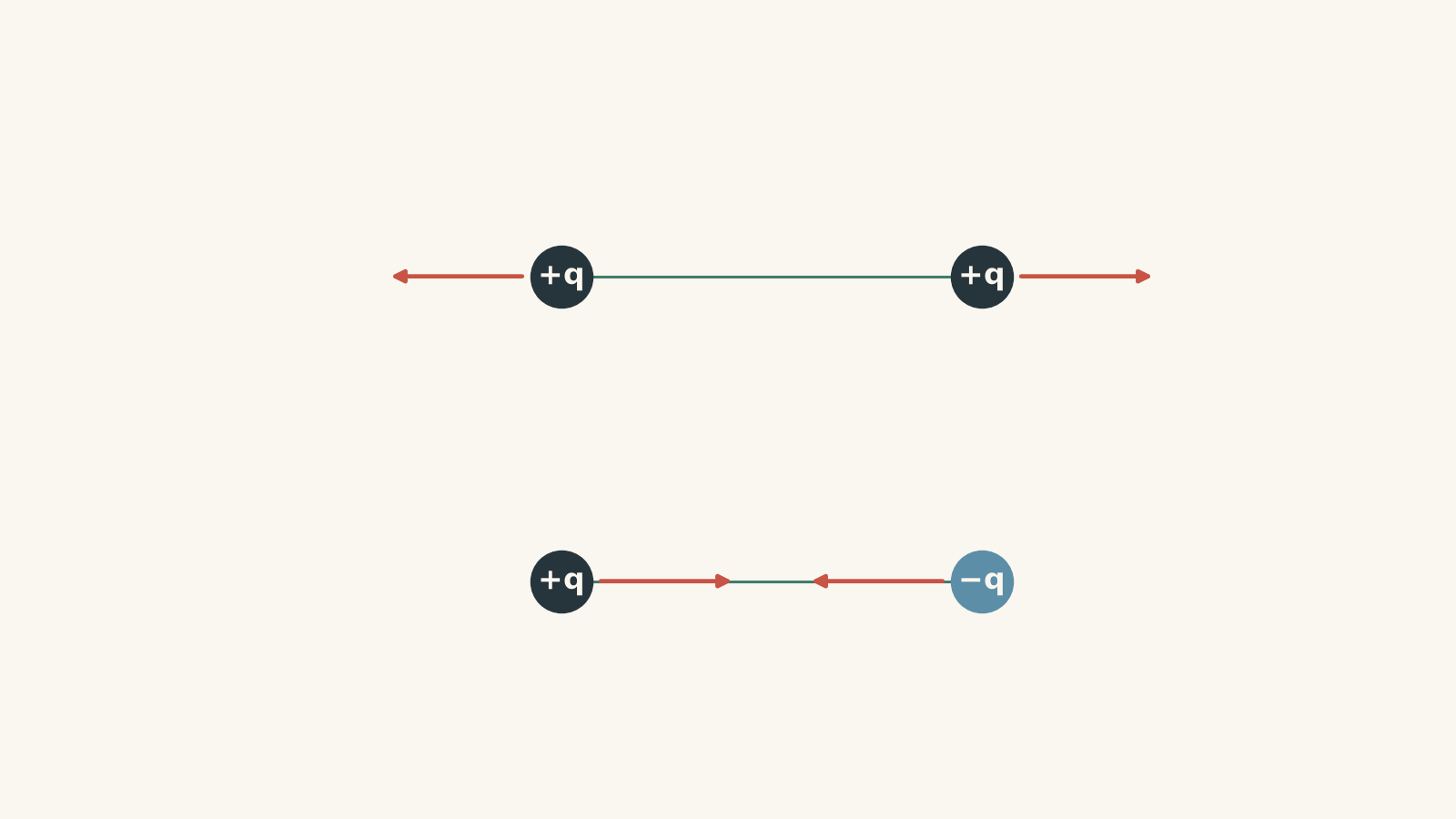
This first picture assumes the charges behave like point charges. Real charged objects have size. Coulomb’s law in its simple form applies exactly to point charges and can also be used for spherically symmetric charge distributions when the separation is measured between their centres.
02What controls the size of the force?
Three things matter:
- the magnitude of the first charge
- the magnitude of the second charge
- the distance between them
If either charge becomes larger, the force becomes larger.
If the charges move further apart, the force becomes smaller.
But distance has the stronger relationship because it is squared.
For example:
| Change | Effect on force magnitude |
|---|---|
| Double \(q_1\) | force becomes \(2F\) |
| Triple \(q_2\) | force becomes \(3F\) |
| Double both charges | force becomes \(4F\) |
| Double distance | force becomes \(F/4\) |
| Triple distance | force becomes \(F/9\) |
| Halve distance | force becomes \(4F\) |
This inverse-square behaviour is worth understanding rather than memorising as a strange rule.
If two charges are twice as far apart, their electric interaction is spread over a geometrically larger region. The result is not a simple halving of the force. The force drops by a factor of four.
03Coulomb’s law
The magnitude of the electrostatic force between two point charges is
\[ F = k\frac{|q_1q_2|}{r^2} \]
where:
- \(F\) is the magnitude of the electrostatic force, measured in newtons (N)
- \(q_1\) and \(q_2\) are the charges, measured in coulombs (C)
- \(r\) is the separation between the charges, measured in metres (m)
- \(k\) is Coulomb’s constant
For charges in a vacuum, and approximately in air,
\[ k = 8.99\times10^9\ \text{N m}^2\text{C}^{-2} \]
The absolute-value signs around \(q_1q_2\) are there because this version of the equation calculates a magnitude. Magnitude cannot be negative.
The signs of the charges are still important, but they are used to determine the direction of the force.
That separation of jobs is useful:
- magnitudes go into Coulomb’s law
- charge signs tell you whether the force is attractive or repulsive
- your diagram or coordinate system tells you whether that direction is positive or negative
04The unit conversion trap
Charges in HSC questions are rarely written as several whole coulombs. One coulomb is a very large amount of charge on the scale of small objects.
You will often see:
\[ 1\ \text{mC} = 1\times10^{-3}\ \text{C} \]
\[ 1\ \mu\text{C} = 1\times10^{-6}\ \text{C} \]
\[ 1\ \text{nC} = 1\times10^{-9}\ \text{C} \]
You must also convert centimetres to metres before using Coulomb’s law.
For example,
\[ 25\ \text{cm} = 0.25\ \text{m} \]
A common mistake is to substitute \(25\) into \(r^2\). That would tell the equation that the charges are 25 metres apart.
05Worked example: Force between two positive charges
Two point charges of \(+3.0\ \mu\text{C}\) and \(+5.0\ \mu\text{C}\) are separated by \(0.40\ \text{m}\). Calculate the magnitude and direction of the electrostatic force on each charge.
Step 1
Both charges are positive, so they repel.
Each charge experiences a force directed away from the other charge.
Step 2
\[ q_1 = 3.0\times10^{-6}\ \text{C} \]
\[ q_2 = 5.0\times10^{-6}\ \text{C} \]
The separation is already in metres:
\[ r = 0.40\ \text{m} \]
Step 3
\[ \begin{aligned} F &= k\frac{|q_1q_2|}{r^2} \\ &= (8.99\times10^9) \frac{(3.0\times10^{-6})(5.0\times10^{-6})}{(0.40)^2} \\ &= 0.843\ \text{N} \end{aligned} \]
To two significant figures,
\[ F = 0.84\ \text{N} \]
Step 4
Each charge experiences a \(0.84\ \text{N}\) force directed away from the other charge.
If the \(+3.0\ \mu\text{C}\) charge is on the left and the \(+5.0\ \mu\text{C}\) charge is on the right, the force on the left charge is leftwards and the force on the right charge is rightwards.
The forces are equal in magnitude and opposite in direction.
06Why you should not use a negative force to mean attraction
Suppose you substitute the signed values \(q_1 = +3.0\ \mu\text{C}\) and \(q_2 = -5.0\ \mu\text{C}\) directly into
\[ F = k\frac{q_1q_2}{r^2} \]
You would obtain a negative number.
It is tempting to say, “negative force means attraction”.
That shortcut is unreliable.
A negative vector component means the force points in the negative direction of your chosen coordinate axis. Attraction is not automatically left, right, positive, or negative. It depends on where the other charge is located.
For example, imagine a positive test charge.
- If a negative charge is to its right, attraction produces a rightward force.
- If the same negative charge is moved to its left, attraction produces a leftward force.
The interaction is attractive in both cases, but the coordinate sign changes.
For most one-dimensional HSC calculations, a safer method is:
- use charge magnitudes in Coulomb’s law
- decide attraction or repulsion
- determine the physical direction
- apply a positive or negative sign only after choosing your axis
07Direction is part of the answer
Suppose two charges lie on an \(x\)-axis.
You decide that right is positive.
Then:
- a force to the right has a positive \(x\)-component
- a force to the left has a negative \(x\)-component
The choice of positive direction is arbitrary. Physics does not prefer right over left.
Think of the sign like choosing which end of a hallway gets called “positive”. The hallway does not change when you swap the labels. Only the numbers you use to describe positions and directions change.
This analogy has a limit. Electric attraction and repulsion are physical interactions, while positive and negative coordinate directions are just bookkeeping choices.
08Worked example: Finding a signed force component
A \(+2.0\ \mu\text{C}\) charge is at \(x = 0\). A \(-6.0\ \mu\text{C}\) charge is at \(x = 0.30\ \text{m}\). Take right as the positive \(x\)-direction. Calculate the force on the \(+2.0\ \mu\text{C}\) charge.
Step 1
The charges have opposite signs, so they attract.
The negative charge is to the right of the positive charge. Therefore, the positive charge is pulled to the right.
So the force on the positive charge will have a positive \(x\)-component.
Step 2
\[ |q_1| = 2.0\times10^{-6}\ \text{C} \]
\[ |q_2| = 6.0\times10^{-6}\ \text{C} \]
and
\[ r = 0.30\ \text{m} \]
Step 3
\[ \begin{aligned} F &= k\frac{|q_1q_2|}{r^2} \\ &= (8.99\times10^9) \frac{(2.0\times10^{-6})(6.0\times10^{-6})}{(0.30)^2} \\ &= 1.20\ \text{N} \end{aligned} \]
Step 4
Right is positive, so
\[ F_x = +1.20\ \text{N} \]
The \(+2.0\ \mu\text{C}\) charge experiences a \(1.20\ \text{N}\) force towards the negative charge.
Notice what produced the plus sign. It was not the signs multiplying to something positive. In fact, the charges have opposite signs. The plus sign comes from the force pointing in the chosen positive \(x\)-direction.
09What happens when more than one charge acts?
Coulomb’s law gives the force caused by one charge on another charge.
If a charge is affected by several other charges, calculate each force separately and then add the forces as vectors.
This is the principle of superposition.
For a charge experiencing forces \(\vec F_1\), \(\vec F_2\), and \(\vec F_3\),
\[ \vec F_{\text{net}} = \vec F_1 + \vec F_2 + \vec F_3 \]
Do not add force magnitudes automatically. Direction matters.
Imagine standing between two people who are both trying to pull you towards themselves. Saying “one pulls with 80 N and the other with 60 N, so the total is 140 N” ignores the awkward detail that they are pulling in opposite directions. Your net force is 20 N towards the stronger pull.
Electric forces work the same way when they lie along one line.
The analogy breaks when the forces are not collinear. Then you must add genuine two-dimensional vectors rather than simply subtracting magnitudes.
10Worked example: Net force from two other charges
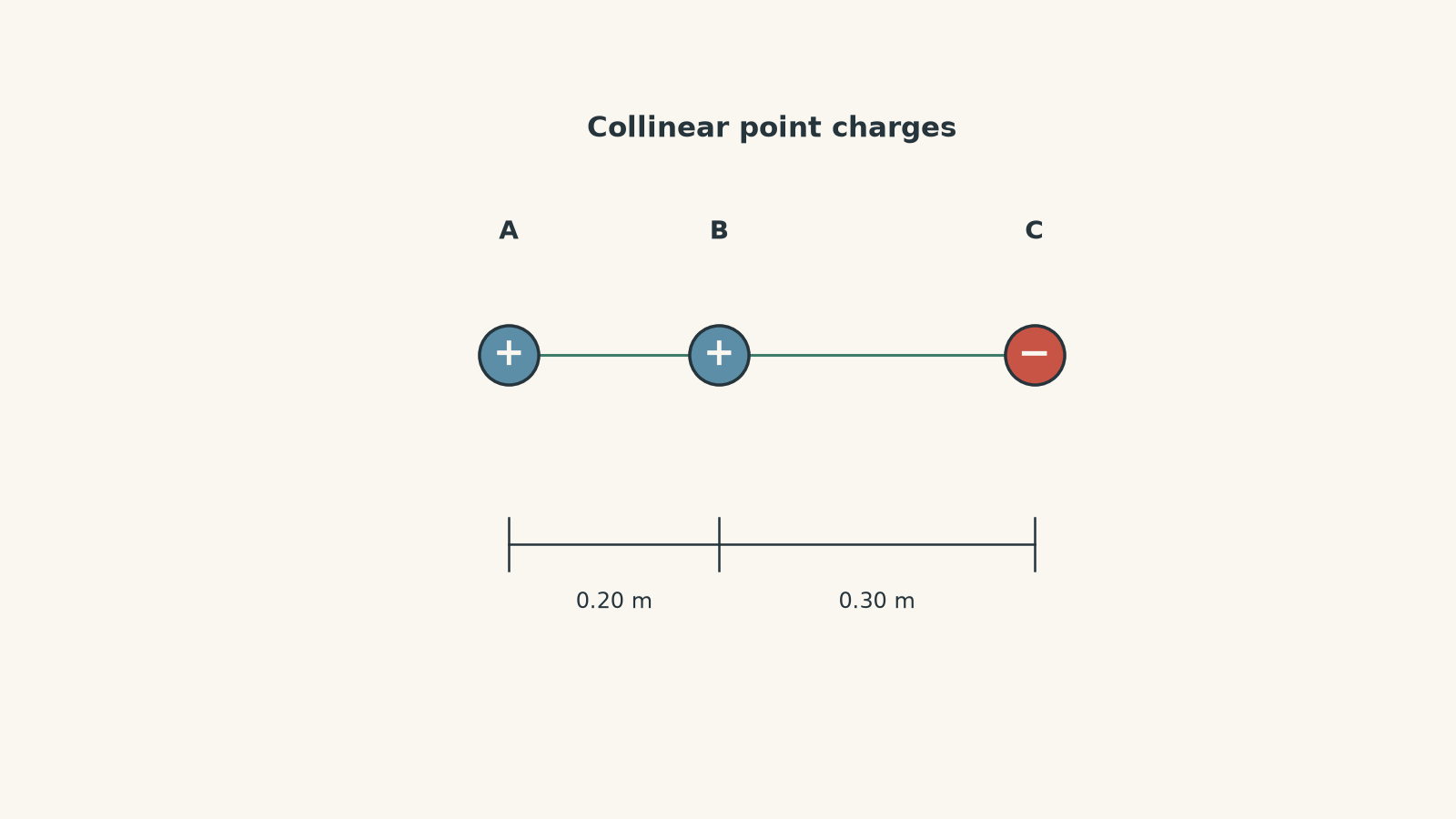
Three point charges lie on a horizontal line.
- Charge \(A = +4.0\ \mu\text{C}\)
- Charge \(B = +2.0\ \mu\text{C}\)
- Charge \(C = -3.0\ \mu\text{C}\)
Charge \(A\) is \(0.20\ \text{m}\) to the left of \(B\). Charge \(C\) is \(0.30\ \text{m}\) to the right of \(B\).
Calculate the net electrostatic force on \(B\). Take right as positive.
Step 1
\(A\) and \(B\) are both positive, so they repel.
Because \(A\) is to the left of \(B\), it pushes \(B\) to the right.
Therefore,
\[ F_{AB} > 0 \]
Step 2
\[ \begin{aligned} F_{AB} &= k\frac{|q_Aq_B|}{r_{AB}^2} \\ &= (8.99\times10^9) \frac{(4.0\times10^{-6})(2.0\times10^{-6})}{(0.20)^2} \\ &= 1.80\ \text{N} \end{aligned} \]
So,
\[ F_{AB} = +1.80\ \text{N} \]
Step 3
\(B\) is positive and \(C\) is negative, so they attract.
Because \(C\) is to the right, \(B\) is pulled to the right.
Therefore,
\[ F_{CB} > 0 \]
Step 4
\[ \begin{aligned} F_{CB} &= k\frac{|q_Cq_B|}{r_{CB}^2} \\ &= (8.99\times10^9) \frac{(3.0\times10^{-6})(2.0\times10^{-6})}{(0.30)^2} \\ &= 0.599\ \text{N} \end{aligned} \]
So,
\[ F_{CB} = +0.599\ \text{N} \]
Step 5
\[ \begin{aligned} F_{\text{net}} &= F_{AB} + F_{CB} \\ &= 1.80 + 0.599 \\ &= 2.40\ \text{N} \end{aligned} \]
The net force on \(B\) is therefore
\[ \boxed{F_{\text{net}} = +2.40\ \text{N}} \]
or \(2.40\ \text{N}\) to the right.
Both interactions push or pull \(B\) in the same direction, even though one interaction is repulsive and the other is attractive.
That is exactly why “attractive means negative” is a poor rule.
11A reliable method for Coulomb’s law questions
When a question involves electric forces, use this sequence.
1. Draw the charges in their correct positions
Include their signs and separations.
Do this even if the arrangement seems obvious. Most direction mistakes begin before the calculator is touched.
2. Choose the charge whose force you are finding
Ask: What forces act on this charge?
Ignore forces acting on other charges unless the question asks for them.
3. Predict each force direction
For each interacting pair:
- same sign means repel
- opposite signs mean attract
Draw an arrow showing the force on the charge of interest.
4. Convert all quantities to SI units
Use:
- coulombs for charge
- metres for distance
- newtons for force
5. Calculate each force magnitude separately
Use
\[ F = k\frac{|q_1q_2|}{r^2} \]
6. Give the forces vector signs
Only now use your coordinate convention.
For example, if right is positive:
- rightward force: positive
- leftward force: negative
7. Add the forces
For one-dimensional problems,
\[ F_{\text{net}} = F_1 + F_2 + \cdots \]
For two-dimensional arrangements, resolve forces into components before adding them.
12The most tempting misconceptions
“Negative charge means negative force”
Not necessarily.
Charge sign describes the type of charge. Force sign describes direction relative to a coordinate system.
They are different ideas.
“Opposite charges always give a negative answer”
Opposite charges always attract. Whether the force component is positive or negative depends on where the charges are and which direction you chose as positive.
“If the distance doubles, the force halves”
Coulomb’s law contains \(r^2\), not \(r\).
Doubling the distance gives
\[ F_{\text{new}} = \frac{F_{\text{old}}}{2^2} = \frac{F_{\text{old}}}{4} \]
“The larger charge experiences the larger force”
Suppose a \(+1\ \mu\text{C}\) charge interacts with a \(+100\ \mu\text{C}\) charge.
It feels reasonable that the \(100\ \mu\text{C}\) charge should somehow “win” and exert the larger force.
It does not.
Coulomb’s law gives the same product \(q_1q_2\) whichever charge you call \(q_1\) or \(q_2\). The force of charge 1 on charge 2 has the same magnitude as the force of charge 2 on charge 1.
The accelerations can still be different if the objects have different masses, because
\[ \vec a = \frac{\vec F}{m} \]
Equal force does not mean equal acceleration.
“A zero net force means there are no electric forces”
Also false.
Two or more non-zero forces can cancel.
A charge could experience \(3\ \text{N}\) to the left and \(3\ \text{N}\) to the right. Its net force is zero even though two electrostatic forces are acting.
This distinction becomes especially important when you study electric fields and equilibrium.
13Questions and solutions
Question 1
Two point charges, \(+2.5\ \mu\text{C}\) and \(+4.0\ \mu\text{C}\), are separated by \(0.50\ \text{m}\).
Calculate the magnitude of the electrostatic force between them and state whether the interaction is attractive or repulsive.
Solution 1
The charges repel with a force magnitude of \(0.360\ \text{N}\).
Both charges are positive, so the interaction is repulsive.
Convert the charges to coulombs:
\[ q_1 = 2.5\times10^{-6}\ \text{C} \]
\[ q_2 = 4.0\times10^{-6}\ \text{C} \]
The separation is
\[ r = 0.50\ \text{m} \]
Using Coulomb’s law,
\[ \begin{aligned} F &= k\frac{|q_1q_2|}{r^2} \\ &= (8.99\times10^9) \frac{(2.5\times10^{-6})(4.0\times10^{-6})}{(0.50)^2} \\ &= 0.3596\ \text{N} \end{aligned} \]
Therefore,
\[ \boxed{F = 0.360\ \text{N}} \]
Each charge experiences this same force magnitude, directed away from the other charge. A common mistake here is to say that the larger \(+4.0\ \mu\text{C}\) charge experiences a larger force. Newton’s third law tells us the two interaction forces have equal magnitudes.
Question 2
A \(+6.0\ \text{nC}\) charge is located at \(x = 0\), and a \(-8.0\ \text{nC}\) charge is located at \(x = -0.12\ \text{m}\).
Take right as positive. Calculate the force on the \(+6.0\ \text{nC}\) charge.
Solution 2
The force on the positive charge is approximately \(-3.00\times10^{-5}\ \text{N}\), meaning it points to the left.
The charges have opposite signs, so they attract. The negative charge is to the left of the positive charge, so the force on the positive charge must also point left.
Convert the charges:
\[ |q_1| = 6.0\times10^{-9}\ \text{C} \]
\[ |q_2| = 8.0\times10^{-9}\ \text{C} \]
Calculate the magnitude:
\[ \begin{aligned} F &= k\frac{|q_1q_2|}{r^2} \\ &= (8.99\times10^9) \frac{(6.0\times10^{-9})(8.0\times10^{-9})}{(0.12)^2} \\ &= 2.997\times10^{-5}\ \text{N} \end{aligned} \]
To three significant figures,
\[ F = 3.00\times10^{-5}\ \text{N} \]
Because left is the negative \(x\)-direction,
\[ \boxed{F_x = -3.00\times10^{-5}\ \text{N}} \]
The negative sign comes from the chosen coordinate direction, not simply from the fact that one charge is negative.
Question 3
A \(+1.0\ \mu\text{C}\) charge experiences a force of magnitude \(0.90\ \text{N}\) due to a second point charge.
The separation between them is doubled, while both charge magnitudes remain unchanged.
What is the new force magnitude? Explain without repeating the full Coulomb’s law calculation from the beginning.
Solution 3
The new force magnitude is \(0.225\ \text{N}\).
Coulomb’s law gives the relationship
\[ F \propto \frac{1}{r^2} \]
If the distance changes from \(r\) to \(2r\), then
\[ \frac{F_{\text{new}}}{F_{\text{old}}} = \frac{r^2}{(2r)^2} = \frac{1}{4} \]
Therefore,
\[ \begin{aligned} F_{\text{new}} &= \frac{0.90}{4} \\ &= 0.225\ \text{N} \end{aligned} \]
So,
\[ \boxed{F_{\text{new}} = 0.225\ \text{N}} \]
The main trap is treating the relationship as inverse rather than inverse-square. Doubling the separation does not halve the force. It reduces it to one quarter.
Question 4
Three point charges lie on the \(x\)-axis.
- \(A = +3.0\ \mu\text{C}\) at \(x = -0.20\ \text{m}\)
- \(B = +1.0\ \mu\text{C}\) at \(x = 0\)
- \(C = +12.0\ \mu\text{C}\) at \(x = +0.40\ \text{m}\)
Take right as positive.
Calculate the net electrostatic force on \(B\).
Solution 4
The net force on \(B\) is zero, even though two non-zero electrostatic forces act on it.
First consider the force from \(A\).
Both \(A\) and \(B\) are positive, so \(A\) repels \(B\). Because \(A\) is to the left, this force points right.
Its magnitude is
\[ \begin{aligned} F_{AB} &= k\frac{|q_Aq_B|}{r_{AB}^2} \\ &= (8.99\times10^9) \frac{(3.0\times10^{-6})(1.0\times10^{-6})}{(0.20)^2} \\ &= 0.674\ \text{N} \end{aligned} \]
Therefore,
\[ F_{AB} = +0.674\ \text{N} \]
Now consider the force from \(C\).
\(B\) and \(C\) are also both positive, so \(C\) repels \(B\). Because \(C\) is to the right, this force points left.
Its magnitude is
\[ \begin{aligned} F_{CB} &= k\frac{|q_Cq_B|}{r_{CB}^2} \\ &= (8.99\times10^9) \frac{(12.0\times10^{-6})(1.0\times10^{-6})}{(0.40)^2} \\ &= 0.674\ \text{N} \end{aligned} \]
Therefore,
\[ F_{CB} = -0.674\ \text{N} \]
Add the vector components:
\[ \begin{aligned} F_{\text{net}} &= F_{AB} + F_{CB} \\ &= 0.674 - 0.674 \\ &= 0 \end{aligned} \]
Hence,
\[ \boxed{F_{\text{net}} = 0\ \text{N}} \]
The interesting feature is that charge \(C\) is four times further from \(B\) than \(A\) is? Check the actual distances carefully: \(C\) is \(0.40\ \text{m}\) away while \(A\) is \(0.20\ \text{m}\) away, so \(C\) is twice as far away. Because distance is squared, being twice as far away weakens the force by a factor of four. The charge on \(C\) is four times larger, exactly compensating for that reduction.
Zero net force therefore does not mean zero electrostatic interaction. It means the individual vector forces cancel.
Question 5
Two fixed positive point charges lie on a straight line.
- \(Q_1 = +4.0\ \mu\text{C}\) at \(x = 0\)
- \(Q_2 = +9.0\ \mu\text{C}\) at \(x = 1.00\ \text{m}\)
A small positive test charge is placed somewhere on the same line.
Find the position between \(Q_1\) and \(Q_2\) where the net electrostatic force on the test charge is zero. Explain why the test charge’s own charge does not need to be known.
Solution 5
The test charge must be placed at \(x = 0.400\ \text{m}\), measured from \(Q_1\).
Because the test charge is positive, both fixed positive charges repel it.
Between \(Q_1\) and \(Q_2\):
- \(Q_1\) pushes the test charge to the right
- \(Q_2\) pushes the test charge to the left
For the net force to be zero, these force magnitudes must be equal.
Let the unknown position be \(x\) metres from \(Q_1\).
Its distance from \(Q_2\) is therefore
\[ 1.00-x \]
Let the test charge be \(q\). Equating the two force magnitudes gives
\[ k\frac{|Q_1q|}{x^2} = k\frac{|Q_2q|}{(1.00-x)^2} \]
The factors \(k\) and \(|q|\) appear on both sides, so they cancel:
\[ \frac{Q_1}{x^2} = \frac{Q_2}{(1.00-x)^2} \]
Substitute the charge magnitudes:
\[ \frac{4.0}{x^2} = \frac{9.0}{(1.00-x)^2} \]
Taking the positive square root is appropriate because both \(x\) and \(1.00-x\) represent positive distances:
\[ \frac{2}{x} = \frac{3}{1.00-x} \]
Cross-multiplying,
\[ \begin{aligned} 2(1.00-x) &= 3x \\ 2.00-2x &= 3x \\ 2.00 &= 5x \\ x &= 0.400\ \text{m} \end{aligned} \]
Therefore,
\[ \boxed{x = 0.400\ \text{m}} \]
The test charge’s magnitude is not needed because it multiplies both competing forces equally and cancels when the forces are set equal.
The location also makes physical sense. The \(+9.0\ \mu\text{C}\) charge is stronger, so the balance point must be closer to the weaker \(+4.0\ \mu\text{C}\) charge. At \(x=0.400\ \text{m}\), the test charge is \(0.400\ \text{m}\) from \(Q_1\) but \(0.600\ \text{m}\) from the stronger \(Q_2\).
A tempting approach is to look for the midpoint. That would work only if the two fixed charges had equal magnitudes.
14From force to electric field
Coulomb’s law tells you the force between particular charges. The next useful step is to separate the source of the interaction from the object placed there.
If a charge \(Q\) produces an electric influence around itself, we can describe that influence using the electric field. A second charge placed in that field then experiences a force.
That shift turns
\[ F = k\frac{|Qq|}{r^2} \]
into the closely related idea
\[ E = k\frac{|Q|}{r^2} \]
where \(E\) is electric field strength.
So the direction work you have done here carries straight across: first understand which way a positive test charge would be pushed, then attach the vector direction. That is the bridge from Coulomb’s law to electric fields, field diagrams, electric potential, and eventually the motion of charged particles in electric fields.