
Charging by Friction, Contact and Induction Explained
Learn how friction, contact and induction charge objects by tracking electron transfer and polarisation. Includes worked examples, misconceptions and HSC-style practice.
Rub a plastic rod with a cloth and the rod can attract tiny pieces of paper. Touch a charged metal sphere to a neutral one and both can end up charged. Bring a charged rod near a metal sphere without touching it, and charges inside the sphere move anyway.
These look like three different tricks. They are really different ways of controlling the same thing: where electrons are.
Before reading on, predict this: if a negatively charged rod is brought close to a neutral metal sphere but never touches it, has the sphere become positively charged?
Not yet. Its charges have rearranged, but its net charge is still zero. That distinction between moving charge around and transferring charge onto or off an object is the key to understanding friction, contact, and induction.
01Start with the particles that can actually move
An ordinary object contains positive protons and negative electrons.
The protons are locked inside atomic nuclei. In the charging processes studied in HSC Physics, they do not move from one object to another. Electrons are the particles that move.
That gives us a useful rule:
- an object that gains electrons becomes negatively charged
- an object that loses electrons becomes positively charged
- a neutral object has equal total positive and negative charge
A positive object has not “gained positive charge” in the usual electrostatic processes. It has lost some electrons.
Charge is also conserved. Electrons can move between objects, or between an object and Earth, but charge is not created from nothing.
02Conductors and insulators behave differently
Before comparing charging methods, we need one distinction.
In a conductor, some electrons can move freely through the material. Metals are the main HSC example. If one part of a metal object experiences an electric force, its mobile electrons can redistribute.
In an insulator, electrons are much less free to travel through the object. A transferred charge can therefore remain concentrated near the place where it was deposited.
Imagine students at a school formal. In a conductor, everyone is allowed to move around the room. If something awkward happens at one end, the crowd can shift.
In an insulator, everyone has been assigned a seat. They might lean slightly, but they cannot all migrate across the room.
The analogy is limited. Electrons do not make social decisions, and even bound charges in an insulator can shift slightly within atoms or molecules. The important idea is simply that charge moves much more freely through a conductor.
03Charging by friction
Suppose two initially neutral insulating materials are rubbed together and then separated. One ends up negative and the other positive.
Where did the charge come from?
A tempting answer is that friction creates charge. It does not.
When different materials are brought into close contact, their electrons do not necessarily have the same tendency to remain associated with each material. Some electrons can transfer across the contact surface. Rubbing increases the amount and repetition of contact, so it can make this transfer more noticeable.
After the materials separate:
- the material that gained electrons has a net negative charge
- the material that lost electrons has an equal amount of positive charge, if the pair is isolated
So the simplified HSC model is electron transfer between different materials.
Strictly, the microscopic details of triboelectric charging can be more complicated than a simple ranking of which substance “likes electrons more”. Surface condition, contamination, humidity, and the particular materials matter. For HSC electrostatics, the important model is that electrons transfer while total charge is conserved.
Worked example: How many electrons were transferred?
A plastic strip becomes charged to \(-3.2\ \text{nC}\) after being rubbed with a cloth. Assuming its charge is caused by transferred electrons, how many extra electrons are on the strip?
Step 1
The negative charge means the strip has gained electrons.
Step 2
The magnitude of the electron charge is
\[ e = 1.60 \times 10^{-19}\ \text{C} \]
The number of transferred electrons \(N\) is related to the total charge magnitude \(Q\) by
\[ N = \frac{|Q|}{e} \]
where \(Q\) is measured in coulombs and \(e\) is the magnitude of the charge of one electron.
Step 3
\[ \begin{aligned} |Q| &= 3.2 \times 10^{-9}\ \text{C} \\ N &= \frac{3.2 \times 10^{-9}}{1.60 \times 10^{-19}} \\ &= 2.0 \times 10^{10} \end{aligned} \]
Step 4
The strip gained approximately
\[ \boxed{2.0 \times 10^{10}\ \text{electrons}} \]
That sounds enormous, but it is a tiny fraction of all the electrons already present in a macroscopic object.
04Charging by contact
Now replace the insulating rods with conducting metal spheres.
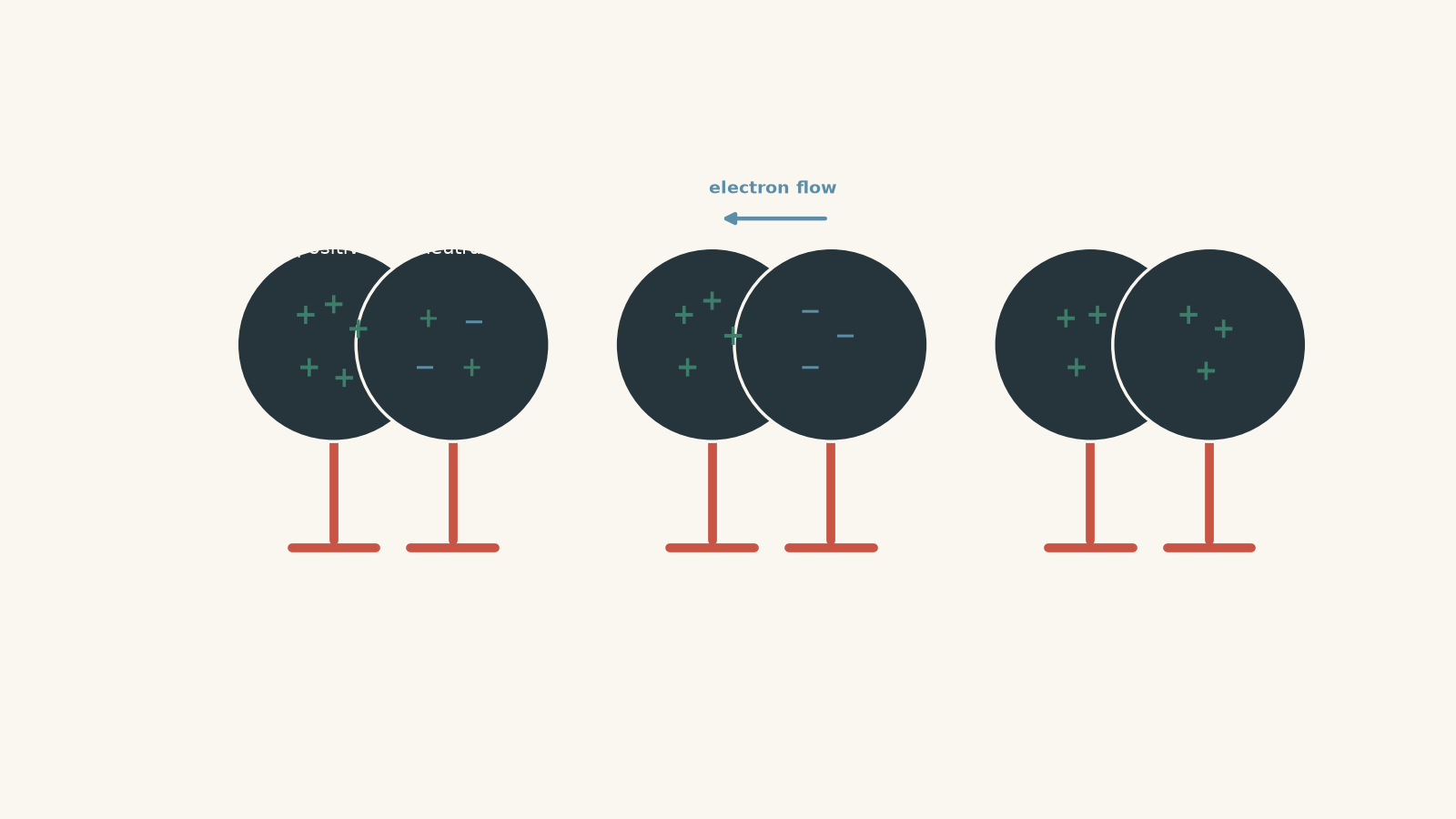
Suppose sphere A is positively charged and sphere B is neutral. They are both mounted on insulating stands so charge cannot escape to Earth.
What happens if they touch?
Because the spheres are conductors, mobile electrons can move through the point of contact. The positively charged sphere has an electron deficit, so electrons move from the neutral sphere towards it.
The redistribution continues until the connected conductors reach electrostatic equilibrium.
After they separate, both can remain positively charged.
Does contact always split charge equally?
No.
This is one of the easiest shortcuts to overuse.
Two identical conducting spheres that are sufficiently separated after contact will share their total charge equally because their geometry is the same.
For non-identical conductors, you cannot automatically divide the total charge by two. The final distribution depends on the conductors’ sizes and shapes because electrostatic equilibrium requires the connected conductors to be at the same electric potential.
Worked example: Which way did the electrons move?
Two identical isolated conducting spheres have initial charges of \(+10\ \text{nC}\) and \(-2\ \text{nC}\). They touch, reach electrostatic equilibrium, and are then separated. Find the final charge on each sphere and the number of electrons transferred during contact.
Step 1
\[ Q_{\text{total}} = +10\ \text{nC} + (-2\ \text{nC}) = +8\ \text{nC} \]
Charge is conserved because the two-sphere system is isolated.
Step 2
Identical spheres share the total charge equally after reaching equilibrium:
\[ Q_{\text{final}} = \frac{+8\ \text{nC}}{2} = +4\ \text{nC} \]
So each sphere ends with
\[ \boxed{+4\ \text{nC}} \]
Step 3
The sphere that began at \(+10\ \text{nC}\) ended at \(+4\ \text{nC}\).
Its charge changed by
\[ \Delta Q = +4\ \text{nC} - (+10\ \text{nC}) = -6\ \text{nC} \]
A change towards a less positive charge means that sphere gained electrons.
So \(6\ \text{nC}\) worth of negative charge moved onto it from the other sphere.
Step 4
\[ \begin{aligned} N &= \frac{6.0 \times 10^{-9}}{1.60 \times 10^{-19}} \\ &= 3.75 \times 10^{10} \end{aligned} \]
Therefore,
\[ \boxed{3.75 \times 10^{10}\ \text{electrons}} \]
moved from the sphere initially at \(-2\ \text{nC}\) to the sphere initially at \(+10\ \text{nC}\).
Notice what moved: electrons. We do not describe positive charge carriers travelling in the opposite direction through the metal.
05Polarisation: rearrangement without changing net charge
Charging by induction makes much more sense once you understand polarisation.
Take a neutral conducting sphere. It contains equal positive and negative charge overall.
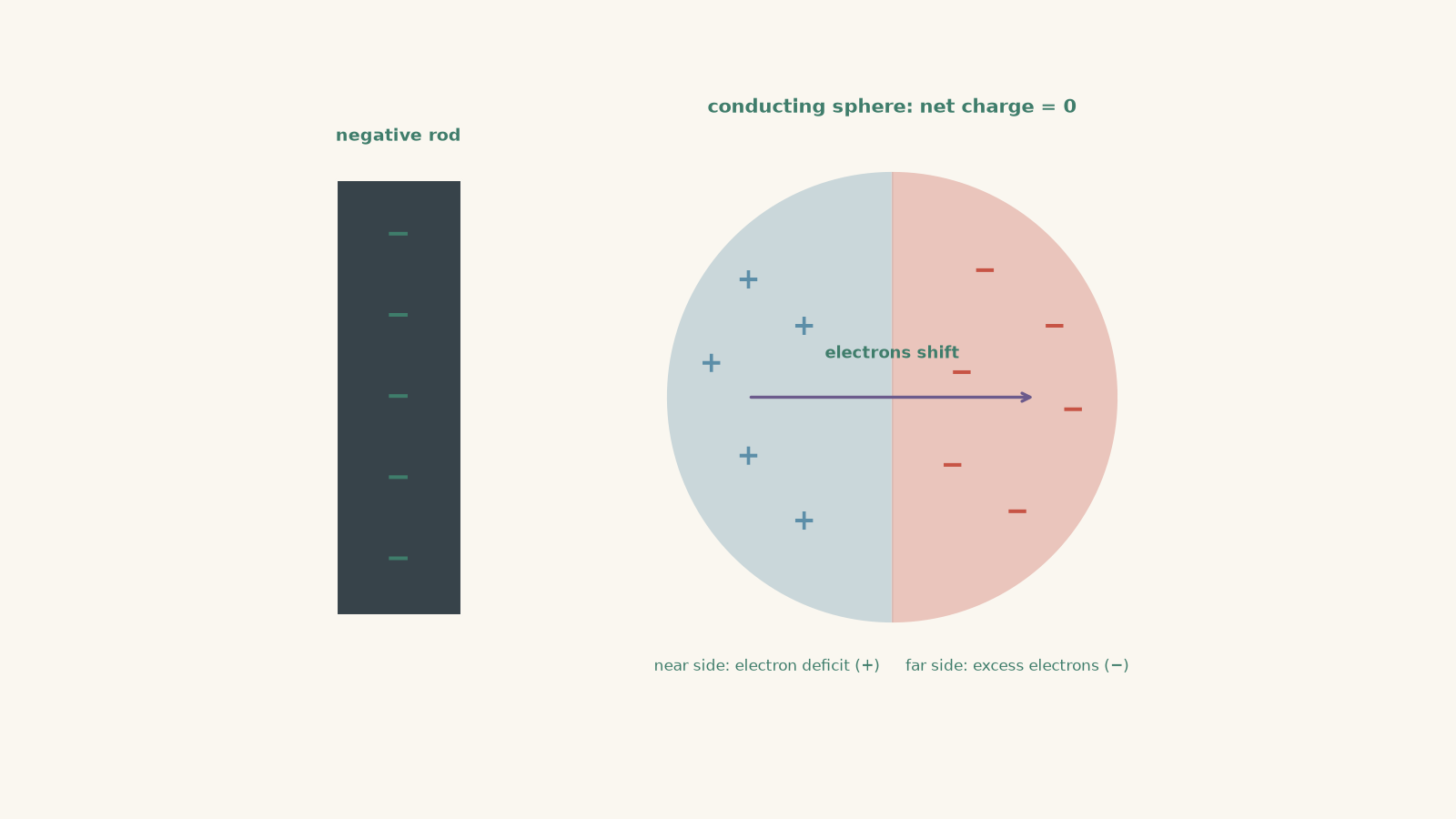
Now bring a negatively charged rod near its left side without touching it.
Predict where the sphere’s mobile electrons will move.
They are repelled by the negative rod, so they move towards the far side of the sphere.
The near side is left with an electron deficit and therefore behaves positively. The far side has an excess of electrons and behaves negatively.
But no electrons have entered or left the sphere.
Its total charge is still
\[ Q_{\text{net}} = 0 \]
This separation of positive and negative charge within an object is called polarisation.
Why can a neutral object be attracted to a charged object?
This explains the attraction between a charged object and some neutral objects.
Suppose the external rod is negative. It polarises a nearby neutral conductor so that positive charge is concentrated on the nearer side and negative charge on the farther side.
The negative rod:
- attracts the closer positive region
- repels the farther negative region
Electric force becomes weaker with increasing separation. The attractive interaction with the nearer region is therefore stronger than the repulsive interaction with the farther region.
The result can be a net attractive force, even though the other object remains neutral overall.
That is why “it was attracted, so it must have the opposite net charge” is not a safe conclusion.
06Charging by induction
Polarisation alone does not permanently charge an isolated conductor.
To give it a net charge without touching it with the charged object, we need one extra ingredient: a path for electrons to enter or leave.
That path is usually a connection to Earth.
Suppose we want to charge a conducting sphere positively using a negatively charged rod.
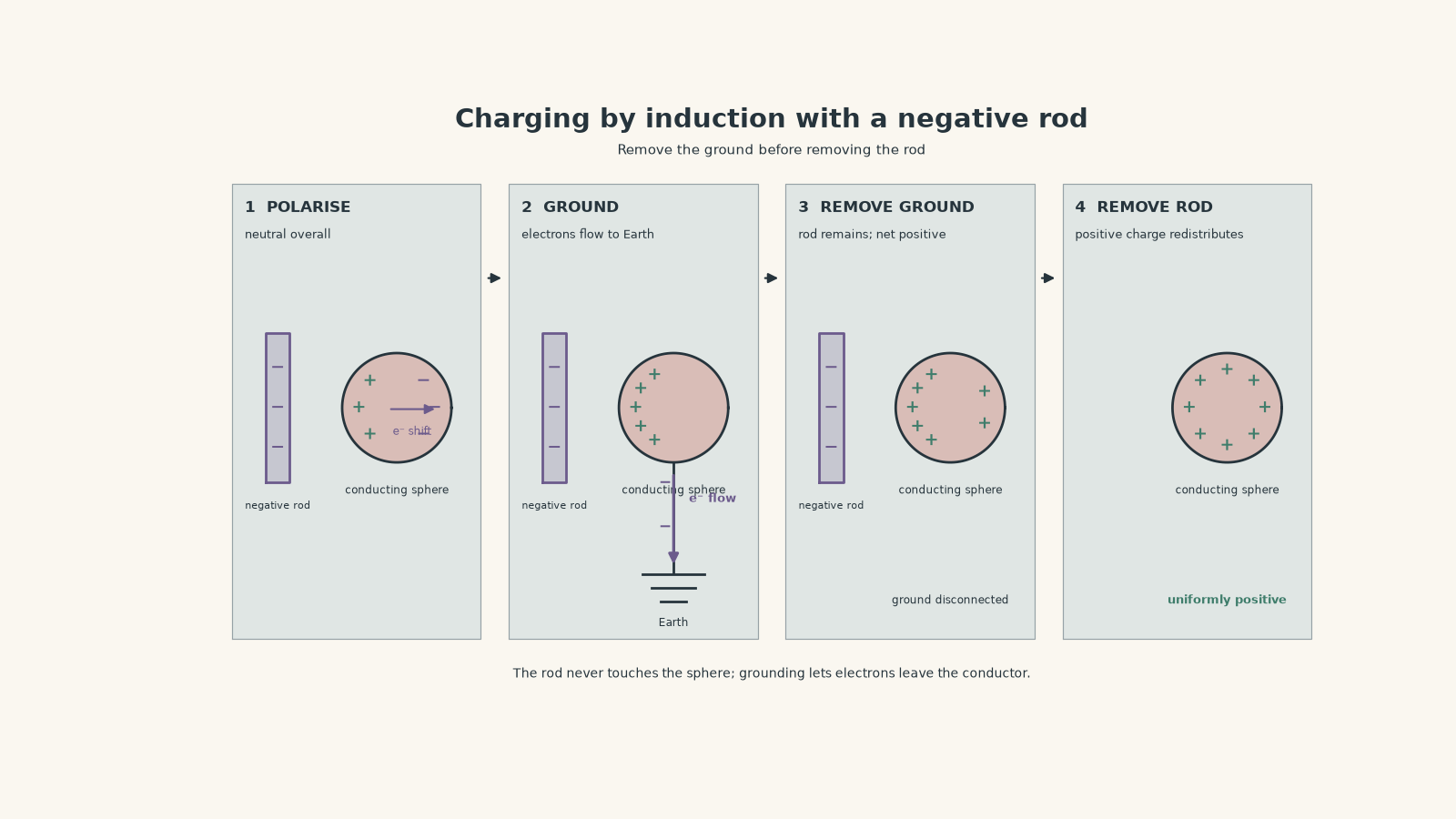
Step 1: Bring the charged rod close
Move the negative rod near the neutral conducting sphere without touching it.
The sphere polarises. Its mobile electrons move away from the rod.
Step 2: Connect the sphere to Earth
While the rod remains nearby, connect the sphere to Earth.
The negative rod repels some electrons from the sphere through the conducting path into Earth.
Earth acts as an enormous charge reservoir. It can accept or supply a relatively small number of electrons without noticeably changing its electric potential.
Step 3: Remove the Earth connection first
This order matters.
Disconnect the grounding path while the charged rod is still present.
The electrons that left the sphere can no longer return through the Earth connection.
The sphere now has an electron deficit, so it has a net positive charge.
Step 4: Remove the charged rod
When the rod is finally moved away, the remaining charge spreads around the conductor.
The sphere stays positively charged.
If the inducing rod were positive, the directions would reverse. Electrons would be attracted from Earth onto the conductor, leaving it negatively charged once the ground was removed.
07The order in induction is not a minor detail
Suppose a negative rod is beside a grounded metal sphere. Electrons have been pushed from the sphere into Earth.
What happens if you remove the rod before disconnecting the ground?
Once the rod disappears, the repulsive electric influence disappears too. Because the sphere is still connected to Earth, electrons can flow back until the sphere returns towards neutrality.
So the intended induced charge is lost.
For standard induction:
- bring the inducing charge near
- connect to Earth
- remove the Earth connection
- remove the inducing charge
The grounding connection must be removed before the inducer.
08Friction, contact, and induction compared
| Process | Does the charging object touch the object being charged? | Are electrons transferred? | Is polarisation important? | Typical final sign |
|---|---|---|---|---|
| Friction | Yes, through repeated surface contact | Yes, between the materials | Not the main idea in the basic model | The two materials usually become oppositely charged |
| Contact | Yes | Yes, through the conducting contact | Redistribution occurs as equilibrium is reached | A neutral conductor usually acquires the same sign as the initially charged conductor |
| Induction | No contact with the inducing object | Yes, but between the conductor and Earth during grounding | Yes, it starts the process | Opposite to the inducing charge in the standard grounded procedure |
| Polarisation only | No | No net transfer onto or off the isolated object | Yes | Net charge remains zero |
The most useful question to ask in any charging problem is:
Where can the electrons actually go?
If you can answer that, the sign of the final charge usually follows.
09Three misconceptions worth catching early
“Friction creates electrons”
It does not. Friction helps bring surfaces repeatedly into contact, allowing electrons to transfer. Total charge is conserved.
“If charges move inside an object, the object must be charged”
Not necessarily. A neutral conductor can become polarised while keeping zero net charge.
Moving electrons from one side to the other changes the distribution of charge, not the total amount.
“Positive charge moves through a metal”
In the ordinary solid metal model used here, the positive atomic nuclei remain fixed in the lattice. Mobile electrons move.
It is sometimes mathematically convenient to describe positive conventional current in other contexts, but that does not mean protons are travelling through the metal in an electrostatic charging experiment.
10Questions and solutions
Question 1
A neutral plastic strip is rubbed with a piece of fabric. After separation, the strip has a charge of \(+4.8\ \text{nC}\).
Explain what happened to the strip’s electrons, and calculate the number of electrons transferred.
Solution 1
The strip lost \(3.0 \times 10^{10}\) electrons to the fabric, which left it with a positive net charge.
A positive charge means an electron deficit. The number of transferred electrons is
\[ \begin{aligned} N &= \frac{|Q|}{e} \\ &= \frac{4.8 \times 10^{-9}}{1.60 \times 10^{-19}} \\ &= 3.0 \times 10^{10} \end{aligned} \]
where \(Q = 4.8 \times 10^{-9}\ \text{C}\) is the magnitude of the strip’s charge and \(e = 1.60 \times 10^{-19}\ \text{C}\) is the magnitude of one electron’s charge.
So the strip lost
\[ \boxed{3.0 \times 10^{10}\ \text{electrons}} \]
The positive charge was not produced by adding protons. It resulted from removing electrons.
Question 2
A negatively charged metal sphere touches an identical neutral metal sphere. Both are mounted on insulating stands. The spheres are separated after reaching electrostatic equilibrium.
State the sign of each sphere after separation and explain the direction of electron movement.
Solution 2
Both spheres are negatively charged after separation, and electrons move from the initially negative sphere onto the initially neutral sphere.
The negatively charged sphere begins with an excess of electrons. Once the conducting spheres touch, those mobile electrons can redistribute across the combined conductor.
Because the spheres are identical, they reach the same final charge when the total charge is shared equally.
The important point is that the neutral sphere does not become charged because positive particles move onto it. It becomes negative because it gains electrons.
Question 3
A negatively charged rod is brought close to an isolated neutral metal sphere but does not touch it. A student says, “The side closest to the rod becomes positive, so the sphere must now have a positive net charge.”
Assess the student’s statement.
Solution 3
The statement is incorrect because the sphere is polarised but still has zero net charge.
The negative rod repels the sphere’s mobile electrons towards the far side. This leaves an electron deficit on the near side, which behaves positively, while the far side has an electron excess.
However, no conducting path allows electrons to enter or leave the isolated sphere. Its total number of electrons has not changed.
Therefore,
\[ \boxed{Q_{\text{net}} = 0} \]
even though its charge distribution is no longer uniform.
The trap is confusing a positively charged region with a positively charged object.
Question 4
Two identical isolated conducting spheres, A and B, carry charges of \(+14\ \text{nC}\) and \(-6\ \text{nC}\), respectively. They are touched together and then separated.
Determine:
a. the final charge on each sphere
b. the magnitude and direction of electron transfer
Solution 4
Each sphere finishes at \(+4\ \text{nC}\), and \(6.25 \times 10^{10}\) electrons move from sphere B to sphere A.
First, conserve total charge:
\[ Q_{\text{total}} = +14\ \text{nC} - 6\ \text{nC} = +8\ \text{nC} \]
Because the spheres are identical, the charge is shared equally:
\[ Q_A = Q_B = \frac{+8\ \text{nC}}{2} = \boxed{+4\ \text{nC}} \]
Now consider sphere A. Its charge changes from \(+14\ \text{nC}\) to \(+4\ \text{nC}\). It has become \(10\ \text{nC}\) less positive, so it must have gained electrons.
The number transferred is
\[ \begin{aligned} N &= \frac{10 \times 10^{-9}}{1.60 \times 10^{-19}} \\ &= 6.25 \times 10^{10} \end{aligned} \]
Therefore,
\[ \boxed{6.25 \times 10^{10}\ \text{electrons}} \]
move from B to A.
A common mistake is to look only at the final positive charges and conclude that positive charge moved from A to B. At the particle level, it is the electrons that moved in the opposite direction.
Question 5
A student tries to charge a neutral metal sphere by induction using a negatively charged rod.
They perform these steps:
- bring the negative rod close to the sphere
- connect the sphere to Earth
- remove the negative rod
- disconnect the Earth connection
They expect the sphere to remain positively charged.
Explain why this procedure fails and give the corrected sequence.
Solution 5
The procedure fails because the rod is removed while the sphere is still grounded, allowing electrons to return from Earth and largely restore neutrality.
When the negative rod is initially nearby, it repels electrons in the sphere. With the sphere grounded, some of these electrons can flow into Earth.
At that moment, the sphere can have an electron deficit.
However, the student then removes the negative rod while the Earth connection remains. The force that was driving electrons away has disappeared, but the conducting path to Earth’s electron reservoir is still available. Electrons can therefore flow back towards the sphere.
The correct sequence is:
- bring the negative rod near the neutral conductor
- connect the conductor to Earth
- disconnect the Earth connection while the rod remains nearby
- remove the rod
This leaves the sphere with an electron deficit and therefore a net positive charge.
The hidden issue is not merely whether grounding occurred. The order in which the ground and inducing charge are removed determines whether the transferred charge is trapped on the conductor.
Question 6
A small neutral conducting sphere is suspended by an insulating thread. A negatively charged rod is brought nearby, and the sphere moves towards the rod.
A student concludes that electrons must have left the sphere, making it positively charged.
Is that conclusion justified? Explain what additional observation would be needed to distinguish polarisation from permanent charging.
Solution 6
No. Attraction alone does not show that the sphere has acquired a positive net charge.
A neutral conducting sphere can be attracted to the negative rod through polarisation. The rod repels mobile electrons towards the far side of the sphere, leaving the closer side relatively positive.
Because the opposite charge is closer to the rod than the like charge on the far side, the attraction can be stronger than the repulsion, producing a net force towards the rod.
To test whether the sphere has been permanently charged, the external rod should be removed and the sphere’s net charge tested independently, for example by examining its interaction with a known charge under conditions where induced polarisation is accounted for.
If the sphere returns to an unpolarised neutral state once the rod is removed, the original attraction did not require any net electron transfer.
The key trap is assuming that attraction proves opposite net charges. Attraction can result from either opposite net charge or induced polarisation.
11What this idea lets you do next
Friction, contact, and induction are easiest to separate by tracking two things: electron transfer and polarisation.
That same reasoning becomes useful when you move into electric fields and electric potential. An external electric field is what pushes mobile electrons around a conductor, while electric potential helps explain why charge redistributes until a conductor reaches electrostatic equilibrium.
Once you stop treating “positive” and “negative” as labels and start tracking where the electrons can move, electrostatics becomes much less mysterious.