
Oxidation and Reduction by Electron Transfer: HSC Chemistry
Learn how to identify oxidation, reduction, oxidising agents, and reducing agents by tracking electron transfer in redox reactions.
Put a strip of zinc metal into a blue copper(II) solution and something odd happens: copper metal begins to coat the zinc, while zinc atoms leave the strip and enter the solution as ions.
What has actually moved from zinc to copper?
It isn’t an oxygen atom, and it isn’t a proton. The key transfer is much smaller: electrons move from zinc atoms to copper(II) ions. Once you can track that electron handover, oxidation and reduction become much easier to identify.
01Start by following the electrons
Consider the reaction
\[
\ce{Zn(s) + Cu^2+(aq) -> Zn^2+(aq) + Cu(s)}
\]
Before reading on, predict what happens to the electrons.
A neutral zinc atom becomes \(\mathrm{Zn}^{2+}\). To become \(2+\), it must lose two negatively charged electrons:
\[
\ce{Zn -> Zn^2+ + 2e^-}
\]
Meanwhile, a \(\mathrm{Cu}^{2+}\) ion becomes a neutral copper atom. It must gain two electrons:
\[
\ce{Cu^2+ + 2e^- -> Cu}
\]
Those two changes have special names:
- oxidation is the loss of electrons
- reduction is the gain of electrons
You may have seen the mnemonic OIL RIG: Oxidation Is Loss, Reduction Is Gain. It is useful, but don’t stop at memorising it. The important idea is that electrons are transferred from one species to another.
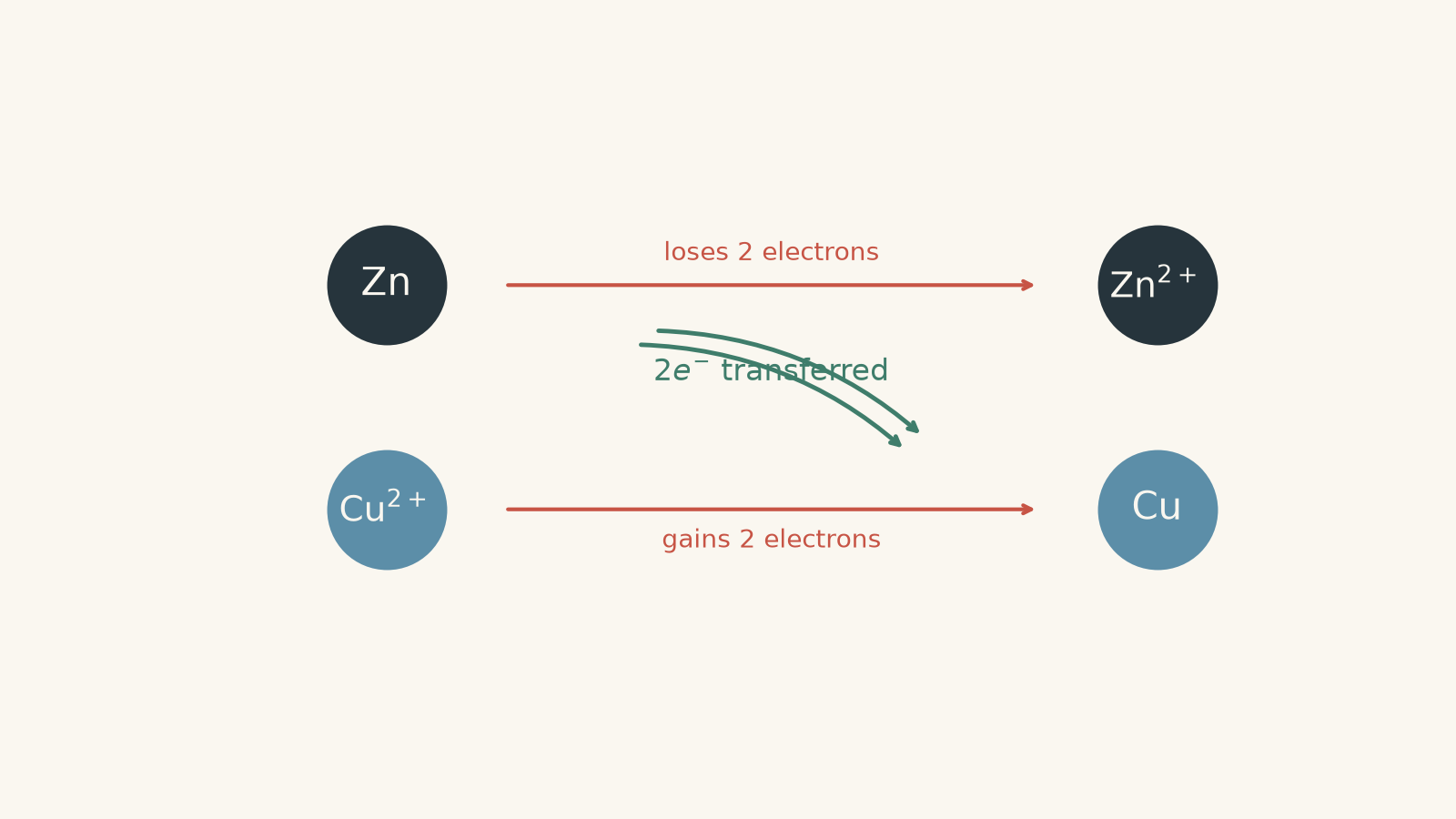
Think of it as handing over a concert ticket. If one person receives the ticket, somebody else must give it up. Electron transfer works the same way: a species cannot gain electrons unless another species loses them.
The analogy breaks because electrons are real particles, not tickets, and a chemical reaction does not always involve electrons travelling as free particles directly across the solution. The half-equations are a way of accounting for where the electrons come from and where they go.
02Oxidation and reduction always occur together
Suppose zinc loses two electrons:
\[
\ce{Zn -> Zn^2+ + 2e^-}
\]
Could that be the whole reaction?
No. The electrons cannot simply disappear. Another species must accept them.
That is why oxidation and reduction are paired processes. Together, they form a redox reaction.
In the zinc-copper reaction:
- zinc is oxidised because it loses electrons
- copper(II) ions are reduced because they gain electrons
The two equations
\[
\ce{Zn -> Zn^2+ + 2e^-}
\]
and
\[
\ce{Cu^2+ + 2e^- -> Cu}
\]
are called half-equations. Each shows one side of the electron transfer.
When we add them, the electrons cancel:
\[
\ce{Zn + Cu^2+ -> Zn^2+ + Cu}
\]
This cancellation matters. It confirms that the number of electrons lost equals the number gained.
03The names that cause most of the trouble
Students often identify oxidation and reduction correctly, then reverse the oxidising and reducing agents.
The safest rule is to focus on what each species does to the other species.
| Species | What happens to it? | What does it do? | Name |
|---|---|---|---|
| Loses electrons | Oxidised | Gives electrons to another species | Reducing agent |
| Gains electrons | Reduced | Takes electrons from another species | Oxidising agent |
So in
\[
\ce{Zn + Cu^2+ -> Zn^2+ + Cu}
\]
zinc loses electrons. Zinc is therefore:
- oxidised, and
- the reducing agent
Copper(II) ions gain those electrons. \(\mathrm{Cu}^{2+}\) is therefore:
- reduced, and
- the oxidising agent
The names seem backwards at first. They aren’t.
The reducing agent is called the reducing agent because it causes another species to be reduced. To do that, it has to donate electrons, so the reducing agent itself becomes oxidised.
Similarly, the oxidising agent causes another species to be oxidised by accepting its electrons. The oxidising agent itself becomes reduced.
A mildly ridiculous way to remember it: imagine two people on a terrible date exchanging a jacket. The person giving away the jacket makes the other person warmer, but becomes colder themselves. Likewise, a reducing agent gives electrons away and causes the other species to be reduced, while it undergoes the opposite process itself.
04A reliable method for identifying each species
When you are given a redox equation, use this order.
Step 1: Find a species that has lost electrons
Look for an atom or ion that becomes more positively charged, or less negatively charged.
That species has been oxidised.
Step 2: Find a species that has gained electrons
Look for an atom or ion that becomes less positively charged, or more negatively charged.
That species has been reduced.
Step 3: Name the agents
The species that loses electrons is the reducing agent.
The species that gains electrons is the oxidising agent.
Step 4: Check the electron numbers
Electrons lost must equal electrons gained once the half-equations are multiplied by suitable coefficients.
That final check catches a surprising number of mistakes.
Worked example: Magnesium reacting with hydrogen ions
Magnesium reacts with an acidic solution according to
\[
\ce{Mg(s) + 2H+(aq) -> Mg^2+(aq) + H2(g)}
\]
Identify the species oxidised, the species reduced, the reducing agent, and the oxidising agent.
Step 1
Magnesium begins as neutral \(\ce{Mg}\) and becomes \(\mathrm{Mg}^{2+}\). It has lost two electrons:
\[
\ce{Mg -> Mg^2+ + 2e^-}
\]
Magnesium is oxidised.
Step 2
Two \(\mathrm{H}^{+}\) ions gain two electrons to form one \(\ce{H2}\) molecule:
\[
\ce{2H+ + 2e^- -> H2}
\]
Hydrogen ions are reduced.
Step 3
Magnesium donates electrons, so magnesium is the reducing agent.
Hydrogen ions accept electrons, so \(\mathrm{H}^{+}\) is the oxidising agent.
Step 4
Magnesium loses two electrons, and the hydrogen ions gain two electrons. The electron accounting is consistent.
So the complete identification is:
- oxidised species: \(\ce{Mg}\)
- reduced species: \(\mathrm{H}^{+}\)
- reducing agent: \(\ce{Mg}\)
- oxidising agent: \(\mathrm{H}^{+}\)
This electron transfer is what sits underneath many reactions covered in metal reactivity with dilute acids.
05Don’t confuse electron transfer with the word “oxygen”
Historically, oxidation was associated with reactions involving oxygen. For example,
\[
\ce{2Mg + O2 -> 2MgO}
\]
does involve oxidation of magnesium.
But “oxidation means gaining oxygen” is not a sufficiently general definition.
Magnesium is also oxidised here:
\[
\ce{Mg + 2H+ -> Mg^2+ + H2}
\]
There is no oxygen anywhere in the equation.
The electron-transfer definition handles both cases. Magnesium loses electrons in each reaction.
For HSC questions about redox, thinking in terms of electron loss and gain gives you the more general model.
Worked example: Aluminium reacting with copper(II) ions
Consider
\[
\ce{2Al(s) + 3Cu^2+(aq) -> 2Al^3+(aq) + 3Cu(s)}
\]
Identify the oxidation and reduction processes, then identify the oxidising and reducing agents.
Step 1
Each aluminium atom loses three electrons:
\[
\ce{Al -> Al^3+ + 3e^-}
\]
Aluminium is oxidised.
Because the overall reaction contains two aluminium atoms, multiply the half-equation by two:
\[
\ce{2Al -> 2Al^3+ + 6e^-}
\]
Step 2
Each \(\mathrm{Cu}^{2+}\) ion gains two electrons:
\[
\ce{Cu^2+ + 2e^- -> Cu}
\]
There are three copper(II) ions in the reaction, so:
\[
\ce{3Cu^2+ + 6e^- -> 3Cu}
\]
Step 3
Aluminium loses six electrons in total, while copper(II) ions gain six electrons.
The electron transfer therefore balances.
Step 4
Aluminium supplies electrons, so it is the reducing agent.
\(\mathrm{Cu}^{2+}\) accepts electrons, so it is the oxidising agent.
The complete picture is therefore:
\[
\underbrace{\ce{2Al -> 2Al^3+ + 6e^-}}_{\text{oxidation}}
\]
\[
\underbrace{\ce{3Cu^2+ + 6e^- -> 3Cu}}_{\text{reduction}}
\]
Notice that the coefficients do not tell you which process is oxidation. Aluminium has coefficient 2 and copper(II) has coefficient 3, but those numbers simply make the electron transfer balance. You still have to follow the electrons.
06A change in charge is evidence, not the definition
For simple ions, charge changes make electron transfer easy to see.
For example,
\[
\ce{Fe^2+ -> Fe^3+ + e^-}
\]
is oxidation because \(\mathrm{Fe}^{2+}\) loses an electron.
And
\[
\ce{Fe^3+ + e^- -> Fe^2+}
\]
is reduction because \(\mathrm{Fe}^{3+}\) gains an electron.
A more positive charge often signals oxidation, while a less positive charge often signals reduction.
But be careful with the wording. Oxidation is not defined as “becoming more positive”. The underlying definition is still electron loss.
Charge is simply a useful clue when the reacting species are ions.
07The role belongs to the species in that particular reaction
It is tempting to memorise statements such as “metals are reducing agents” or “\(\mathrm{Fe}^{3+}\) is an oxidising agent”.
Those statements may describe common behaviour, but the role must ultimately be determined from the reaction actually occurring.
For example:
\[
\ce{Fe^2+ -> Fe^3+ + e^-}
\]
Here, \(\mathrm{Fe}^{2+}\) loses an electron, so it acts as a reducing agent.
But in another reaction, a species may participate differently. Redox labels describe an electron-transfer role, not a permanent personality trait attached to a chemical species.
This becomes especially useful when you study the metal activity series, because the series helps predict which electron transfers are likely to occur between metals and metal ions.
08Questions and solutions
Question 1
Consider the reaction
\[
\ce{Zn(s) + 2Ag+(aq) -> Zn^2+(aq) + 2Ag(s)}
\]
Identify:
a. the species oxidised
b. the species reduced
c. the reducing agent
d. the oxidising agent
Write the oxidation and reduction half-equations.
Solution 1
Zinc is oxidised and is the reducing agent, while \(\mathrm{Ag}^{+}\) is reduced and is the oxidising agent.
Zinc changes from neutral \(\ce{Zn}\) to \(\mathrm{Zn}^{2+}\), so it loses two electrons:
\[
\ce{Zn -> Zn^2+ + 2e^-}
\]
That is oxidation.
Each silver ion gains one electron:
\[
\ce{Ag+ + e^- -> Ag}
\]
Because two silver ions react, the reduction half-equation can be multiplied by two:
\[
\ce{2Ag+ + 2e^- -> 2Ag}
\]
The two electrons lost by zinc exactly match the two electrons gained by silver ions.
Therefore:
- oxidised species: \(\ce{Zn}\)
- reduced species: \(\mathrm{Ag}^{+}\)
- reducing agent: \(\ce{Zn}\)
- oxidising agent: \(\mathrm{Ag}^{+}\)
A tempting mistake is to call zinc the oxidising agent because zinc is being oxidised. The agent names describe what a species causes in the other reactant. Zinc supplies electrons and causes \(\mathrm{Ag}^{+}\) to be reduced, so zinc is the reducing agent.
Question 2
A student is given the reaction
\[
\ce{2Fe^3+(aq) + Sn^2+(aq) -> 2Fe^2+(aq) + Sn^4+(aq)}
\]
They say:
“Tin goes from \(2+\) to \(4+\), so it has gained two positive charges and must have gained something. Therefore tin is reduced.”
Determine whether the student is correct. Identify the species oxidised and reduced, the two agents, and demonstrate that the electron transfer balances.
Solution 2
The student is incorrect. \(\mathrm{Sn}^{2+}\) is oxidised and is the reducing agent, while \(\mathrm{Fe}^{3+}\) is reduced and is the oxidising agent.
Tin changes according to
\[
\ce{Sn^2+ -> Sn^4+ + 2e^-}
\]
The ion becomes more positive because it has lost two negatively charged electrons. It has not “gained positive charges”.
Iron undergoes
\[
\ce{Fe^3+ + e^- -> Fe^2+}
\]
Each \(\mathrm{Fe}^{3+}\) ion gains one electron. Since there are two iron(III) ions:
\[
\ce{2Fe^3+ + 2e^- -> 2Fe^2+}
\]
Now the accounting is clear:
- \(\mathrm{Sn}^{2+}\) loses \(2e^-\)
- two \(\mathrm{Fe}^{3+}\) ions gain \(2e^-\)
Therefore:
- oxidised species: \(\mathrm{Sn}^{2+}\)
- reduced species: \(\mathrm{Fe}^{3+}\)
- reducing agent: \(\mathrm{Sn}^{2+}\)
- oxidising agent: \(\mathrm{Fe}^{3+}\)
The tempting route is to treat positive charge as if it were a substance being added. Charge is instead the net result of protons and electrons. When the number of protons in the nucleus stays fixed, becoming more positively charged means electrons have been lost.
Question 3
A clean zinc strip is placed in a solution containing excess silver ions.
The reaction is
\[
\ce{Zn(s) + 2Ag+(aq) -> Zn^2+(aq) + 2Ag(s)}
\]
After some time, the strip has increased in mass.
A student argues that zinc therefore cannot have been oxidised because “oxidation removes zinc from the strip, so the strip should get lighter”.
The molar masses are:
- Zn: \(65.4\ \text{g mol}^{-1}\)
- Ag: \(107.9\ \text{g mol}^{-1}\)
Is the student’s conclusion valid? Explain the redox chemistry and show whether a mass increase is possible.
Solution 3
The student’s conclusion is not valid. Zinc can be oxidised even while the total mass of the solid strip increases.
The oxidation process is
\[
\ce{Zn -> Zn^2+ + 2e^-}
\]
so zinc atoms leave the metal as \(\mathrm{Zn}^{2+}\) ions. Zinc is therefore oxidised and is the reducing agent.
Silver ions undergo reduction:
\[
\ce{2Ag+ + 2e^- -> 2Ag}
\]
The silver produced can deposit on the remaining zinc strip.
For every \(1.00\ \text{mol}\) of Zn oxidised, the strip loses
\[
1.00\ \text{mol} \times 65.4\ \text{g mol}^{-1}
= 65.4\ \text{g}
\]
of zinc.
But the same reaction deposits \(2.00\ \text{mol}\) of Ag:
\[
2.00\ \text{mol} \times 107.9\ \text{g mol}^{-1}
= 215.8\ \text{g}
\]
of silver.
If all of that silver remains attached to the strip, the net mass change is
\[
215.8\ \text{g} – 65.4\ \text{g}
= +150.4\ \text{g}
\]
per mole of zinc reacted.
So an increase in the measured mass is entirely compatible with zinc being oxidised.
The tempting assumption is that “oxidised” means “the object must lose mass”. Oxidation describes electron loss by a species. The balance reading depends on every material entering or leaving the object being weighed. Zinc leaves the solid, but a larger mass of silver can simultaneously be deposited onto it.
Question 4
An iron-containing solution undergoes two successive reactions.
Stage 1:
\[
\ce{2Fe^3+ + 2I^- -> 2Fe^2+ + I2}
\]
Stage 2:
\[
\ce{2Fe^2+ + Cl2 -> 2Fe^3+ + 2Cl^-}
\]
For each stage:
a. identify the oxidised and reduced species
b. identify the reducing and oxidising agents
Then add the two reactions to obtain the overall equation. Explain what has happened to the iron species across the complete two-stage process.
Solution 4
In Stage 1, \(\mathrm{I}^{-}\) is oxidised and acts as the reducing agent, while \(\mathrm{Fe}^{3+}\) is reduced and acts as the oxidising agent. In Stage 2, \(\mathrm{Fe}^{2+}\) is oxidised and acts as the reducing agent, while \(\ce{Cl2}\) is reduced and acts as the oxidising agent. Across both stages, the iron species are regenerated and cancel from the overall reaction.
For Stage 1, iodide loses electrons:
\[
\ce{2I^- -> I2 + 2e^-}
\]
Iron(III) ions gain them:
\[
\ce{2Fe^3+ + 2e^- -> 2Fe^2+}
\]
So:
- oxidised: \(\mathrm{I}^{-}\)
- reduced: \(\mathrm{Fe}^{3+}\)
- reducing agent: \(\mathrm{I}^{-}\)
- oxidising agent: \(\mathrm{Fe}^{3+}\)
In Stage 2, the iron change reverses:
\[
\ce{2Fe^2+ -> 2Fe^3+ + 2e^-}
\]
while chlorine gains the electrons:
\[
\ce{Cl2 + 2e^- -> 2Cl^-}
\]
So:
- oxidised: \(\mathrm{Fe}^{2+}\)
- reduced: \(\ce{Cl2}\)
- reducing agent: \(\mathrm{Fe}^{2+}\)
- oxidising agent: \(\ce{Cl2}\)
Now add the two given reactions:
\[
\begin{aligned}
\ce{2Fe^3+ + 2I^-} &\ce{-> 2Fe^2+ + I2}\\
\ce{2Fe^2+ + Cl2} &\ce{-> 2Fe^3+ + 2Cl^-}
\end{aligned}
\]
Both \(\ce{2Fe^3+}\) and \(\ce{2Fe^2+}\) appear on opposite sides and cancel, leaving
\[
\ce{2I^- + Cl2 -> I2 + 2Cl^-}
\]
Across the complete process, iron begins as \(\mathrm{Fe}^{3+}\), becomes \(\mathrm{Fe}^{2+}\), then returns to \(\mathrm{Fe}^{3+}\). It participates in the electron-transfer pathway but has no net change in the overall equation.
The tempting route is to assign one permanent role to “iron”. That fails because redox roles belong to a species in a particular reaction. \(\mathrm{Fe}^{3+}\) accepts electrons in Stage 1, while \(\mathrm{Fe}^{2+}\) donates electrons in Stage 2.
The overall electron transfer is from iodide to chlorine, even though that transfer occurs through the intermediate iron species.
Question 5
Consider the reaction
\[
\ce{2Cu+ -> Cu^2+ + Cu}
\]
A student claims that this cannot be a redox reaction because there is only one reactant species, \(\mathrm{Cu}^{+}\), so there cannot be a separate electron donor and electron acceptor.
a. Determine whether the reaction is redox.
b. Write suitable oxidation and reduction half-equations.
c. Identify the oxidising and reducing species.
d. Explain whether a single \(\mathrm{Cu}^{+}\) ion must both lose and gain an electron.
e. If the entire reaction were reversed, identify the oxidising and reducing agents in the reverse reaction.
Solution 5
The reaction is a redox reaction, and \(\mathrm{Cu}^{+}\) acts as both the oxidising species and the reducing species because different \(\mathrm{Cu}^{+}\) ions undergo opposite electron-transfer changes.
One \(\mathrm{Cu}^{+}\) ion can be oxidised:
\[
\ce{Cu+ -> Cu^2+ + e^-}
\]
It loses an electron, so this \(\mathrm{Cu}^{+}\) acts as a reducing agent.
A different \(\mathrm{Cu}^{+}\) ion can be reduced:
\[
\ce{Cu+ + e^- -> Cu}
\]
It gains an electron, so this \(\mathrm{Cu}^{+}\) acts as an oxidising agent.
Adding the two half-equations gives
\[
\ce{2Cu+ -> Cu^2+ + Cu}
\]
The electron lost by one copper(I) ion is exactly the electron gained by another.
A single \(\mathrm{Cu}^{+}\) ion does not need to lose and gain the same electron. The equation describes a population of ions. One copper(I) ion follows the oxidation pathway while another follows the reduction pathway.
That is the constraint that defeats the student’s argument. A redox reaction requires paired electron loss and gain, but it does not require the electron donor and electron acceptor to begin as chemically different species.
Now reverse the reaction:
\[
\ce{Cu^2+ + Cu -> 2Cu+}
\]
The half-equations reverse as well.
Copper metal is oxidised:
\[
\ce{Cu -> Cu+ + e^-}
\]
so \(\ce{Cu}\) is the reducing agent.
Copper(II) ions are reduced:
\[
\ce{Cu^2+ + e^- -> Cu+}
\]
so \(\mathrm{Cu}^{2+}\) is the oxidising agent.
The deeper point is that “oxidising agent” and “reducing agent” are not permanent labels. They describe which way electrons move in the reaction being considered.
That electron bookkeeping is the foundation for the next useful step in redox chemistry: predicting which species is likely to surrender electrons in the first place. For metals, that leads directly into relative reactivity and the activity series.