Tutorgum
Prueba una clase

Física, Química y MatemáticasTutoría para el HSC

Prueba una clase
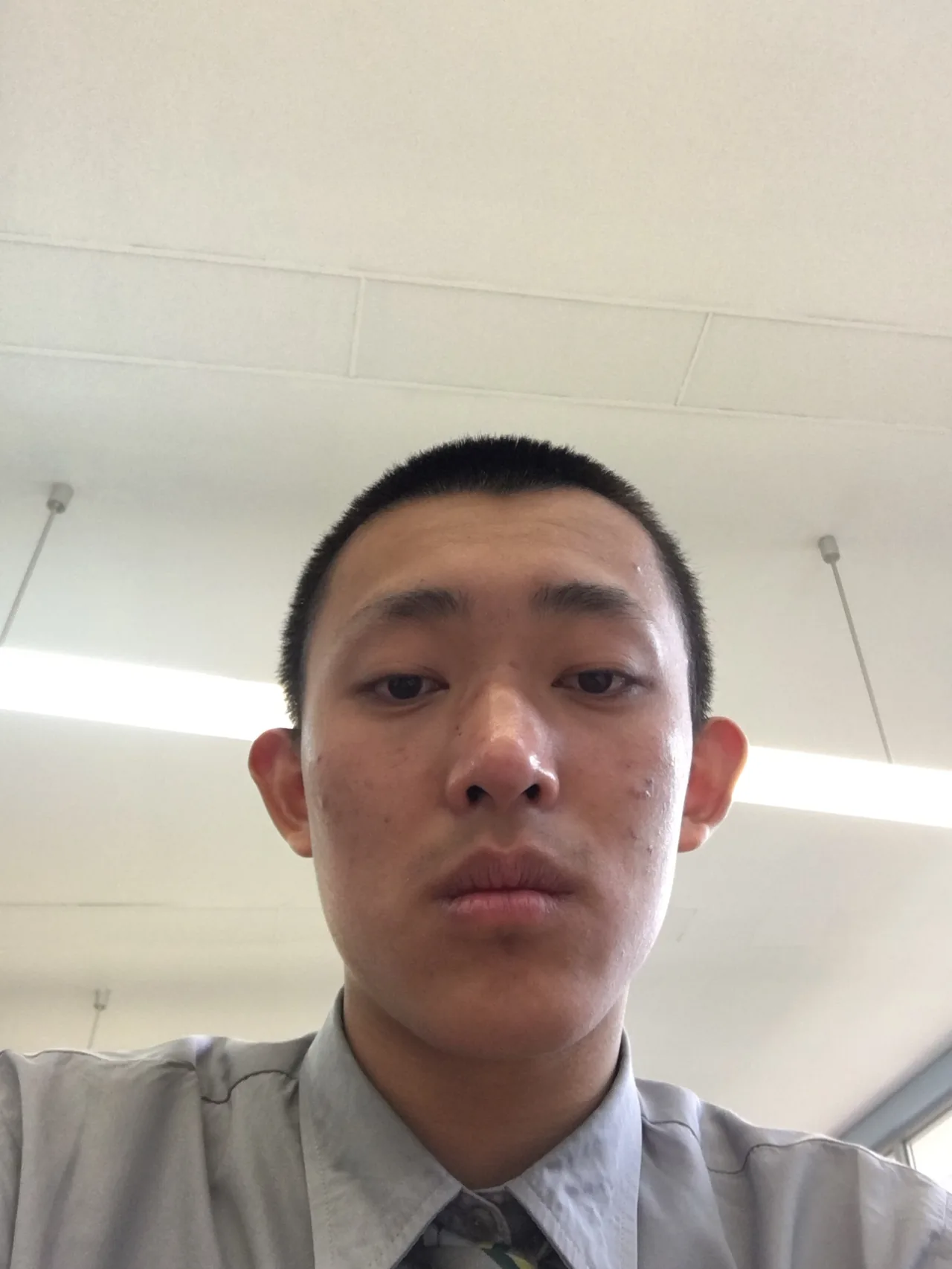
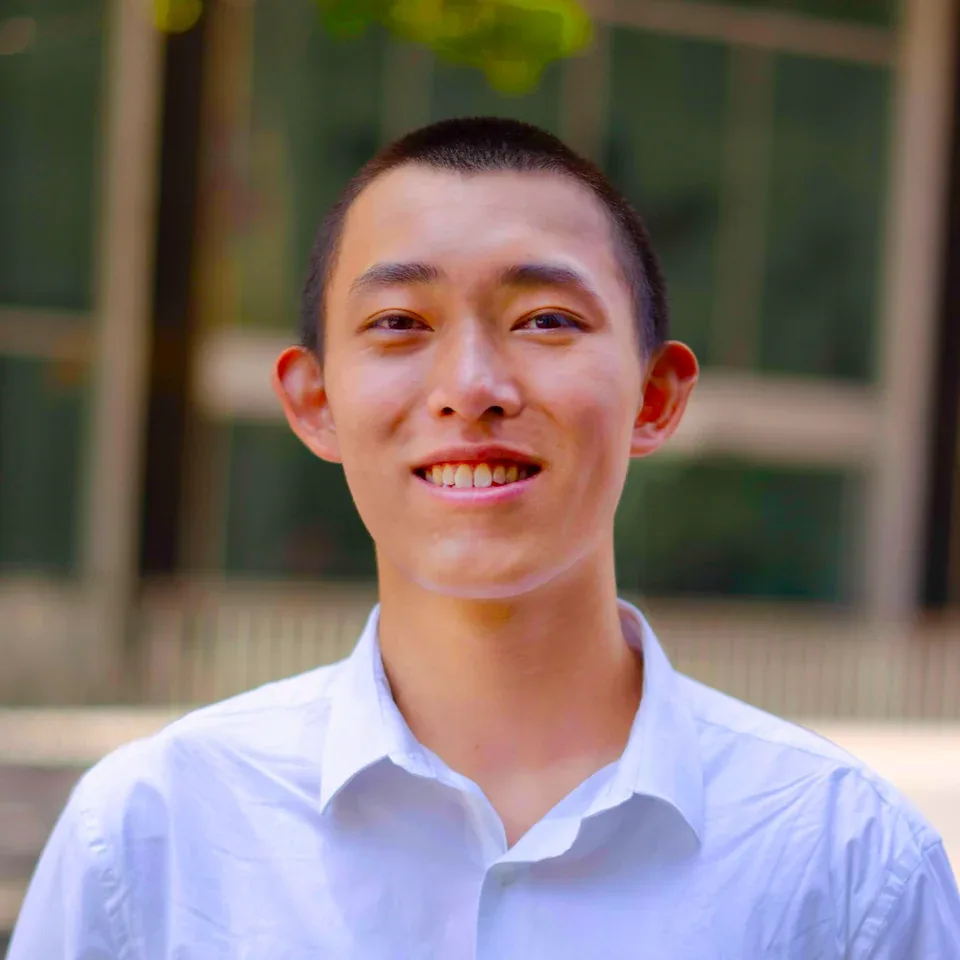
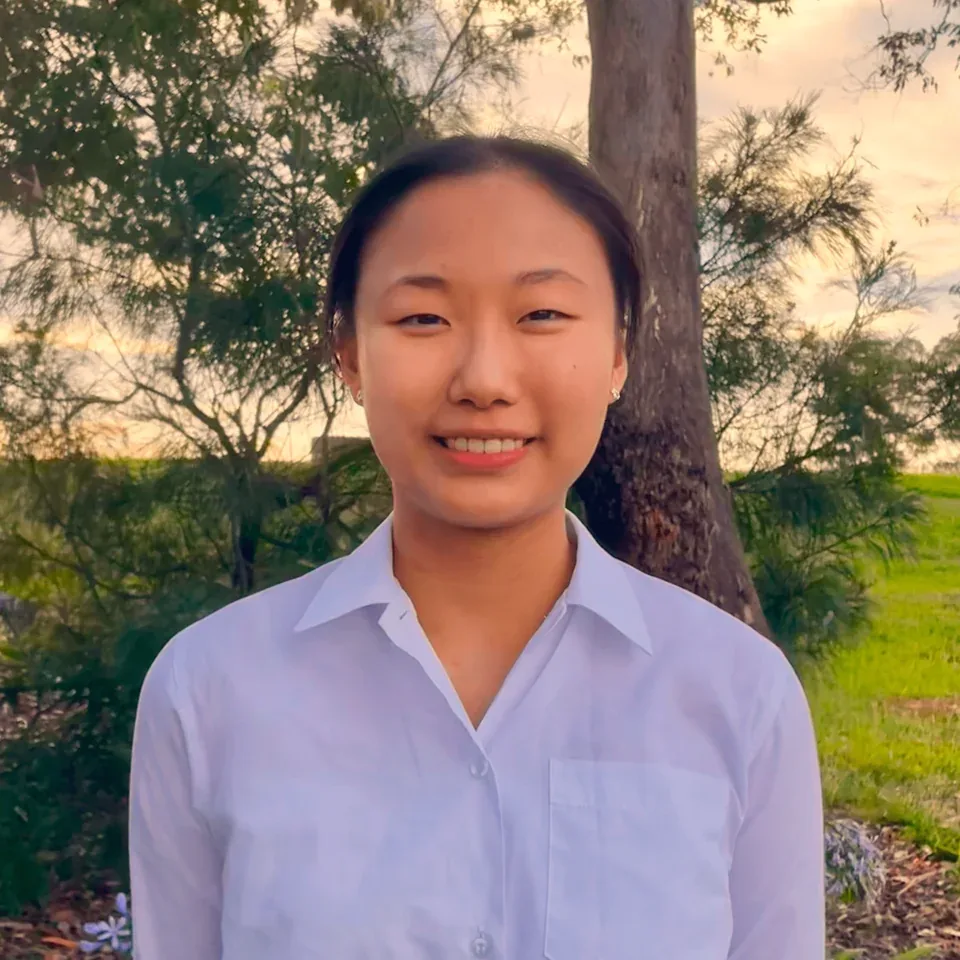
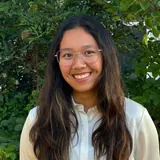
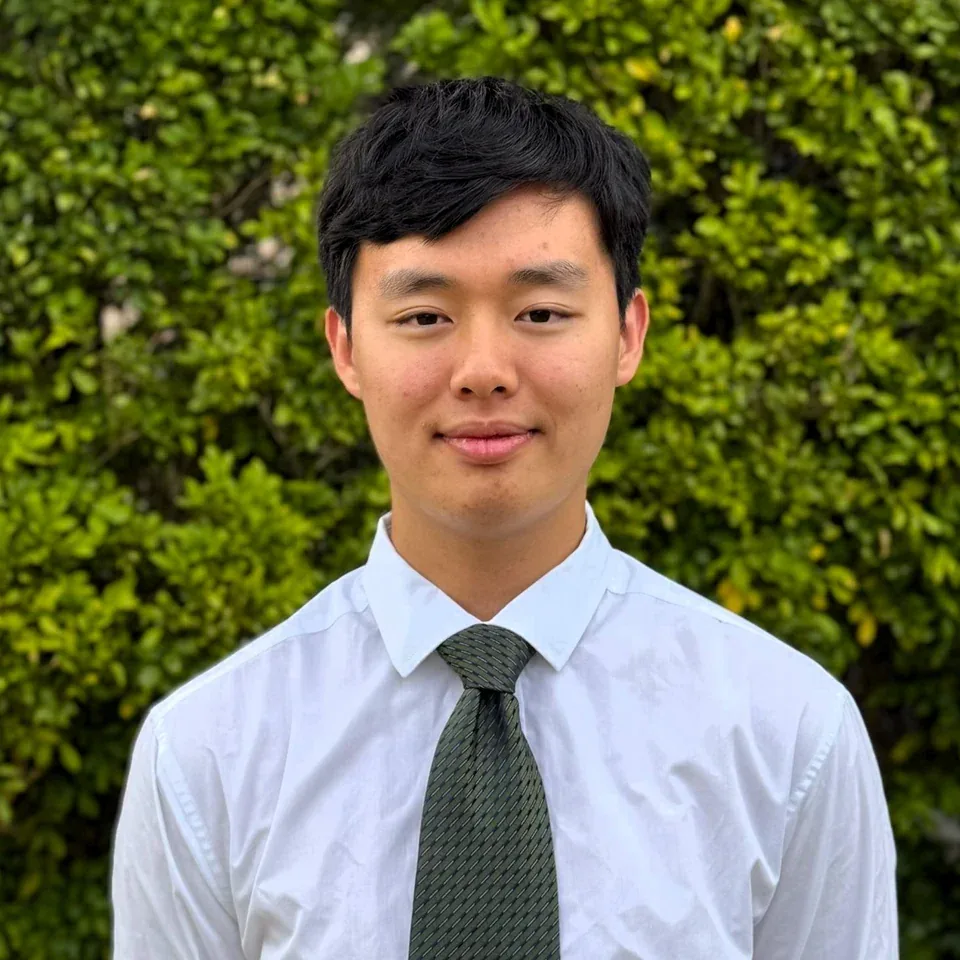
Selfi de Bob con el uniforme de Year 10
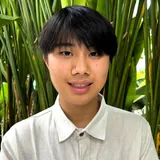
Puesto 50 de la promoción en Ciencias en James Ruse
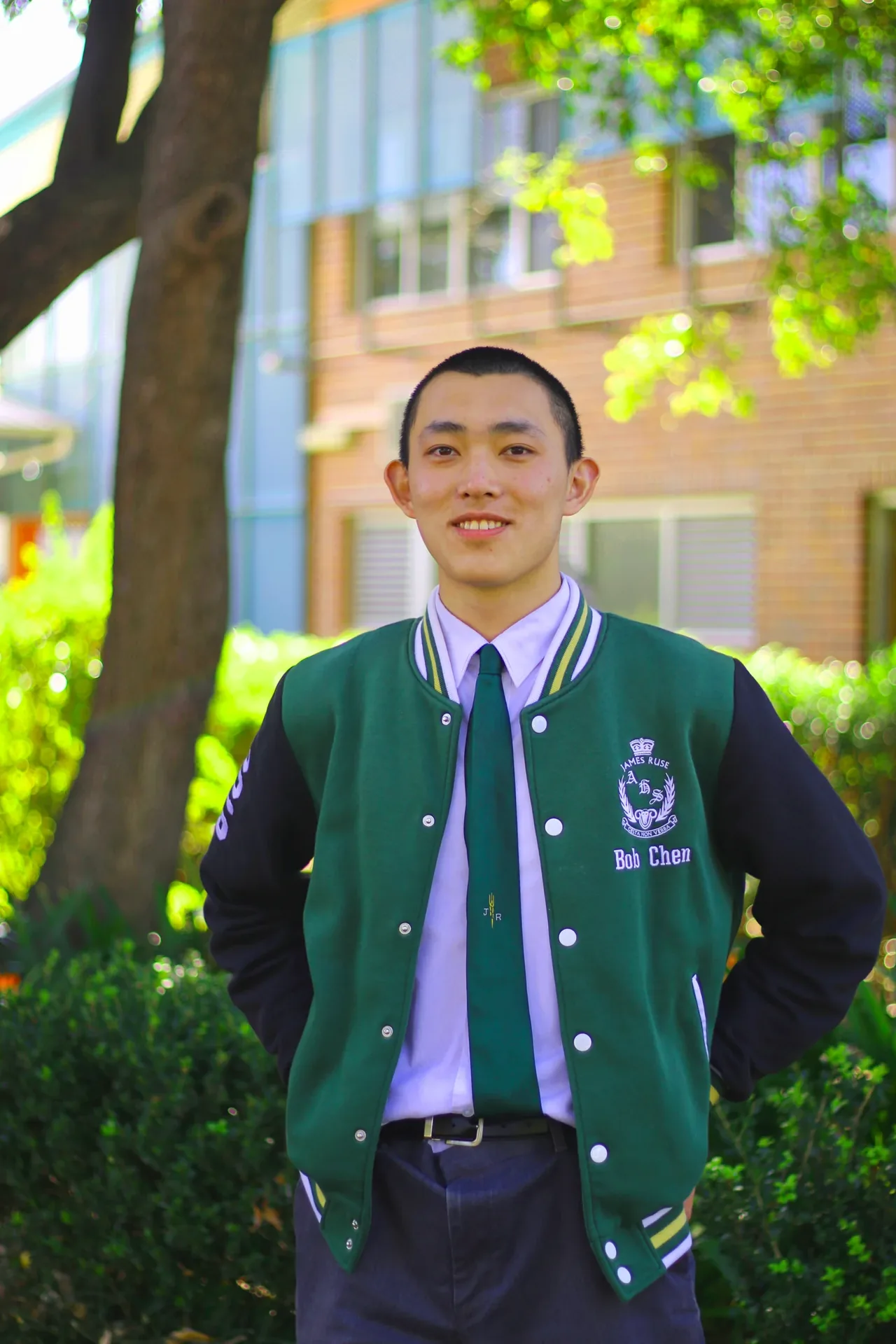
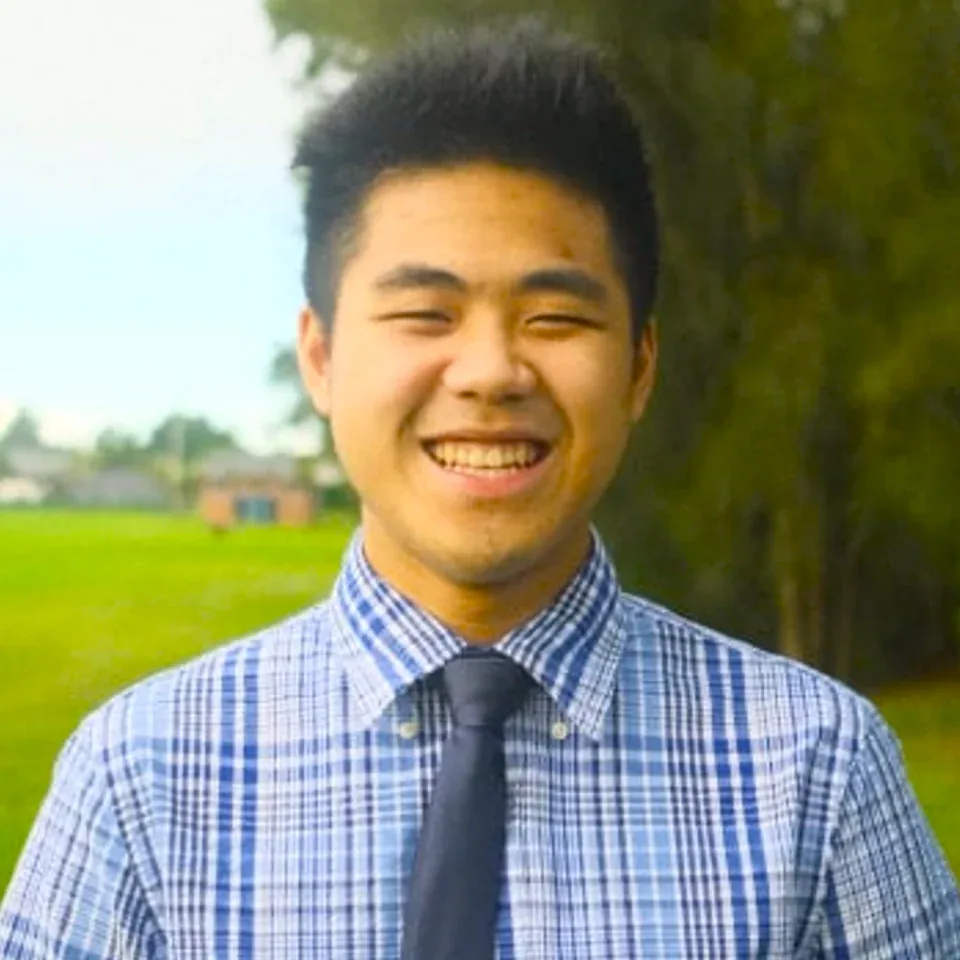
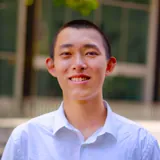
Bob con la chaqueta de James Ruse en Year 12
  • Primero en Física en James Ruse
  • Primer puesto estatal de Física en NSW
  • ATAR 99,85
  • Medicina en la University of Sydney

Tutoría para el HSC en Física, Química y Matemáticas.

Ver una demostración de 10 minutos

Los logros de nuestros estudiantes

Nuestros estudiantes tienen más probabilidades de obtener un Band 6
3,8 veces más que el promedio de NSW
.

Cómo calculamos esta cifra

Calculamos la tasa de Band 6 de Tutorgum en el HSC dividiendo el número de estudiantes de Year 12 Physics que obtuvieron un Band 6 entre el total de nuestros estudiantes al cierre de 2025. La comparamos con la tasa de Física del HSC de Nueva Gales del Sur en 2025.

En el HSC de Química de 2025, la tasa de Band 6 de Tutorgum fue 4,5 veces la tasa de Nueva Gales del Sur.

Antes de quedar primero en Física en James Ruse,me daba miedo contarle mis notas a mamá.

Antes de quedar primero en Física en James Ruse,
me daba miedo contarle mis notas a mamá.

Así era yo en Year 10.

No destacaba.

Pero había algo que se me daba peor que hacerme selfis.

Ciencias.

Porque mis notas eran malas.

Uf.
Quedé en el puesto 50 de toda la promoción.

Odiaba ciencias.

Estudiaba. Memorizaba. Practicaba.

Seguía usando mal las fórmulas.
En los exámenes, adivinaba.

No conseguía un puesto alto ni una nota superior al 90 %.

Perdí el control.

No quería contarle mis notas a mamá.

Así que supe que algo tenía que cambiar.

Con el tiempo conseguí

  1. Primero en Física en James Ruse: primer puesto.
  2. Primer puesto estatal de Física en NSW: primer puesto.
  3. ATAR 99,85.
  4. Medicina en USYD.
1.Explicaciones más claras

Explicamos las cosas de otra manera.
Cada semana, nuestras explicaciones profundas, visuales y claras te ayudan a desarrollar la comprensión.

Comprender bien los temas mejora tu confianza, rapidez y precisión en los exámenes.Esto ayudó a Jade Yang (Meriden) a pasar del 49 % al 91 % en Química del HSC.

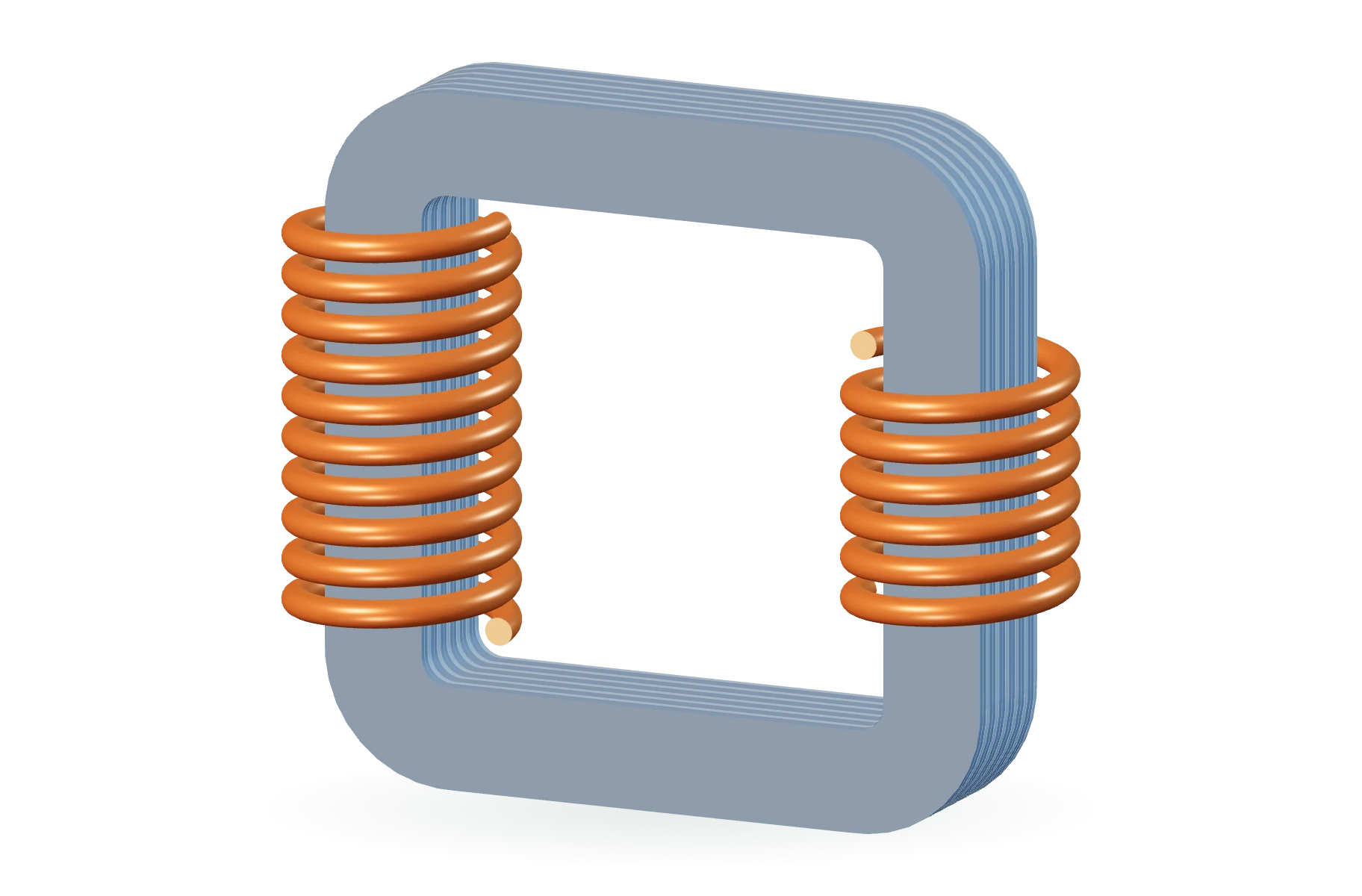
Two copper coils around a layered iron core. A changing current in the first coil creates a changing magnetic field, inducing a voltage in the second.

We all learn about transformers. But what if you could see why every component is the way it is?

First, we’re gonna strip it to the basics — just two coils of wire.

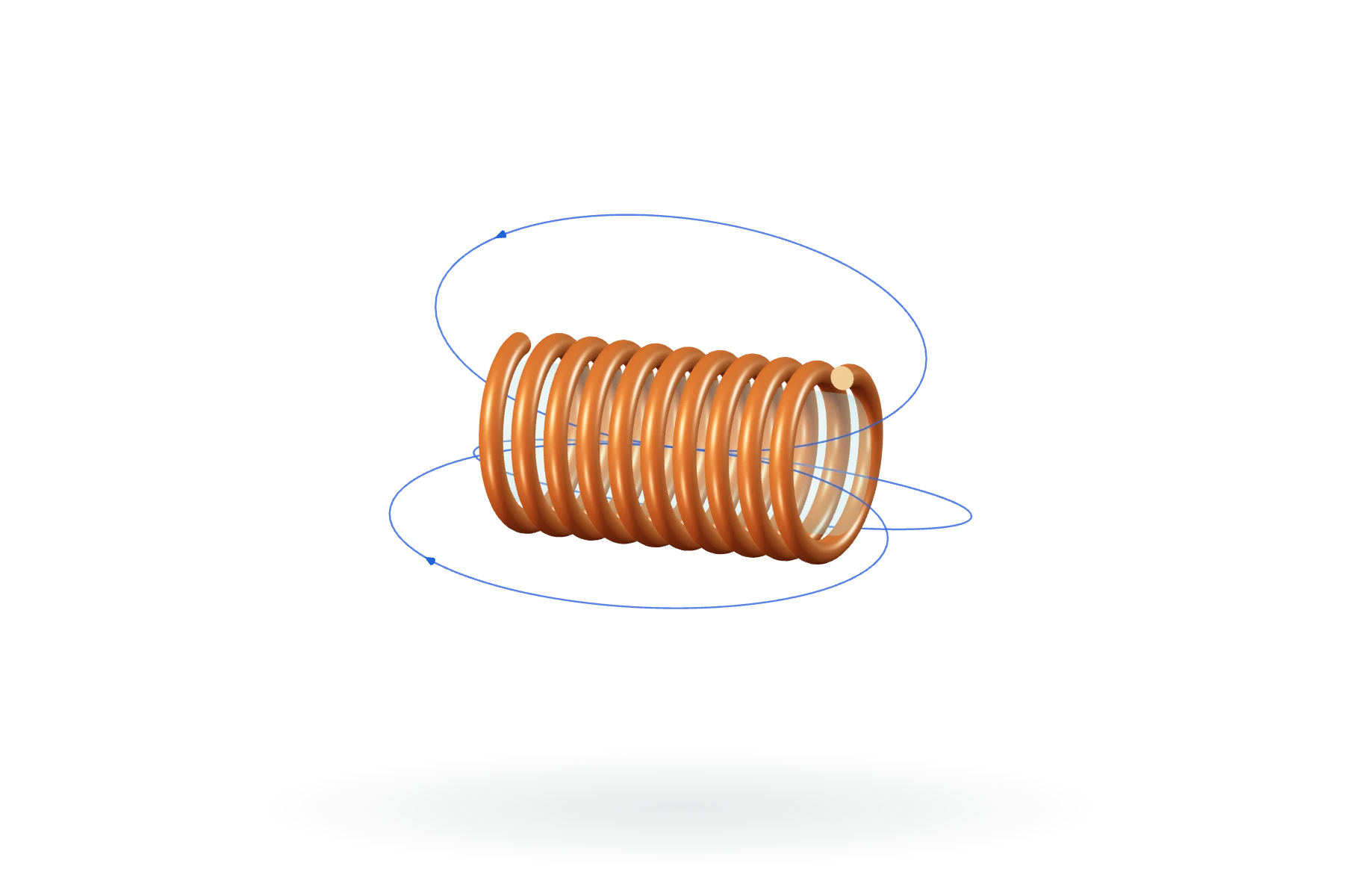
A current through a wire creates a magnetic field around it.

If we wind that wire around, we get a solenoid, which produces a magnetic field.

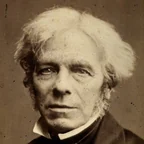
The left coil’s changing magnetic field induces a voltage in the right. That’s Faraday’s law.Photograph of Michael Faraday

Wireless chargers use this air-core setup. But we can make it even more efficient!

We add a soft iron core. Recall this boosts the magnetic field in the LHS solenoid.

The ingenious part is when we extend it into the RHS coil. This way, we bring way more of the magnetic field into the RHS coil, increasing the change in flux.

Close the iron loop to give the magnetic field a return path.

Use insulated iron sheets to reduce eddy currents and heating. That’s our full transformer!

2.Deberes con formato de examen

Ya sabes lo que aprendes
en clase…

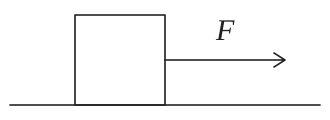
Un bloque sobre una superficie horizontal recibe una fuerza horizontal F.F

Pero luego, en el examen,
te encuentras con…
But then, in the exam, te encuentras con…

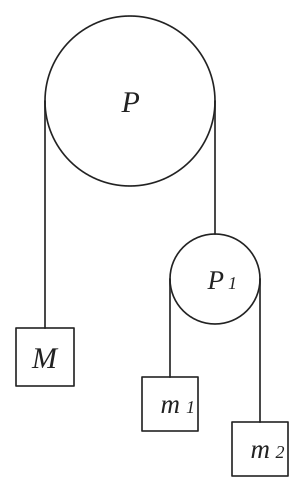
Tres masas conectadas por dos poleas: la masa M cuelga de la polea grande P, que sostiene la polea pequeña P₁ con las masas m₁ y m₂.PP1Mm1m2

¿Y si cada semana tuvieras preguntas como estas en los deberes?

Física de Year 12 · Curvas peraltadas

Una curva de 78 m de radio tiene un peralte de 10 grados. El coeficiente de rozamiento es 0,1.

  1. ¿Cuál es la velocidad ideal para que el coche no necesite rozamiento?
  2. ¿Cuál es la velocidad mínima para tomar esta curva?
  3. Supón ahora que el coeficiente de rozamiento es 0,3. ¿Entre qué velocidades puede tomar el coche la curva? Explica por qué el resultado de la velocidad es negativo.

Y cada pregunta incluyera una solución explicada paso a paso.

Desplegar todoMostrar menos

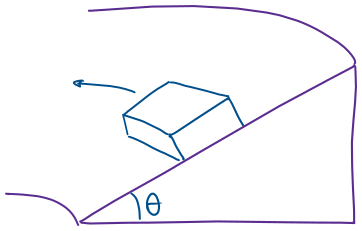
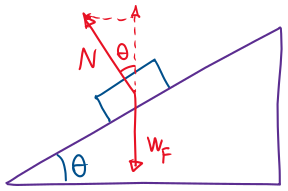
a) ¿Cuál es la velocidad ideal para que el coche no necesite rozamiento?

ANSWER

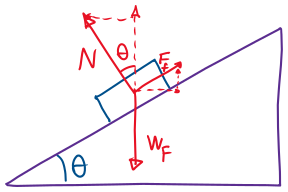
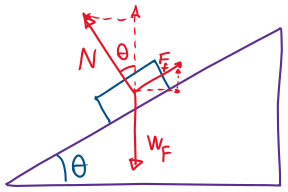
Step 1: Force diagram
Step 2: Force analysis

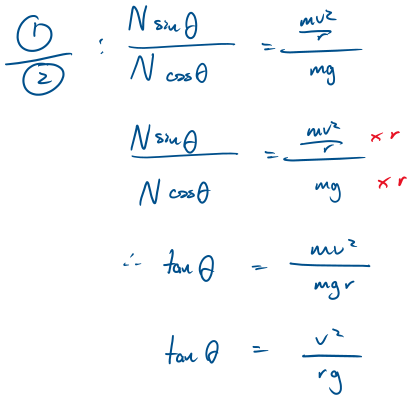
Considering the x – there is a net force! The horizontal part of tension must be the centripetal force!

Considering the y – there is no net force. Thus the vertical part of tension must balance the weight force

Step 3: Set up equation
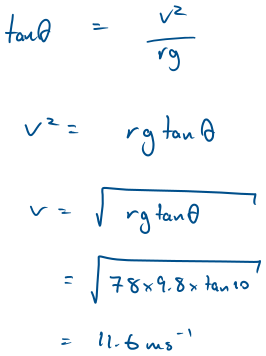
Step 4: Plug and chug

b) ¿Cuál es la velocidad mínima para tomar esta curva?

ANSWER

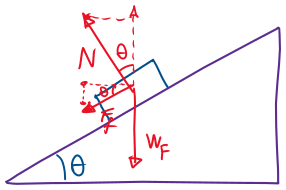
Step 1: Draw force diagram

The force of friction must point up the slope. When the car goes really slow, the car will slip towards the centre.

Step 2: Write out force equations

Vertically:

Ncos⁡θ+Ffsin⁡θ=Wf(1)N\cos \theta +{F}_{f}\sin \theta ={W}_{f}\quad (1)

Horizontally:

FC=Nsin⁡θ−Ffcos⁡θ(2){F}_{C}=N\sin \theta -{F}_{f}\cos \theta \quad (2)

If we transform them:

FC=−Ffcos⁡θ+Nsin⁡θ(2)′{F}_{C}=-{F}_{f}\cos \theta +N\sin \theta \quad {(2)}^{'}
Wf=Ff+sin⁡θ+Ncos⁡θ(1)′{W}_{f}={F}_{f}+\sin \theta +N\cos \theta \quad {(1)}^{'}
Step 3: Maths
(2)′(1)′FCWf=−Ffcos⁡θ+Nsin⁡θFf+sin⁡θ+Ncos⁡θ\frac{{(2)}^{'}}{{(1)}^{'}} \frac{{F}_{C}}{{W}_{f}}=\frac{-{F}_{f}\cos \theta +N\sin \theta }{{F}_{f}+\sin \theta +N\cos \theta }
mv2rmg=−μNcos⁡θ+Nsin⁡θμN+sin⁡θ+Ncos⁡θ\frac{\frac{m{v}^{2}}{r}}{mg}=\frac{-\mu N\cos \theta +N\sin \theta }{\mu N+\sin \theta +N\cos \theta }
v2rg=−μcos⁡θ+sin⁡θμsin⁡θ+cos⁡θ\frac{\frac{{v}^{2}}{r}}{g}=\frac{-\mu \cos \theta +\sin \theta }{\mu \sin \theta +\cos \theta }
v2=−0.1cos⁡10+sin⁡100.1sin⁡10+cos⁡10×78×9.8{v}^{2}=\frac{-0.1\cos 10+\sin 10}{0.1\sin 10+\cos 10}\times 78\times 9.8
v=7.6ms−1v=7.6 {ms}^{-1}

c) Supón ahora que el coeficiente de rozamiento es 0,3. ¿Entre qué velocidades puede tomar el coche la curva? Explica por qué el resultado de la velocidad es negativo.

ANSWER

If you do the calculations, you’ll see that the min speed is negative!

What does this mean!?

It means there is no minimum speed. At any speed the friction will prevent you from sliding down. You could be going at 0m/s and you’ll be able to stay on the curve (there’s just a lot of friction!). it’s like how you can stand on a slanted hill surface.

Step 1: Force equations

Vertically:

Ncos⁡θ+Ffsin⁡θ=Wf(1)N\cos \theta +{F}_{f}\sin \theta ={W}_{f}\quad (1)

Horizontally:

Fc=Nsin⁡θ−Ffcos⁡θ(2){F}_{c}=N\sin \theta -{F}_{f}\cos \theta \quad (2)

At maximum friction:

Ff=μN{F}_{f}=\mu N
Step 2: Maths

Dividing (2) by (1):

FcWf=−μNcos⁡θ+Nsin⁡θμNsin⁡θ+Ncos⁡θ\frac{{F}_{c}}{{W}_{f}}=\frac{-\mu N\cos \theta +N\sin \theta }{\mu N\sin \theta +N\cos \theta }
mv2/rmg=−μcos⁡θ+sin⁡θμsin⁡θ+cos⁡θ\frac{m{v}^{2}/r}{mg}=\frac{-\mu \cos \theta +\sin \theta }{\mu \sin \theta +\cos \theta }
v2rg=−0.3cos⁡10+sin⁡100.3sin⁡10+cos⁡10\frac{{v}^{2}}{rg}=\frac{-0.3\cos 10+\sin 10}{0.3\sin 10+\cos 10}
v2=−89.8{v}^{2}=-89.8

Since v2{v}^{2} cannot be negative, there is no minimum speed.

Step 3: Maximum speed

Friction now acts down the slope, as the car tends to slide up the slope.

Vertically:

Ncos⁡θ−Ffsin⁡θ=Wf(1)N\cos \theta -{F}_{f}\sin \theta ={W}_{f}\quad (1)

Horizontally:

Fc=Nsin⁡θ+Ffcos⁡θ(2){F}_{c}=N\sin \theta +{F}_{f}\cos \theta \quad (2)

Using Ff=μN{F}_{f}=\mu N, divide (2) by (1):

FcWf=μNcos⁡θ+Nsin⁡θNcos⁡θ−μNsin⁡θ\frac{{F}_{c}}{{W}_{f}}=\frac{\mu N\cos \theta +N\sin \theta }{N\cos \theta -\mu N\sin \theta }
v2rg=μcos⁡θ+sin⁡θcos⁡θ−μsin⁡θ\frac{{v}^{2}}{rg}=\frac{\mu \cos \theta +\sin \theta }{\cos \theta -\mu \sin \theta }

Substitute:

v2=78(9.8)(0.3cos⁡10+sin⁡10cos⁡10−0.3sin⁡10){v}^{2}=78(9.8)(\frac{0.3\cos 10+\sin 10}{\cos 10-0.3\sin 10})
v=384.4v=\sqrt{384.4}
v=19.6m/sv=19.6 m/s

Hence the range of speeds is

0≤v≤19.6m/s0\leq v\leq 19.6 m/s

And don’t worry,
there’s plenty more where that came from.

3.Apoyo individual del tutor

Pregunta en clase, al terminar o cuando quieras entre clases. Puedes escribirle a tu tutor en cualquier momento.

No ofrecemos tutoría individual aparte.

Bob Chen
7thNSW Physics state rank
Eunice Huang
1stMaths Ext 2 · North Sydney Girls
Johnny Tran
5thPhysics · James Ruse
Crystal Fu Chen
1stMaths Ext 1 exam · Meriden
Jerome Shin
100%Maths Ext 1 exam · James Ruse
Jaiden Chee
1stMaths Ext 1 internal rank · Reddam House
Linus Guo
1stPhysics exam · James Ruse
Queenie Pham
99.75ATAR
Claire Zhang
2ndMaths Ext 2 · Hurlstone
Victor Yuan
99.70ATAR
Cayleen Xu
100%Chemistry internal assessment · Sydney Girls
Austen Wong
State rankChinese Continuers
Janice Chang
99.60ATAR
Janet Chow
4thPhysics · North Sydney Girls

¿Cómo es una semana normal en Tutorgum?

Primero mira la semana completa y luego únete a la clase de muestra del lunes. El horario depende del grupo.

Toda la semana.

Lunes → Domingo

La clase termina. El aprendizaje continúa.

Lun
Mar
Mié
Jue
Vie
Sáb
Dom
Clase7–9pm
DeberesResuelve preguntas tipo examen y consulta las soluciones paso a paso.
Apoyo del tutorPregunta cuando se te ocurra algo. No tienes que esperar a la próxima clase.
Encuentra tu clase

Lunes 7–9pm

01 / 06
  1. Cuestionario

  2. Repaso

  3. Teoría

  4. Preguntas

  5. Teoría

  6. Preguntas

Pricing &
timetabling.

Year 10/11

Build your HSC foundations.

$55/ hr

$110 per week

  • Includes a two-hour class
  • Homework with step-by-step solutions for every question
  • Help with any extra questions you have
  • Exam and depth study preparation

Year 12

Make your HSC year count.

$60/ hr

$120 per week

  • Includes a two-hour class
  • Homework with step-by-step solutions for every question
  • Help with any extra questions you have
  • Exam and depth study preparation
Book a trial

The first lesson is only charged if you want to continue, otherwise it's totally free!

Find your class.

¿Por qué no pruebas una clase? ¡Sin compromiso!

Solo cobramos la primera clase si decides continuar; si no, es gratis.

FAQ

Group lessons don't work for my child. They're too shy to ask questions.

I was always that shy boy. I was scared to ask questions - I was scared of what other people would think.

  • Students can ask questions 1-1 after class, or between classes via email/text.
  • I ask every student questions during class – so everyone is forced to interact.
  • I monitor every student to see if they’re falling behind.

If you definitely need a 1-1 setting, then you should hire someone else.

But, is the setting more important to you, than your child getting an expert? There’s a lot of tutors out there. But how many of them have topped NSW? Not all of them know chemical equilibrium and electromagnetism like I do. Or how to explain it to get the "Aha!" moment. Or why students lose marks. Or how to fix it. And that means they won't produce results, like helping Kirsten Chu, 2022, move from 56% to 91%.

Can my child catchup to the group pace?

No one wants to be in an environment where they're far behind everyone else. To help you judge if it's suitable, the average student we get comes in with marks at, or a bit below average. We get a mix of selective (NSB, NSG, Ruse etc), private (Scots, St Patricks, Meriden etc) and comprehensive schools (Castle Hill, Carlingford HS etc). We help them catchup by answering questions after class and providing support material for previous topics.

In class when we go through a new topic, we will always explain it from scratch - so even if you have missed out on previous concepts, it won't stop you from getting the new ones.

But what if my child has questions?

Our group is run differently to most tutors. I am willing to spend 1-1 time with you. If you have questions – you can ask me 1-1 after class! And throughout the week! I’ll spend an hour with you if you need it.

How do your classes work?

We have one 2 hour session per week. It's online, via Zoom.

What do you do in class?

We start the lesson with a 10 min quiz. Then we go through a new concept and then do a few questions to solidfy it. Then we repeat this for the whole lesson. When exam time comes, we do revision lessons where a practice exam is sent before class, and the hard questions students request are reviewed in class.

How does payment work?

We accept payment via Bank Transfer. We typically bill termly. If you wish to discontinue, all unused lessons will be refunded, in full, to you.

What if I miss a lesson?

We highly recommend not to skip lessons for exams - if you are pressed for time, it is best if you skip the homework but come anyway. If you are away for a lesson, all materials will be provided and a recording will be made for you, however, the lesson will not be refunded.

Do you have other class times?
Do you have classes in the holidays?

Yes - classes run as per usual. It's as if the holidays do not exist. But we do not run intensive lessons in the holidays as they are ineffective for students.

Group size

It varies, but often hovers around 5

What do students need to join online?

Enthusiasm, pen, and preferably a dedicated book. All other resources will be sent.

How do you prepare students for School Exams?

The major reason why students do not do well in their exams is because they lack knowledge of the core concepts. After doing content with us, most students do not experience this anymore. From this strong foundation, we do weekly exam style problems in the homework - meaning weekly practice for exams.

Just before exams, we will also give access to our private collection of school past papers which is the best practice. We will also go through exam technique in class before exams.

When will you finish the syllabus?

In the accelerated classes, we usually finish the entire syllabus 1 term before trials (final Year 12 exams in Term 3 Week 2). This gives us ~7 weeks of revision before trials. We will then have ~10 weeks of revision after Trials for the HSC. We will revise each module with a weekly exam on that module, and then do mock papers.

In School Paced classes, we match school - so we have around 6 weeks of revision for HSC.

What order do you cover the syllabus content in?

Module 1, 2, 3, 4, 5, 6, 7, 8.

But that order isn't what my school is doing!

Some schools do decide to do it out of order. In my experience, this is ok because the same content is covered by the time you sit the exam. The most important factor is that the student learns something - even if it's not synchronised with school.

What is your typical student like?

Our students typically come with marks at, or a bit below average. We get a mix of selective (NSB, NSG, Ruse etc), private (Scots, St Patricks, Meriden etc) and comprehensive schools (Castle Hill, Carlingford HS etc).

What does a good candidate for your program look like?

Your improvement does not depend on how smart you are. The most important quality that determines success in the program is your willingness to work. Students that have shown dramatic improvements like Jade Yang and Kirsten Chu put in 10h+ per week into Physics and Chemistry. We make it easy for you - as long as you do all the homework (exam practice) and come to every class, you will improve.

The question is - will you do it?

Do you offer online Physics and Chemistry tutoring?

Yes. Our online Physics tutoring and Chemistry tutoring are small-group classes for Year 11 and Year 12 students studying the NSW HSC. Physics is sometimes shortened to ‘phys’, but the course is the same HSC Physics subject. Lessons take place on Zoom, with exam-style homework, worked solutions and 1-to-1 tutor support between classes.

Explore Physics tutoring or Chemistry tutoring to see the courses, or check prices and class times.

Can I join from Sydney, regional NSW or outside NSW?

Yes. Classes are online, so you can join from Sydney, Newcastle, Wollongong, regional NSW or elsewhere in Australia. You do not need to travel to a tutoring centre.

The Physics and Chemistry courses are designed for the NSW HSC. If you study another state's syllabus or a different curriculum, contact us with your year and topics so we can discuss whether the course is suitable. Online access does not mean every curriculum is covered.

Still have a question?

Call 0490 496 078