
Inductive Effects on Acidity: How Substituents Change Acid Strength
Learn how electron-withdrawing groups stabilise conjugate bases, why their inductive effect weakens with distance, and how molecular structure changes acid strength. Includes worked examples and challenging extension questions.
Replacing one hydrogen in acetic acid’s methyl group with chlorine makes the acid significantly stronger. The hydrogen that leaves is still attached to the same carboxyl group, yet the pKa drops from approximately 4.76 to 2.86.
Predict what happens when chlorine is added. Does it make the O-H bond easier to break, or does it change something about the products formed when the acid loses its proton?
The more useful explanation is the second one. Chlorine helps stabilise the negative charge left behind when the acid donates a proton. This effect is called the inductive effect, and it provides a way to predict how molecular structure influences acidity.
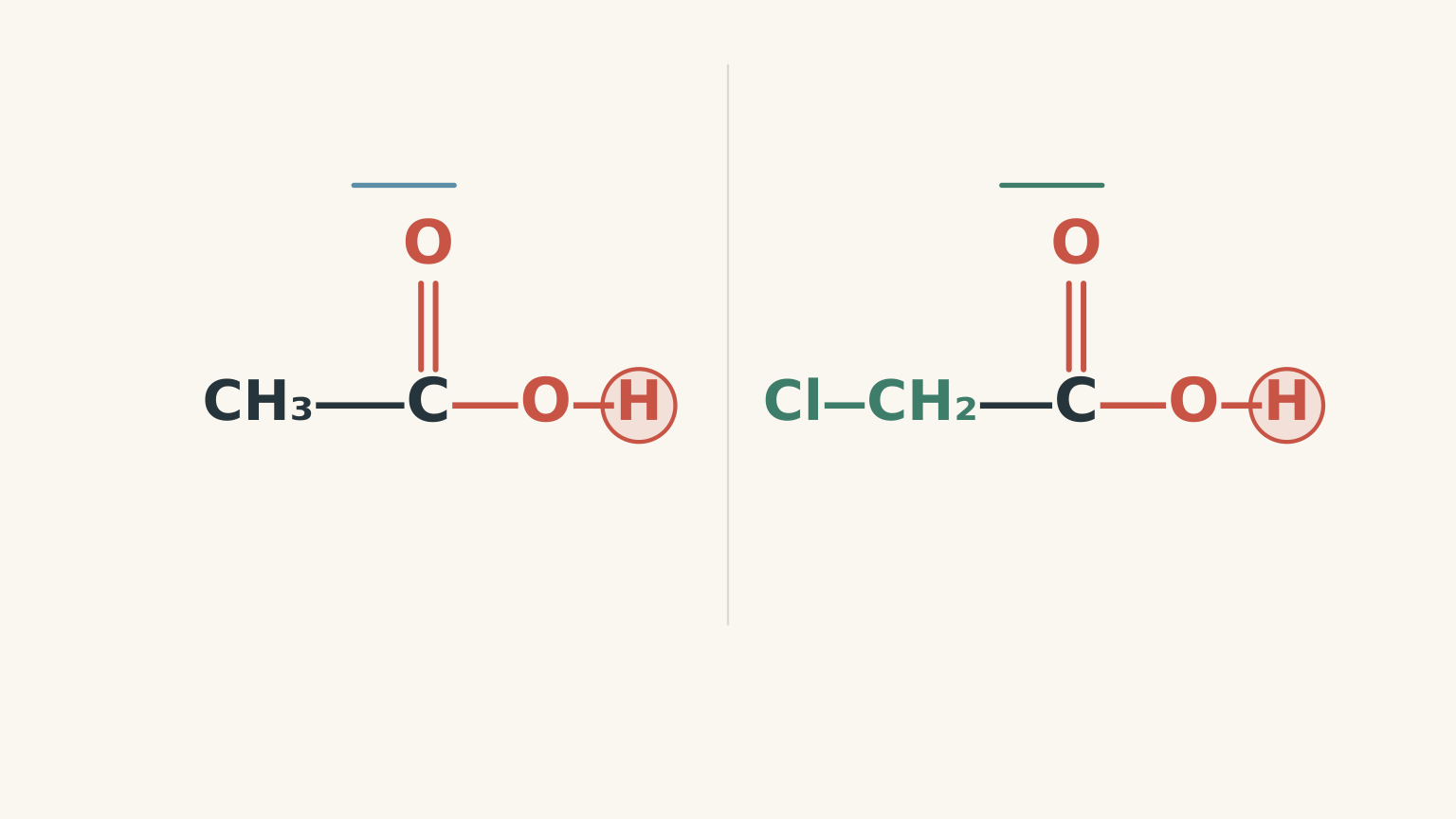
Due to technical limitations, this figure may display incorrectly or contain inaccuracies. Please check key details against your course materials.
Syllabus scope: This is extension chemistry beyond the required Year 12 acid-base content. The Brønsted-Lowry model, conjugate acid-base pairs, and acid dissociation provide the foundation, but understanding inductive effects is not an additional HSC assessment requirement. The NSW Chemistry 11-12 Syllabus (2025) is scheduled for implementation from 2028, with its first HSC examination in 2029. See NESA’s syllabus implementation timeline.
01The acid-base foundation
Before comparing acids, we need to establish what actually happens when an acid donates a proton.
Under Brønsted-Lowry theory:
- An acid donates a proton, H⁺.
- A base accepts a proton, H⁺.
- A conjugate acid-base pair consists of two substances that differ by one proton.
For example, when ethanoic acid (acetic acid) reacts with water:
\[ \ce{CH3COOH + H2O <=> CH3COO^- + H3O^+} \]
Ethanoic acid donates H⁺ and becomes the ethanoate ion, \(\mathrm{CH_{3}COO}^{-}\).
Water accepts H⁺ and becomes the hydronium ion, \(\mathrm{H_{3}O}^{+}\).
The conjugate pairs are:
| Acid-base pair | Relationship |
|---|---|
| \(\ce{CH3COOH/CH3COO^-}\) | Acid and its conjugate base |
| \(\ce{H2O/H3O^+}\) | Base and its conjugate acid |
You should also recognise amphiprotic substances. These can donate or accept a proton depending on the reaction partner.
For example, hydrogen carbonate, \(\mathrm{HCO_{3}}^{-}\), can donate a proton:
\[ \ce{HCO3^- + H2O <=> CO3^2- + H3O^+} \]
It can also accept a proton:
\[ \ce{HCO3^- + H3O^+ <=> H2CO3 + H2O} \]
This distinction matters because the strength of an acid is connected to the stability of the conjugate base it forms after donating H⁺.
Measuring acid strength
The acid dissociation constant, \(K_a\), describes the position of the equilibrium when an acid dissociates in a particular solvent.
A larger \(K_a\) means greater dissociation and therefore a stronger acid.
Chemists often use pKa instead:
\[ pK_a=-\log_{10}(K_a) \]
This gives us an important comparison rule:
- Lower pKa means a stronger acid.
- Higher pKa means a weaker acid.
- A decrease of one pKa unit corresponds to a tenfold increase in \(K_a\).
For example, an acid with pKa 3 is ten times stronger in terms of its dissociation constant than an acid with pKa 4, under the same conditions.
Remember that acid strength and concentration are different things. A concentrated weak acid does not automatically become a strong acid.
The relationship between \(K_a\) and pKa follows the standard equilibrium treatment described in the IUPAC Gold Book.
02Why the conjugate base matters
Consider a carboxylic acid, which contains the functional group \(-\ce{COOH}\).
We can represent a general carboxylic acid as:
\[ \ce{RCOOH} \]
Here, \(R\) represents the rest of the molecule, such as a carbon chain.
When the acid donates its proton, it forms a carboxylate ion:
\[ \ce{RCOOH <=> RCOO^- + H^+} \]
Notice that the product has a negative charge.
This creates an important question: how comfortable is the molecule with carrying that negative charge?
The answer helps determine how readily the acid donates its proton.
The existing stability of a carboxylate ion
A carboxylate ion has an important structural advantage. Its negative charge is delocalised across two oxygen atoms.
This happens through resonance.
We can represent the two main resonance contributors as:
\[ \ce{R-C(=O)-O^- <-> R-C(-O^-)=O} \]
These are not two separate molecules rapidly switching between structures. They are two representations of the same resonance hybrid.
In the actual ion, the negative charge is shared across both oxygen atoms, and the two carbon-oxygen bonds are equivalent.
This delocalisation stabilises the carboxylate ion.
Now consider what happens when we change the rest of the molecule.
We are no longer changing the carboxyl group itself. We are changing the environment around it.
That is where the inductive effect becomes important.
03Understanding the inductive effect
Imagine attaching a chlorine atom to the carbon chain next to a carboxylic acid group.
Chlorine is more electronegative than carbon. It attracts shared electrons more strongly, making the carbon-chlorine bond polar.
This influences the distribution of electrons in neighbouring bonds as well.
The resulting redistribution of electron density through the molecular framework is called the inductive effect.
In the standard introductory model, the effect is transmitted through sigma (\(\sigma\)) bonds. These are the single covalent bonds that form the framework connecting atoms in the molecule.
An electron-withdrawing substituent pulls electron density towards itself.
Examples include:
- Fluorine atoms.
- Chlorine atoms.
- Groups containing several electronegative atoms, such as \(\ce{CF3}\).
These are called electron-withdrawing groups.
How does this affect acidity?
Return to our carboxylic acid.
When it loses H⁺, the conjugate base carries a negative charge. A nearby electron-withdrawing group helps stabilise this negatively charged product.
In other words, it makes the formation of the conjugate base more favourable relative to the undissociated acid.
This shifts the acid dissociation equilibrium towards the products.
The overall relationship is:
\[ \begin{aligned} \text{Electron withdrawal} &\uparrow\\ \text{Conjugate-base stability} &\uparrow\\ K_a &\uparrow\\ pK_a &\downarrow \end{aligned} \]
This is the central idea behind inductive effects on acidity.
A useful way to picture it is to imagine a line of people passing a gentle tug along a chain. The person closest to the original pull experiences the strongest influence. Each additional connection weakens the effect.
The analogy captures the decreasing influence with distance. It does not mean electrons physically travel down the chain. Instead, the electron distribution is polarised across the bonds.
A common misconception: chlorine simply weakens the O-H bond
It is tempting to explain the stronger acidity by saying that chlorine pulls electrons away from the O-H bond, making hydrogen easier to remove.
This is an incomplete explanation.
Acid strength is determined by the equilibrium between the acid and its dissociation products. The stability of the conjugate base is particularly important.
An electron-withdrawing substituent can make an acid stronger by stabilising the negatively charged conjugate base, even though the proton being donated is several bonds away from that substituent.
The important comparison is the relative stability of the acid and its conjugate base, not simply the strength of one bond considered in isolation.
04Distance matters: the closer the substituent, the stronger its effect
The inductive effect does not extend equally throughout a molecule.
As the distance between an electron-withdrawing group and the carboxyl group increases, its influence generally becomes weaker.
Consider three structural isomers of chlorobutanoic acid.
They all contain:
- One carboxyl group.
- One chlorine atom.
- The same molecular formula.
The difference is the position of the chlorine atom.
For carboxylic acid naming, the carboxyl carbon is carbon 1.
This gives us three important positions:
- The alpha (\(\alpha\)) carbon is carbon 2, directly next to the carboxyl group.
- The beta (\(\beta\)) carbon is carbon 3.
- The gamma (\(\gamma\)) carbon is carbon 4.
The representative aqueous pKa values are:
| Compound | Position of chlorine | pKa |
|---|---|---|
| 2-chlorobutanoic acid | Alpha | 2.86 |
| 3-chlorobutanoic acid | Beta | 4.05 |
| 4-chlorobutanoic acid | Gamma | 4.52 |
These values are consistent with the substituent-effect data presented in OpenStax Organic Chemistry.
The pattern is clear.
2-chlorobutanoic acid is the strongest acid, while 4-chlorobutanoic acid is the weakest of the three.
Why?
In 2-chlorobutanoic acid, chlorine is directly attached to the carbon adjacent to the carboxyl group. Its electron-withdrawing influence is strongest at the acid group.
In 3-chlorobutanoic acid, an additional carbon separates chlorine from the carboxyl group. The effect is weaker.
In 4-chlorobutanoic acid, the chlorine is even further away, so its influence on the carboxylate ion is smaller again.
Notice something important: the inductive effect does not suddenly disappear after one carbon. It gradually weakens as the distance increases.
This gives us a useful prediction rule:
For otherwise comparable carboxylic acids, an electron-withdrawing substituent generally increases acidity more when it is closer to the carboxyl group.
05What happens when there is more than one electron-withdrawing group?
So far, we have considered acids containing one chlorine atom.
What happens if we add another?
Consider the following series:
| Acid | Structure | pKa |
|---|---|---|
| Acetic acid | \(\ce{CH3COOH}\) | 4.76 |
| Chloroacetic acid | \(\ce{ClCH2COOH}\) | 2.86 |
| Dichloroacetic acid | \(\ce{Cl2CHCOOH}\) | 1.29 |
| Trichloroacetic acid | \(\ce{Cl3CCOOH}\) | 0.65 |
These are representative reported experimental values; small differences between reference tables can occur because of measurement conditions.
Each additional chlorine atom increases the electron-withdrawing influence around the carboxyl group.
This makes the conjugate base more stable and increases the tendency of the acid to dissociate.
Consequently, pKa decreases as the number of chlorine atoms increases.
However, do not assume that every additional chlorine atom produces exactly the same change in pKa.
The pKa scale is logarithmic, and the electronic environment changes as more substituents are added. The effect is not a simple fixed numerical adjustment for each chlorine atom.
We will examine this more closely in the questions.
06When the inductive effect is not the whole story
The inductive effect is an excellent starting model, particularly when comparing substituted carboxylic acids with saturated carbon chains.
However, not every substituent influences acidity through induction alone.
Another important mechanism is resonance donation or withdrawal.
This becomes particularly relevant when the substituent is connected to the carboxyl group through a conjugated system, such as a benzene ring.
For example, consider three benzoic acids:
| Compound | Substituent | pKa |
|---|---|---|
| p-Nitrobenzoic acid | \(\ce{NO2}\) | 3.41 |
| Benzoic acid | \(\ce{H}\) | 4.19 |
| p-Methoxybenzoic acid | \(\ce{OCH3}\) | 4.46 |
Here, para (p-) means that the substituent is attached to the carbon opposite the carboxyl group on the benzene ring.
These values are reported in OpenStax’s comparison of substituted benzoic acids.
The nitro group, \(\ce{NO2}\), withdraws electron density through both inductive and resonance effects. This helps stabilise the conjugate base, making p-nitrobenzoic acid stronger than benzoic acid.
The methoxy group, \(\ce{OCH3}\), presents a more interesting situation.
Oxygen is highly electronegative, so it can withdraw electron density through induction. However, its lone pair of electrons can also donate electron density into the benzene ring through resonance.
In this case, the resonance donation outweighs the inductive withdrawal. The overall effect is electron donation, which makes the conjugate base less favourable and increases the pKa.
This is why simply identifying an electronegative atom is not always enough to predict acidity.
You need to consider how the substituent is connected to the acid group and whether other electronic effects are operating.
The distinction between inductive and electrostatic field contributions is also more subtle in advanced treatments than the simple through-bond model suggests. IUPAC discusses this distinction in its definition of the inductive effect.
Worked example: Comparing acetic acid and chloroacetic acid
Acetic acid has a pKa of 4.76, while chloroacetic acid has a pKa of 2.86.
Calculate how many times greater the acid dissociation constant of chloroacetic acid is compared with that of acetic acid.
Step 1
Chloroacetic acid has the lower pKa, so it is the stronger acid.
We need to calculate the ratio of their acid dissociation constants.
Step 2
For two acids, A and B:
\[ \frac{K_{a,A}}{K_{a,B}} = 10^{pK_{a,B}-pK_{a,A}} \]
Here, A is chloroacetic acid and B is acetic acid.
Step 3
\[ \begin{aligned} \frac{K_{a,\text{chloro}}}{K_{a,\text{acetic}}} &=10^{4.76-2.86}\\ &=10^{1.90}\\ &\approx79.4 \end{aligned} \]
Step 4
Chloroacetic acid has an acid dissociation constant approximately 79 times greater than that of acetic acid.
This means it dissociates more readily under the same aqueous conditions.
The chlorine atom is attached to the alpha carbon, so its inductive effect helps stabilise the carboxylate ion.
Worked example: How does the position of chlorine change acidity?
Three acids have the following pKa values:
- 2-chlorobutanoic acid: 2.86
- 3-chlorobutanoic acid: 4.05
- 4-chlorobutanoic acid: 4.52
Determine which is the strongest acid and calculate how many times greater its \(K_a\) is than that of the weakest acid.
Step 1
The lowest pKa belongs to 2-chlorobutanoic acid.
The highest pKa belongs to 4-chlorobutanoic acid.
Therefore, 2-chlorobutanoic acid is the strongest, and 4-chlorobutanoic acid is the weakest.
Step 2
\[ \frac{K_{a,2}}{K_{a,4}} = 10^{pK_{a,4}-pK_{a,2}} \]
Step 3
\[ \begin{aligned} \frac{K_{a,2}}{K_{a,4}} &=10^{4.52-2.86}\\ &=10^{1.66}\\ &\approx45.7 \end{aligned} \]
Step 4
The acid dissociation constant of 2-chlorobutanoic acid is approximately 46 times greater than that of 4-chlorobutanoic acid.
Both molecules contain one chlorine atom, but its position changes the strength of its inductive influence.
The chlorine in 2-chlorobutanoic acid is closer to the carboxyl group, so it provides greater stabilisation of the conjugate base.
The difference in acidity is therefore a consequence of molecular structure, not the number of chlorine atoms alone.
07Questions and solutions
Question 1
Glycolic acid, \(\ce{HOCH2COOH}\), has a pKa of 3.83, while acetic acid, \(\ce{CH3COOH}\), has a pKa of 4.76.
Considering the carboxyl proton in each molecule:
a) Identify the stronger acid.
b) Calculate the ratio of their acid dissociation constants.
c) Explain the structural reason for the difference in acidity.
Solution 1
Glycolic acid is the stronger acid, with an acid dissociation constant approximately 8.5 times greater than that of acetic acid.
a) Identify the stronger acid.
Glycolic acid has the lower pKa:
\[ 3.83 < 4.76 \]
Therefore, glycolic acid is stronger.
b) Calculate the ratio of acid dissociation constants.
\[ \begin{aligned} \frac{K_{a,\text{glycolic}}}{K_{a,\text{acetic}}} &=10^{4.76-3.83}\\ &=10^{0.93}\\ &\approx8.51 \end{aligned} \]
Glycolic acid has approximately 8.5 times the acid dissociation constant of acetic acid.
c) Explain the structural difference.
Glycolic acid contains a hydroxyl group attached to the alpha carbon.
The oxygen atom is highly electronegative and withdraws electron density through the sigma-bond framework.
This inductive effect stabilises the carboxylate ion formed after the carboxyl proton is donated.
Acetic acid has a methyl group in the equivalent position, which is comparatively electron-donating.
Therefore, glycolic acid forms a more favourably stabilised conjugate base and is the stronger acid.
The comparison concerns the carboxyl proton, not the hydrogen attached to the hydroxyl oxygen.
Question 2
Consider three haloacetic acids with the following experimentally reported aqueous pKa values at approximately 25°C:
| Acid | pKa |
|---|---|
| Fluoroacetic acid | 2.586 |
| Chloroacetic acid | 2.866 |
| Bromoacetic acid | 2.902 |
The structures are \(\ce{FCH2COOH}\), \(\ce{ClCH2COOH}\), and \(\ce{BrCH2COOH}\), respectively.
a) Rank the acids from strongest to weakest.
b) Calculate the ratio of the acid dissociation constant of fluoroacetic acid to that of bromoacetic acid.
c) Explain why the results support an inductive-effect model. Why should you avoid assuming that the difference in electronegativity directly determines the numerical difference in acid strength?
The pKa values are drawn from the measurements and literature comparisons discussed by Bowden, Clegg, and Brimblecombe in their study of haloacetic acids (Journal of Atmospheric Chemistry, 1998).
Solution 2
Fluoroacetic acid is the strongest acid, followed by chloroacetic acid and then bromoacetic acid. Its acid dissociation constant is approximately 2.1 times that of bromoacetic acid.
a) Rank the acids.
The strongest acid has the lowest pKa.
Therefore:
\[ \text{Fluoroacetic} > \text{Chloroacetic} > \text{Bromoacetic} \]
b) Calculate the ratio of acid dissociation constants.
\[ \begin{aligned} \frac{K_{a,\text{fluoro}}}{K_{a,\text{bromo}}} &=10^{2.902-2.586}\\ &=10^{0.316}\\ &\approx2.07 \end{aligned} \]
Fluoroacetic acid has approximately 2.1 times the acid dissociation constant of bromoacetic acid.
c) Explain the trend.
All three molecules have the same basic structure. The halogen is attached to the alpha carbon, so its distance from the carboxyl group is unchanged.
The main difference is the identity of the halogen.
Fluorine is more electronegative than chlorine, which is more electronegative than bromine.
The stronger electron-withdrawing influence of fluorine helps stabilise the carboxylate ion more effectively.
However, electronegativity alone does not give an exact numerical prediction of pKa. The measured value also reflects the complete molecular structure and the stabilisation of the acid and its ions by water.
The inductive effect provides a useful qualitative prediction, not a universal equation that converts electronegativity directly into acid strength.
Question 3
Consider the following series of carboxylic acids:
| Acid | pKa |
|---|---|
| Acetic acid | 4.76 |
| Chloroacetic acid | 2.86 |
| Dichloroacetic acid | 1.29 |
| Trichloroacetic acid | 0.65 |
A student makes the following claim:
“Every time another chlorine atom is added, the acid becomes stronger by the same proportional factor because each chlorine atom has the same electron-withdrawing effect.”
Evaluate this claim.
Calculate the ratio of the acid dissociation constants for each consecutive pair of acids, then use the results to explain whether the student’s model is supported.
The values are representative experimental values reported in the supporting information for a Royal Society of Chemistry publication (Swift, Seaton, and Rimmer).
Solution 3
The student’s claim is incorrect. Each additional chlorine atom increases acidity, but the proportional increase in the acid dissociation constant is not constant.
We can test this by calculating the consecutive ratios.
First comparison: acetic acid and chloroacetic acid
\[ \begin{aligned} \frac{K_{a,\text{chloro}}}{K_{a,\text{acetic}}} &=10^{4.76-2.86}\\ &=10^{1.90}\\ &\approx79.4 \end{aligned} \]
Adding the first chlorine increases \(K_a\) by approximately 79 times.
Second comparison: chloroacetic acid and dichloroacetic acid
\[ \begin{aligned} \frac{K_{a,\text{dichloro}}}{K_{a,\text{chloro}}} &=10^{2.86-1.29}\\ &=10^{1.57}\\ &\approx37.2 \end{aligned} \]
Adding the second chlorine increases \(K_a\) by approximately 37 times.
Third comparison: dichloroacetic acid and trichloroacetic acid
\[ \begin{aligned} \frac{K_{a,\text{trichloro}}}{K_{a,\text{dichloro}}} &=10^{1.29-0.65}\\ &=10^{0.64}\\ &\approx4.37 \end{aligned} \]
Adding the third chlorine increases \(K_a\) by approximately 4.4 times.
Interpret the results.
The three proportional increases are approximately:
| Addition | Increase in Ka |
|---|---|
| First chlorine | 79.4 times |
| Second chlorine | 37.2 times |
| Third chlorine | 4.37 times |
Each additional chlorine makes the acid stronger, but the increase is not the same.
The mistake in the student’s reasoning is assuming that identical substituents must produce identical changes in acidity.
Each new chlorine atom changes the electronic environment of the molecule. The effects are not simply independent numerical contributions.
The pKa scale also represents logarithmic changes in \(K_a\), rather than a direct measurement of the number of electron-withdrawing groups.
The correct conclusion is that increasing electron-withdrawing substitution strengthens these acids, but the magnitude of the change must be determined from the actual molecular system.
Question 4
Three substituted benzoic acids have the following pKa values:
| Compound | pKa |
|---|---|
| p-Nitrobenzoic acid | 3.41 |
| Benzoic acid | 4.19 |
| p-Methoxybenzoic acid | 4.46 |
A student argues:
“The oxygen in the methoxy group is highly electronegative, so p-methoxybenzoic acid should be stronger than benzoic acid because oxygen withdraws electrons through induction.”
a) Rank the three acids from strongest to weakest.
b) Explain why the student’s prediction about p-methoxybenzoic acid is incorrect.
c) Identify the additional electronic effect that must be considered when a substituent is attached to a benzene ring.
Solution 4
The acidity order is p-nitrobenzoic acid, benzoic acid, then p-methoxybenzoic acid. The student’s prediction fails because resonance donation from the methoxy group outweighs its inductive electron withdrawal.
a) Rank the acids.
The lower the pKa, the stronger the acid.
Therefore:
\[ \text{p-Nitrobenzoic} > \text{Benzoic} > \text{p-Methoxybenzoic} \]
b) Explain the methoxy effect.
The oxygen atom in the methoxy group is electronegative, so it does withdraw electron density through induction.
However, oxygen also has lone pairs that can interact with the benzene ring.
These lone pairs can donate electron density into the ring through resonance.
For p-methoxybenzoic acid, this resonance donation has a stronger overall influence than the inductive withdrawal.
Consequently, the methoxy group behaves as an overall electron donor in this comparison.
This makes the conjugate base less favourably stabilised relative to the neutral acid, increasing pKa.
c) Identify the additional effect.
The additional effect is resonance.
The nitro group withdraws electron density through both induction and resonance, helping stabilise the conjugate base.
The methoxy group has competing effects: inductive withdrawal and resonance donation.
This question demonstrates why the simple inductive model cannot be applied in isolation to every molecule.
When a substituent is connected to an acid through a conjugated system, you must consider both inductive and resonance effects.
Question 5
Oxalic acid has the molecular structure:
\[ \ce{HOOC-COOH} \]
It contains two carboxylic acid groups.
Its two successive ionisations have the following approximate pKa values:
\[ pK_{a1}=1.2 \]
\[ pK_{a2}=4.2 \]
A student argues:
“The two carboxyl groups are identical and next to each other. The first carboxyl group should withdraw electrons from the second, stabilising its conjugate base. Therefore, both protons should be relatively easy to remove.”
Explain why this argument fails.
Your answer must:
a) Explain why the two carboxyl groups can initially be treated as equivalent.
b) Describe what changes after the first proton is removed.
c) Calculate the ratio of the first and second acid dissociation constants.
d) Explain why the second dissociation is substantially less favourable, even though inductive stabilisation is present.
Solution 5
The second dissociation is approximately 1000 times less favourable in terms of its acid dissociation constant because it creates a dianion with two adjacent negatively charged carboxylate groups. The first dissociation changes the electronic and electrostatic environment of the remaining acid group.
This is the crucial difference between the two ionisation steps.
a) Explain why the groups are initially equivalent.
In neutral oxalic acid, the two carboxyl groups have identical chemical environments.
Neither group is initially different from the other.
The first proton can therefore be donated from either carboxyl group, producing the same type of hydrogen oxalate ion.
The first ionisation is:
\[ \ce{H2C2O4 <=> HC2O4^- + H^+} \]
The product, \(\mathrm{HC_{2}O_{4}}^{-}\), is called the hydrogen oxalate ion.
b) Describe what changes after the first proton is removed.
This is where the student’s argument breaks down.
After the first dissociation, the molecule is no longer neutral.
One carboxyl group has become a negatively charged carboxylate group, while the other still contains its acidic proton.
The second dissociation is:
\[ \ce{HC2O4^- <=> C2O4^2- + H^+} \]
The product is the oxalate ion, which carries an overall charge of 2−.
The second dissociation therefore creates an additional negative charge on a molecule that is already negatively charged.
c) Calculate the ratio of the acid dissociation constants.
We are given:
\[ pK_{a1}=1.2 \]
\[ pK_{a2}=4.2 \]
Using the pKa relationship:
\[ \begin{aligned} \frac{K_{a1}}{K_{a2}} &=10^{pK_{a2}-pK_{a1}}\\ &=10^{4.2-1.2}\\ &=10^3\\ &=1000 \end{aligned} \]
Therefore:
\[ \boxed{\frac{K_{a1}}{K_{a2}}=1000} \]
The first acid dissociation constant is 1000 times greater than the second.
d) Explain why the second dissociation is less favourable.
The first dissociation benefits from the electron-withdrawing influence of the neighbouring carboxyl group.
This helps stabilise the hydrogen oxalate ion formed during the first ionisation.
However, the second dissociation has a different starting point.
The hydrogen oxalate ion already carries a negative charge. Removing another proton creates the oxalate dianion, with two negatively charged carboxylate groups next to each other.
These negative charges repel each other.
The formation of the dianion therefore involves an additional electrostatic penalty. The surrounding water molecules also influence how favourably the charged species are stabilised.
This makes the second dissociation much less favourable, despite the inductive effects operating within the molecule.
The important lesson is that the effect of a substituent depends on the charge state of the entire molecule.
You cannot always predict successive acid dissociations by looking at the original neutral structure and treating each functional group independently.
08Where this leads
You can now use molecular structure to make a prediction about acid strength before looking up a pKa value.
For a simple substituted carboxylic acid, identify the electron-withdrawing groups, consider their distance from the carboxyl group, and assess how they influence the stability of the conjugate base.
Then check whether resonance effects or existing charges change that prediction.
The next useful step is connecting pKa to pH. Once you understand how molecular structure changes pKa, you can predict which form of an acid will dominate in solution at a particular pH.
That is the foundation of acid-base speciation diagrams: reading species versus pH.