
When Does Changing Pressure Have No Effect on Gaseous Equilibrium?
Learn when changing pressure does not shift gaseous equilibrium, including equal gaseous mole numbers and adding inert gases. Explore partial pressures, forward and reverse reaction rates, and worked HSC Chemistry examples.
Compress a sealed container of gas at constant temperature. The pressure doubles. Has the equilibrium shifted towards the side with fewer gas molecules?
Not necessarily. If the balanced chemical equation has the same total number of gaseous particles on both sides, compressing the container does not change the equilibrium composition.
There is another situation where pressure has no effect: adding an inert gas at constant volume. The total pressure increases, but the partial pressures of the reacting gases remain unchanged.
The key is to look beyond the pressure gauge. You need to know what happened to the partial pressures of the reacting gases, and whether the forward and reverse reaction rates are still balanced.
01When does changing pressure have no effect?
There are two important cases.
Case 1: Equal numbers of gaseous moles on both sides of the equation.
When a gaseous equilibrium is compressed or expanded at constant temperature, all reacting gas partial pressures change by the same factor.
If the total number of gaseous moles is equal on both sides, the equilibrium expression is affected equally in its numerator and denominator. The reaction quotient therefore remains unchanged, and there is no equilibrium shift.
For example:
\[ \ce{CO(g) + H2O(g) <=> CO2(g) + H2(g)} \]
There are two moles of gas on the left and two on the right.
Compressing this mixture does not favour either direction.
Case 2: Adding an inert gas at constant volume.
An inert gas, such as argon, does not participate in the equilibrium reaction.
Adding argon to a sealed container at constant volume increases the total pressure. However, the partial pressures of the reacting gases do not change.
Since their partial pressures remain constant, the equilibrium position does not change, regardless of the number of gaseous moles on either side.
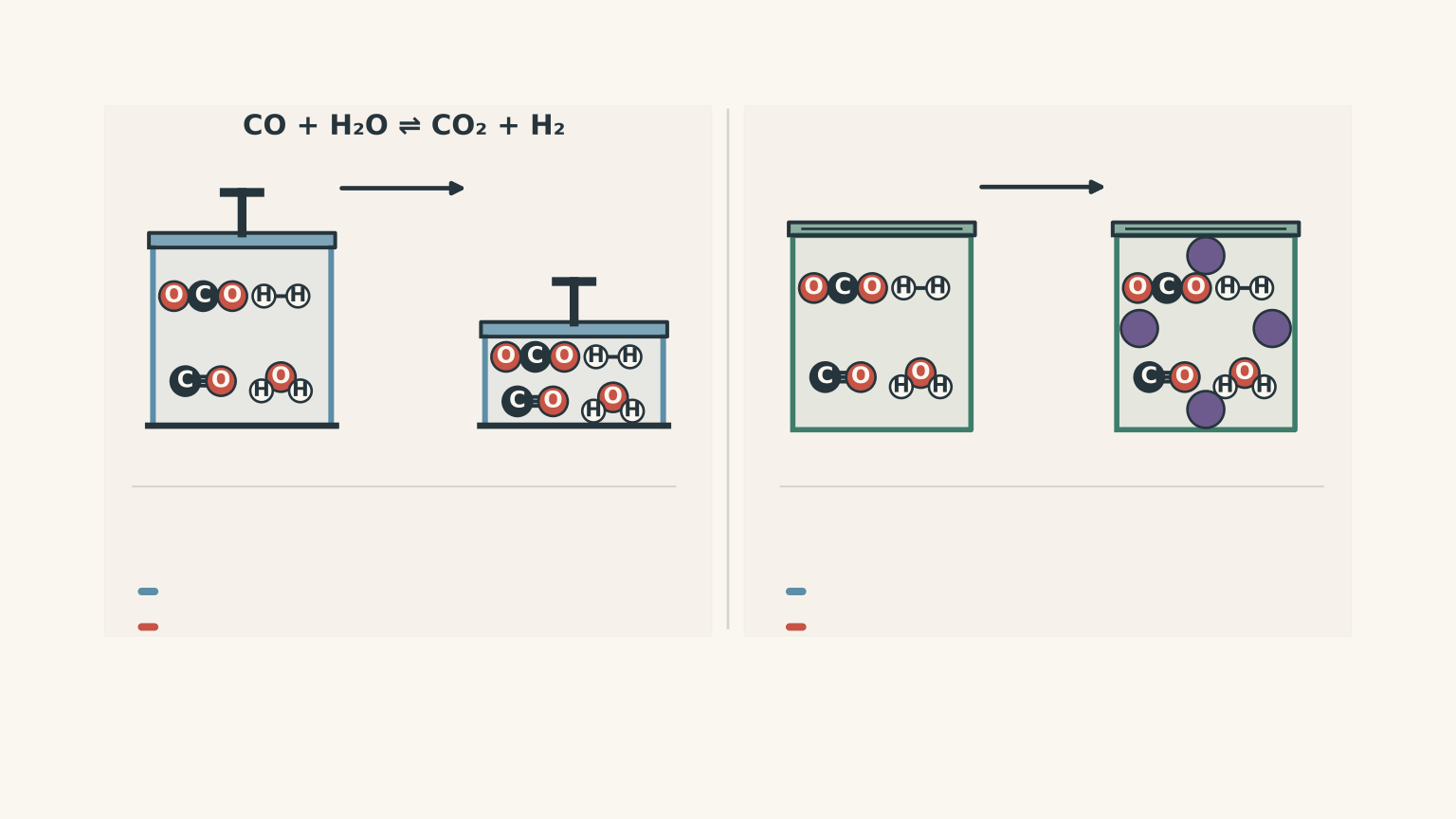
Due to technical limitations, this figure may display incorrectly or contain inaccuracies. Please check key details against your course materials.
These two cases are related, but they are not the same. Understanding the difference is essential for more difficult HSC equilibrium questions.
02Why does the number of gaseous moles matter?
Let’s build the reasoning from the equilibrium expression.
Consider a general gaseous equilibrium:
\[ \ce{A(g) + B(g) <=> C(g) + D(g)} \]
Its equilibrium expression is:
\[ K_p=\frac{p_Cp_D}{p_Ap_B} \]
Here, \(p_A\), \(p_B\), \(p_C\), and \(p_D\) are the partial pressures of the gases.
The equilibrium constant, \(K_p\), is fixed at a particular temperature.
At equilibrium, the reaction quotient \(Q_p\) equals \(K_p\).
Now imagine compressing the container to half its original volume while keeping the temperature constant.
Assuming ideal gas behaviour, the partial pressure of every gas doubles.
The new reaction quotient becomes:
\[ Q_p'=\frac{(2p_C)(2p_D)} {(2p_A)(2p_B)} \]
Simplifying:
\[ Q_p'=\frac{4p_Cp_D}{4p_Ap_B} \]
Therefore:
\[ Q_p'=Q_p \]
The numerator and denominator have both increased by a factor of four.
If the system was initially at equilibrium, then:
\[ Q_p'=K_p \]
The system is still at equilibrium. No net reaction occurs.
The general rule
We can express this result for any gaseous equilibrium.
First, calculate the change in gaseous mole number:
\[ \Delta n_g= \sum \nu_{\text{products}} - \sum \nu_{\text{reactants}} \]
Only gaseous species are included. Pure solids and liquids are excluded.
If every reacting gas partial pressure is multiplied by a factor \(f\), then:
\[ Q_p'=Q_p f^{\Delta n_g} \]
This equation gives us a useful way to predict the effect of compression or expansion.
| Change in gaseous moles | Effect of compression | Equilibrium response |
|---|---|---|
| \(\Delta n_g=0\) | \(Q_p\) unchanged | No shift |
| \(\Delta n_g>0\) | \(Q_p\) increases | Shifts in reverse |
| \(\Delta n_g<0\) | \(Q_p\) decreases | Shifts forward |
For expansion, the directions are reversed.
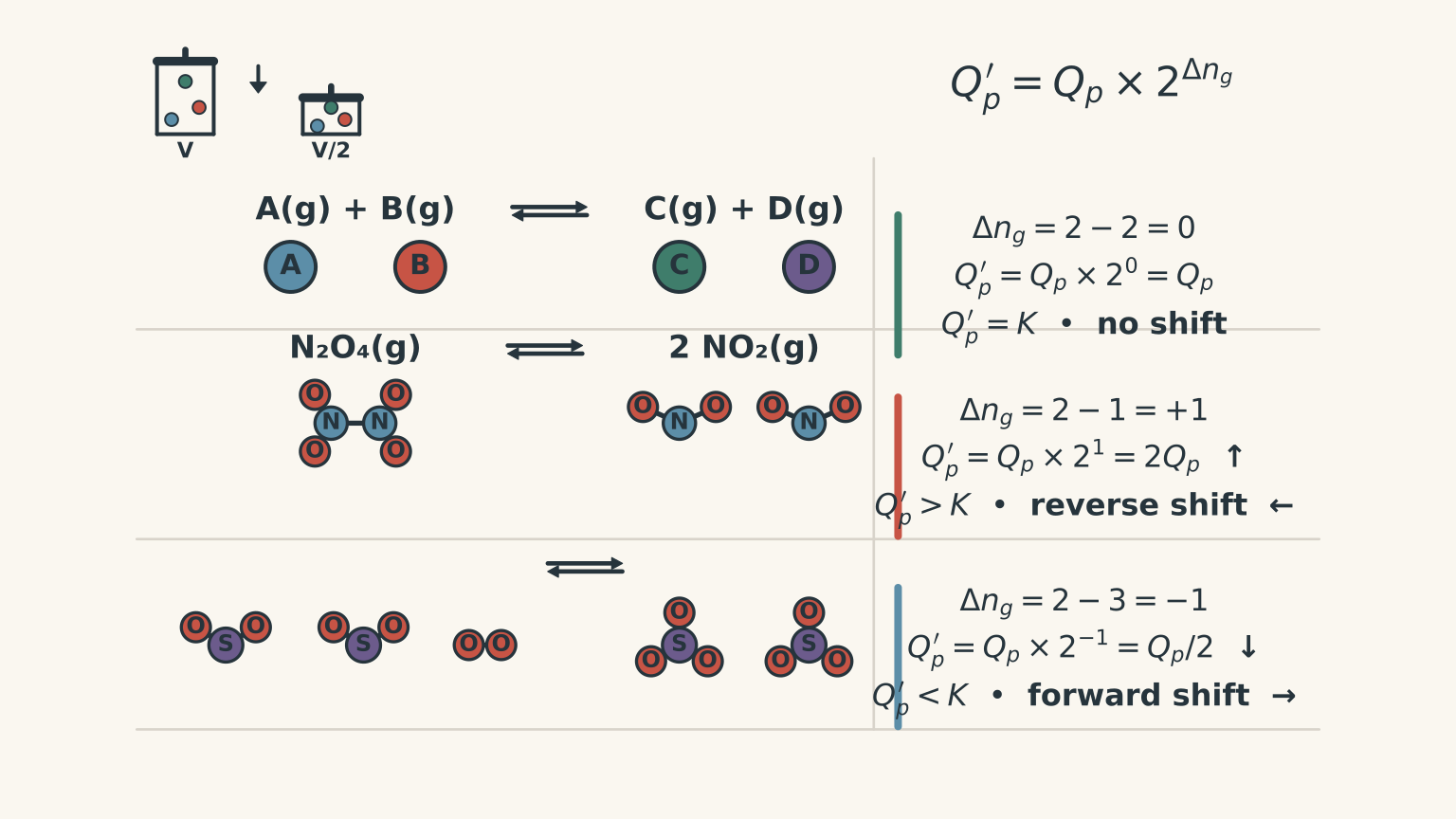
Due to technical limitations, this figure may display incorrectly or contain inaccuracies. Please check key details against your course materials.
Notice that this rule is about the coefficients of gaseous species, not the total number of coefficients in the entire equation.
For example:
\[ \ce{C(s) + CO2(g) <=> 2CO(g)} \]
The solid carbon does not count.
Therefore:
\[ \Delta n_g=2-1=+1 \]
This equilibrium is affected by compression, even though there is only one gaseous reactant.
03What happens to the forward and reverse reaction rates?
So far, we’ve used the reaction quotient to determine whether the equilibrium position changes.
But there’s another way to understand what’s happening: consider the forward and reverse reaction rates.
At equilibrium:
\[ r_f=r_r \]
The forward reaction rate equals the reverse reaction rate.
This does not mean that both reactions have stopped. Both reactions continue, but there is no net change in the amounts of reactants and products.
What happens when the gaseous mole numbers are equal?
Consider the simple elementary reversible reaction:
\[ \ce{A(g) + B(g) <=> C(g) + D(g)} \]
For this simplified kinetic model, the forward and reverse rates are:
\[ r_f=k_f[A][B] \]
\[ r_r=k_r[C][D] \]
Here, \(k_f\) and \(k_r\) are the forward and reverse rate constants, while the square brackets represent concentrations.
When the container is compressed to half its volume, every gas concentration doubles.
The new forward rate is:
\[ r_f'=k_f(2[A])(2[B]) \]
\[ r_f'=4r_f \]
Similarly:
\[ r_r'=k_r(2[C])(2[D]) \]
\[ r_r'=4r_r \]
Both rates increase by the same factor.
If they were initially equal, they remain equal.
The reaction has not shifted, even though both reaction rates have increased.
This is an important distinction: a change in reaction rate does not automatically mean a change in equilibrium position.
The rate equations above illustrate an elementary reaction. Real reactions can involve several steps, so their rate laws cannot automatically be obtained from the overall balanced equation. The reaction quotient provides the more general test for an equilibrium shift.
Compare this with an equilibrium that has unequal gaseous mole numbers
Consider:
\[ \ce{N2O4(g) <=> 2NO2(g)} \]
There is one mole of gaseous reactant and two moles of gaseous product.
For an elementary dissociation and recombination model:
\[ r_f=k_f[\ce{N2O4}] \]
\[ r_r=k_r[\ce{NO2}]^2 \]
When the container is compressed to half its volume, both concentrations double.
The forward rate becomes:
\[ r_f'=2r_f \]
The reverse rate becomes:
\[ r_r'=4r_r \]
The reverse reaction now occurs faster than the forward reaction.
Consequently, more \(\ce{N2O4}\) forms, and the equilibrium shifts to the left.
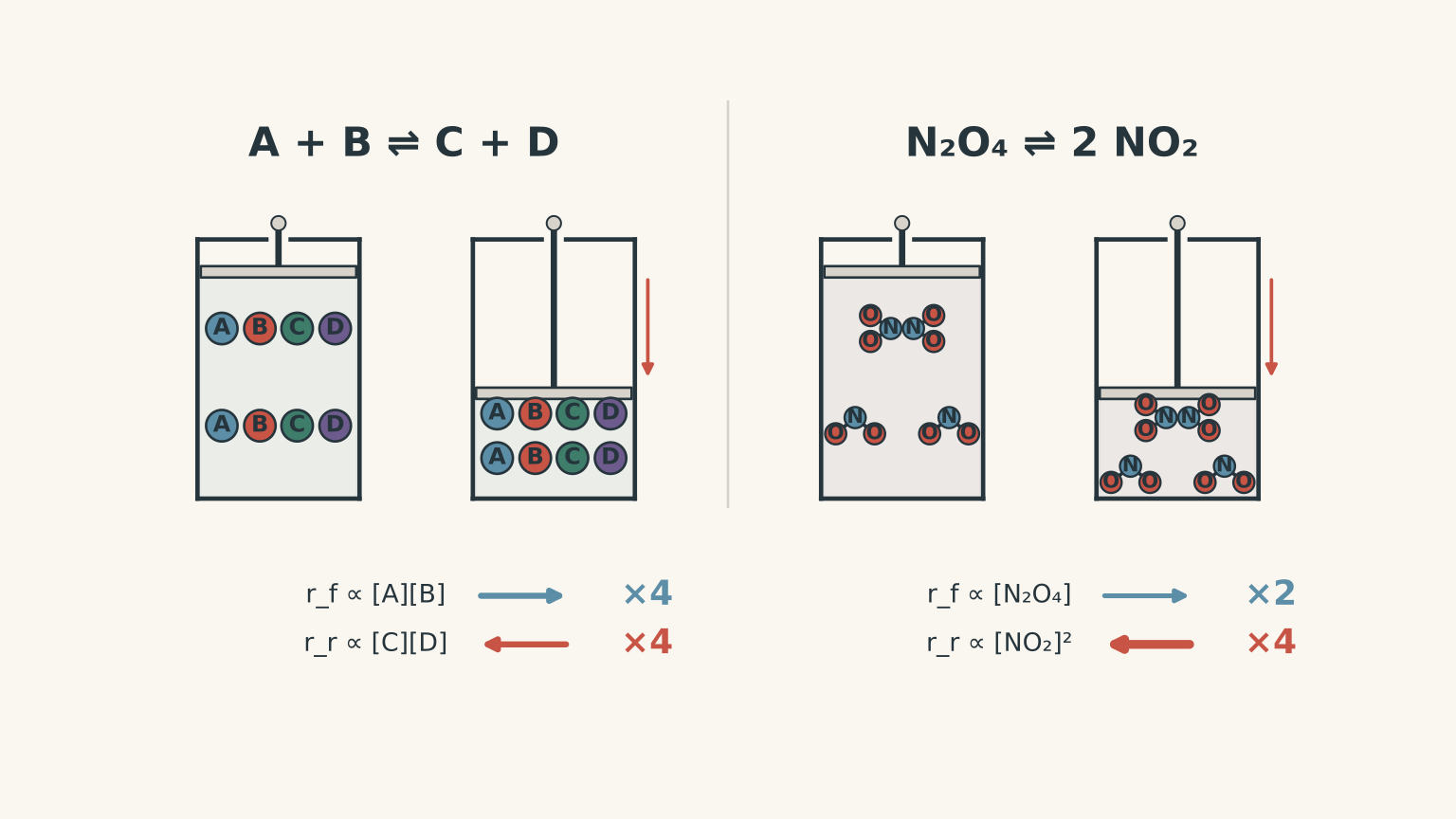
Due to technical limitations, this figure may display incorrectly or contain inaccuracies. Please check key details against your course materials.
The difference comes from the number of gaseous particles involved in each direction.
04Not every increase in pressure causes the same response
This is where many students lose marks.
An increase in total pressure can be produced in different ways. You cannot assume that all of them affect equilibrium in the same manner.
The important question is: what happened to the partial pressures of the reacting gases?
Method 1: Compressing the container
Suppose the container is sealed and its volume decreases.
At constant temperature, the partial pressures of all reacting gases increase.
For an equilibrium with \(\Delta n_g=0\), the reaction quotient remains unchanged.
There is no equilibrium shift.
For an equilibrium with \(\Delta n_g\neq0\), the reaction generally shifts towards the side with fewer gaseous moles.
Method 2: Adding an inert gas at constant volume
Suppose argon is added to a rigid container.
The total pressure increases because there are now more gas particles inside.
However, the volume and temperature remain constant, and the number of moles of each reacting gas has not changed.
Using the ideal gas equation:
\[ p_i=\frac{n_iRT}{V} \]
where:
- \(p_i\) is the partial pressure of gas \(i\),
- \(n_i\) is the number of moles of that gas,
- \(R\) is the gas constant,
- \(T\) is absolute temperature,
- \(V\) is the container volume.
Adding argon does not change \(n_i\), \(T\), or \(V\) for any reacting gas.
Therefore, its partial pressure remains unchanged.
There is no equilibrium shift, even if the reaction has unequal gaseous mole numbers.
Method 3: Adding an inert gas at constant pressure
This situation is different.
If argon is added while the total pressure is kept constant, the container must expand.
The reacting gases now occupy a larger volume.
Their partial pressures decrease, because their amounts remain constant while the volume increases.
This is effectively an expansion of the reacting mixture.
If \(\Delta n_g=0\), there is still no equilibrium shift.
If \(\Delta n_g\neq0\), the equilibrium shifts towards the side with more gaseous moles.
Compare the three situations
| Disturbance | Reacting gas partial pressures | Does equilibrium shift when \(\Delta n_g=0\)? |
|---|---|---|
| Compression at constant temperature | All increase by the same factor | No |
| Inert gas added at constant volume | Unchanged | No |
| Inert gas added at constant pressure | All decrease by the same factor | No |
| Reactive gas added | One or more change individually | Depends on the new \(Q_p\) |
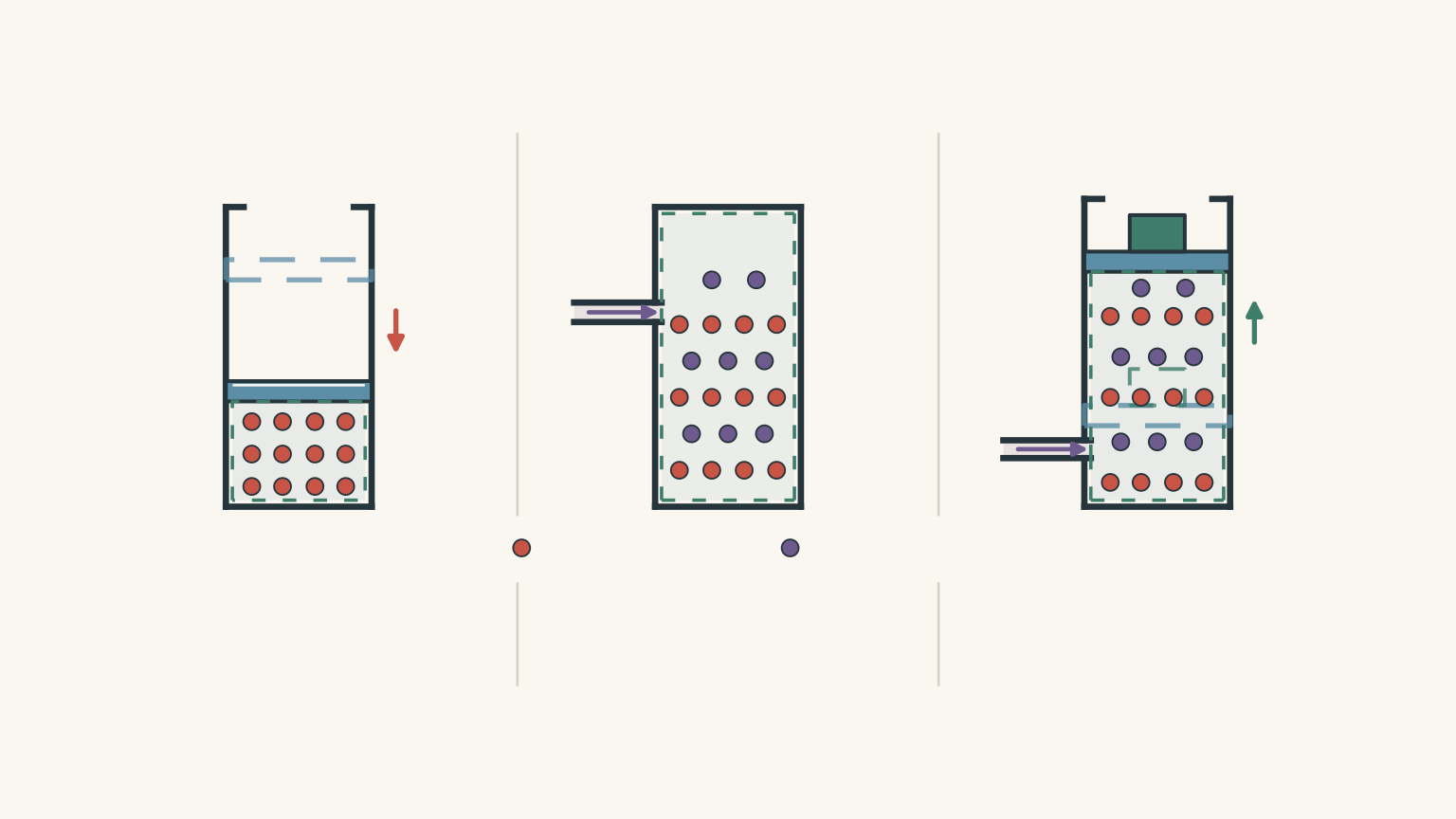
Due to technical limitations, this figure may display incorrectly or contain inaccuracies. Please check key details against your course materials.
One final distinction: adding a reacting gas is not the same as compressing the entire mixture. Adding a reactant changes its individual partial pressure, so the reaction quotient may change even when \(\Delta n_g=0\).
05How could we test whether pressure actually shifts equilibrium?
Imagine designing an experiment to investigate the claim that compressing a 2:2 gaseous equilibrium does not change its composition.
We need to distinguish two things:
- The immediate physical effect of compressing a gas.
- Any subsequent chemical reaction that changes the composition.
A pressure gauge alone cannot distinguish them.
Setting up the investigation
Consider the equilibrium:
\[ \ce{CO(g) + H2O(g) <=> CO2(g) + H2(g)} \]
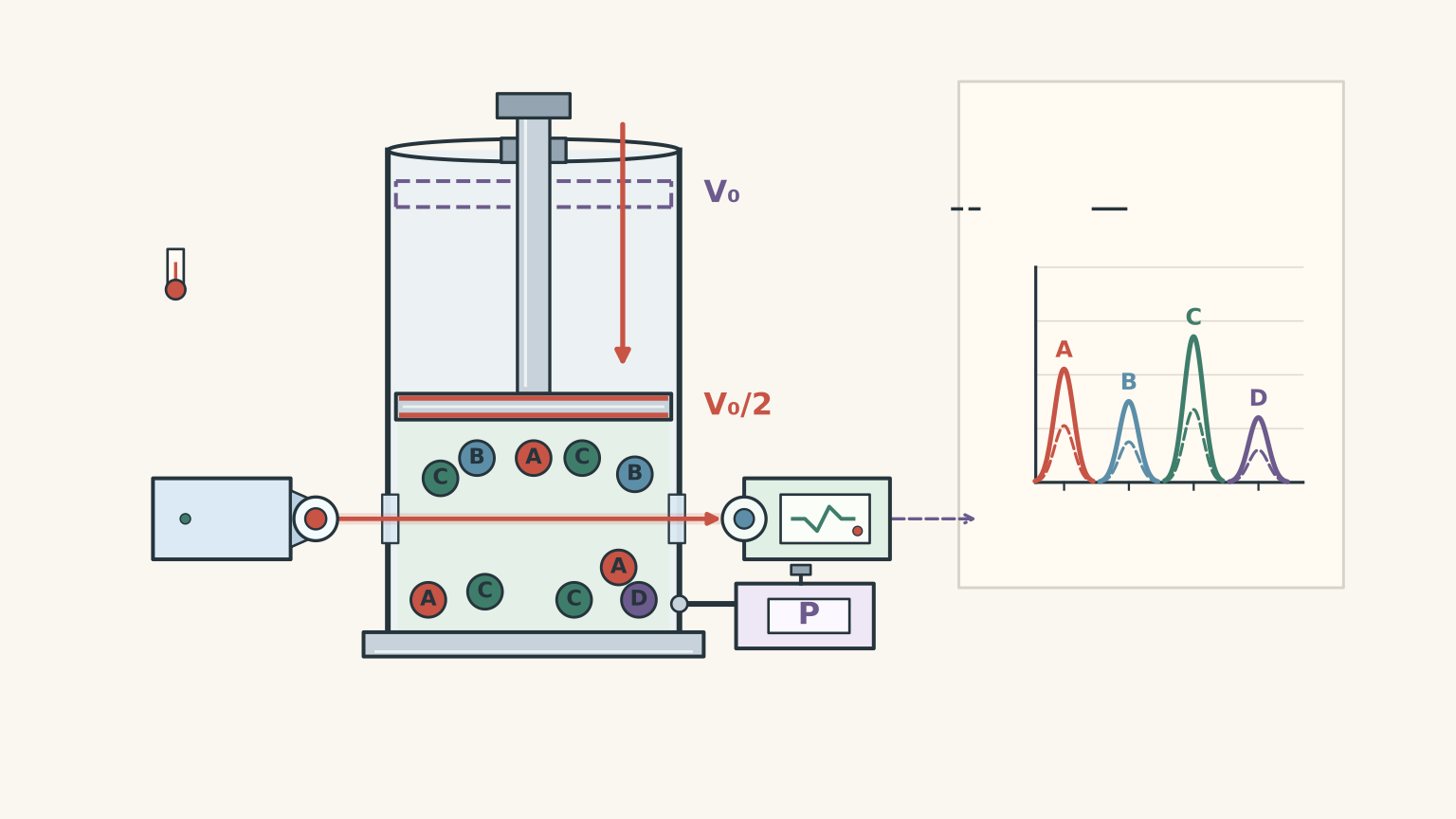
A suitable experimental arrangement would contain:
- A sealed cylinder containing the equilibrium mixture.
- A movable, gas-tight piston to change the volume.
- A temperature-controlled jacket surrounding the cylinder.
- A pressure transducer connected to measure total pressure.
- An infrared probe passing through the gas to monitor the composition.
The infrared detector can distinguish absorption signals associated with different gas species. Its readings must be calibrated and corrected for changes in gas density.
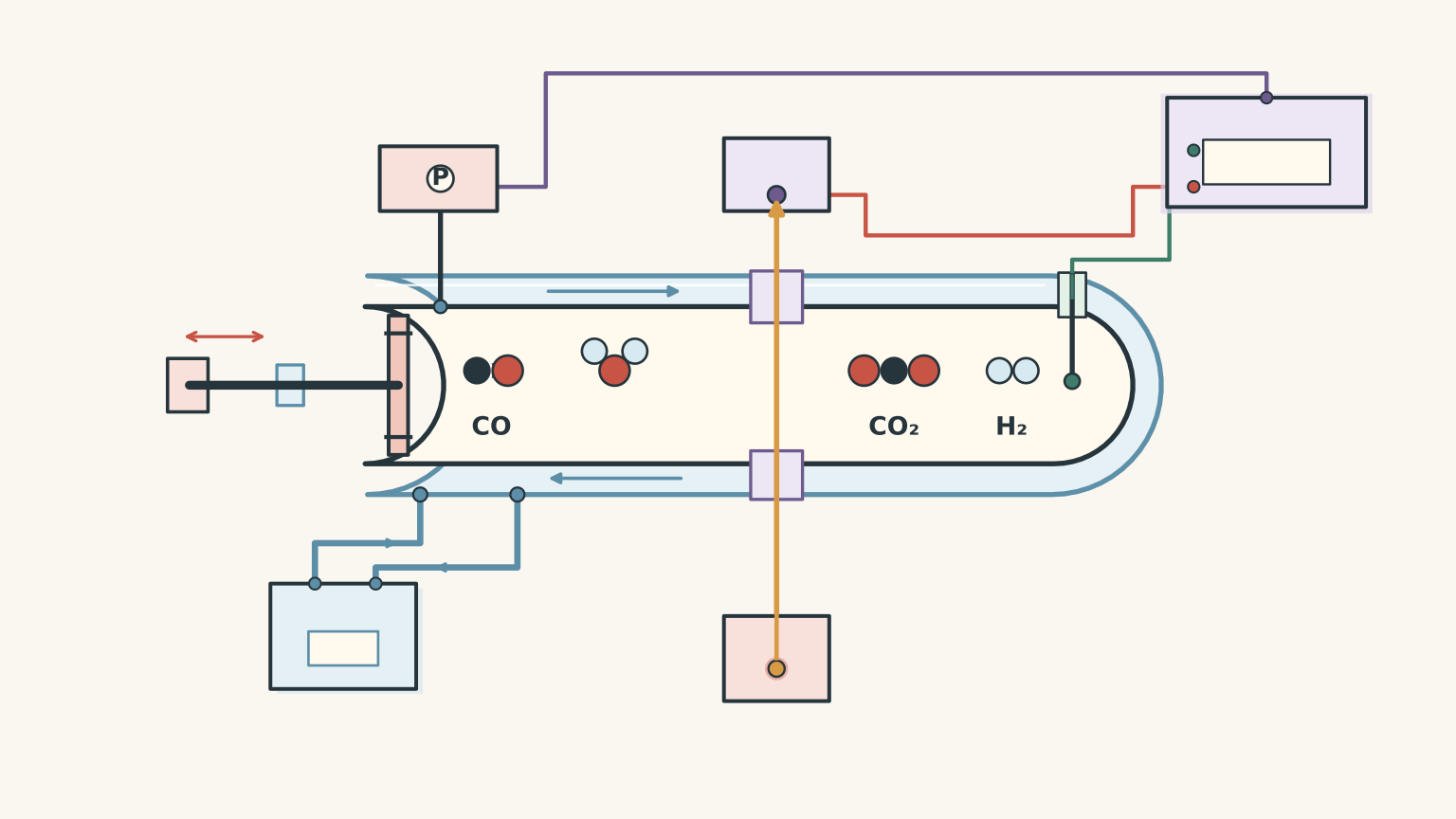
Due to technical limitations, this figure may display incorrectly or contain inaccuracies. Please check key details against your course materials.
Before performing the pressure change, the mixture is allowed to reach equilibrium.
Suppose its initial volume is 2.00 L and its total pressure is 1.50 bar.
The piston is then moved rapidly until the volume is 1.00 L, while the temperature remains constant.
What should happen?
For an ideal gas, halving the volume initially doubles the partial pressure of every gas.
However, because there are two gaseous moles on each side of the reaction, the reaction quotient remains unchanged.
Predicted results
The following values are illustrative, not experimental measurements.
| Measurement | Before compression | Immediately after compression |
|---|---|---|
| Volume | 2.00 L | 1.00 L |
| Total pressure | 1.50 bar | 3.00 bar |
| \(p_{\ce{CO}}\) | 0.20 bar | 0.40 bar |
| \(p_{\ce{H2O}}\) | 0.30 bar | 0.60 bar |
| \(p_{\ce{CO2}}\) | 0.40 bar | 0.80 bar |
| \(p_{\ce{H2}}\) | 0.60 bar | 1.20 bar |
Initially:
\[ Q_p=\frac{0.40\times0.60}{0.20\times0.30} =4.0 \]
Immediately after compression:
\[ Q_p'=\frac{0.80\times1.20}{0.40\times0.60} =4.0 \]
The reaction quotient is unchanged.
The mole fractions of the four gases are also unchanged. Only their partial pressures and concentrations have increased.
Why the original measurement design is insufficient
Suppose the experiment only used a pressure gauge.
The gauge would record a doubling of pressure, but that does not demonstrate a chemical shift. It simply confirms that the container was compressed.
Even an infrared detector needs careful interpretation. At a fixed optical path length, raw absorption can increase because the gas concentration has increased, even when the mole fraction of that gas has not changed.
The improved experiment therefore needs to use calibrated gas-specific signals, together with the total pressure, to determine the mole fractions of the reacting gases.
A useful control would be to repeat the investigation with:
\[ \ce{N2O4(g) <=> 2NO2(g)} \]
This reaction has unequal gaseous mole numbers. Compression should cause a reverse shift, consuming \(\ce{NO2}\) relative to the immediately compressed mixture.
The control helps establish that the measurement method can distinguish a genuine composition change from the direct effect of compression.
The conclusion is that an increase in total pressure is not sufficient evidence of an equilibrium shift. You need to establish whether the composition of the reacting mixture has changed.
06Worked examples
Worked example: Does compressing a 2:2 equilibrium cause a shift?
A gaseous equilibrium is established:
\[ \ce{H2(g) + I2(g) <=> 2HI(g)} \]
At equilibrium, the partial pressures are:
- \(p_{\ce{H2}}=0.20\) bar
- \(p_{\ce{I2}}=0.30\) bar
- \(p_{\ce{HI}}=0.60\) bar
The container is compressed to half its original volume at constant temperature.
Determine whether the equilibrium shifts.
Step 1
Reactants:
\[ 1+1=2 \]
Products:
\[ 2 \]
Therefore:
\[ \Delta n_g=2-2=0 \]
Step 2
\[ Q_p=\frac{p_{\ce{HI}}^2} {p_{\ce{H2}}p_{\ce{I2}}} \]
Substituting:
\[ Q_p=\frac{0.60^2}{0.20\times0.30} \]
\[ Q_p=\frac{0.36}{0.06}=6.0 \]
Since the system is initially at equilibrium, \(K_p=6.0\).
Step 3
Halving the volume doubles every partial pressure.
Therefore:
\[ p_{\ce{H2}}'=0.40\text{ bar} \]
\[ p_{\ce{I2}}'=0.60\text{ bar} \]
\[ p_{\ce{HI}}'=1.20\text{ bar} \]
Step 4
\[ Q_p'=\frac{1.20^2}{0.40\times0.60} \]
\[ Q_p'=\frac{1.44}{0.24}=6.0 \]
Therefore:
\[ Q_p'=K_p \]
Conclusion: There is no equilibrium shift.
Although the pressure and concentrations of all gases have doubled, the reaction quotient remains equal to the equilibrium constant. The forward and reverse reactions remain balanced.
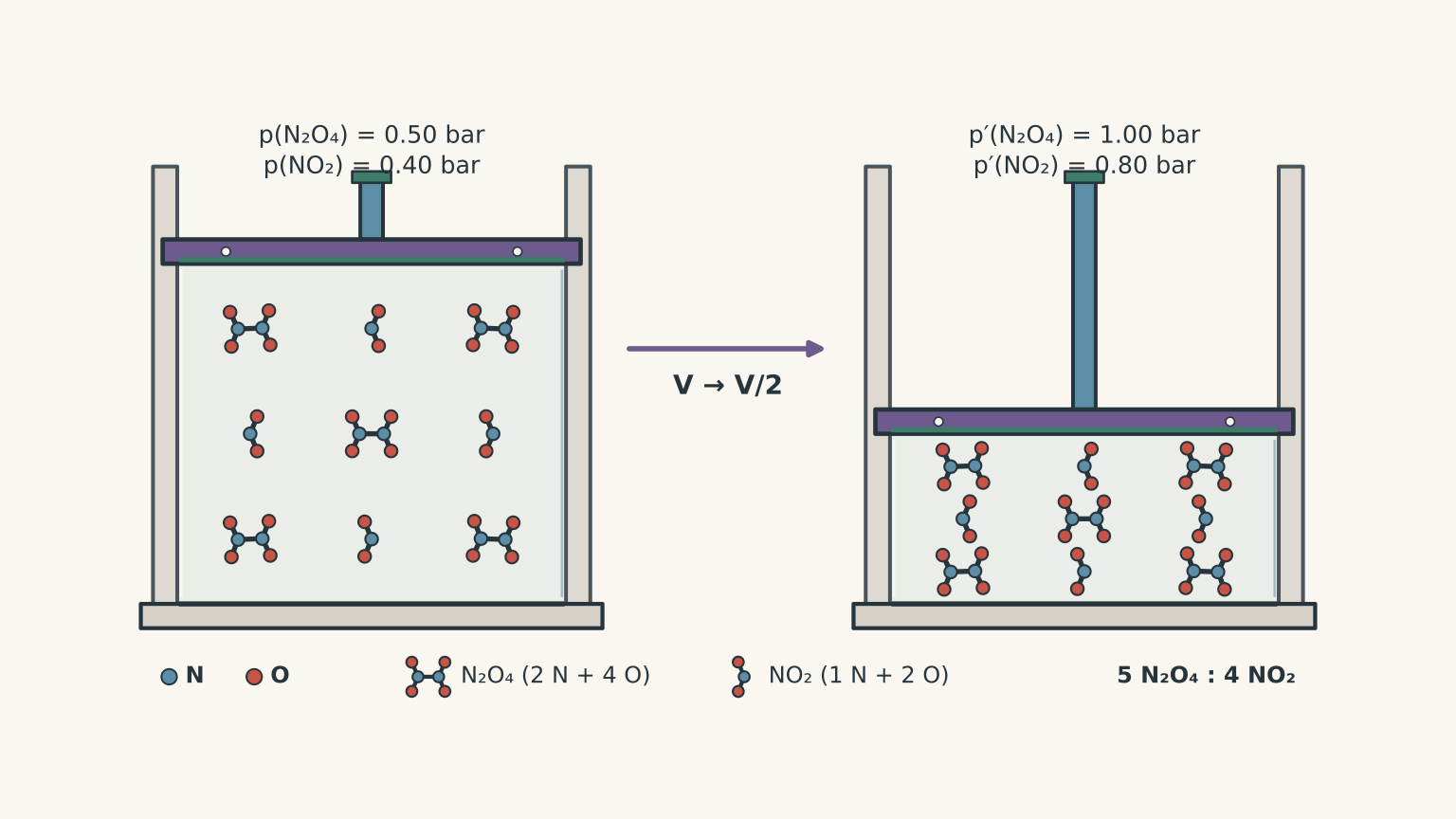
Worked example: Does compression affect an equilibrium with unequal gaseous mole numbers?
Consider:
\[ \ce{N2O4(g) <=> 2NO2(g)} \]
At equilibrium:
- \(p_{\ce{N2O4}}=0.50\) bar
- \(p_{\ce{NO2}}=0.40\) bar
The container is compressed to half its original volume at constant temperature.
Determine the direction of the equilibrium shift.
Step 1
Reactants:
\[ 1 \]
Products:
\[ 2 \]
Therefore:
\[ \Delta n_g=2-1=+1 \]
Step 2
\[ K_p=\frac{p_{\ce{NO2}}^2}{p_{\ce{N2O4}}} \]
Substituting:
\[ K_p=\frac{0.40^2}{0.50} \]
\[ K_p=0.32\text{ bar} \]
Step 3
After compression, all partial pressures double:
\[ p_{\ce{N2O4}}'=1.00\text{ bar} \]
\[ p_{\ce{NO2}}'=0.80\text{ bar} \]
Step 4
\[ Q_p'=\frac{0.80^2}{1.00} \]
\[ Q_p'=0.64\text{ bar} \]
Compare the values:
\[ Q_p'>K_p \]
The reaction quotient is now greater than the equilibrium constant.
Conclusion: The equilibrium shifts to the left, towards \(\ce{N2O4}\).
The reverse reaction is favoured because compression increases the reaction quotient. More \(\ce{NO2}\) reacts to form \(\ce{N2O4}\) until the equilibrium condition is restored.
Notice the contrast with the previous example. Both containers were compressed to half their volume, but only the equilibrium with unequal gaseous mole numbers shifted.
Due to technical limitations, this figure may display incorrectly or contain inaccuracies. Please check key details against your course materials.
07A reliable method for HSC pressure questions
When you encounter a question about changing pressure, avoid immediately writing that equilibrium shifts towards fewer gaseous moles.
First identify exactly what has changed.
Use this sequence:
- Identify the disturbance. Was the container compressed, expanded, or was an inert gas added?
- Check the system conditions. Is the temperature constant? Is the volume fixed? Is the total pressure fixed?
- Count gaseous moles. Calculate \(\Delta n_g\), excluding solids and liquids.
- Determine the new partial pressures. Do not confuse total pressure with the partial pressures of reacting gases.
- Calculate \(Q_p\). Compare it with \(K_p\) to determine the direction of any shift.
Remember:
| Comparison | Equilibrium response |
|---|---|
| \(Q_p=K_p\) | No net shift |
| \(Q_p>K_p\) | Reverse reaction favoured |
| \(Q_p<K_p\) | Forward reaction favoured |
Also remember that changing pressure at constant temperature does not change \(K_p\).
For more practice distinguishing the immediate physical change from the subsequent chemical response, see Instantaneous Concentration Changes vs Equilibrium Shifts.
08Questions and solutions
The following questions progress from straightforward pressure calculations to situations involving multiple equilibria and competing effects.
Question 1
A sealed container contains the following gaseous equilibrium at constant temperature:
\[ \ce{N2(g) + O2(g) <=> 2NO(g)} \]
The container is compressed to one-third of its original volume.
Determine whether the equilibrium shifts. Explain your answer using the number of gaseous moles and the reaction quotient.
Solution 1
The equilibrium does not shift. There are two moles of gaseous reactants and two moles of gaseous products.
Therefore:
\[ \Delta n_g=2-2=0 \]
Compressing the container to one-third of its volume triples the partial pressure of every reacting gas.
The new reaction quotient is:
\[ Q_p'=\frac{(3p_{\ce{NO}})^2} {(3p_{\ce{N2}})(3p_{\ce{O2}})} \]
Simplifying:
\[ Q_p'=\frac{9p_{\ce{NO}}^2} {9p_{\ce{N2}}p_{\ce{O2}}} \]
Therefore:
\[ Q_p'=Q_p=K_p \]
There is no net reaction in either direction.
The important point is that increasing pressure does not automatically favour the side with fewer gaseous moles when both sides contain equal numbers.
Question 2
A sealed container initially holds an equilibrium mixture for the reaction:
\[ \ce{2SO2(g) + O2(g) <=> 2SO3(g)} \]
At equilibrium, the partial pressures are:
- \(p_{\ce{SO2}}=0.40\) bar
- \(p_{\ce{O2}}=0.20\) bar
- \(p_{\ce{SO3}}=0.60\) bar
The initial total pressure is 1.20 bar.
Consider two separate experiments.
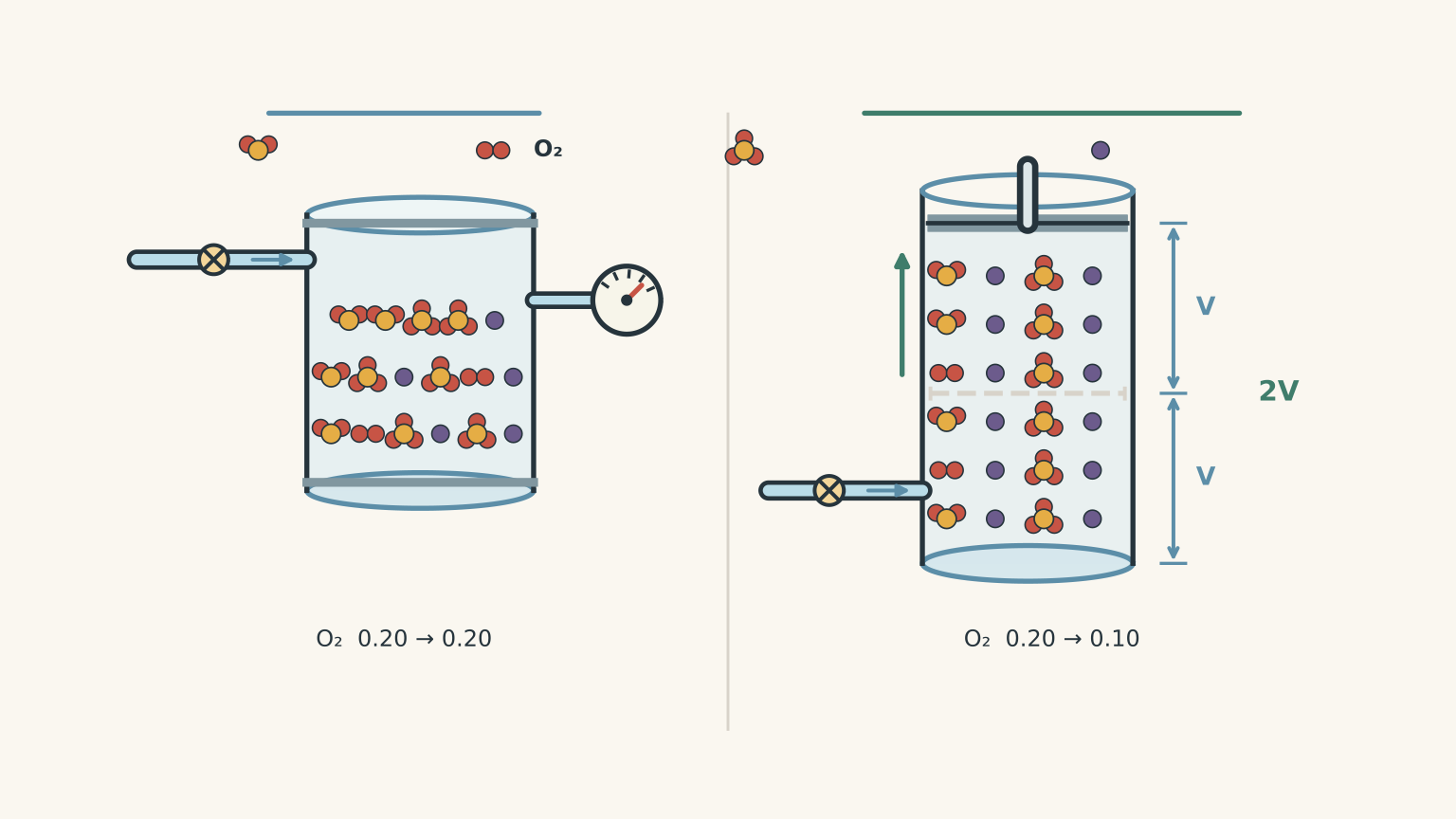
Experiment A: Argon is added until the total pressure increases by 0.50 bar. The container has a fixed volume.
Experiment B: Starting with the original equilibrium mixture, argon is added while a movable piston allows the volume to double. The total pressure is maintained at 1.20 bar.
For each experiment:
a. Calculate the new partial pressures of the reacting gases.
b. Determine whether the equilibrium shifts.
c. Explain why the two experiments produce different outcomes.
Due to technical limitations, this figure may display incorrectly or contain inaccuracies. Please check key details against your course materials.
Solution 2
Experiment A produces no equilibrium shift, while Experiment B shifts the equilibrium to the left. The difference is whether the addition of argon changes the partial pressures of the reacting gases.
First, calculate the initial equilibrium constant:
\[ K_p=\frac{p_{\ce{SO3}}^2} {p_{\ce{SO2}}^2p_{\ce{O2}}} \]
Substituting:
\[ K_p=\frac{0.60^2}{0.40^2\times0.20} \]
\[ K_p=\frac{0.36}{0.032} \]
\[ K_p=11.25\text{ bar}^{-1} \]
Experiment A: Argon added at constant volume
The total pressure increases from 1.20 bar to 1.70 bar.
However, the partial pressures of the reacting gases remain unchanged.
Therefore:
\[ p_{\ce{SO2}}'=0.40\text{ bar} \]
\[ p_{\ce{O2}}'=0.20\text{ bar} \]
\[ p_{\ce{SO3}}'=0.60\text{ bar} \]
The new reaction quotient is:
\[ Q_p'=11.25\text{ bar}^{-1} \]
Since:
\[ Q_p'=K_p \]
There is no equilibrium shift.
Argon has increased the total pressure without changing the conditions experienced by the reacting gases in the ideal gas model.
Experiment B: Argon added at constant pressure
The volume doubles while the total pressure remains at 1.20 bar.
The partial pressures of the reacting gases are therefore halved.
\[ p_{\ce{SO2}}'=0.20\text{ bar} \]
\[ p_{\ce{O2}}'=0.10\text{ bar} \]
\[ p_{\ce{SO3}}'=0.30\text{ bar} \]
The argon partial pressure is 0.60 bar, keeping the total pressure at 1.20 bar.
Calculate the new reaction quotient:
\[ Q_p'=\frac{0.30^2}{0.20^2\times0.10} \]
\[ Q_p'=\frac{0.09}{0.004} \]
\[ Q_p'=22.5\text{ bar}^{-1} \]
Therefore:
\[ Q_p'>K_p \]
The reverse reaction is favoured.
The equilibrium shifts to the left, producing more \(\ce{SO2}\) and \(\ce{O2}\).
The tempting mistake is to assume that adding an inert gas never affects equilibrium. It does not cause a shift at constant volume, but it can cause a shift at constant pressure because the volume must increase.
Question 3
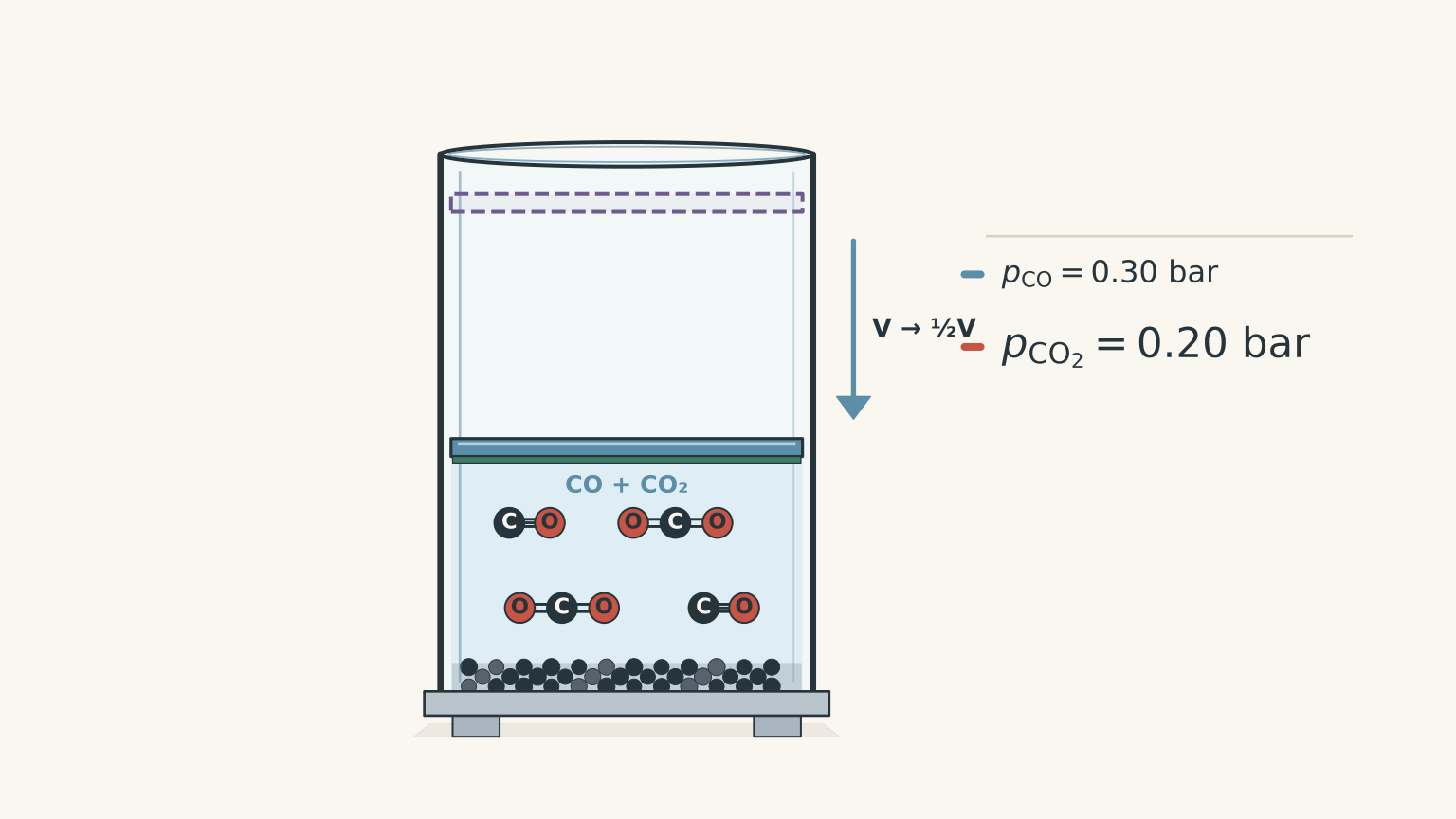
A sealed vessel contains solid carbon and a gaseous equilibrium:
\[ \ce{C(s) + CO2(g) <=> 2CO(g)} \]
At equilibrium:
- \(p_{\ce{CO}}=0.30\) bar
- \(p_{\ce{CO2}}=0.20\) bar
The equilibrium constant is:
\[ K_p=0.45\text{ bar} \]
The vessel is compressed to half its original volume at constant temperature.
a. Calculate the new reaction quotient immediately after compression.
b. Predict the direction of the equilibrium shift.
c. Explain why solid carbon is excluded when calculating the change in gaseous mole numbers.
Assume sufficient solid carbon remains throughout the process.
Due to technical limitations, this figure may display incorrectly or contain inaccuracies. Please check key details against your course materials.
Solution 3
The equilibrium shifts to the left, producing more solid carbon and \(\ce{CO2}\). Compression increases the reaction quotient because there are more gaseous moles on the product side.
The equilibrium expression is:
\[ K_p=\frac{p_{\ce{CO}}^2}{p_{\ce{CO2}}} \]
Solid carbon is excluded because the activity of a pure solid is treated as constant.
Step 1: Determine the change in gaseous mole numbers.
Reactants contain one gaseous mole from \(\ce{CO2}\).
Products contain two gaseous moles from \(\ce{CO}\).
Therefore:
\[ \Delta n_g=2-1=+1 \]
Step 2: Determine the new partial pressures.
Halving the volume doubles both partial pressures.
\[ p_{\ce{CO}}'=0.60\text{ bar} \]
\[ p_{\ce{CO2}}'=0.40\text{ bar} \]
Step 3: Calculate the new reaction quotient.
\[ Q_p'=\frac{(0.60)^2}{0.40} \]
\[ Q_p'=\frac{0.36}{0.40} \]
\[ Q_p'=0.90\text{ bar} \]
Compare this with the equilibrium constant:
\[ Q_p'=0.90>K_p=0.45 \]
The reverse reaction is favoured.
Consequently, some \(\ce{CO}\) is consumed to produce \(\ce{CO2}\) and solid carbon.
The common mistake is to count the solid carbon as another mole of gaseous reactant. Only gaseous species contribute to \(\Delta n_g\).
Question 4
A student investigates the equilibrium:
\[ \ce{A(g) + B(g) <=> C(g) + D(g)} \]
The mixture is initially at equilibrium.
A piston compresses the container to half its original volume at constant temperature.
The student records the following illustrative data:
| Gas | Initial partial pressure | Partial pressure after compression |
|---|---|---|
| A | 0.30 bar | 0.60 bar |
| B | 0.20 bar | 0.40 bar |
| C | 0.40 bar | 0.80 bar |
| D | 0.15 bar | 0.30 bar |
The student also observes that the raw infrared absorbance signals for all four gases approximately double.
They conclude:
“The products have increased in concentration, so the equilibrium has shifted to the right.”
Evaluate this conclusion. Your answer should discuss the reaction quotient, the mole fractions of the gases, and the significance of the absorbance measurements.
Due to technical limitations, this figure may display incorrectly or contain inaccuracies. Please check key details against your course materials.
Solution 4
The student’s conclusion is incorrect. There is no equilibrium shift. All four partial pressures double by the same factor, so the reaction quotient remains unchanged.
Step 1: Calculate the initial reaction quotient.
\[ Q_p=\frac{p_Cp_D}{p_Ap_B} \]
Substituting:
\[ Q_p=\frac{0.40\times0.15} {0.30\times0.20} \]
\[ Q_p=\frac{0.060}{0.060}=1.0 \]
Since the mixture is initially at equilibrium:
\[ K_p=1.0 \]
Step 2: Calculate the reaction quotient after compression.
\[ Q_p'=\frac{0.80\times0.30} {0.60\times0.40} \]
\[ Q_p'=\frac{0.240}{0.240}=1.0 \]
Therefore:
\[ Q_p'=K_p \]
There is no net reaction.
Step 3: Examine the mole fractions.
The initial total pressure is:
\[ P_{\text{initial}}=0.30+0.20+0.40+0.15 \]
\[ P_{\text{initial}}=1.05\text{ bar} \]
The final total pressure is:
\[ P_{\text{final}}=2.10\text{ bar} \]
For each gas, its mole fraction is its partial pressure divided by the total pressure.
For example:
\[ y_A=\frac{0.30}{1.05}=0.286 \]
After compression:
\[ y_A'=\frac{0.60}{2.10}=0.286 \]
The same result applies to B, C and D.
The mole fractions have not changed. The relative composition of the mixture is identical.
Step 4: Interpret the infrared measurements.
At constant optical path length, raw infrared absorbance can increase when the concentration of an absorbing gas increases.
All four gas concentrations have doubled because the volume has halved.
Therefore, all four absorbance signals can increase without any chemical reaction occurring.
The student has confused an increase in absolute concentration with a change in relative composition.
In the simplified elementary kinetic model, both forward and reverse rates also increase by a factor of four, so neither direction is favoured.
Question 5
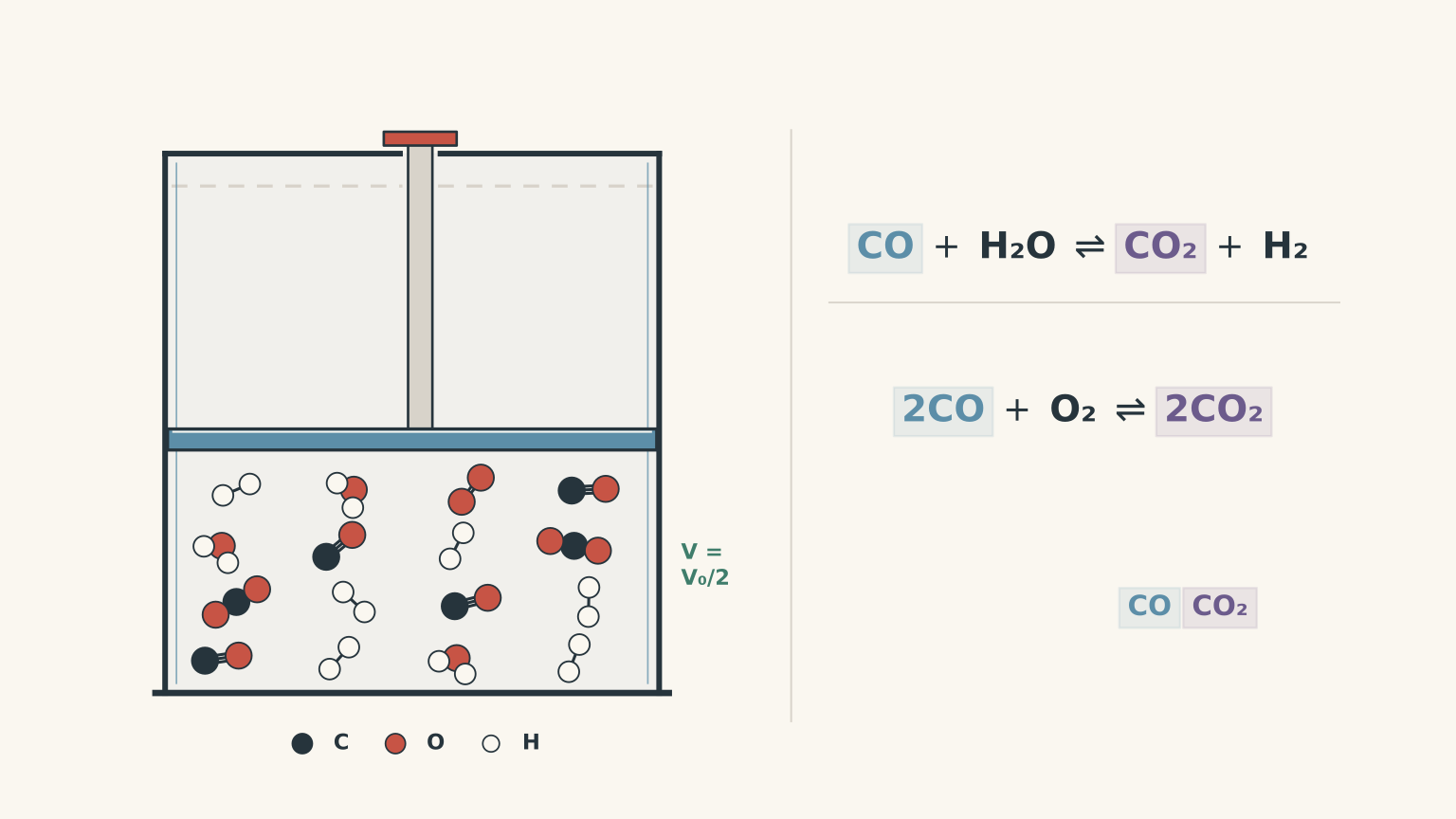
An ideal gas mixture contains five gaseous species and is initially at equilibrium for both of the following reactions:
Reaction 1
\[ \ce{CO(g) + H2O(g) <=> CO2(g) + H2(g)} \]
Reaction 2
\[ \ce{2CO(g) + O2(g) <=> 2CO2(g)} \]
Assume these are the only two reactions occurring in the system.
At the initial equilibrium, the partial pressures are:
| Gas | Partial pressure |
|---|---|
| CO | 0.40 bar |
| H2O | 0.30 bar |
| CO2 | 0.20 bar |
| H2 | 0.60 bar |
| O2 | 0.10 bar |
At this temperature, the equilibrium constants are:
\[ K_{p,1}=1.0 \]
\[ K_{p,2}=2.5\text{ bar}^{-1} \]
A piston suddenly compresses the vessel to half its original volume. The temperature remains constant, and the piston is then held in its new position.
Answer the following:
a. Calculate the reaction quotient for each reaction immediately after compression.
b. Determine which reaction initially experiences a net forward or reverse reaction.
c. Once the first reaction begins to respond chemically, determine the direction in which it shifts.
d. Explain why the statement “Reaction 1 has equal gaseous mole numbers, so pressure cannot affect its equilibrium composition” is incomplete.
Due to technical limitations, this figure may display incorrectly or contain inaccuracies. Please check key details against your course materials.
Solution 5
Reaction 2 initially shifts forward, and this subsequently causes Reaction 1 to shift in reverse. Although Reaction 1 is directly unaffected by the initial uniform pressure increase, it is not isolated from the other equilibrium in the mixture.
This is an example of two equilibria influencing each other through shared chemical species.
Step 1: Calculate the reaction quotient for Reaction 1 immediately after compression.
For Reaction 1:
\[ Q_{p,1}= \frac{p_{\ce{CO2}}p_{\ce{H2}}} {p_{\ce{CO}}p_{\ce{H2O}}} \]
Initially:
\[ Q_{p,1}= \frac{0.20\times0.60} {0.40\times0.30} \]
\[ Q_{p,1}=1.0 \]
This equals the initial equilibrium constant.
After compression, all partial pressures double:
- \(p_{\ce{CO}}=0.80\) bar
- \(p_{\ce{H2O}}=0.60\) bar
- \(p_{\ce{CO2}}=0.40\) bar
- \(p_{\ce{H2}}=1.20\) bar
- \(p_{\ce{O2}}=0.20\) bar
The new reaction quotient is:
\[ Q_{p,1}'= \frac{0.40\times1.20} {0.80\times0.60} \]
\[ Q_{p,1}'=\frac{0.48}{0.48}=1.0 \]
Therefore:
\[ Q_{p,1}'=K_{p,1} \]
Reaction 1 initially remains at equilibrium.
This makes sense because it has two gaseous moles on each side.
Step 2: Calculate the reaction quotient for Reaction 2.
For Reaction 2:
\[ Q_{p,2}= \frac{p_{\ce{CO2}}^2} {p_{\ce{CO}}^2p_{\ce{O2}}} \]
Immediately after compression:
\[ Q_{p,2}'= \frac{0.40^2} {0.80^2\times0.20} \]
\[ Q_{p,2}'= \frac{0.16}{0.128} \]
\[ Q_{p,2}'=1.25\text{ bar}^{-1} \]
Compare this with the equilibrium constant:
\[ Q_{p,2}'=1.25<K_{p,2}=2.5 \]
The forward reaction is favoured.
Therefore, Reaction 2 proceeds towards producing more \(\ce{CO2}\).
Step 3: Determine what happens to Reaction 1 as Reaction 2 proceeds.
This is the crucial part.
Reaction 2 consumes \(\ce{CO}\) and produces \(\ce{CO2}\).
As a result:
- The partial pressure of \(\ce{CO}\) decreases.
- The partial pressure of \(\ce{CO2}\) increases.
These two gases also participate in Reaction 1.
Recall its reaction quotient:
\[ Q_{p,1}= \frac{p_{\ce{CO2}}p_{\ce{H2}}} {p_{\ce{CO}}p_{\ce{H2O}}} \]
An increase in \(p_{\ce{CO2}}\), combined with a decrease in \(p_{\ce{CO}}\), causes \(Q_{p,1}\) to increase.
Therefore:
\[ Q_{p,1}>K_{p,1} \]
Reaction 1 now favours the reverse direction.
It consumes \(\ce{CO2}\) and \(\ce{H2}\), producing \(\ce{CO}\) and \(\ce{H2O}\).
The reverse reaction partially counteracts the changes caused by Reaction 2.
Step 4: Explain the limitation of the equal-gaseous-mole rule.
The statement that Reaction 1 is unaffected by compression is correct only when considering its direct response to the initial pressure change.
It is not correct to conclude that its composition must remain unchanged throughout the entire process.
Reaction 2 changes the partial pressures of species shared by Reaction 1. This creates a new disturbance for Reaction 1, causing it to shift.
The final mixture reaches a new state in which both reaction quotients again equal their respective equilibrium constants.
This question exposes an important limitation of applying Le Chatelier’s principle to one reaction in isolation. In a mixture containing multiple coupled equilibria, a reaction can be directly unaffected by compression yet still shift because another reaction changes its composition.
The most useful next step is learning to track these changes over time. Immediately after a pressure disturbance, concentrations can change physically before any chemical reaction occurs. Subsequent concentration changes reveal the actual equilibrium response. See How to Interpret a Concentration-Time Graph Approaching Equilibrium to develop that part of your equilibrium reasoning.